437
14–61.
SOLUTION
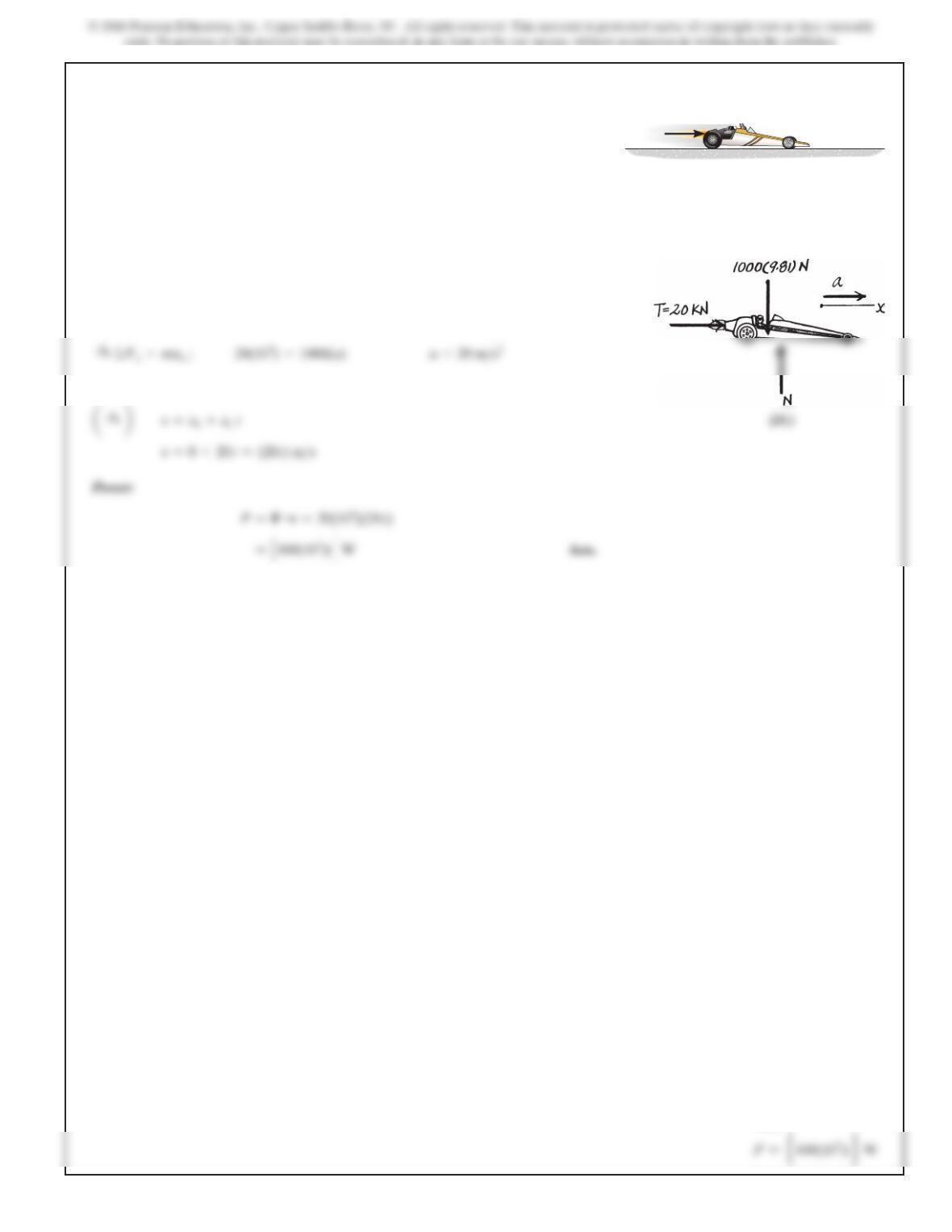
Equations of Motion: By referring to the free-body diagram of the dragster shown
in Fig. a,
Kinematics: The velocity of the dragster can be determined from
If the jet on the dragster supplies a constant thrust of
, determine the power generated by the jet as a
function of time. Neglect drag and rolling resistance, and
the loss of fuel. The dragster has a mass of 1 Mg and starts
from rest.
T=20 kN
T
Ans:
438
14–62.
SOLUTION
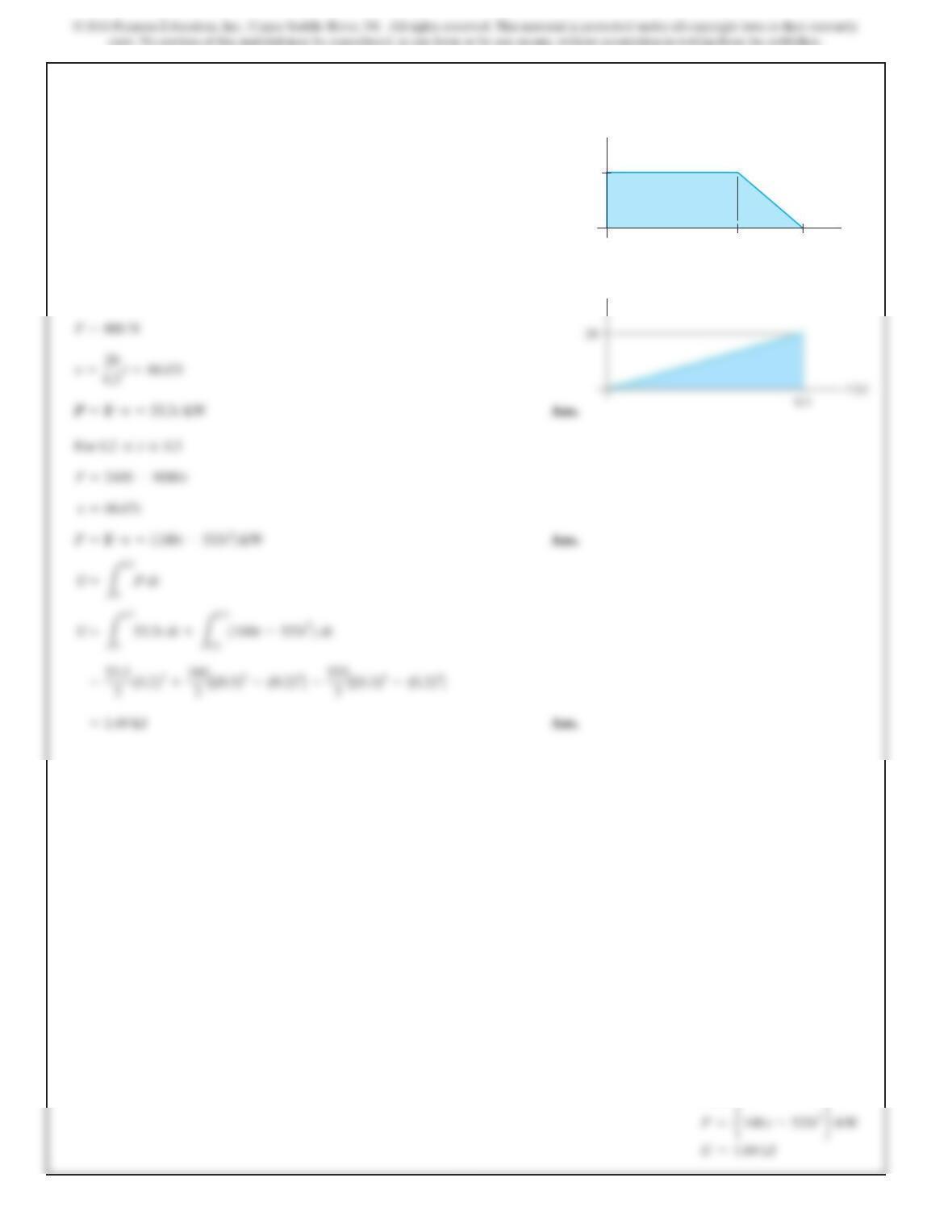
For
0…t…0.2
An athlete pushes against an exercise machine with a force
that varies with time as shown in the first graph. Also, the
velocity of the athlete’s arm acting in the same direction as
the force varies with time as shown in the second graph.
Determine the power applied as a function of time and the
work done in t=0.3 s.
800
0.20.3
t(s)
F(N)
v(m/s)
Ans:
439
14–63.
SOLUTION
See solution to Prob. 14–62.
An at
hl
ete pus
h
es aga
i
nst an exerc
i
se mac
hi
ne w
i
t
h
a
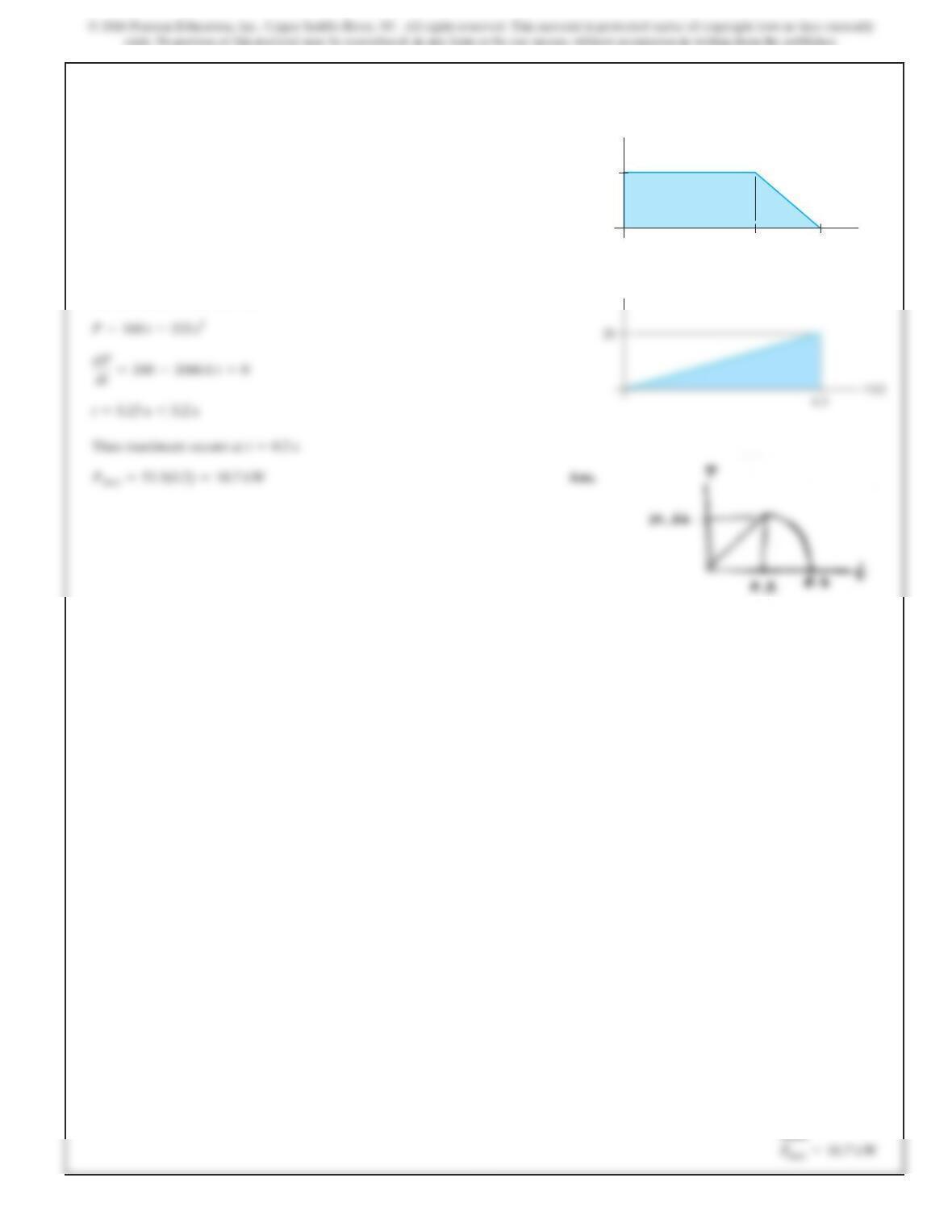
force that varies with time as shown in the first graph.
Also,the velocity of the athlete’s arm acting in the same
direction as the force varies with time as shown in the
second graph. Determine the maximum power developed
during the 0.3-second time period.
800
0.2 0.3
t(s)
F(N)
v(m/s)
Ans:
440
Ans:
*14–64.
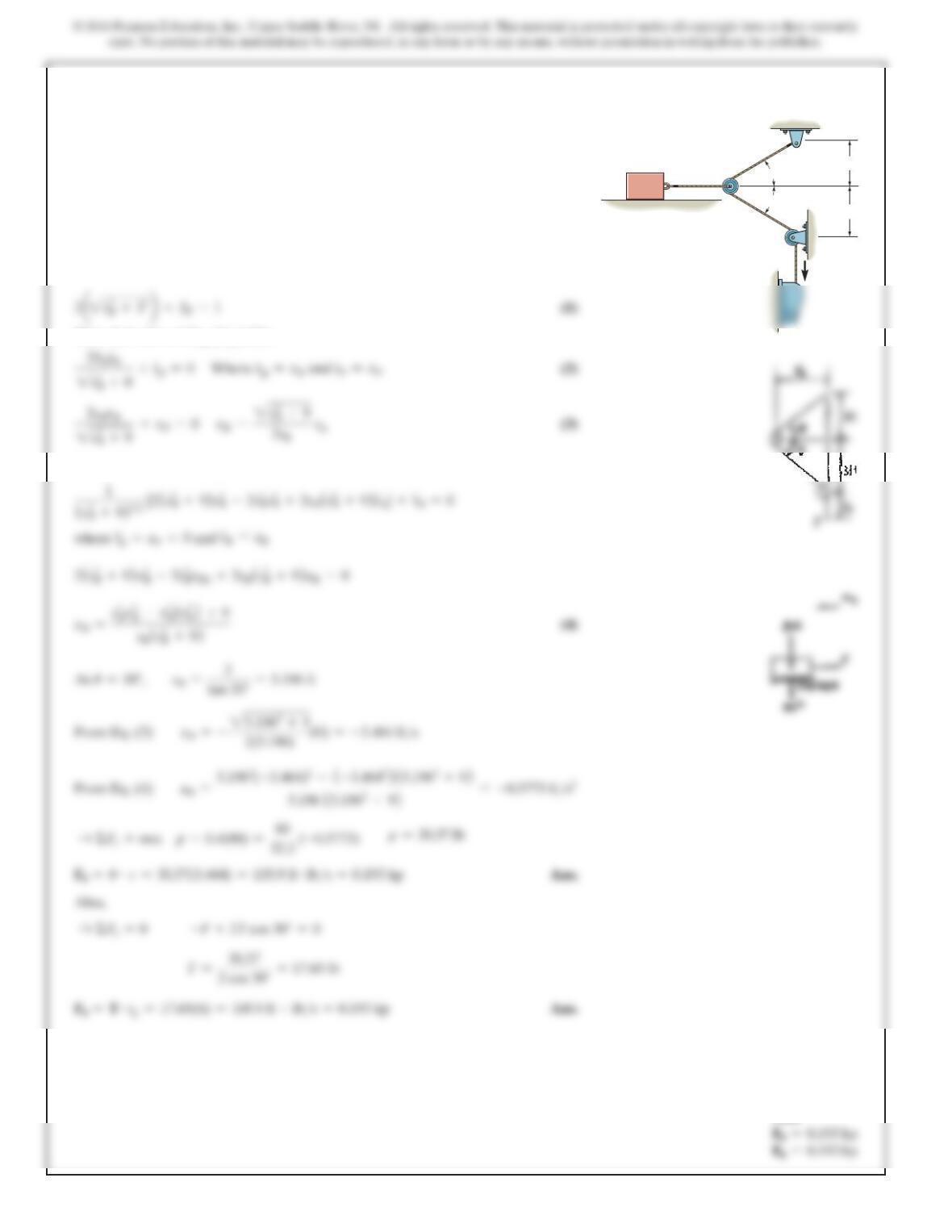
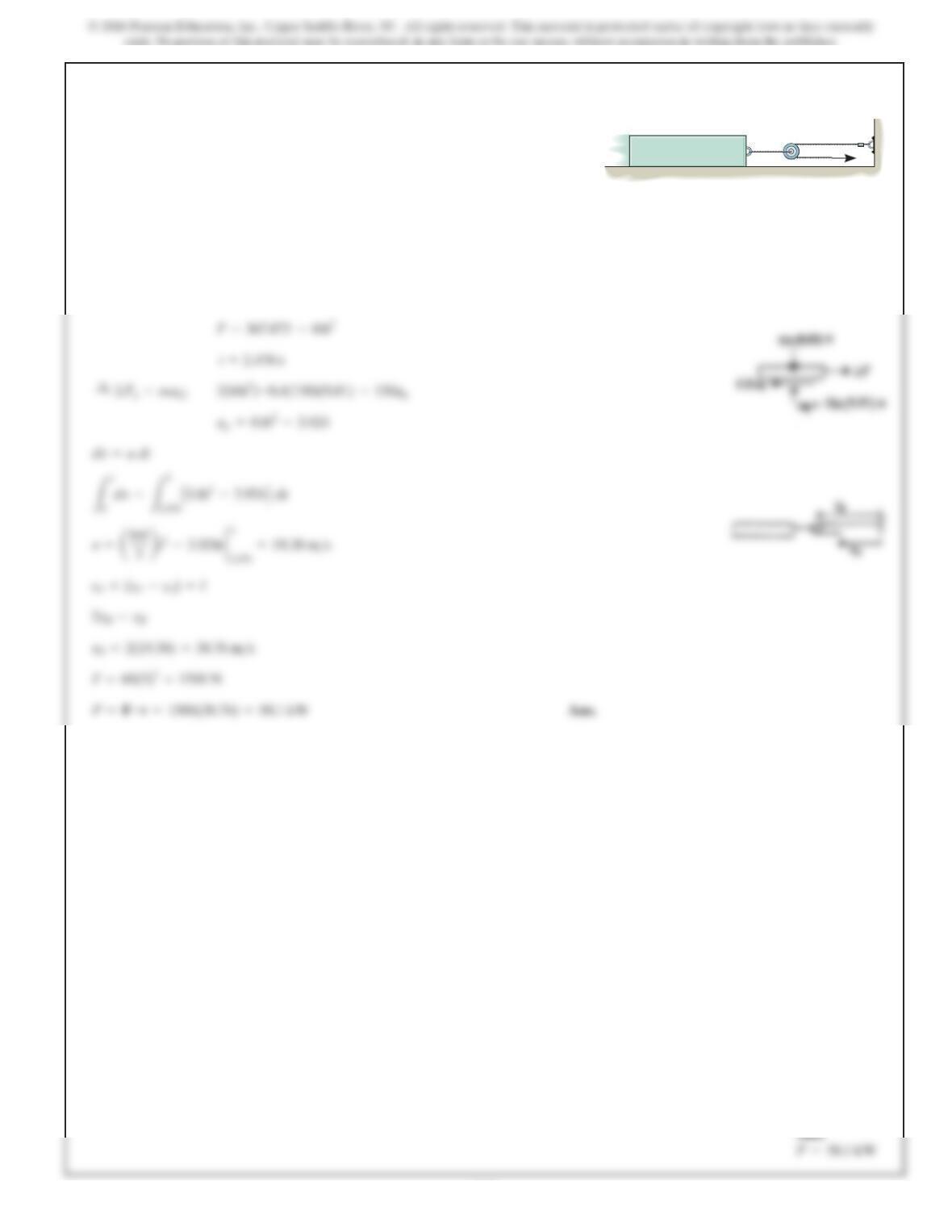
The block has a weight of 80 lb and rests on the floor for
which m
k=0.4.
If the motor draws in the cable at a constant
rate of
6 ft>s,
determine the output of the motor at the
instant
u=30°.
Neglect the mass of the cable and pulleys. u
u
3 ft
3 ft
6 ft/s
SOLUTION
Time derivative of Eq. (1) yields:
Time derivative of Eq. (2) yields:
u=30°
441
14–65.
SOLUTION
:
+©Fx=0; 2F–0.5(150)(9.81) =0
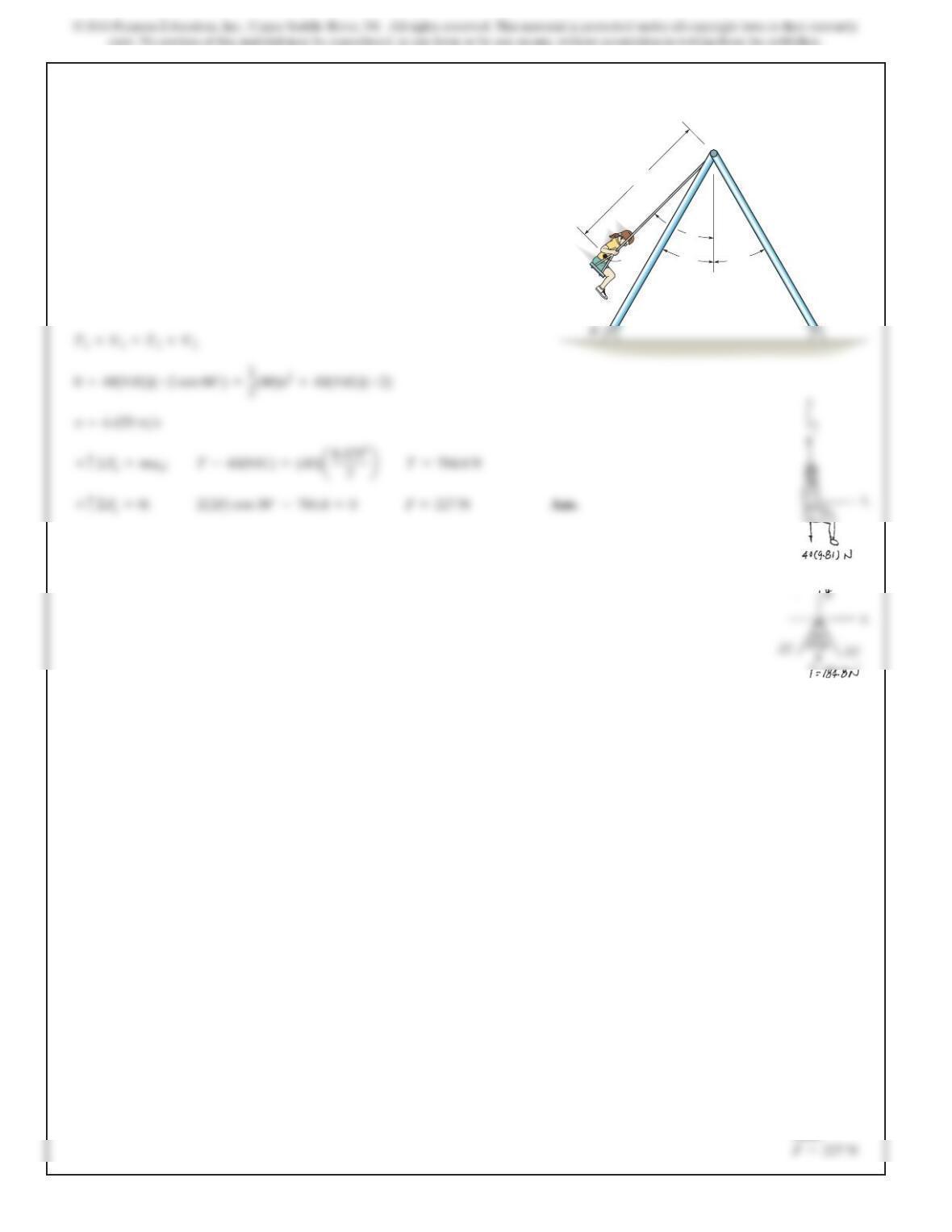
Theblock has amass of 150 kg and rests on asurface for
which the coefficients of static and kinetic friction are
and respectively.Ifaforce
where tis in seconds,isapplied to the cable,
determine the power developed by the force when
Hint: First determine the time needed for the force to
cause motion.
t=5s.
F=160t22N,
mk=0.4,ms=0.5
F
442
14–66.
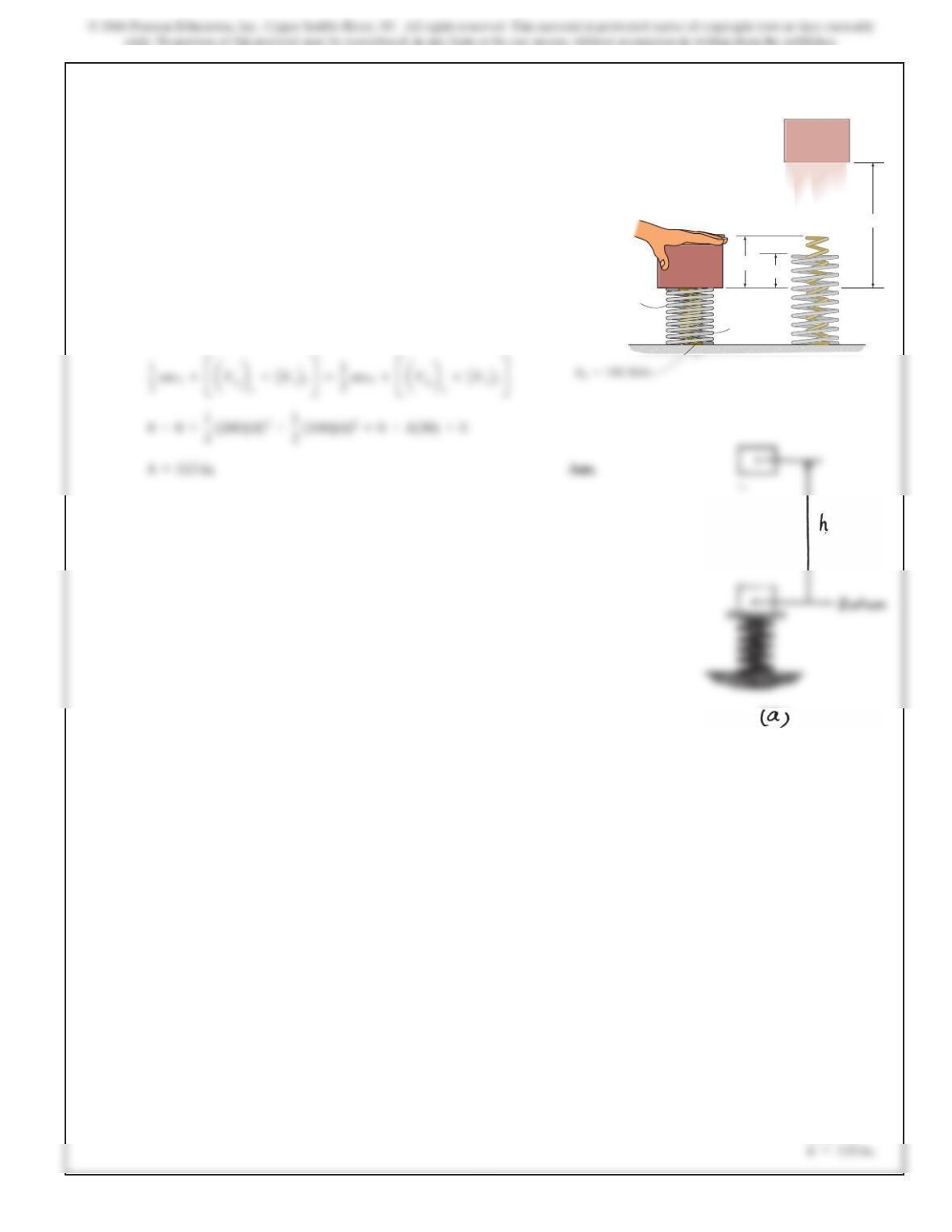
The girl has a mass of 40 kg and center of mass at G. If she
is swinging to a maximum height defined by
determine the force developed along each of the four
supporting posts such as AB at the instant The
swing is centrally located between the posts.
u=0°.
u=60°,
2 m
3030
A
G
SOLUTION
The maximum tension in the cable occurs when .
u=0°
Ans:
443
14–67.
SOLUTION
Conservation of Energy:
T1+V1=T2+V2
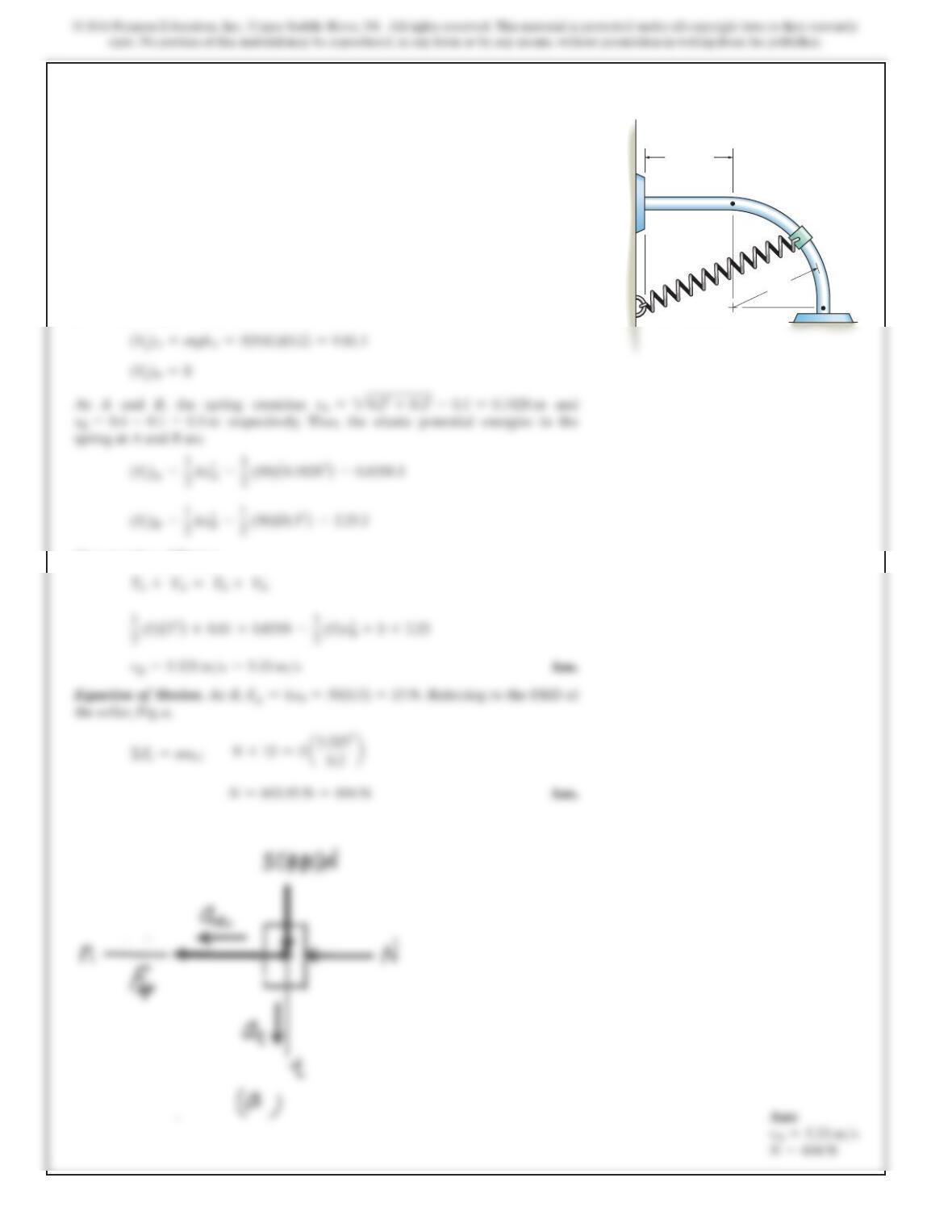
The 30-lb block Ais placed on top of two nested springs B
and Cand then pushed down to the position shown. If it is
then released, determine the maximum height hto which it
will rise.
A
B
6 in. 4 in.
A
h
kB200 lb/in.
Ans:
444
*14–68.
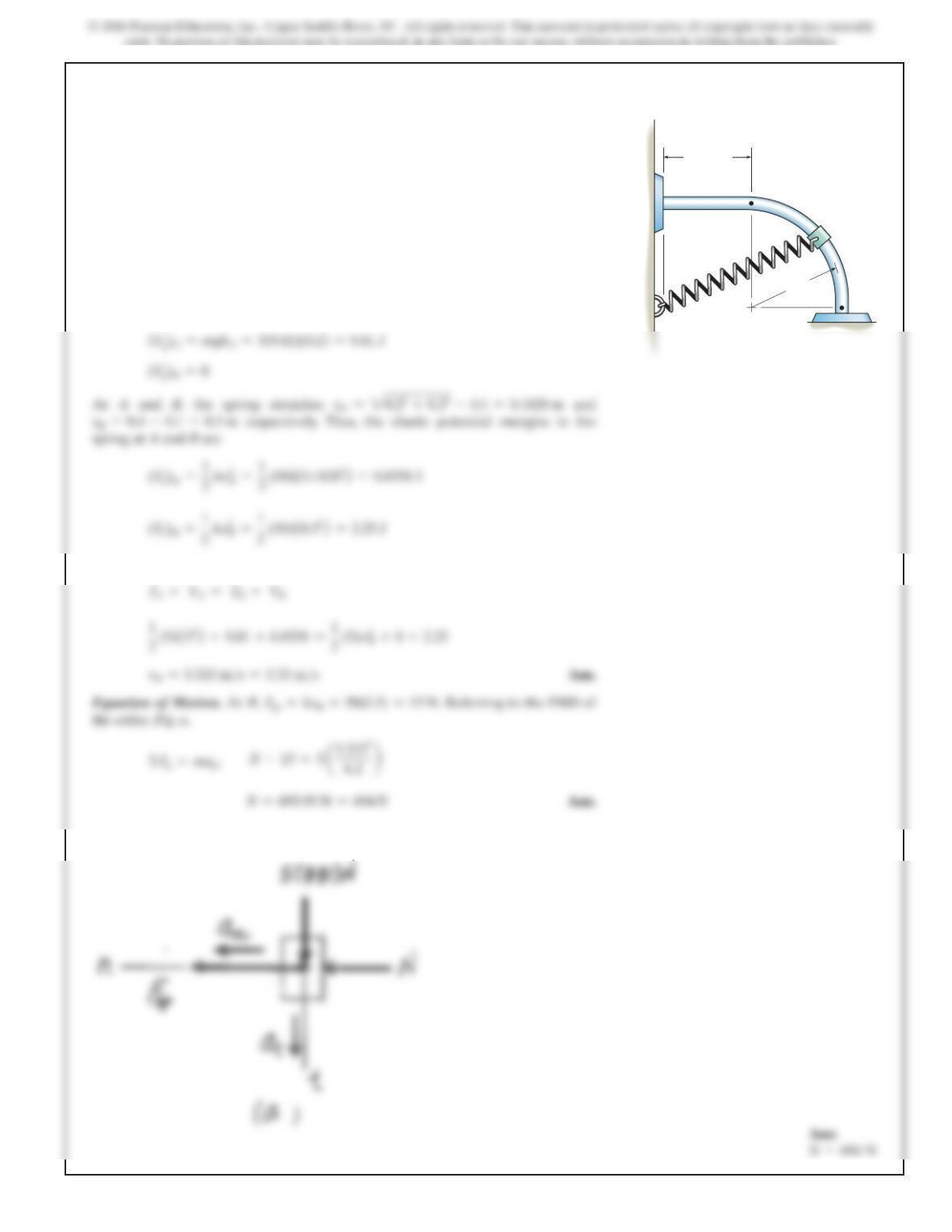
The 5-kg collar has a velocity of
5 m>s
to the right when it is
at A. It then travels down along the smooth guide.
Determine the speed of the collar when it reaches point B,
which is located just before the end of the curved portion of
the rod. The spring has an unstretched length of
100 mm
and B is located just before the end of the curved portion of
the rod.
k 50 N/m
200 mm
200 mm
A
B
SOLUTION
Potential Energy. With reference to the datum set through B the gravitational
potential energies of the collar at A and B are
Conservation of Energy.
445
14–69.
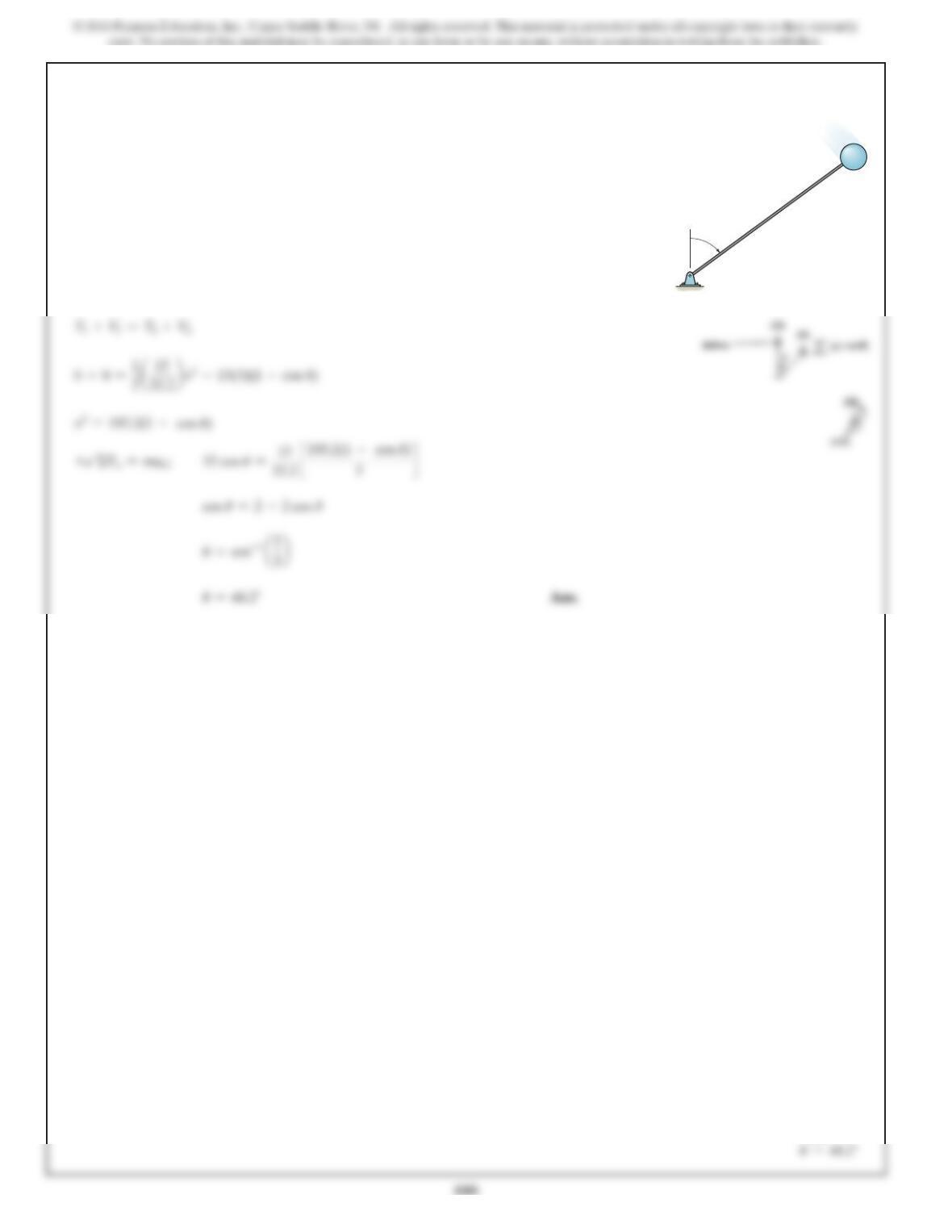
The 5-kg collar has a velocity of
5 m>s
to the right when it is
at A. It then travels along the smooth guide. Determine its
speed when its center reaches point B and the normal force it
exerts on the rod at this point. The spring has an unstretched
length of
100 mm
and B is located just before the end of the
curved portion of the rod.
k 50 N/m
200 mm
200 mm
A
B
SOLUTION
Potential Energy. With reference to the datum set through B the gravitational
potential energies of the collar at A and B are
Conservation of Energy.
14–70.
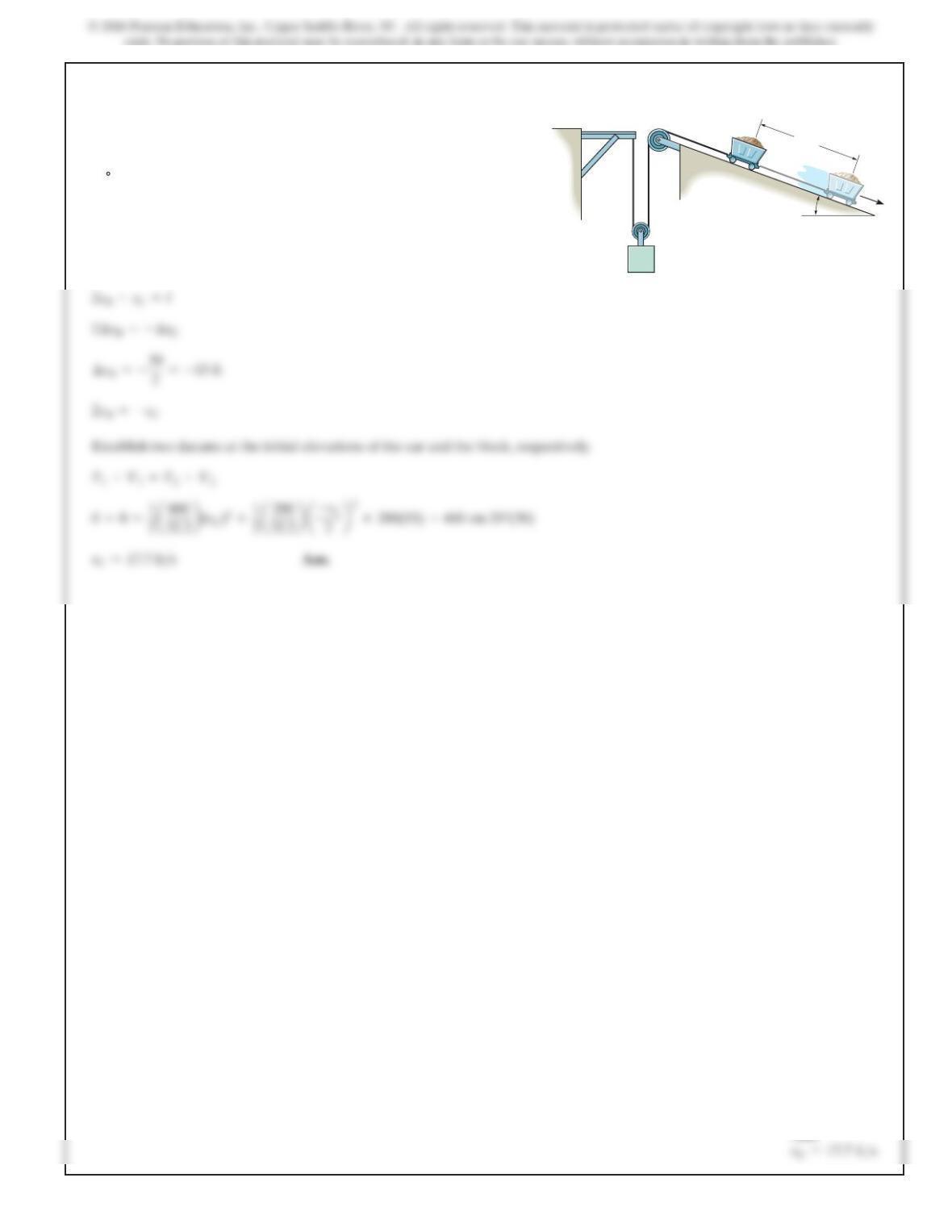
The ball has a weight of 15 lb and is fi xed to a rod having
a negligible mass. If it is released from rest when u=0°,
determine the angle u at which the compressive force in the
rod becomes zero.
SOLUTION
θ
3 ft
Ans:
447
14–71.
SOLUTION
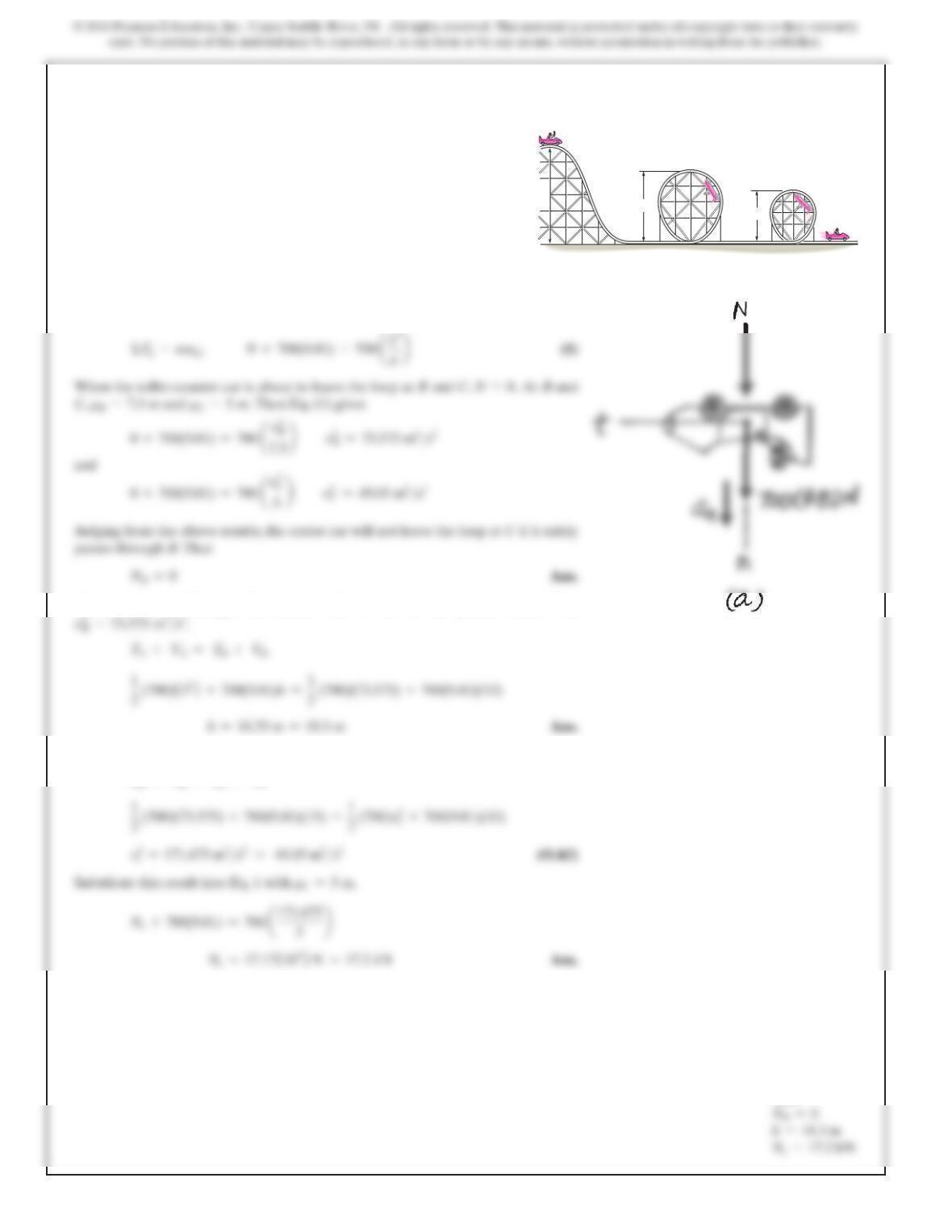
The car Cand its contents have a weight of 600 lb,whereas
block Bhasaweight of 200 lb.If the car is released from
rest, determine its speed when it travels 30 ft down the
20 incline. Suggestion: To measure the gravitational
potential energy, establish separate datums at the initial
elevations of Band C.
v
20°
30 ft
B
C
Ans:
448
Ans:
*14–72.
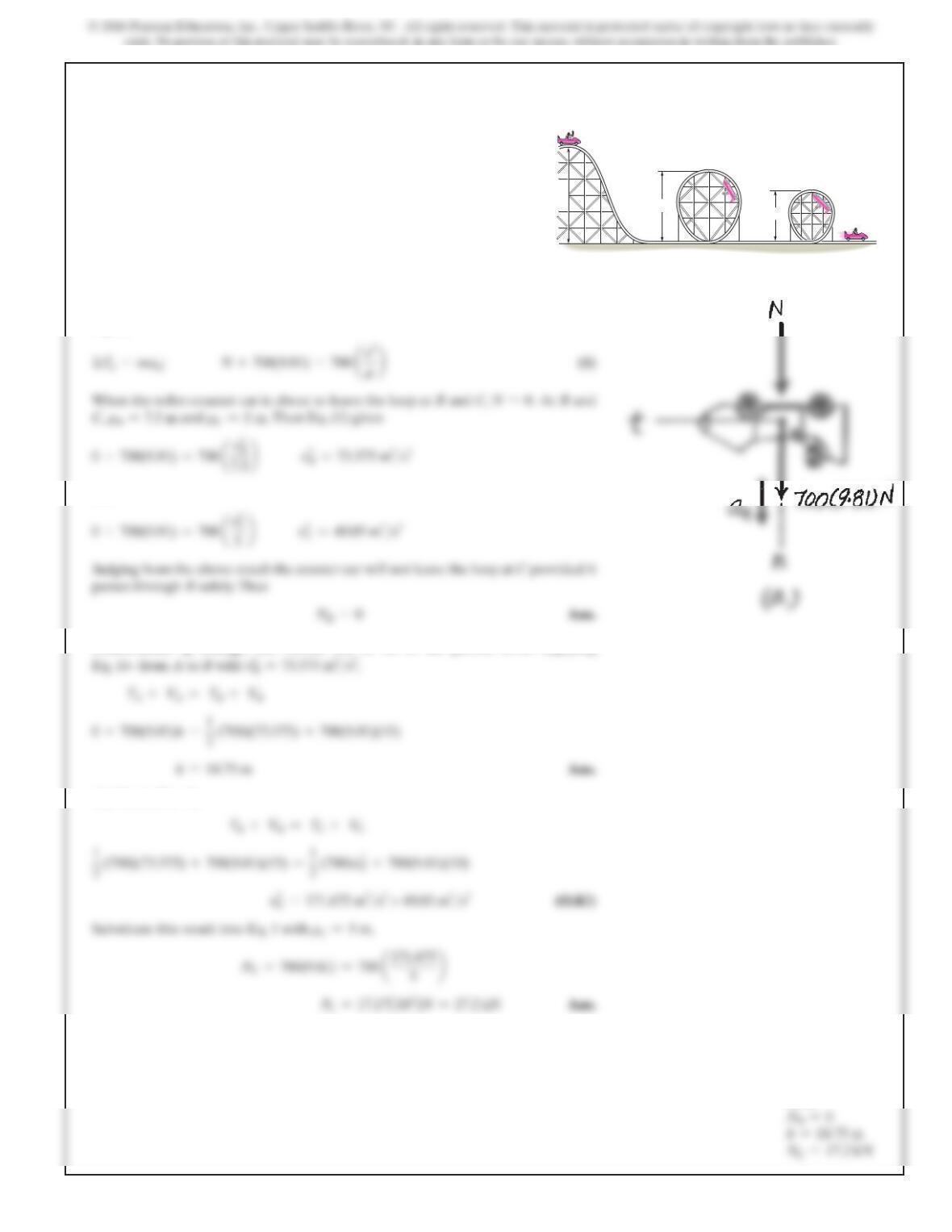
The roller coaster car has a mass of 700 kg, including its
passenger. If it starts from the top of the hill A with a speed
vA
=3 m>s
, determine the minimum height h of the hill
crest so that the car travels around the inside loops without
leaving the track. Neglect friction, the mass of the wheels,
and the size of the car. What is the normal reaction on the
car when the car is at B and when it is at C? Take r
B=7.5 m
and r
C=5 m.
SOLUTION
Equation of Motion. Referring to the FBD of the roller-coaster car shown in Fig. a,
Conservation of Energy. The datum will be set at the ground level. With
And from B to C,
TB+ VB= TC+ VC
h15 m
C
B
A
10 m
449
14–73.
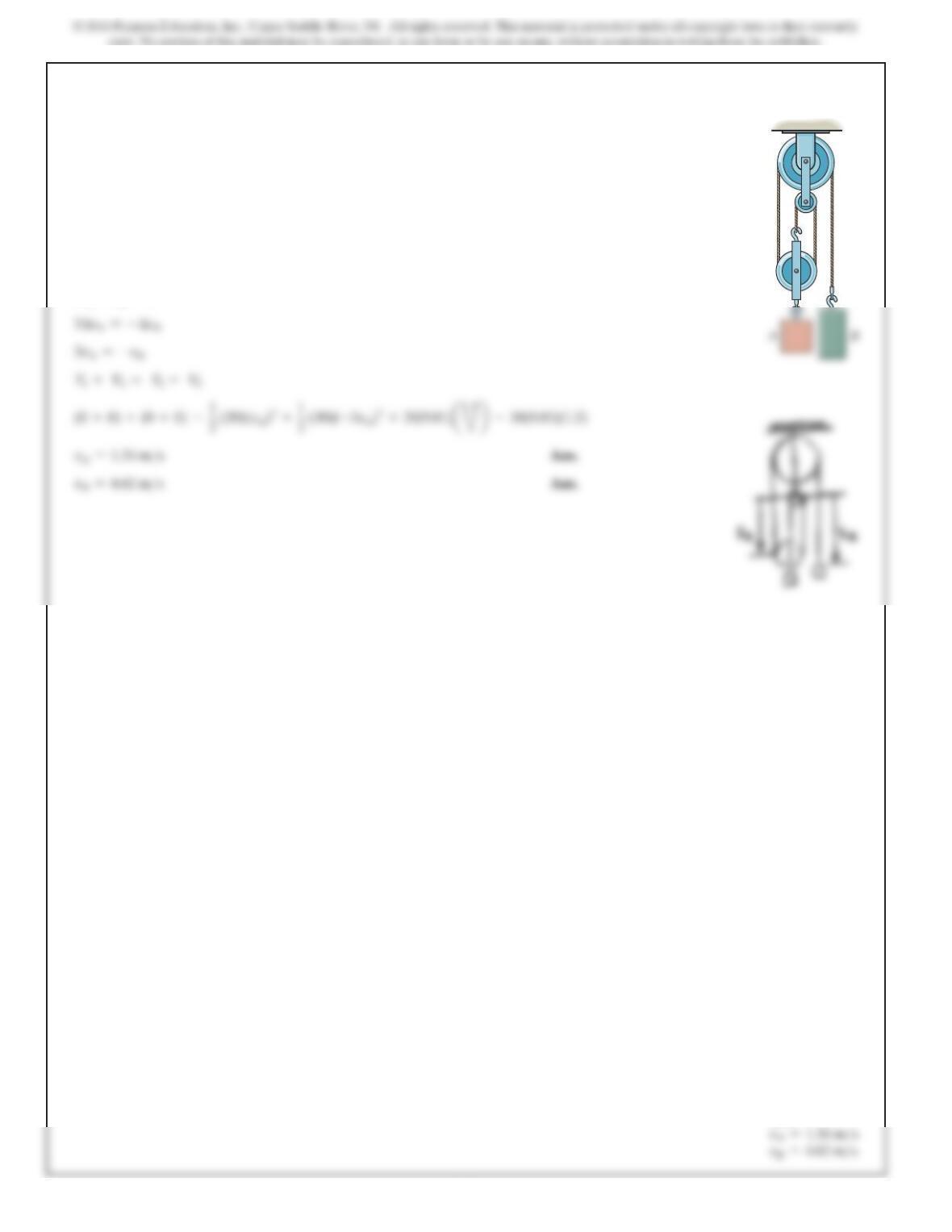
The roller coaster car has a mass of 700 kg, including its
passenger. If it is released from rest at the top of the hill A,
determine the minimum height h of the hill crest so that the
car travels around both inside the loops without leaving the
track. Neglect friction, the mass of the wheels, and the size
of the car. What is the normal reaction on the car when the
car is at B and when it is at C? Take r
B=7.5 m
and
r
C=5 m.
SOLUTION
Equation of Motion. Referring to the FBD of the roller-coaster car shown in
Fig. a,
B=7.5 m
C=5 m.
and
Conservation of Energy. The datum will be set at the ground level. Applying
And from B to C,
C=5 m
h15 m
C
B
A
10 m
Ans:
450
14–74.
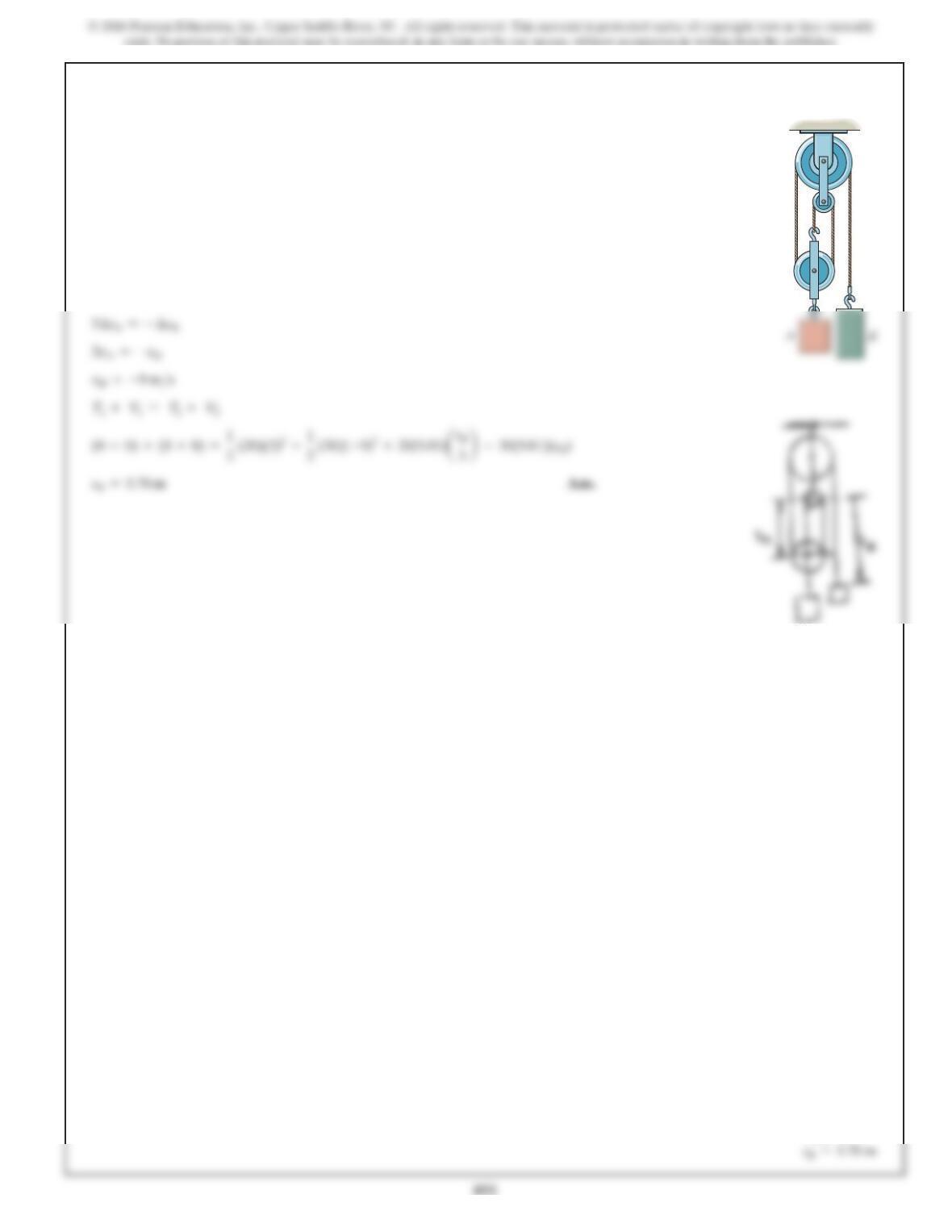
The assembly consists of two blocks A and B which have a
mass of 20 kg and 30 kg, respectively. Determine the speed
of each block when B descends 1.5 m. The blocks are
released from rest. Neglect the mass of the pulleys and
cords.
SOLUTION
3sA+sB=l
3vA=–vB
Ans:
14–75.
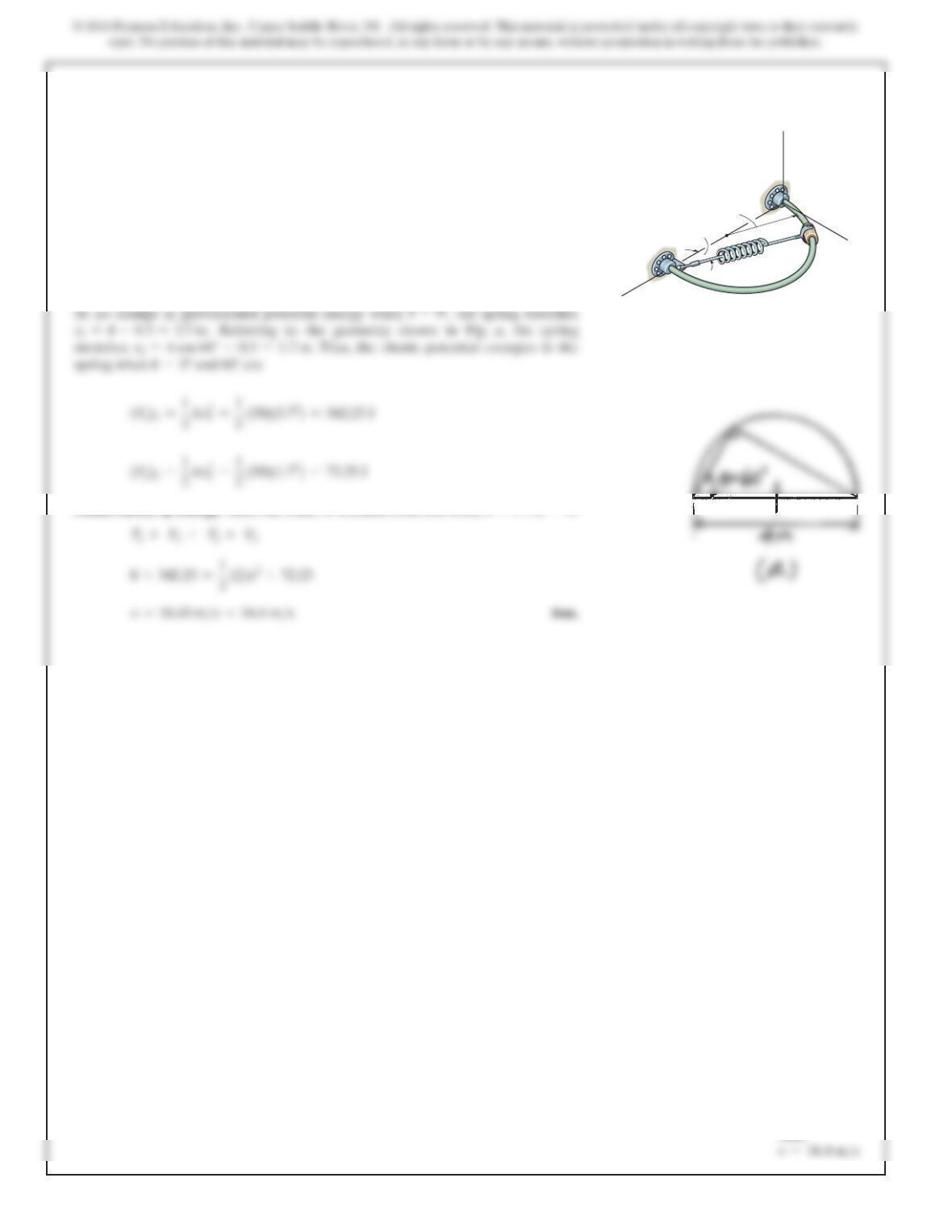
The assembly consists of two blocks A and B, which have
a mass of 20 kg and 30 kg, respectively. Determine the
distance B must descend in order for A to achieve a speed
of
3 m>s
starting from rest.
SOLUTION
3sA+sB=l
3vA=–vB
Ans:
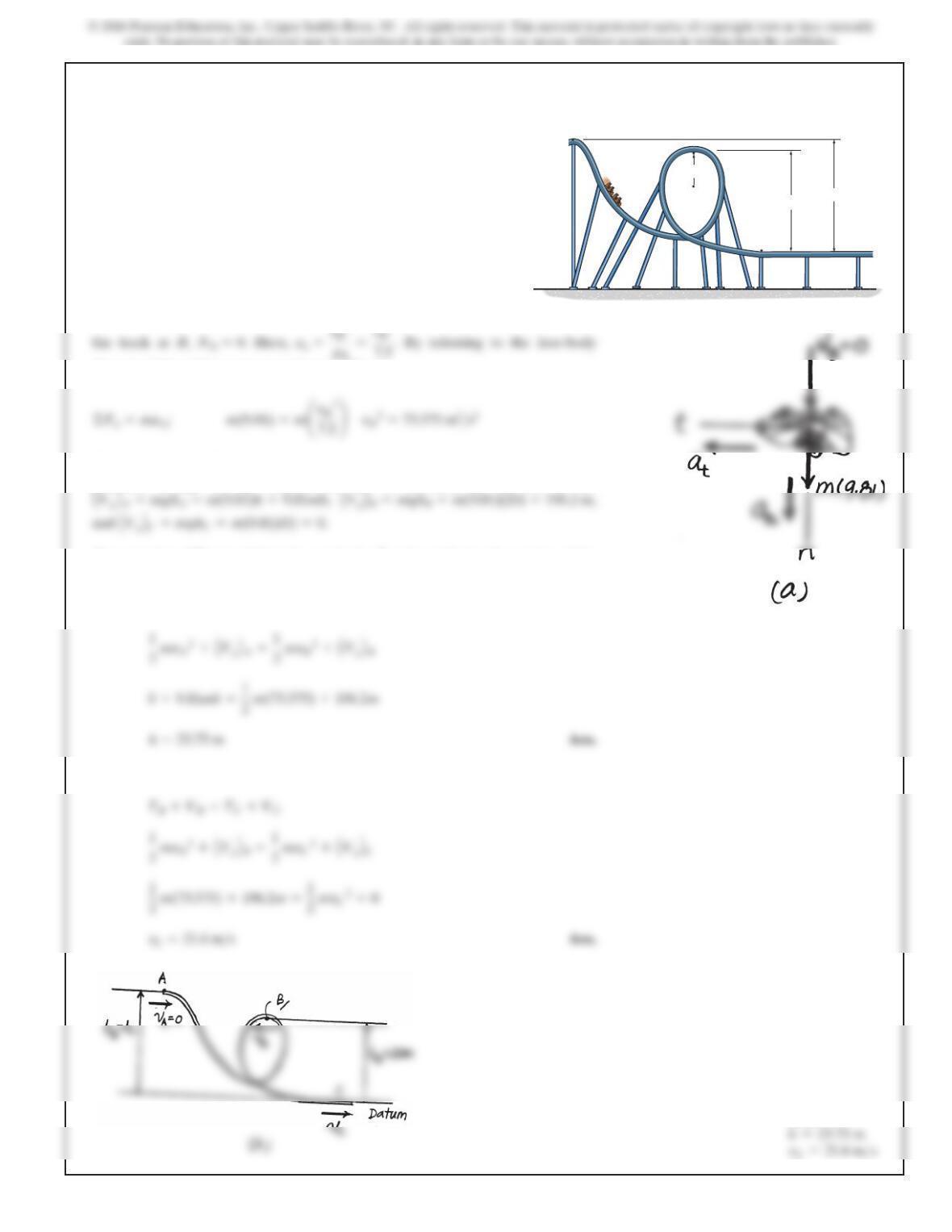
452
*14–76.
The spring has a stiffness
k=50 N>m
and an unstretched
length of 0.3 m. If it is attached to the 2-kg smooth collar
and the collar is released from rest at A
(
u
=0°),
determine
the speed of the collar when
u=60°.
The motion occurs in
the horizontal plane. Neglect the size of the collar.
z
A
x
2 m
uy
k 50 N/m
SOLUTION
Potential Energy. Since the motion occurs in the horizontal plane, there will
u=0°
Ans:
453
14–77.
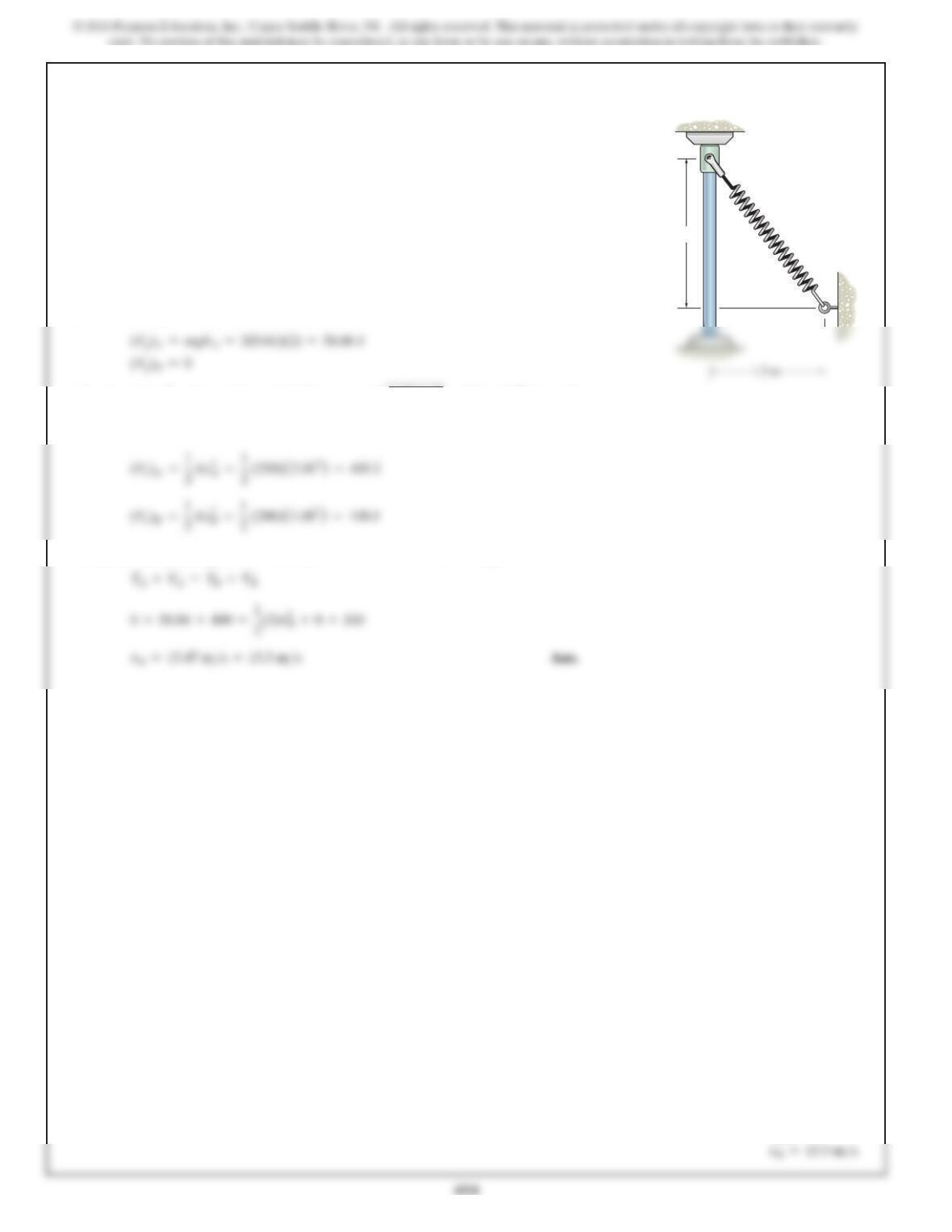
The roller coaster car having a mass mis released from rest
at point A. If the track is to be designed so that the car does
not leave it at B, determine the required height h. Also, find
the speed of the car when it reaches point C. Neglect
friction.
SOLUTION
Equation of Motion: Since it is required that the roller coaster car is about to leave
diagram of the roller coaster car shown in Fig. a,
Potential Energy: With reference to the datum set in Fig. b, the gravitational
potential energy of the rollercoaster car at positions A,B, and Care
Conservation of Energy: Using the result of and considering the motion of the
car from position Ato B,
Also, considering the motion of the car from position Bto C,
TA+VA=TB+VB
vB2
C
A
B
20 m
7.5 m
h
Ans:
14–78.
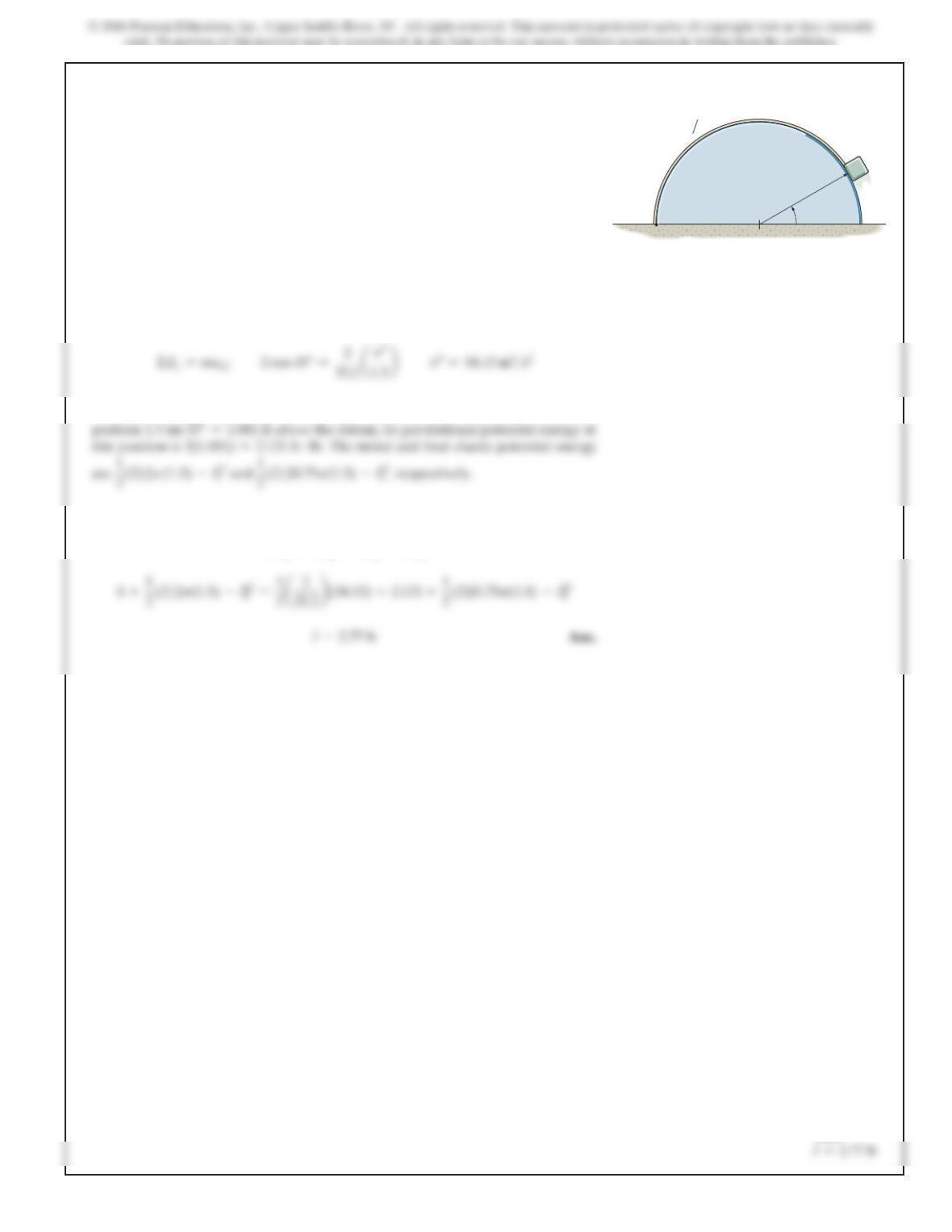
The spring has a stiffness
k=200 N>m
and an unstretched
length of 0.5 m. If it is attached to the 3-kg smooth collar
and the collar is released from rest at A, determine the
speed of the collar when it reaches B. Neglect the size of the
collar.
2 m
A
B
k 200 N/m
SOLUTION
Potential Energy. With reference to the datum set through B, the gravitational
potential energies of the collar at A and B are
At A and B, the spring stretches
xA=21.5
2
+2
2
–0.5 =2.00 m
and
xB=1.5 –0.5 =1.00 m
. Thus, the elastic potential energies in the spring when the
collar is at A and B are
Conservation of Energy. Since the collar is released from rest at A,
TA=0
.
Ans:
455
14–79.
SOLUTION
Equation of Motion: It is required that N=0. Applying Eq. 13–8, we have
Potential Energy: Datum is set at the base of cylinder. When the block moves to a
Conservation of Energy:
ΣT1+ΣV
1=ΣT2+ΣV
2
1.5 ft
θ
= 2 lb ft
A
B
C
k
A 2-lb block rests on the smooth semicylindrical surface
at A. An elastic cord having a stiffness of k = 2 lb>ft is
attached to the block at B and to the base of the semicylinder
at C. If the block is released from rest at A, determine the
longest unstretched length of the cord so the block begins
to leave the cylinder at the instant u = 45°. Neglect the size
of the block.
Ans: