456
Ans:
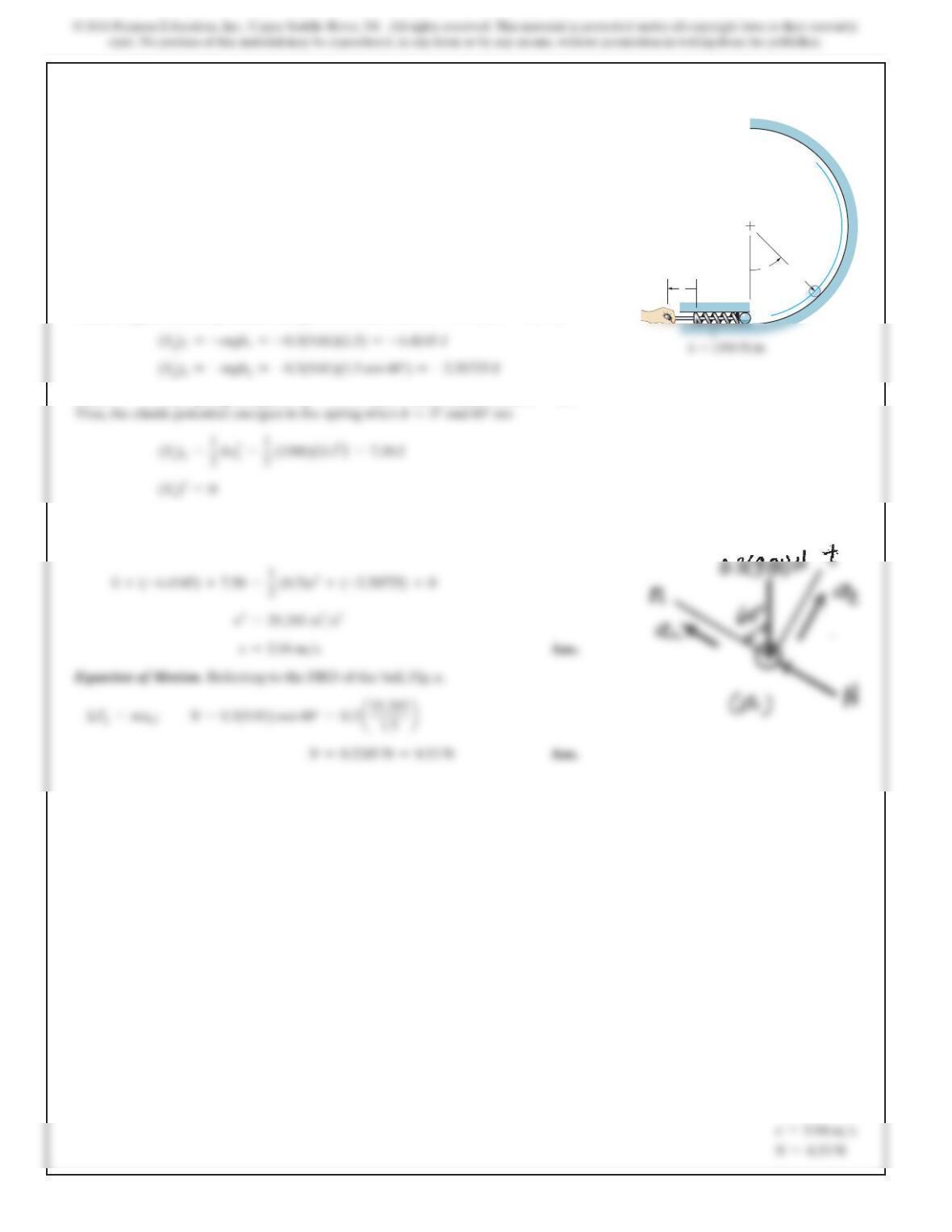
*14–80.
When
s=0
, the spring on the firing mechanism is
unstretched. If the arm is pulled back such that
s=100 mm
and released, determine the speed of the 0.3-kg ball and the
normal reaction of the circular track on the ball when
u=60°
. Assume all surfaces of contact to be smooth.
Neglect the mass of the spring and the size of the ball.
SOLUTION
Potential Energy. With reference to the datum set through the center of the circular
track, the gravitational potential energies of the ball when
u=0°
and
u=60°
are
When
u=0°
, the spring compress
x1=0.1 m
and is unstretched when
u=60°
.
u=0°
Conservation of Energy. Since the ball starts from rest,
T1=0
.
T1+V1=T2+V2
s
1.5 m
u
457
SOLUTION
Equation of Motion. It is required that the ball leaves the track, and this will occur
provided
u790°
. When this happens,
N=0
. Referring to the FBD of the ball, Fig. a
Potential Energy. With reference to the datum set through the center of the circular
track Fig. b, the gravitational potential Energies of the ball when
u=0°
and
u
are
When
u=0°
, the spring compresses
x1=0.1 m
and is unstretched when the ball
is at
u
for max height. Thus, the elastic potential energies in the spring when
u=0°
and
u
are
Conservation of Energy. Since the ball starts from rest,
T1=0
.
Equating Eqs. (1) and (2),
u=117.77°=118°
s
1.5 m
u
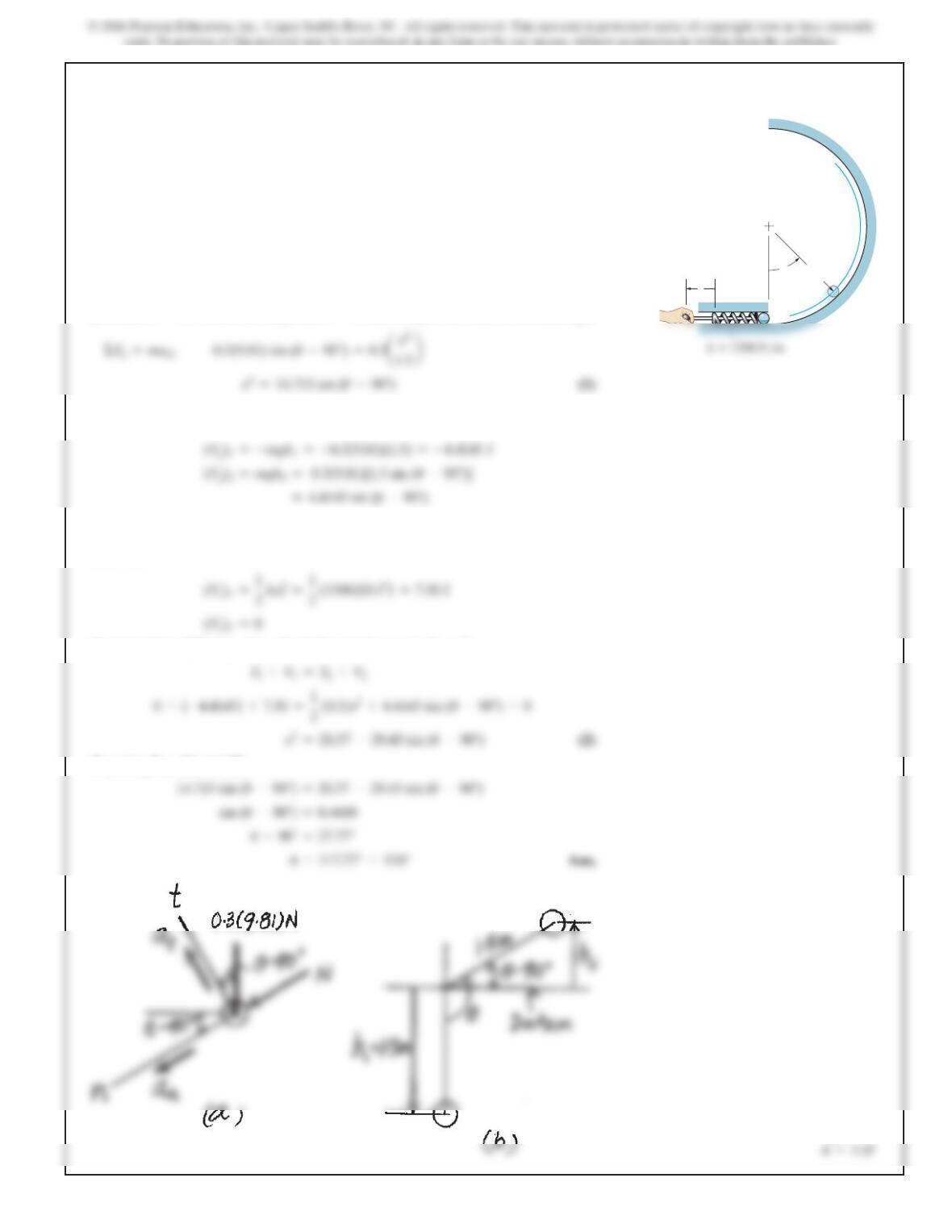
14–81.
When
s=0
, the spring on the firing mechanism is
unstretched. If the arm is pulled back such that
s=100 mm
and released, determine the maximum angle
u
the ball will
travel without leaving the circular track. Assume all surfaces
of contact to be smooth. Neglect the mass of the spring and
the size of the ball.
Ans:
458
Ans:
14–82.
SOLUTION
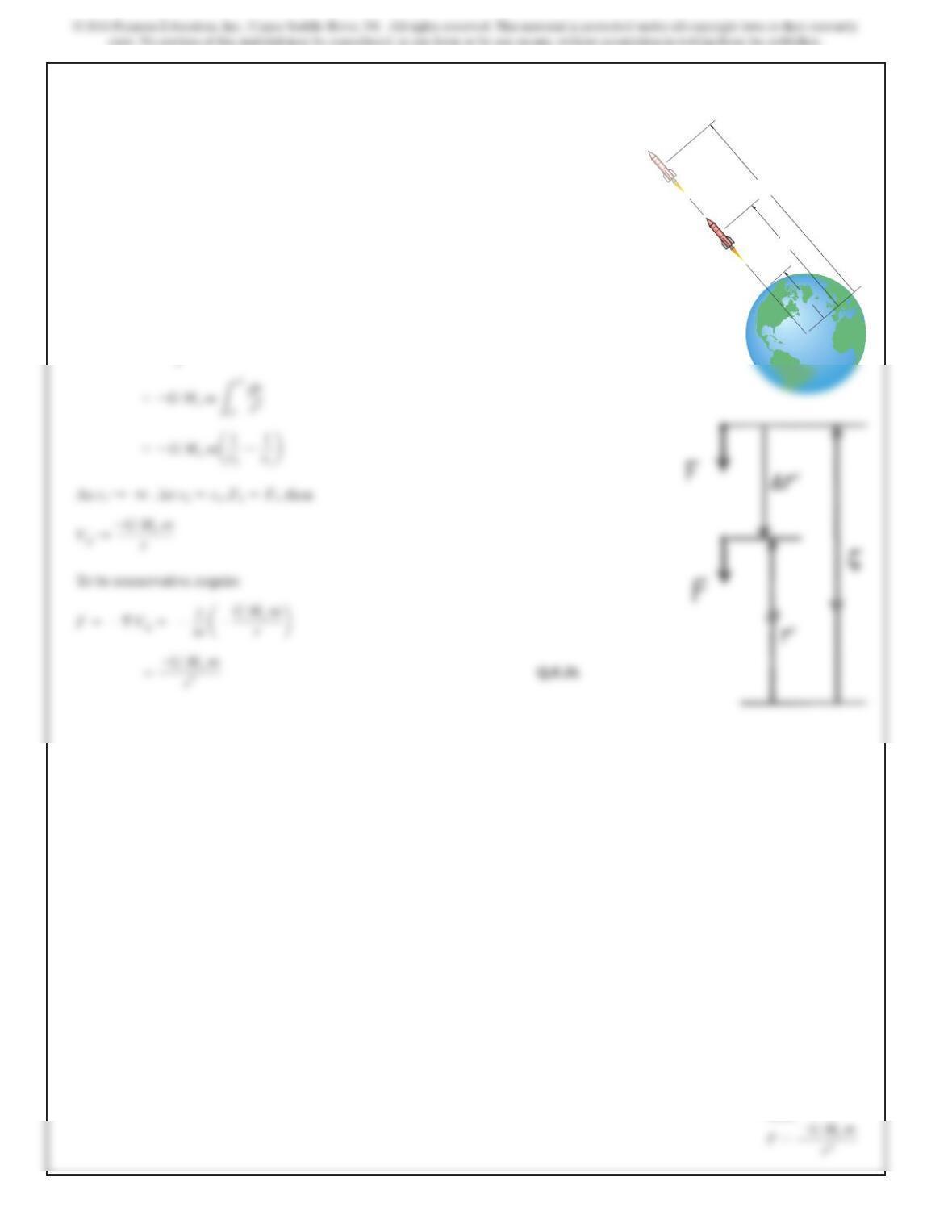
The work is computed by moving Ffrom position r1to a farther position r2.
Vg=- U=- LFdr
If the mass of the earth is
Me
, show that the gravitational
potential energy of a body of mass m located a distance r
from the center of the earth is Vg =−GMem>r. Recall that
the gravitational force acting between the earth and the
body is F =G(Mem>r 2), Eq. 13–1. For the calculation, locate
force.
r2
r1
r
the datum at r : q. Also, prove that F is a conservative
459
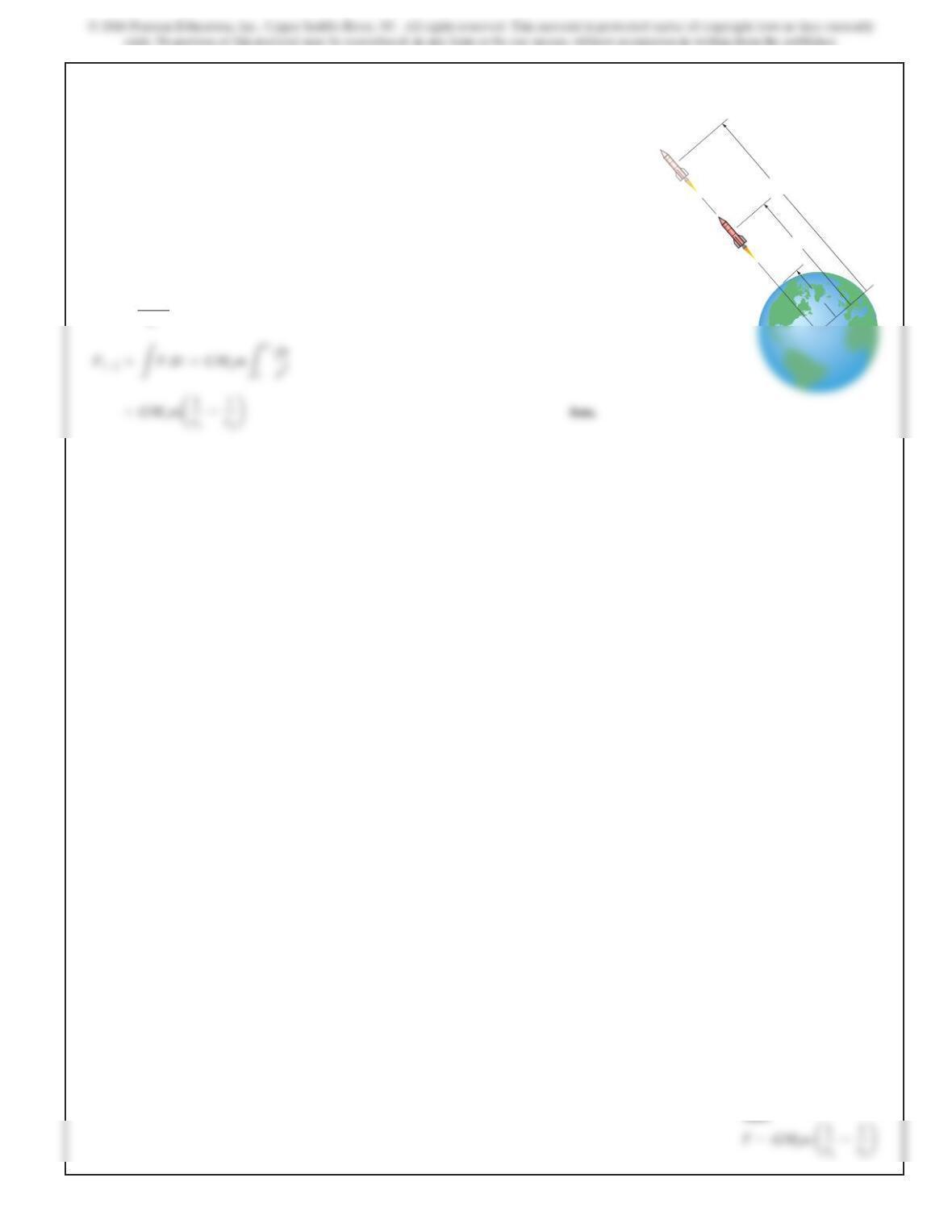
14–83.
A rocket of mass mis fired vertically from the surface of the
earth, i.e., at Assuming no mass is lost as it travels
upward, determine the work it must do against gravity to
reach a distance The force of gravity is
(Eq. 13–1), where is the mass of the earth and rthe
distance between the rocket and the center of the earth.
Me
F=GMem>r2
r2.
r=r1.
SOLUTION
F=GMem
r2
r1
r
Ans:
460
Ans:
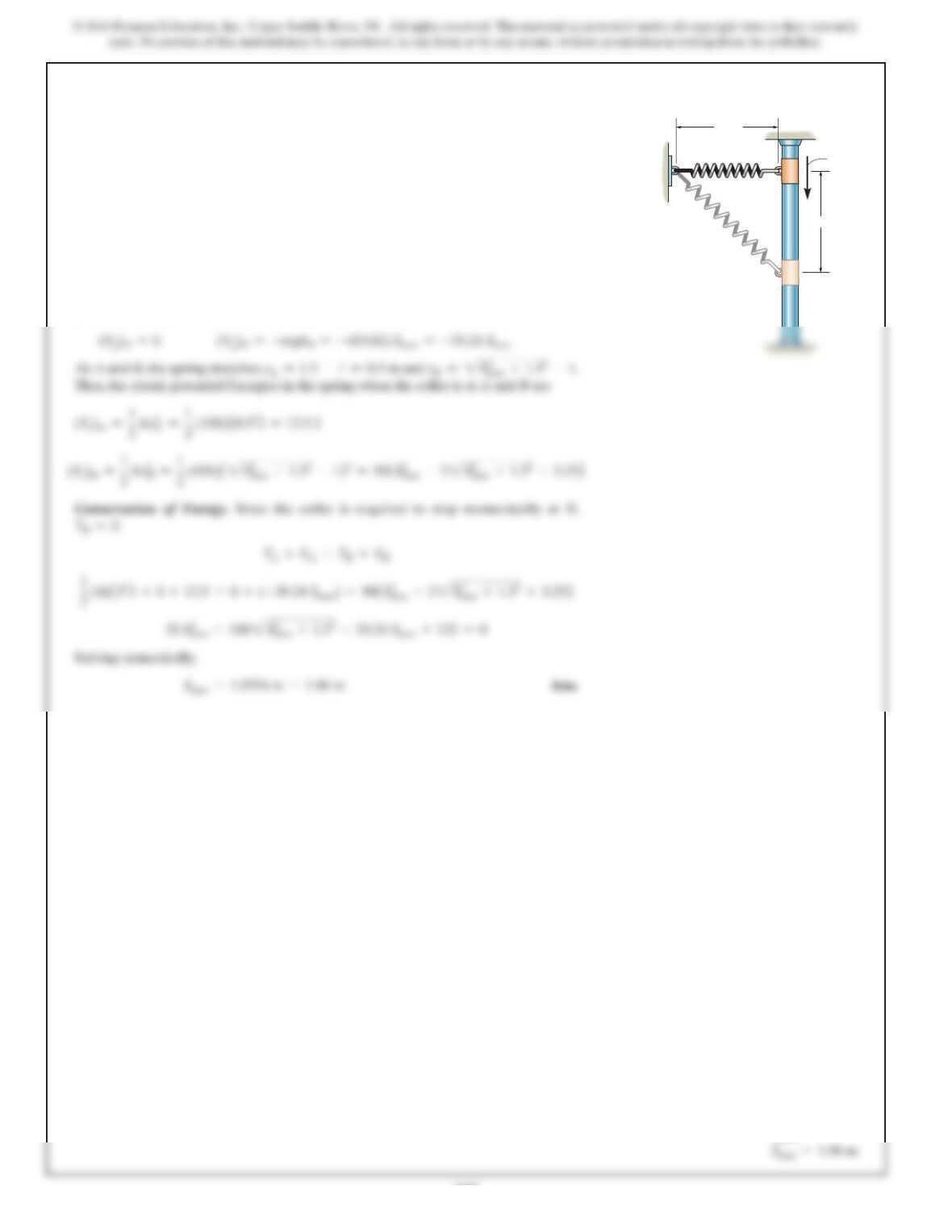
*14–84.
The 4-kg smooth collar has a speed of
3 m>s
when it is at
s=0.
Determine the maximum distance s it travels before
it stops momentarily. The spring has an unstretched length
of
1 m
.
SOLUTION
Potential Energy. With reference to the datum set through A the gravitational
potential energies of the collar at A and B are
2
1.5 m
3 m/
s
k 100 N/m
s
A
B
14–85.
SOLUTION
yA=40 Mm>h=11 111.1 m>s
A
B
v
A
vBrB80 Mm
rA20 Mm
A 60-kg satellite travels in free flight along an elliptical orbit
such that at A, where rA = 20 Mm, it has a speed vA = 40 Mm>h.
What is the speed of the satellite when it reaches point B, where
rB = 80 Mm? Hint: See Prob. 14–82, where Me = 5.976(1024) kg
and G = 66.73(10–12) m3>(kg # s2).
Ans:
462
14–86.
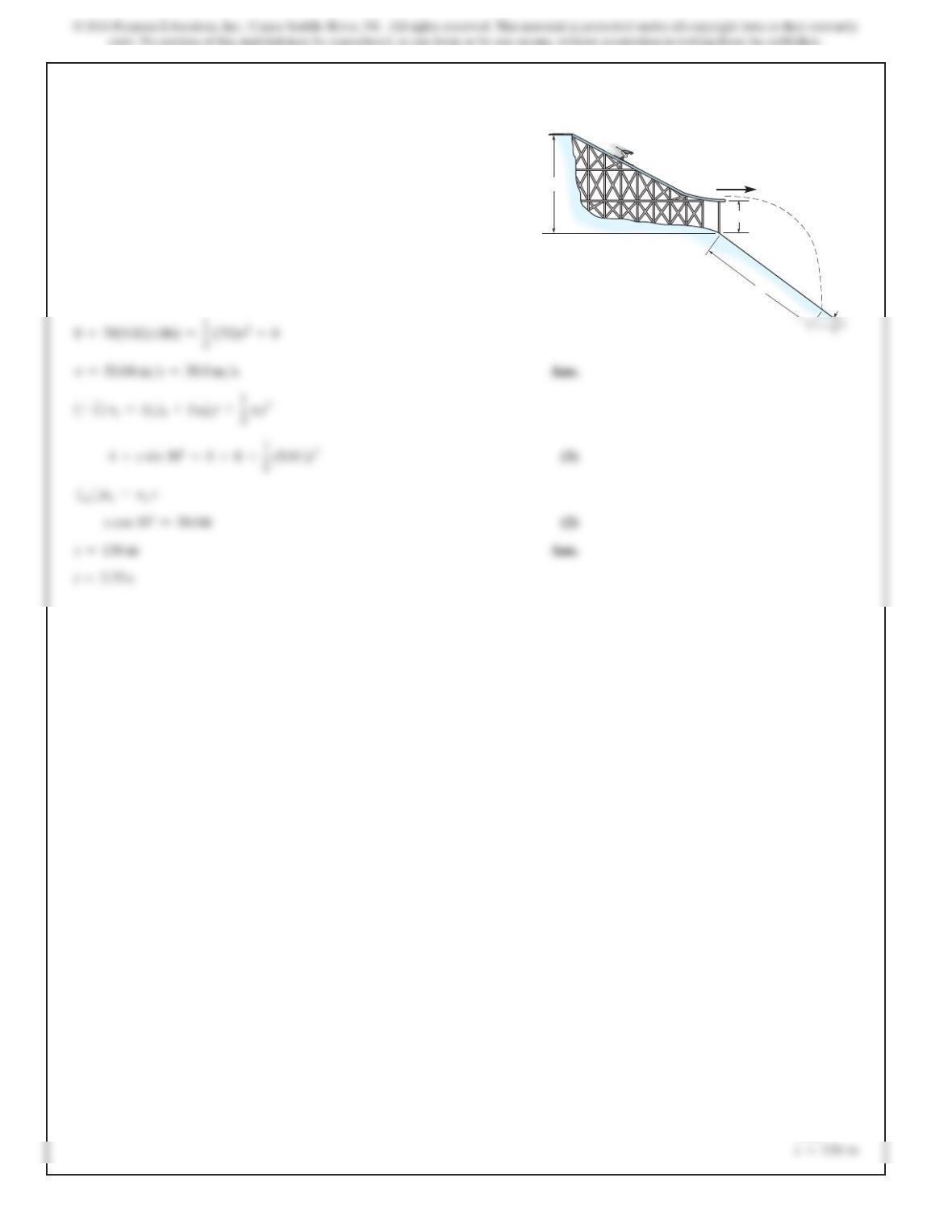
The skier starts from rest at A and travels down the ramp. If
friction and air resistance can be neglected, determine his
speed
vB
when he reaches B. Also, compute the distance s to
where he strikes the ground at C, if he makes the jump
traveling horizontally at B. Neglect the skier’s size. He has a
mass of 70 kg.
SOLUTION
TA+ VA= TB+ VB
4 m
vB
s
C
B
A
50 m
30
Ans:
463
14–87.
SOLUTION
Datum at initial position:
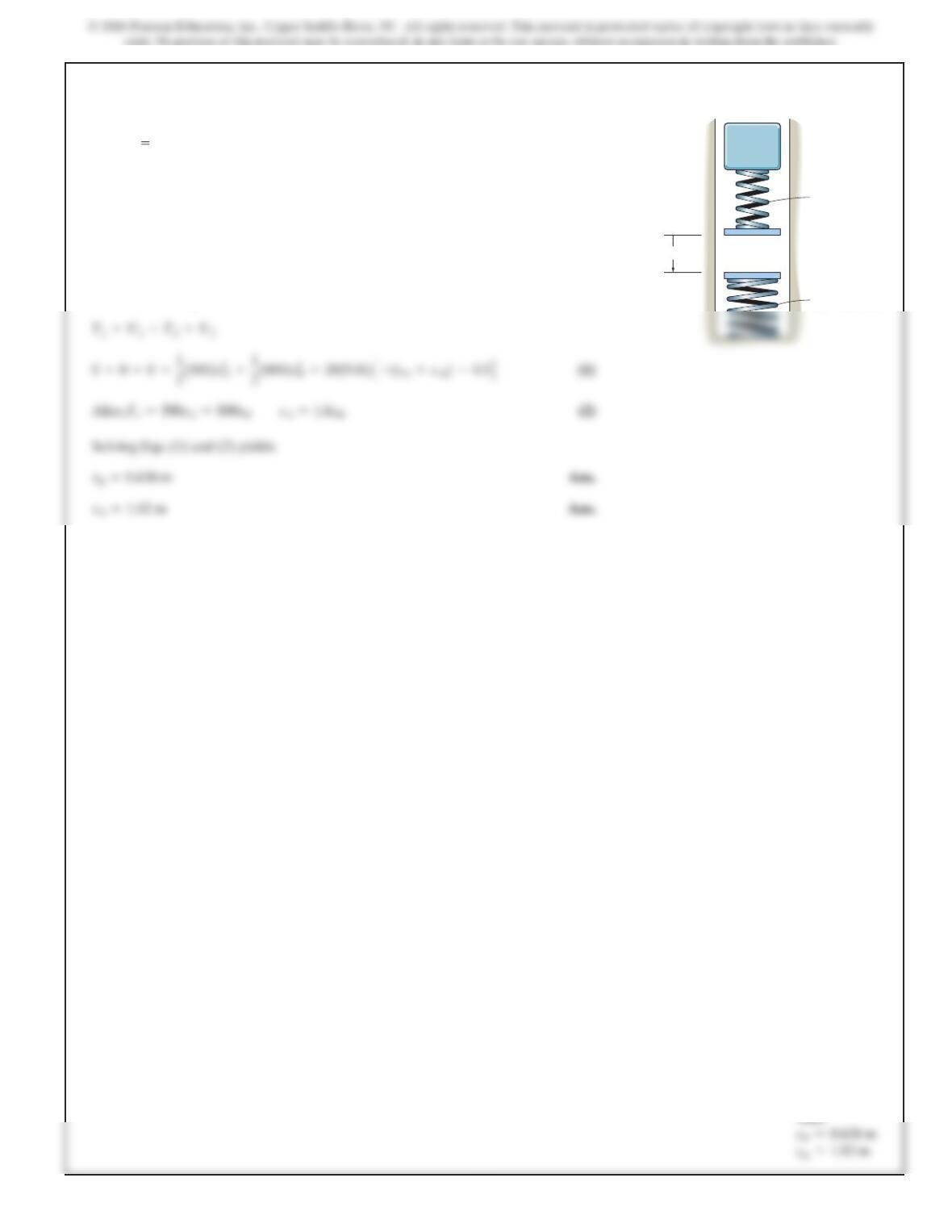
The block has a mass of 20 kg and is released from rest
when s0.5m. If the mass of the bumpers Aand Bcan
be neglected, determine the maximum deformation of each
spring due to the collision.
k
B
= 800 N/m
s= 0.5 m
A
B
k
A
= 500 N/m
Ans:
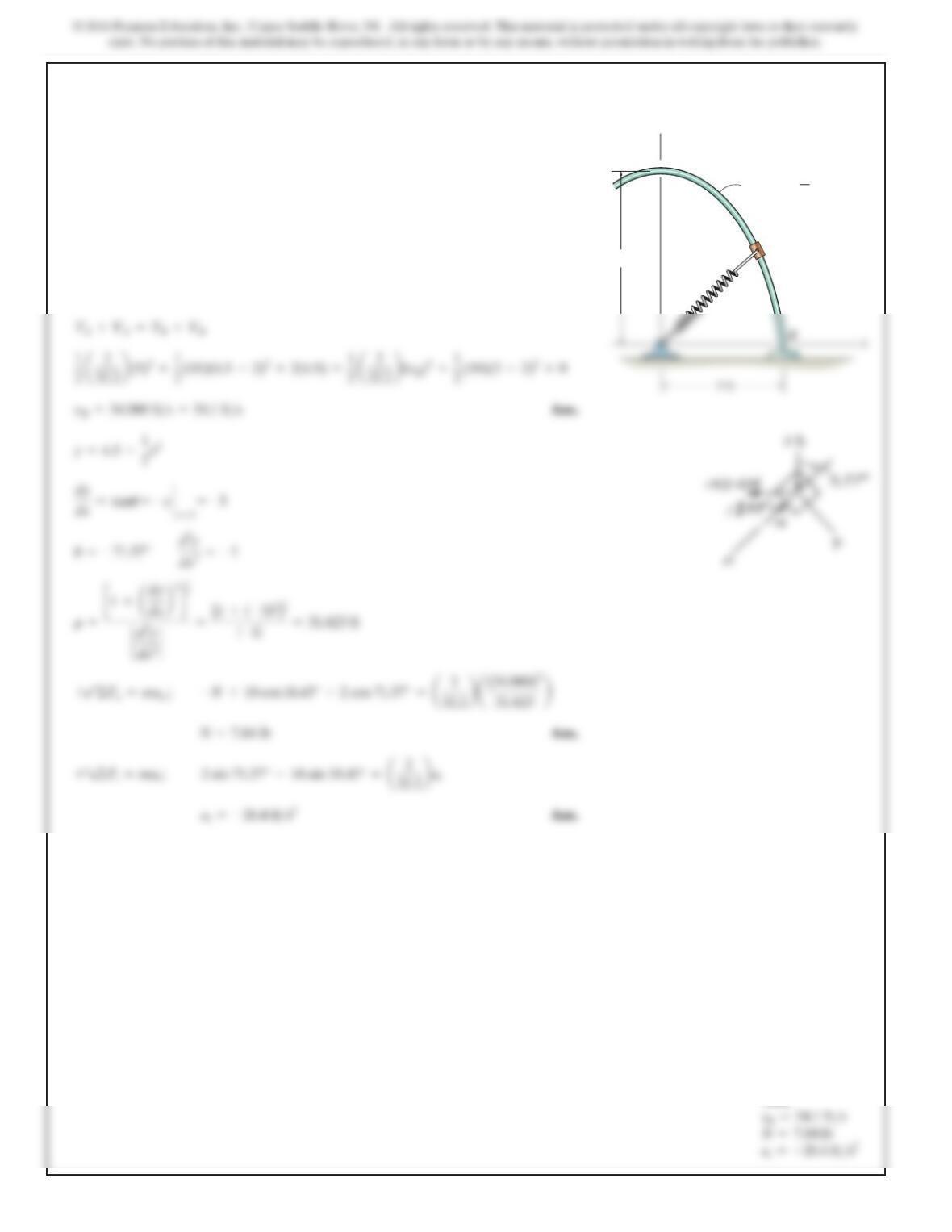
464
Ans:
*14–88.
SOLUTION
Datum at B:
The 2-lb collar has a speed of at A.The attached
spring has an unstretched length of 2 ft and a stiffness of
If the collar moves over the smooth rod,
determine its speed when it reaches point B, the normal
force of the rod on the collar, and the rate of decrease in its
speed.
k=10 lb>ft.
5ft>s
y
A
4.5 ft
k10 lb/ft
x
2
1
2
y4.5
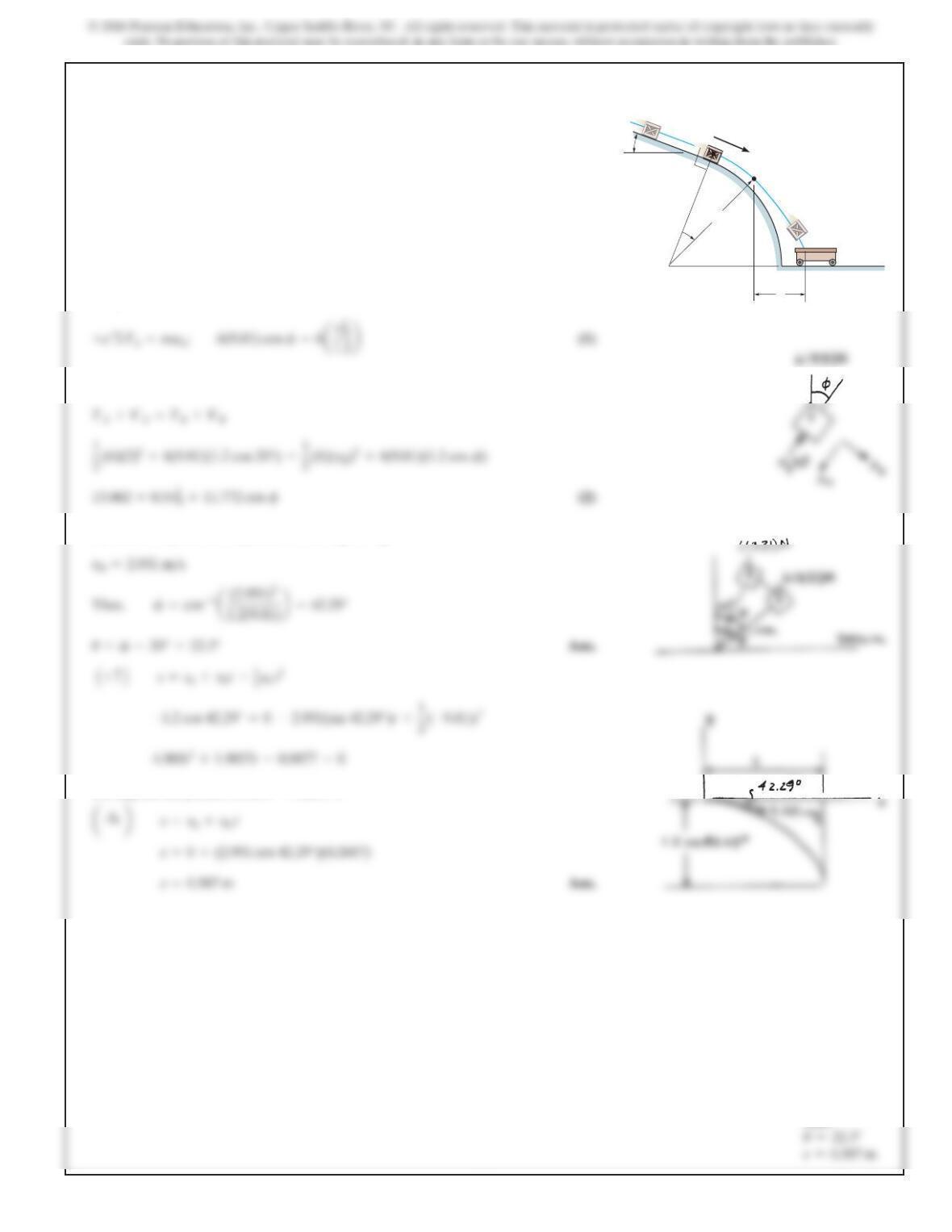
465
14–89.
SOLUTION
At point B:
Datum at bottom of curve:
Substitute Eq. (1) into Eq. (2), and solving for ,
Solving for the positive root:
t=0.2687 s
vB
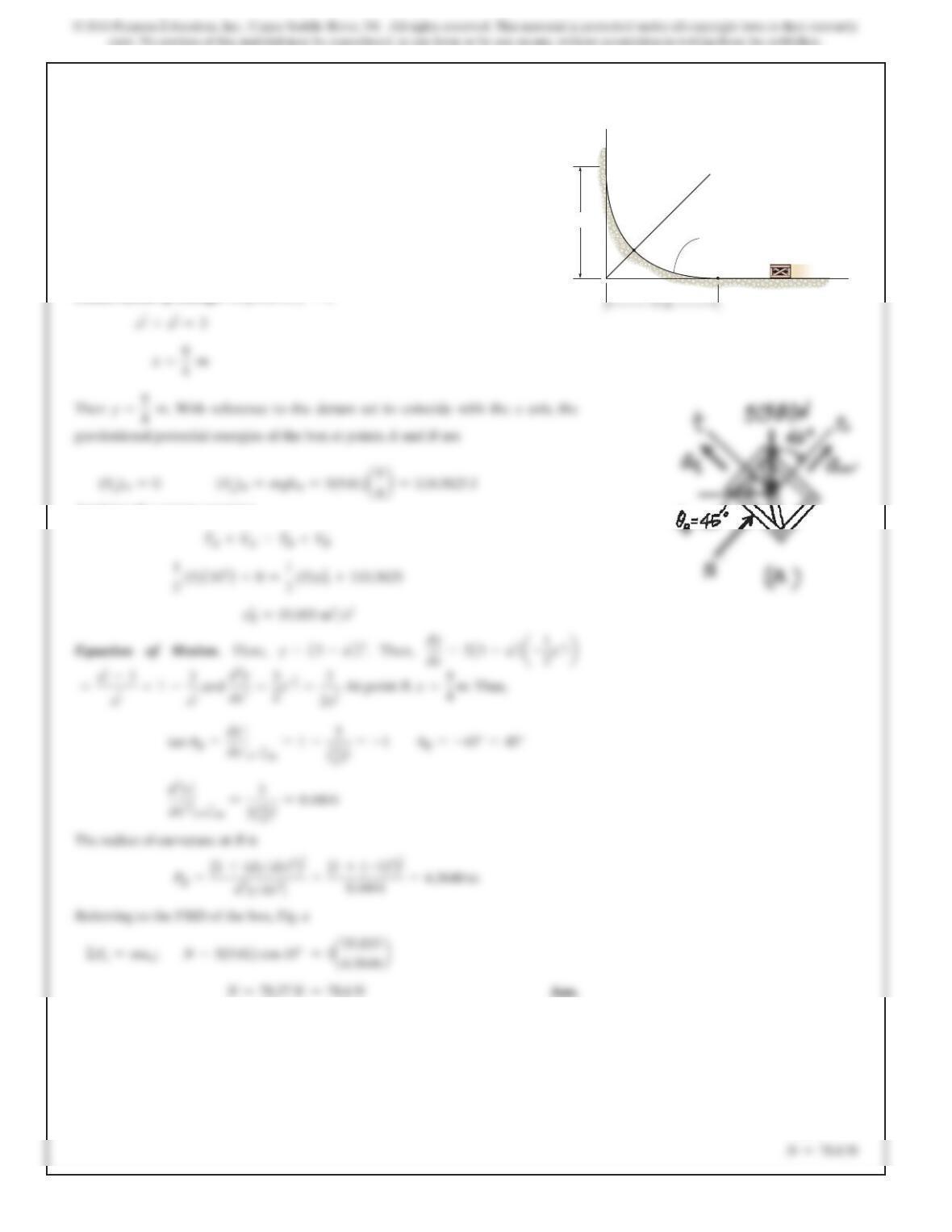
When the 6-kg box reaches point Ait has a speed of
Determine the angle at which it leaves the
smooth circular ramp and the distance sto where it falls
into the cart. Neglect friction.
uvA=2m>s. vA=2m/s
1.2 m
B
A
s
θ
20°
Ans:
466
14–90.
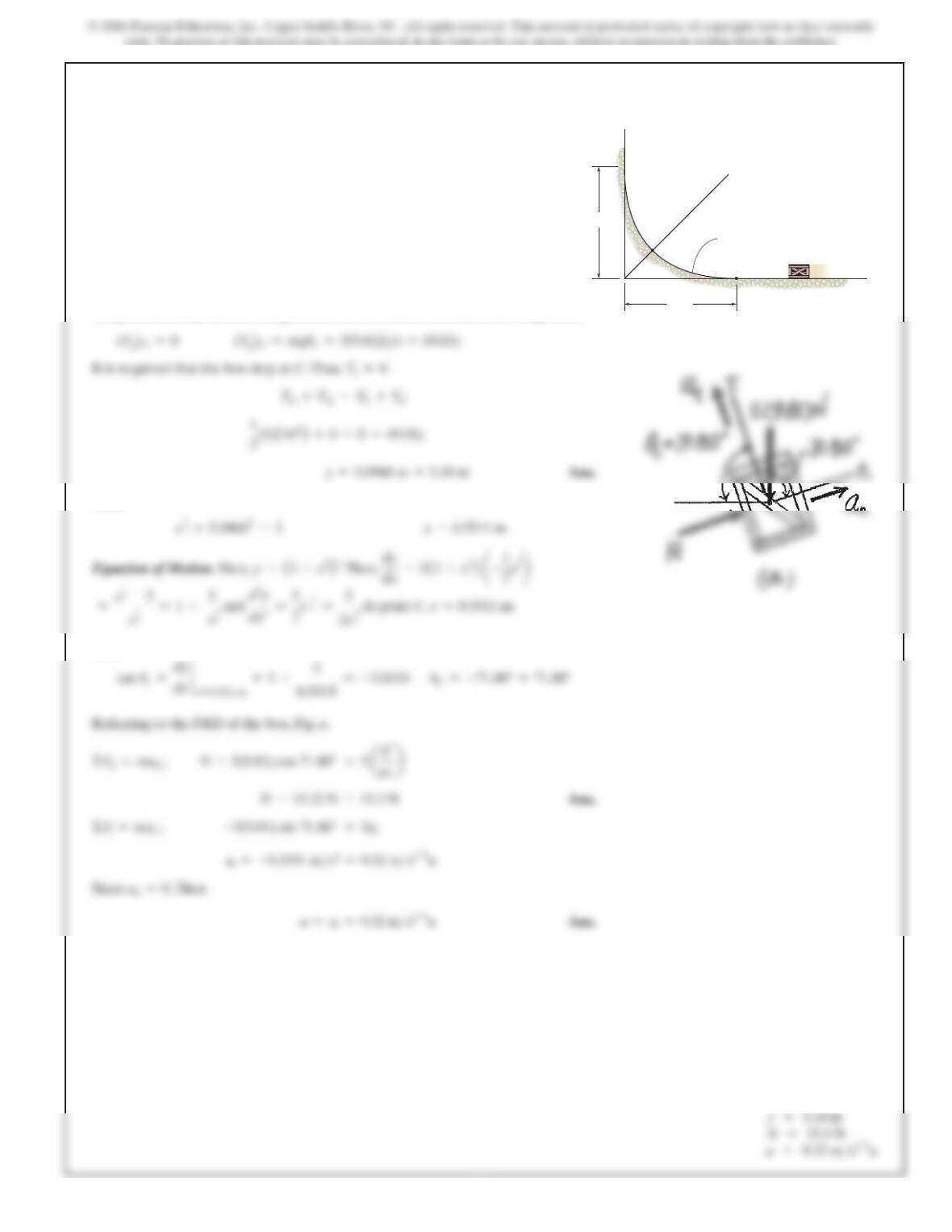
When the 5-kg box reaches point A it has a speed
vA
=10 m>s.
Determine the normal force the box exerts
on the surface when it reaches point B. Neglect friction and
the size of the box.
SOLUTION
Conservation of Energy. At point B,
y=x
Applying the energy equation,
9 m
B
y
x
A
y x
x1/2 y1/2 3
Ans:
467
SOLUTION
Conservation of Energy. With reference to the datum set coincide with
x
axis,
the gravitational potential energy of the box at A and C (at maximum height) are
Then,
Thus
14–91.
When the 5-kg box reaches point A it has a speed
vA
=10 m>s.
Determine how high the box reaches up the
surface before it comes to a stop. Also, what is the resultant
normal force on the surface at this point and the
acceleration? Neglect friction and the size of the box.
9 m
9 m
B
y
x
A
y x
x1/2 y1/2 3
Ans:
468
Ans:
*14–92.
SOLUTION
Datum at A:
TA+VA=TB+VB
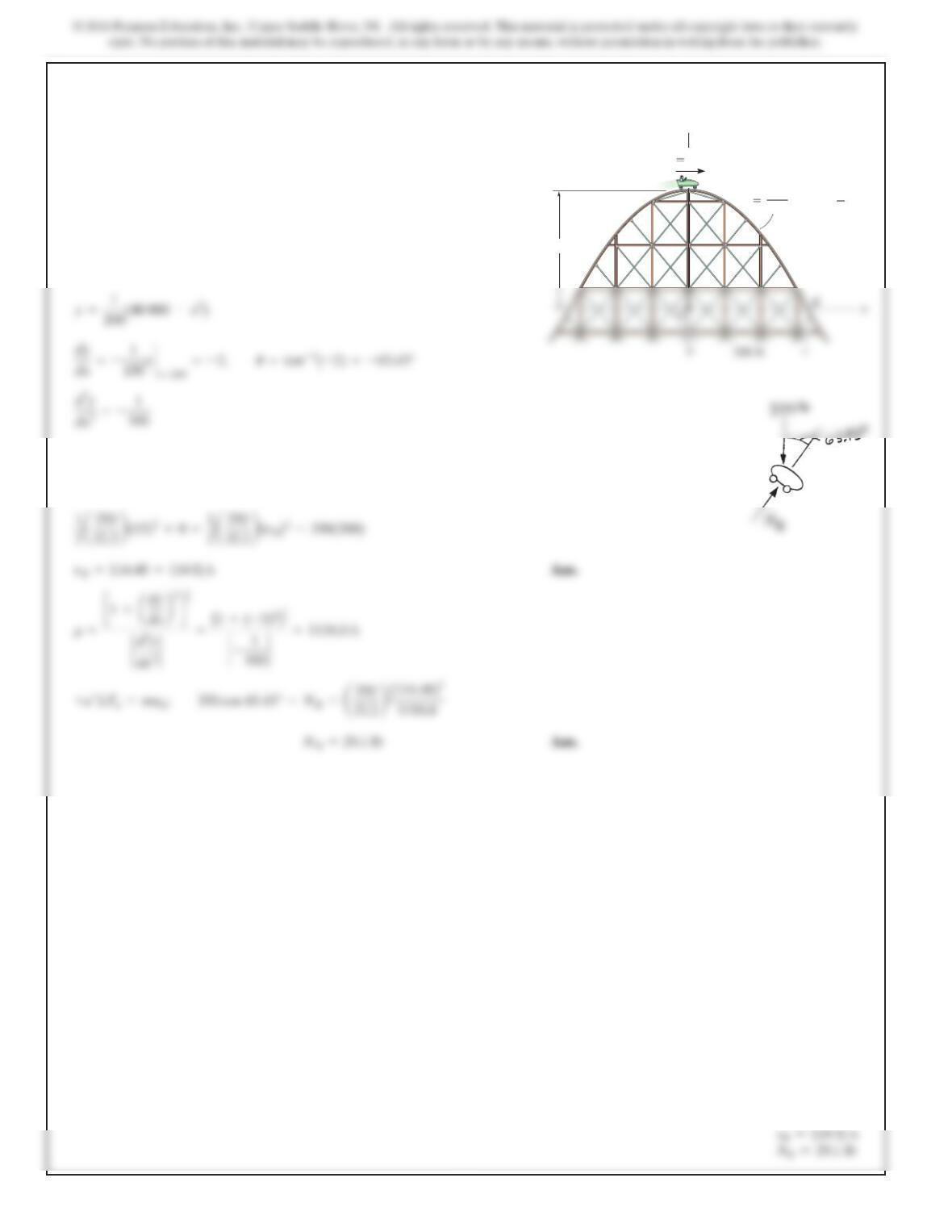
Theroller-coaster car hasaspeed of when it is at
the crestofavertical parabolic track. Determine the car’s
velocity and the normal force it exerts on the track when it
reaches point B.Neglect friction and the mass of the
wheels.The total weight of the car and the passengers is
350lb.
15 ft
>
s
v
A
15 ft/s
200 ft
A
y
(40 000 x
2
)
1
200
y
469
14–93.
A
k 500 N/m
D
E
B
0.4 m
u
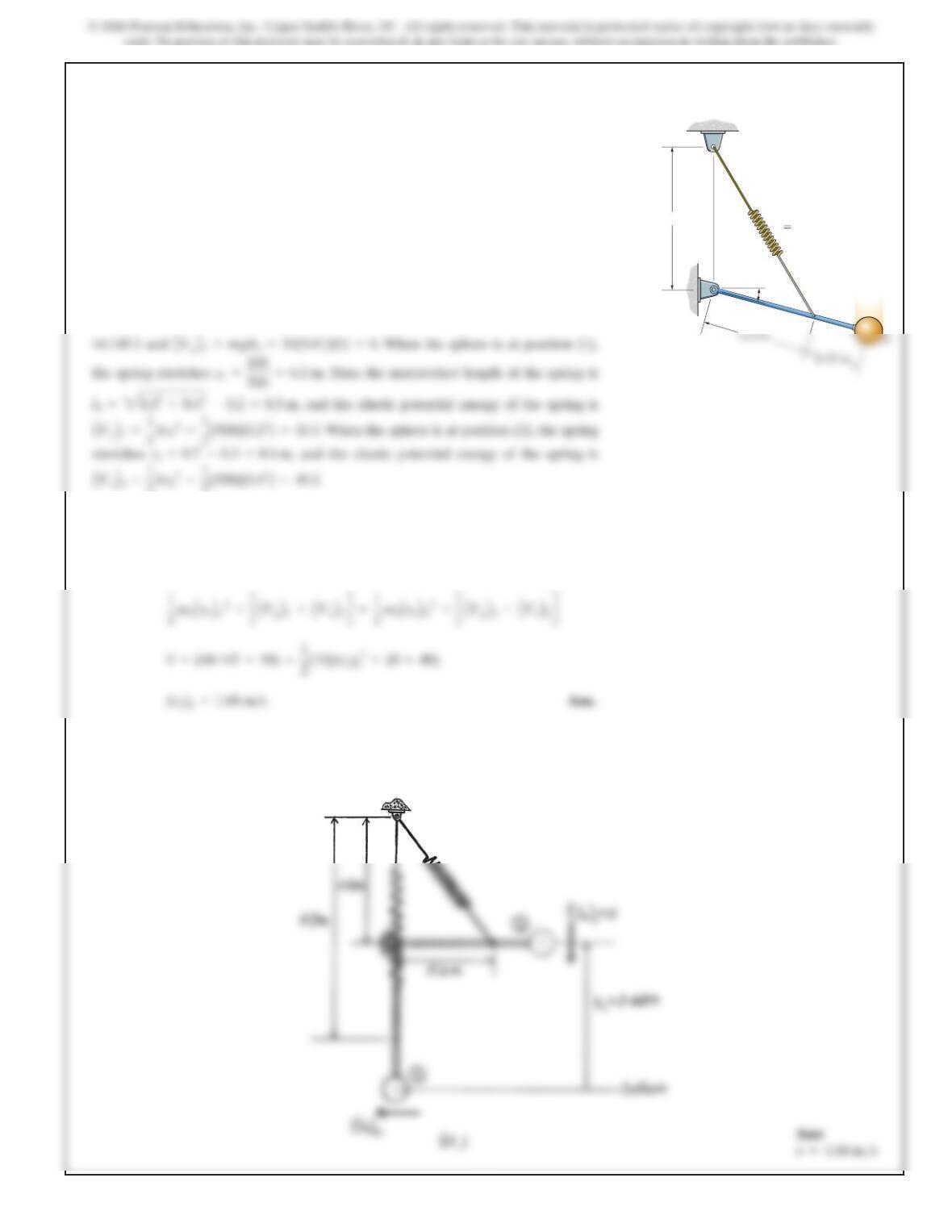
The 10-kg sphere Cis released from rest when and
the tension in the spring is .Determine the speed of
the sphere at the instant .Neglect the mass of rod
and the size of the sphere.AB
u=90°
100 N
u=0°
SOLUTION
Potential Energy: With reference to the datum set in Fig. a,the gravitational potential
energy of the sphere at positions (1) and (2) are
Conservation of Energy:
T1+V1=T2+V2
2 ks22=1
2(500)(0.42)=40 J
A
Vg
B
1=mgh1=10(9.81)(0.45) =
470
14–94.
SOLUTION
Conservation of Energy:
T1+V1=T2+V2
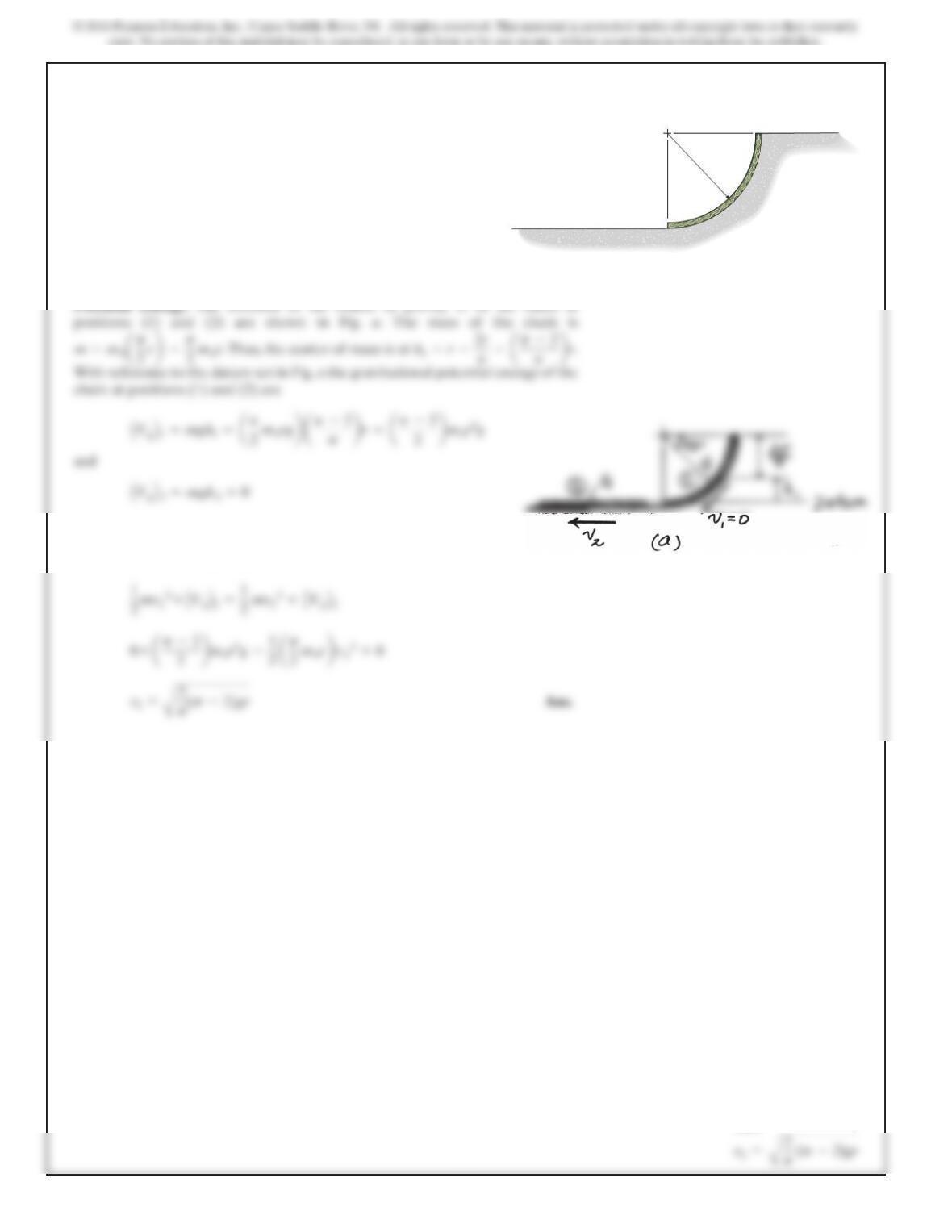
Aquarter-circular tube AB of mean radius rcontains a smooth
chain that has a mass per unit length of . If the chain is
released from rest from the position shown, determine its
speed when it emerges completely from the tube.
m0
A
B
O
r
Ans:
SOLUTION
14–95.
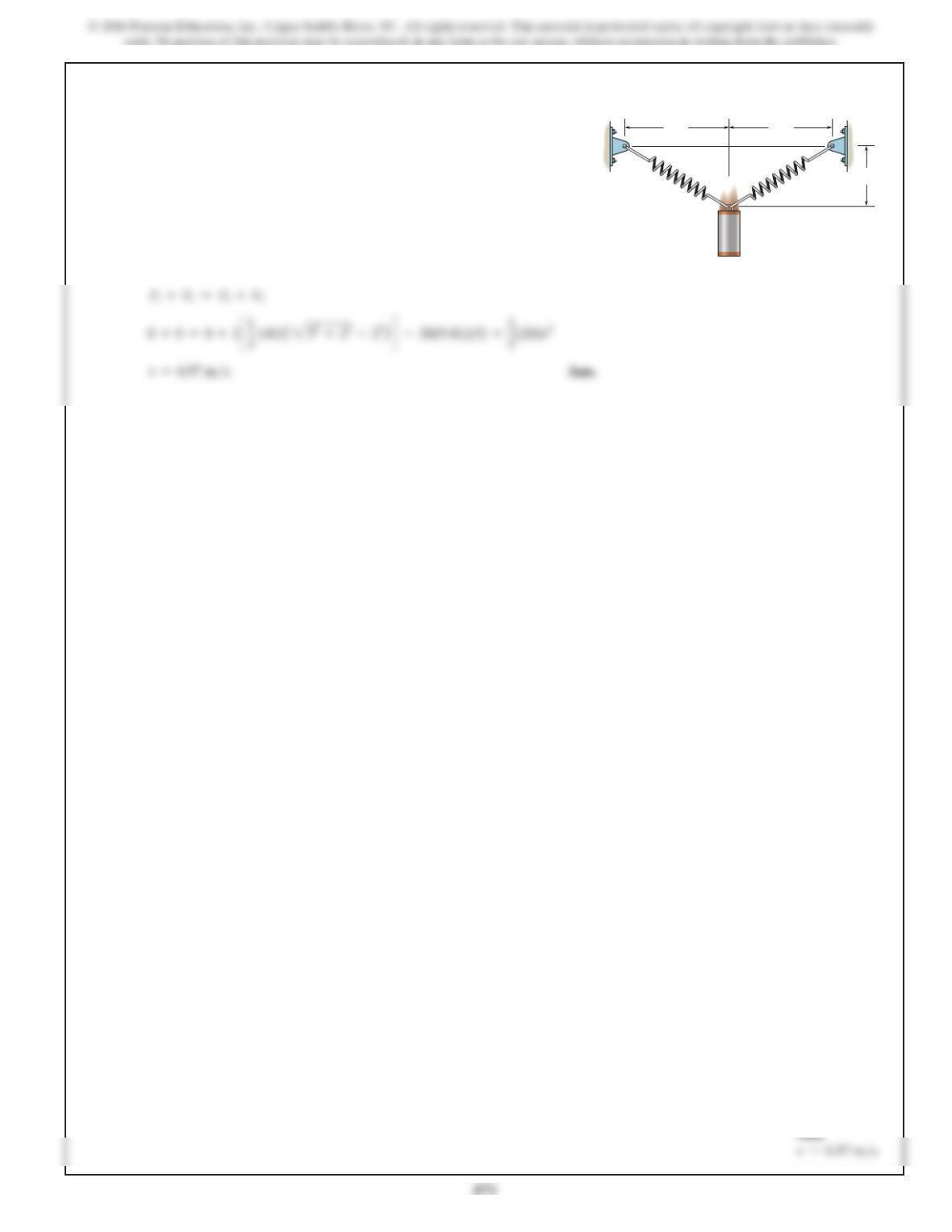
The cylinder has a mass of 20 kg and is released from rest
when
h=0.
Determine its speed when
h=3 m.
Each
spring has a stiffness
k=40 N>m
and an unstretched
length of 2 m.
kk
h
2 m 2 m
472
Ans:
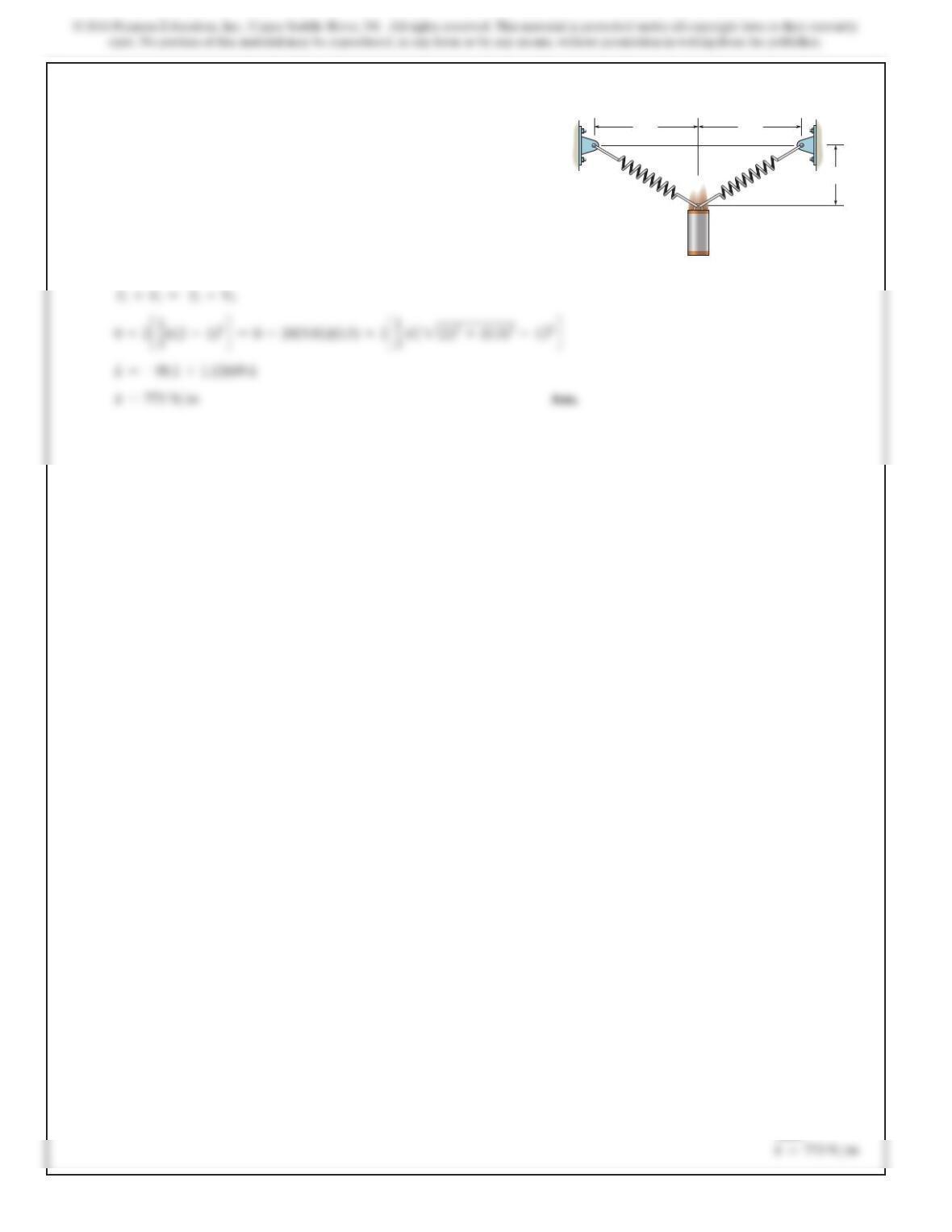
*14–96.
If the 20-kg cylinder is released from rest at
h=0,
determine the required stiffness k of each spring so that its
motion is arrested or stops when
h=0.5 m.
Each spring
has an unstretched length of 1 m.
SOLUTION
kk
h
2 m 2 m
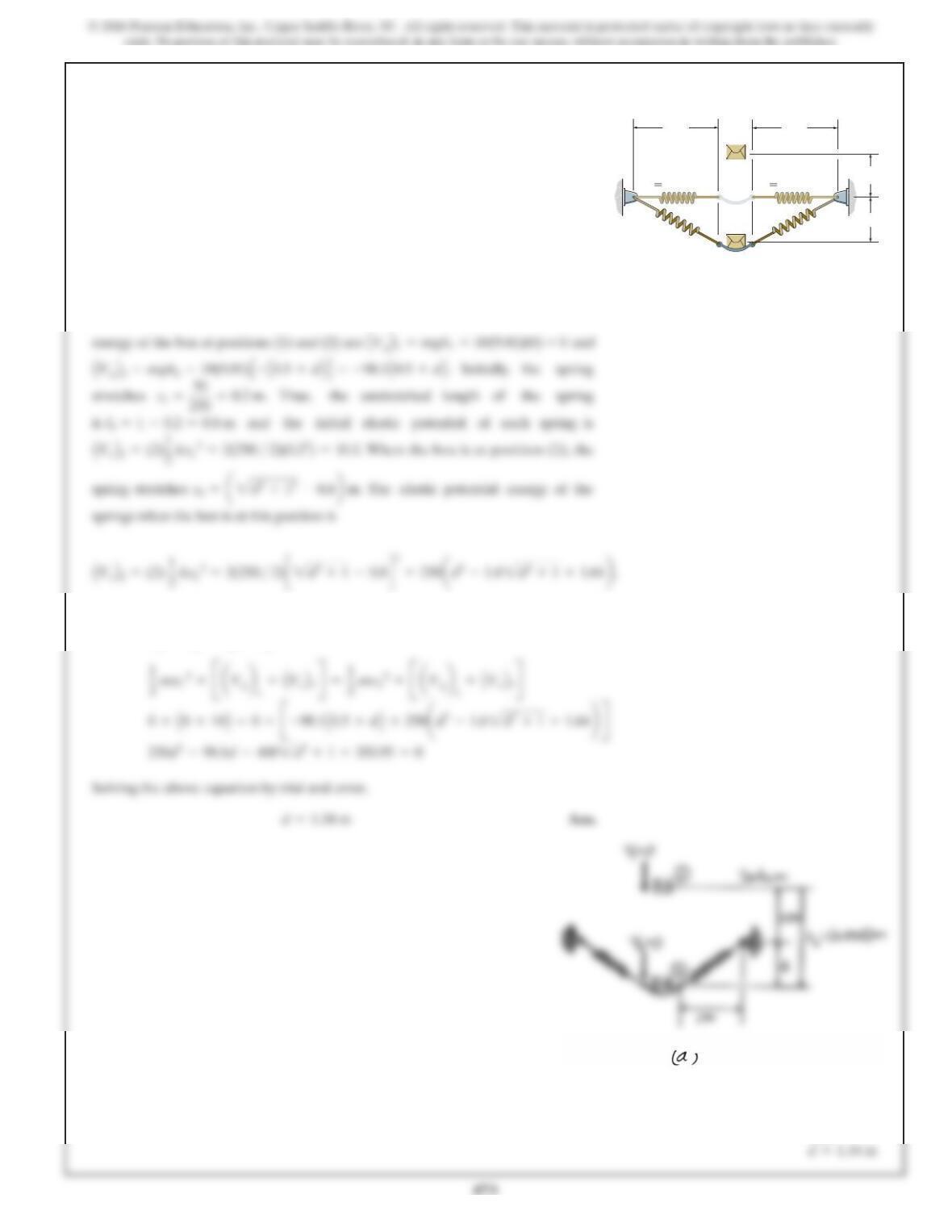
14–97.
Apan of negligible mass is attached to two identical springs of
stiffness .If a 10-kg box is dropped from a height
of 0.5 m above the pan, determine the maximum vertical
displacement d.Initially each spring has a tension of 50 N.
k=250 N>m
SOLUTION
Potential Energy: With reference to the datum set in Fig. a,the gravitational potential
1m 1m
0.5 m
k250 N/m k250 N/m
d
Conservation of Energy:
T1+V1+T2+V2
Ans: