345
13–101.
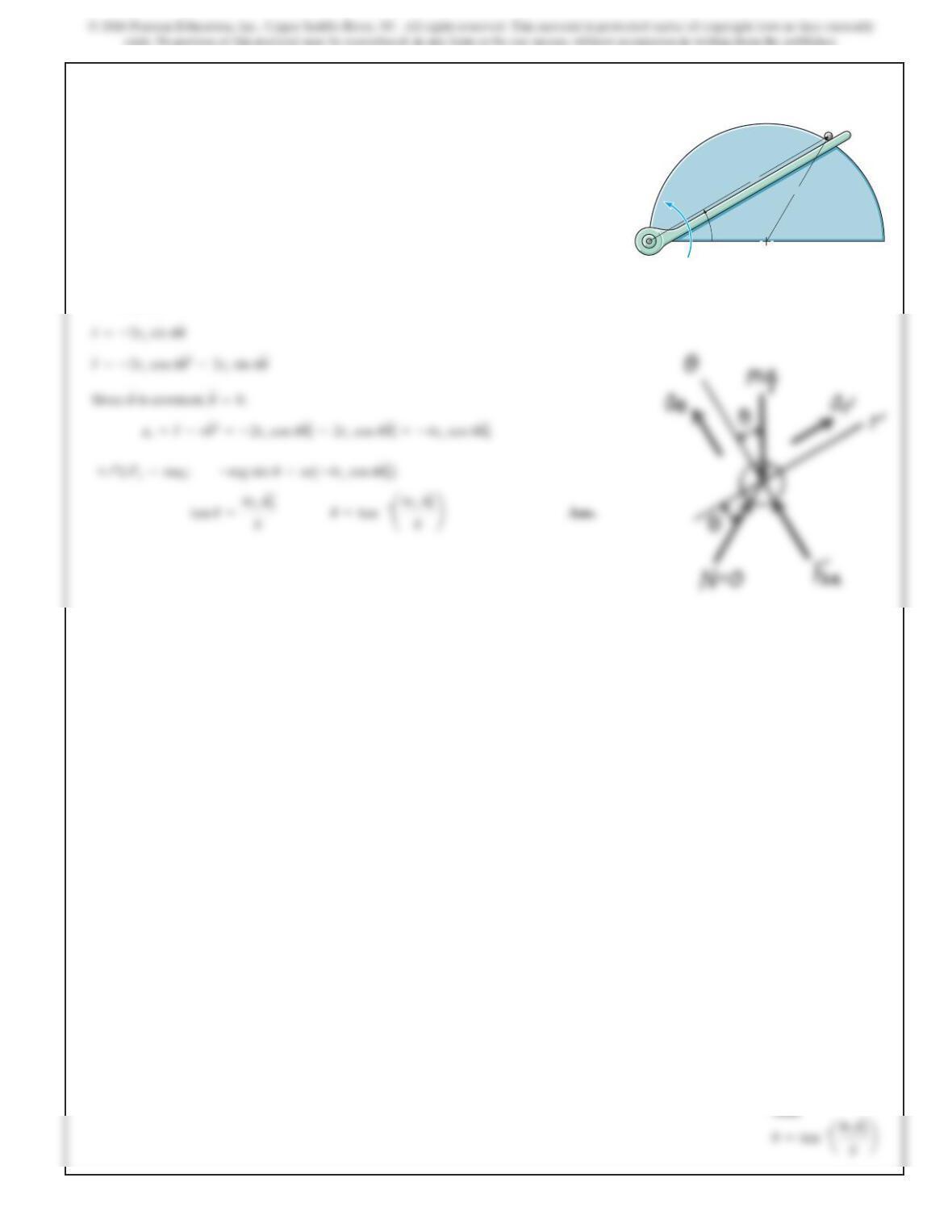
The ball of mass mis guided along the vertical circular path
using the arm OA.If the arm has a constant
angular velocity ,determine the angle at which
the ball starts to leave the surface of the semicylinder.
Neglect friction and the size of the ball.
u…45°u
#
0
r=2rccos u
SOLUTION
r=2rccos u
P
r
u
A
O
rc
346
13–102.
SOLUTION
r=0.6ur
#=0.6 ur
$=0.6 u
$
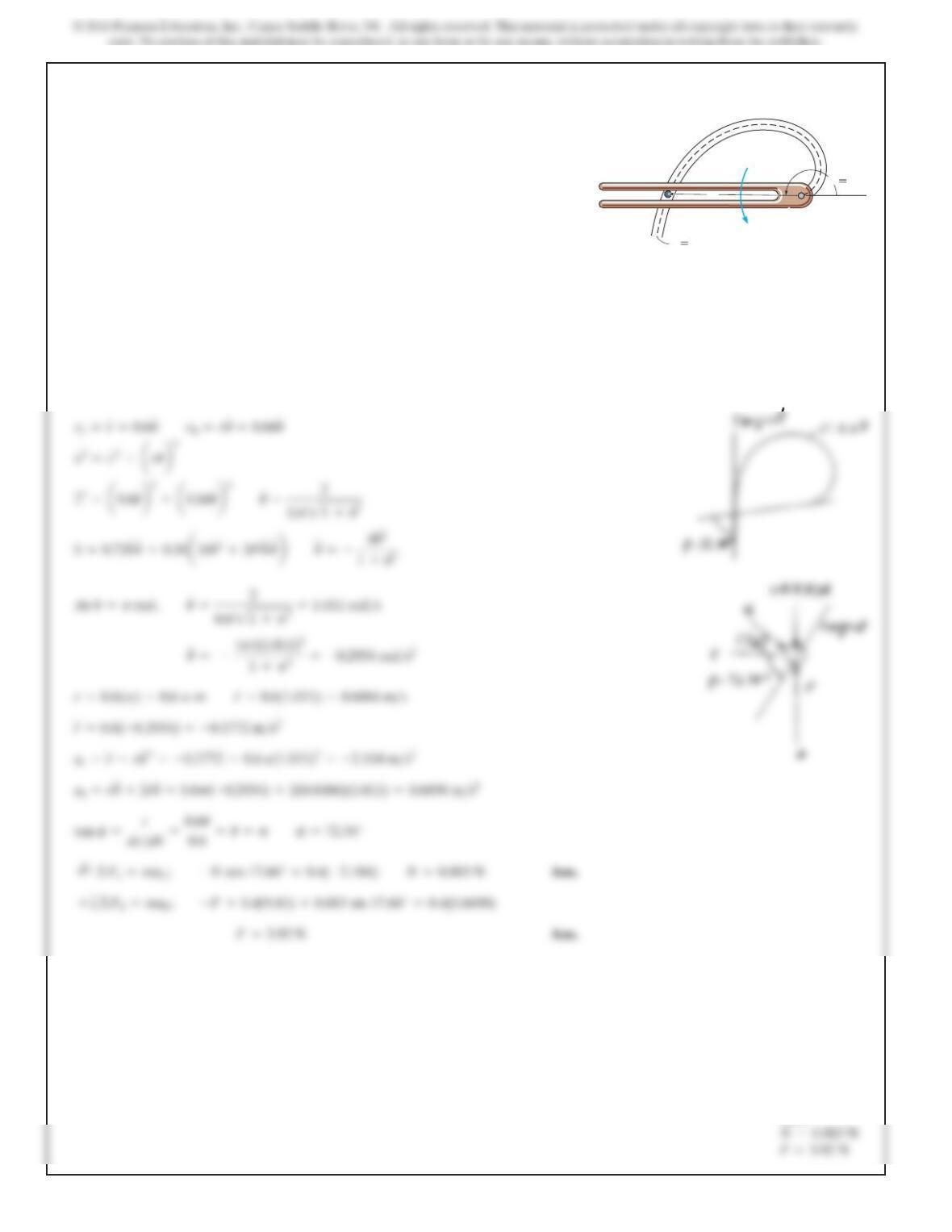
Using a forked rod, a smooth cylinder P, having a mass of
0.4 kg, is forced to move along the vertical slotted path
where is in radians. If the cylinder has a
constant speed of determine the force of the
rod and the normal force of the slot on the cylinder at the
instant Assume the cylinder is in contact with
only one edge of the rod and slot at any instant. Hint:To
obtain the time derivatives necessary to compute the
cylinder’s acceleration components and take the first
and second time derivatives of Then, for further
information, use Eq. 12–26 to determine Also, take the
time derivative of Eq. 12–26, noting that to
determine u
$.
v
#
C=0,
u
#.
r=0.6u.
au,ar
u=prad.
vC=2m>s,
ur=10.6u2m,
r
P
r 0.6u
u p
Ans:
347
SOLUTION
Kinematic. Using the chain rule, the first and second time derivatives of r are
r=200(1 +cos
When
u=0°
,
r=200(1 +cos 0°)=400 m
Using Eq. 12–26
13–103.
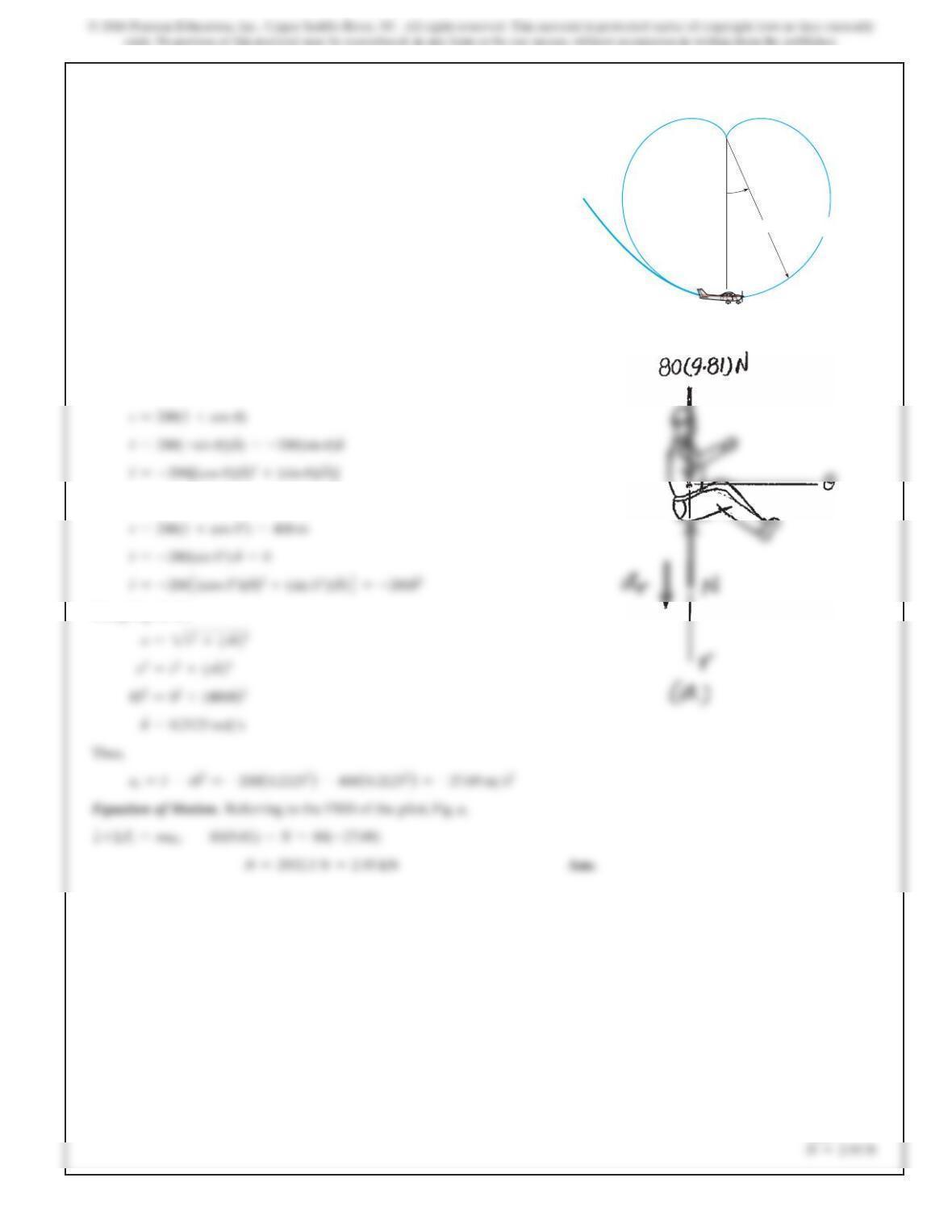
The pilot of the airplane executes a vertical loop which in
part follows the path of a cardioid,
r=200(1 +cos
u
) m
,
where
u
is in radians. If his speed at A is a constant
vp
=85 m>s
, determine the vertical reaction the seat of the
plane exerts on the pilot when the plane is atA. He has a
mass of 80 kg. Hint: To determine the time derivatives
necessary to calculate the acceleration components ar and
au,
take the first and second time derivatives of
r=200(1 +cos
u
).
Then, for further information, use
Eq.12–26 to determine
u
#
.
Ans:
A
fi
r 200 (1 cos ) m
fi
348
*13–104.
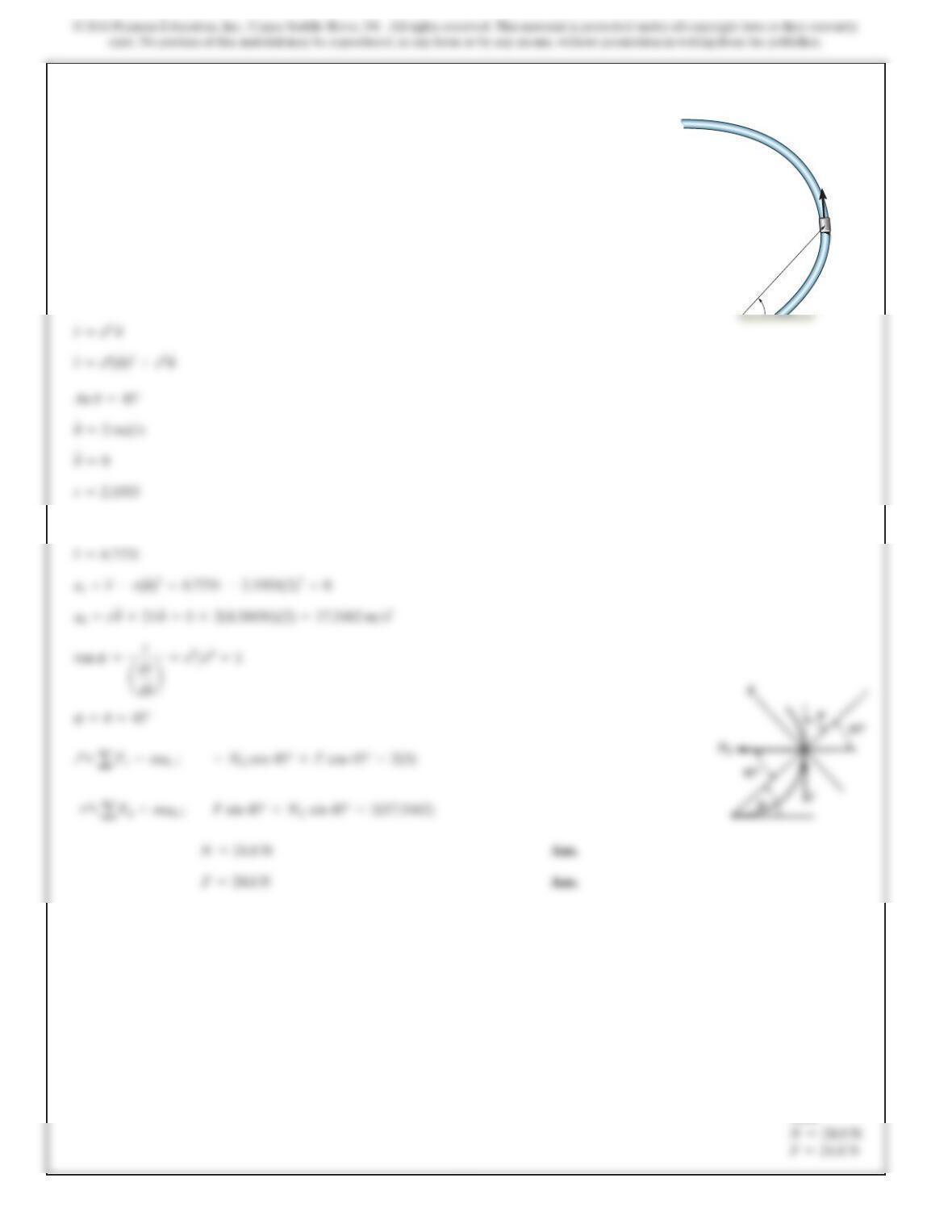
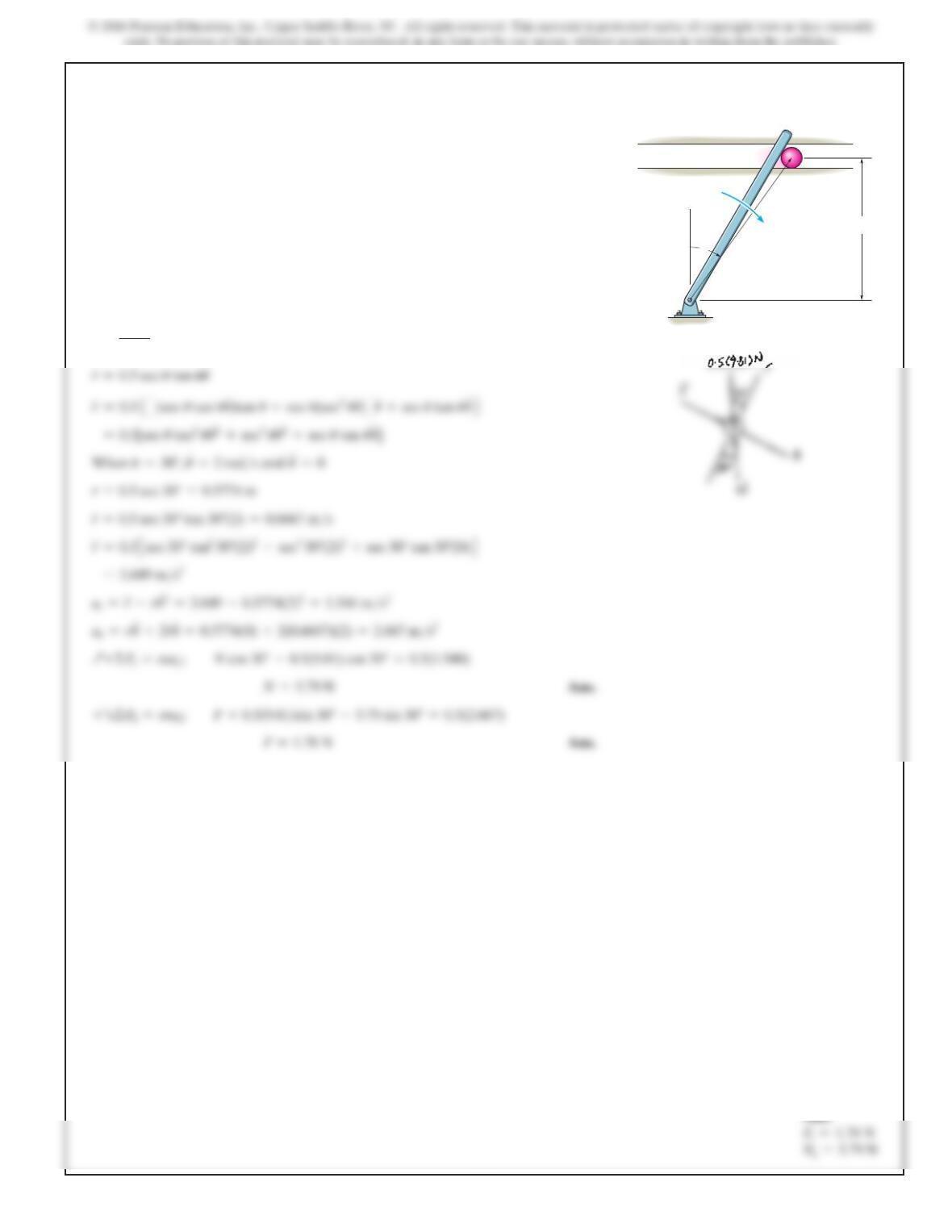
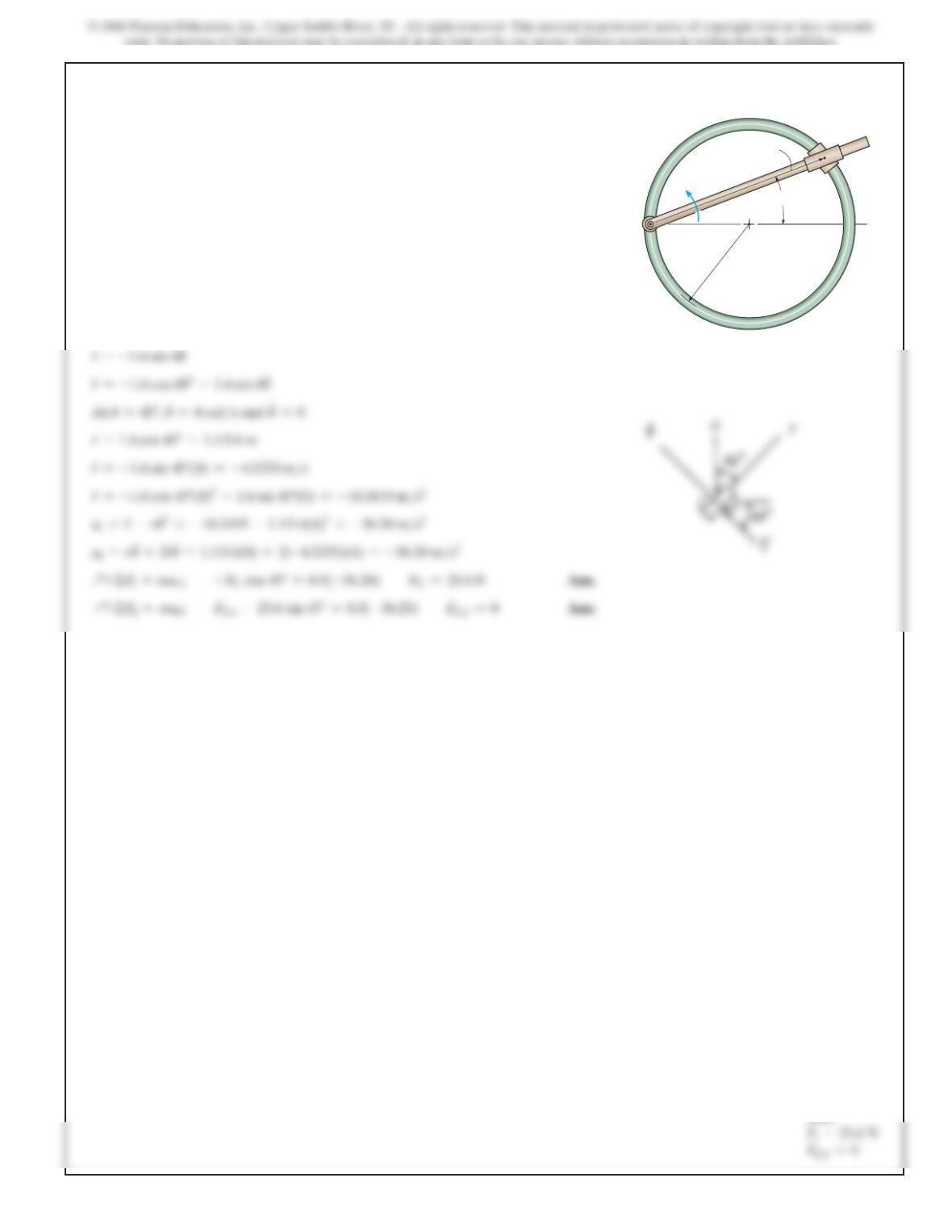
The collar has a mass of 2 kg and travels along the smooth
horizontal rod defined by the equiangular spiral
where is in radians.Determine the tangential force Fand
the normal force Nacting on the collar when if the
force Fmaintains a constant angular motion u
#=2 rad>s.
u=45°,
u
r=1eu2m,
SOLUTION
r
#=4.38656
r=eu
r
F
θ
r=e
θ
Ans:
349
SOLUTION
r=
0.5
cos u
=0.5 sec u
u=30°
13–105.
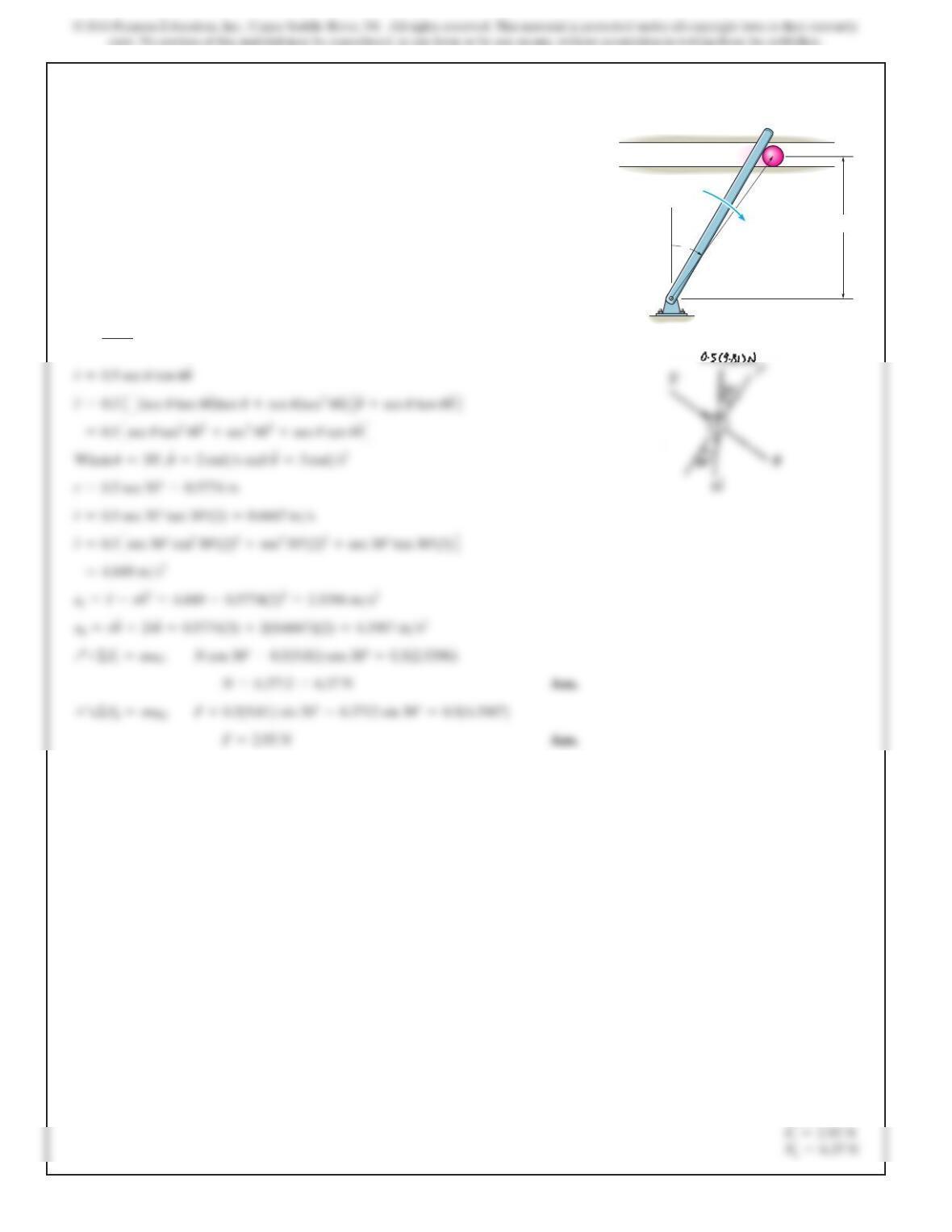
The particle has a mass of 0.5 kg and is confined to move
along the smooth horizontal slot due to the rotation of the
arm OA. Determine the force of the rod on the particle and
the normal force of the slot on the particle when
u=30°.
The rod is rotating with a constant angular velocity
u
.
=
2
rad>s.
Assume the particle contacts only one side of
the slot at any instant.
0.5 m
O
A
r
u
·
u fi 2 rad/s
350
SOLUTION
r=
0.5
cos u
=0.5 sec u
#
=
>
$
=
>
2
13–106.
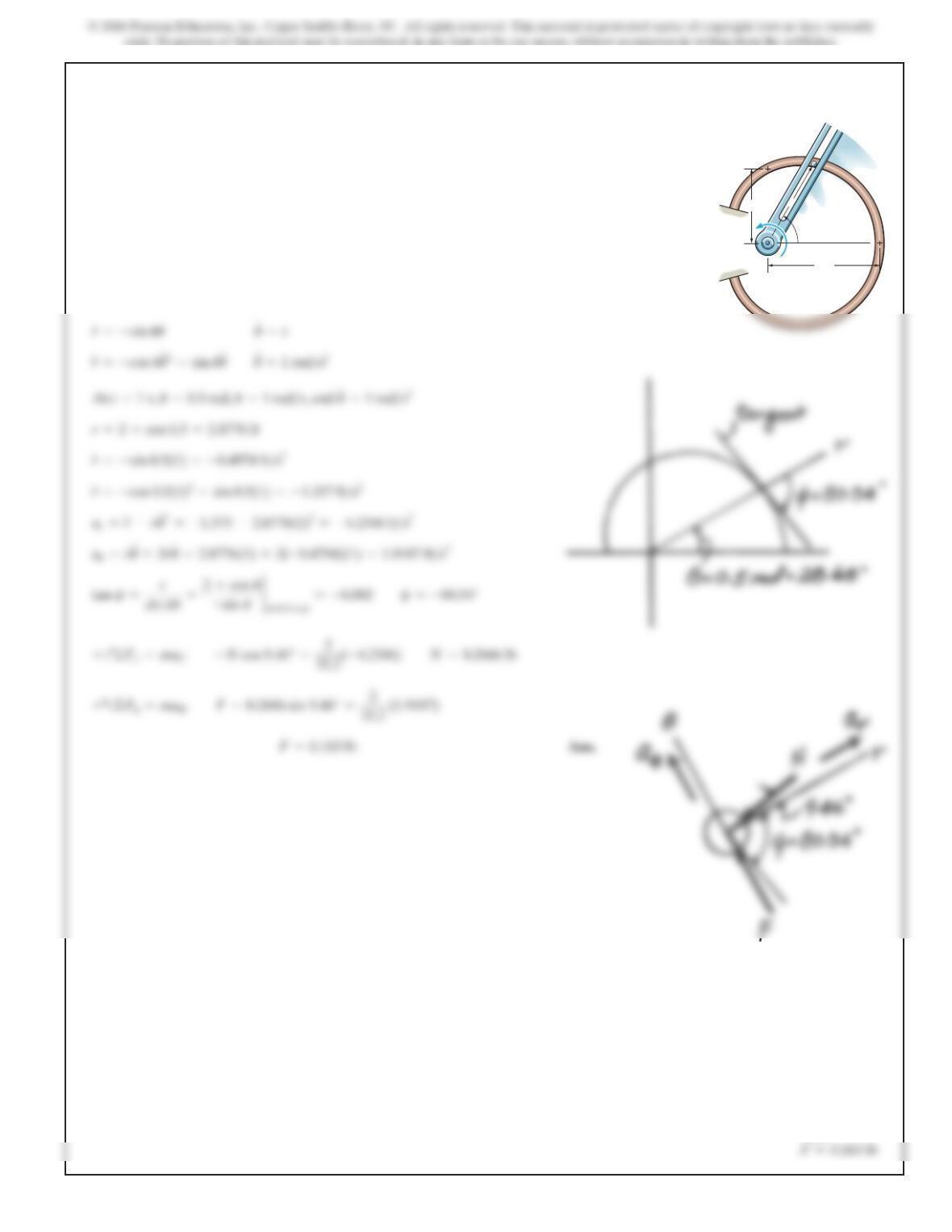
Solve Prob. 13–105 if the arm has an angular acceleration of
u
$
=
3 rad
>
s
2
when u
#
=
2 rad
>
s at
u=30°.
Ans:
0.5 m
O
A
r
u
·
u fi 2 rad/s
351
13–107.
Ans:
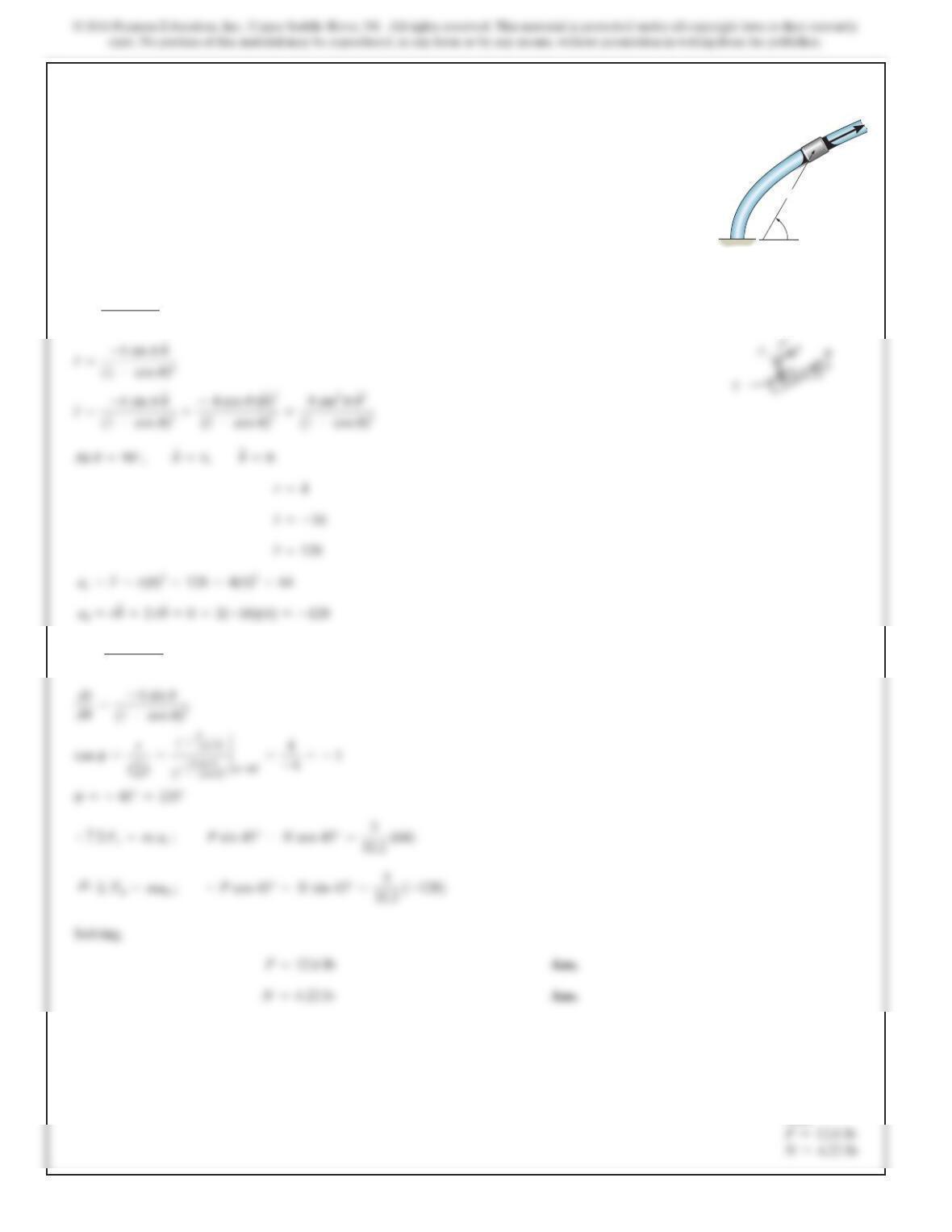
The forked rod is used to move the smooth
2-lb particle around the horizontal path in the shape of a
limaçon, . If rad, where tis in
seconds, determine the force which the rod exerts on the
particle at the instant .The fork and path contact the
particle on only one side.
t=1s
u=(0.5t2)r=(2 +cos u)ft
SOLUTION
r=2+cos uu=0.5t2
3ft
r
2ft
·
u
u
352
*13–108.
SOLUTION
r=4
1–cos u
r=4
1–cos u
The collar,which has a weight of 3 lb,slides along the
smooth rod lying in the horizontal plane and having the
shape of a parabola where is in radians
and ris in feet. If the collar’s angular rate is constant and
equals determine the tangential retarding
force Pneeded to cause the motion and the normal force
that the collar exerts on the rod at the instant u=90°.
u
#=4 rad>s,
ur=4>11–cos u2,
r
P
u
Ans:
353
SOLUTION
r=1.6 cos u
u=45°
#
13–109.
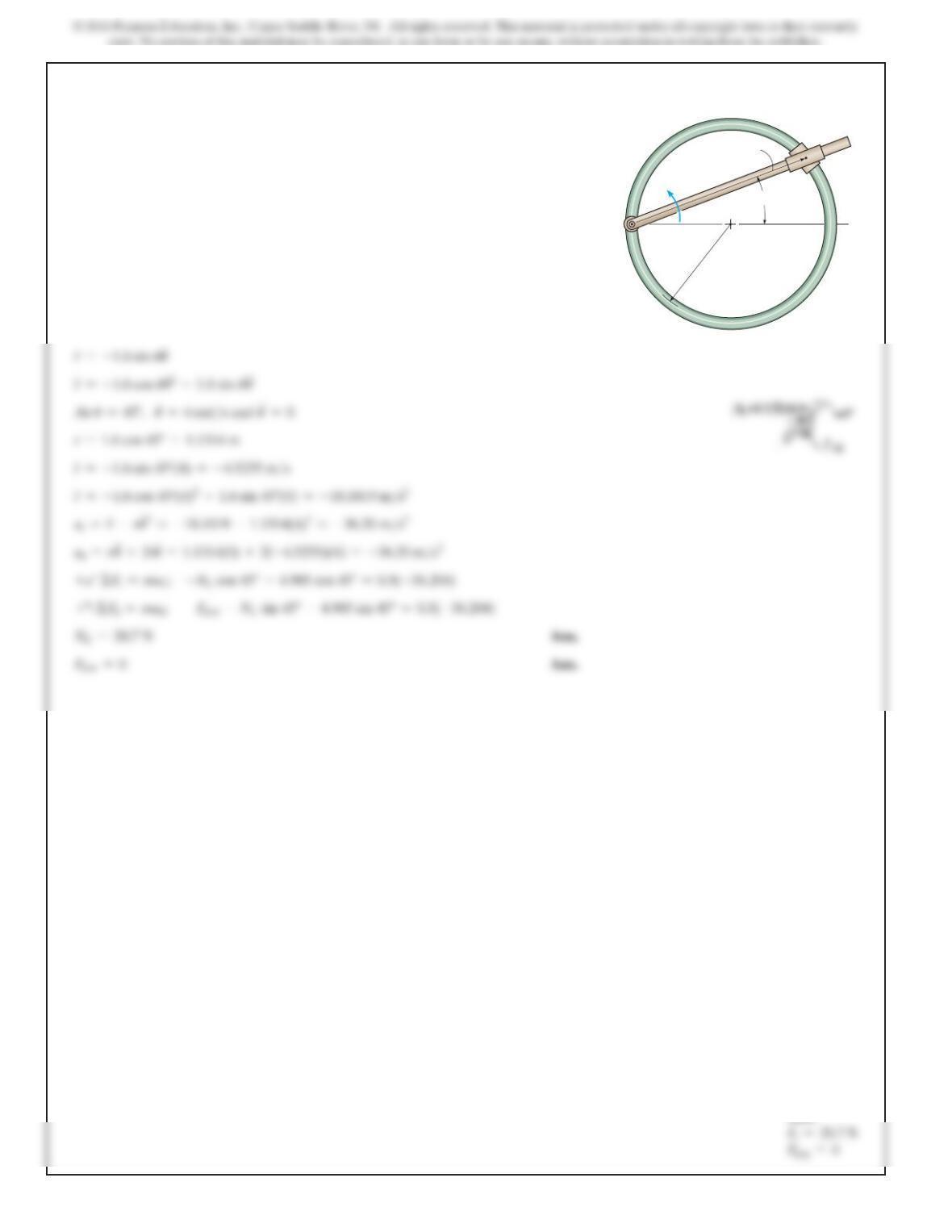
Rod OA rotates counterclockwise at a constant angular
rate u
.
=
4
rad>s.
The double collar B is pin-connected
together such that one collar slides over the rotating rod
and the other collar slides over the circular rod described
by the equation
r=(1.6 cos
u
) m
. If both collars have a
mass of 0.5 kg, determine the force which the circular rod
exerts on one of the collars and the force that OA exerts on
the other collar at the instant
u=45°.
Motion is in the
horizontal plane.
Ans:
A
B
0.8 m
r fi 1.6 cos u
O
u = 4 rad/s
u
354
Ans:
SOLUTION
r=1.6 cos u
13–110.
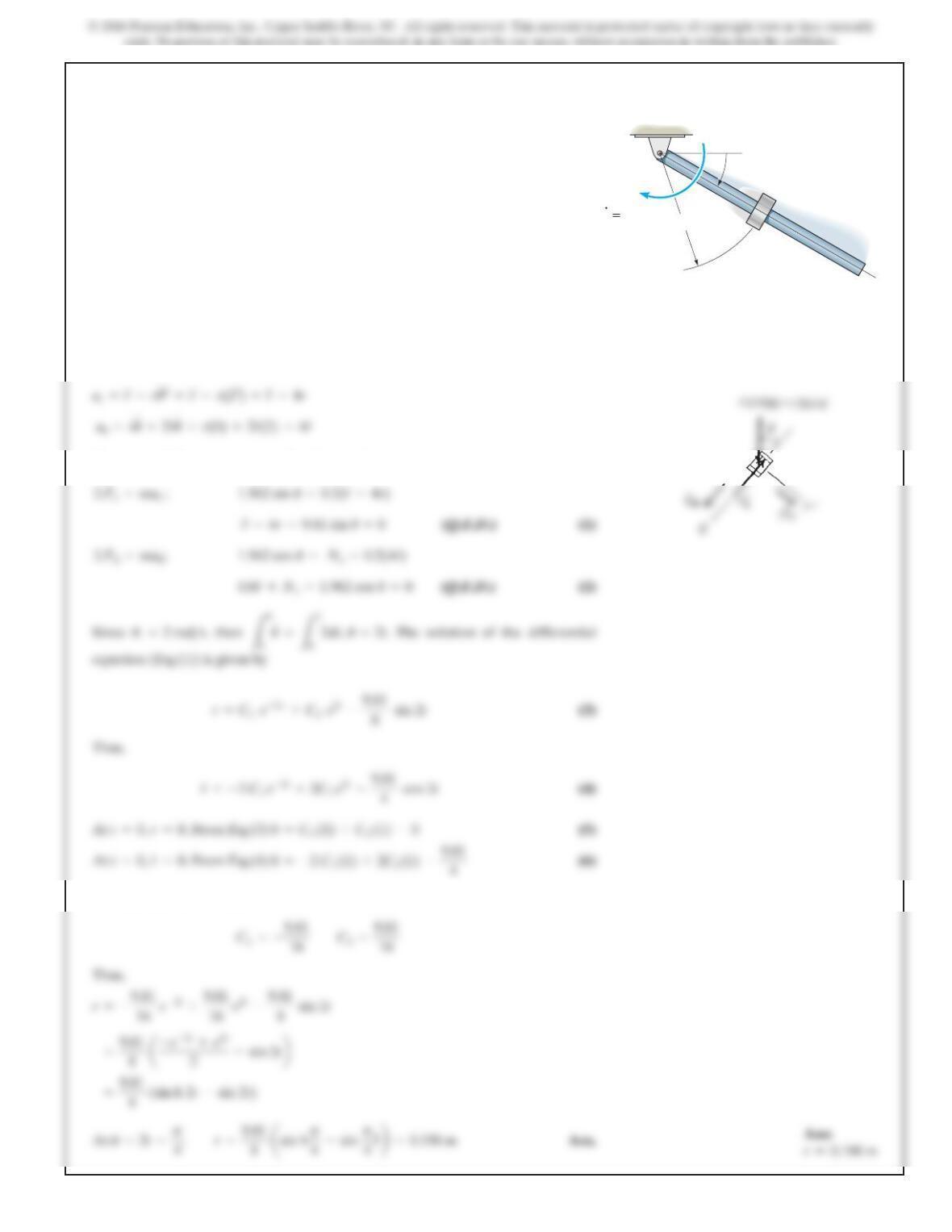
Solve Prob. 13–109 if motion is in the vertical plane. A
B
0.8 m
r fi 1.6 cos u
O
u = 4 rad/s
u
355
13–111.
SOLUTION
Kinematic: Here, and .Applying Eqs.12–29, we have
Equation of Motion: Applying Eq.13–9, we have
Solving Eqs.(5) and (6) yields
u
## =0u.=2 rad>s
A 0.2-kg spool slides down along a smooth rod.
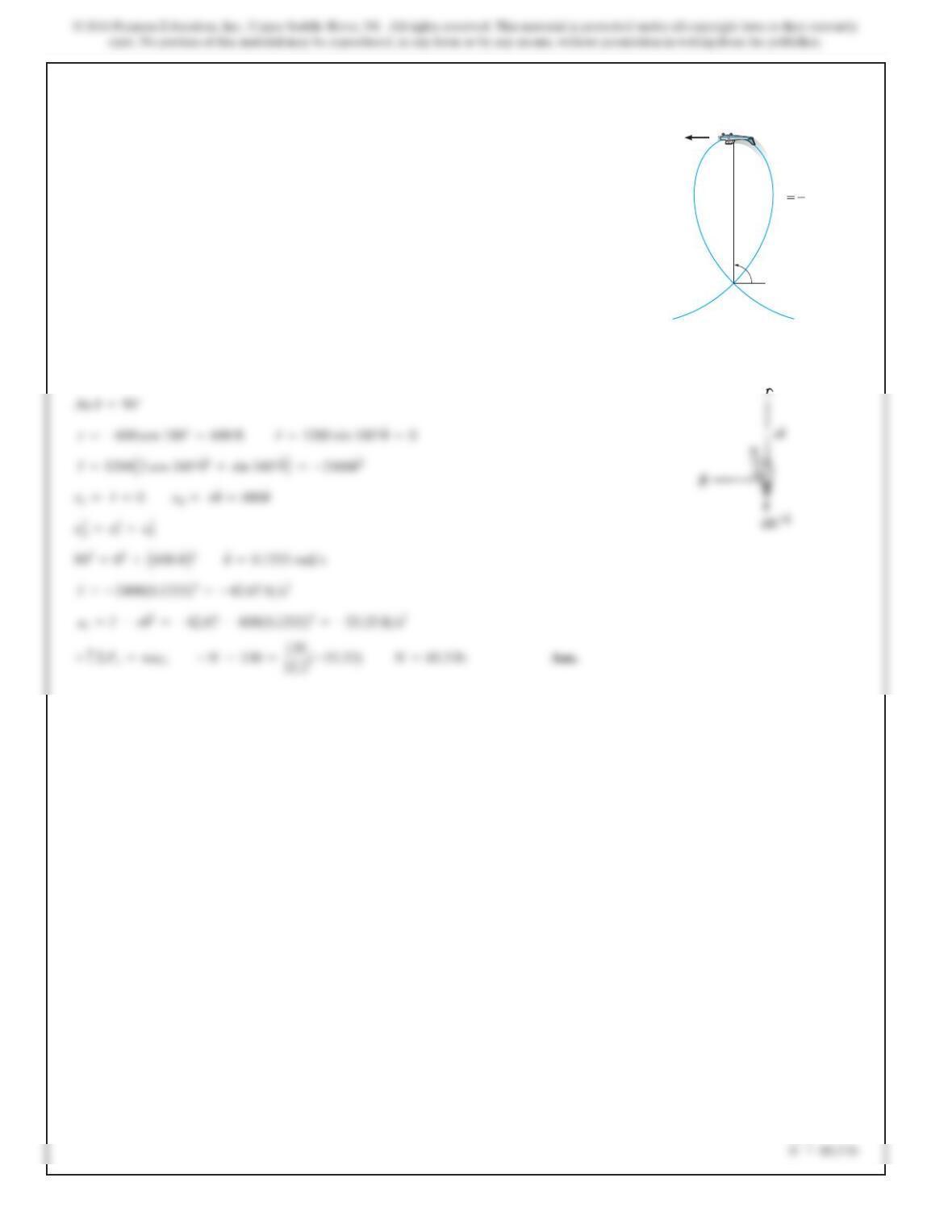
If the rod has a constant angular rate of rotation
in the vertical plane, show that the equations of
dna era loops eht rof noitom
where is the magnitude of
the normal force of the rod on the spool. Using the
methods of differential equations, it can be shown that
the solution of the first of these equations is
If r, and are
zero when evaluate the constants and to
determine rat the instant u=p>4 rad.
C2
C1
t=0,
ur
#,r=C1e–2t+C2e2t–19.81>82 sin 2t.
N
s
0.8r
#+N
s–1.962 cos u=0,
r
$–4r–9.81 sin u=0
u
#=2 rad>s
r
u
u 2 rad/s
356
*13–112.
SOLUTION
r=-600 cos 2u
r
#=1200 sin 2uu
#
r
$=1200
A
2 cos 2uu
#2+sin 2uu
$
B
T
h
e p
il
ot of an a
i
rp
l
ane executes a vert
i
ca
l
l
oop w
hi
c
h
i
n part
follows the path of a “four-leaved rose,”
where is in radians. If his speed at Ais a constant
determine the vertical reaction the seat of the
plane exerts on the pilot when the plane is at A.Heweighs
130 lb.Hint: To determine the time derivatives necessary to
compute the acceleration components and take the first
and second time derivatives of Then, for
further information, use Eq. 12–26 to determine Also,take
the time derivative of Eq. 12–26, noting that to
determine u
$.
v
#
C=0,
u
#.
r=40011+cos u2.
au,ar
vP=80 ft>s,
u
r=1–600 cos 2u2 ft,
r
r 600 cos 2
u
80 ft/s
A
u
Ans:
357
Ans:
13–113.
SOLUTION
e=Ch2
GMS
where C=1
r0
¢
1–GMS
r0v2
0
≤
and h=r0v0
The earth has an orbit with eccentricity
e
= 0.0167 around the
sun. Knowing that the earth’s minimum distance from the
sun is 146(106) km, find the speed at which the earth travels
when it is at this distance. Determine the equation in polar
coordinates which describes the earth’s orbit about the sun.
358
13–114.
SOLUTION
The period of the satellite around the circular orbit of radius
The velocity of the satellite orbiting around the circular orbit of radius
A communications satellite is in a circular orbit above the
earth such that it always remains directly over a point on
the earth’s surface. As a result, the period of the satellite
must equal the rotation of the earth, which is approximately
24 hours. Determine the satellite’s altitude habove the
earth’s surface and its orbital speed.
Ans:
359
13–115.
The speed of a satellite launched into a circular orbit
about the earth is given by Eq.13–25.Determine the
speed of a satellite launched parallel to the surface of
the earth so that it travels in a circular orbit 800 km
from the earth’s surface.
SOLUTION
For a 800-km orbit
360
*13–116.
The rocket is in circular orbit about the earth at an altitude
of 20 Mm. Determine the minimum increment in speed it
must have in order to escape the earth’s gravitational field.
SOLUTION
The speed of the rocket in circular orbit is
20 Mm
Ans: