13–21.
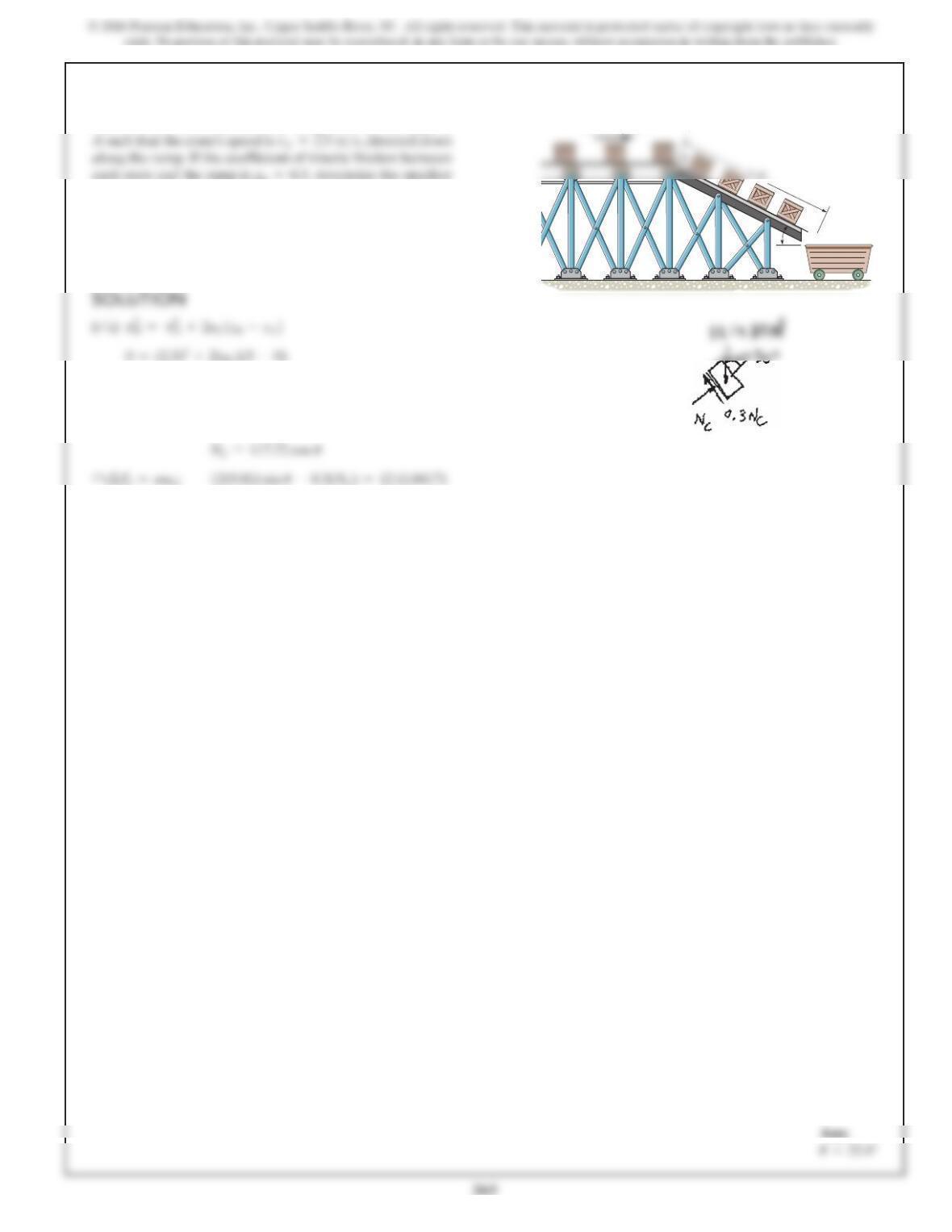
The conveyor belt delivers each 12-kg crate to the ramp at
k=0.3,
incline
u
of the ramp so that the crates will slide off and fall
into the cart.
vA 2.5 m/s
B
u
aC=1.0417
Q + ΣF
y
=ma
y
;
NC–12(9.81) cos
u
=0
NC=117.72 cos
117.72 sin u–35.316 cos u–12.5 =0
Solving,
u=22.6°
Ans.
13–22.
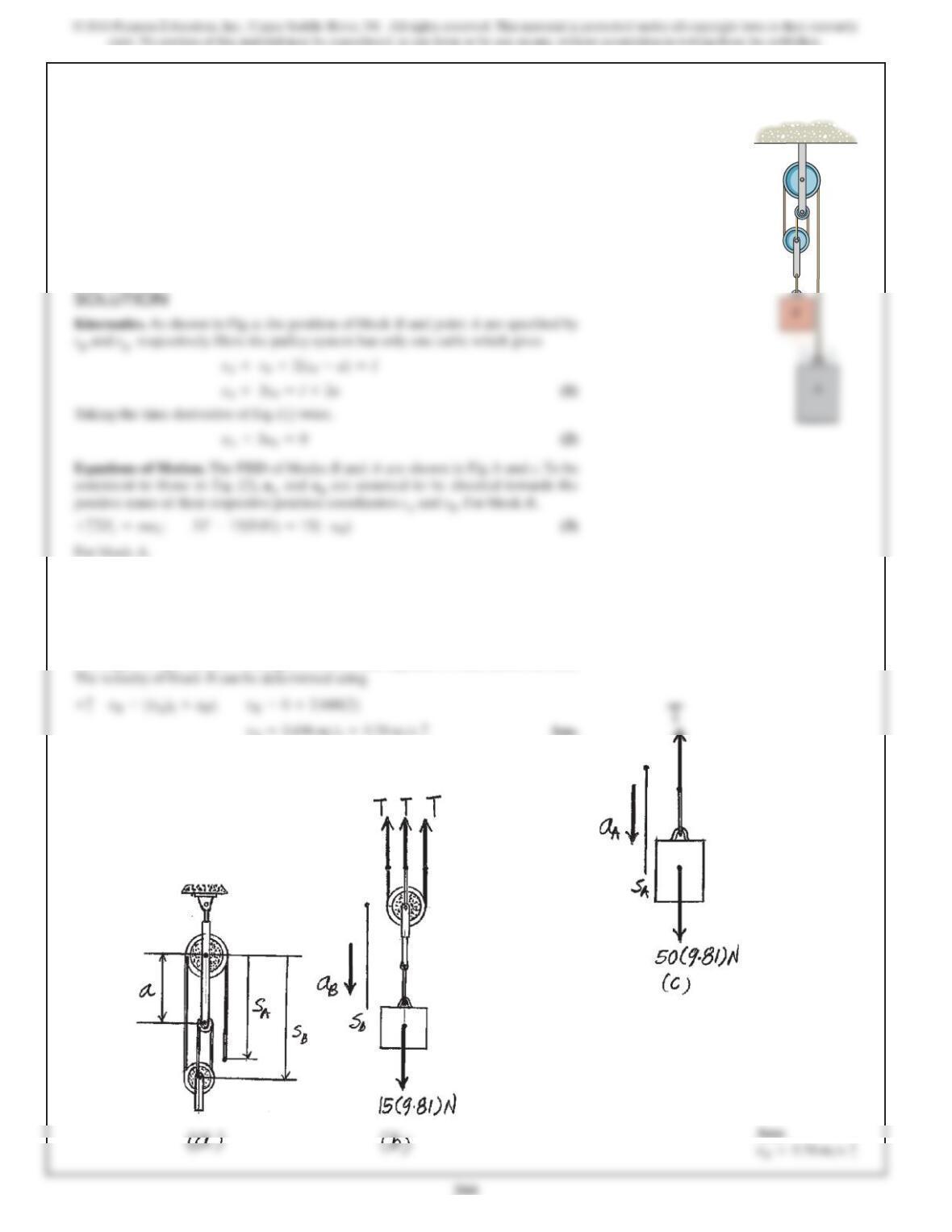
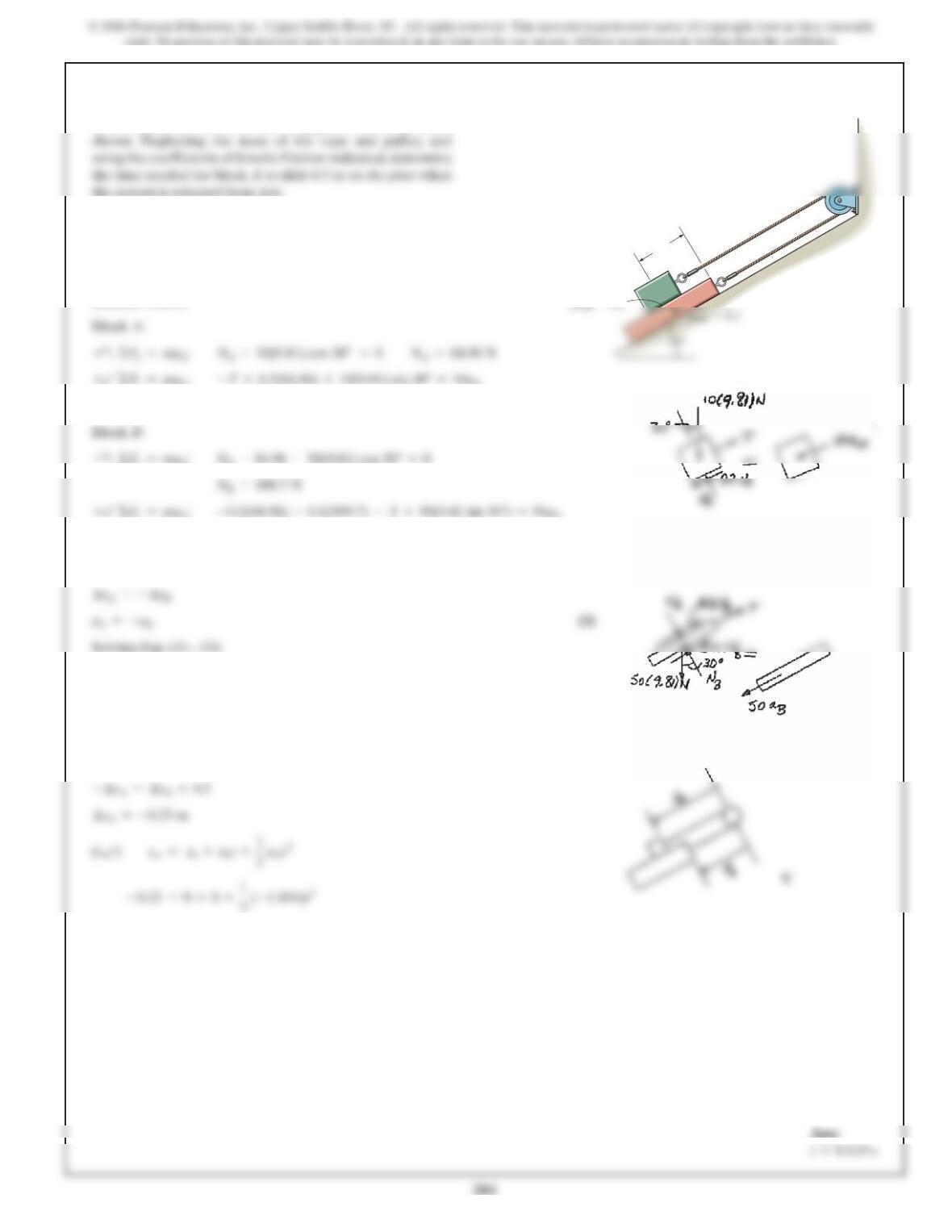
The 50-kg block A is released from rest. Determine the
velocity of the 15-kg block B in 2 s.
+
c
ΣF
y=
ma
y
;
T–50(9.81) =50(–aA)
(4)
Solving Eqs. (2), (3) and (4),
aB=–2.848 m>s2=2.848 m>s2
c
aA=8.554 m>s2
T=63.29 N
The negative sign indicates that aB acts in the sense opposite to that shown in FBD.
B=5.696 m>s=5.70 m>s
D
C
E
267
13–23.
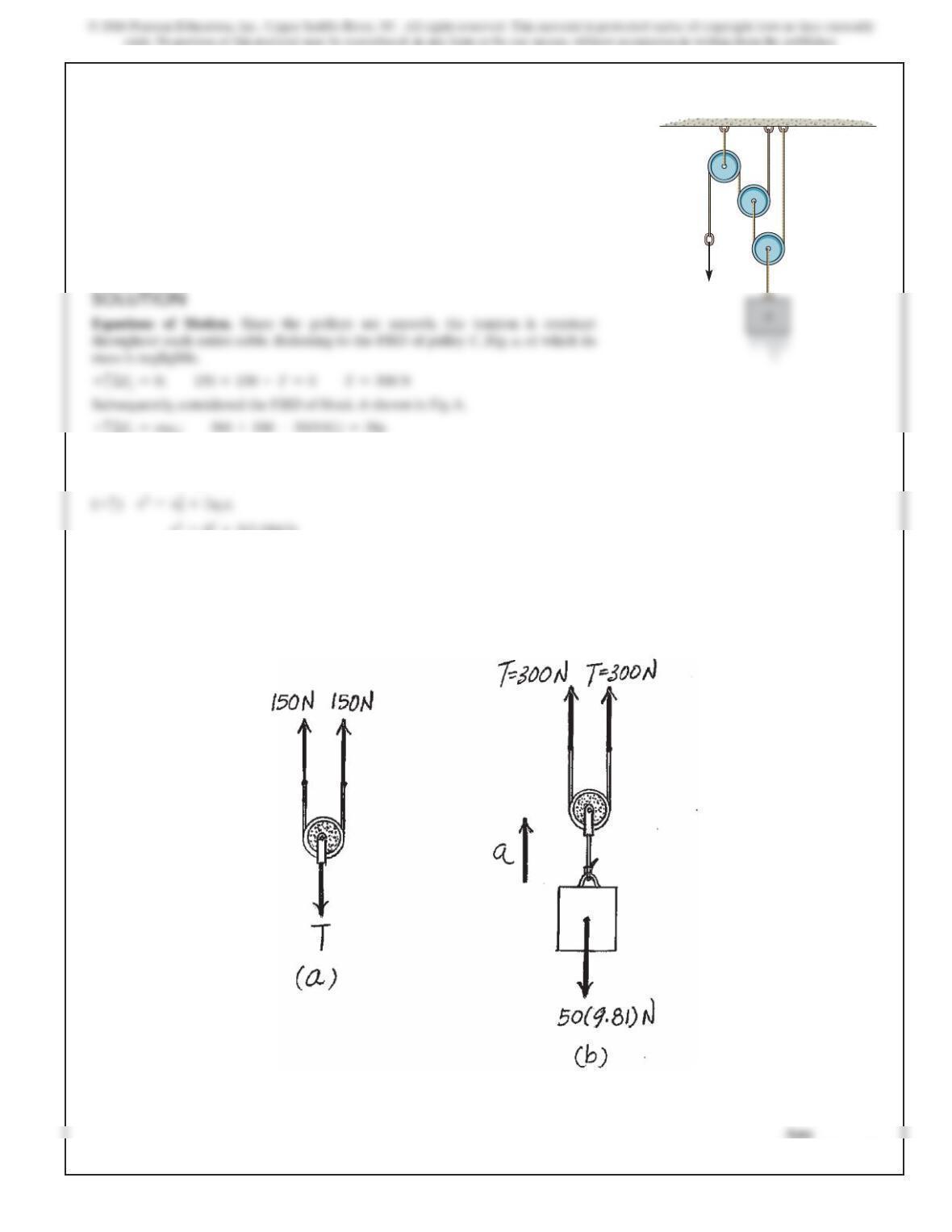
If the supplied force F
=
150 N, determine the velocity of
the 50-kg block A when it has risen 3 m, starting from rest.
y=
y
a=2.19 m>s2
c
Kinematics. Using the result of a,
v
v=3.6249 m>s=3.62 m>s
Ans.
B
C
F
v
=3.62 m>s
c
268
v=7.0036 m>s
tAC =1.4278 s
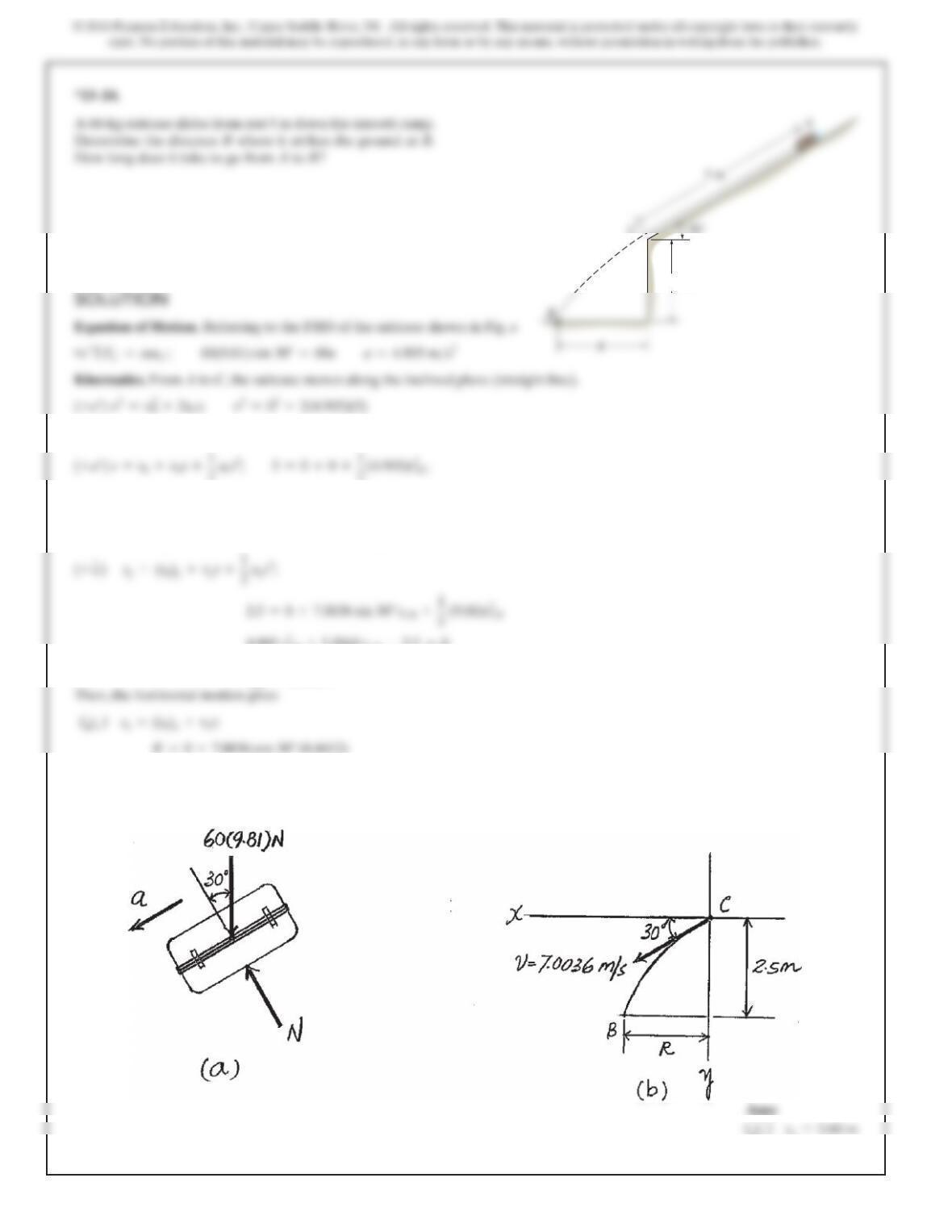
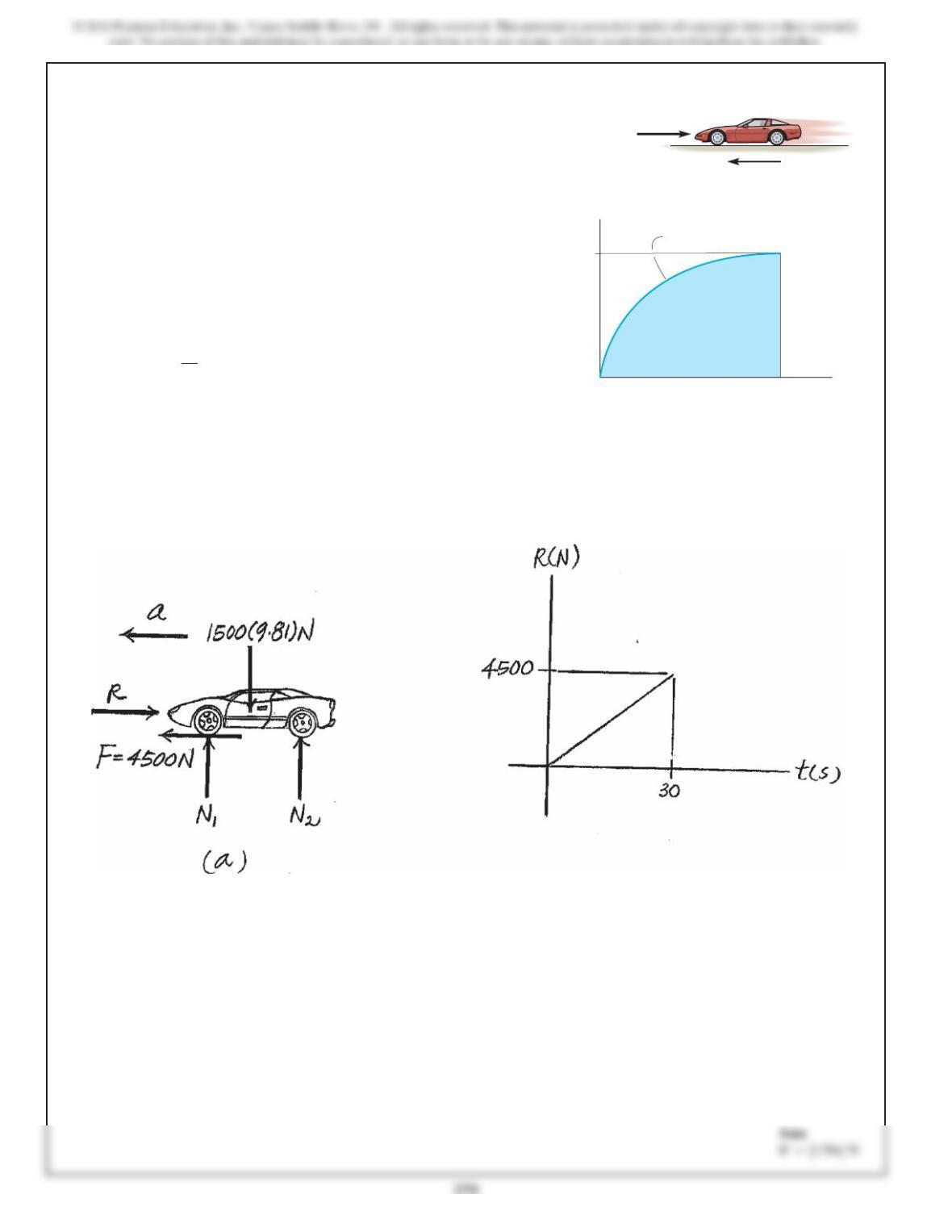
From C to B, the suitcase undergoes projectile motion. Referring to x–y coordinate
system with origin at C, Fig. b, the vertical motion gives
4.905 tCB
Solve for positive root,
tCB =0.4412 s
=2.676 m =2.68 m
Ans.
The time taken from A to B is
tAB = tAC + tCB =1.4278 +0.4412 =1.869 s =1.87 s
Ans.
2.5 m
C
x
tAB =1.87 s
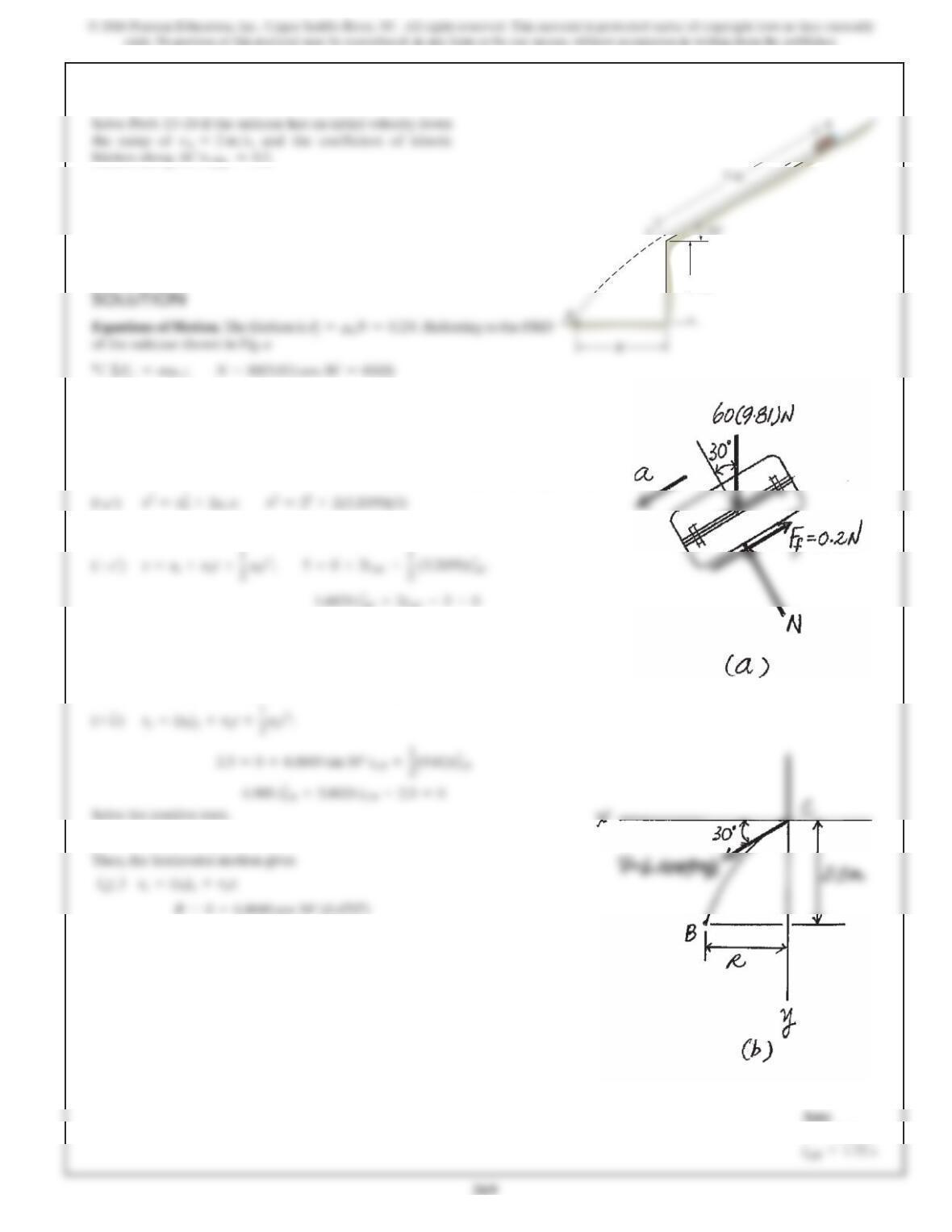
N=509.74 N
+ b ΣFx′=max′
;
60(9.81) sin 30°–0.2(509.74) =60 a
a=3.2059 m>s2 b
Kinematics. From A to C, the suitcase moves along the inclined plane (straight line).
v=6.0049 m>s b
AC
AC –5=0
Solve for positive root,
tAC =1.2492 s
From C to B, the suitcase undergoes projectile motion. Referring to x–y coordinate
system with origin at C, Fig. b, the vertical motion gives
tCB =0.4707 s
=2.448 m =2.45 m
Ans.
The time taken from A to B is
tAB = tAC + tCB =1.2492 +0.4707 =1.7199 s =1.72 s
Ans.
13–25.
k =0.2.
2.5 m
C
R=2.45 m
13–26.
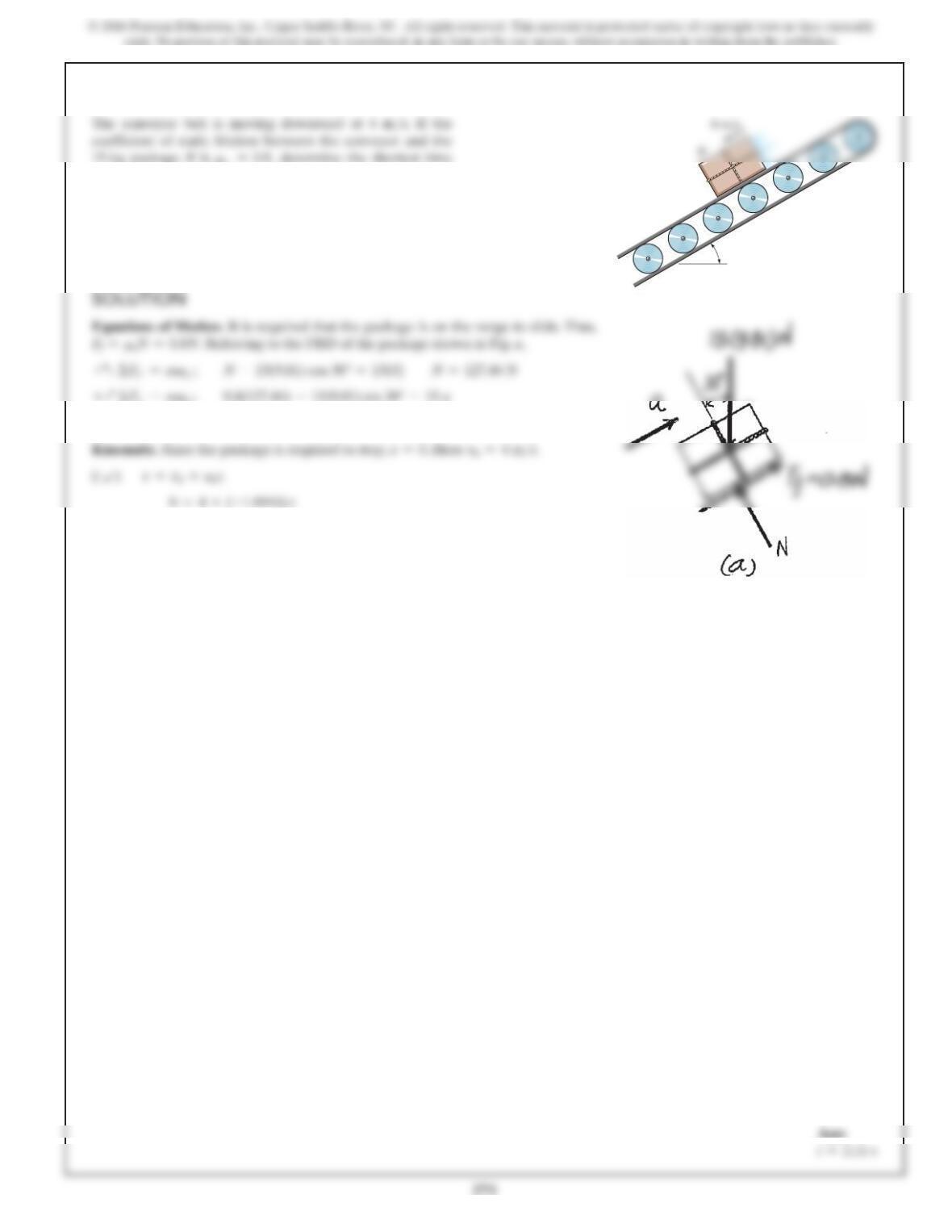
The 1.5 Mg sports car has a tractive force of
F=4.5 kN
. If
it produces the velocity described by v–t graph shown, plot
the air resistance R versus t for this time period.
SOLUTION
Kinematic. For the
v9t
graph, the acceleration of the car as a function of t is
a=
dv
dt
=
5
–0.1t+3
6
m
>
s2
Equation of Motion. Referring to the FBD of the car shown in Fig. a,
(d
+)ΣFx=max;
4500 –R=1500(–0.1t+3)
R=5150t6N
The plot of R vs t is shown in Fig. b
t (s)
v (m/s)
45
30
F
R
v (–0.05t2 + 3t) m/s
13–27.
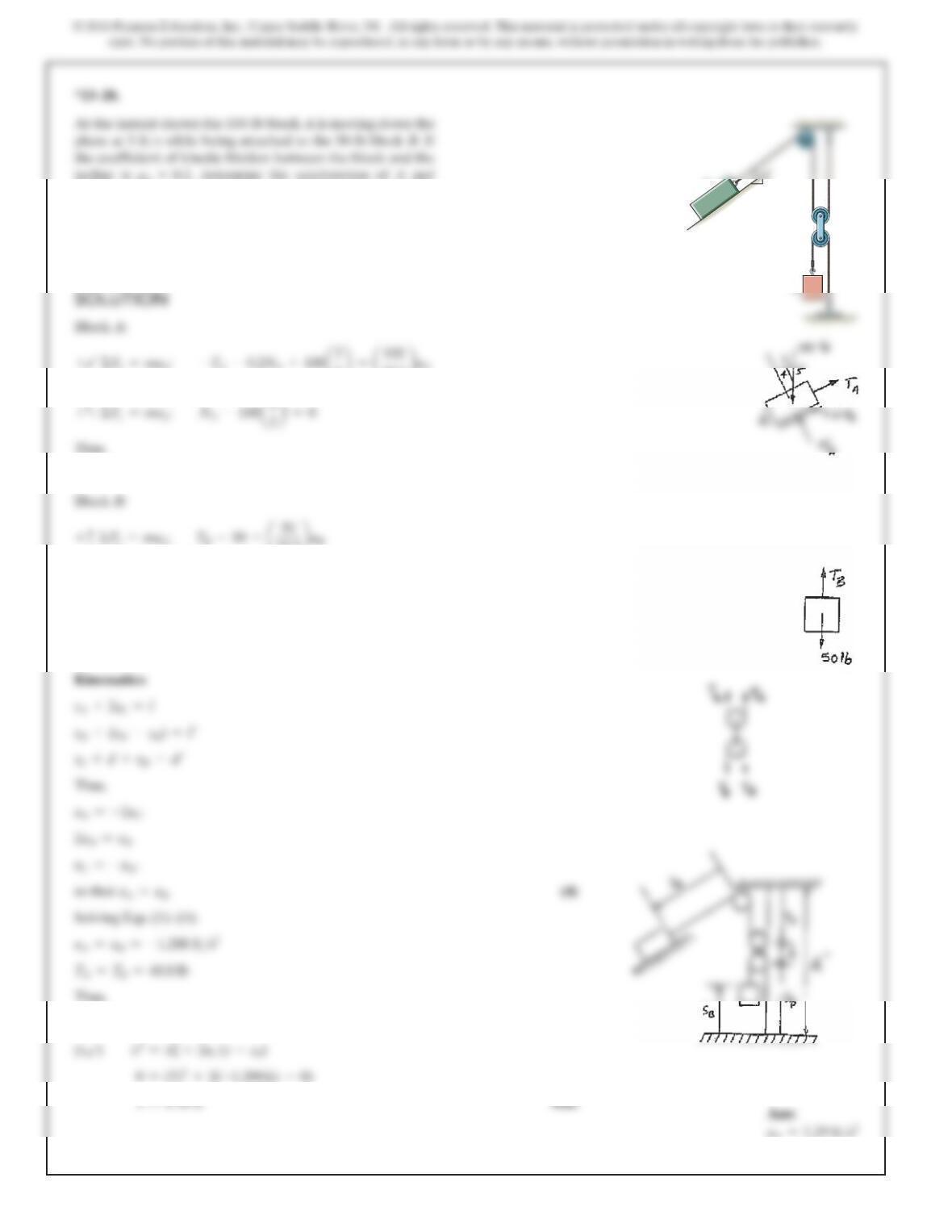
s =0.8,
the belt can stop so that the package does not slide on
thebelt.
a=1.8916 m>s2 Q
t=2.1146 s =2.11 s
Ans.
30
272
k=0.2,
thedistance A slides before it stops. Neglect the mass of the
pulleys and cables.
5b
32.2 b
TA–44 =–3.1056aA
(1)
+
c
ΣF
32.2 b
TB–50 =1.553aB
(2)
Pulleys at C and D:
+
c
ΣF
y=
0
;
2TA–2TB=0
TA=TB
(3)
aA=aB
aA=aB=–1.288 ft>s2
aA=1.29 ft>s2
Ans.
C
B
D
3
A4
A=
>
s=9.70 ft
273
13–29.
Kinematics: The velocity of the crate can be obtained by integrating the kinematic
Ans.v
=
8.05(2.52)
–
32.2(2.5)
+
32.2
=
2.01 ft
>
s
a=(16.1t–32.2) ft>s2
A
v=2.01
ft>s
274
13–30.
The force of the motor Mon the cable is shown in the graph.
Determine the velocity of the 400-kg crate Awhen .t=2 s
Kinematics: The velocity of the crate can be obtained by integrating the kinematic
When ,
Ans.v=1.0417(23)–9.81(2) +11.587 =0.301 m>s
t=2 s
=
A
1.0417t3–9.81t+11.587
B
m>s
A
B
1.772 s
0
1.772 s
A
B
a=(3.125t2–9.81) m>s2
A
B
A
B
M
F (N)
F 625 t2
2500
2t (s)
v=0.301
m>s
13–31.
The tractor is used to lift the 150-kg load Bwith the 24-m-
long rope, boom, and pulley system. If the tractor travels to
the right at a constant speed of 4 ms, determine the tension
in the rope when .When ,.sB=0sA=0sA=5m >
12 m
–s
B–
A
s2
A+144
B
–3
2asAs
Ab2
+
A
s2
A+144
B
–1
2as
Ab+
A
s2
A+144
B
–1
2asAs
Ab=0
276
–s
B–
A
s2
A+144
B
–3
2asAs
Ab2
+
A
s2
A+144
B
–1
2as
Ab+
A
s2
A+144
B
–1
2asAs
Ab=0
sA
T=1.80
kN
13–33.
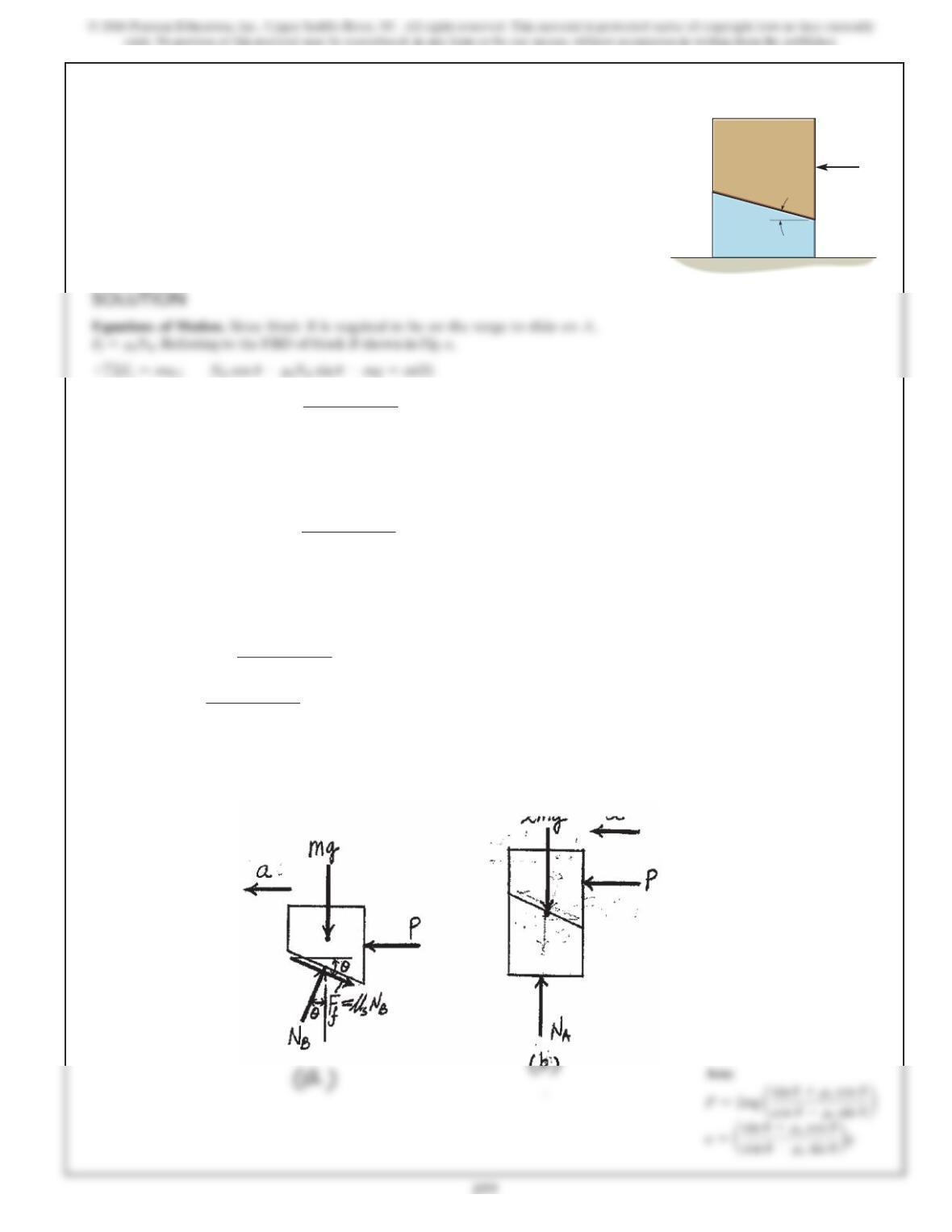
Block A and B each have a mass m. Determine the largest
horizontal force P which can be applied to B so that it will
not slide on A. Also, what is the corresponding acceleration?
The coefficient of static friction between A and B is
ms.
Neglect any friction between A and the horizontal surface.
NB=
mg
cos
u
–
m
s sin
u (1)
d
+ΣF
x
=ma
x
;
P–NB sin
u
–
m
sNB cos
u
=ma
P–N
B
(sin
u
+
ms
cos
u
)=ma
(2)
Substitute Eq. (1) into (2),
P–
asin
u
+
ms
cos
u
cos u
–
m
s
sin u
b
mg =ma (3)
Referring to the FBD of blocks A and B shown in Fig. b
d
+ΣFx=max;
P=2 ma
(4)
Solving Eqs. (2) into (3),
P=2mg
asin
u
+
ms
cos
u
cos u
–
m
s
sin u
b
Ans.
a=
asin
u
+
ms
cos
u
cos u
–
m
s
sin u
b
g Ans.
P
A
B
13–34.
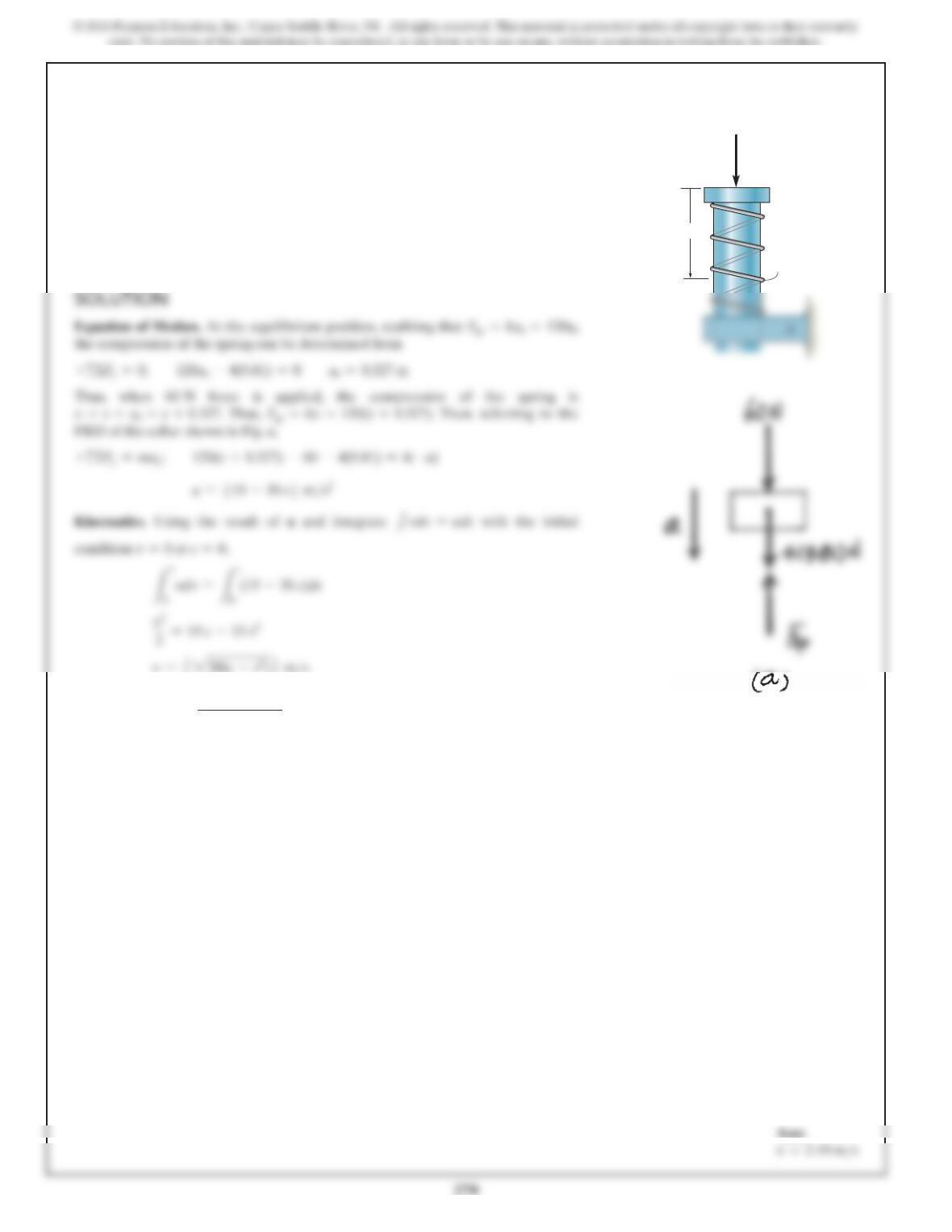
The 4-kg smooth cylinder is supported by the spring having
a stiffness of kAB
=
120 N
>
m. Determine the velocity of the
cylinder when it moves downward s
=
0.2 m from its
equilibrium position, which is caused by the application of
the force F
=
60 N.
At
s=0.2 m
,
v
=2
30(0.2
–
0.22)
=
2.191 m
>
s
=
2.19 m
>
s Ans.
s
kAB 120 N/
m
F
60 N
B
13–35.
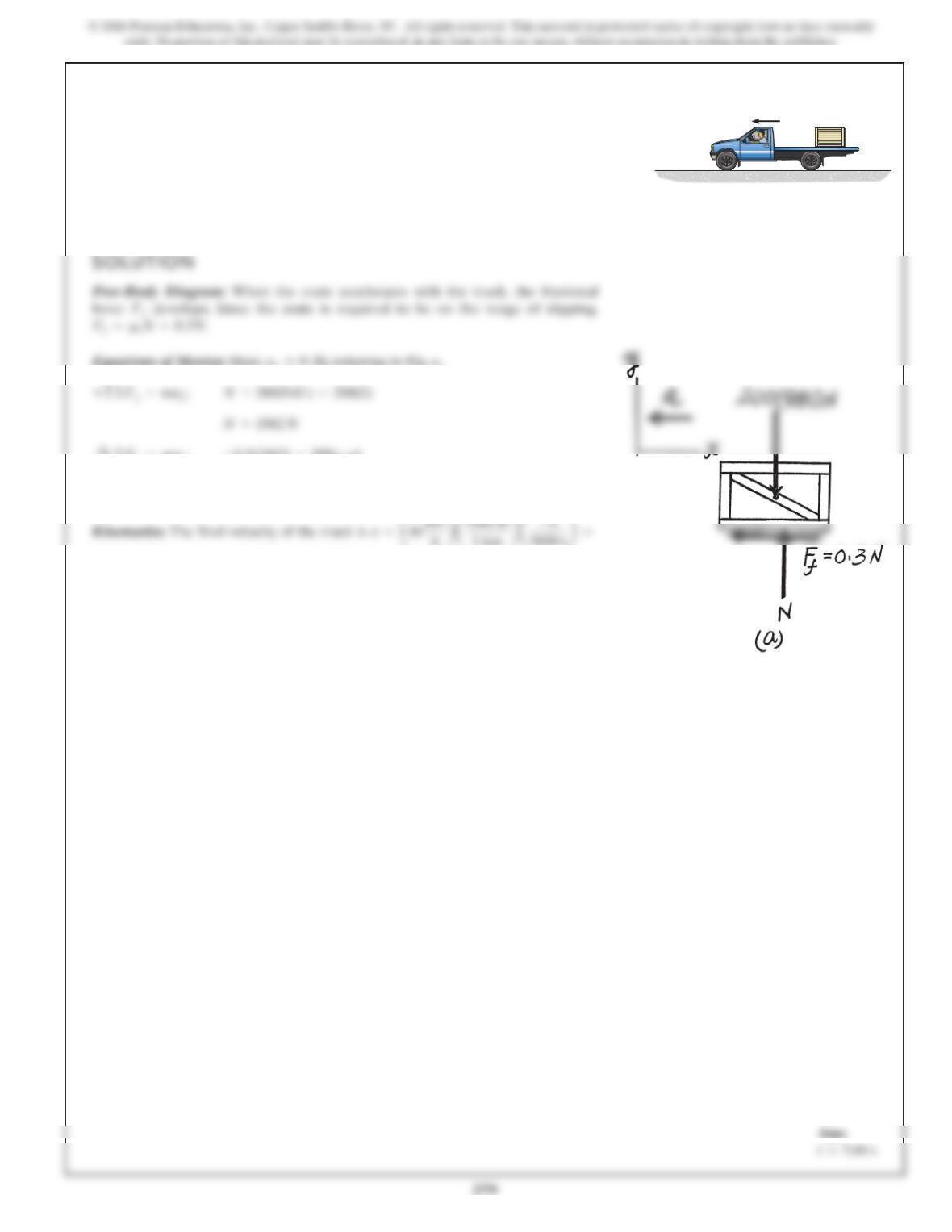
The coefficient of static friction between the 200-kg crate
and the flat bed of the truck is Determine the
shortest time for the truck to reach a speed of 60 km h,
starting from rest with constant acceleration, so that the
crate does not slip.
>
ms =0.3.
;
. Since the acceleration of the truck is constant,
Ans.t=5.66 s
16.67 =0+2.943t
v=v0+ac t(;
+)
16.67 m>s
a=2.943 m>s2 ;
–0.3(1962) =200(–a):
280
Ans.v=14.6 ft>s
32.2
0
¢
21+s2
≤
15 a2
32.2 bvdv
A
B
¢
≤
v
=14.6 ft>s
13–37.
The 10-kg block A rests on the 50-kg plate B in the position
SOLUTION
T–66.04 =–10aA
(1)
y
y;
177.28 –T=50aB
(2)
sA+sB=l
aA=–aB
aB=1.854 m>s2
aA=–1.854 m>s2
T=84.58 N
In order to slide 0.5 m along the plate the block must move 0.25 m. Thus,
(+b)
s
B
=s
A
+ s
B
>
A
(+b)
t=0.519 s
Ans.
C
A
mAB 0.2
0.5 m
282
13–38.
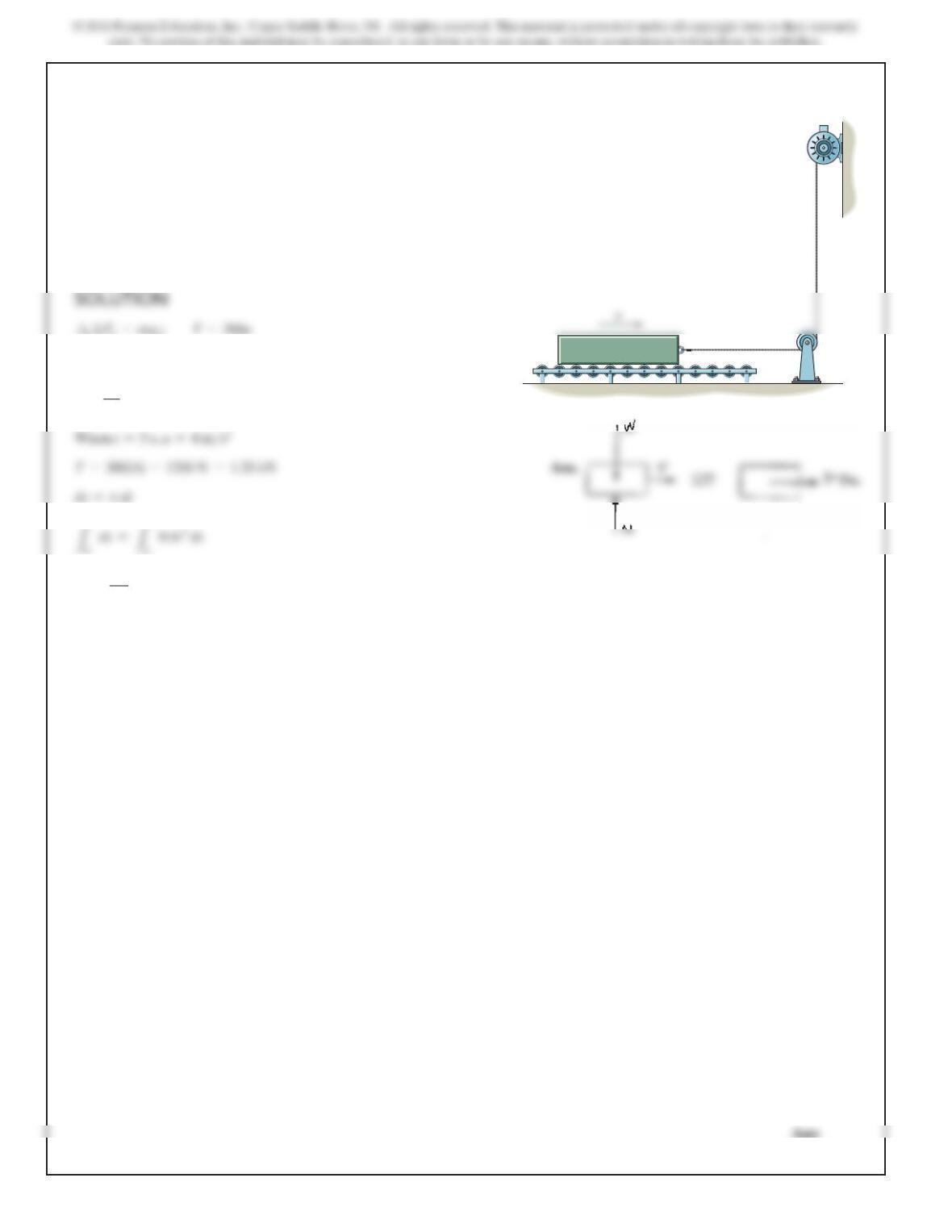
The 300-kg bar B, originally at rest, is being towed over a
series of small rollers. Determine the force in the cable
when t
=
5 s, if the motor M is drawing in the cable for a
short time at a rate of v
=
(0.4t
2
) m
>
s, where t is in seconds
(0 …t…6 s).
How far does the bar move in 5 s? Neglect
the mass of the cable, pulley, and the rollers.
S
v=0.4t2
a=
dv
dt
=0.8t
=
s=
a0.4
3b
(5)3=16.7 m Ans.
B
M
s=16.7 m
13–39.
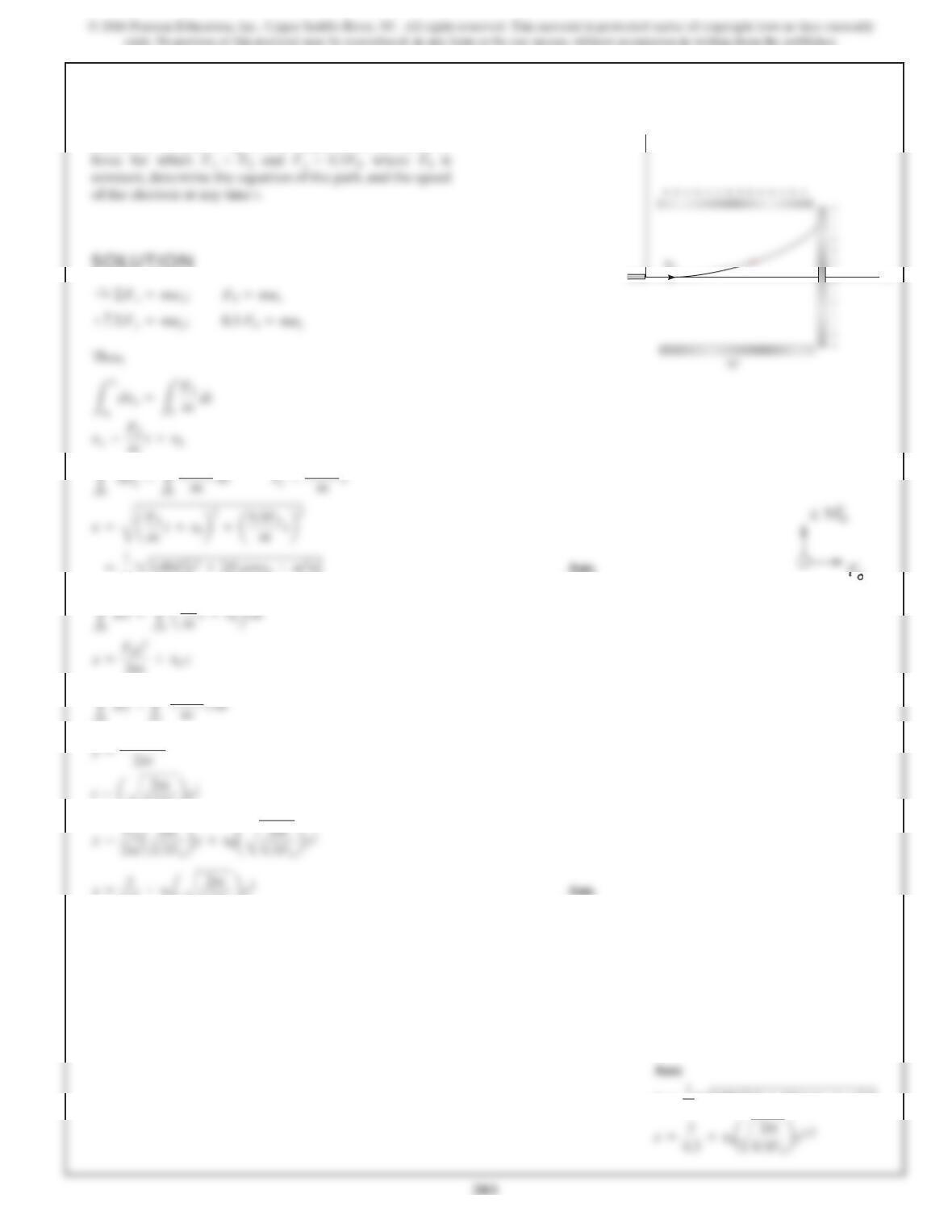
An electron of mass mis discharged with an initial
horizontal velocity of v0. If it is subjected to two fields of
0.3
B
0.3F0
0.3F0by 1
Lt
m21.09F0
0.3F0
y
x
v=
m2
1.09F2
0 t2+2F
0tmv0+m2v2
0
32.2 b
Thus,
T=206 lb
Ans.