245
13–1.
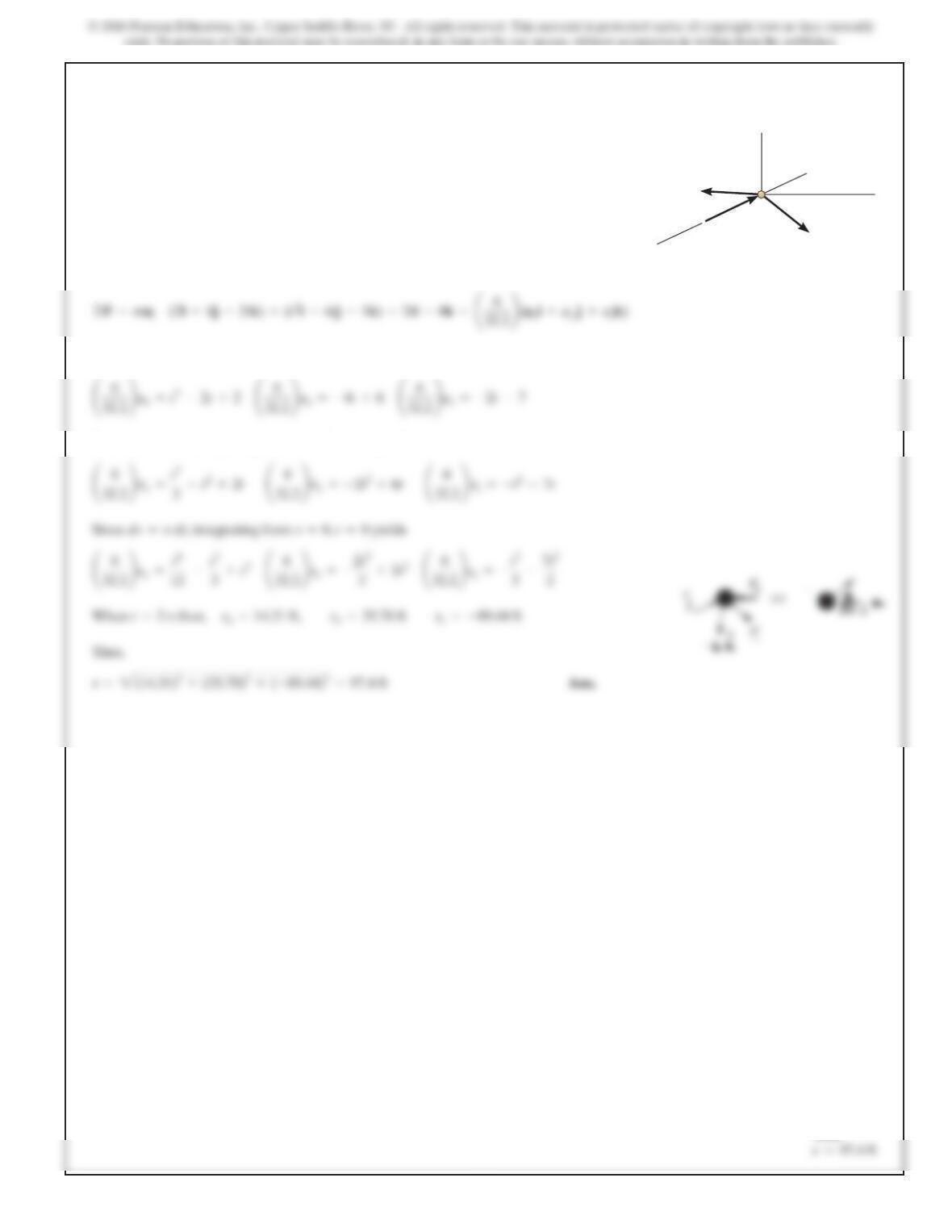
The 6-lb particle is subjected to the action of
its weight and forces
and where tis in
seconds. Determine the distance the ball is from the origin
2safter being released from rest.
F3=5–2ti6lb,5t2i–4tj–1k6lb,
F2=F1=52i+6j–2tk6lb,
SOLUTION
Equating components:
Since , integrating from ,,yields
t=0n=0dv =adt
z
y
x
F1
F3
F2
Ans:
13–2.
C
5°
AB
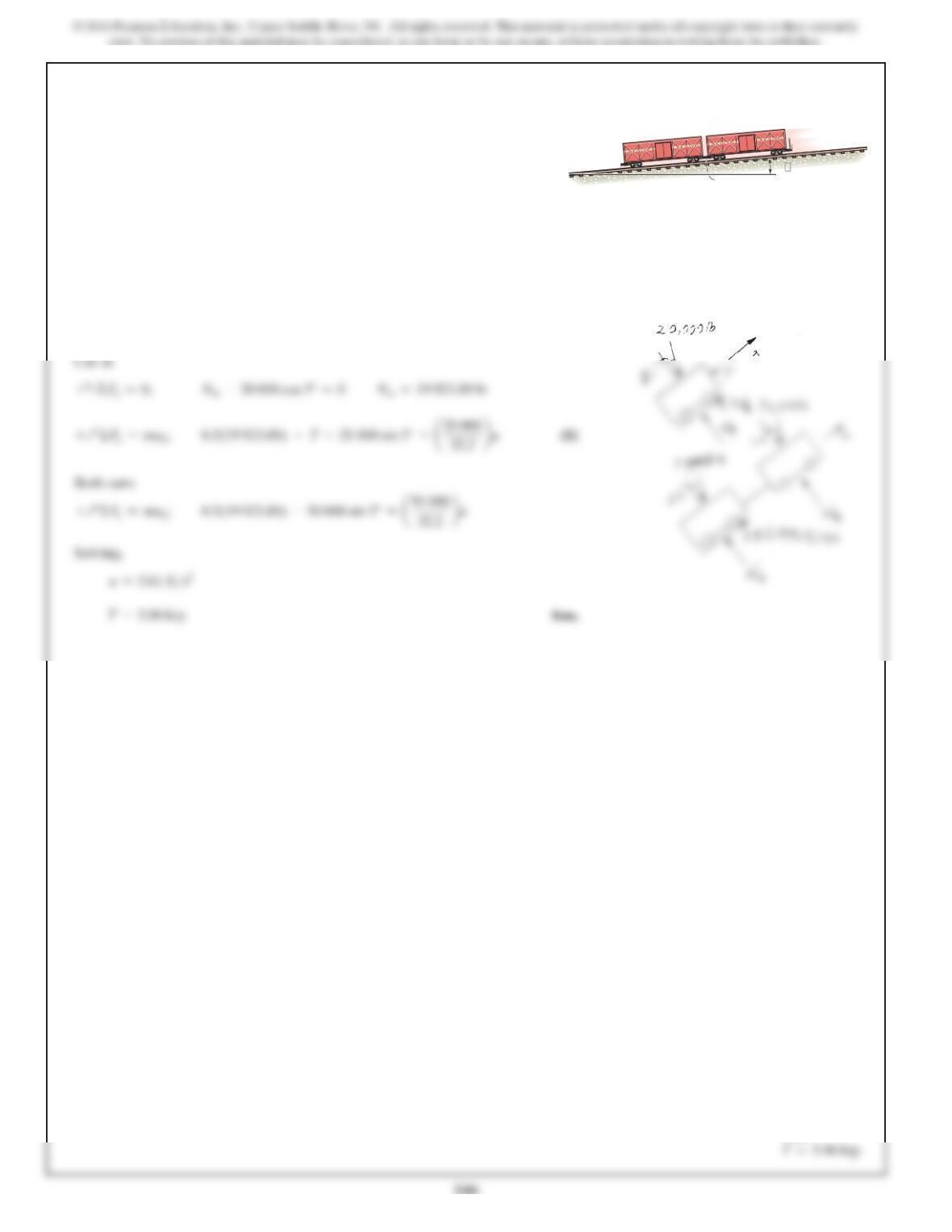
The two boxcars A and B have a weight of 20000lb and
30 000 lb, respectively. If they are freely coasting down
the incline when the brakes are applied to all the wheels
of car A, determine the force in the coupling C between
the two cars. The coeffi cient of kinetic friction between
the wheels of A and the tracks is mk=0.5. The wheels of
car B are free to roll. Neglect their mass in the calculation.
Suggestion: Solve the problem by representing single
resultant normal forces acting on A and B, respectively.
SOLUTION
Ans:
247
13–3.
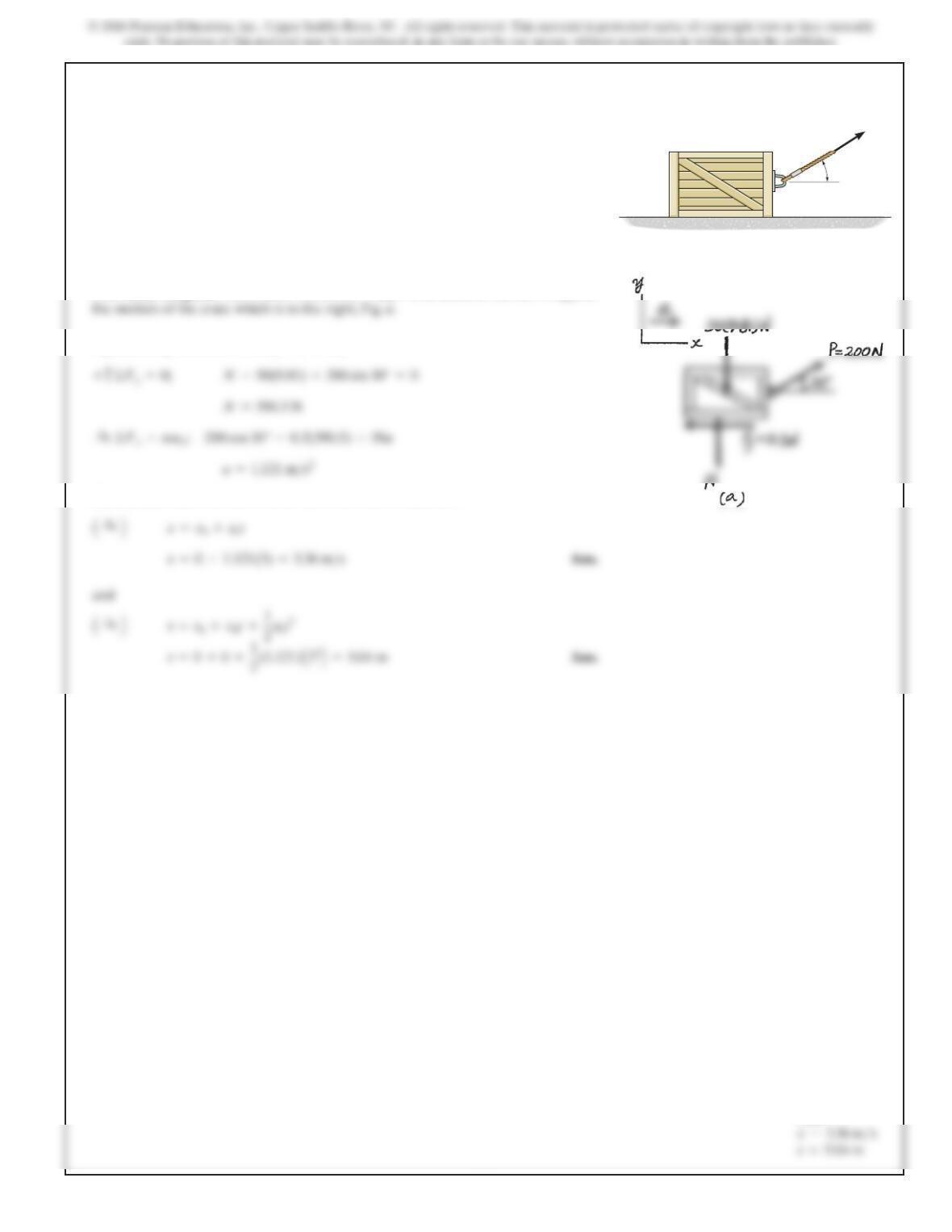
If the coefficient of kinetic friction between the 50-kg crate
and the ground is , determine the distance the
crate travels and its velocity when The crate starts
from rest, and .P=200 N
t=3 s.
mk =0.3
SOLUTION
Free-Body Diagram: The kinetic friction is directed to the left to oppose
Equations of Motion: Here,.Thus,
Kinematics: Since the acceleration aof the crate is constant,
ay=0
Ff=mkN
30
P
Ans:
248
*13–4.
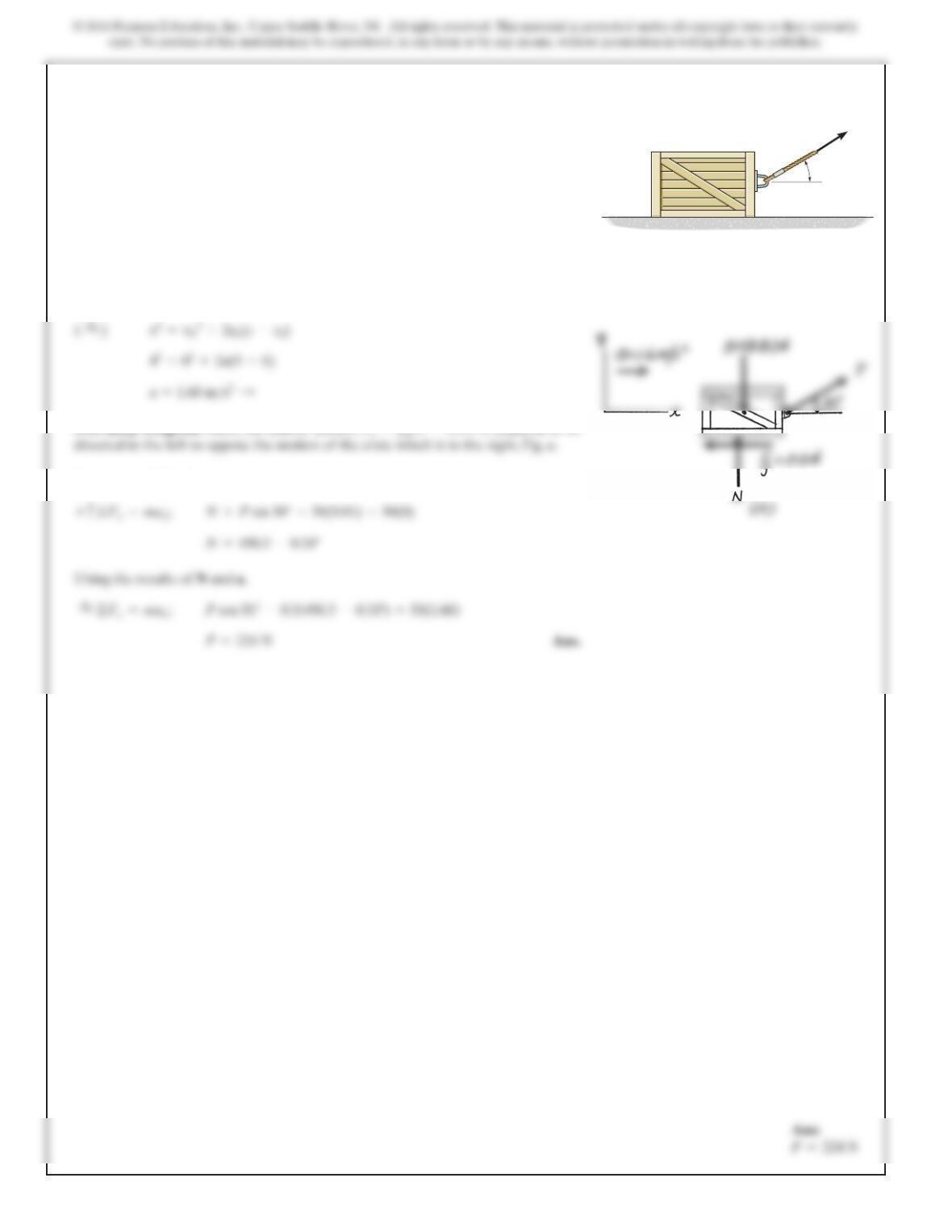
If the 50-kg crate starts from rest and achieves a velocity of
when it travels a distance of 5 m to the right,
determine the magnitude of force Pacting on the crate.
The coefficient of kinetic friction between the crate and the
ground is .mk=0.3
v=4 m>s
SOLUTION
Kinematics: The acceleration aof the crate will be determined first since its motion
is known.
Free-Body Diagram: Here, the kinetic friction is required to be
Equations of Motion:
Ff=mkN=0.3N
30
P
249
13–5.
SOLUTION
Free-Body Diagram: Here, the kinetic friction and
Equations of Motion: By referring to Figs. (a) and (b),
and
Solving Eqs. (1) and (2) yields
(Ff)A=mANA=0.1NA
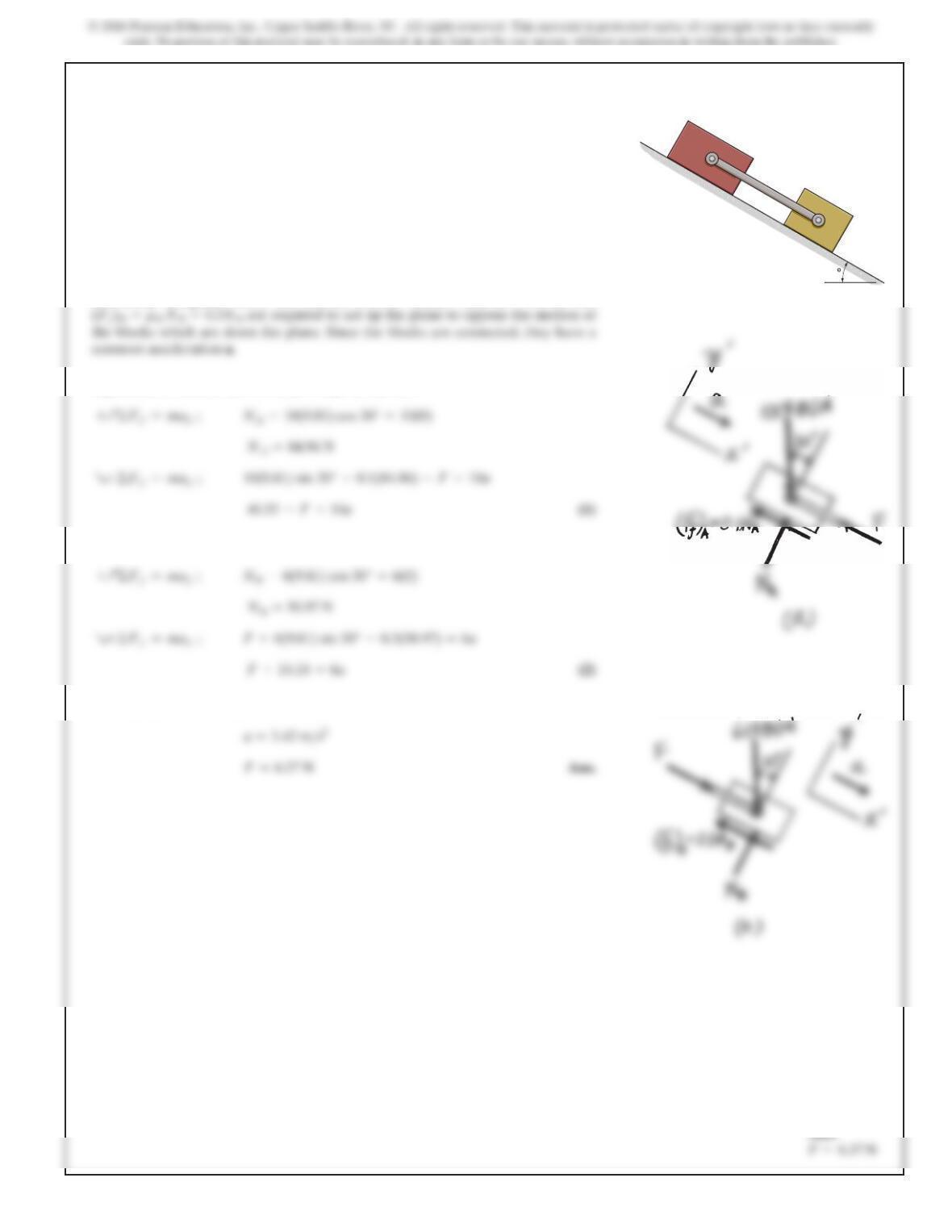
If blocks Aand Bof mass 10 kg and 6 kg, respectively, are
placed on the inclined plane and released, determine the
force developed in the link.The coefficients of kinetic
friction between the blocks and the inclined plane are
and . Neglect the mass of the link.mB=0.3mA=0.1
A
B
30
13–6.
The 10-lb block has a speed of 4 ft
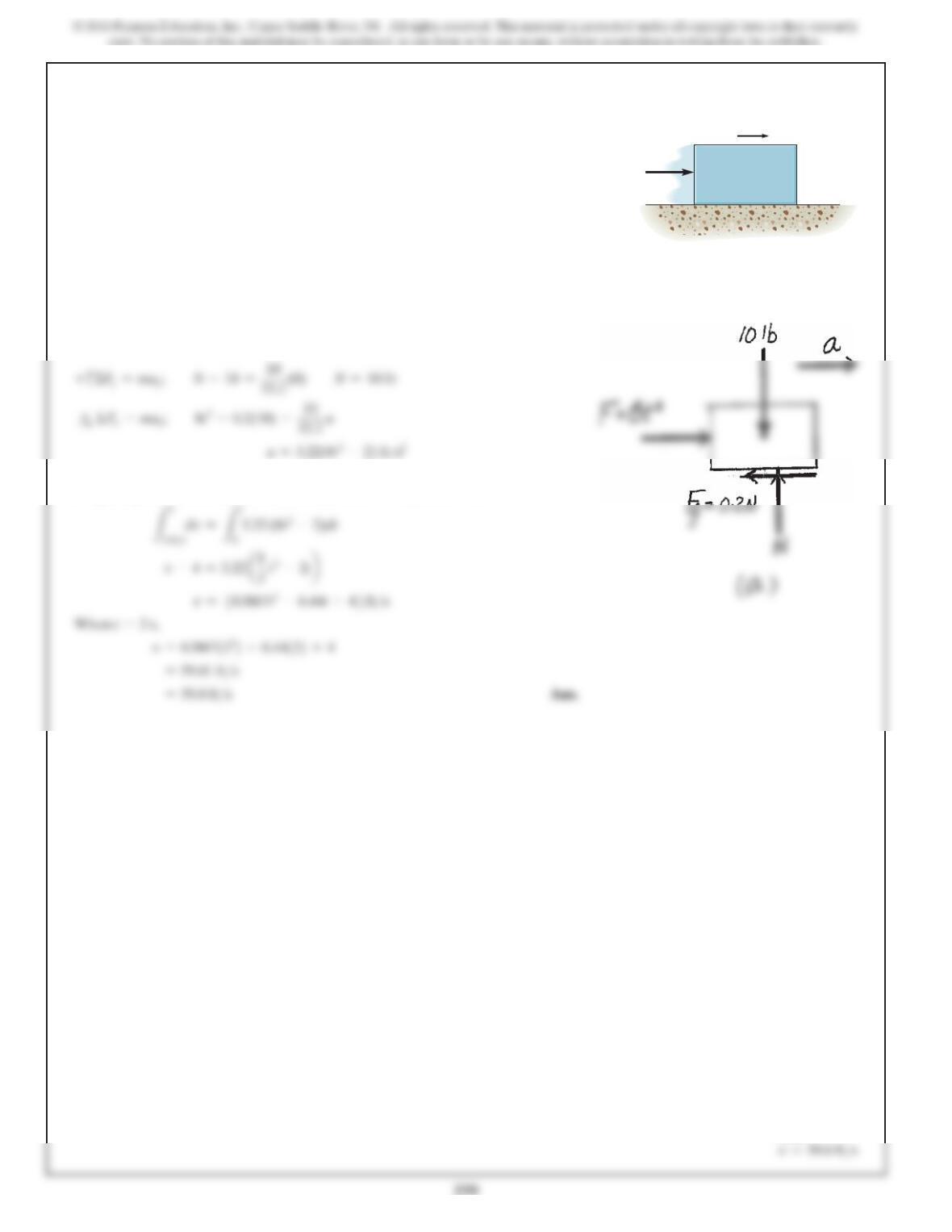
>
s when the force of
F
=
(8t2) lb is applied. Determine the velocity of the block
when t
=
2 s. The coefficient of kinetic friction at the surface
is m
k=0.2.
SOLUTION
Equations of Motion. Here the friction is
F
f
=
mk
N=0.2N
. Referring to the FBD
of the block shown in Fig. a,
Kinematics. The velocity of the block as a function of t can be determined by
integrating
dv=a dt
using the initial condition
v=4 ft>s
at
t=0
.
v
4 ft
/
s
F (8t2) lb
Ans:
251
13–7.
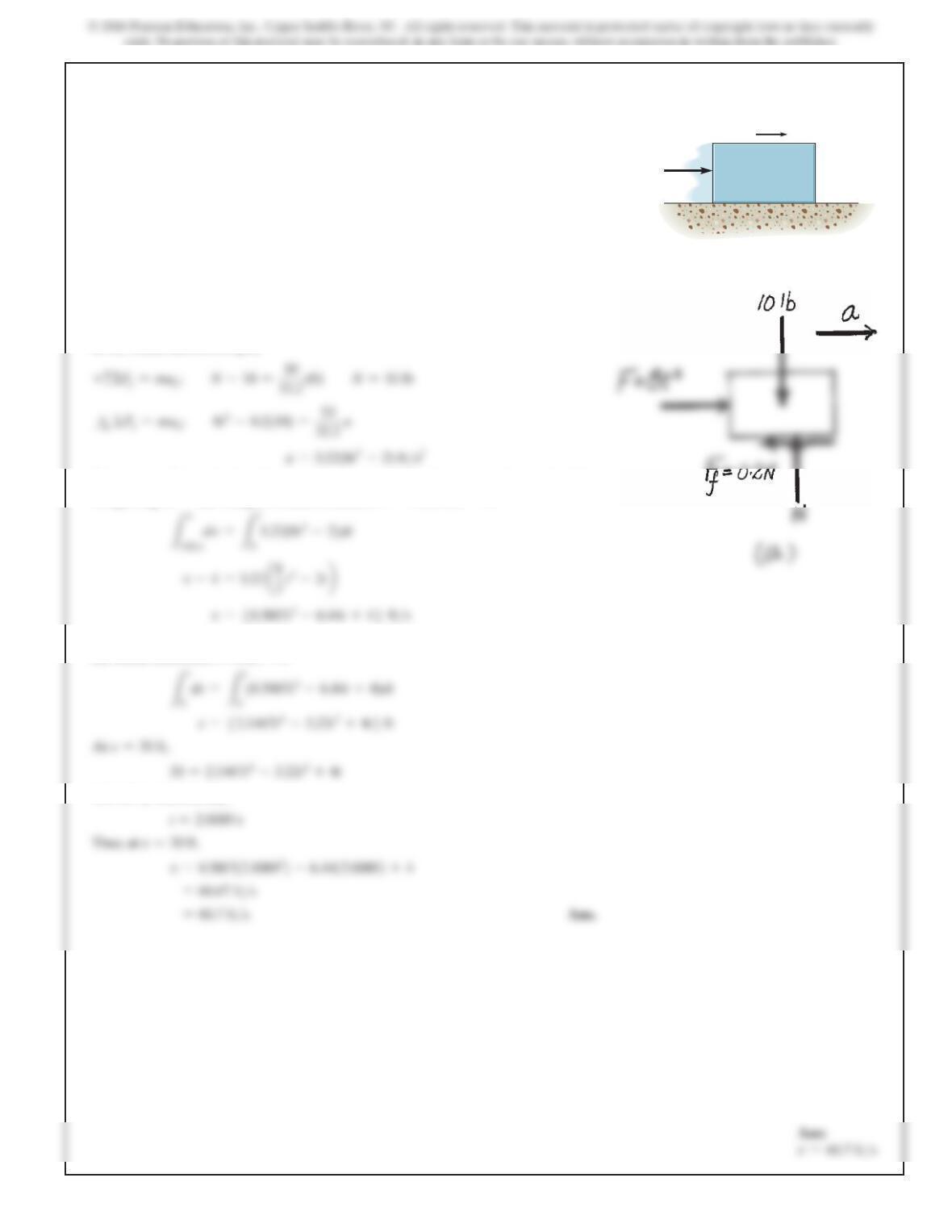
The 10-lb block has a speed of 4 ft
>
s when the force of
F
=
(8t2) lb is applied. Determine the velocity of the block
when it moves s
=
30 ft. The coefficient of kinetic friction at
the surface is m
s=0.2.
SOLUTION
Equations of Motion. Here the friction is
F
f
=
mk
N=0.2N
. Referring to the FBD
of the block shown in Fig. a,
Kinematics. The velocity of the block as a function of t can be determined by
integrating
dv=adt
using the initial condition
v=4 ft>s
at
t=0
.
The displacement as a function of t can be determined by integrating
ds =vdt
using
the initial condition s = 0 at t = 0
Solved by numerically,
v
4 ft
/
s
F (8t2) lb
exist. No portion of this material may be reproduced, in any form or by any means, without permission in writing from the publisher.
*13–8.
SOLUTION
Kinematics: For ..Applying equation ,
we have
Equation of Motion:
For
0…t610 s
a=dv
dt
v=60
10 t={6t}ft>s0…t610 s
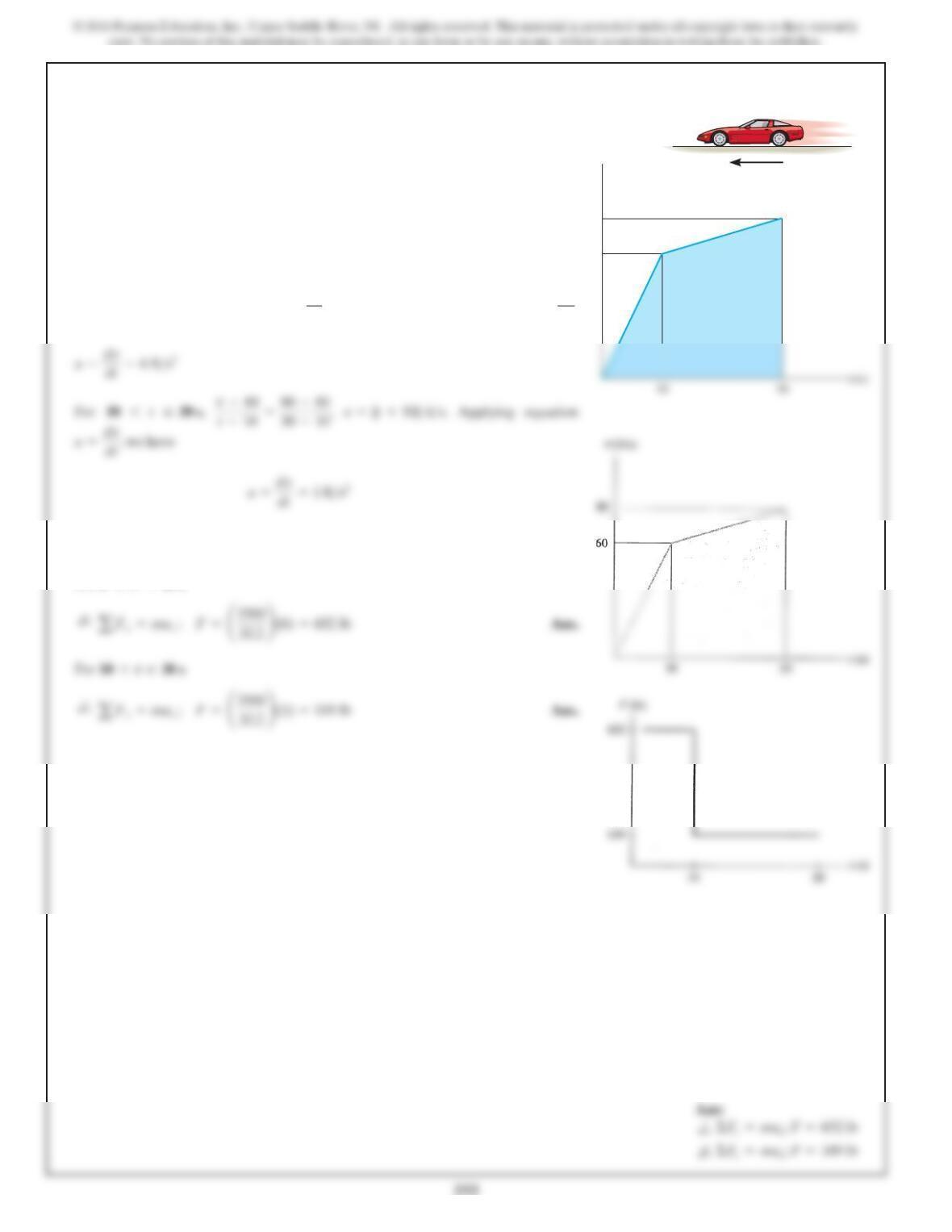
The speed of the 3500-lb sports car is plotted over the 30-s
time period. Plot the variation of the traction force Fneeded
to cause the motion.
v(ft/s)
80
60
F
13–9.
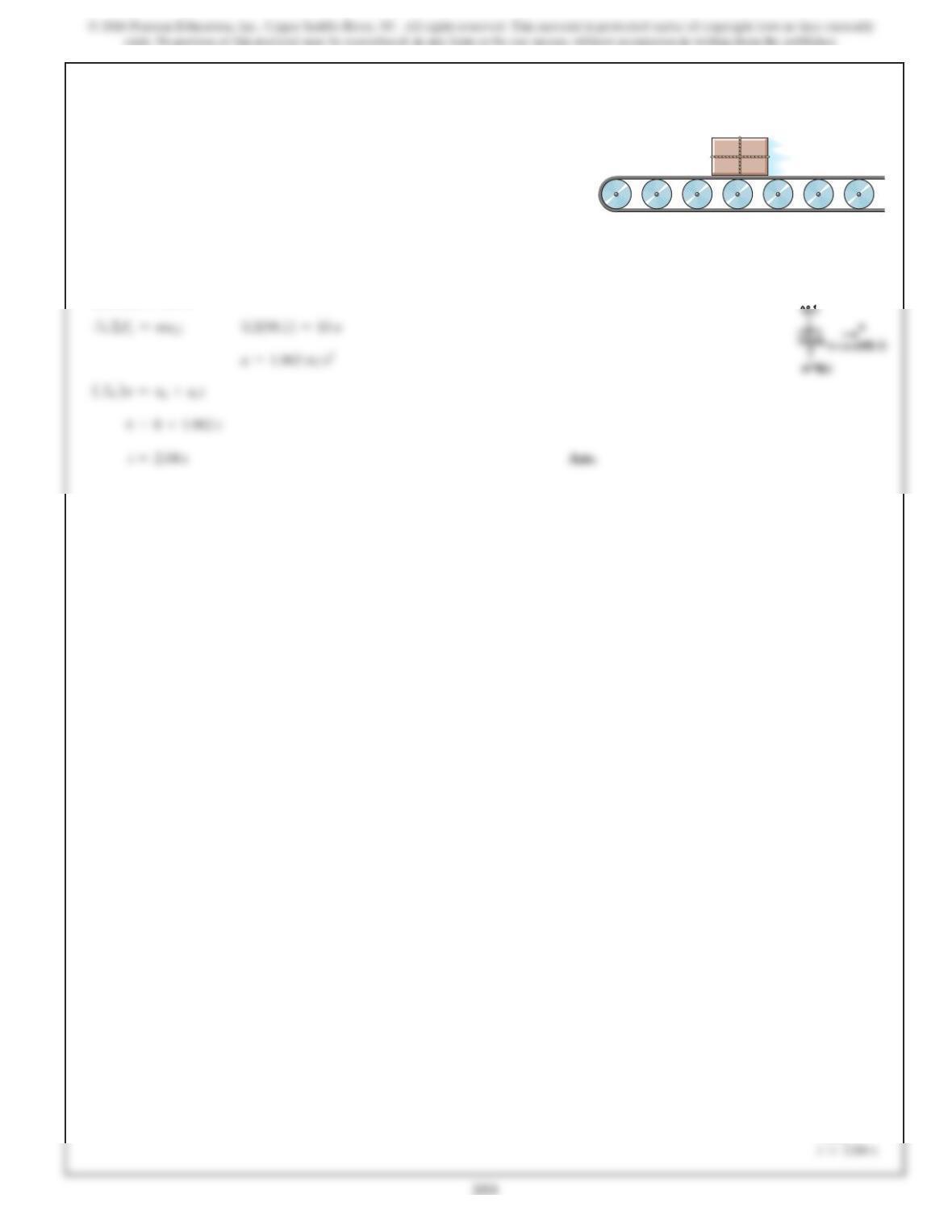
The conveyor belt is moving at 4 m>s. If the
coeffi cient of static friction between the conveyor and
the 10-kg package B is ms=0.2, determine the shortest time
the belt can stop so that the package does not slide on the belt.
SOLUTION
B
Ans:
254
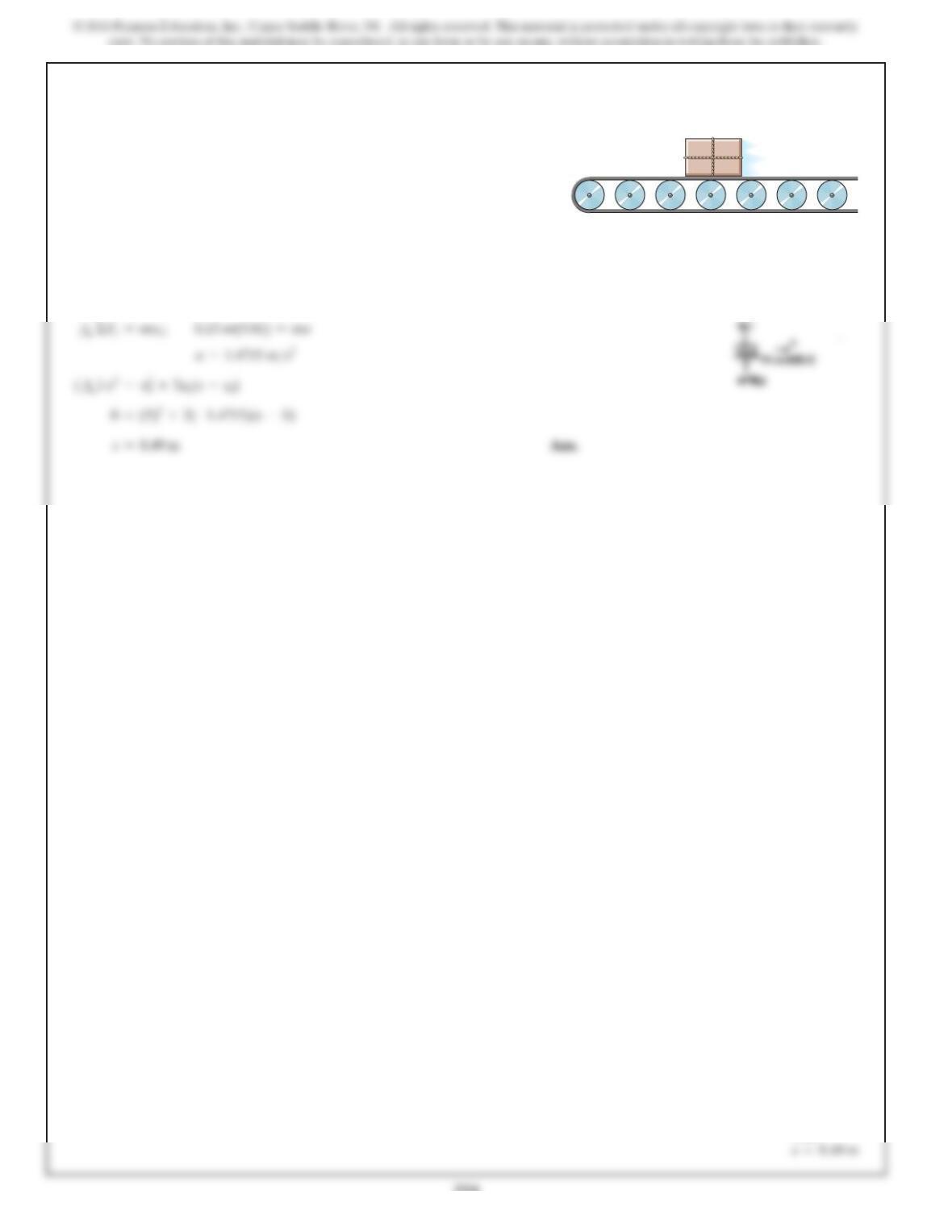
13–10.
The conveyor belt is designed to transport packages of
various weights. Each 10-kg package has a coefficient of
kinetic friction m
k=0.15.
If the speed of the conveyor is
5 m
>
s, and then it suddenly stops, determine the distance
the package will slide on the belt before coming to rest.
SOLUTION
Ans:
B
255
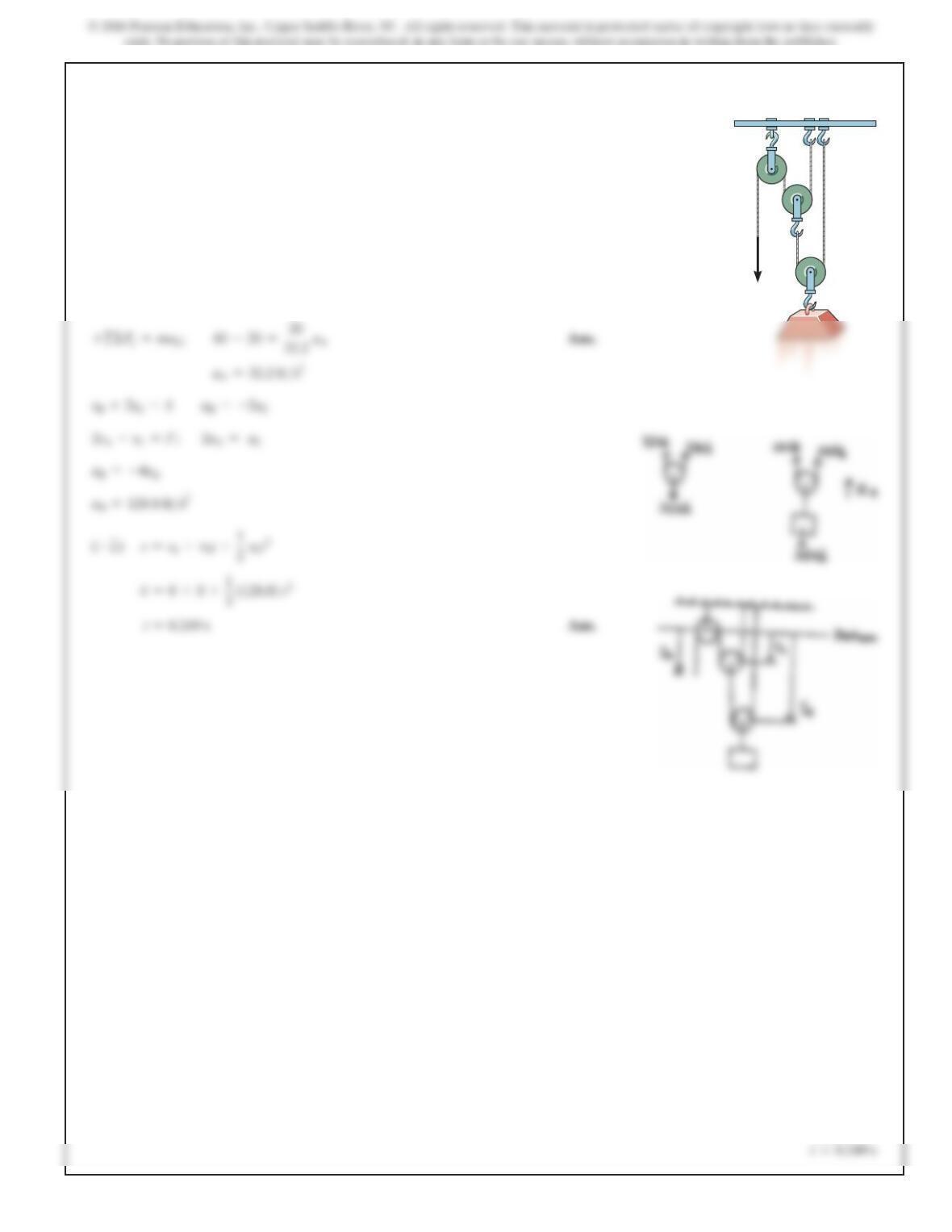
13–11.
Determine the time needed to pull the cord at B down 4 ft
starting from rest when a force of 10 lb is applied to the
cord. Block A weighs 20 lb. Neglect the mass of the pulleys
and cords.
SOLUTION
Ans:
A
10 lb
B
C
256
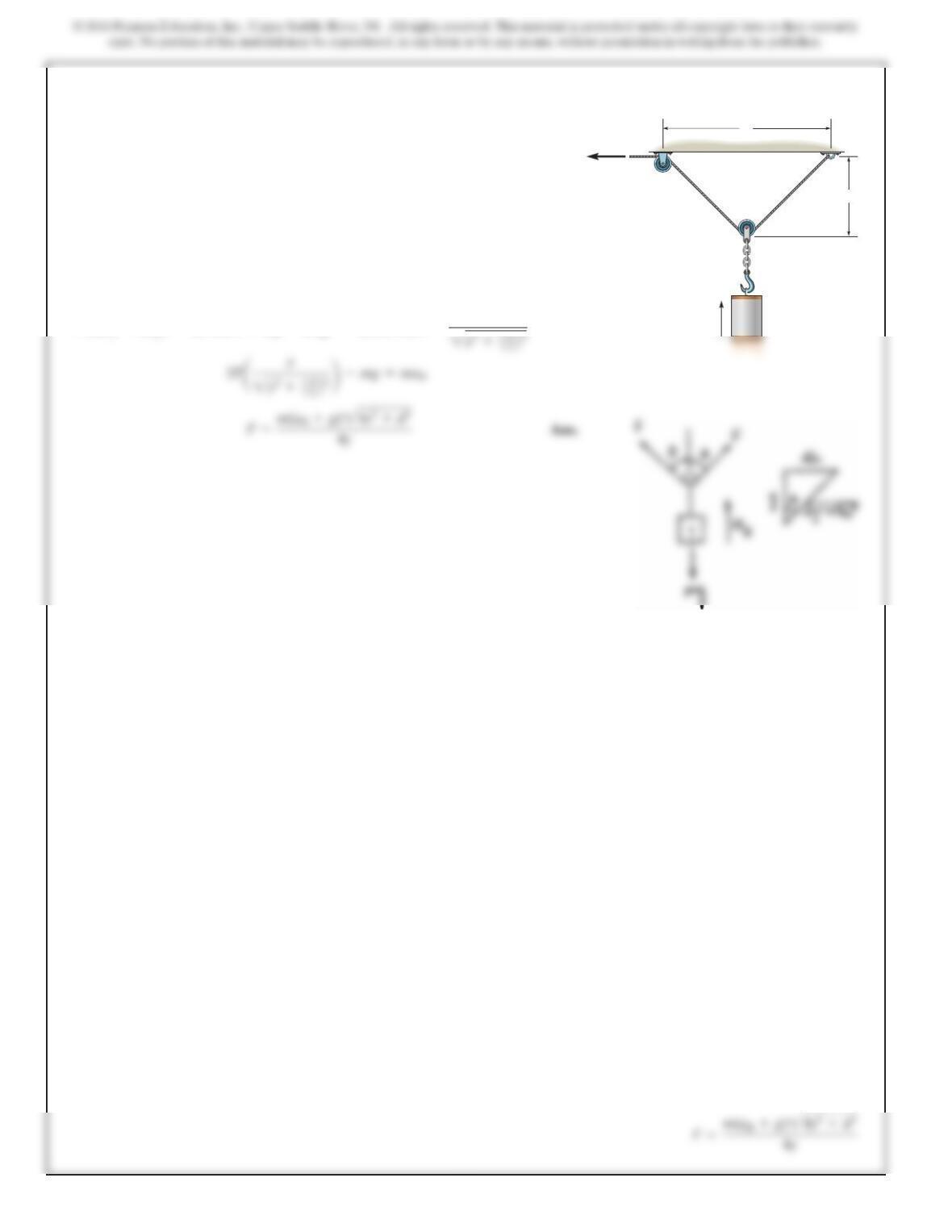
*13–12.
Cylinder B has a mass m and is hoisted using the cord and
pulley system shown. Determine the magnitude of force F
as a function of the block’s vertical position y so that when
F is applied the block rises with a constant acceleration aB.
Neglect the mass of the cord and pulleys.
SOLUTION
+
c
Σ
Fy=may;
2F cos
u
–mg =maB
where cos u=
y
aBB
F
y
d
Ans:
257
13–13.
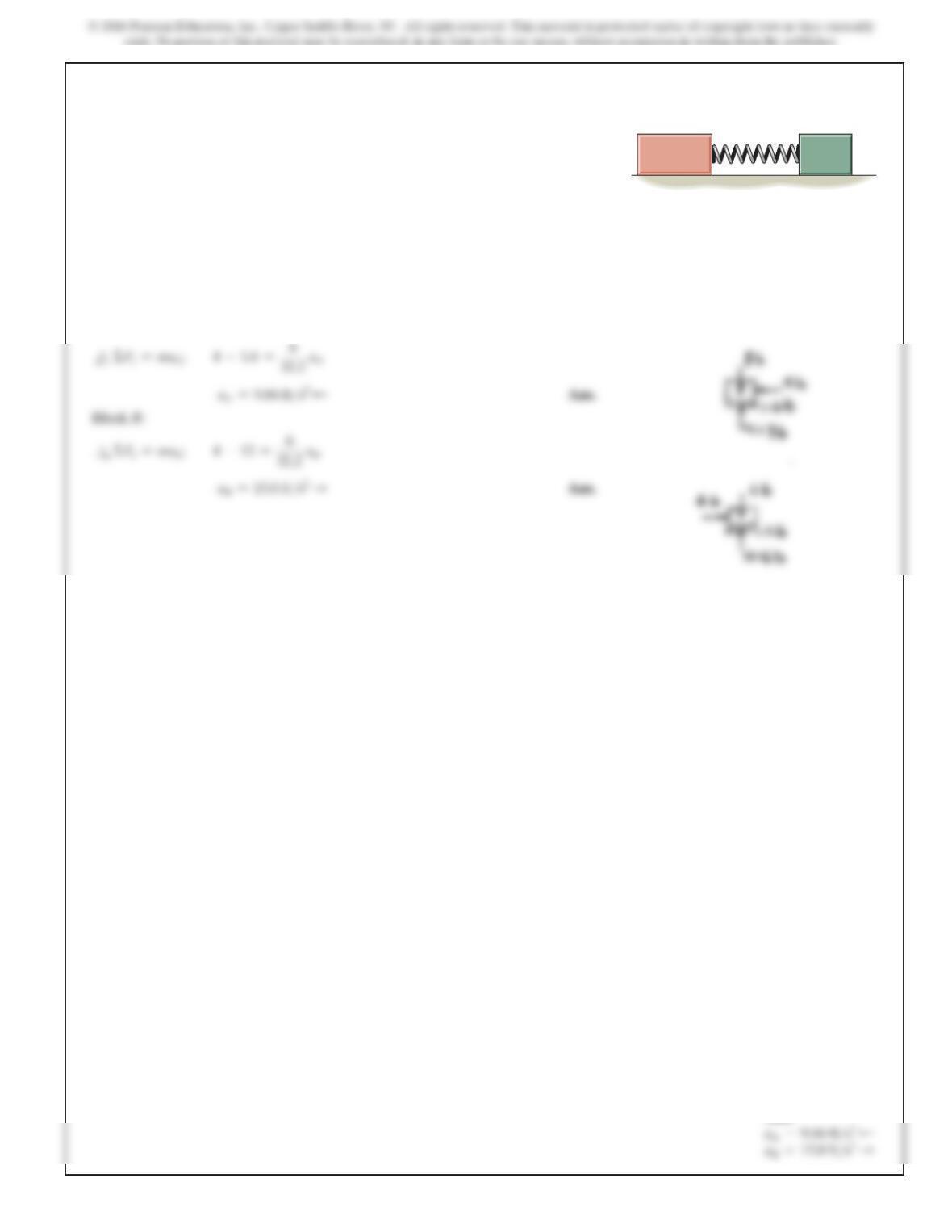
Block A has a weight of 8 lb and block B has a weight of 6 lb.
They rest on a surface for which the coefficient of kinetic
friction is m
k=0.2.
If the spring has a stiffness of k
=
20 lb
>
ft,
and it is compressed 0.2 ft, determine the acceleration of each
block just after they are released.
k
BA
SOLUTION
Block A:
Ans:
258
13–14.
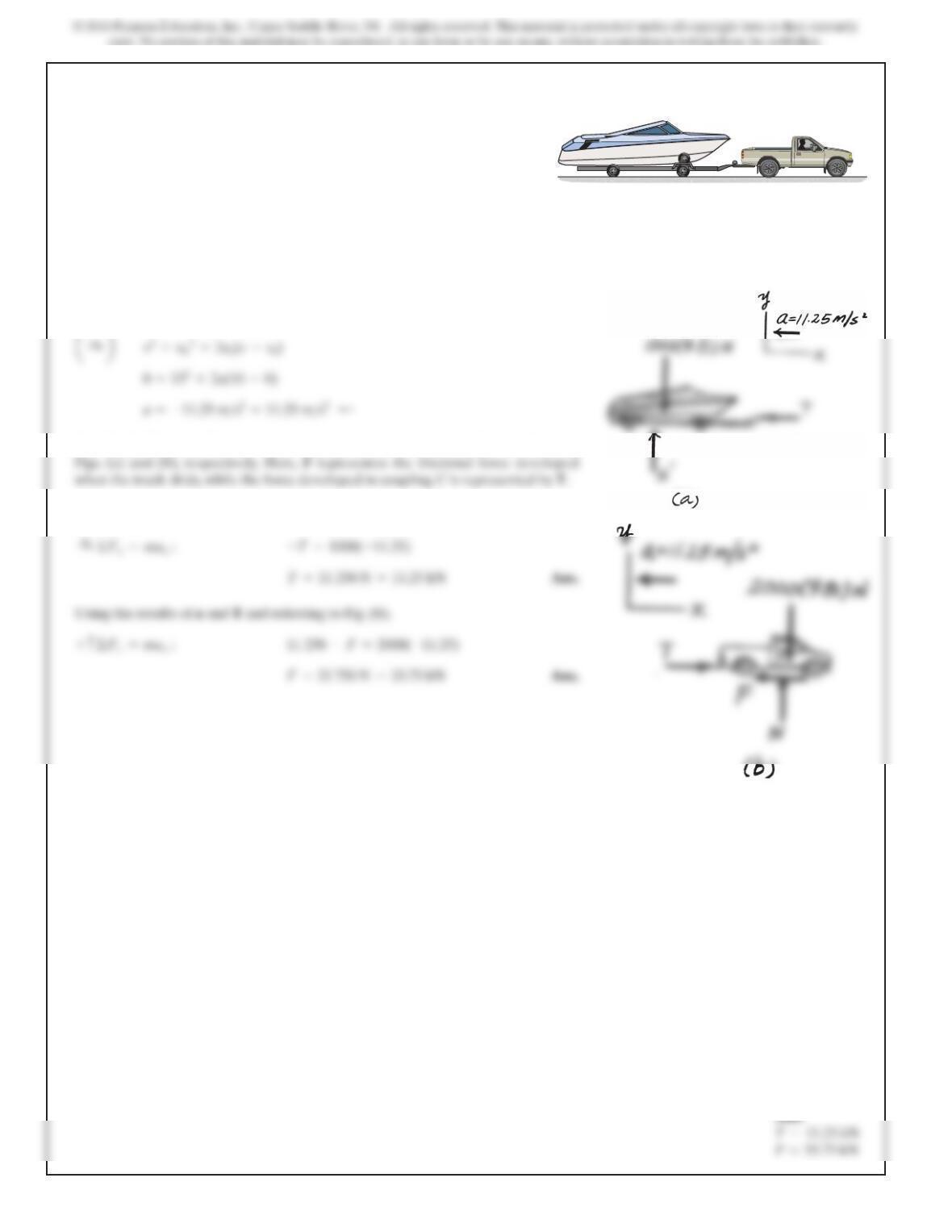
The 2-Mg truck is traveling at 15 ms when the brakes on all its
wheels are applied, causing it to skid for a distance of 10 m
before coming to rest. Determine the constant horizontal force
developed in the coupling C,and the frictional force
developed between the tires of the truck and the road during
this time.The total mass of the boat and trailer is 1 Mg.
>
SOLUTION
Kinematics: Since the motion of the truck and trailer is known, their common
acceleration awill be determined first.
Free-Body Diagram:The free-body diagram of the truck and trailer are shown in
Equations of Motion:Using the result of aand referrning to Fig. (a),
C
259
13–15.
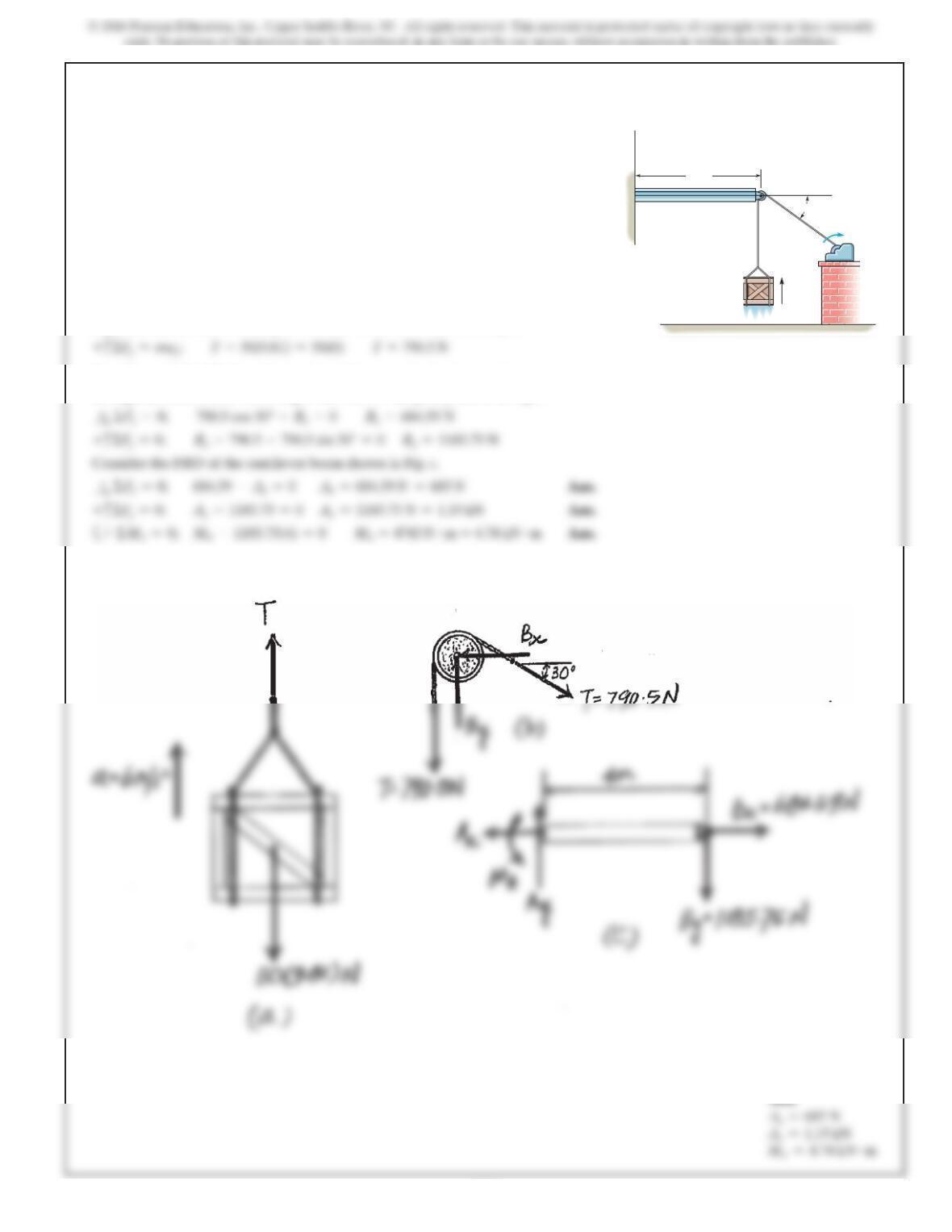
The motor lifts the 50-kg crate with an acceleration of
6 m
>
s2. Determine the components of force reaction and
the couple moment at the fixed support A.
SOLUTION
Equation of Motion. Referring to the FBD of the crate shown in Fig. a,
Equations of Equilibrium. Since the pulley is smooth, the tension is constant
throughout entire cable. Referring to the FBD of the pulley shown in Fig. b,
4 m
y
x
B
A
6 m/s2
30
260
*13–16.
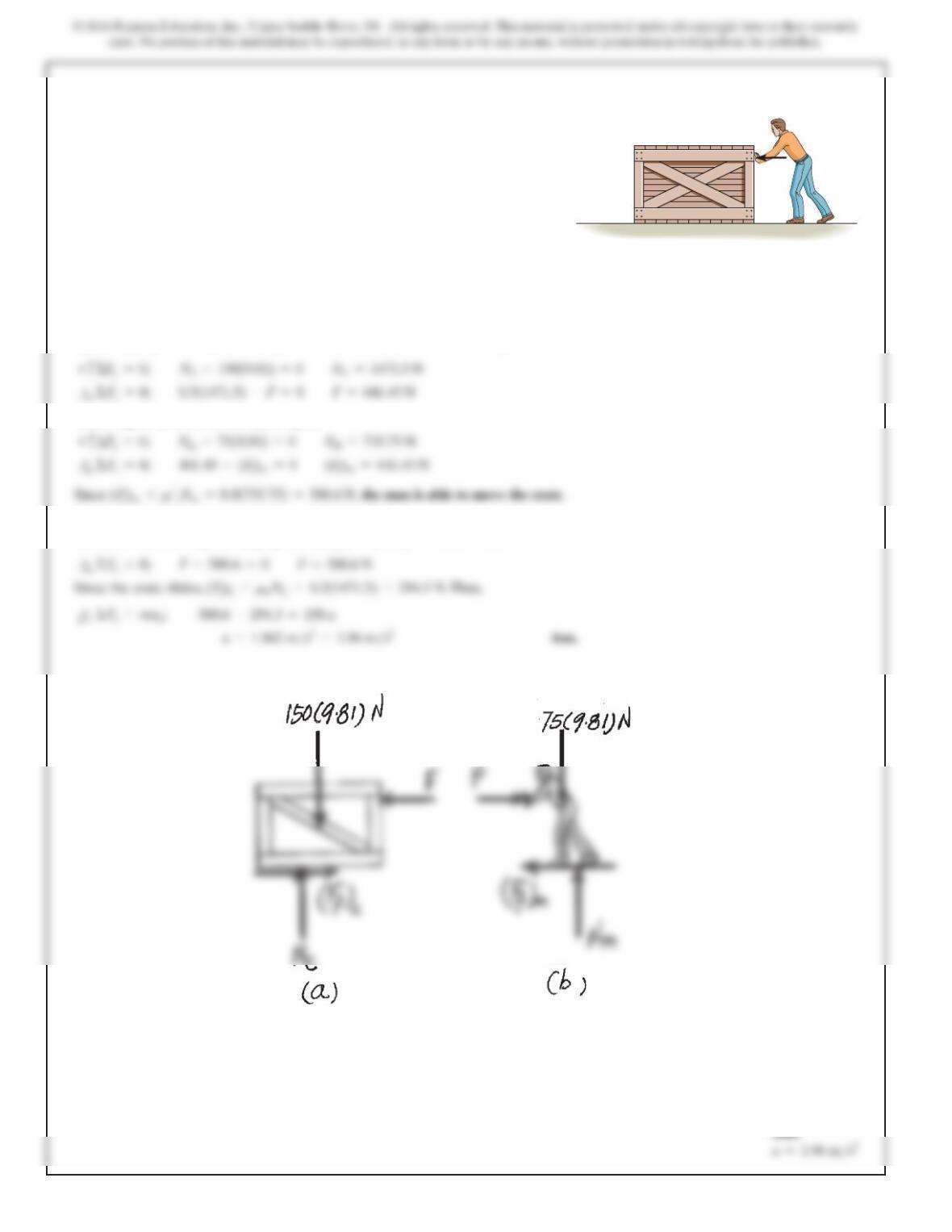
The 75-kg man pushes on the 150-kg crate with a horizontal
force F. If the coefficients of static and kinetic friction
between the crate and the surface are m
s=0.3
and
m
k=0.2,
and the coefficient of static friction between the
man’s shoes and the surface is m
s=0.8
, show that the man
is able to move the crate. What is the greatest acceleration
the man can give the crate?
F
SOLUTION
Equation of Equilibrium. Assuming that the crate is on the verge of sliding
(F
f
)
C
=
ms
N
C
=0.3N
C. Referring to the FBD of the crate shown in Fig. a,
Referring to the FBD of the man, Fig. b,
)
(F
)
Equation of Motion. The greatest acceleration of the crate can be produced when
the man is on the verge of slipping. Thus,
(F
f
)
m
=
m
′
s
N
m
=0.8(735.75) =588.6 N
.
(F
)
=
261
13–17.
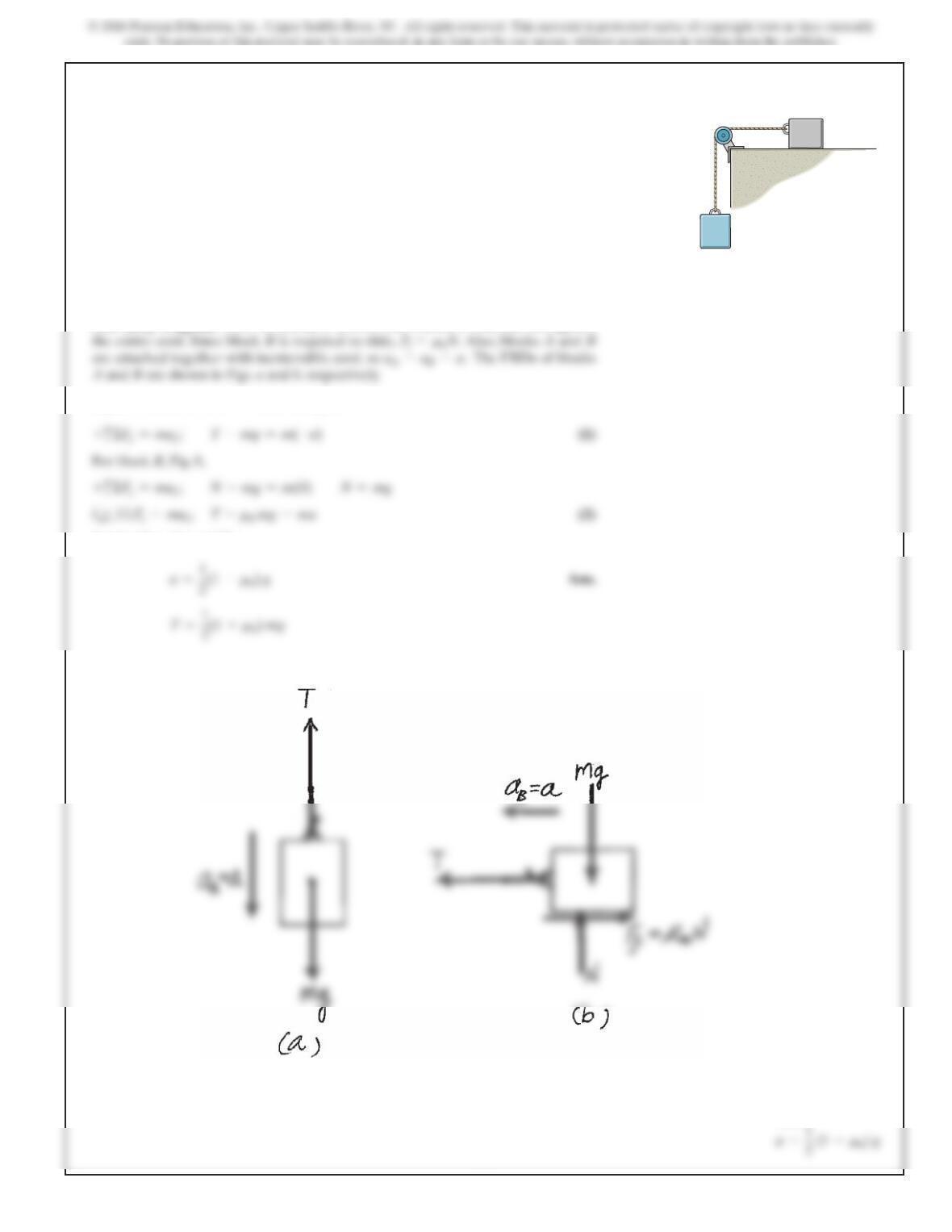
Determine the acceleration of the blocks when the system is
released. The coefficient of kinetic friction is
mk,
and the
mass of each block is m. Neglect the mass of the pulleys
andcord.
SOLUTION
Free Body Diagram. Since the pulley is smooth, the tension is constant throughout
Equations of Motion. For block A, Fig. a,
Solving Eqs. (1) and (2)
A
B
Ans:
262
13–18.
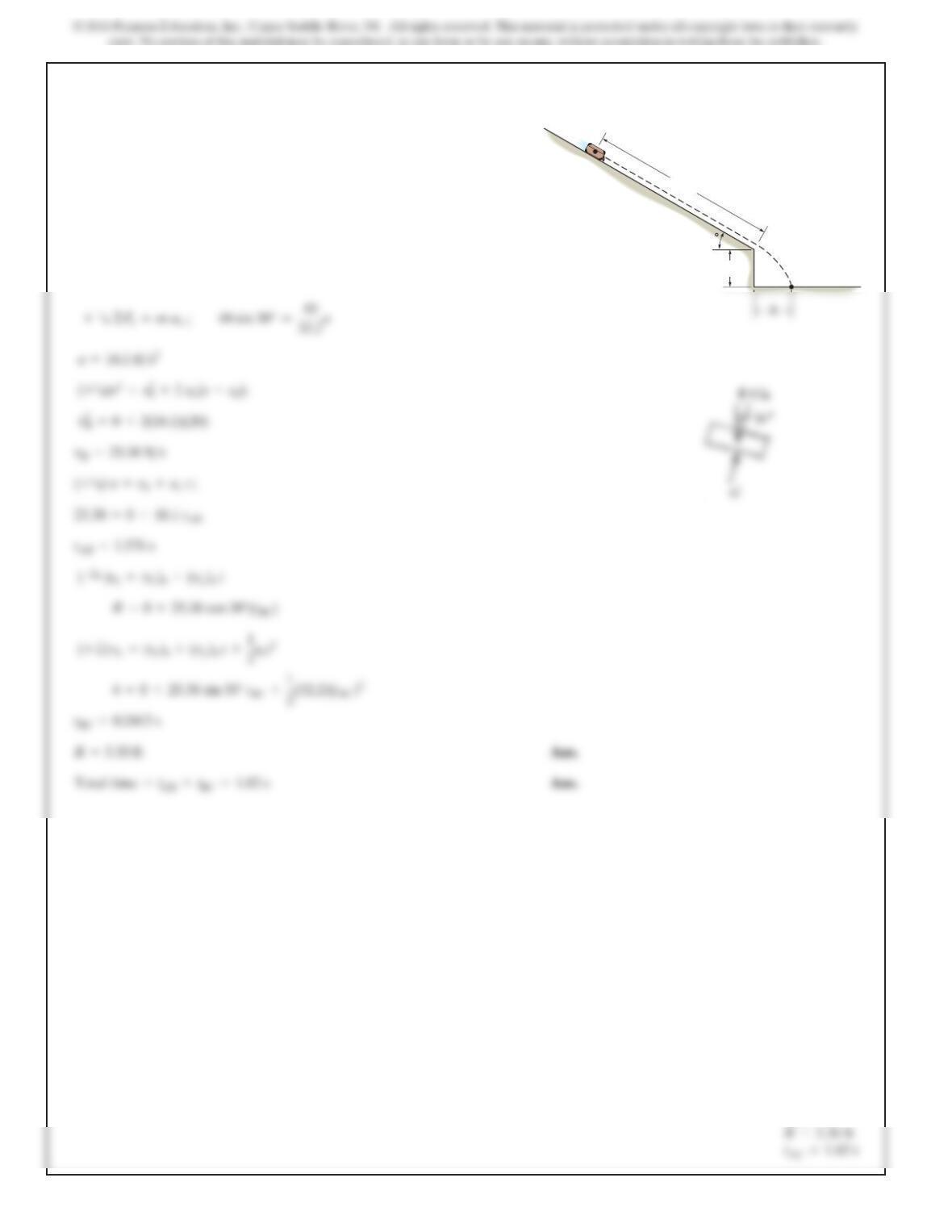
SOLUTION
A 40-lb suitcase slides from rest 20 ft down the smooth
ramp. Determine the point where it strikes the ground at C.
How long does it take to go from Ato C?
20 ft
4 ft
30
C
A
B
Ans:
263
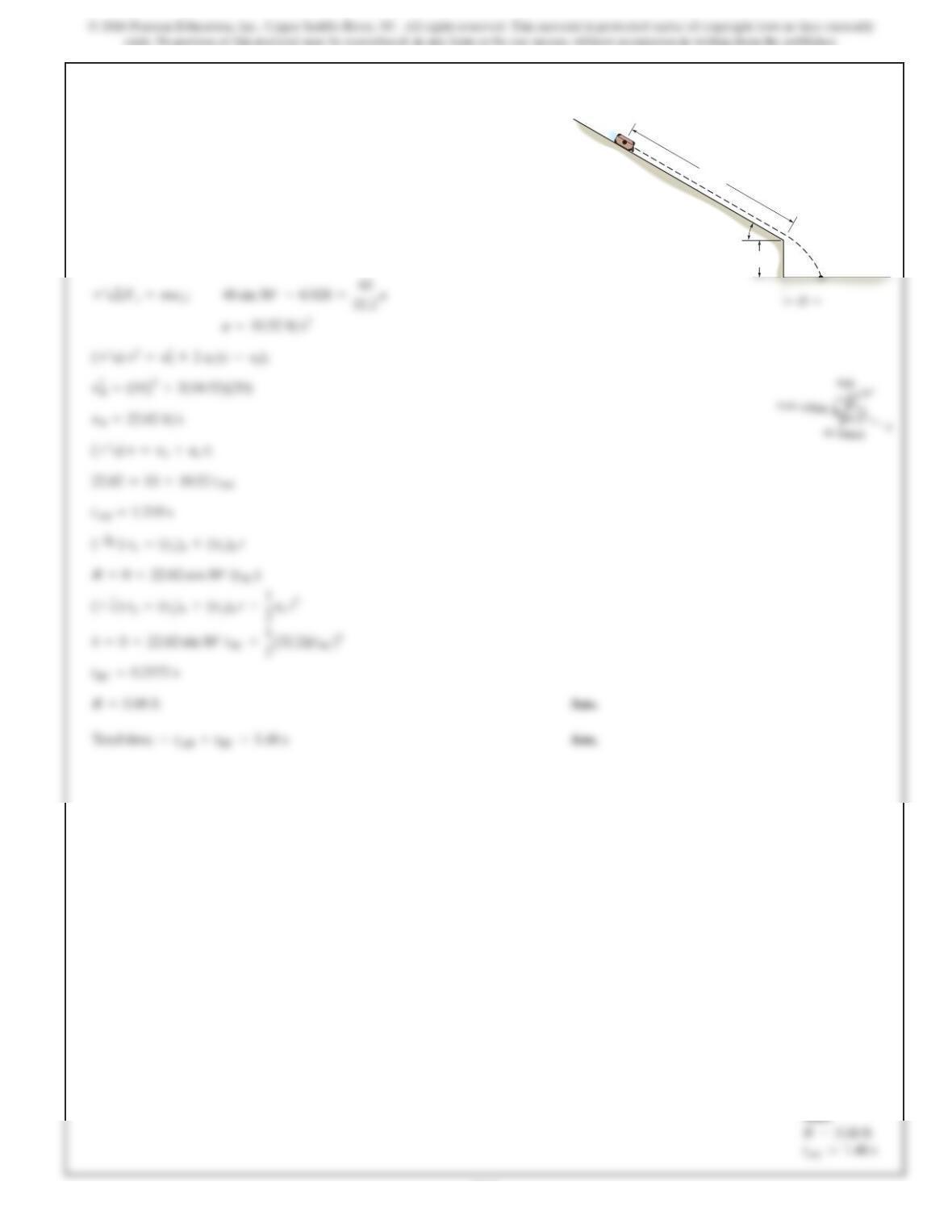
13–19.
Solve Prob. 13–18 if the suitcase has an initial velocity down
the ramp of and the coefficient of kinetic
friction along AB is .mk =0.2
vA =10 ft>s
SOLUTION
20 ft
4 ft
30
C
A
B
264
*13–20.
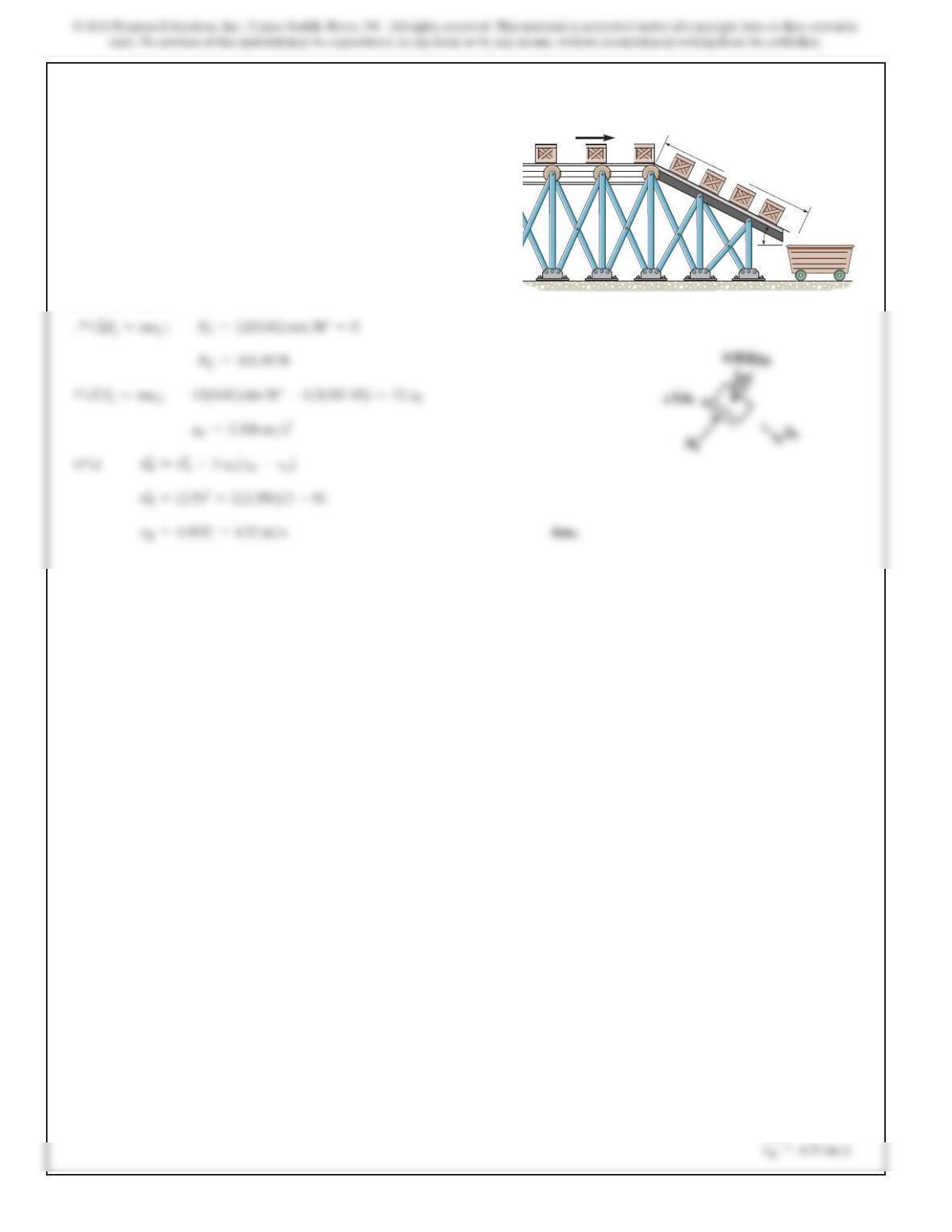
The conveyor belt delivers each 12-kg crate to the ramp at
A such that the crate’s speed is vA
=2.5 m>s,
directed
down along the ramp. If the coefficient of kinetic friction
between each crate and the ramp is m
k=0.3,
determine the
speed at which each crate slides off the ramp at B. Assume
that no tipping occurs. Take
u=30°.
vA 2.5 m/s
3 m
A
B
u
SOLUTION
Ans: