CHAPTER 12
INRODUCTION TO ELECTRICITY
OVERVIEW
This chapter covers the fundamentals of electrical circuits and laws applicable to the electrical
equipment and systems commonly installed in buildings, but excludes what may be employed in
industrial process. In fact, most of the topics discussed in this chapter have been covered in
college physics. This chapter is merely a review of the fundamental law of physics with
emphasis on the power distribution quantities, such as resistance, reactance, impedance, current,
voltage, power, and energy.
Alternating current is the dominant system used for building power distribution systems,
although direct current is increasingly used for building transportation (elevators and escalators)
and communications (data, computer, telephone) systems. These DC systems are converted
from AC locally within or in proximity of the equipment. Thus, architects and engineers need
not be concerned with the conversion details.
The most basic things for students to understand about the AC systems are the Ohm’s Law and
the Kirchhoff’s Law. All relations and behavior of AC power are derived from these laws.
The reversing and cyclic nature of alternating current (AC) is hard to perceive, by the students,
although everyone tends to accept it as a matter of fact. In power systems, the standard
frequency in the U.S.A. is 60 cycles per second (Hz), but in communications the frequency may
be as high as millions (MHZ) or billions cycles per second (GHZ). However, those are direct
currents.
We found students frequently misunderstand the difference between “power” (watts, kilowatts)
and “energy” (watt-hours, kilowatt-hours). It would help to encourage more class discussion to
drill on this subject. (In electrical terms, power is watt, energy is watt-hour. But in mechanical
terms, power is Btu per hour (Btu/hr.) and energy is in Btu. These units are often the source of
confusion leading to misunderstanding.)
CHAPTER 12
INRODUCTION TO ELECTRICITY
QUESTIONS AND ANSWERS
12.1 The flow of electrical current through a circuit is directly proportional to the EMF
(voltage) for both AC and DC systems. ( True ) ( False )
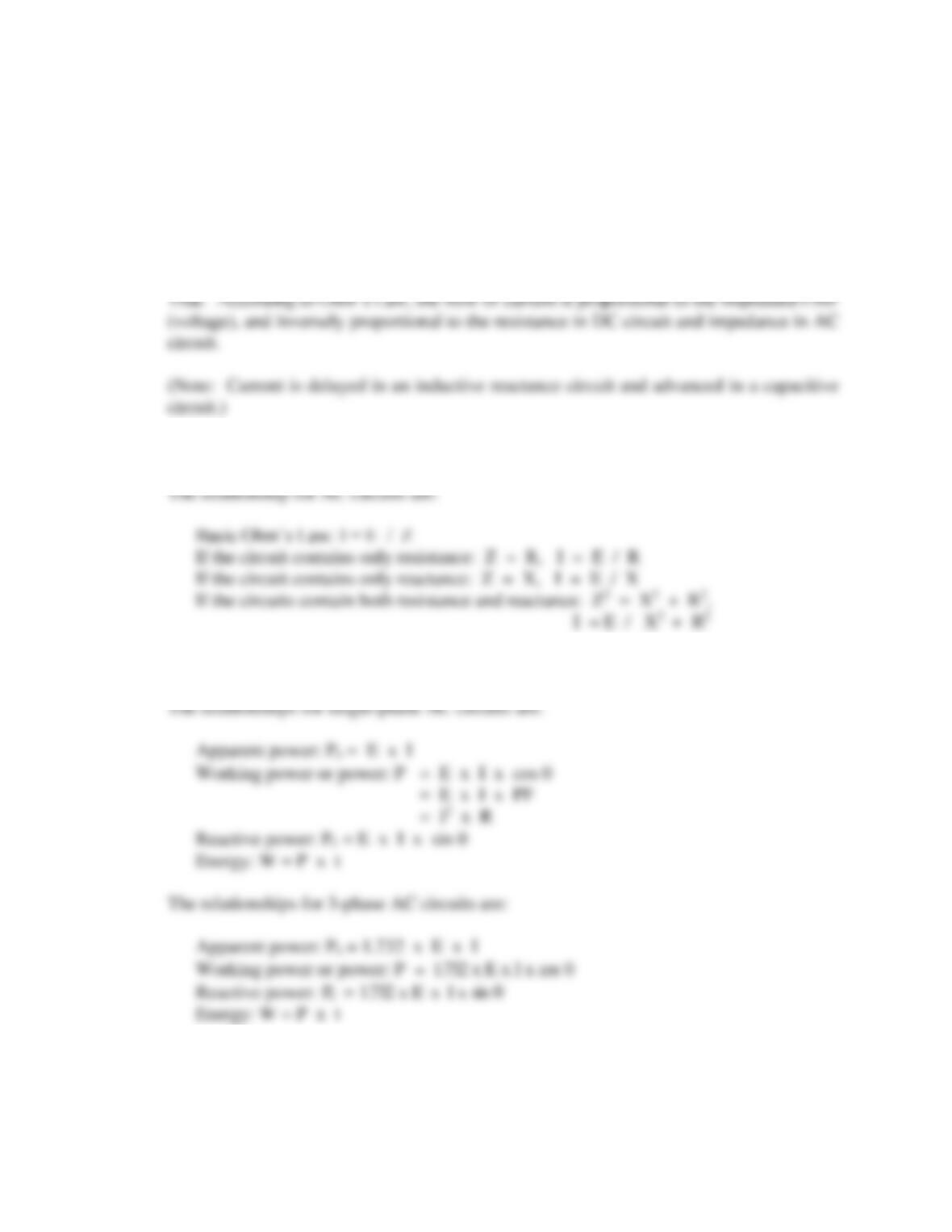
12.2 What is the relationship between current, voltage and impedance in an AC circuit?
12.3 What is the relationship between energy, power, current, and voltage in a AC system?
12.4 What is the standard voltage rating for convenience power (plug-in receptacles) in
the USA? In Europe?
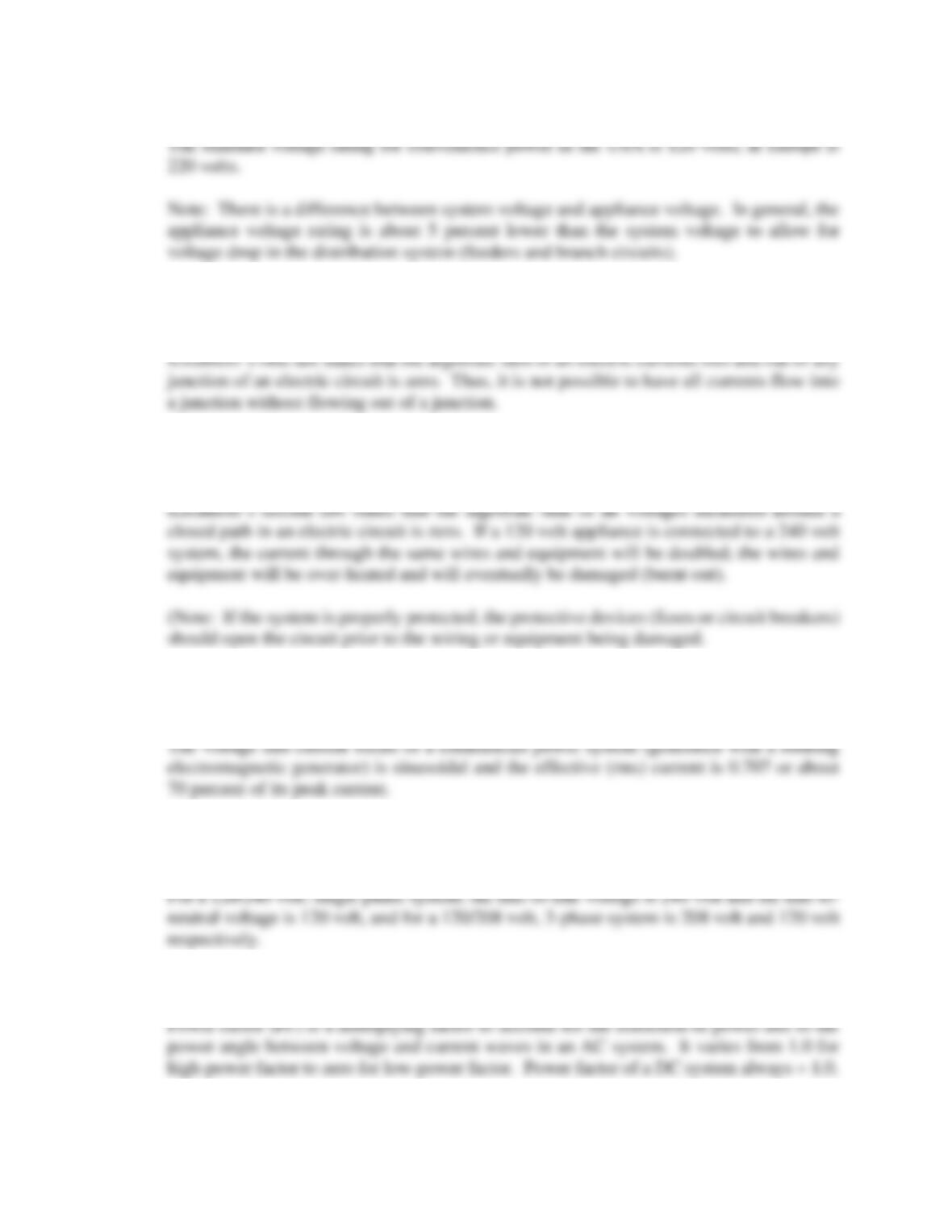
12.5 What is Kirchhoff’s first law of electrical circuit? Is it possible to have all currents
flow into a junction?
12.6 What is Kirchhoff’s second law of electrical circuit? What will happen when a 120
volt appliance is connected to a 240 volt system?
12.7 What is the relation between peak current and effective (rms) current of an AC power
system generated by commercial power companies in the USA?
12.8 What are the line-to-line and line-to-neutral voltages in a 120/240 volt, single phase
AC system? In a 120/208 volt, 3 phase system?
12.9 What is power factor? What is the power factor of a DC system?
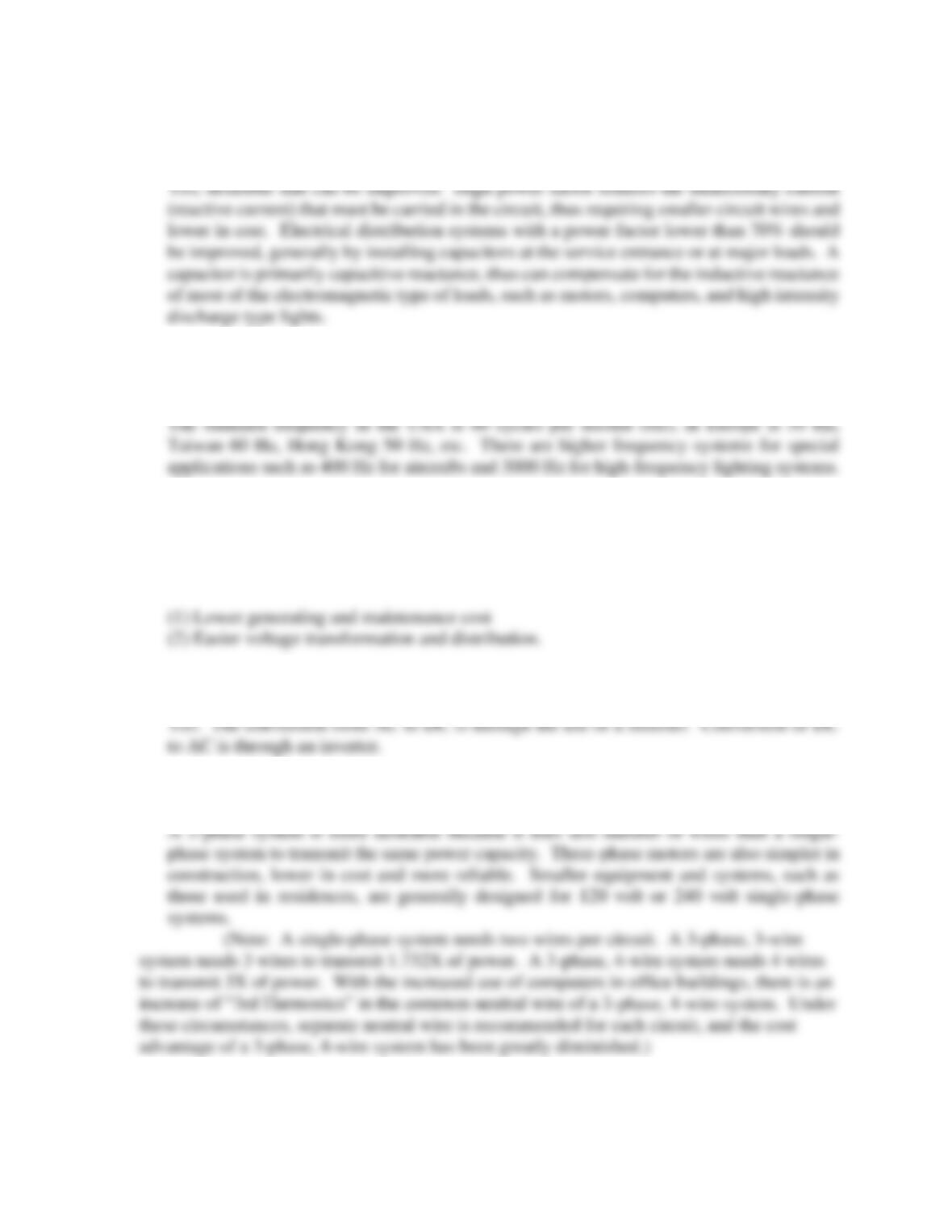
12.10 Is it desirable to maintain a high power factor in an electrical system? Can the power
factor be improved? How?
12.11 What is the standard AC system frequency in the United States and in some other
countries?
12.12 Name the two major advantages of an AC system over a DC system in building
applications.
The two major advantages are
12.13 Can AC and DC systems be inter-converted, and if so, how?
12.14 What is the advantage of a 3-phase system over a single-phase system?
12.15 Due to the internal resistance and/or reactance of the distribution equipment, the
voltage of an electrical system varies at different locations in the system. The voltage
at the end of the distribution system is always lower than the beginning. A well
designed system should limit the voltage drop to a minimum. Answer the following:
(a) What is the recommended maximum overall voltage drop for a combination of
lighting and power system?
(b) For an electrical heating system?
(c) What is the nominal voltage rating of single phase appliances in the United
States?
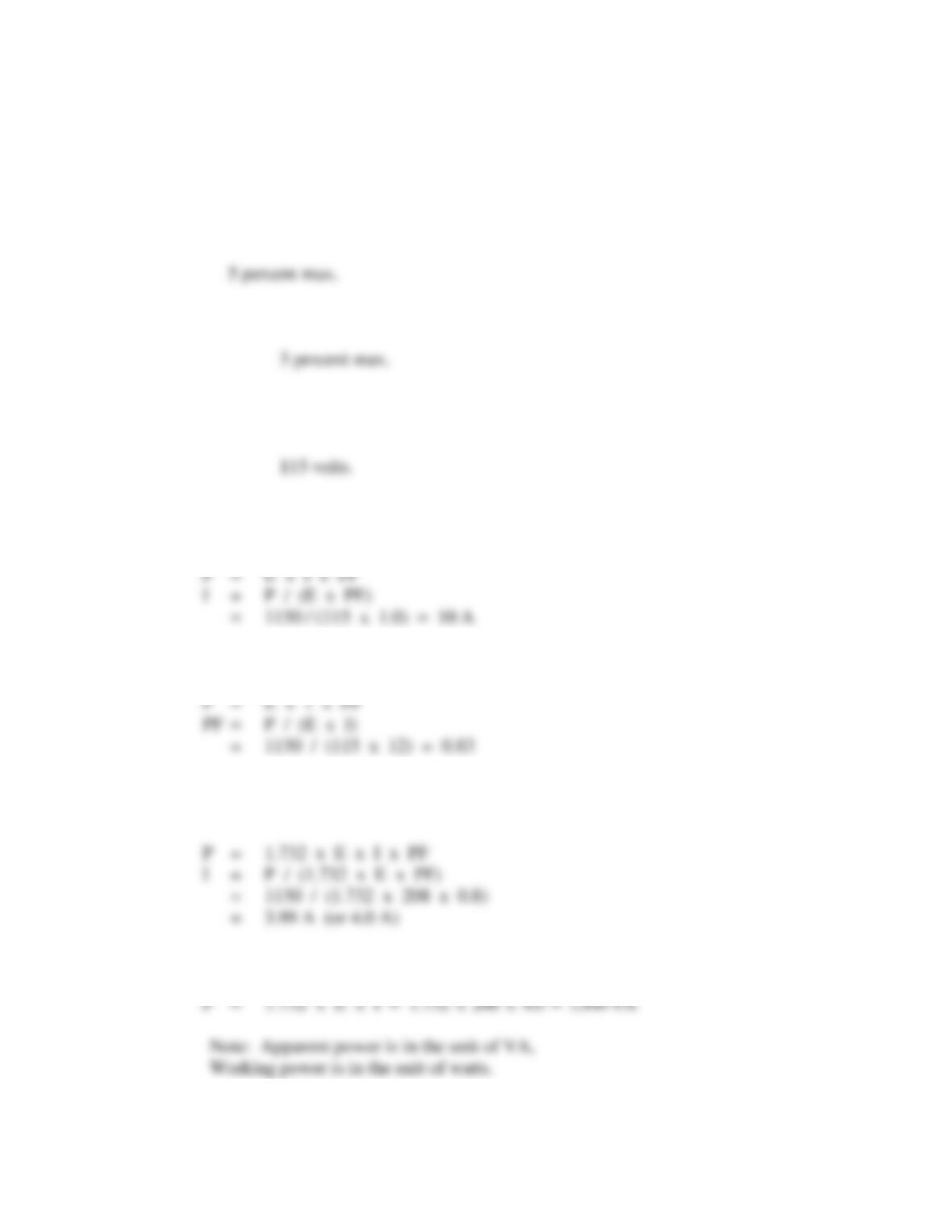
12.16 An electrical load is rated for 1150 watts at 115 volts, single phase. What is the load
current if the power factor is 1.0 or 100 percent?
12.17 If the current of the load in question 12.17 is 12 amps, what is the power factor?
12.18 If the same load as in question 12.17 (1150 watts) is 208 volt, three-phase, what is the
current with 0.8 PF?
12.19 What is the apparent power in VA, of the load in question 12.19?
12.20 What is the peak current of the load in question 12.9?
12.21 What is the peak voltage of a 120 volt, single-phase system? a 208 volt, 3-phase
system?
12.22 If the resistance and reactance of a circuit are 4 ohms 2 ohms, respectively, what is
the impedance?
12.23 If three loads rated for 2, 3, and 4 kW are connected in parallel, what is the total load?
12.24 If the system voltage for the loads in question 12.23 is 480 volts, 3-phase what is the
total current of the load? (Note: PF is not given, then it must be assumed.)
12.25 Describe the difference between power and energy.
Power is the time rate of consuming (or transmitting) energy. It is easier to understand
12.26 If a single-phase electrical resistance load operates at 115 volts, how much current is
required to consume 800 watts of power?
12.27 If the load operates for 15 minutes per day, year round, how much energy has been
consumed?
12.28 What is the power of a three-phase system for a 100-Amp device with 208 V between
each phase? What energy will be consumed after 20 hours of operation of the load?
12.29 What is the current flow in the line supplying a single-phase load of 2 kW at 208-V
single phase? (Assuming the load is 100% resistance.)
12.30 What is the current flow in the line supplying a three-phase load of 2 kW at 208-V
three phase? (Assuming the load is 100% resistance.)