1
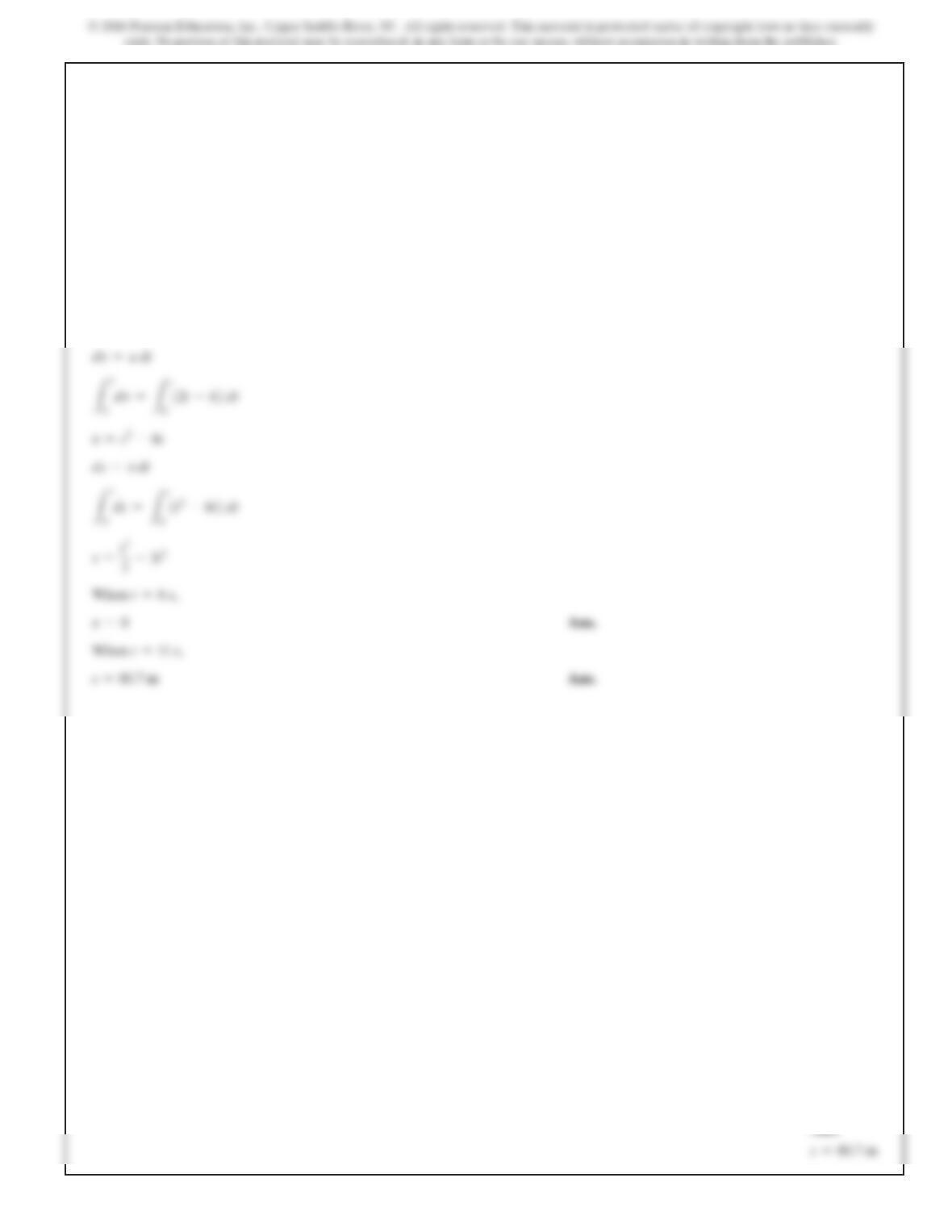
SOLUTION
a=2t–6
12–1.
Starting from rest, a particle moving in a straight line has an
acceleration of a = (2t – 6) m
>
s2, where t is in seconds. What
is the particle’s velocity when t = 6 s, and what is its position
when t = 11 s?
Ans:
2
12–2.
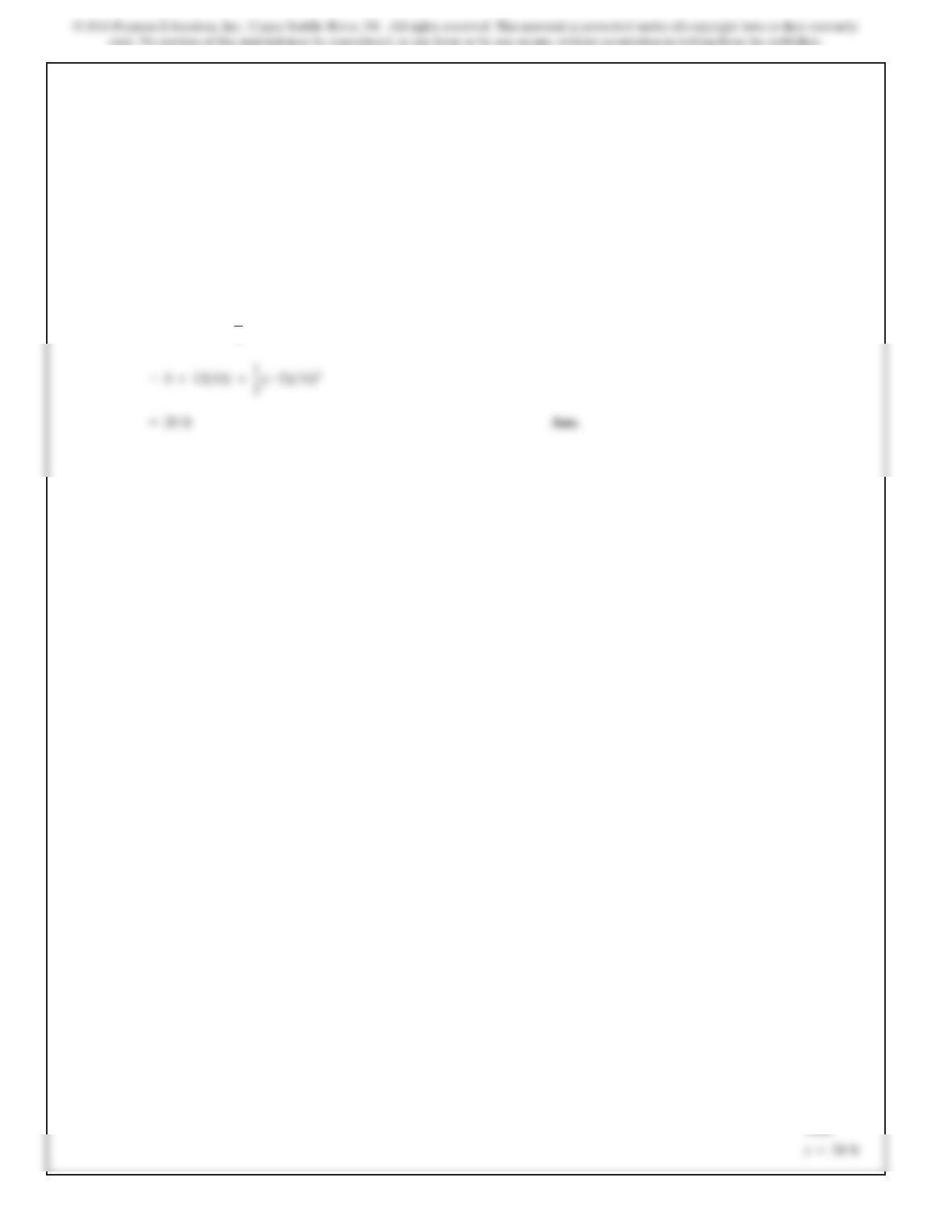
SOLUTION
1
S
+
2
s=s0+v0
t+1
2
ac
t2
If a particle has an initial velocity of v0=12 ft>s to the
right, at s0=0, determine its position when t=10 s, if
a=2 ft>s2 to the left.
Ans:
12–3.
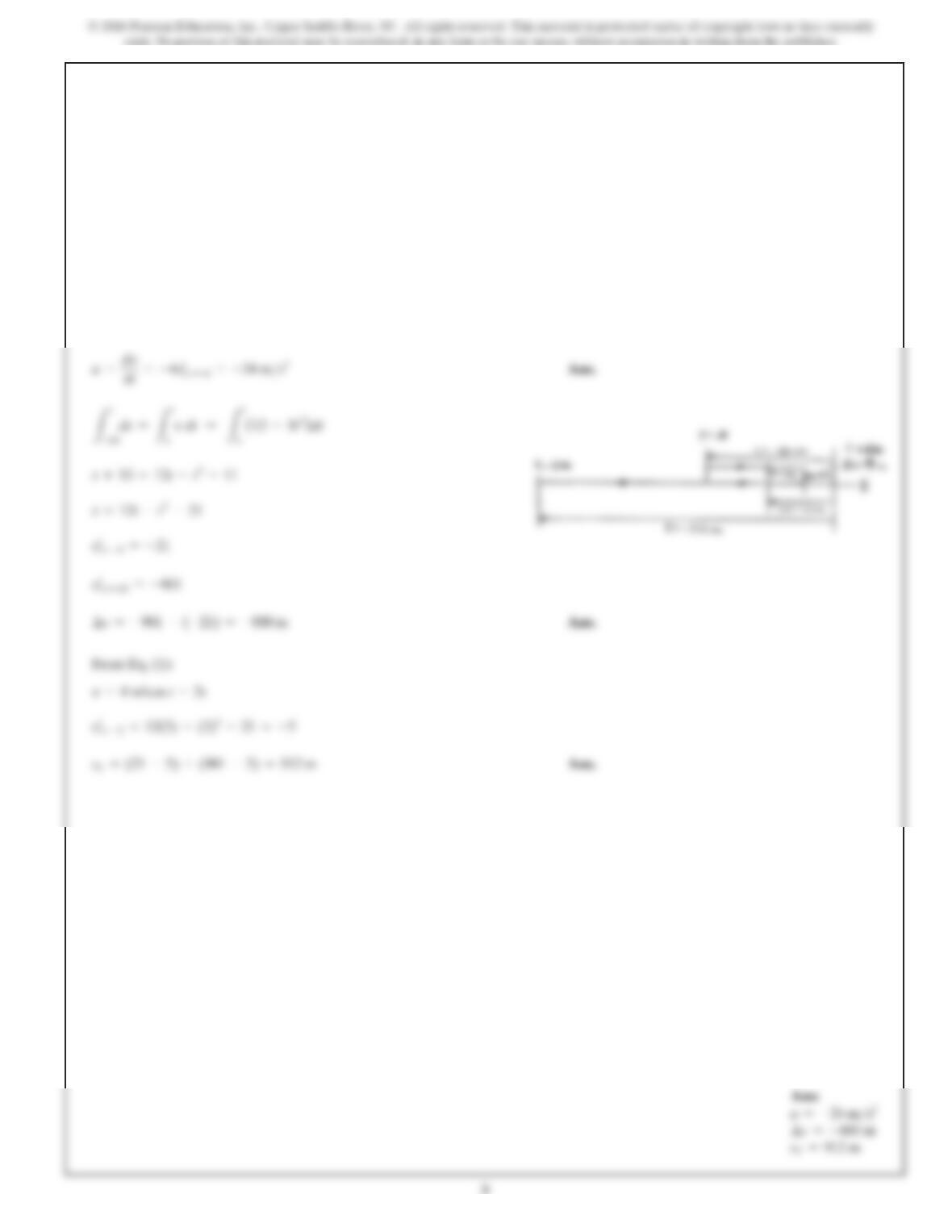
A particle travels along a straight line with a velocity
v=(12–3t2) m>s, where t is in seconds. When t=1 s, the
particle is located 10 m to the left of the origin. Determine
the acceleration when t=4
s, the displacement from
t=0 to t=10 s, and the distance the particle travels during
this time period.
SOLUTION
v=12 –3t2 (1)
*12–4.
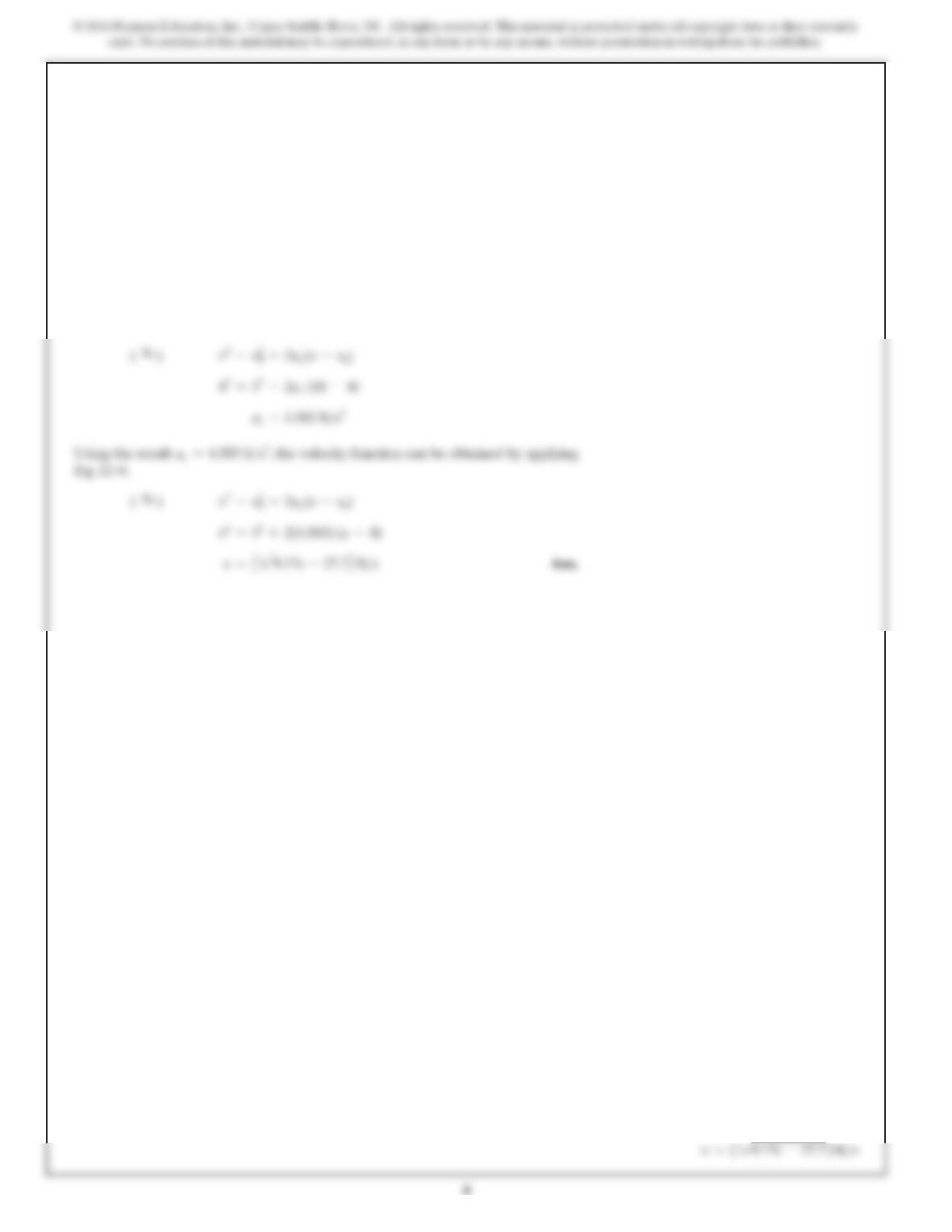
SOLUTION
Velocity: To determine the constant acceleration , set ,,
and and apply Eq. 12–6.
v=8ft>ss=10 ft
v0=3ft>ss0=4ftac
Apart
i
c
l
e trave
l
s a
l
ong a stra
i
g
h
t
li
ne w
i
t
h
a constant
acceleration. When ,and when ,
.Determine the velocity as a function of position.v=8ft>s
s=10 ftv=3ft>ss=4ft
Ans:
12–5.
The velocity of a particle traveling in a straight line is given
by v = (6t – 3t2) m
>
s, where t is in seconds. If s = 0 when
t= 0, determine the particle’s deceleration and position
when t = 3 s. How far has the particle traveled during the
3-stime interval, and what is its average speed?
SOLUTION
v=6t–3t2
L
s
0
ds =
Lt
0
(6t –3t2)dt
12–6.
SOLUTION
Position:The position of the particle when is
Total Distance Traveled:The velocity of the particle can be determined by applying
Eq. 12–1.
The times when the particle stops are
The position of the particle at ,1 s and 5 s are
t=0s
t=6s
T
h
e pos
i
t
i
on of a part
i
c
l
e a
l
ong a stra
i
g
h
t
li
ne
i
s g
i
ven
b
y
, where tis in seconds.
Determine the position of the particle when and the
total distance it travels during the 6-s time interval. Hint:
Plot the path to determine the total distance traveled.
t=6s
s=(1.5t3–13.5t2+22.5t)ft
12–7.
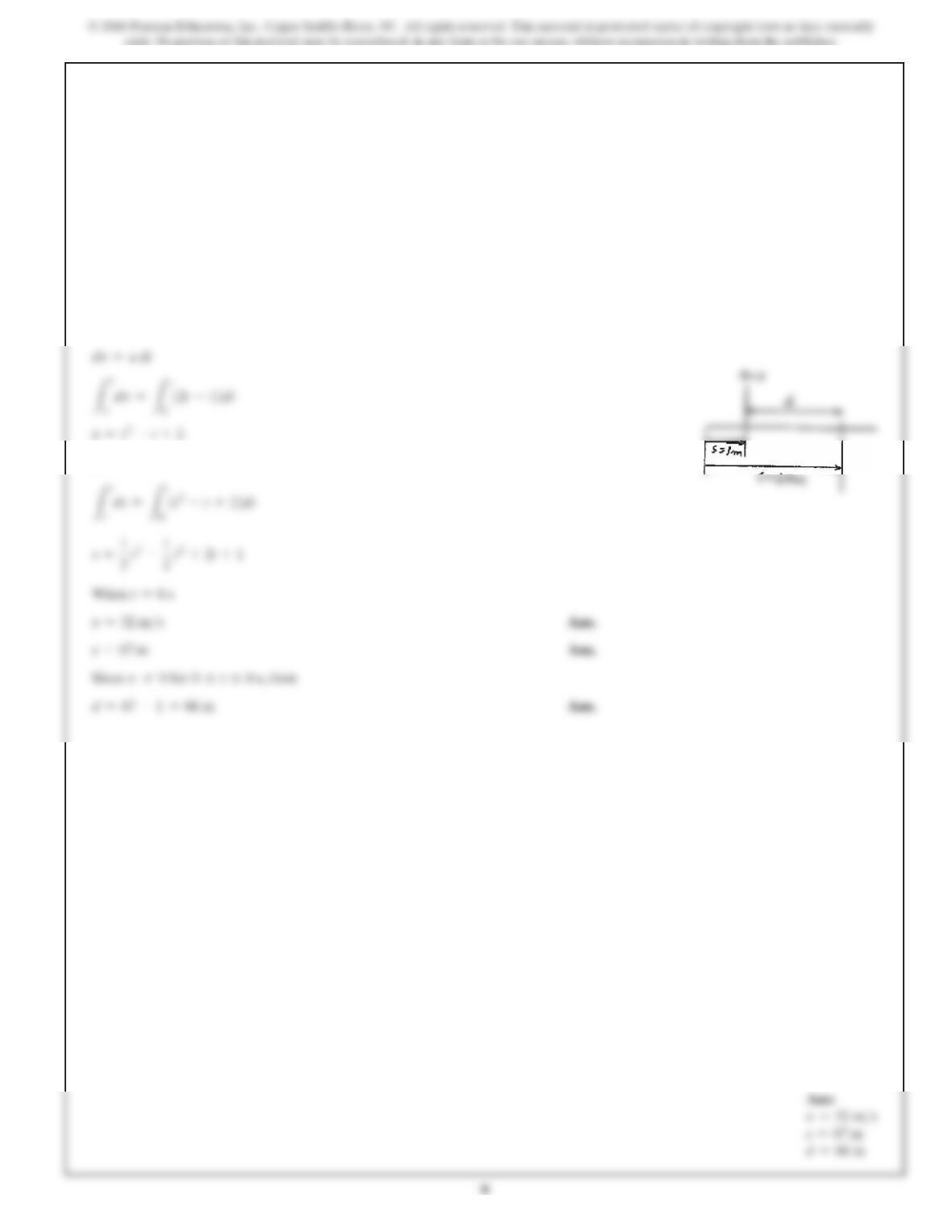
A particle moves along a straight line such that its position
is defined by s = (t2 – 6t + 5) m. Determine the average
velocity, the average speed, and the acceleration of the
particle when t = 6 s.
SOLUTION
s=t2–6t +5
8
*12–8.
A particle is moving along a straight line such that its
position is defined by , where tis in
seconds. Determine (a) the displacement of the particle
during the time interval from to , (b) the
average velocity of the particle during this time interval,
and (c) the acceleration when .t=1s
t=5st=1s
s=(10t2+20) mm
SOLUTION
(a)
s|1s=10(1)2+20 =30 mm
s=10t2+20
Ans:
12–9.
The acceleration of a particle as it moves along a straight
line is given by a
=
(2t
–
1) m
>
s
2
, where t is in seconds. If
s=1 m
and
v=2 m>s
when
t=0,
determine the
particle’s velocity and position when
t=6 s.
Also,
determine the total distance the particle travels during this
time period.
SOLUTION
a=2t –1
dx =v dt
s=67 m
12–10.
SOLUTION
Aparticle moves along a straight line with an acceleration
of , where sis in meters.
Determine the particle’s velocity when , if it starts
from rest when .Use a numerical method to evaluate
the integral.
s=1m
s=2m
a=5>(3s1>3+s5>2)m>s2
Ans:
1 1
12–11.
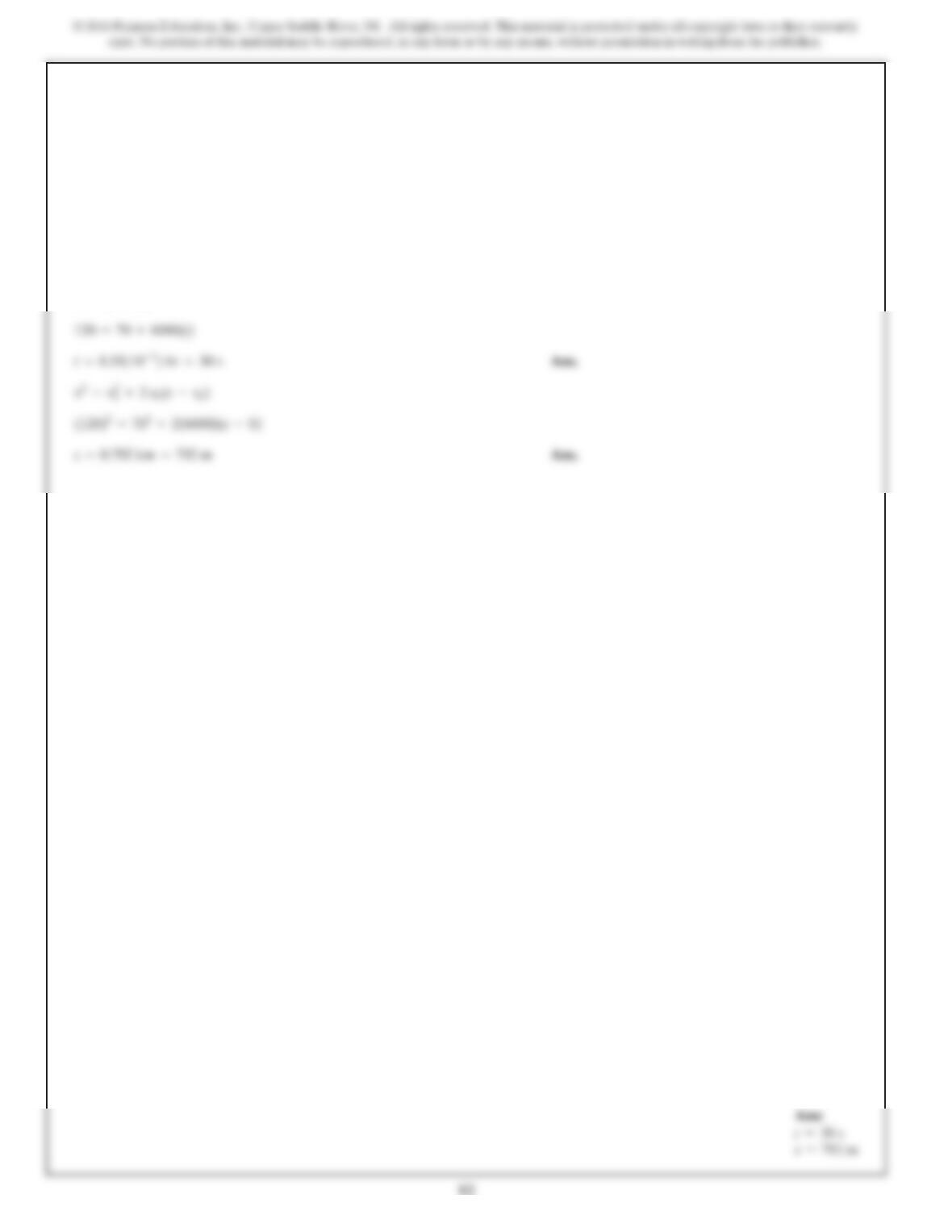
A particle travels along a straight-line path such that in 4 s
it moves from an initial position sA=–8 m to a position
sB=+3 m. Then in another 5 s it moves from sB to
sC=–6 m. Determine the particle’s average velocity and
average speed during the 9-s time interval.
SOLUTION
Average Velocity: The displacement from A to C is ∆s=sC–SA=–6–(–8)
Ans:
*12–12.
SOLUTION
v=v1+act
Traveling with an initial speed of a car accelerates
at along a straight road. How long will it take to
reach a speed of Also, through what distance
does the car travel during this time?
120 km>h?
6000 km>h2
70 km
>
h,
12–13.
SOLUTION
Stopping Distance: For normal driver, the car moves a distance of
before he or she reacts and decelerates the car.The
stopping distance can be obtained using Eq. 12–6 with and .
v=0s0=d¿=33.0 ft
d¿=vt=44(0.75) =33.0 ft
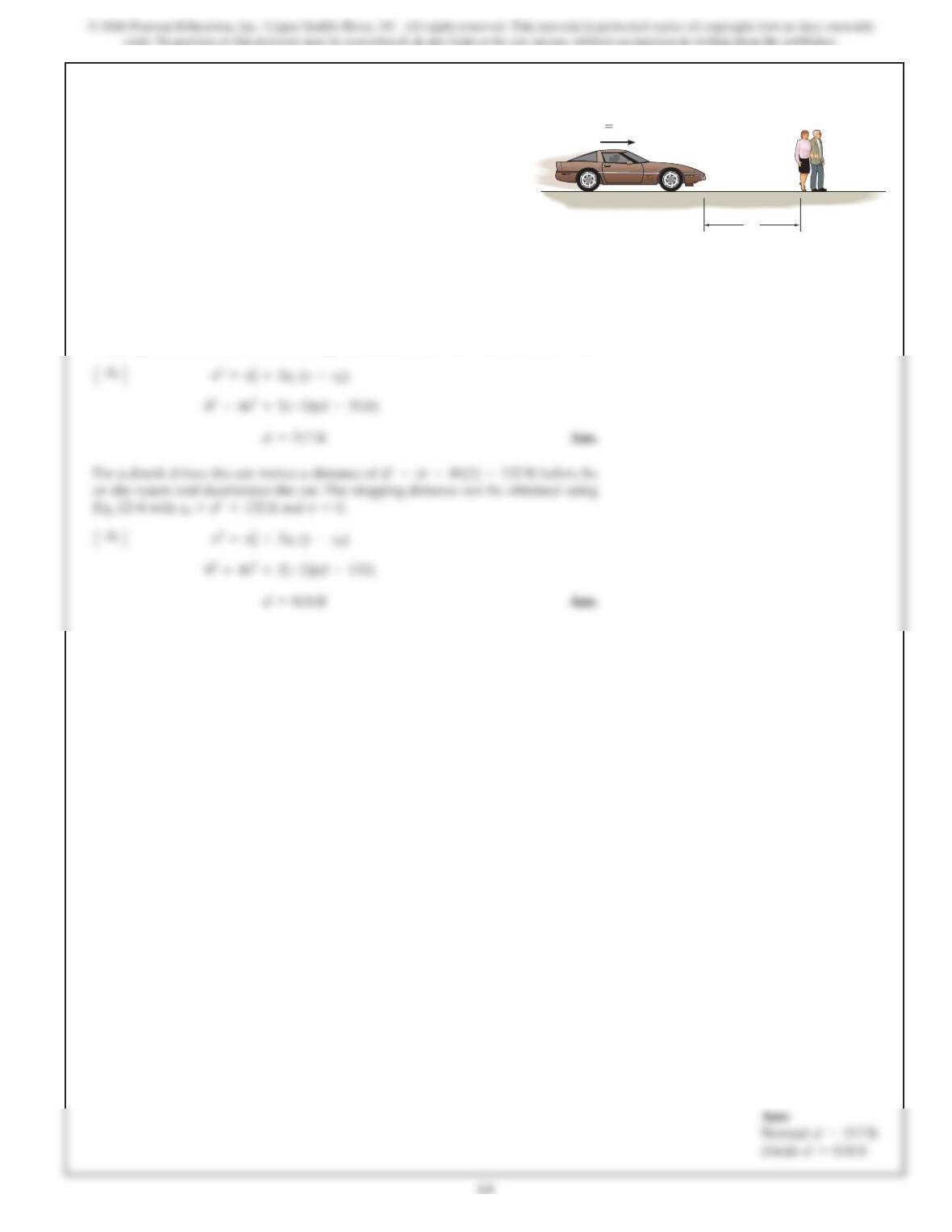
Tests reveal that a normal driver takes about before
he or she can react to a situation to avoid a collision. It takes
about 3 s for a driver having 0.1% alcohol in his system to
do the same. If such drivers are traveling on a straight road
at 30 mph (44 ) and their cars can decelerate at ,
determine the shortest stopping distance dfor each from
the moment they see the pedestrians. Moral: If you must
drink, please don’t drive!
2ft>s2
ft>s
0.75 s
d
v144 ft/s
1 4
12–14.
The position of a particle along a straight-line path is
defined by s = (t3 – 6t2 – 15t + 7) ft, where t is in seconds.
Determine the total distance traveled when t = 10 s. What
are the particle’s average velocity, average speed, and the
instantaneous velocity and acceleration at this time?
SOLUTION
s=t3–6t2–15t+7
When
t=10 s
,
When
t=10 s,
The positive root is
t=5 s
t=0
t=5 s
t=10 s
Ans:
1 5
12–15.
SOLUTION
a=
dn
dt
=-kn3
A part
i
c
l
e
i
s mov
i
ng w
i
t
h
a ve
l
oc
i
ty of w
h
en an
d
If it is subjected to a deceleration of
where kis a constant, determine its velocity and position as
functions of time.
a=-kv3,t=0.
s=0v
0
Ans:
1 6
*12–16.
A part
i
c
l
e
i
s mov
i
ng a
l
ong a stra
i
g
h
t
li
ne w
i
t
h
an
i
n
i
t
i
a
l
velocity of when it is subjected to a deceleration of
, where vis in . Determine how far it
travels before it stops. How much time does this take?
m>sa=(–1.5v1>2)m>s2
6m>s
SOLUTION
Distance Tr aveled: The distance traveled by the particle can be determined by
applying Eq. 12–3.
Time: The time required for the particle to stop can be determined by applying
Eq. 12–2.
ds =vdv
a
1 7
12–17.
SOLUTION
For B:
For A:
Worst case without collision would occur when .
sA=sB
(:
+)v=v0+act
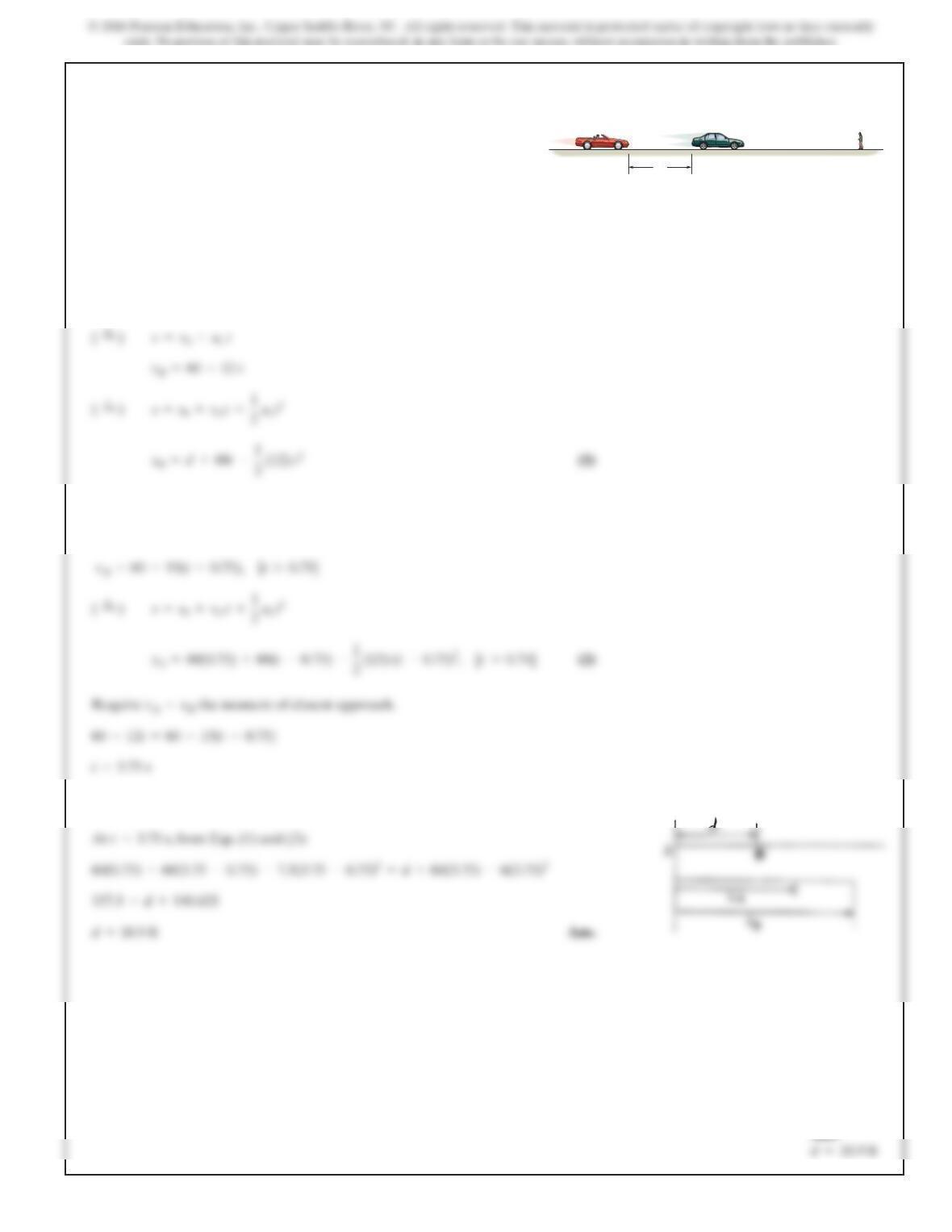
Car Bis traveling a distance dahead of car A.Both cars are
traveling at when the driver of Bsuddenly applies the
brakes,causing his car to decelerate at .It takes the
driver of car A0.75 s to react (this is the normal reaction
time for drivers). When he applies his brakes,he decelerates
at .Determine the minimum distance dbe tween the
cars so as to avoid a collision.
15 ft>s2
12 ft>s2
60 ft>s
d
AB
Ans:
12–18.
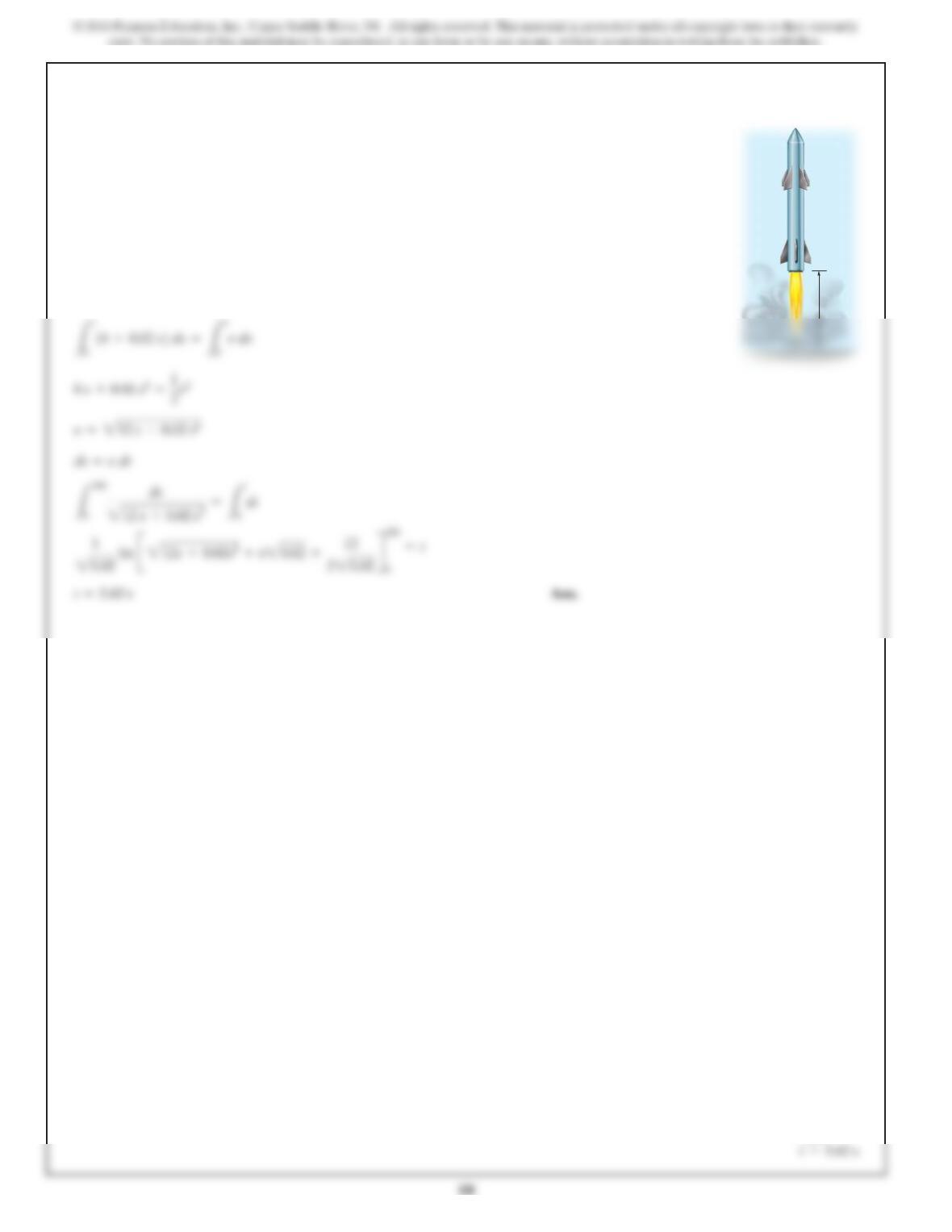
The acceleration of a rocket traveling upward is given by
where sis in meters. Determine the
time needed for the rocket to reach an altitude of
Initially, and when t=0.s=0v=0s=100 m.
a=16+0.02s2m>s2,
SOLUTION
ads=ndv
s
Ans:
1 9
12–19.
A train starts from rest at station Aand accelerates at
for 60 s. Afterwards it travels with a constant
velocity for 15 min. It then decelerates at 1 until it is
brought to rest at station B. Determine the distance
between the stations.
m>s2
0.5 m>s2
SOLUTION
Kinematics: For stage (1) motion, and Thus,
For stage (2) motion, and Thus,
v=v0+act
A
+
:
B
t=15(60) =900 s.ac=0s0=900 m,v0=30 m>s,
ac=0.5 m>s2.t=60 s,s0=0,v0=0,
Ans:
2 0
*12–20.
The velocity of a particle traveling along a straight line is
,where is in seconds.If when
,determine the position of the particle when .
What is the total distance traveled during the time interval
to ? Also, what is the acceleration when ?t=2 st=4 st=0
t=4 st=0
s=4 fttv =(3t2–6t) ft>s
SOLUTION
Position: The position of the particle can be determined by integrating the kinematic
equation using the initial condition when Thus,
The velocity of the particle changes direction at the instant when it is momentarily
brought to rest. Thus,
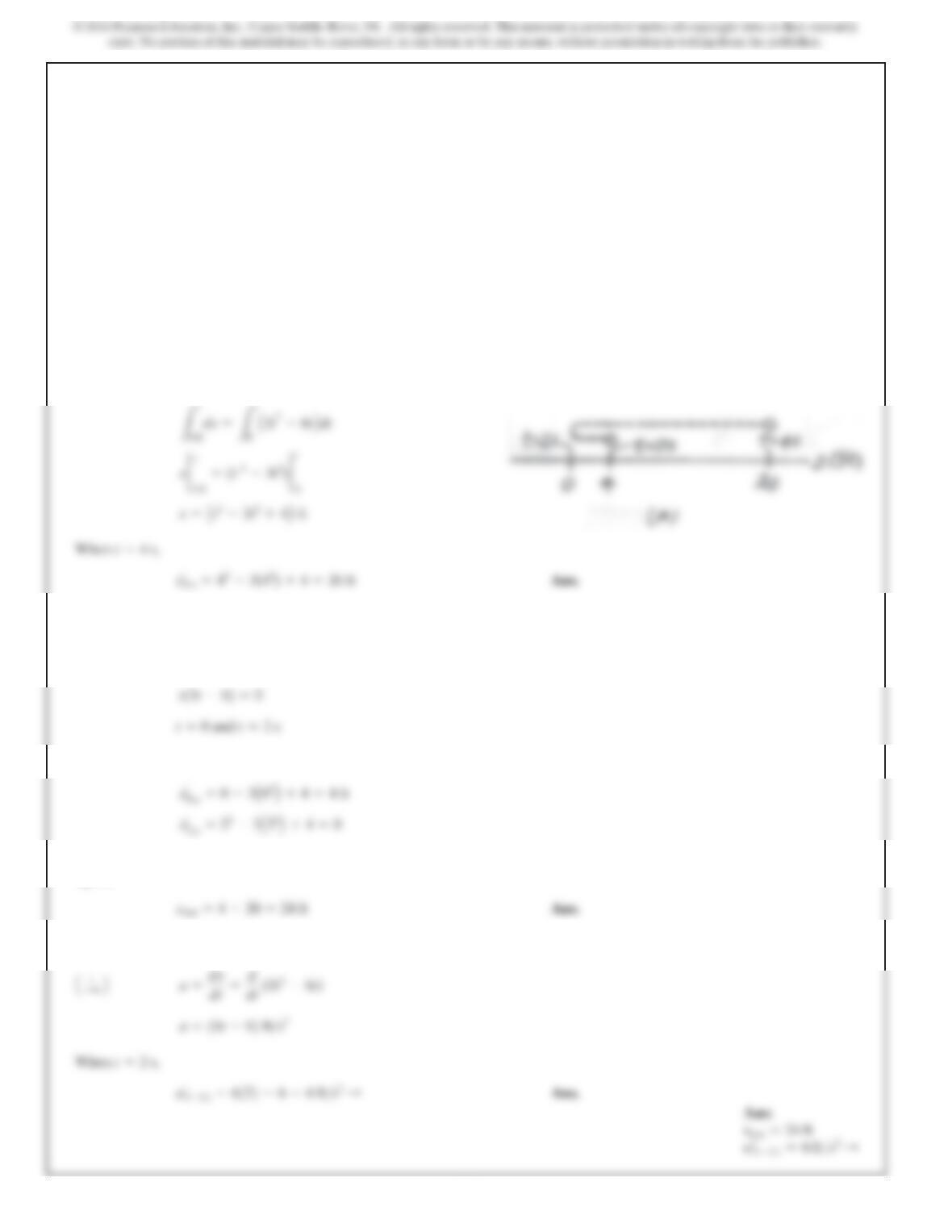
The position of the particle at and 2 s is
Using the above result, the path of the particle shown in Fig.ais plotted. From this
figure,
Acceleration:
t=0
v=3t2–6t=0
ds =v dt
A
+
:
B
t=0 s.s=4 ftds =v dt