181
SOLUTION
Velocity. Using the chain rule, the first and second time derivatives of r can be
determined.
The radial and transverse components of the velocity are
Since
u
#
is in the opposite sense to that of positive
u
, u
#
=–
6 rad
>
s. Thus, at u
=150°,
Thus, the magnitude of the velocity is
These components are shown in Fig. a
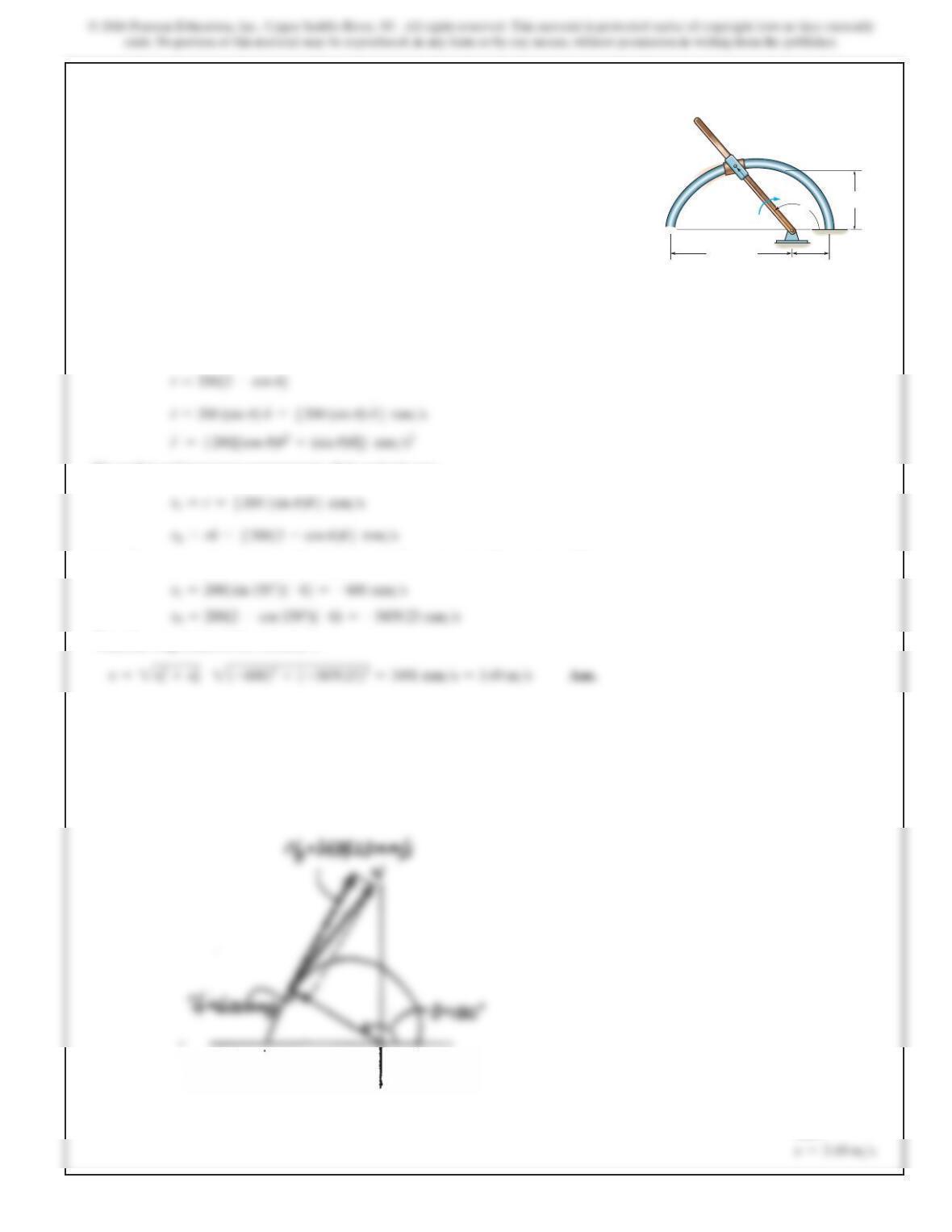
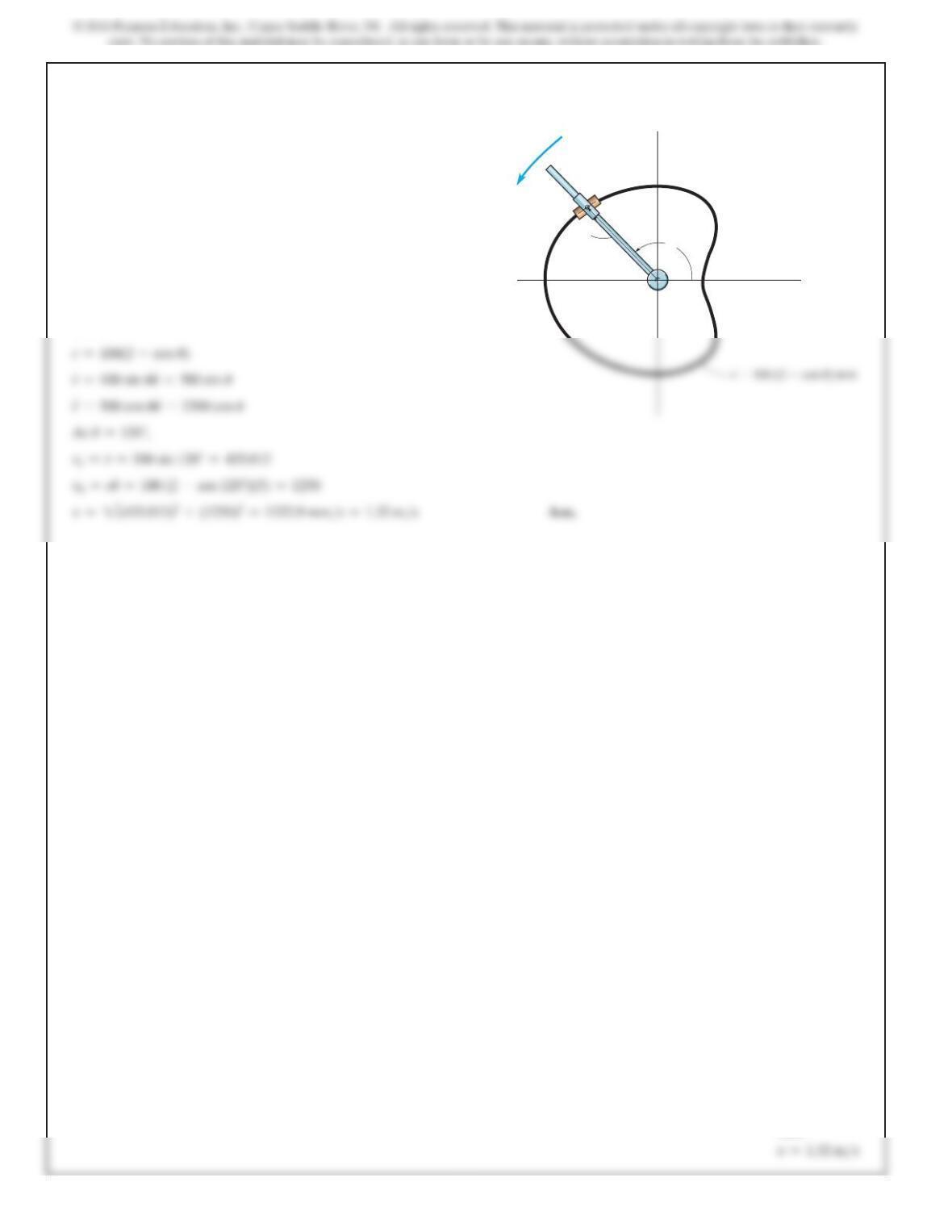
*12–172.
The rod OA rotates clockwise with a constant angular velocity
of 6 rad
>
s. Two pin-connected slider blocks, located at B, move
freely on OA and the curved rod whose shape is a limaçon
described by the equation r = 200(2 − cos
u
) mm. Determine
the speed of the slider blocks at the instant
u=150°
.
O
400 mm
200 mm
600 mm
r
6 rad/s
B
A
u
Ans:
182
SOLUTION
Acceleration. Using the chain rule, the first and second time derivatives of r can be
determined
Here, since
u
#
is constant,
u
$
=0.
Since
u
#
is in the opposite sense to that of positive
u
,
The radial and transverse components of the acceleration are
Thus, the magnitude of the acceleration is
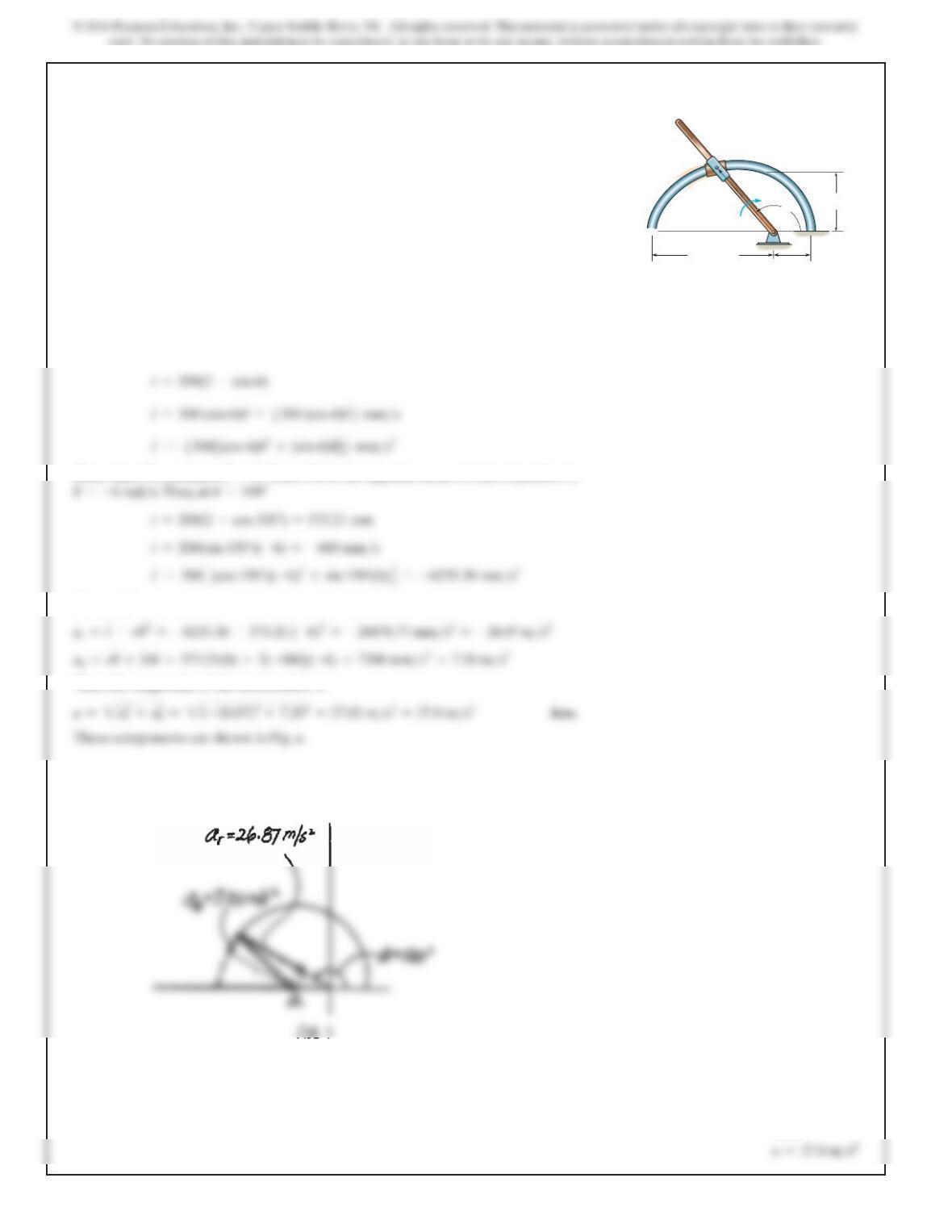
12–173.
Determine the magnitude of the acceleration of the slider
blocks in Prob. 12–172 when
u
= 150°.
O
400 mm
200 mm
600 mm
r
6 rad/s
B
A
u
Ans:
183
SOLUTION
r2=4 cos 2u
u
u
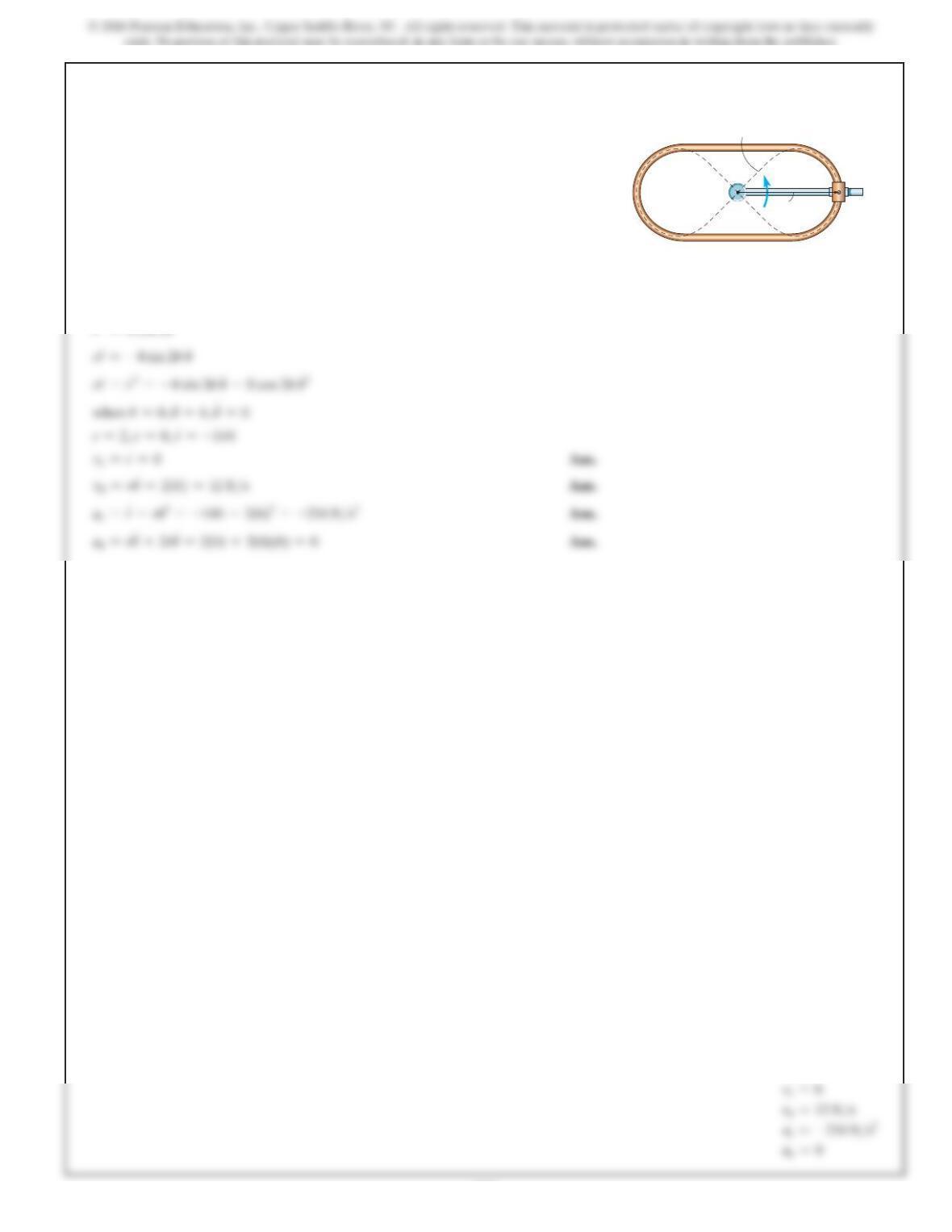
12–174.
A double collar C is pin connected together such that one
collar slides over a fixed rod and the other slides over a
rotating rod. If the geometry of the fixed rod for a short
distance can be defined by a lemniscate, r2 = (4 cos 2
u
) ft2,
determine the collar’s radial and transverse components of
velocity and acceleration at the instant
u
= 0° as shown. Rod
OA is rotating at a constant rate of
u
#
= 6 rad
>
s.
r2 fi 4 cos 2 u
u fi 6 rad/s
O
rC
A
·
Ans:
184
12–175.
SOLUTION
r=4t|t=1=4r
#
=4
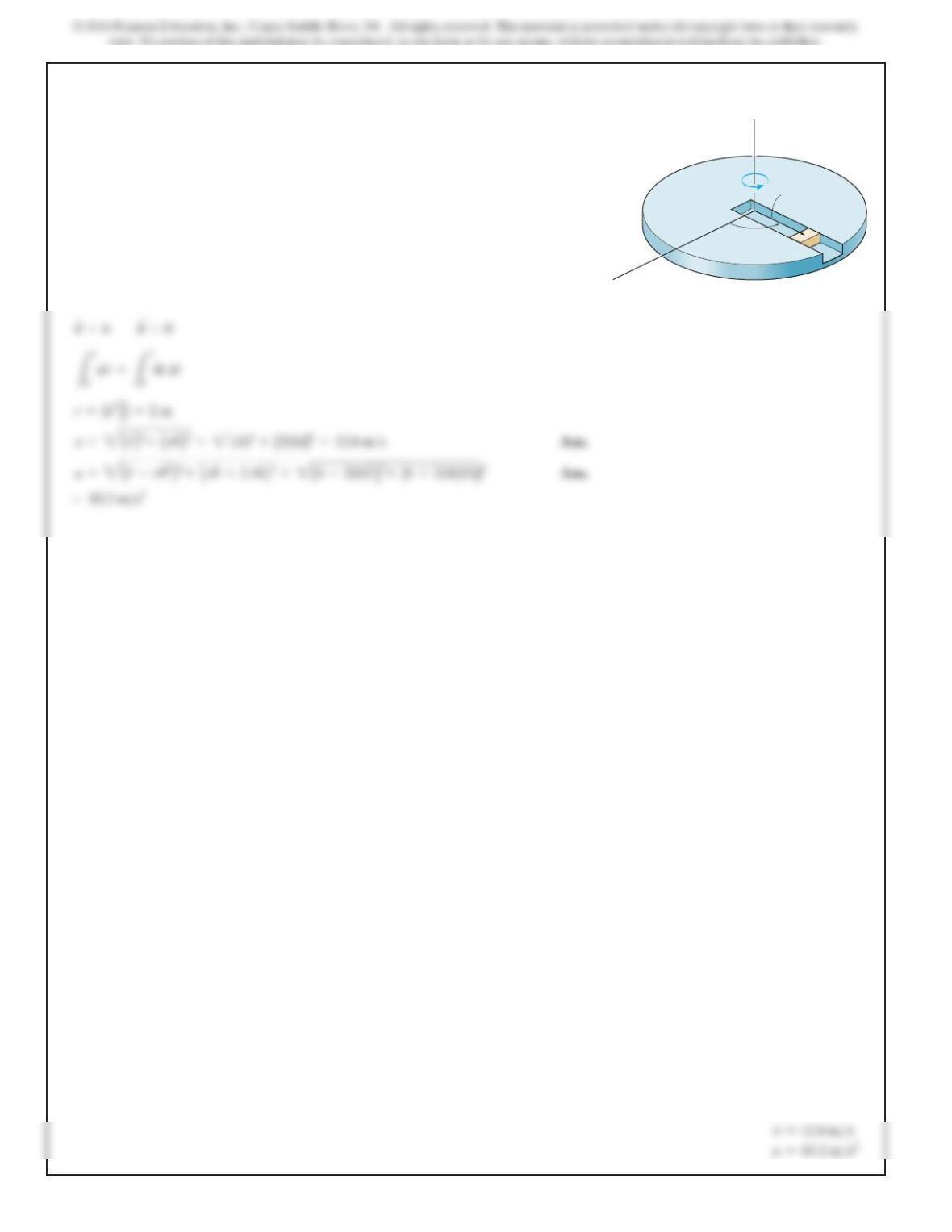
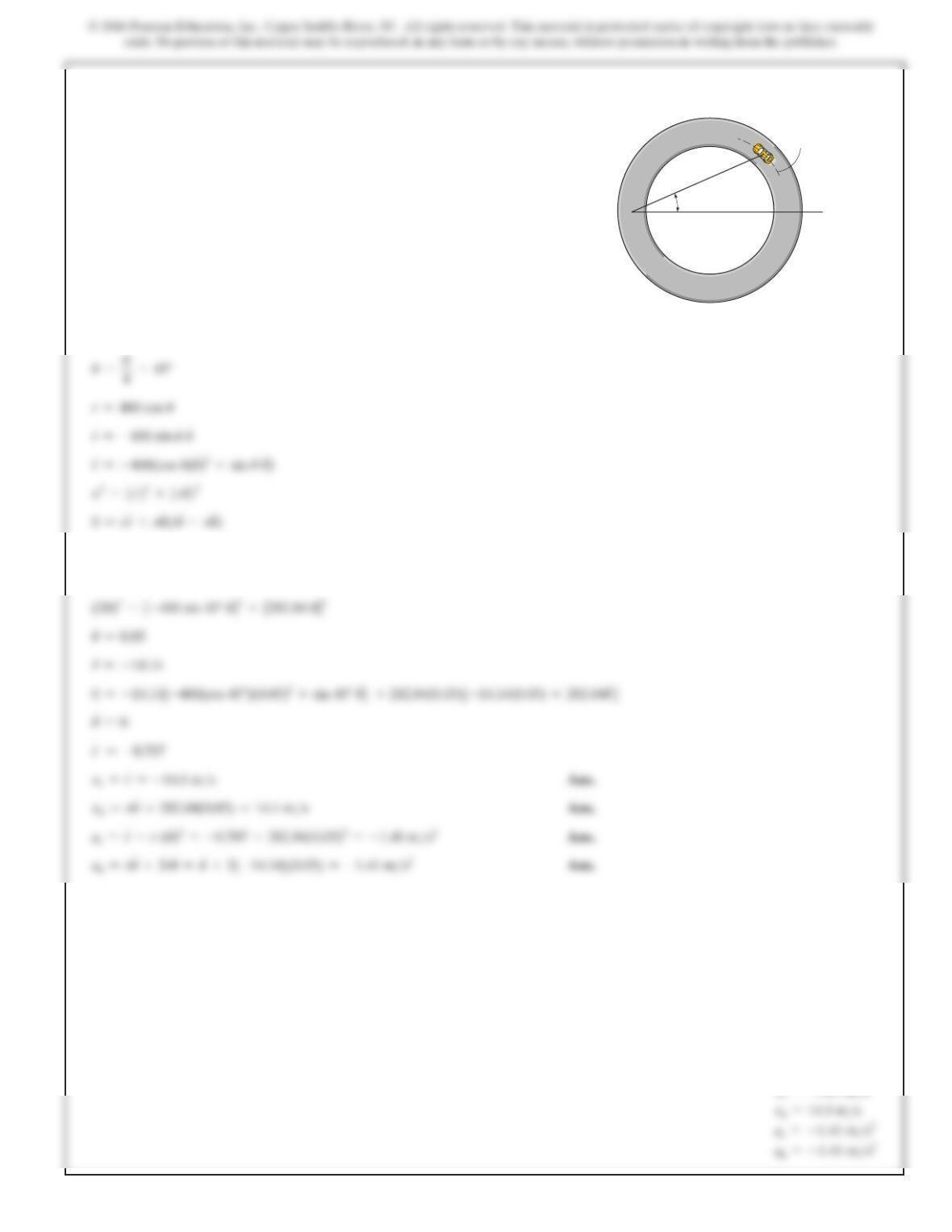
A block moves outward along the slot in the platform with
a speed of where tis in seconds.The platform
rotates at a constant rate of 6 rad/s. If the block starts from
rest at the center, determine the magnitudes of its velocity
and acceleration when t=1s.
r
#
=14t2m>s,
θ
θ
·=6rad/s
r
$
Ans:
185
SOLUTION
v
=
20
m>s
Thus
r=282.84
*12–176.
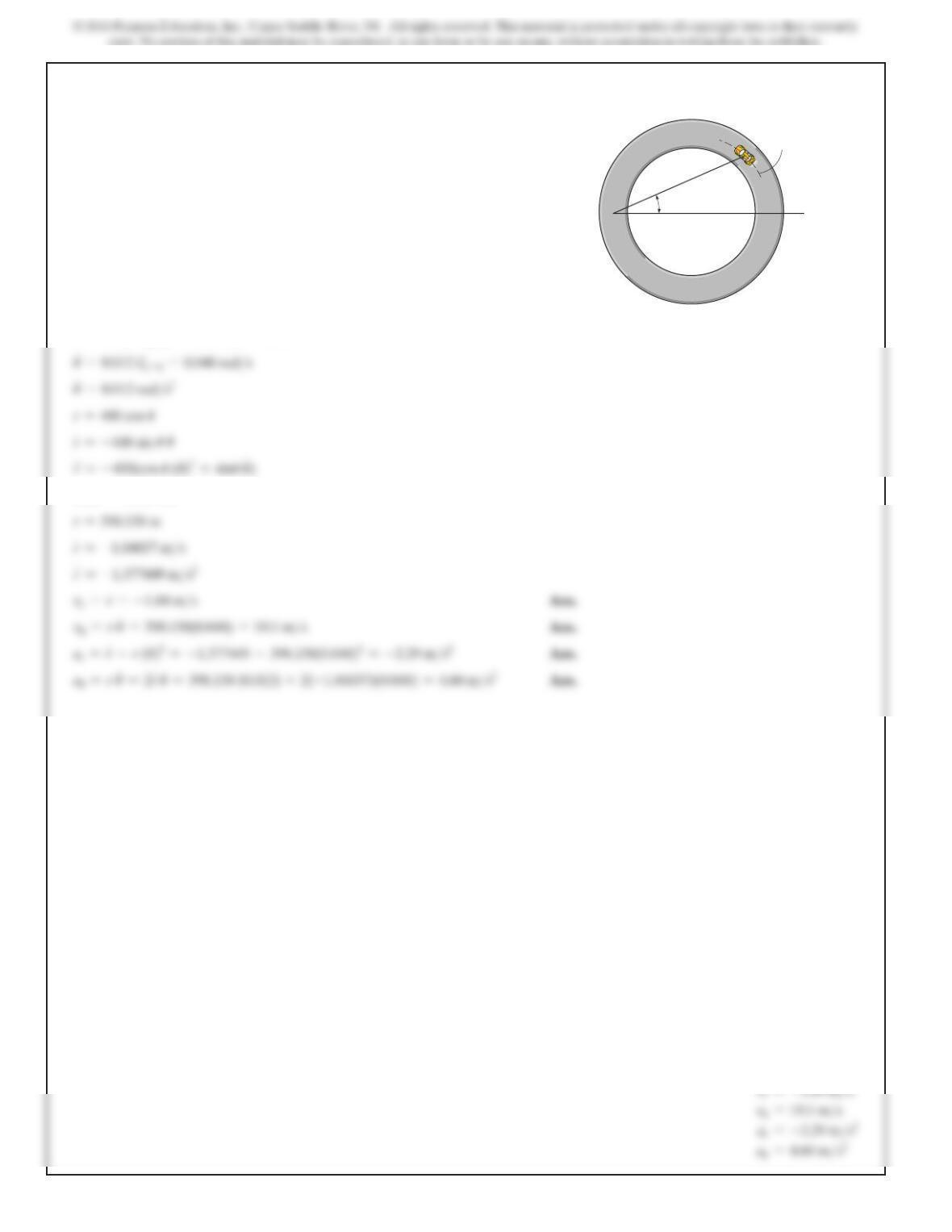
The car travels around the circular track with a constant
speed of 20 m
>
s. Determine the car’s radial and transverse
components of velocity and acceleration at the instant
u
=
p
>4 rad
.
r (400 cos u) m
r
u
Ans:
vr=–14.1 m>s
186
SOLUTION
u
=0.006
t
2
0
t=4=0.096 rad =5.50°
=0.012
At
u=0.096 rad
12–177.
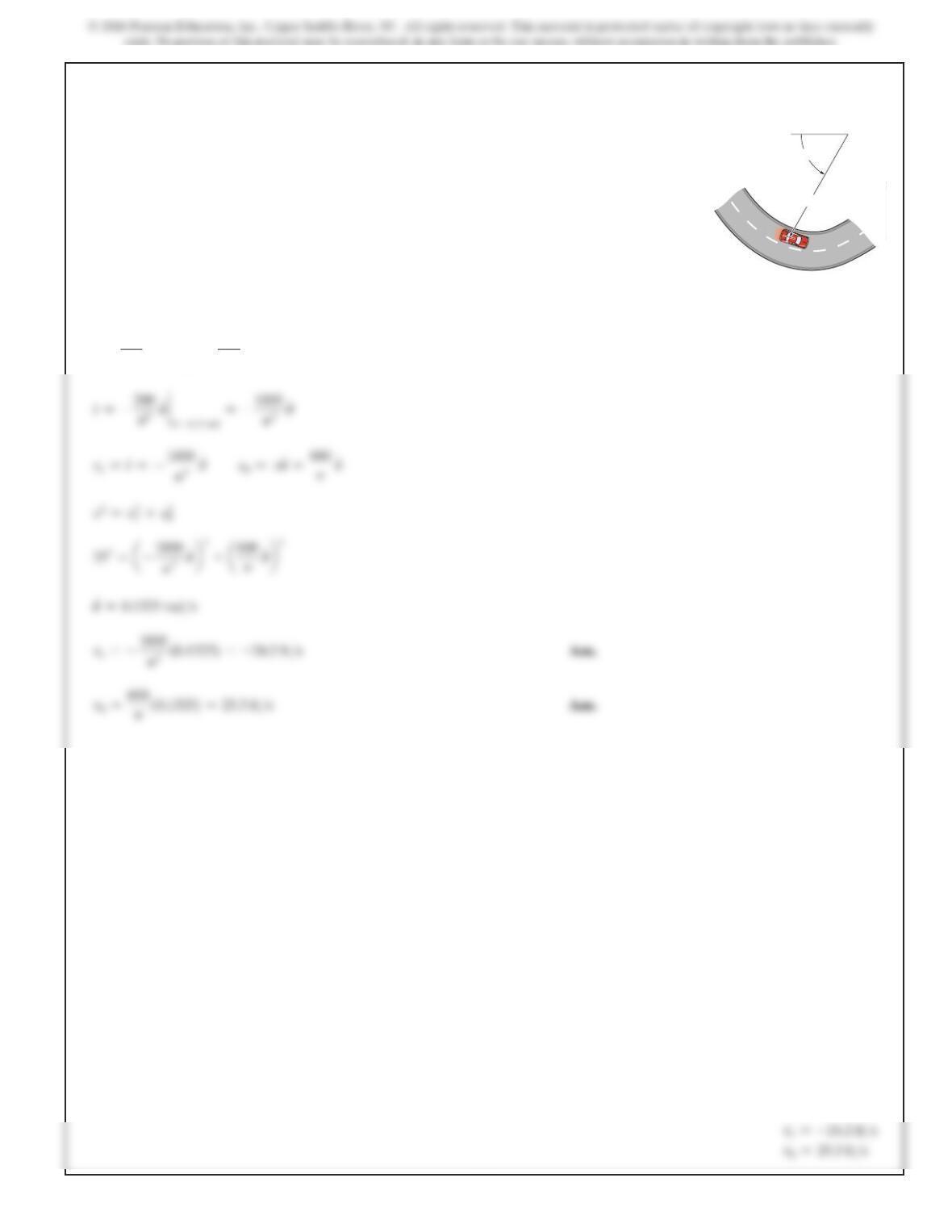
The car travels around the circular track such that its
transverse component is
u
= (0.006t2) rad, where t is in
seconds. Determine the car’s radial and transverse
components of velocity and acceleration at the instant t
=
4 s.
r (400 cos u) m
r
u
Ans:
187
12–178.
SOLUTION
r=
200
u`u=p>3 rad
=
600
p ft
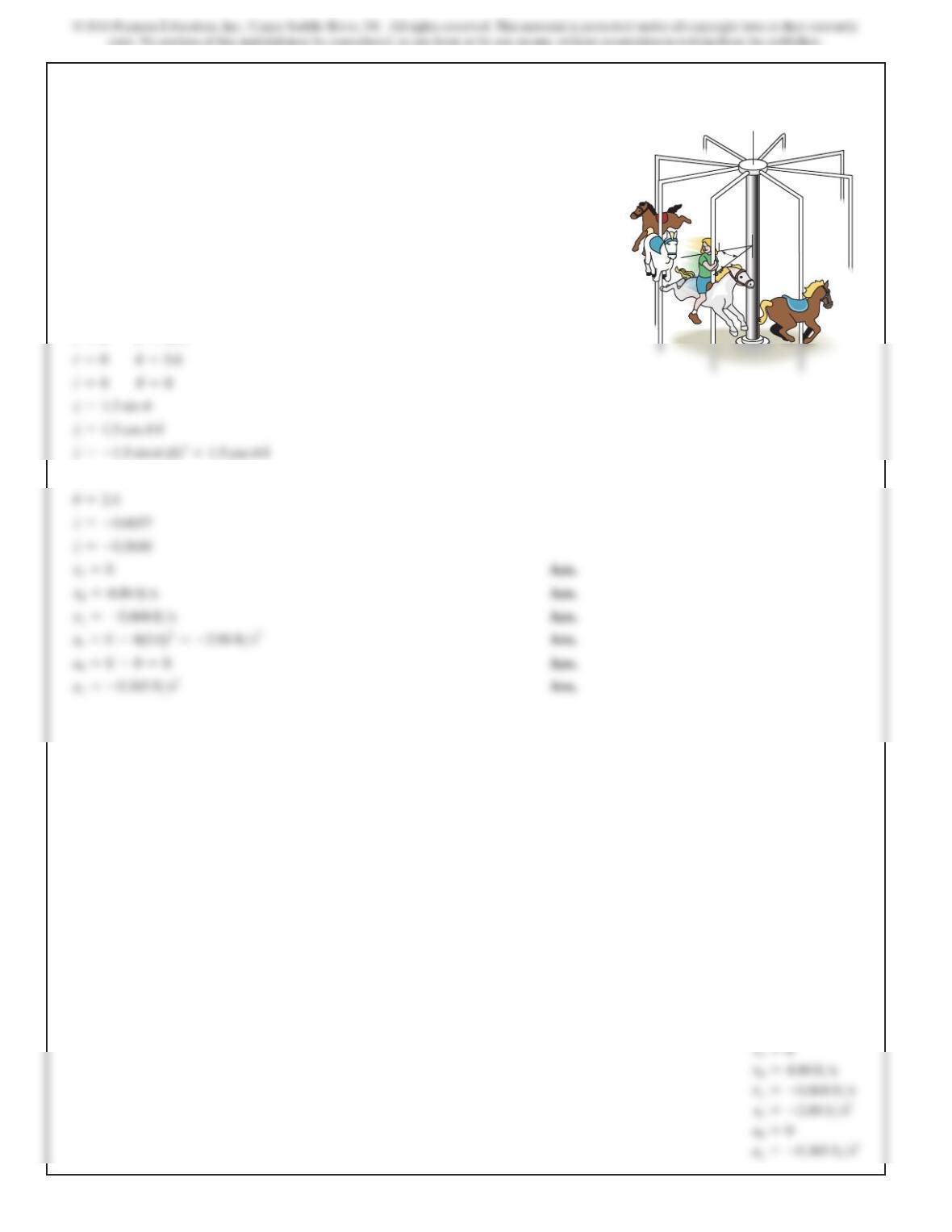
The car travels along a road which for a short distance
is defi ned by r=(200>u) ft, where u is in radians. If it
maintains a constant speed of v=35 ft>s, determine the
radial and transverse components of its velocity when
u=p>3 rad. r
θ
Ans:
188
SOLUTION
r=8
u=0.6 t
u
u
At
t=4 s
12–179.
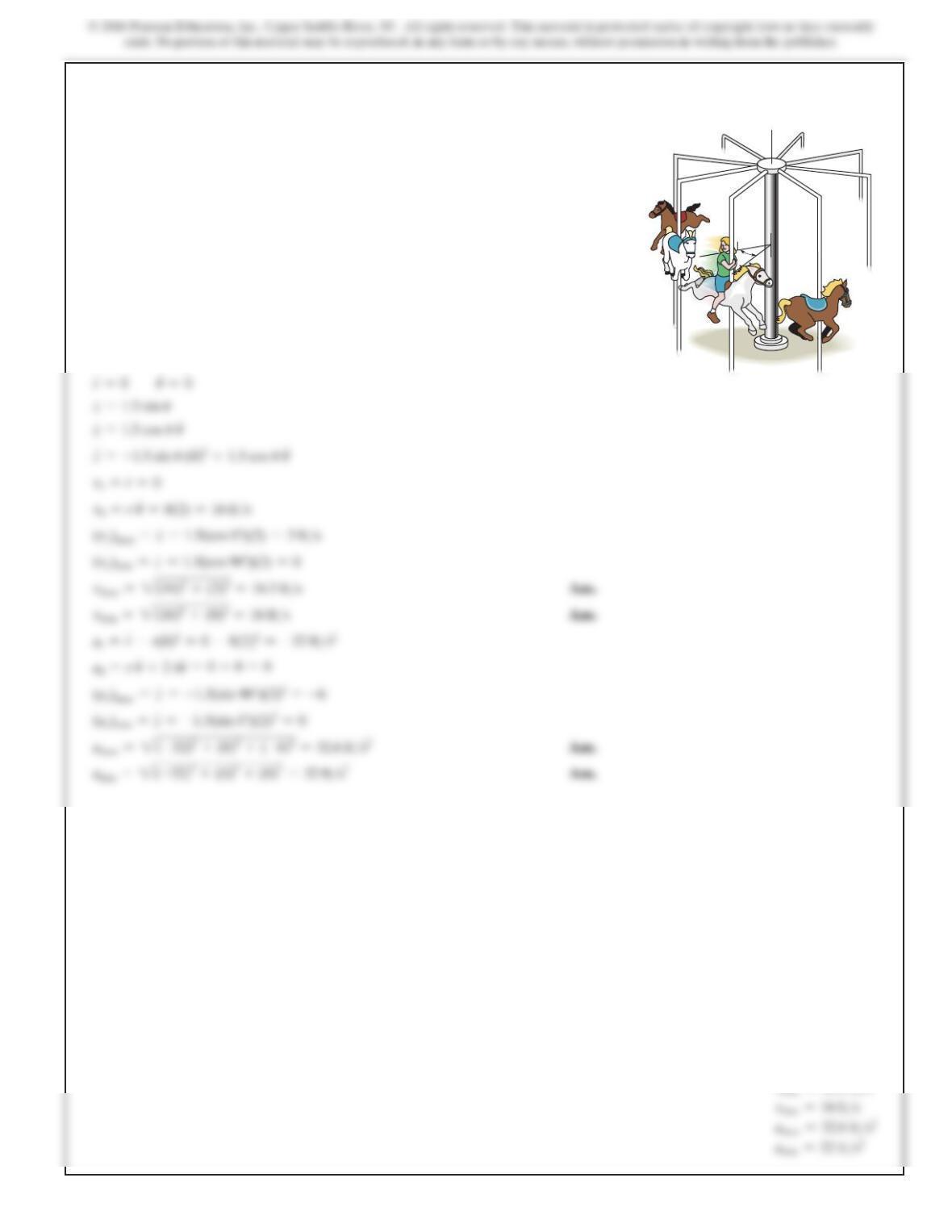
A horse on the merry-go-round moves according to the
equations r
=
8 ft,
u
=
(0.6t) rad, and z
=
(1.5 sin
u
) ft,
where t is in seconds. Determine the cylindrical components
of the velocity and acceleration of the horse when t
=
4 s.
z
z
r
u
Ans:
189
SOLUTION
r=8
r
#
=0
u
#
=2
u
=0
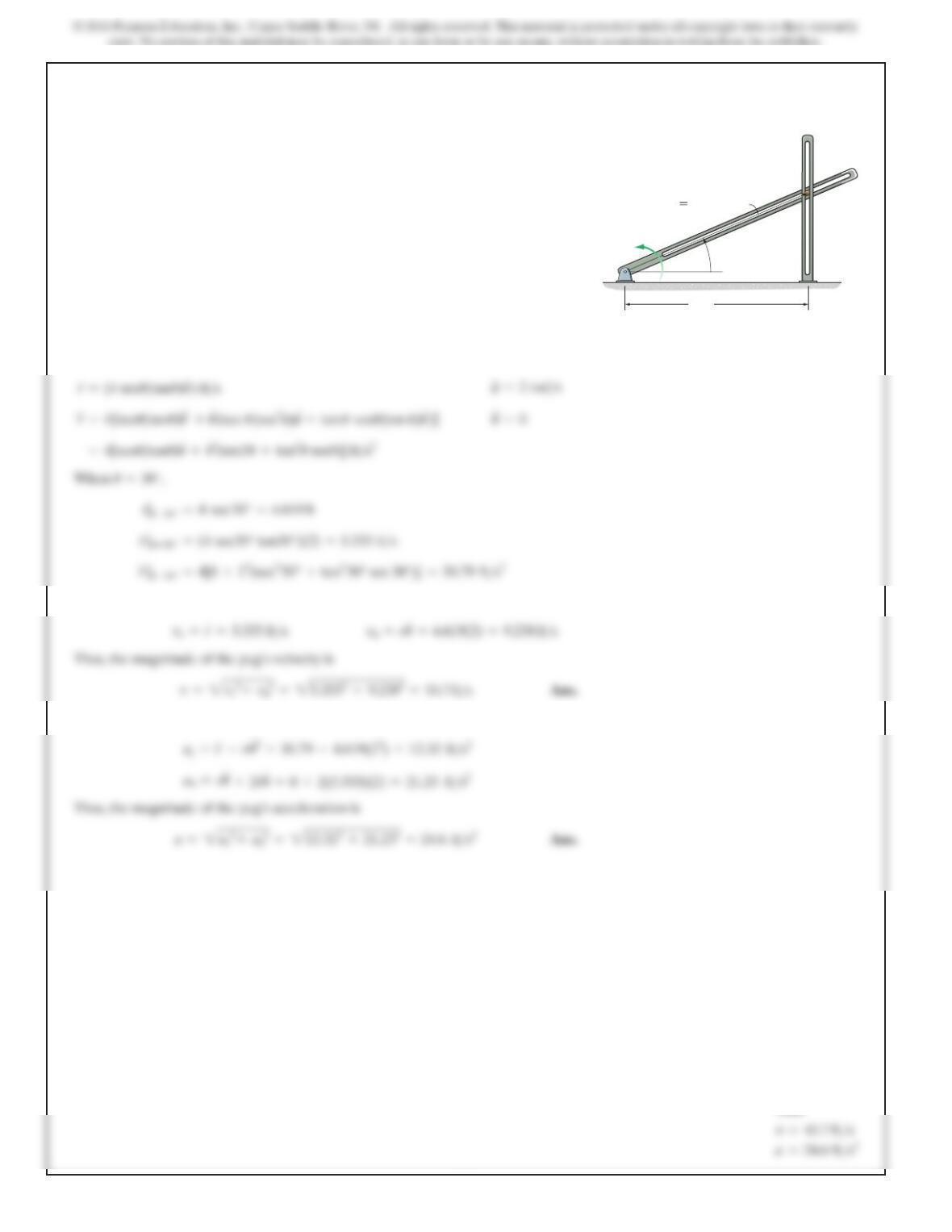
*12–180.
A horse on the merry-go-round moves according to the
equations r
=
8 ft,
u
#
=
2 rad
>
s and z
=
(1.5 sin
u
) ft, where
t is in seconds. Determine the maximum and minimum
magnitudes of the velocity and acceleration of the horse
during the motion.
z
z
r
u
Ans:
vmax =16.3
ft>s
vmin =16
190
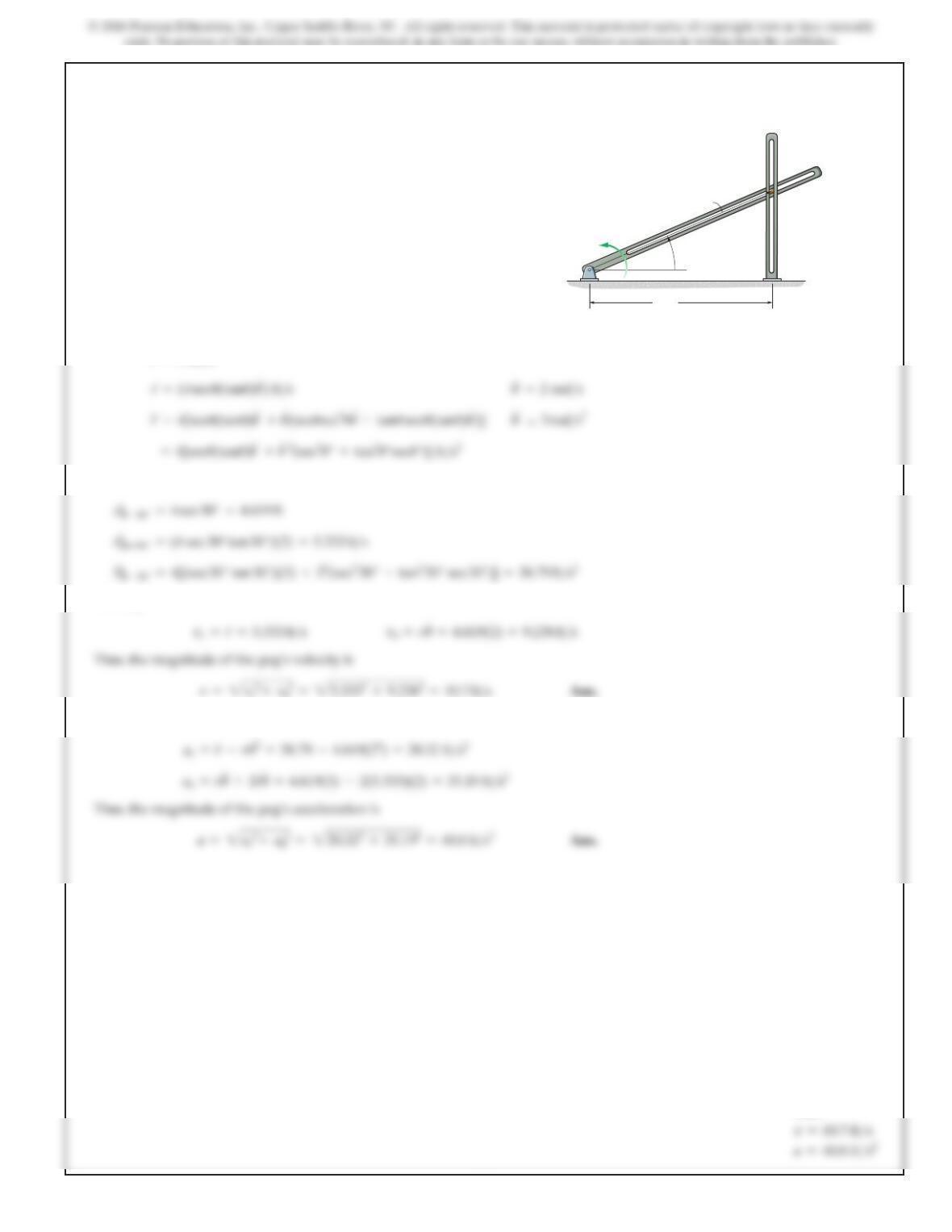
12–181.
If the slotted arm rotates counterclockwise with a
constant angular velocity of , determine the
magnitudes of the velocity and acceleration of peg at
.The peg is constrained to move in the slots of the
fixed bar and rotating bar .ABCD
u=30°
P
u
#
=2 rad>s
AB
SOLUTION
Time Derivatives:
Velocity:
Acceleration:
r=4 sec u
A
D
P
C
r (4 sec ) ft
u
u
4 ft
Ans:
191
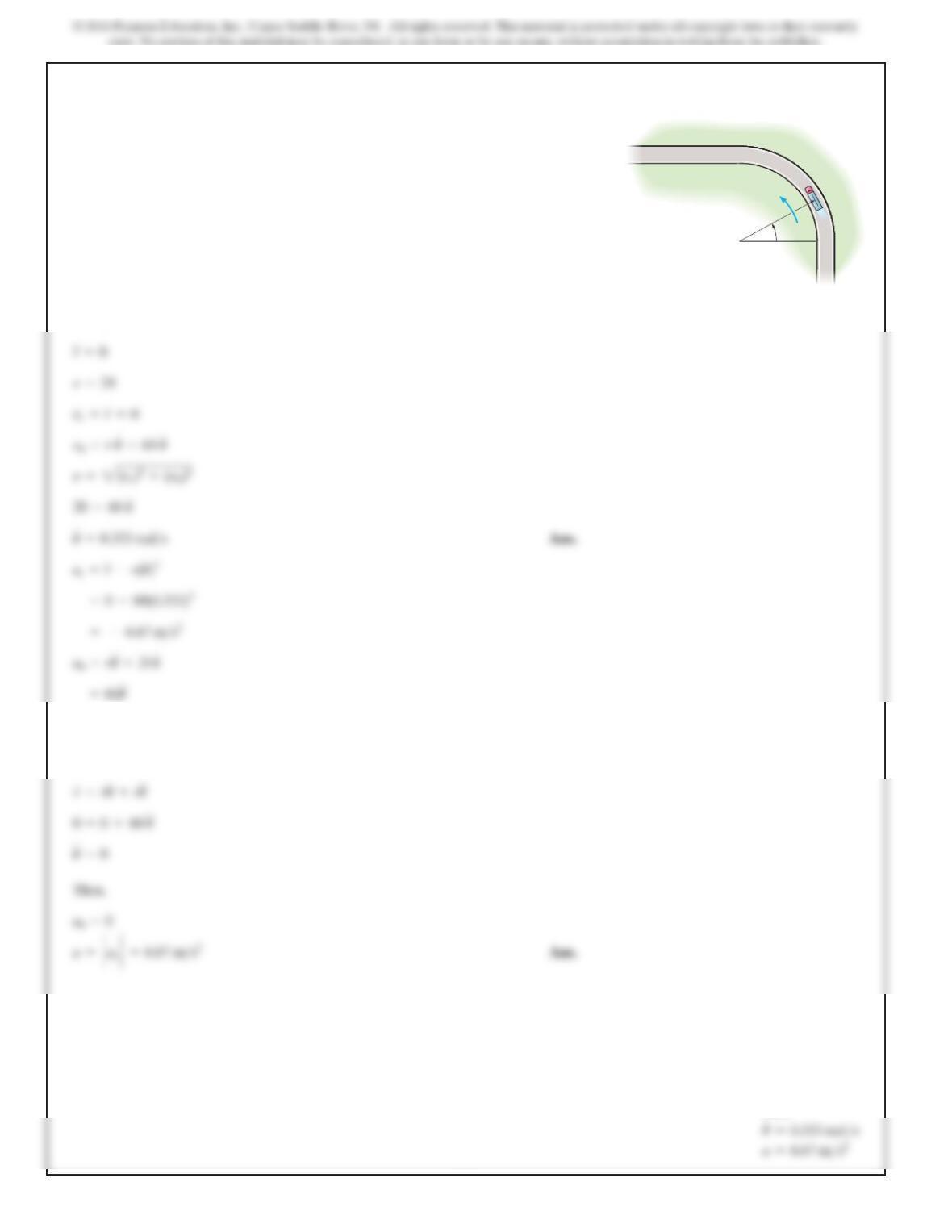
12–182.
The peg is constrained to move in the slots of the fixed bar
and rotating bar .When , the angular
velocity and angular acceleration of arm are
and ,respectively.Determine
the magnitudes of the velocity and acceleration of the peg
at this instant.P
u
$
=3 rad>s2
u
#
=2 rad>s
AB
u=30°ABCD
SOLUTION
Time Derivatives:
When ,
Velocity:
Acceleration:
u=30°
r=4 sec u
A
D
B
P
C
r
fi
(4 sec
)
ft
u
u
4 ft
Ans:
192
12–183.
SOLUTION
Since
v=ru
#
r
#
=0
r=60
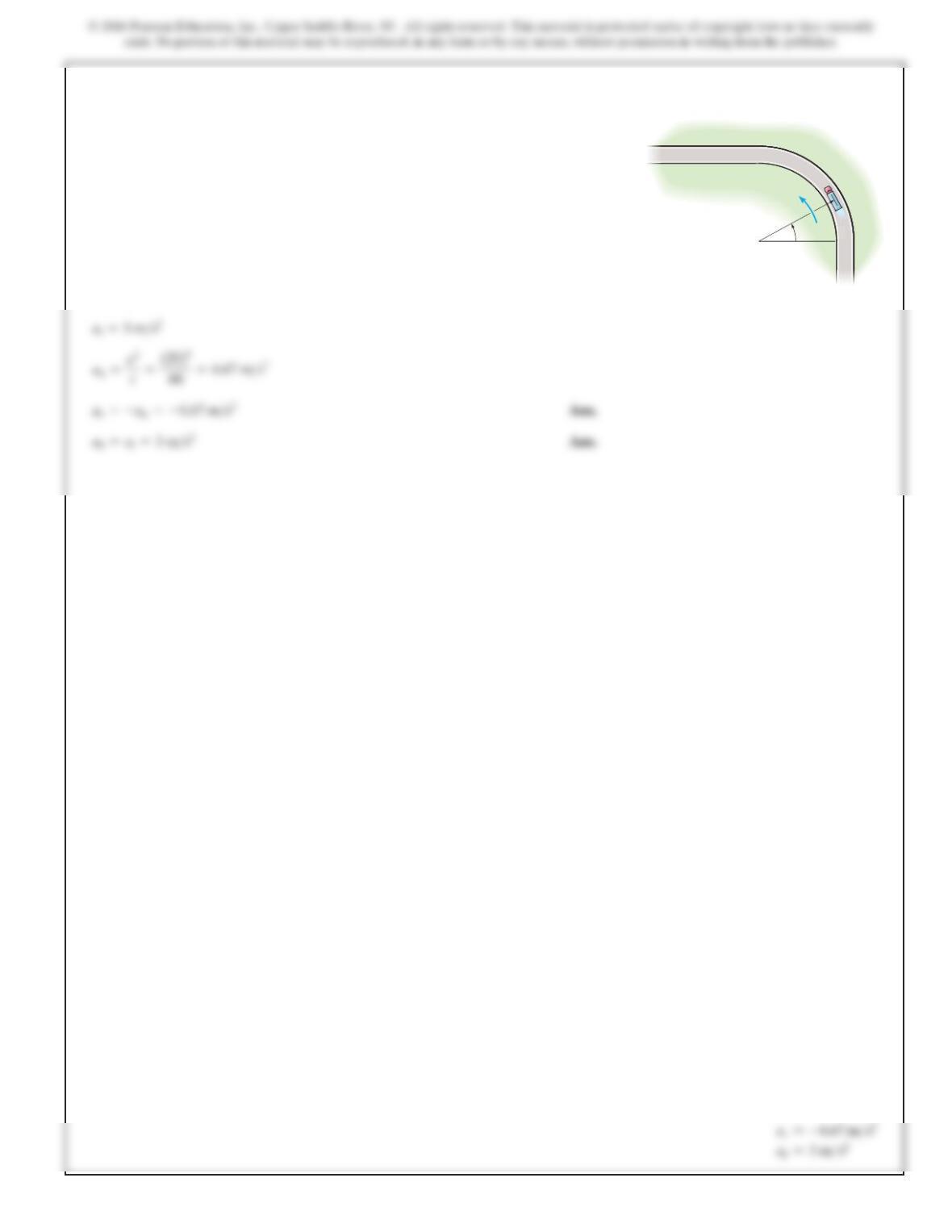
A truck is traveling along the horizontal circular curve of
radius with a constant speed
Determine the angular rate of rotation of the radial line r
and the magnitude of the truck’s acceleration.
u
#v=20 m>s.
r=60 m
rfi60 m
·
u
u
Ans:
193
*12–184.
A truck is traveling along the horizontal circular curve of
r
adius with a speed of which is increasing
at
Determine the truck’s radial and transverse
components of acceleration.
3m>s2.
20 m>sr=60 m
SOLUTION
r=60
rfi60 m
·
u
u
Ans:
194
SOLUTION
#
u=5
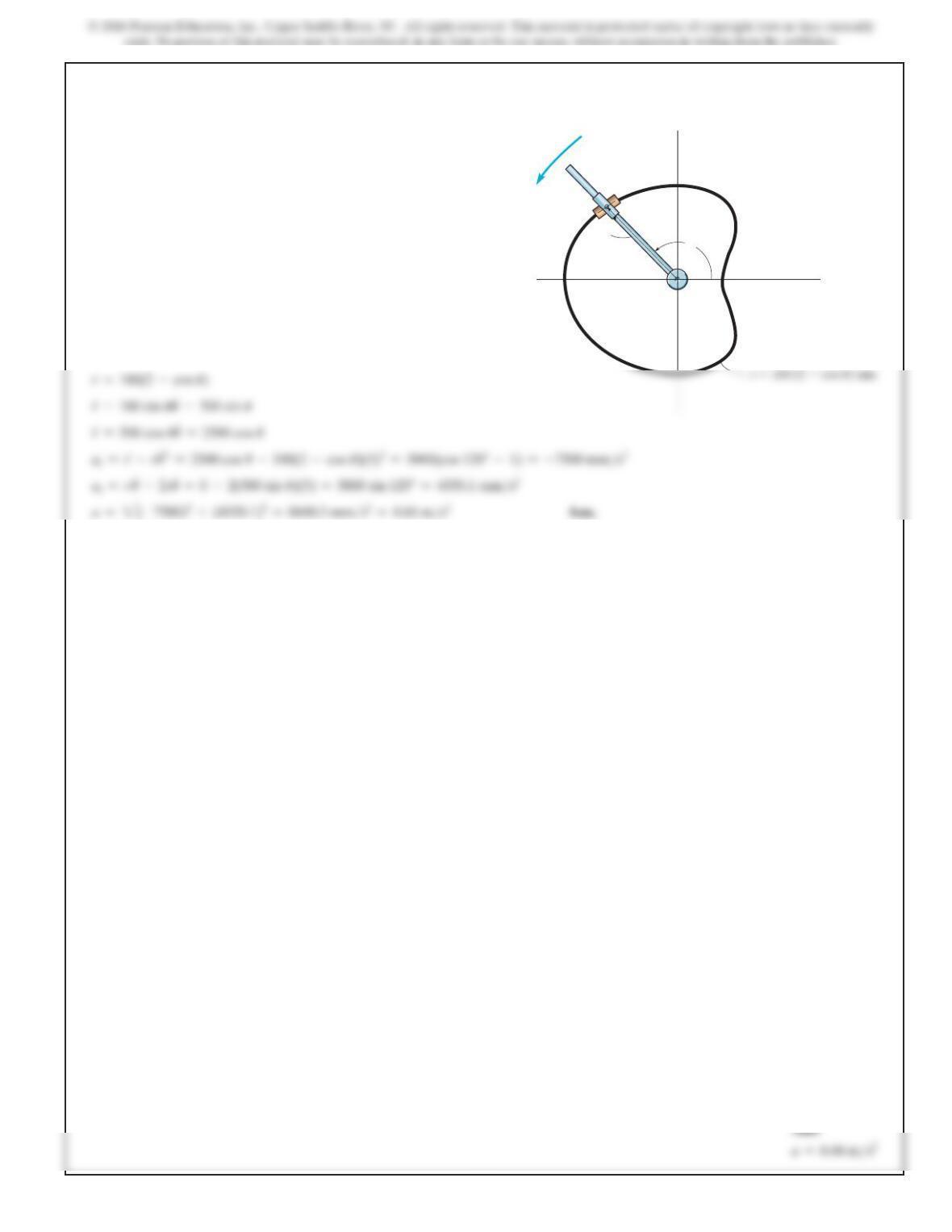
12–185.
The rod OA rotates counterclockwise with a constant
angular velocity of
u
#
= 5 rad
>
s. Two pin-connected slider
blocks, located at B, move freely on OA and the curved rod
whose shape is a limaçon described by the equation
r = 100(2 − cos
u
) mm. Determine the speed of the slider
blocks at the instant
u
= 120°.
A
u
O
B
r
y
x
·
u fi 5 rad/s
Ans:
195
SOLUTION
u
#
=5
u
#
=0
12–186.
Determine the magnitude of the acceleration of the slider
blocks in Prob. 12–185 when
u
= 120°.
A
u
O
B
r
y
x
·
u fi 5 rad/s
196
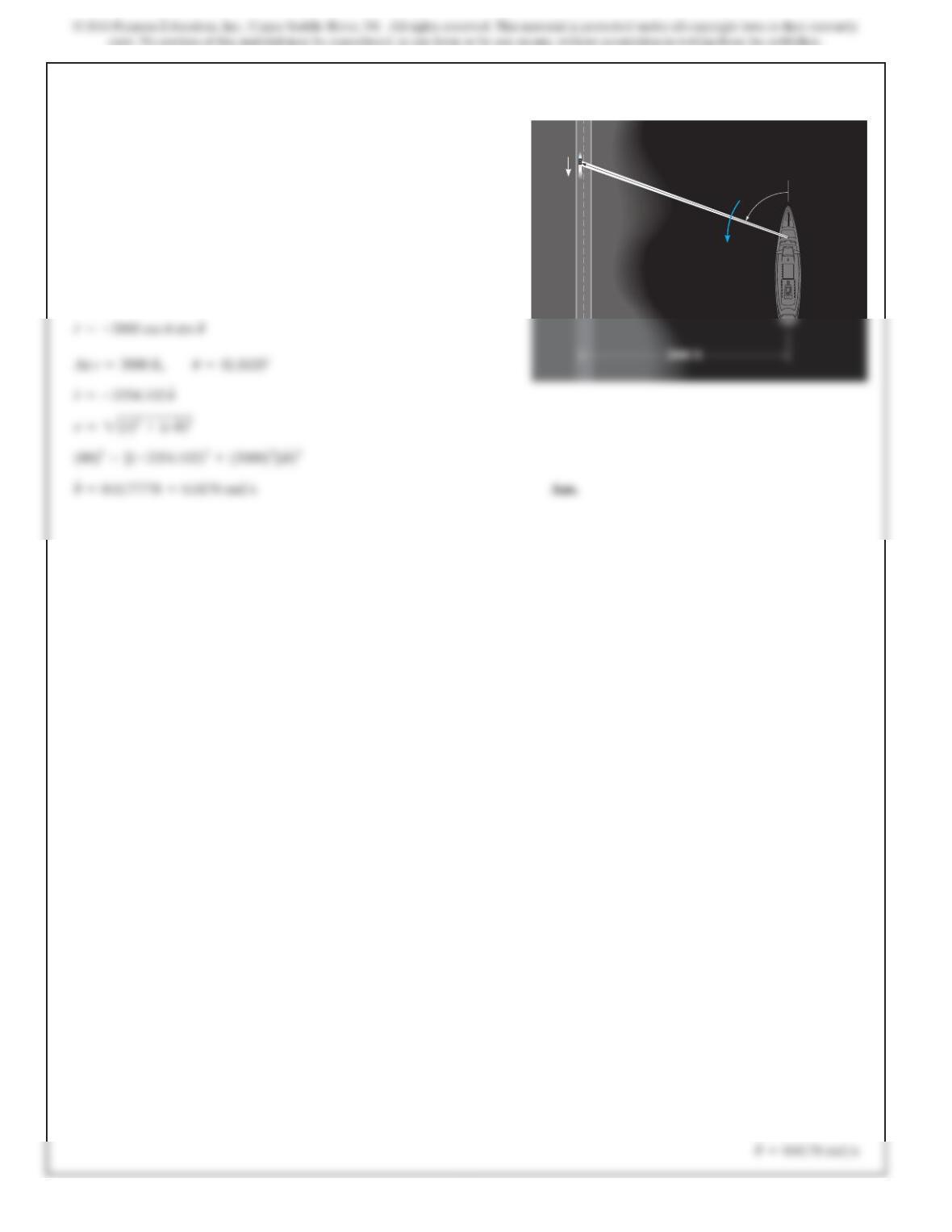
12–187.
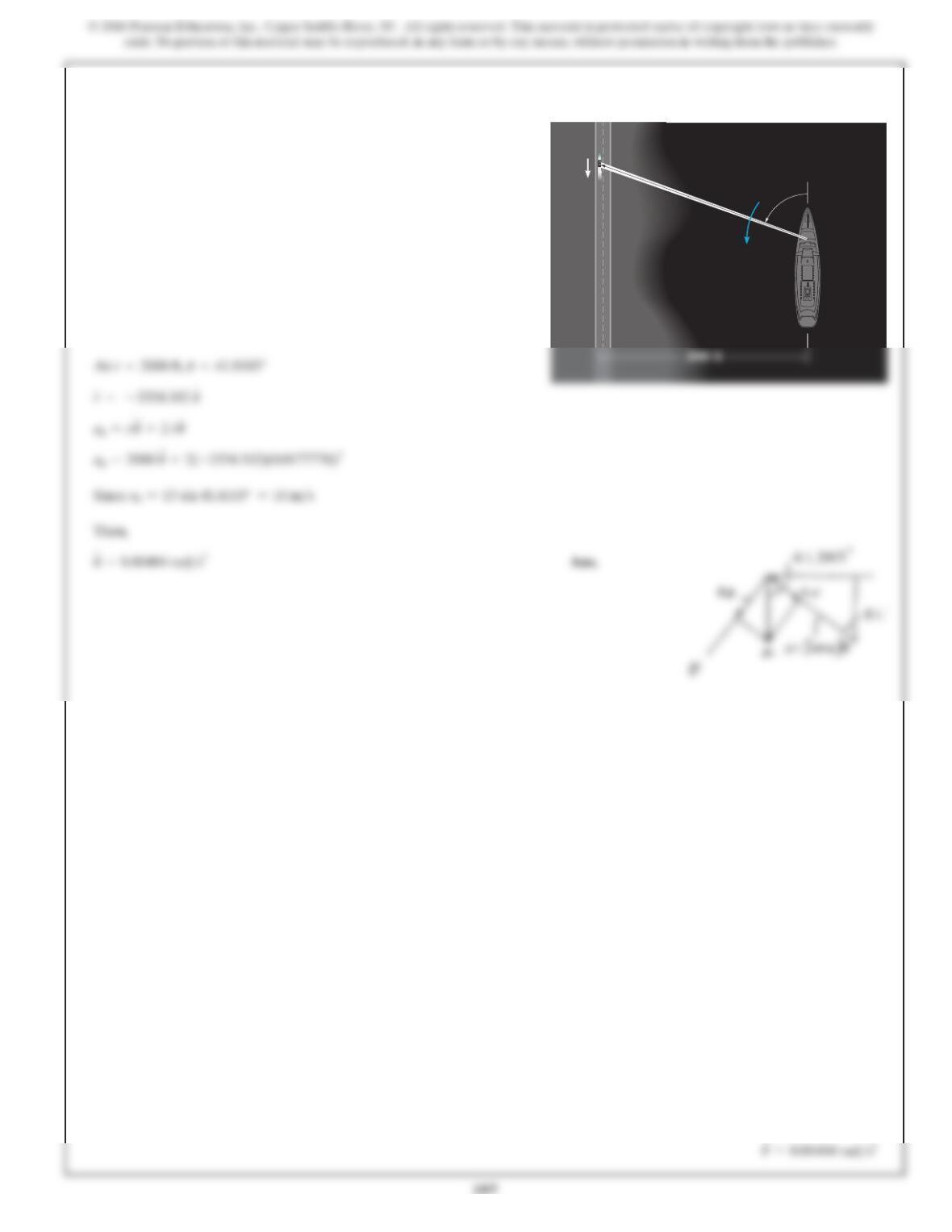
The searchlight on the boat anchored 2000 ft from shore is
turned on the automobile, which is traveling along the
straight road at a constant speed of Determine the
angular rate of rotation of the light when the automobile is
from the boat.r=3000 ft
80 ft>s.
80 ft/s
ru
u
SOLUTION
r=2000 csc u
Ans:
*12–188.
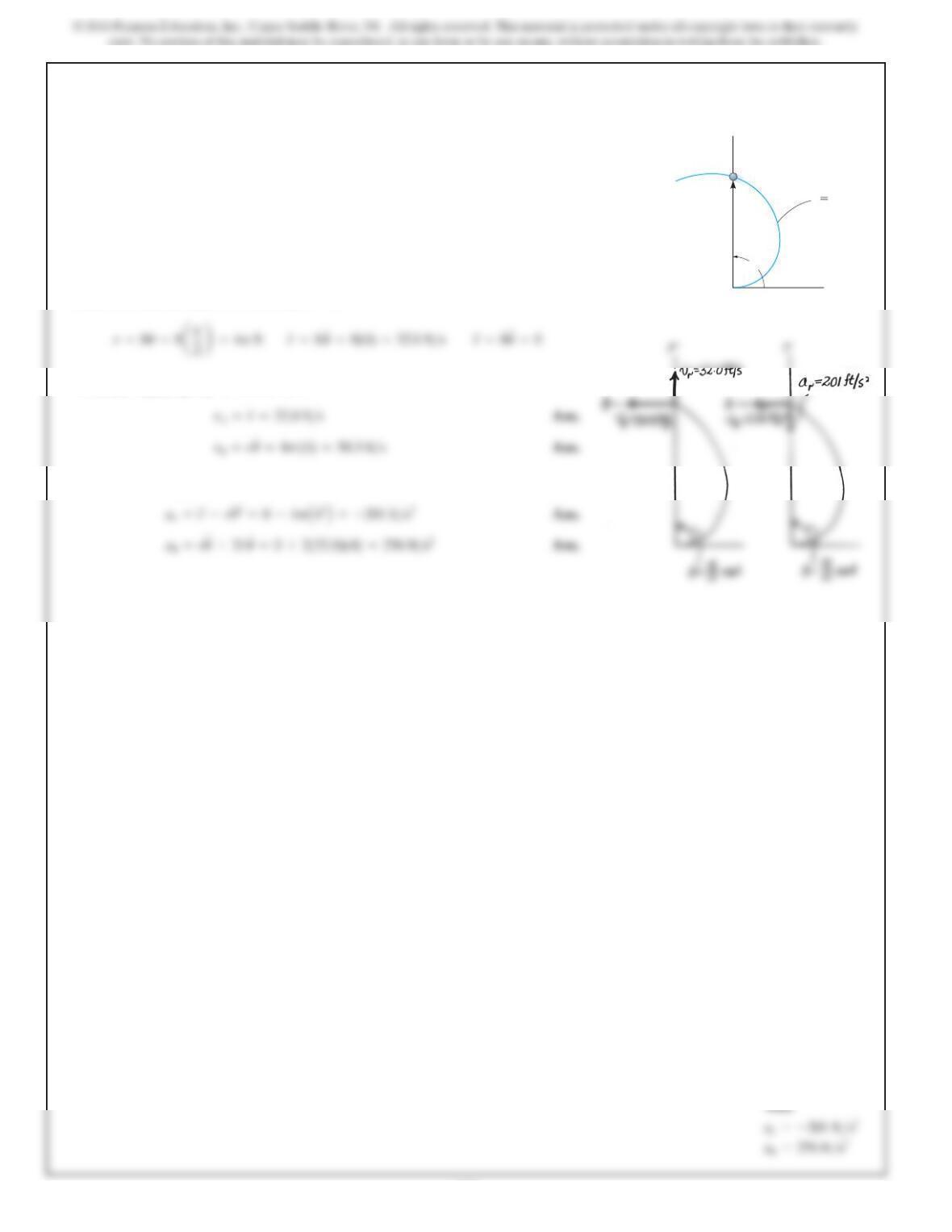
$
required angular acceleration of the light at this instant.u
a velocity of at the instant determine ther=3000 ft,80 ft>s
If the car
>
is accelerating at and has 15 ft s2
80 ft/s
ru
u
SOLUTION
r
#
=-2000 csc uctn uu
#
r=2000 csc u
in Prob. 12–187
Ans:
198
12–189.
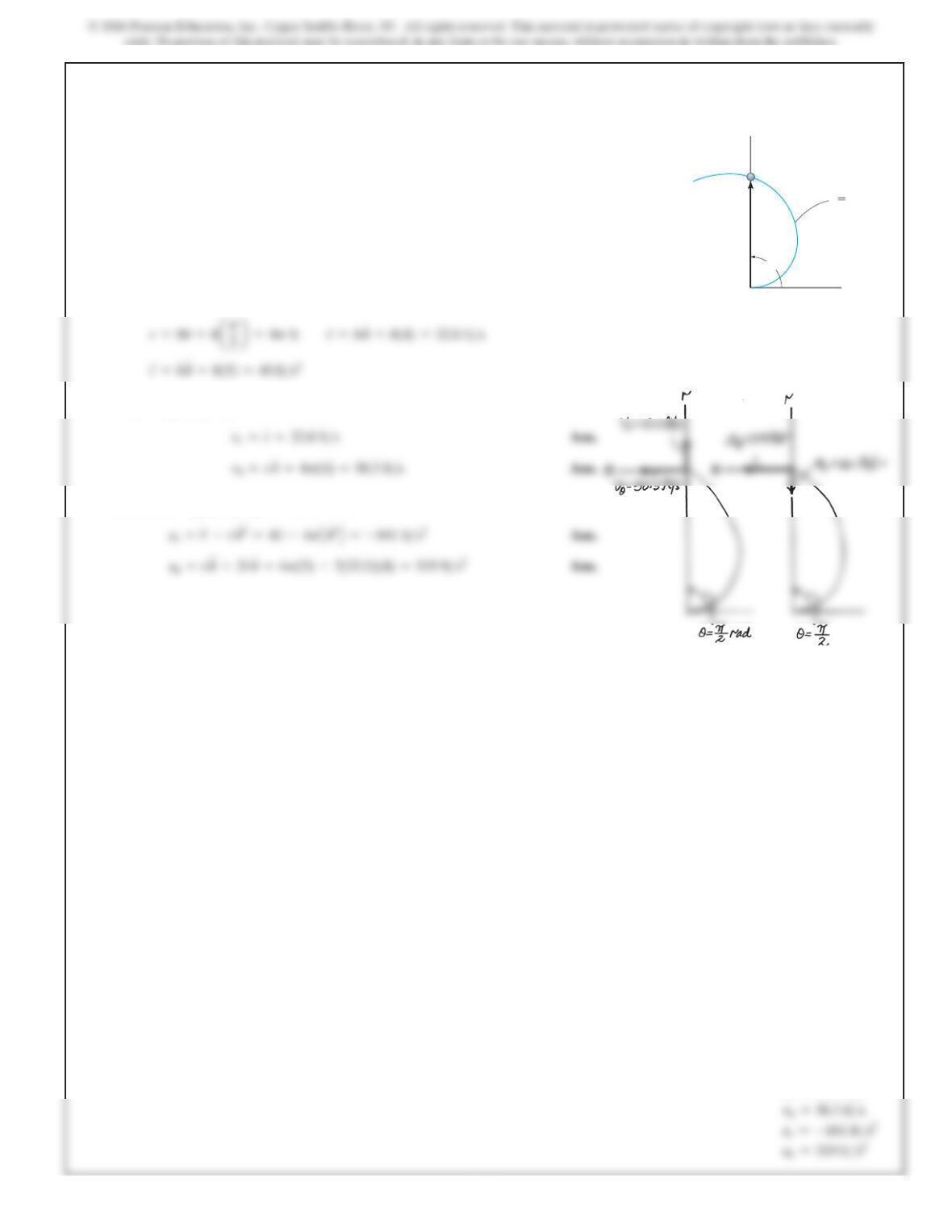
A particle moves along an Archimedean spiral ,
where is given in radians. If (constant),
determine the radial and transverse components of the
particle’s velocity and acceleration at the instant
. Sketch the curve and show the components on
the curve.
u=p>2 rad
u
#
=4 rad>su
r
=(8
u
)ft
SOLUTION
Time Derivatives: Since is constant, .
Velocity:Applying Eq. 12–25, we have
Acceleration: Applying Eq. 12–29, we have
u
$
=0u
#
y
x
u
r(8 u)ft
r
199
12–190.
SOLUTION
Time Derivatives:Here,
Velocity: Applying Eq. 12–25, we have
Acceleration: Applying Eq. 12–29, we have
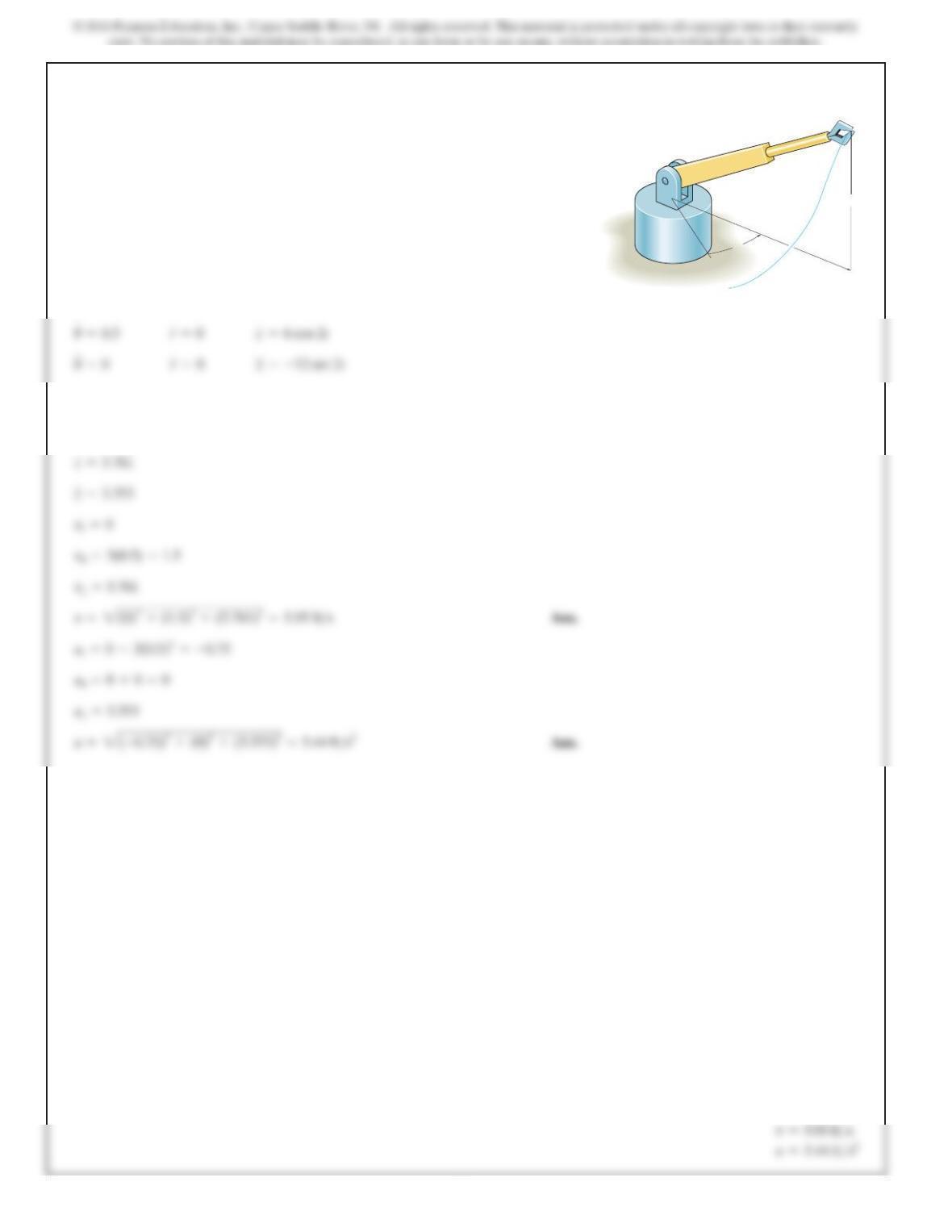
Solve Prob. 12–189 i f the particle has an angular
acceleration when at rad.u=p2u
#
=4 rad>su
$
=5 rad>s2
y
x
u
r(8 u)f
t
r
>
Ans:
v
r=
32.0
ft>s
200
12–191.
SOLUTION
At ,
z=-0.8382
t=3s
u=0.5 tr=3z=3 sin 2t
r
z
A
u
The arm of the robot moves so that r = 3 ft is constant, and
4
1
its grip
A moves along the path z = 3 sin u2ft, where u is in
radians. If ut= 10.5 2rad, where t is in seconds, determine the
magnitudes
of the grip’s
velocity and acceleration when t = 3 s.
Ans: