8 1
SOLUTION
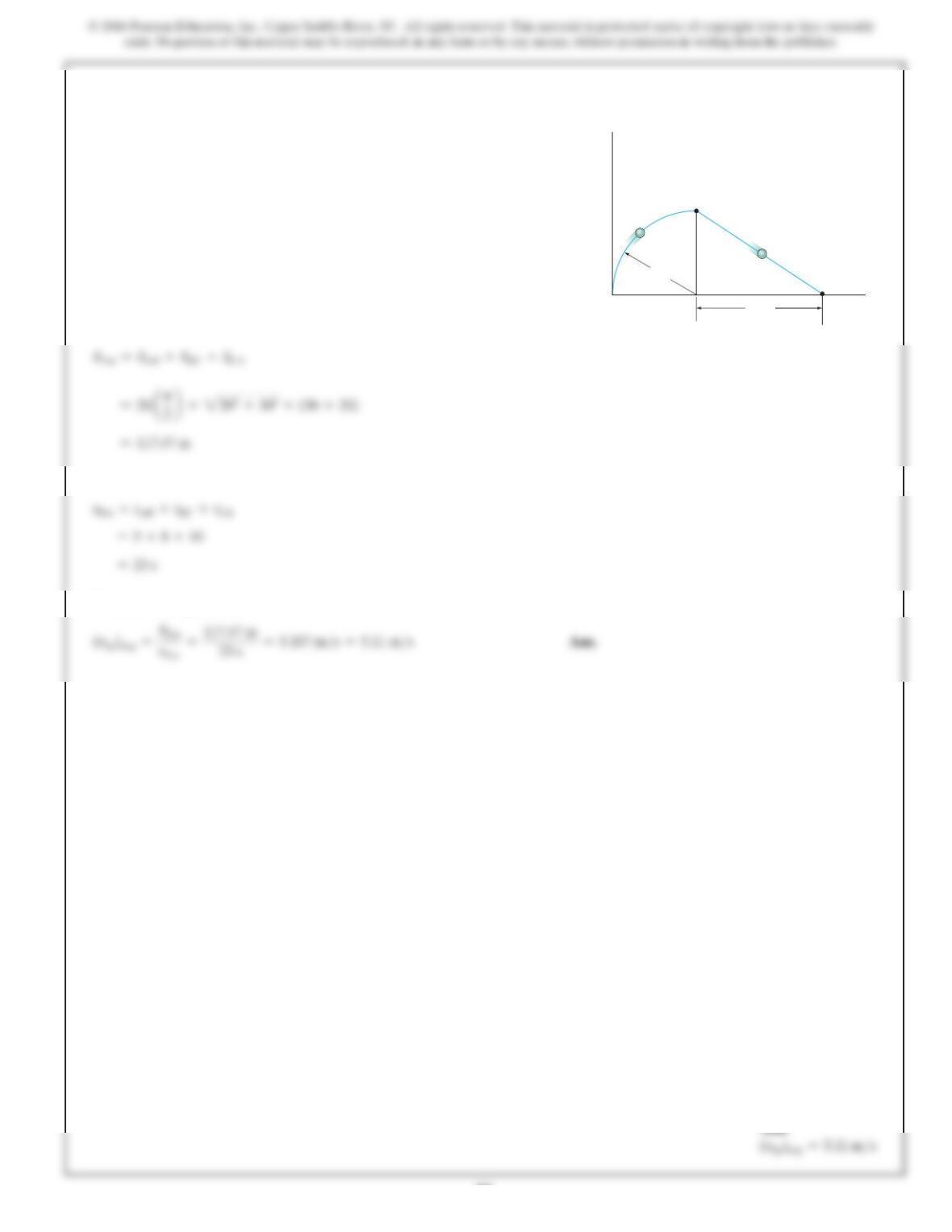
The total distance traveled is
The total time taken is
Thus, the average speed is
*12–76.
A particle travels along the curve from A to B in 5 s. It
takes 8 s for it to go from B to C and then 10 s to go from
C to A. Determine its average speed when it goes around
the closed path.
A
B
x
y
C
20 m
30 m
8 2
12–77.
The position of a crate sliding down a ramp is given by
where t
is in seconds. Determine the magnitude of the crate’s
velocity and acceleration when .t=2 s
y=(1.5t2) m, z=(6 –0.75t5>2) m,x=(0.25t3) m,
SOLUTION
Velocity: By taking the time derivative of x,y, and z, we obtain the x,y, and z
components of the crate’s velocity.
When
Thus, the magnitude of the crate’s velocity is
Acceleration: The x,y, and zcomponents of the crate’s acceleration can be obtained
by taking the time derivative of the results of ,,and ,respectively.
vz
vy
vx
t=2 s,
Ans:
8 3
12–78.
A rocket is fired from rest at and travels along a
parabolic trajectory described by . If the
xcomponent of acceleration is , where tis
in seconds, determine the magnitude of the rocket’s velocity
and acceleration when t= 10 s.
ax=a1
4 t2b m>s2
y2=[120(103)x] m
x=0
SOLUTION
Position: The parameter equation of x can be determined by integrating twice
with respect to t.
Substituting the result of xinto the equation of the path,
Velocity:
Acceleration:
When ,
t=10 s
Ldvx=Laxdt
ax
8 4
12–79.
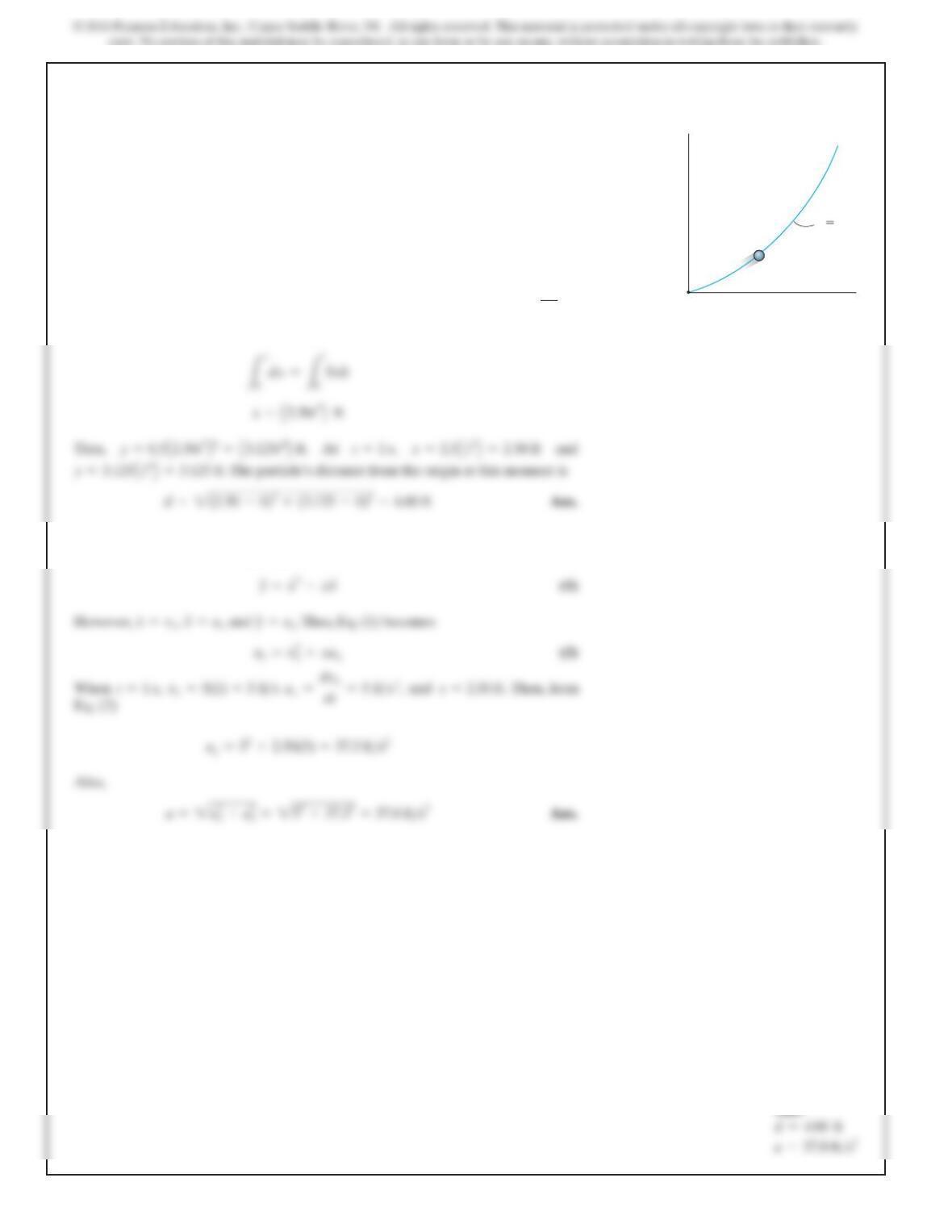
The particle travels along the path defined by the parabola
If the component of velocity along the xaxis is
where tis in seconds, determine the particle’s
distance from the origin Oand the magnitude of its
acceleration when When y=0.x=0,t=0,t=1s.
vx=15t2ft>s,
y=0.5x2.
SOLUTION
Position:The xposition of the particle can be obtained by applying the .
Acceleration:Taking the first derivative of the path ,we have .
The second derivative of the path gives
y
#=xx
#
y=0.5x2
dx =vxdt
vx=dx
dt
x
y
O
y 0.5x2
Ans:
8 5
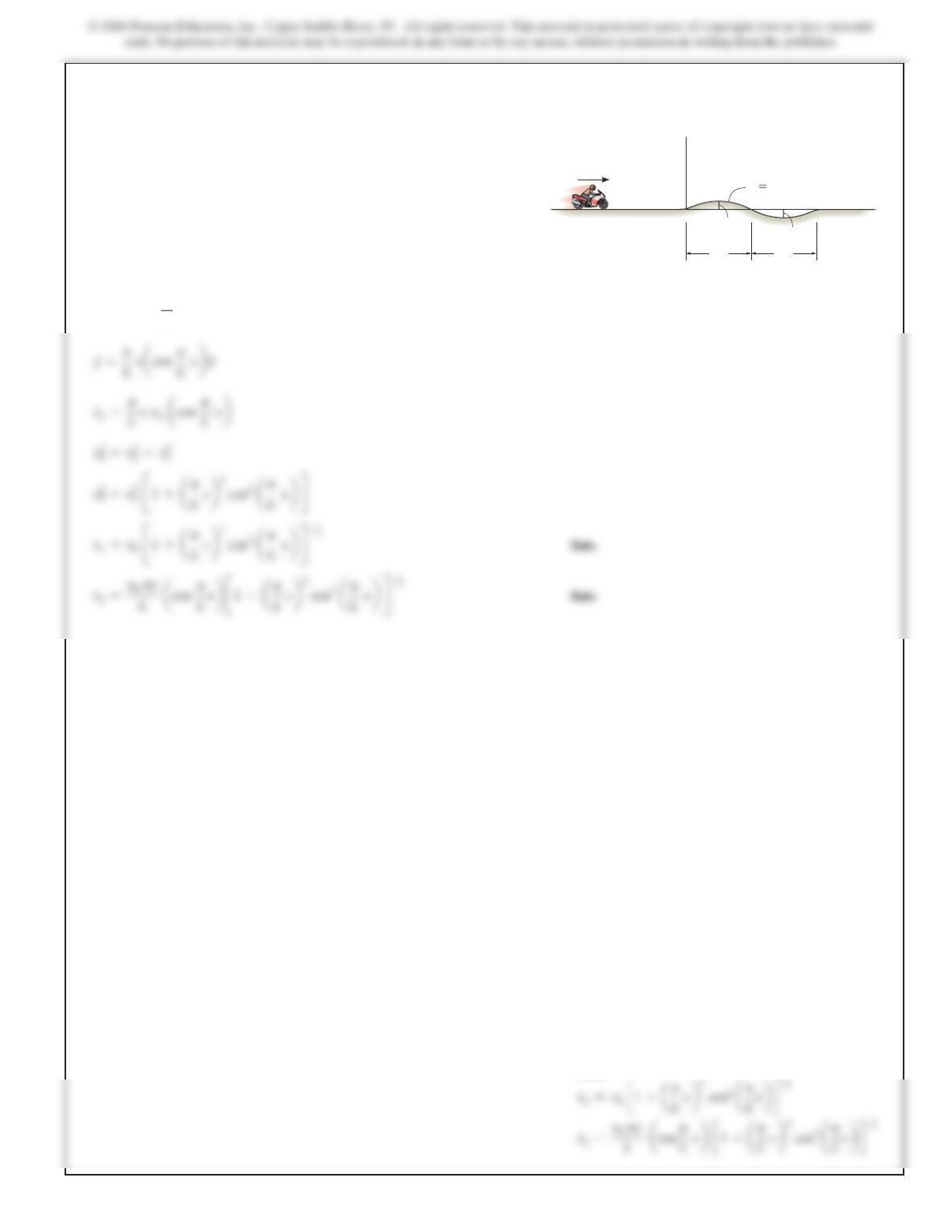
*12–80.
The motorcycle travels with constant speed along the
path that, for a short distance, takes the form of a sine curve.
Determine the xand ycomponents of its velocity at any
instant on the curve.
v0
SOLUTION
y=csin ap
Lxb
LL
cc
x
y
v0
y c sin ( x)––
L
π
Ans:
8 6
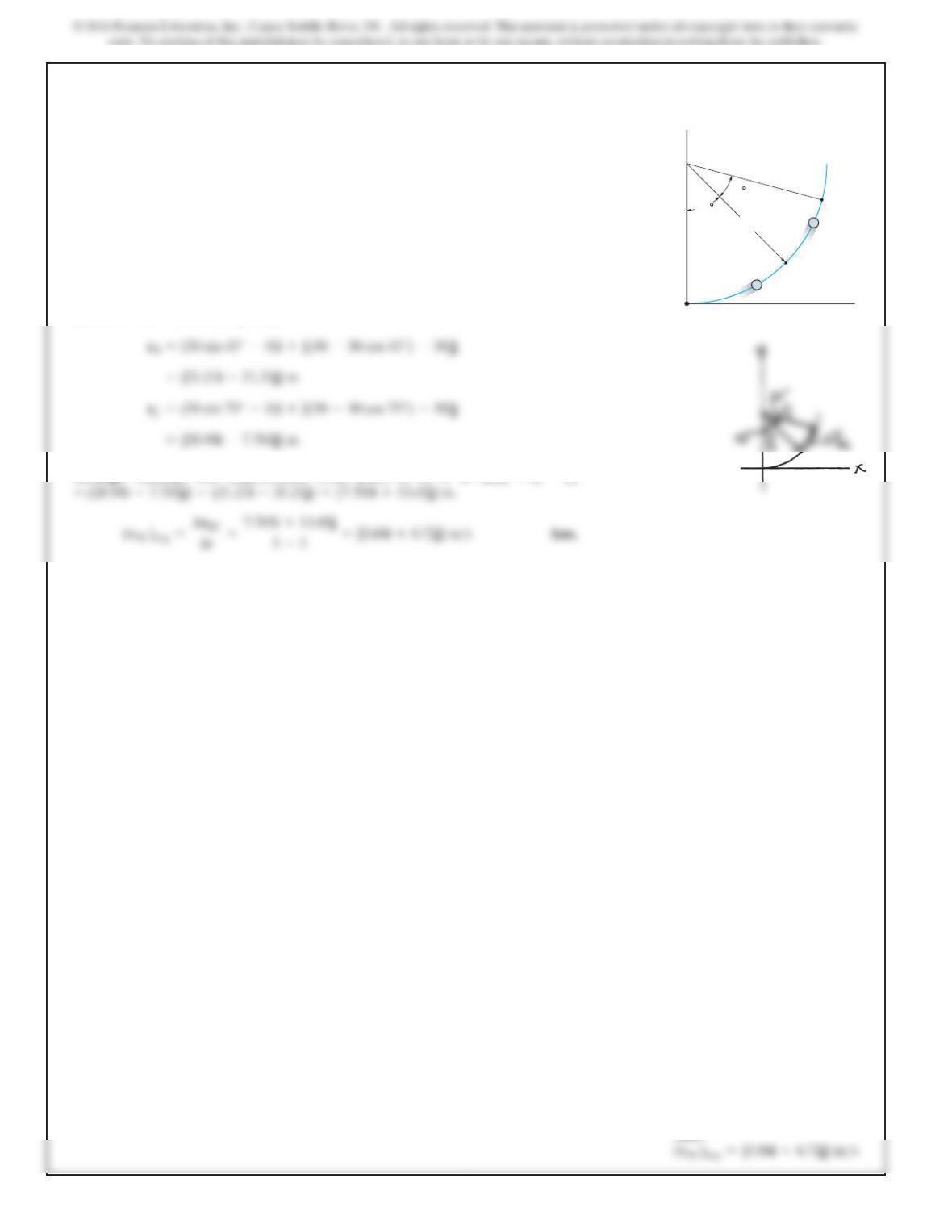
12–81.
45
30
30 m
x
y
A
B
C
SOLUTION
Position: The coordinates for points B and C are and
.Thus,
Average Velocity: The displacement from point Bto Cis
¢rBC =rC–rB
[30 sin 75°, 30 –30 cos 75°]
[30 sin 45°, 30 –30 cos 45°]
A particle travels along the circular path from Ato Bin 1s.
If it takes 3 s for it to go from Ato C, determine its average
velocity when it goes from Bto C.
Ans:
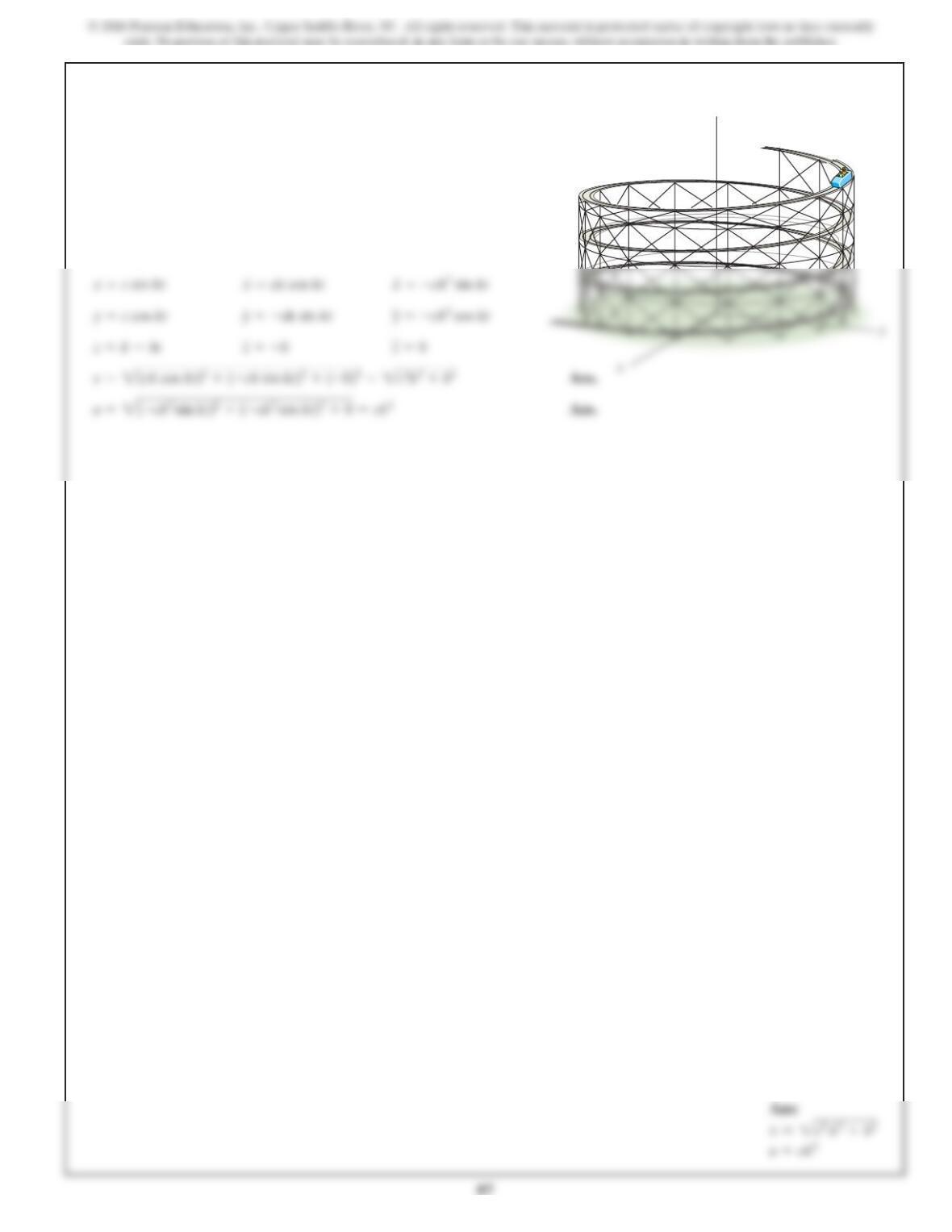
12–82.
SOLUTION
The roller coaster car travels down the helical path at
constant speed such that the parametric equations that define
its position are x = c sin kt, y = c cos kt, z = h − bt, where c, h,
and b are constants. Determine the magnitudes of its velocity
and acceleration.
z
8 8
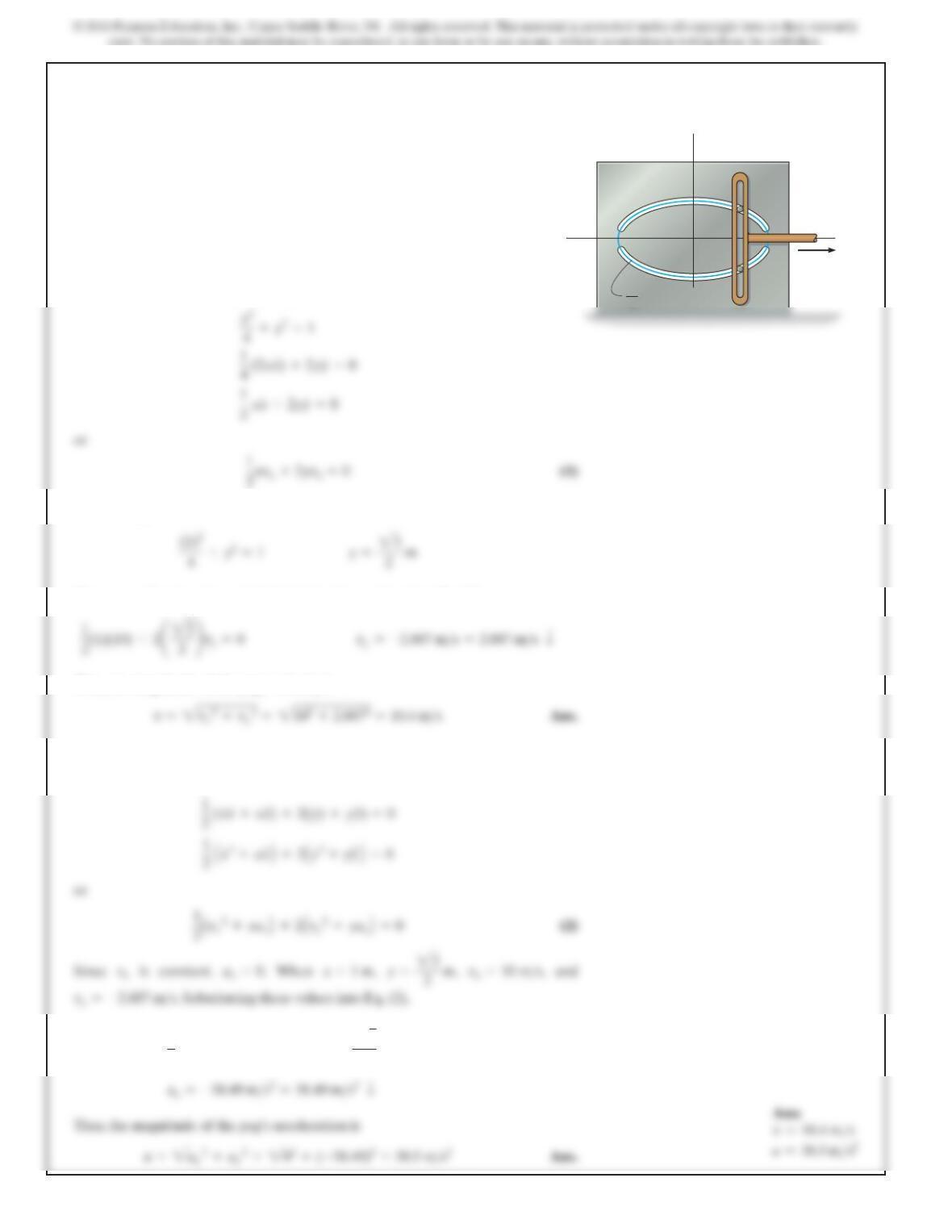
12–83.
Pegs Aand Bare restricted to move in the elliptical slots
due to the motion of the slotted link. If the link moves with
a constant speed of , determine the magnitude of the
velocity and acceleration of peg Awhen .x=1m
10 m/s
SOLUTION
Velocity: The xand ycomponents of the peg’s velocity can be related by taking the
first time derivative of the path’s equation.
At ,
Here, and . Substituting these values into Eq. (1),
Thus, the magnitude of the peg’s velocity is
Acceleration: The xand ycomponents of the peg’s acceleration can be related by
taking the second time derivative of the path’s equation.
1
2
A
102+0
B
+2c(–2.887)2+23
2ayd=0
x=1vx=10 m>s
x=1m
A
CD
B
y
x
v 10 m/s
x2
8 9
*12–84.
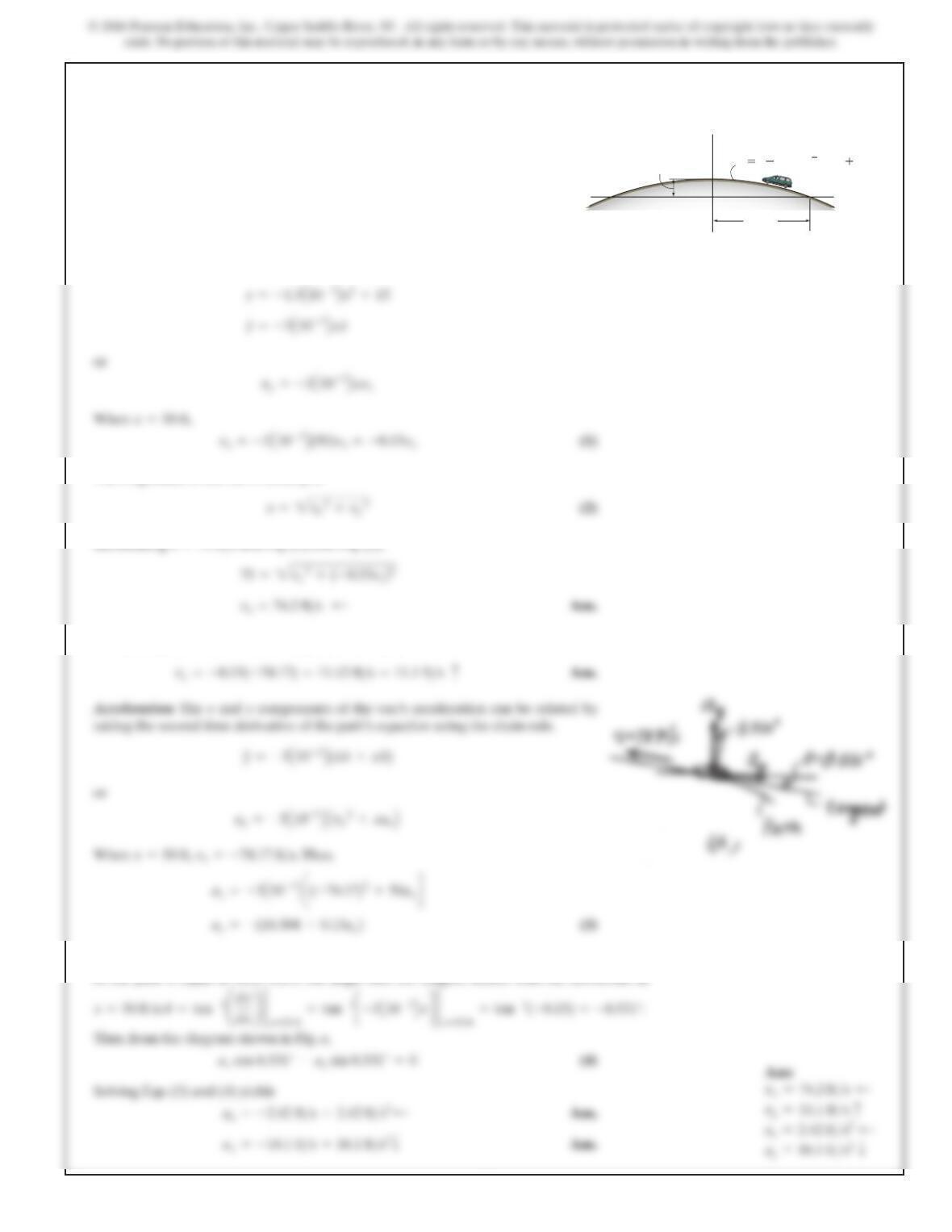
The van travels over the hill described by
. If it has a constant speed of
, determine the xand ycomponents of the van’s
velocity and acceleration when .x=50 ft
75 ft>s
y=(–1.5(10–3)x2+15) ft
x
y( 1.5 (10 3)x215) f
t
y
100 ft
15 ft
SOLUTION
Velocity:The xand ycomponents of the van’s velocity can be related by taking the
first time derivative of the path’s equation using the chain rule.
The magnitude of the van’s velocity is
Substituting the result of into Eq. (1), we obtain
nx
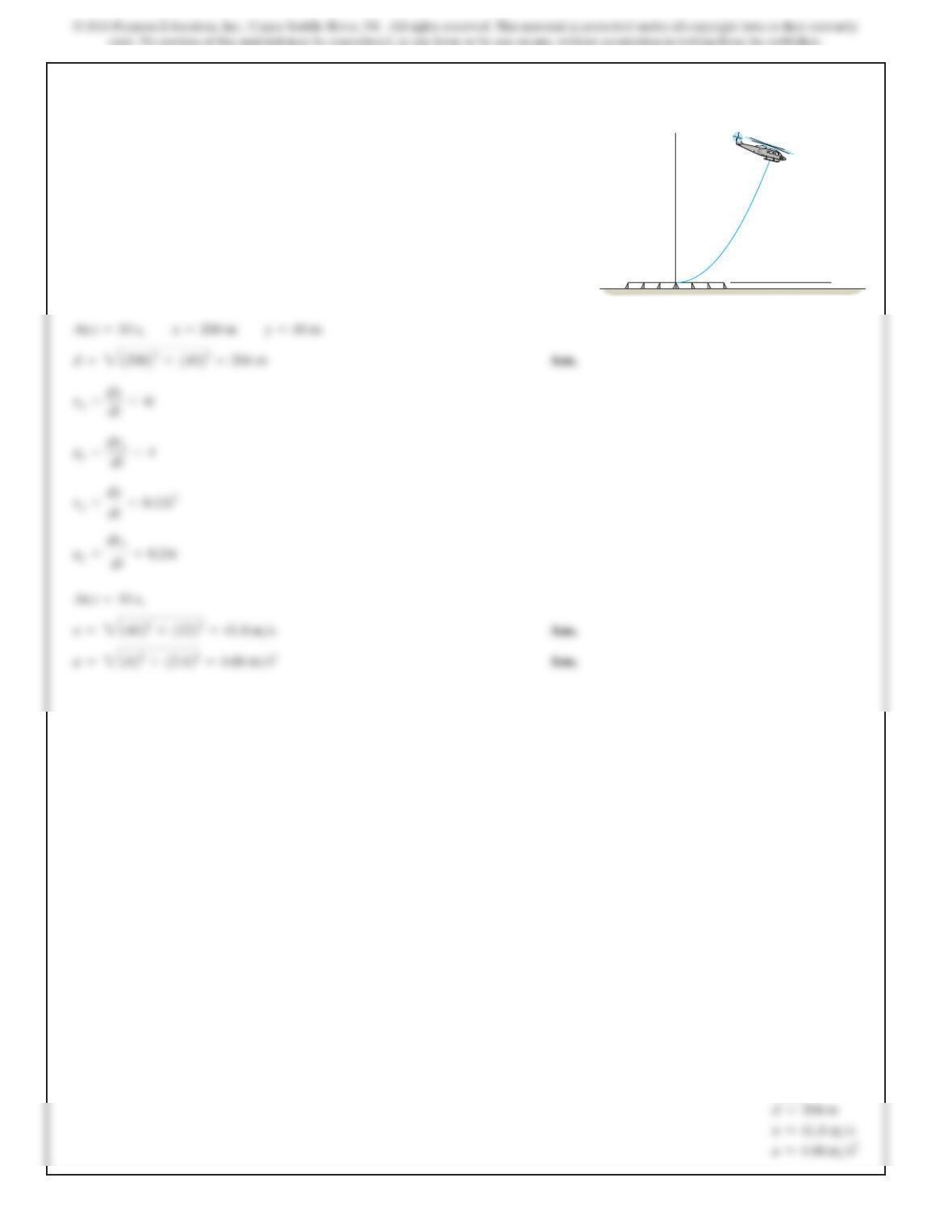
Since the van travels with a constant speed along the path,its acceleration along the tangent
9 0
12–85.
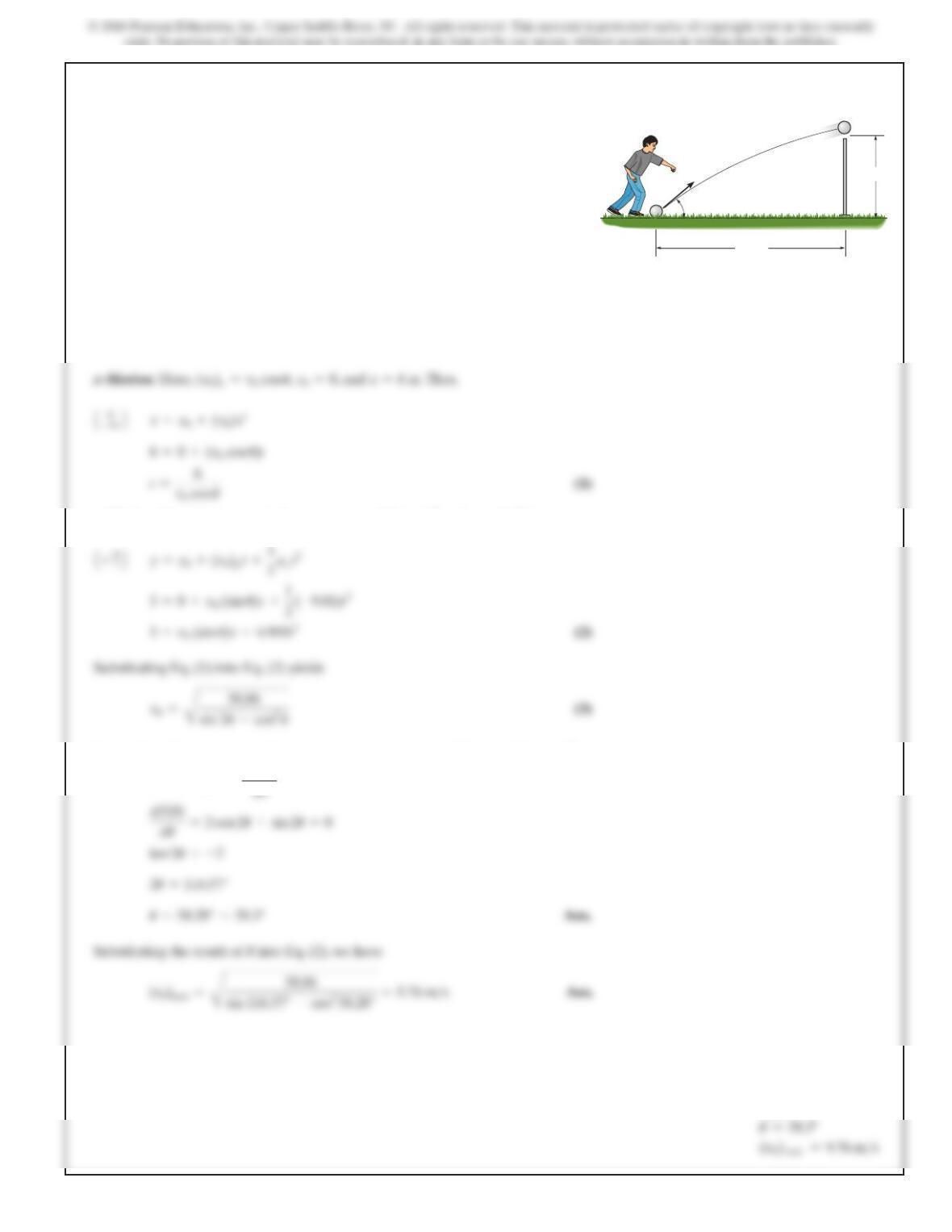
T
h
e f
li
g
h
t pat
h
of t
h
e
h
e
li
copter as
i
t ta
k
es off from A
i
s
defined by the parametric equations and
where tis the time in seconds. Determine
the distance the helicopter is from point Aand the
magnitudes of its velocity and acceleration when t=10 s.
y=10.04t32m,
x=12t22m
SOLUTION
x=2t2y=0.04t3
y
x
A
Ans:
9 1
12–86.
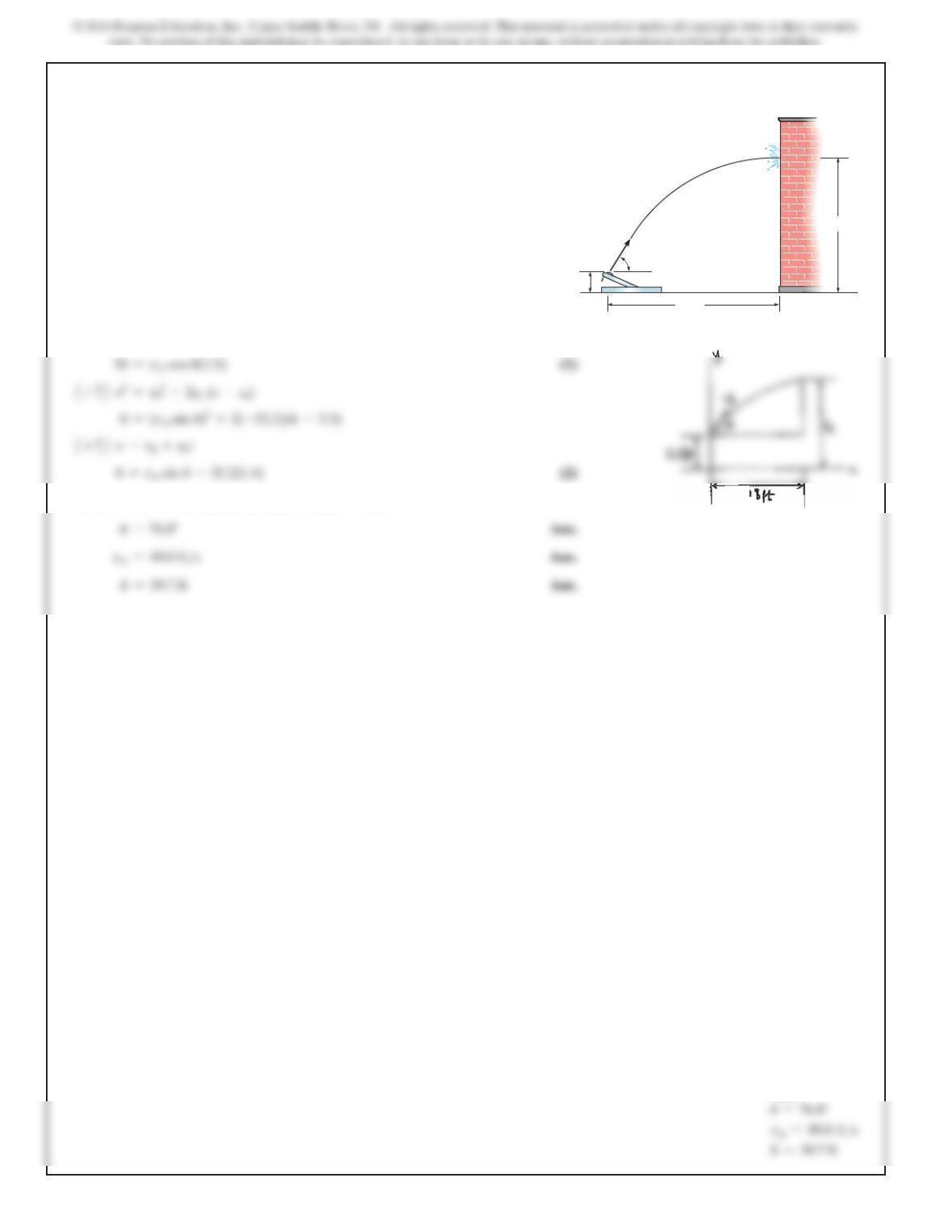
Determine the minimum initial velocity and the
corresponding angle at which the ball must be kicked in
order for it to just cross over the 3-m high fence.
u0
v
0
SOLUTION
Coordinate System: The coordinate system will be set so that its origin
coincides with the ball’s initial position.
y-Motion: Here,, , and .Thus,
From Eq. (3), we notice that is minimum when is
maximum. This requires
df(u)
f(u)=sin 2u–cos2 uv0
y0=0ay=-g=-9.81 m > s
2
(v0)x=v0 sin u
x–y
v03 m
6 m
u0
Ans:
9 2
SOLUTION
1
+
S
2
s=v0t
To solve, first divide Eq. (2) by Eq. (1) to get
u
. Then
12–87.
The catapult is used to launch a ball such that it strikes the
wall of the building at the maximum height of its trajectory.
If it takes 1.5 s to travel from A to B, determine the velocity
vA at which it was launched, the angle of release
u
, and the
height h.
Ans:
18 ft
3.5 ft
h
A
vA
B
u
9 3
SOLUTION
Coordinate System. The origin of the
x@y
coordinate system will be set to coinside
with point A as shown in Fig. a
Horizontal Motion. Here
(vA)x=vA cos 30°S,
(sA)x=0
and
(sB)x=10 m S
.
Also,
Solving Eq. (1) and (3)
Substitute these results into Eq. (2) and (4)
Thus, the magnitude of
vB
is
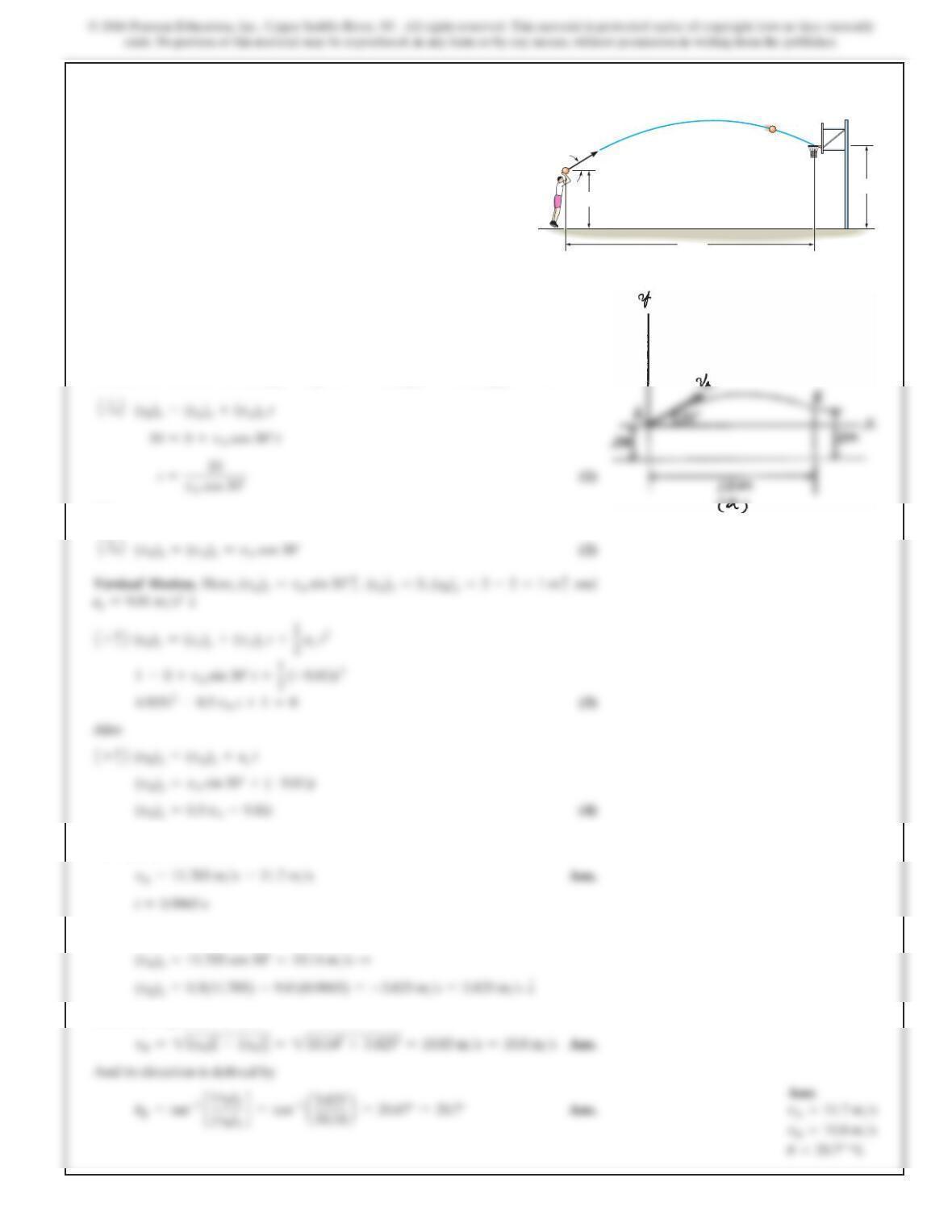
*12–88.
Neglecting the size of the ball, determine the magnitude
vA
of the basketball’s initial velocity and its velocity when it
passes through the basket.
3 m
B
A
vA
30
10 m
2 m
SOLUTION
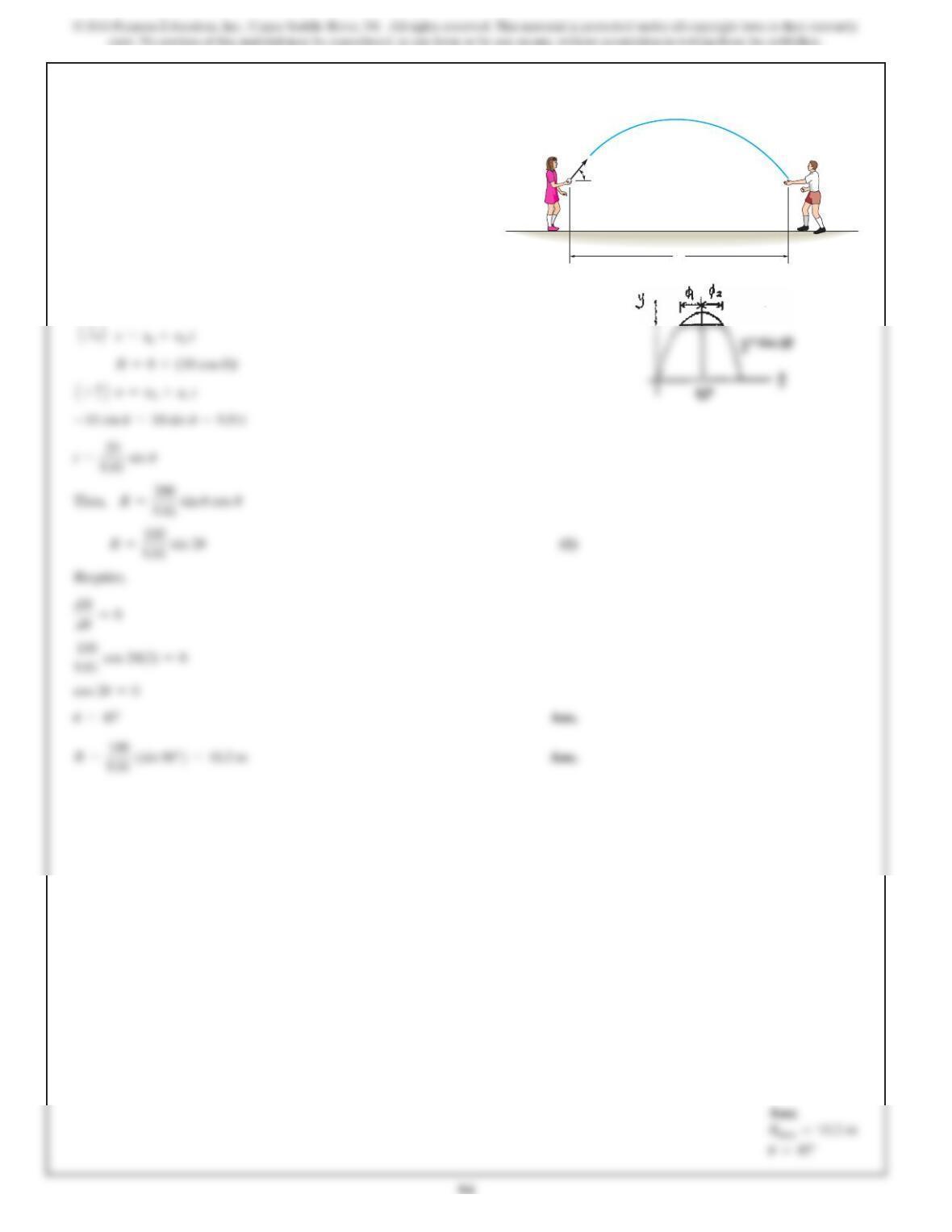
12–89.
The girl at A can throw a ball at vA = 10 m
>
s. Calculate the
maximum possible range R = Rmax and the associated angle
u
at which it should be thrown. Assume the ball is caught at
B at the same elevation from which it is thrown.
R
B
A
vA fi 10 m/s
u
9 5
SOLUTION
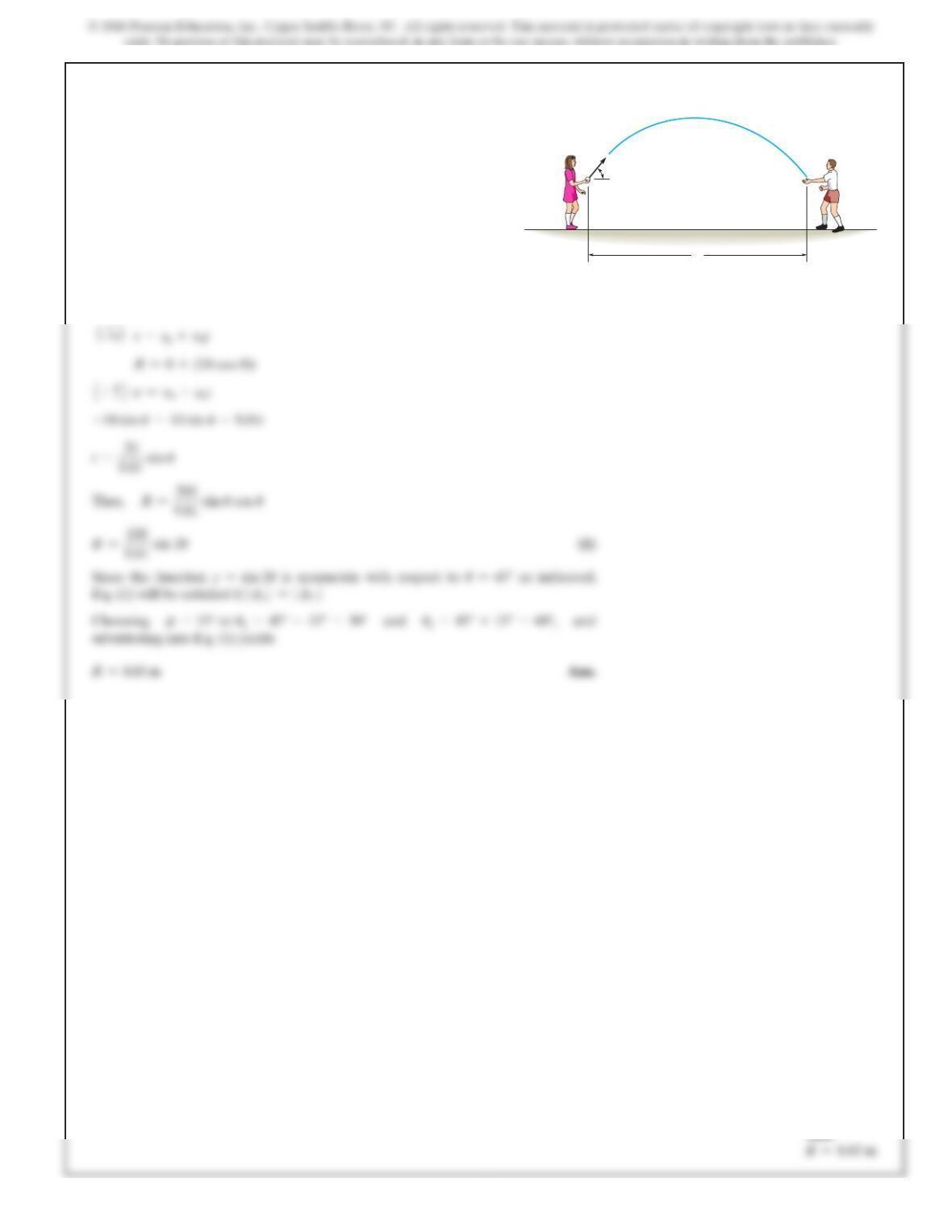
12–90.
Show that the girl at A can throw the ball to the boy at B
by launching it at equal angles measured up or down
from a 45° inclination. If vA = 10 m
>
s, determine the range
R if this value is 15°, i.e.,
u
1 = 45° − 15° = 30° and
u
2 = 45° +
15° = 60°. Assume the ball is caught at the same elevation
from which it is thrown.
R
B
A
vA fi 10 m/s
u
Ans:
9 6
SOLUTION
From Eqs. (1) and (2):
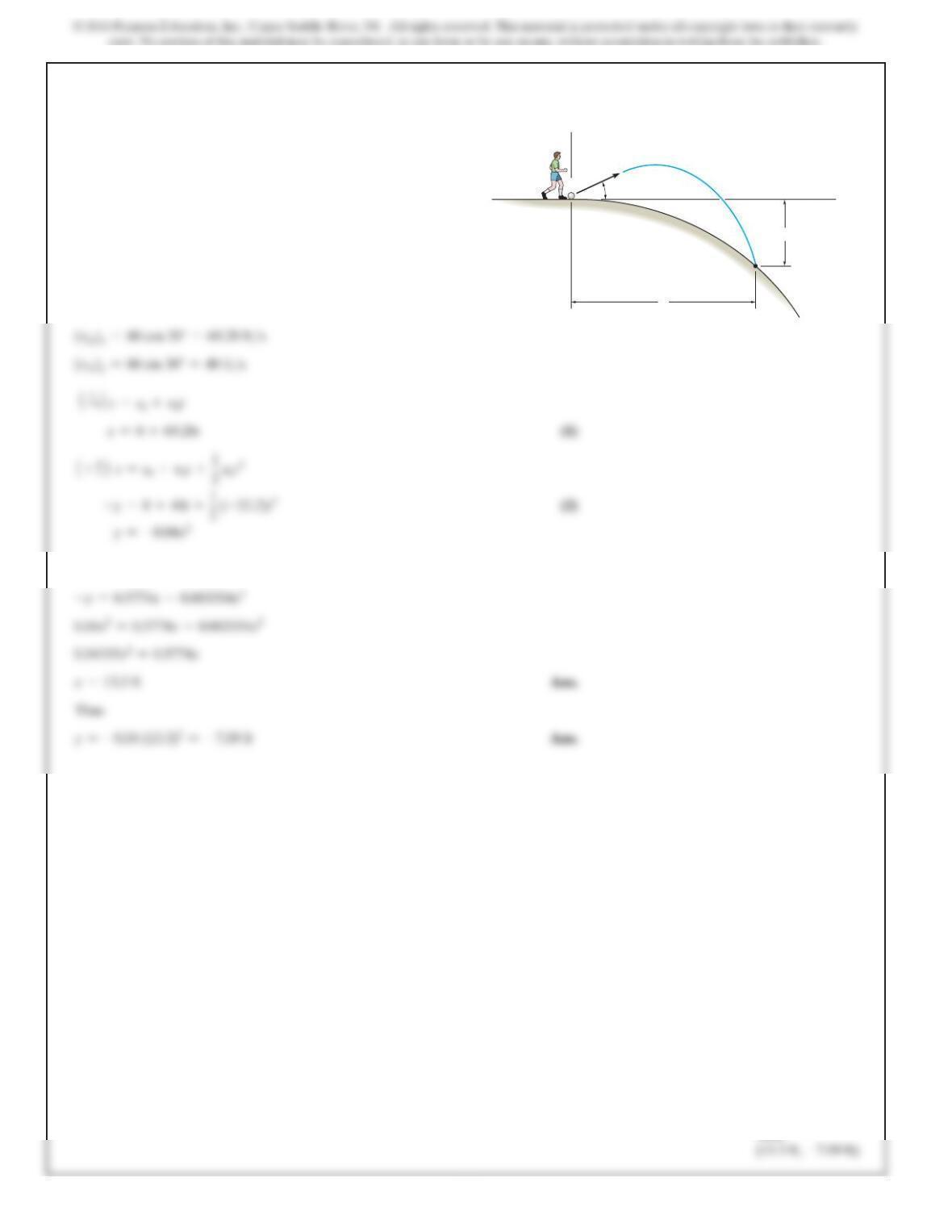
12–91.
The ball at A is kicked with a speed vA = 80 ft
>
s and at an
angle
u
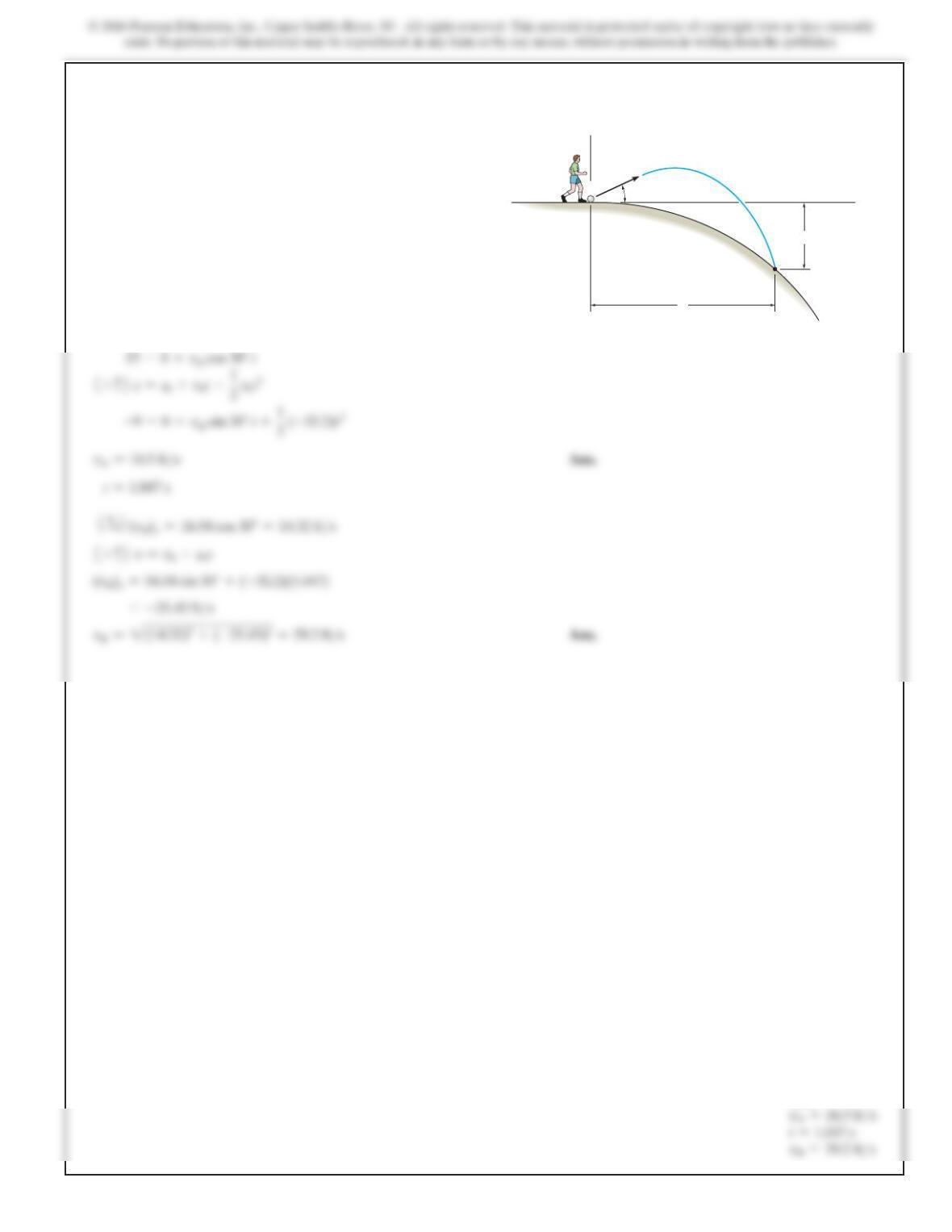
A = 30°. Determine the point (x, –y) where it strikes
the ground. Assume the ground has the shape of a parabola
as shown.
x
y
B
A
vA
y fi 0.04x2
y
x
uA
Ans:
9 7
SOLUTION
1
+
S
2
s=s0+v0t
1
+
S
2
*12–92.
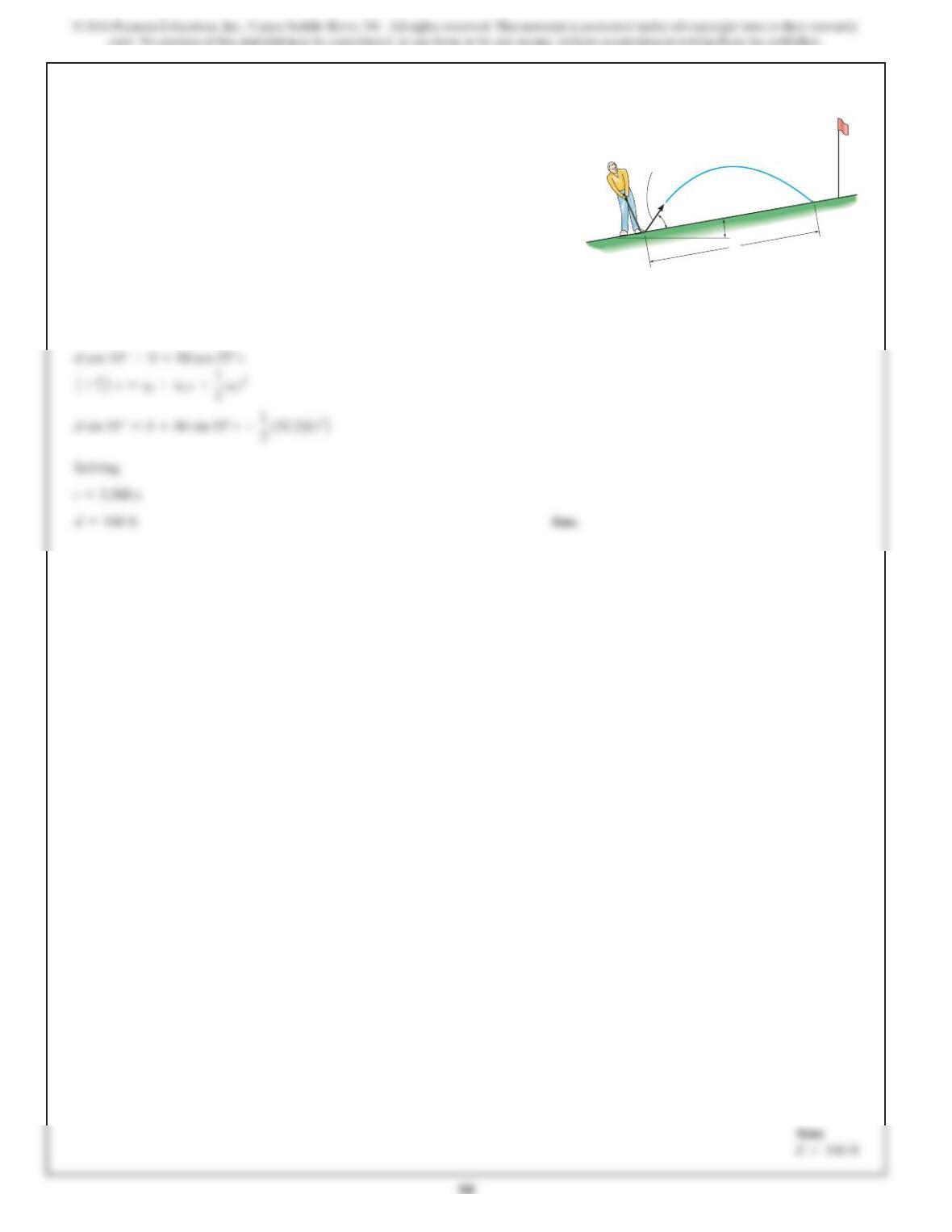
The ball at A is kicked such that u
A=30°.
If it strikes the
ground at B having coordinates
x=15 ft,
y=–9 ft,
determine the speed at which it is kicked and the speed at
which it strikes the ground.
x
y
B
A
vA
y fi 0.04x2
y
x
uA
Ans:
SOLUTION
1
+
S
2
s=s0+v0t
12–93.
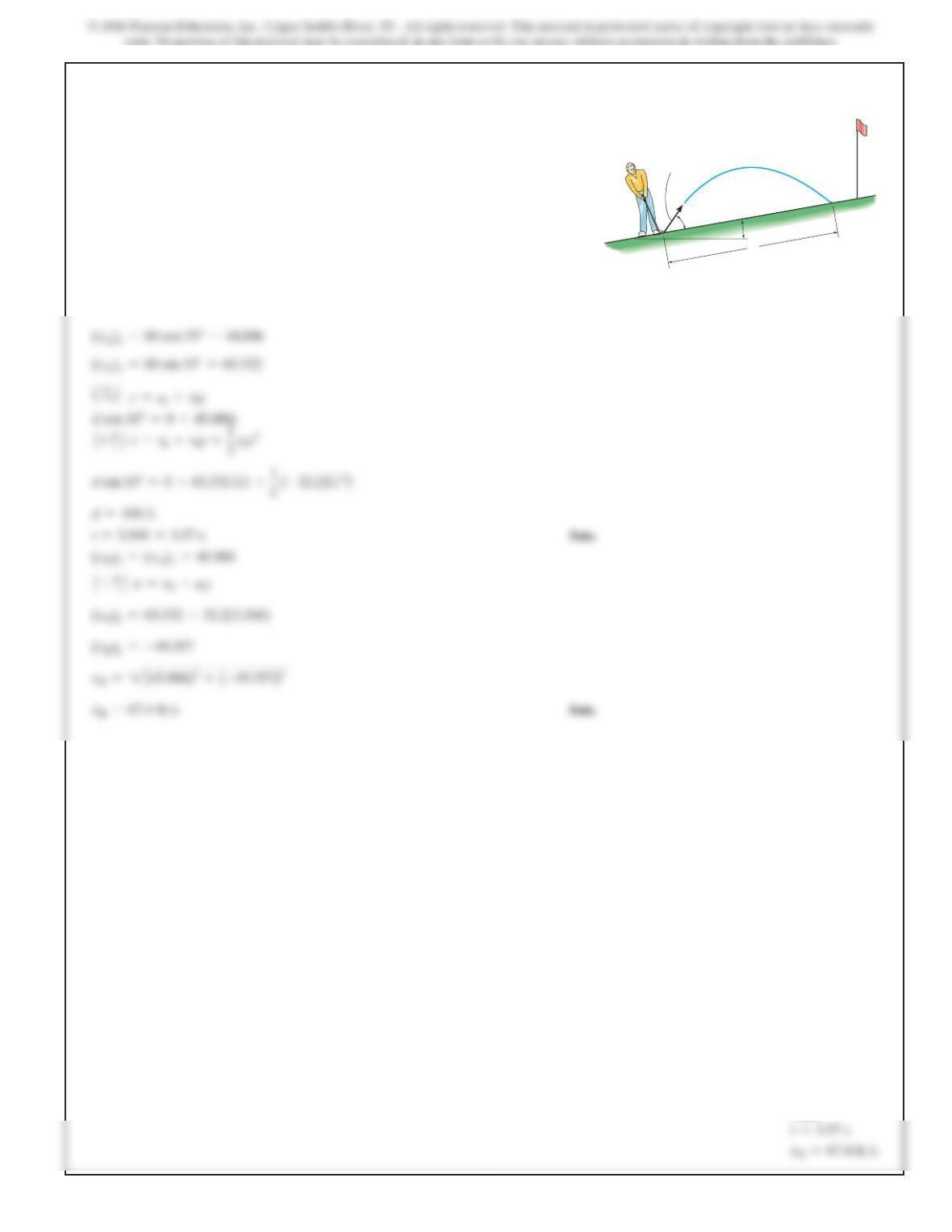
A golf ball is struck with a velocity of 80 ft
>
s as shown.
Determine the distance d to where it will land.
d
B
A10
45
vA fi 80 ft/s
9 9
SOLUTION
12–94.
A golf ball is struck with a velocity of 80 ft
>
s as shown.
Determine the speed at which it strikes the ground at B and
the time of flight from A to B.
d
B
A10
45
vA fi 80 ft/s
Ans:
100
12–95.
SOLUTION
Solving
2(32.2)(tAC
(:
+)s=s0+v0t
10 f
h
C
B
A
v
A
30
5ft25 ft
7ft
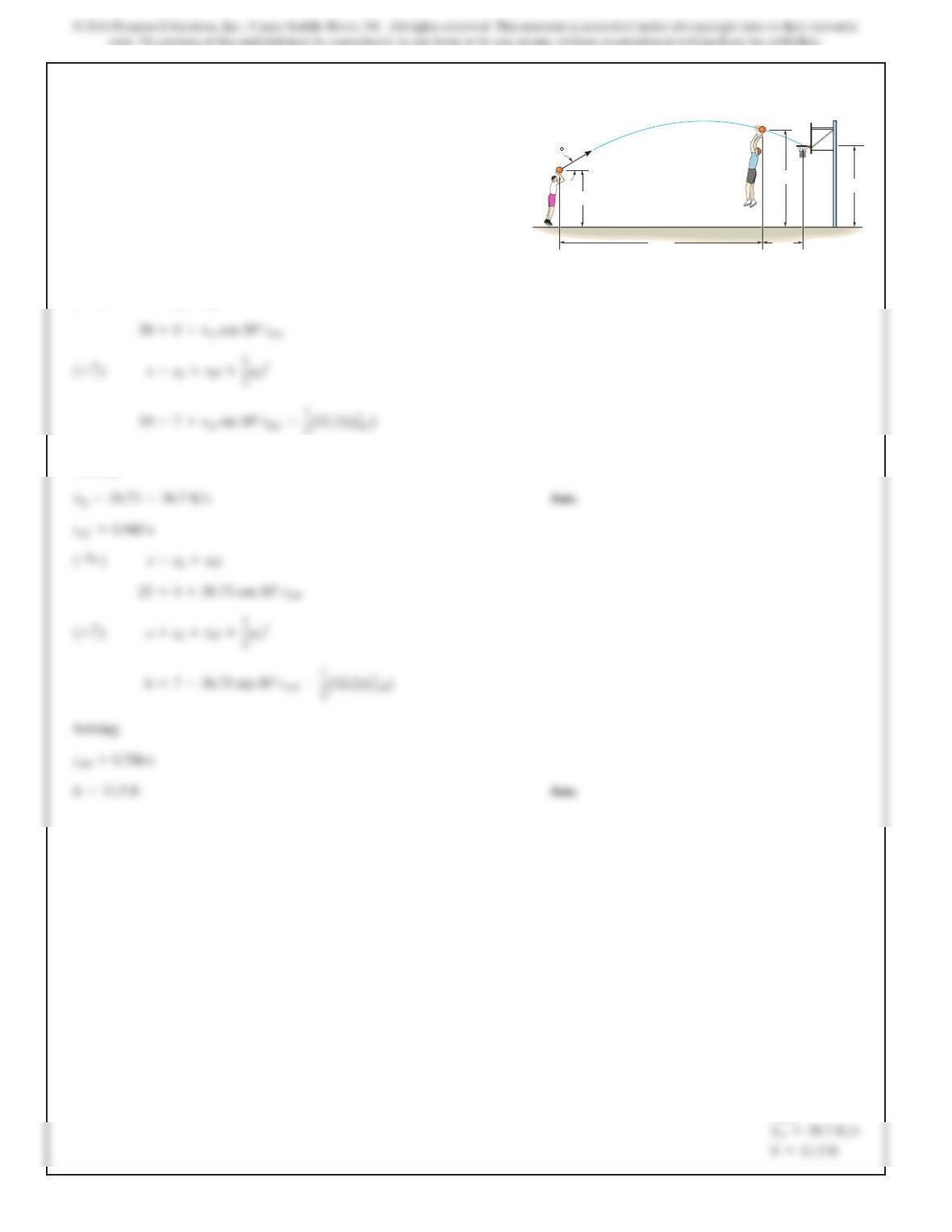
The basketball passed through the hoop even though it barely
cleared the hands of the player B who attempted to block it.
Neglecting the size of the ball, determine the magnitude vA of
its initial velocity and the height h of the ball when it passes
over player B.
Ans: