6 1
SOLUTION
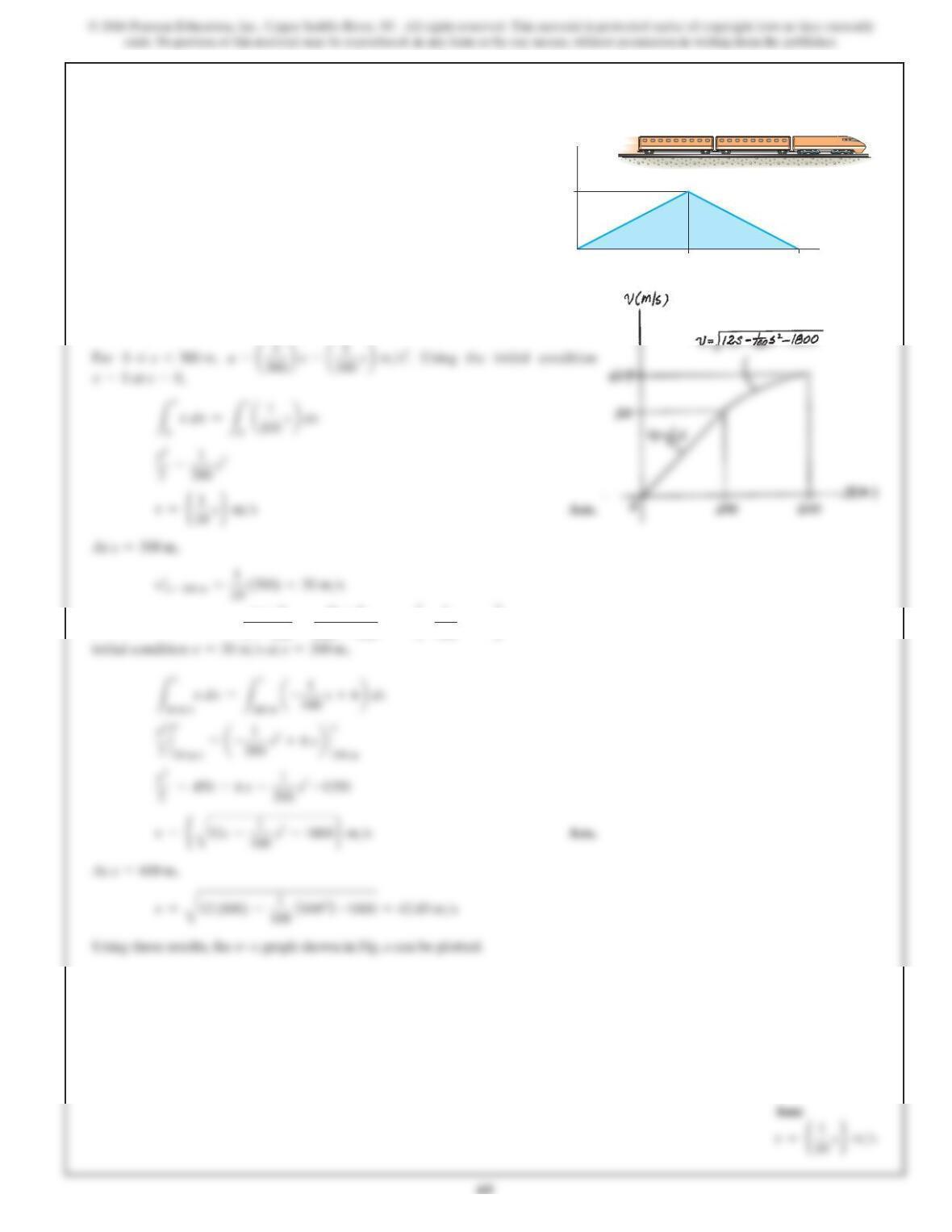
v9s
Graph. The
v–s
function can be determined by integrating
v dv=a ds
. For
Lv
0
v dv =
Ls
0
a
–1
50 s +8
b
ds
At
s=25 ft,
50 ft,
75 ft
and
100 ft
vs=25 ft =
>
>
[800 (25) –252]=19.69 ft
>
s
v dv =
a
–3
b
ds
12–57.
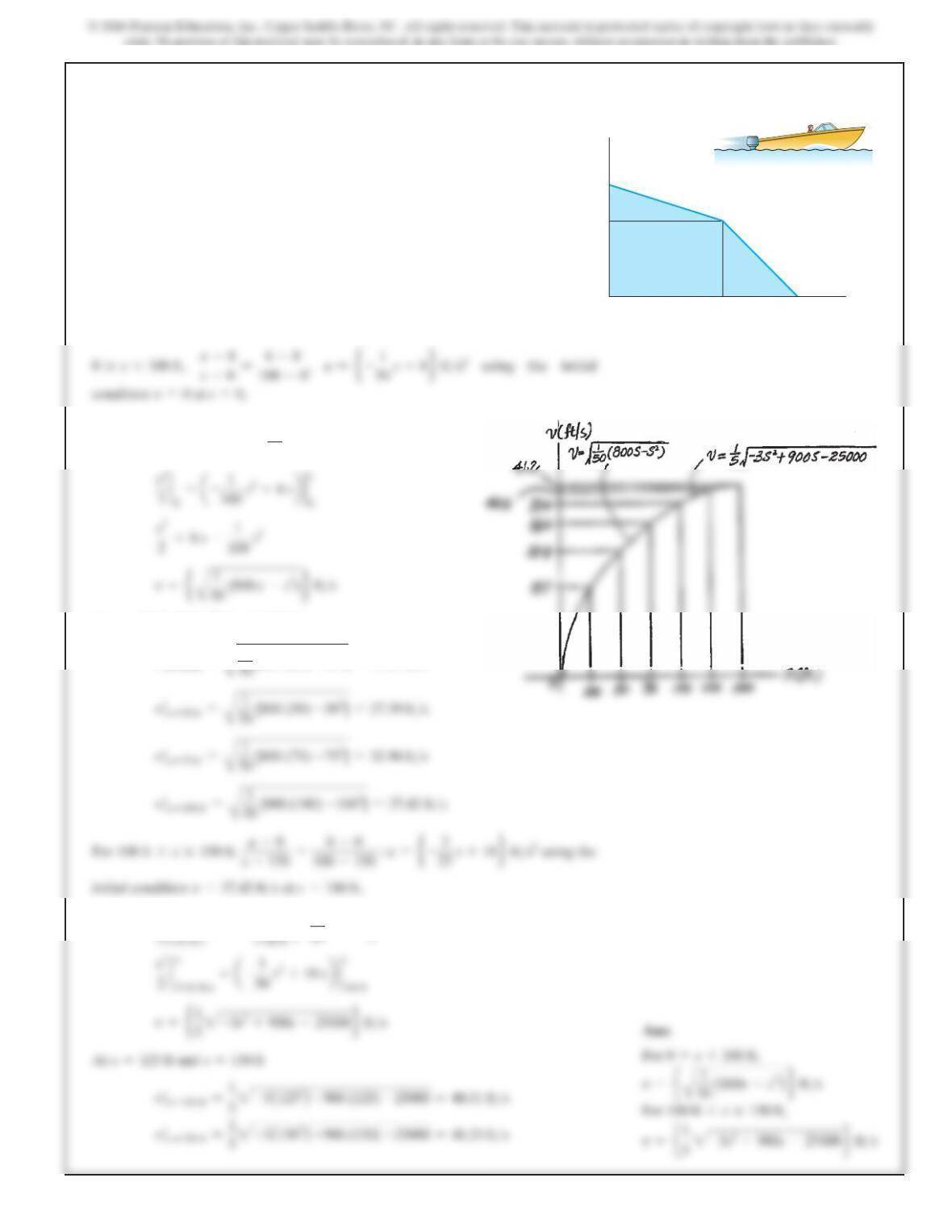
Starting from rest at s = 0, a boat travels in a straight line
with the acceleration shown by the a–s graph. Construct the
v–s graph.
6
8
100 150 s (ft)
a (
ft
/s2)
SOLUTION
For
0…t615
12–58.
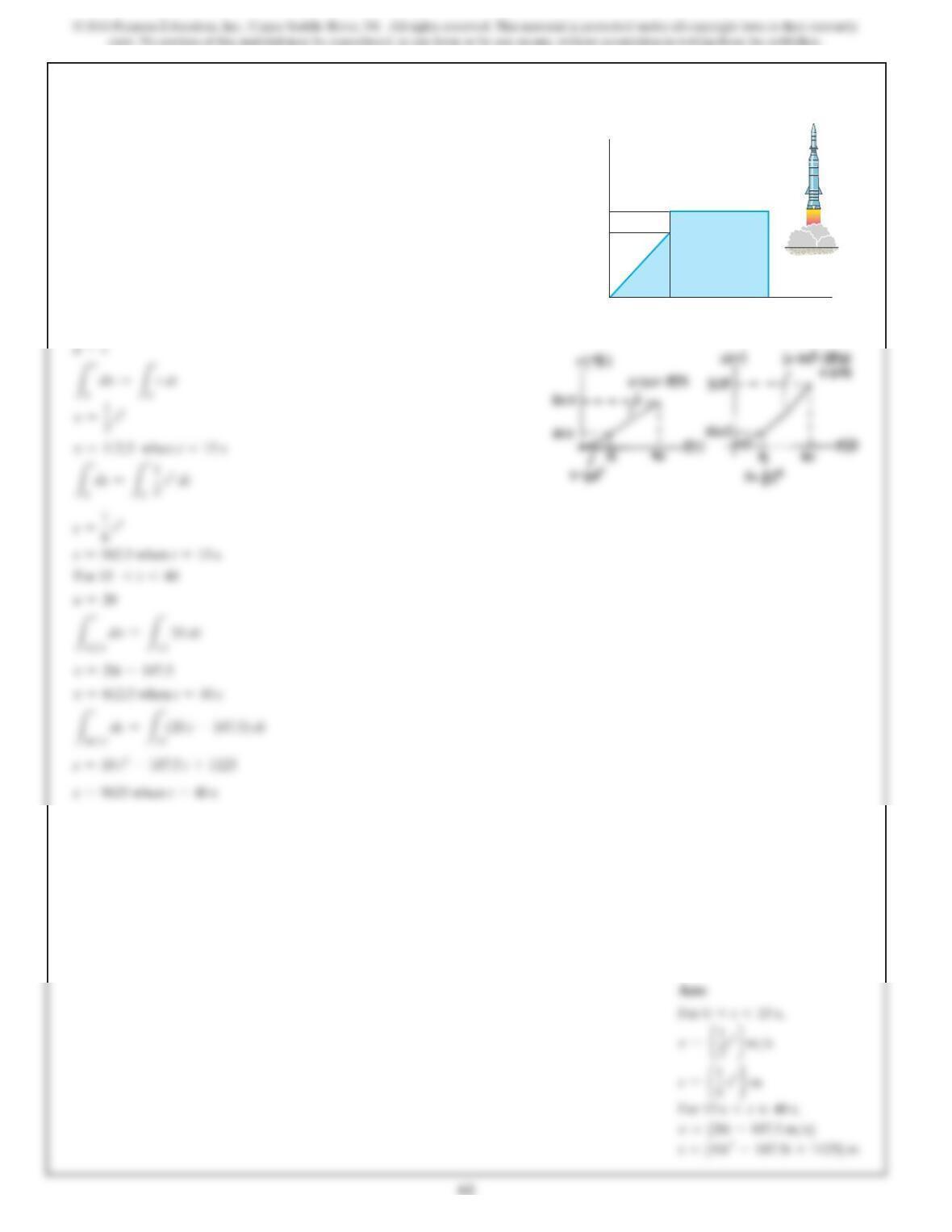
A two-stage rocket is fired vertically from rest with the
acceleration shown. After 15 s the first stage A burns out and
the second stage B ignites. Plot the v–t and s–t graphs which
describe the motion of the second stage for 0 … t … 40 s. A
B
t (s)
a (m/s2)
15
15
20
40
6 3
12–59.
T
h
e spee
d
of a tra
i
n
d
ur
i
ng t
h
e f
i
rst m
i
nute
h
as
b
een
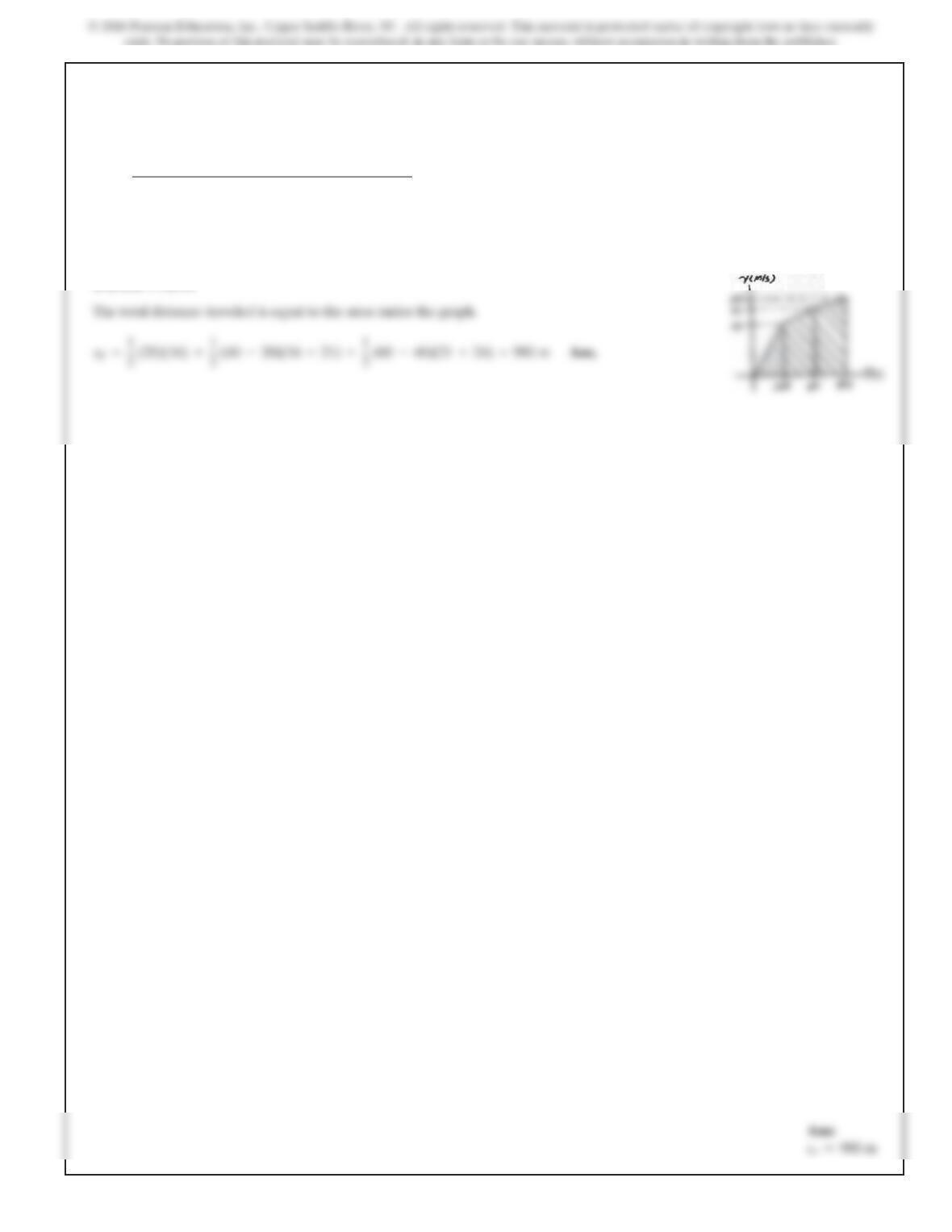
recorded as follows:
Plot the graph, approximating the curve as straight-line
segments between the given points. Determine the total
distance traveled.
v–t
SOLUTION
t(s) 0 20 40 60
() m>sv0 16 21 24
*12–60.
SOLUTION
For package:
For elevator:
(+c)s2=s0+vt
(+c)v2=v0
2+2ac(s2–s0)
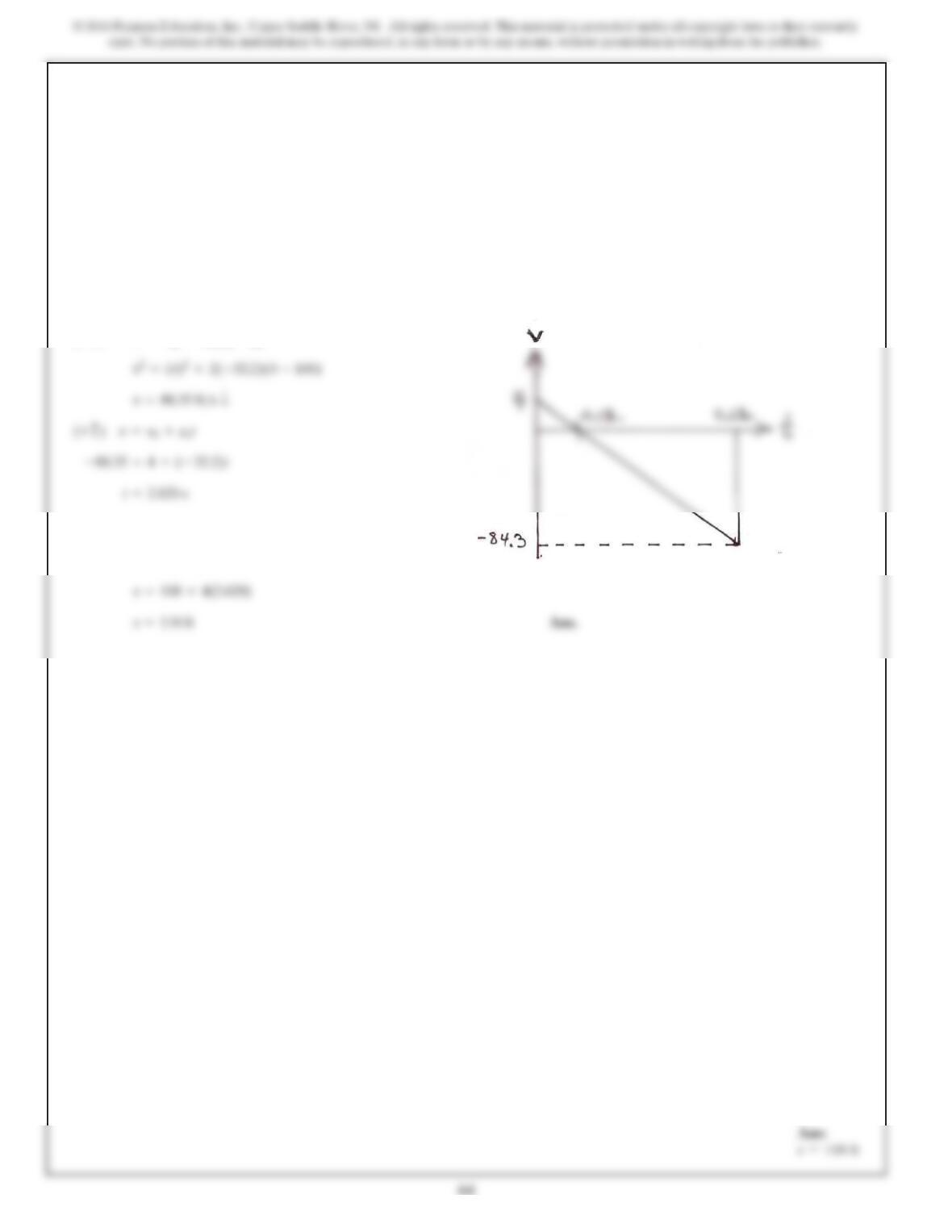
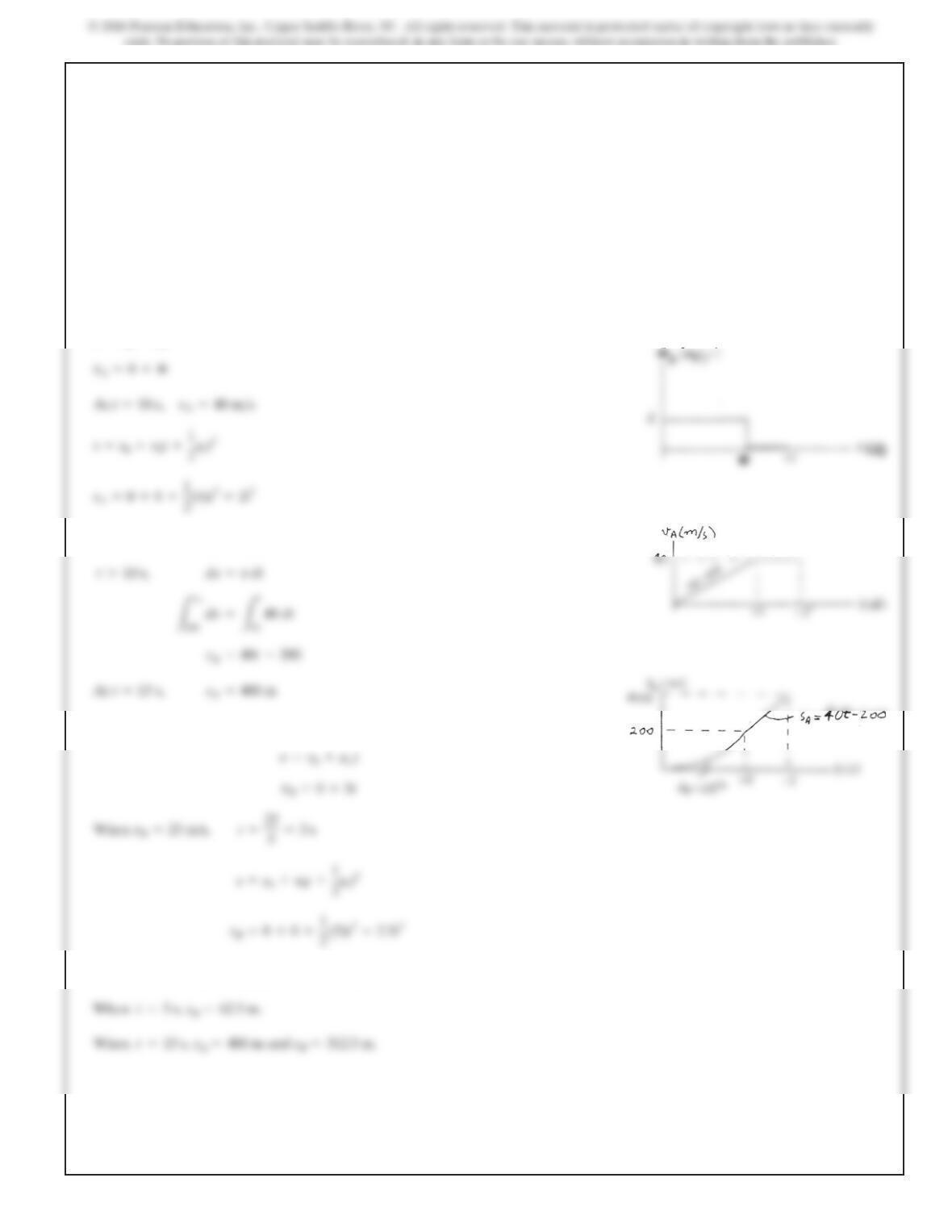
A man riding upward in a freight elevator accidentally
drops a package off the elevator when it is 100 ft from the
ground. If the elevator maintains a constant upward speed
of determine how high the elevator is from the
ground the instant the package hits the ground. Draw the
v–tcurve for the package during the time it is in motion.
Assume that the package was released with the same
upward speed as the elevator.
4ft>s,
6 5
12–61.
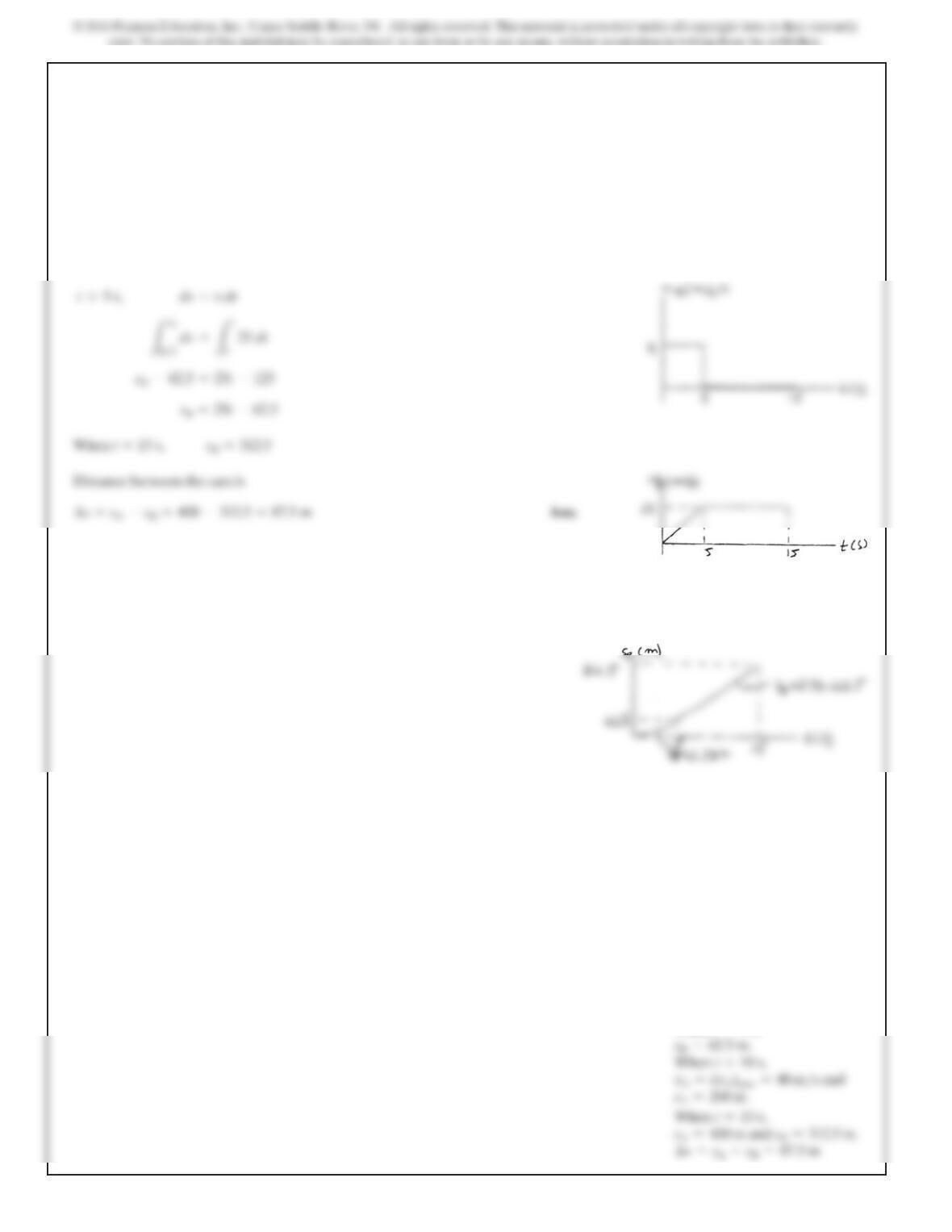
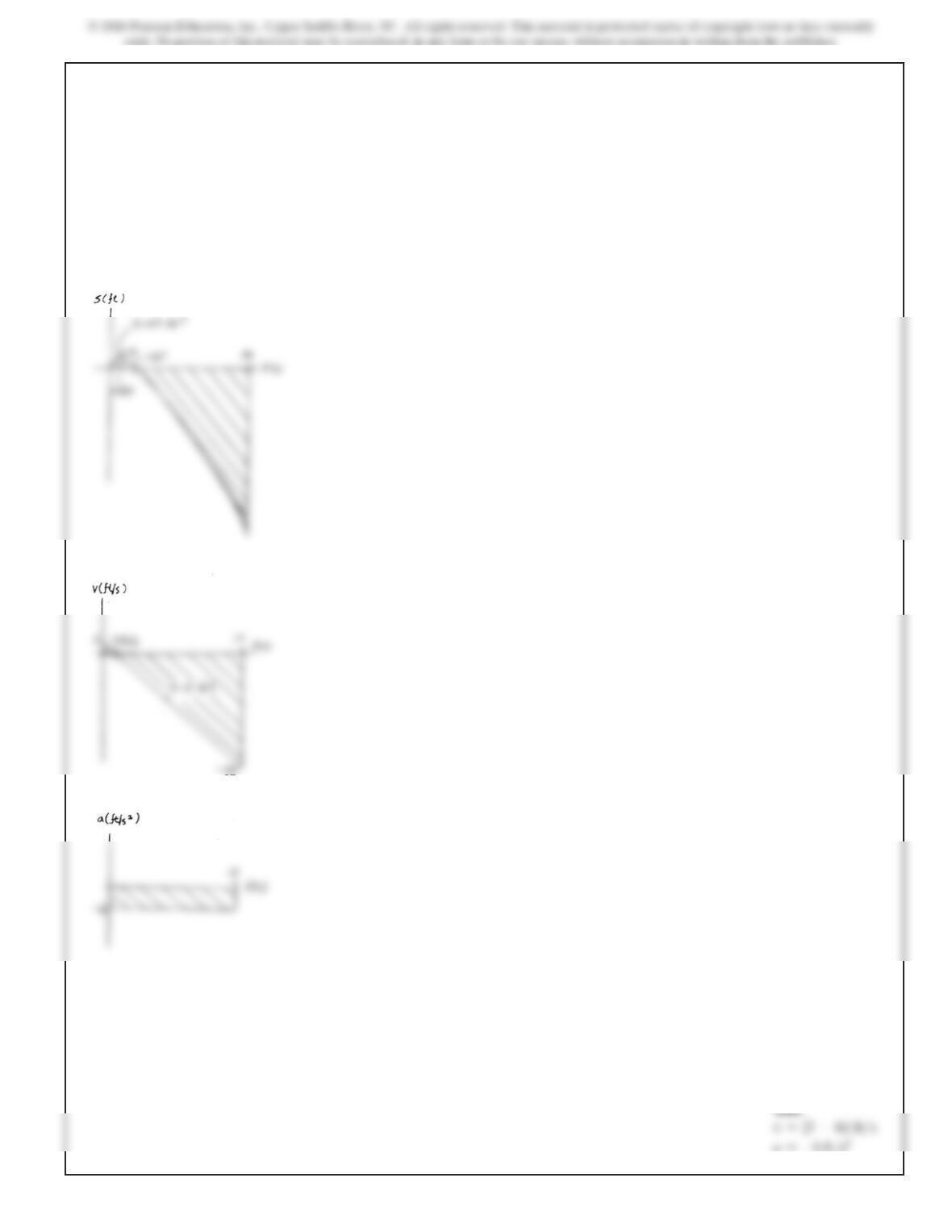
Two cars start from rest side by side and travel along a
straight road. Car Aaccelerates at for 10 s and then
maintains a constant speed. Car Baccelerates at
until reaching a constant speed of 25 m/s and then
maintains this speed. Construct the a–t,v–t, and s–tgraphs
for each car until What is the distance between the
two cars when t=15 s?
t=15 s.
5m>s2
4m>s2
SOLUTION
Car A:
Car B:
When t = 10 s, vA = (vA)max = 40 m/s and sA = 200 m.
At t=10 s,
sA=200 m
v=v0+act
6 6
At
Car Ais ahead of car B.
t=5s,
sB=62.5 m
12–61. Continued
Ans:
When t=5 s
,
When t=10 s
When t=15 s
6 7
12–62.
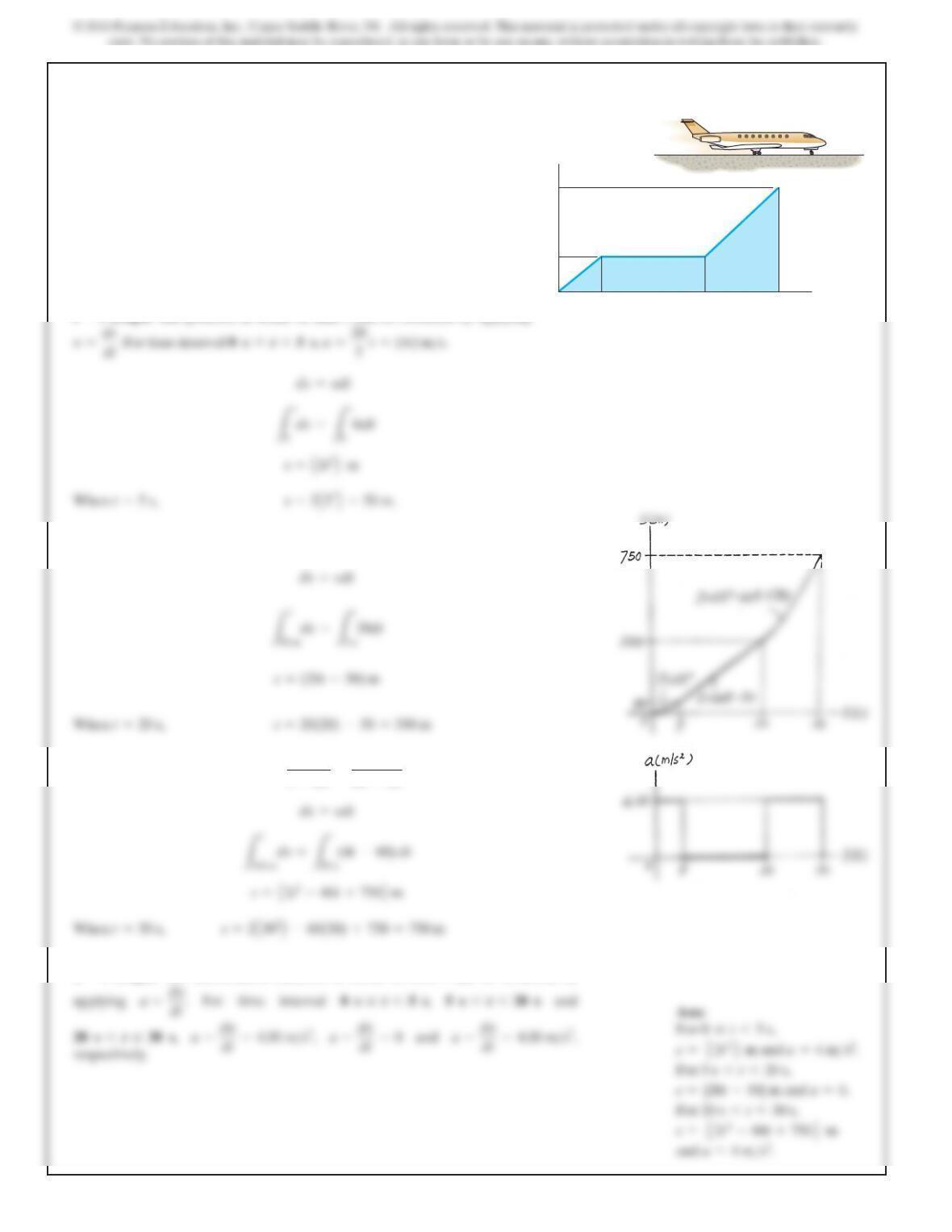
If the position of a particle is defined as
where tis in seconds, construct the s–t,v–t, and a–tgraphs
for 0…t…10 s.
s
=15
t
–3
t
22ft,
SOLUTION
a
=–
6 ft
>
s
6 8
12–63.
From experimental data, the motion of a jet plane while
traveling along a runway is defined by the graph.
Construct the and graphs for the motion. When
,.s=0t=0
a–ts –t
n–t
SOLUTION
Graph: The position in terms of time tcan be obtained by applying
For time interval ,
For time interval ,,.
Graph: The acceleration function in terms of time tcan be obtained by
a–t
y=(4t–60)m>s
y–20
t–20 =60 –20
30 –20
20 s 6t…30 s
5s6t620 s
s–t
t(s)
60
20 30
v(m/s)
20
5
300 600
3
s (m)
a (m/s2)
SOLUTION
v9s
Graph. The
v–s
function can be determined by integrating
v dv=a ds
.
e
For
300 m 6s…600 m,
a–3
s–300
=
0–3
600 –300
; a=
e
–
1
100 s+6
f
m
>
s2, using the
*12–64.
The motion of a train is described by the a–s graph shown.
Draw the v–s graph if v = 0 at s = 0.
7 0
SOLUTION
v9s
Function. Here,
a–75
s–0
=
50 –75
1000 –0
;
a={75 –0.025s} ft>s2
. The function
v
(s)
can be determined by integrating
v dv=a ds
. Using the initial condition
v=0
at
s=0
,
At
s=1000 ft,
Time. t as a function of s can be determined by integrating dt =
ds
v
. Using the initial
condition
s=0
at
t=0
;
12–65.
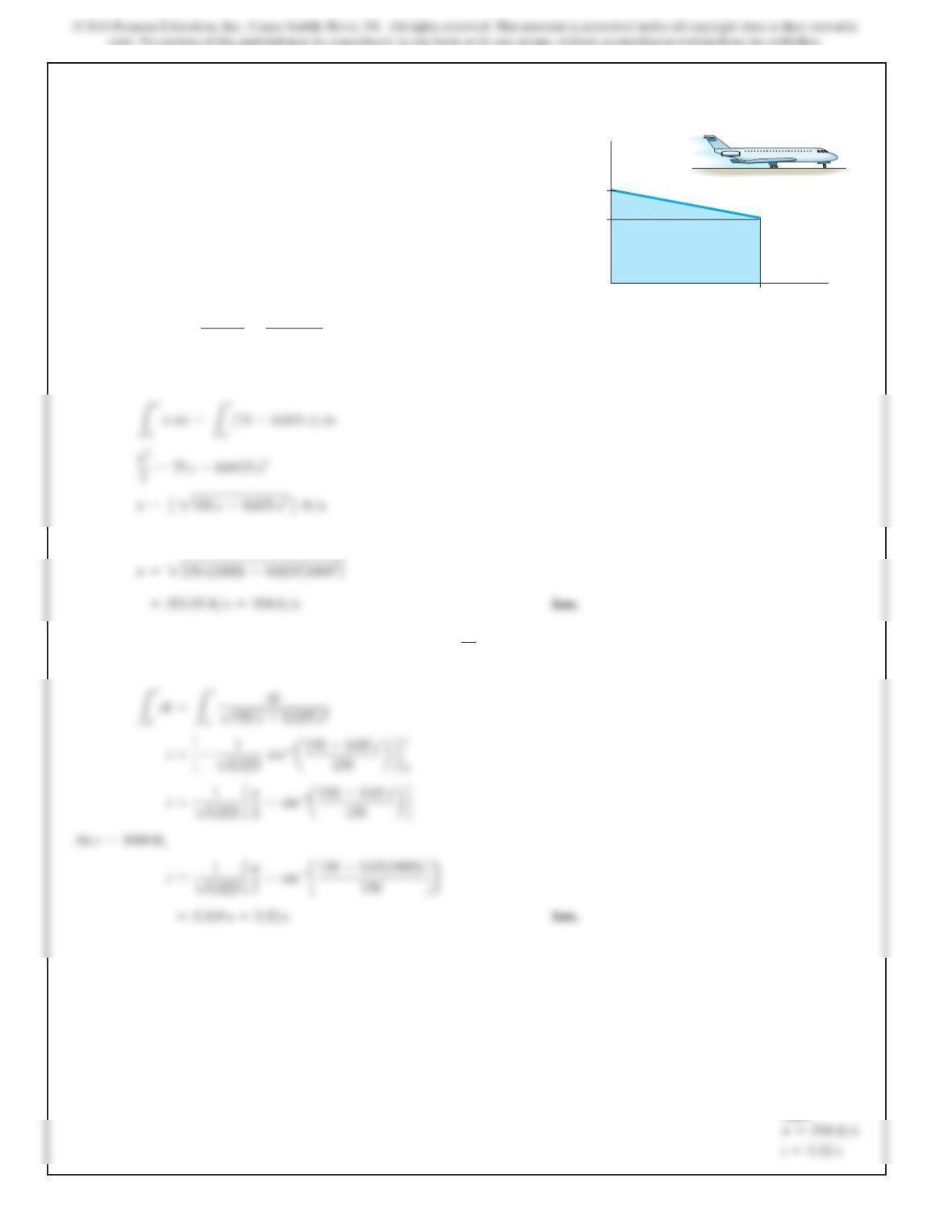
The jet plane starts from rest at s = 0 and is subjected to the
acceleration shown. Determine the speed of the plane when
it has traveled 1000 ft. Also, how much time is required for
it to travel 1000 ft?
75
50
1000
a 75 0.025s
s (ft)
a (
ft
/s2)
Ans:
7 1
12–66.
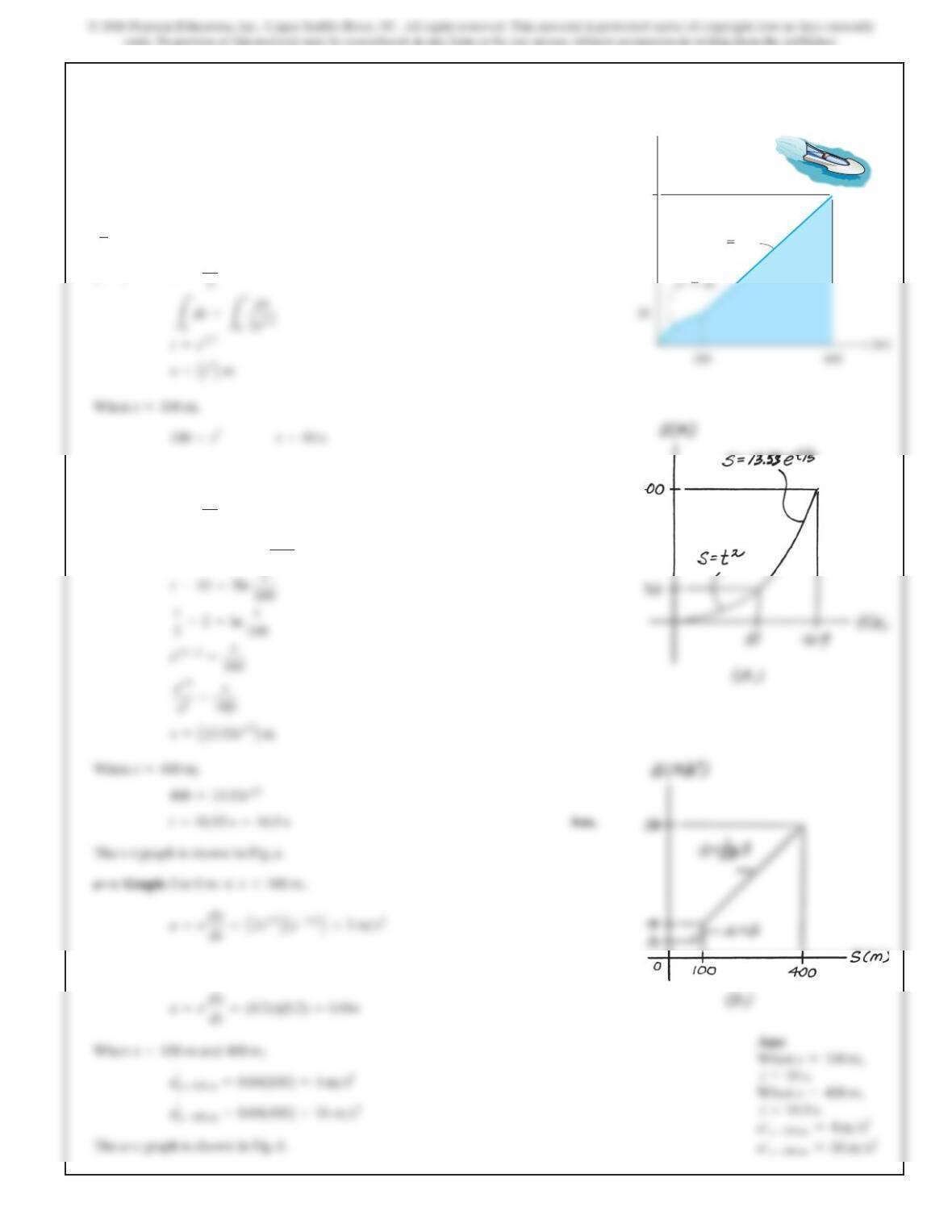
The boat travels along a straight line with the speed
described by the graph. Construct the and graphs.
Also, determine the time required for the boat to travel a
distance if .s=0 when t=0s=400 m
a–ss–t
SOLUTION
Graph: For , the initial condition is when .
For , the initial condition is when .
For ,
100 m 6s…400 m
Lt
10 s
dt =Ls
100 m
ds
0.2s
A
:
+
B
dt =ds
v
t=10 ss=100 m100 6s…400 m
A
:
+
B
dt =ds
t=0ss=00 …s6100 m
t
v (m/s)
80
v 0.2s
s
m
7 2
12–67.
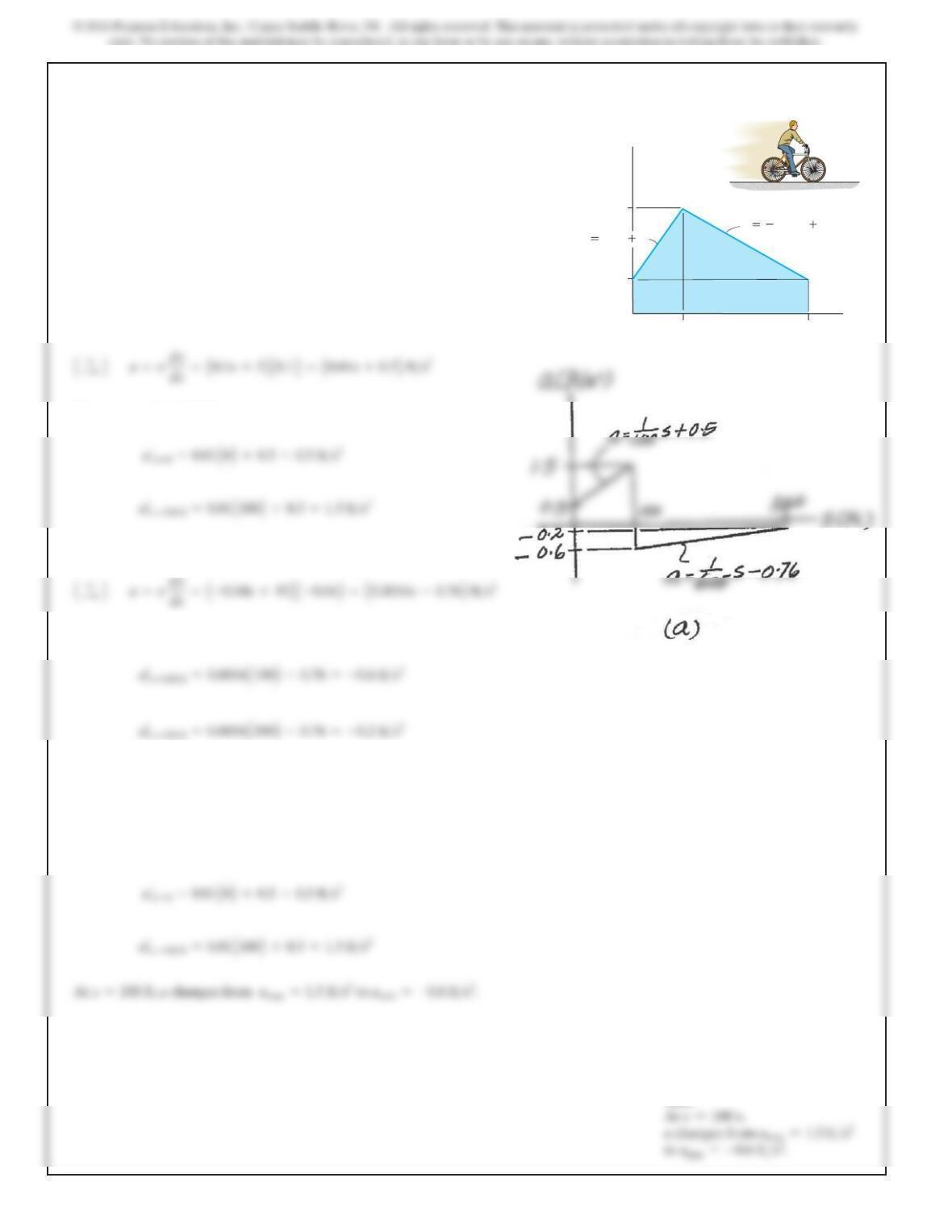
The graph of a cyclist traveling along a straight road is
shown. Construct the graph.a–s
vs
SOLUTION
a–s Graph: For ,
Thus at and
For
Thus at
The graph is shown in Fig. a.
Thus at and
100 fts=0
a–s
s=100 ft and 350 ft
100 ft 6s…350 ft,
100 fts=0
0…s6100 ft
s (ft)
v (ft/s)
100 350
15
5
v 0.1s 5
v 0.04 s 19
–
Ans:
*12–68.
SOLUTION
0…s…150m:
n=1
3s,
T
h
e v–sgrap
h
for a test ve
hi
c
l
e
i
s s
h
own. Determ
i
ne
i
ts
acceleration when and when s=175 m.s=100 m
s(m)
v(m/s)
50
7 4
SOLUTION
v(t)
=
0.8t
2
i
+
12t
1>2
j
+
5k
12–69.
If the velocity of a particle is defined as v(t) = {0.8t2i +
12t1
>
2j + 5k} m
>
s, determine the magnitude and coordinate
direction angles
a
, b,
g
of the particle’s acceleration when
t = 2 s.
Ans:
7 5
12–70.
The velocity of a particle is ,where t
is in seconds.If ,determine the
displacement of the particle during the time interval
.t=1sto t=3s
r=0when t=0
v=
5
3i+
(
6–2t
)
j
6
m
>
s
SOLUTION
Position: The position rof the particle can be determined by integrating the
kinematic equation using the initial condition at as the
integration limit. Thus,
dr=vdt
t=0r=0dr=vdt
Ans:
12–71.
SOLUTION
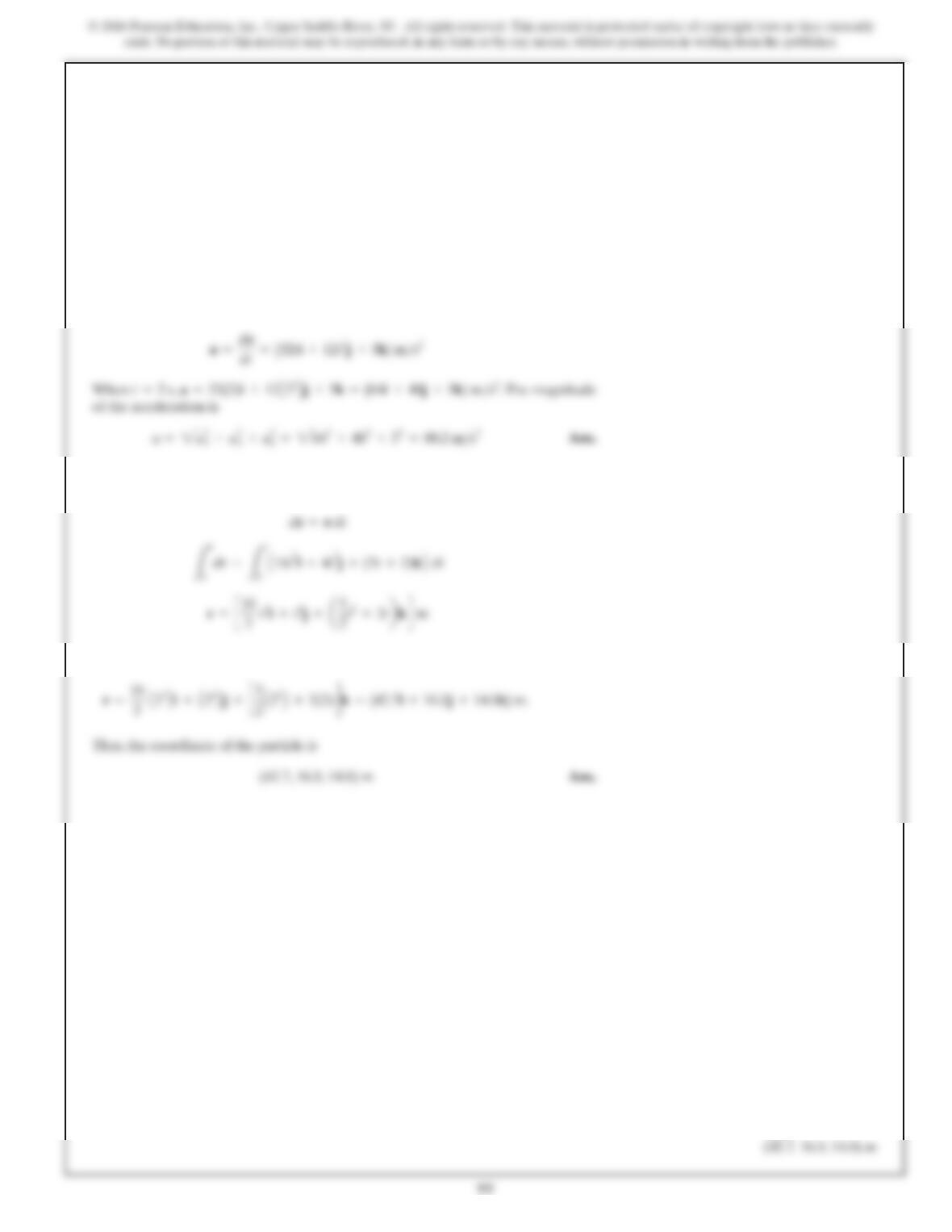
Velocity:The velocity expressed in Cartesian vector form can be obtained by
applying Eq. 12–9.
Position:The position expressed in Cartesian vector form can be obtained by
applying Eq. 12–7.
dr =vdt
Aparticle,originally at rest and located at point
(
3 ft, 2 ft, 5 ft
)
,
is subjected to an acceleration of
Determine the particle’s position (x, y, z)at t=1s.
a=56ti+12t2k6ft>s2.
*12–72.
The velocity of a particle is given by
, where tis in seconds.If
the particle is at the origin when , determine the
magnitude of the particle’s acceleration when . Also,
what is the x, y, zcoordinate position of the particle at this
instant?
t=2s
t=0
v=516t2i+4t3j+(5t+2)k6m>s
SOLUTION
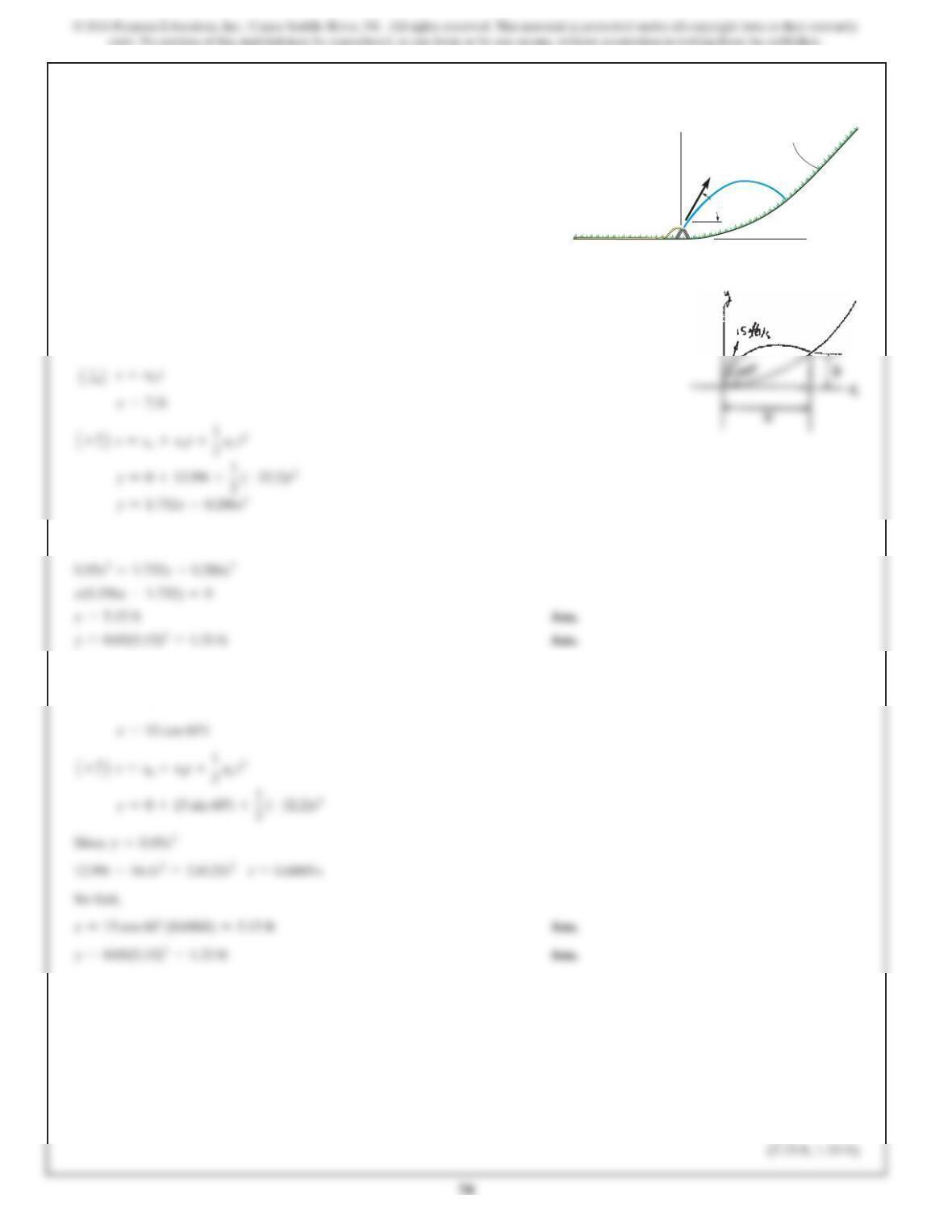
Acceleration: The acceleration expressed in Cartesian vector form can be obtained
by applying Eq. 12–9.
Position: The position expressed in Cartesian vector form can be obtained by
applying Eq. 12–7.
When ,
t=2s
Ans:
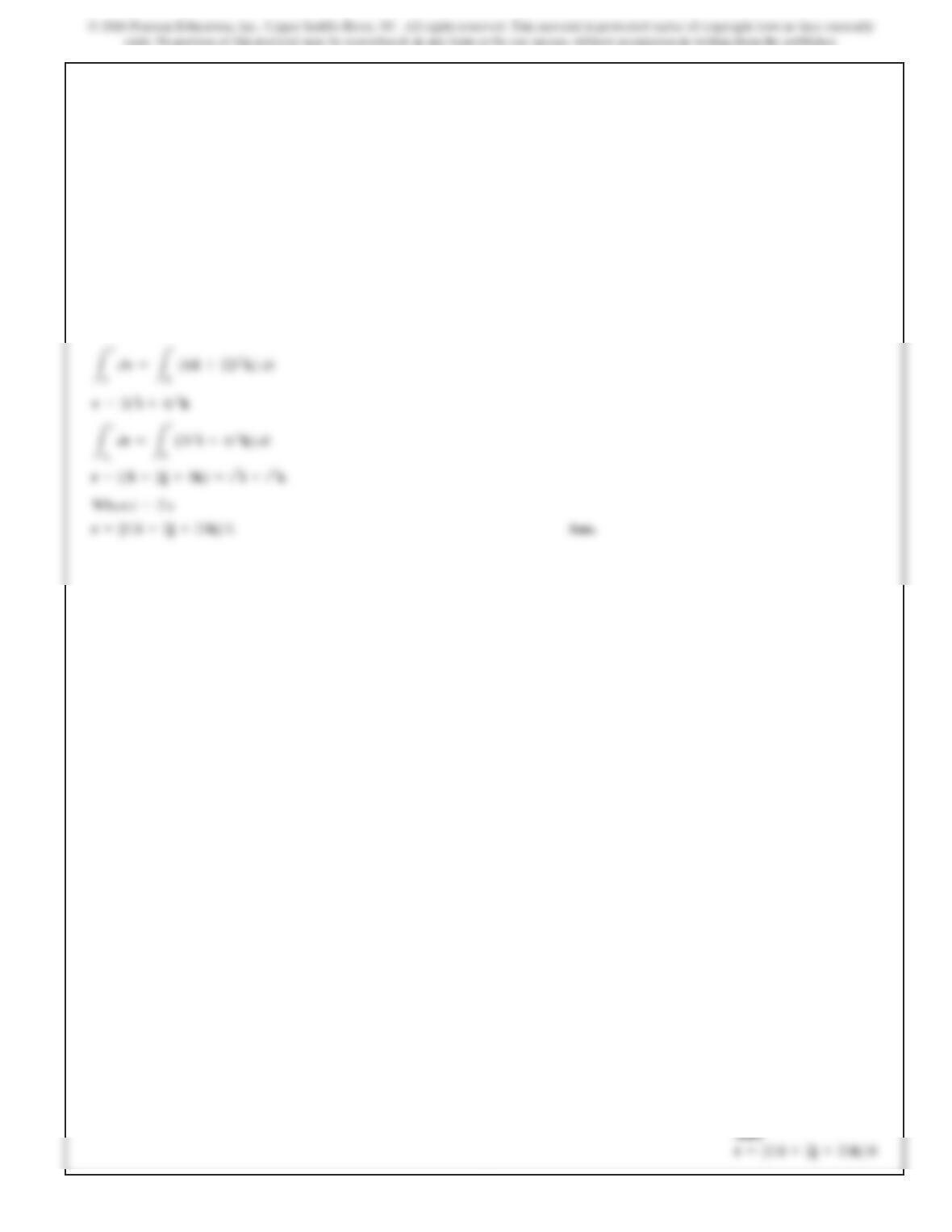
SOLUTION
vx=15 cos 60°=7.5 ft>s
v
y
=15 sin 60°=12.99 ft>s
1
+
2
s=v0 t
=
Since y
=
0.05x
2
,
Also,
1
+
S
2
s=v0t
=
2
12–73.
The water sprinkler, positioned at the base of a hill, releases
a stream of water with a velocity of 15 ft
>
s as shown.
Determine the point B(x, y) where the water strikes the
ground on the hill. Assume that the hill is defined by the
equation y = (0.05x2) ft and neglect the size of the sprinkler.
y
x
60
15 ft/s
B
y (0.05x2) ft
Ans:
7 9
SOLUTION
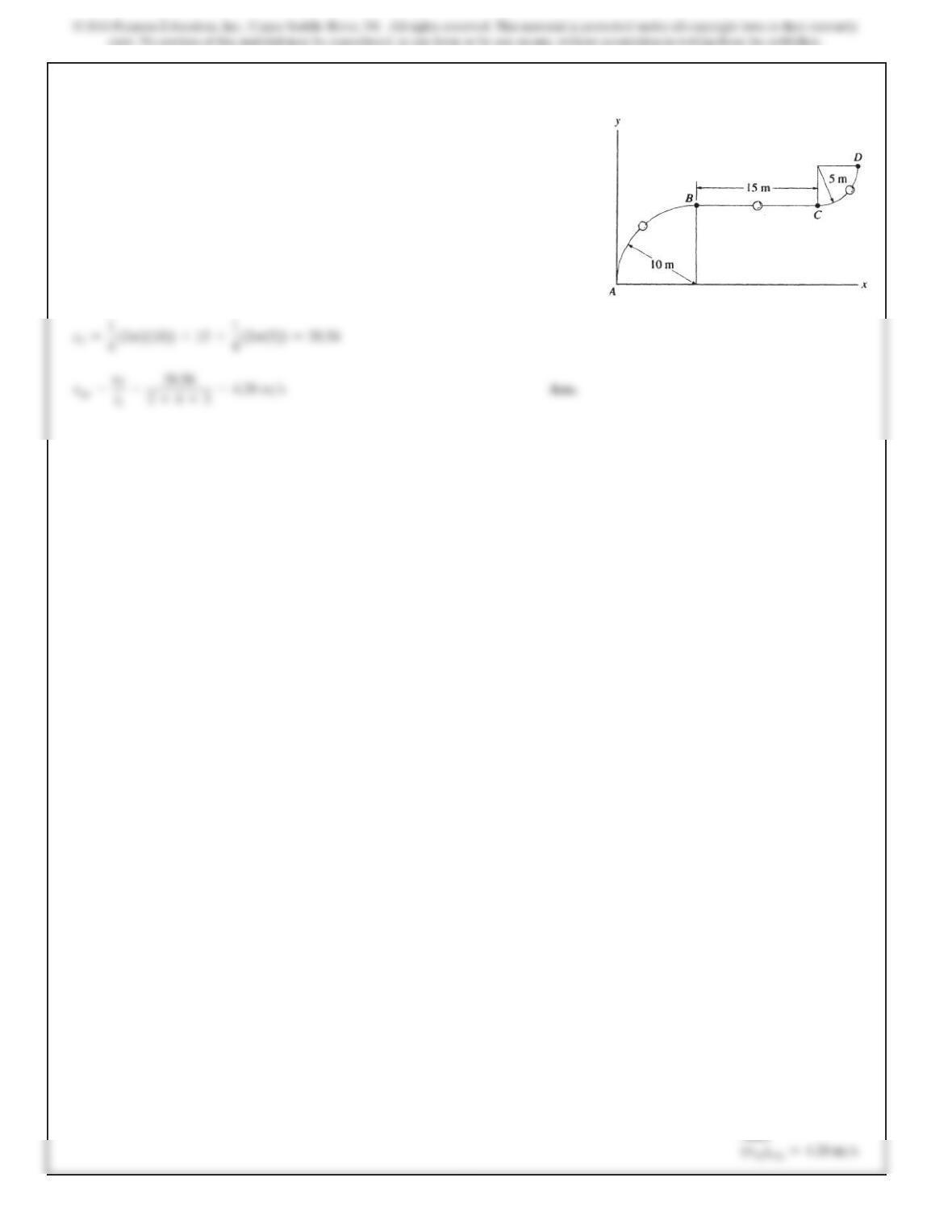
a=6ti+12t2
k
12–74.
A particle, originally at rest and located at point (3 ft, 2 ft, 5 ft),
is subjected to an acceleration a = {6t i + 12t2 k} ft
>
s2.
Determine the particle’s position (x, y, z) when t = 2 s.
8 0
12–75.
A particle travels along the curve from A to B in
2 s. It takes 4 s for it to go from B to C and then 3 s to go
from C to D. Determine its average speed when it goes from
A to D.
SOLUTION
Ans: