84
CHAPTER 11
POWER EQUIPMENT AND SYSTEMS
OVERVIEW
Needless to say, space limitation only allows a small portion of the thousands of
essentials to be covered in this chapter. However, what we have included in this chapter
does represent the most common equipment types in building applications. We believe
what we have included in this chapter does represent the most important equipment and
systems in most electrical installations.
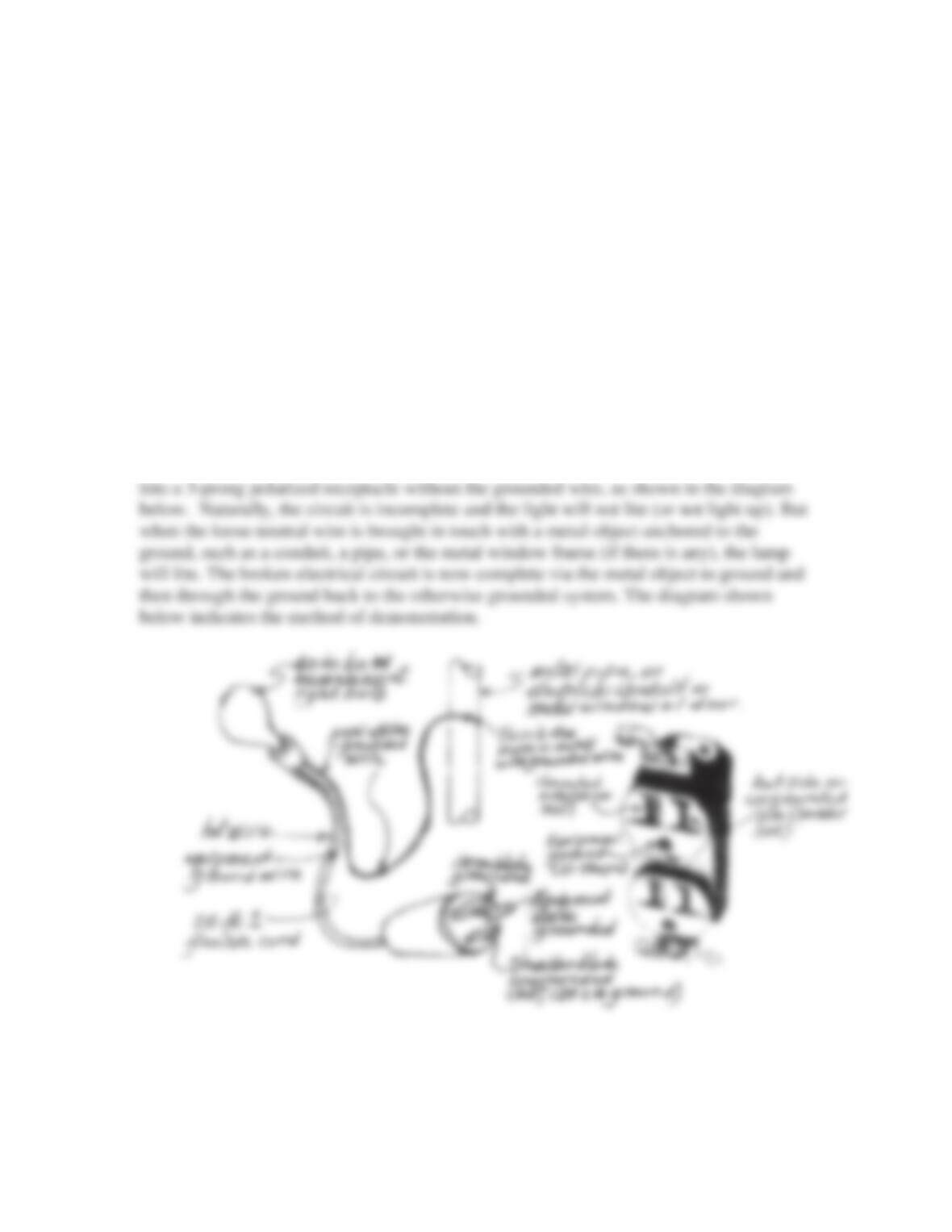
We have found that the principle of electrical grounding is intriguing to students.
According to NEC, all power systems between 50 to 1000 volts to ground must be
grounded (as usual without exceptions). Grounding means connecting the electrical
system to earth, which is a huge conductor. A simple demonstration will catch the
students’ interest by plugging in a portable work light with the grounded wire removed
from the plug. The grounded wire is also called neutral wire. The plug is then plugged
85
Figure 11-1 illustrates a comparison between 277/480 volt and 220/380 volt 3-phase, 4-
wire systems. The latter is commonly used in Europe and some Asian countries whereas
the equivalent in the U.S. is 120/208-volt system is provided. The 220/380volt system is
chosen in lieu of the popular 120/380 volt system in the U.S. is to identify the text with
international readers.
Short circuit of an electrical system is the most important aspect of electrical engineering
in building systems. This is difficult to demonstrate, but protection equipment
manufacturers, such as General Electric, Square-D, or Bussmann, do have well
documented videotapes or CDs on loan for use in the class.
There is electrical distribution equipment in every school building. These are excellent
opportunities to demonstrate electrical power systems. With the help of the maintenance
department, the fronts of panels can be removed to review the interior of a panel. The
jammed wires within the panel always amaze students.
CHAPTER 11
POWER EQUIPMENT AND SYSTEMS
QUESTIONS AND ANSWERS
11.1 What electrical distribution systems are normally used to serve residences?
Small business buildings with load about 100 kVA?
11.2 What electrical distribution systems are normally selected to serve a
combination of single phase and 3-phase loads?
11.3 What is meant by voltage spread of any electrical distribution system?
Voltage drop?
11.4 What is the recommended maximum kVA rating of a single motor-driven
equipment on a 100 kVA, 120/240 volt, single-phase, 3-wire system? Why is
the recommended maximum considerably lower than the system rating?
87
breaker) before the motor can be running at its full speed. In the meantime, the
system voltage will (drop) to the extent causing lights to dim and other equipment
to malfunction.
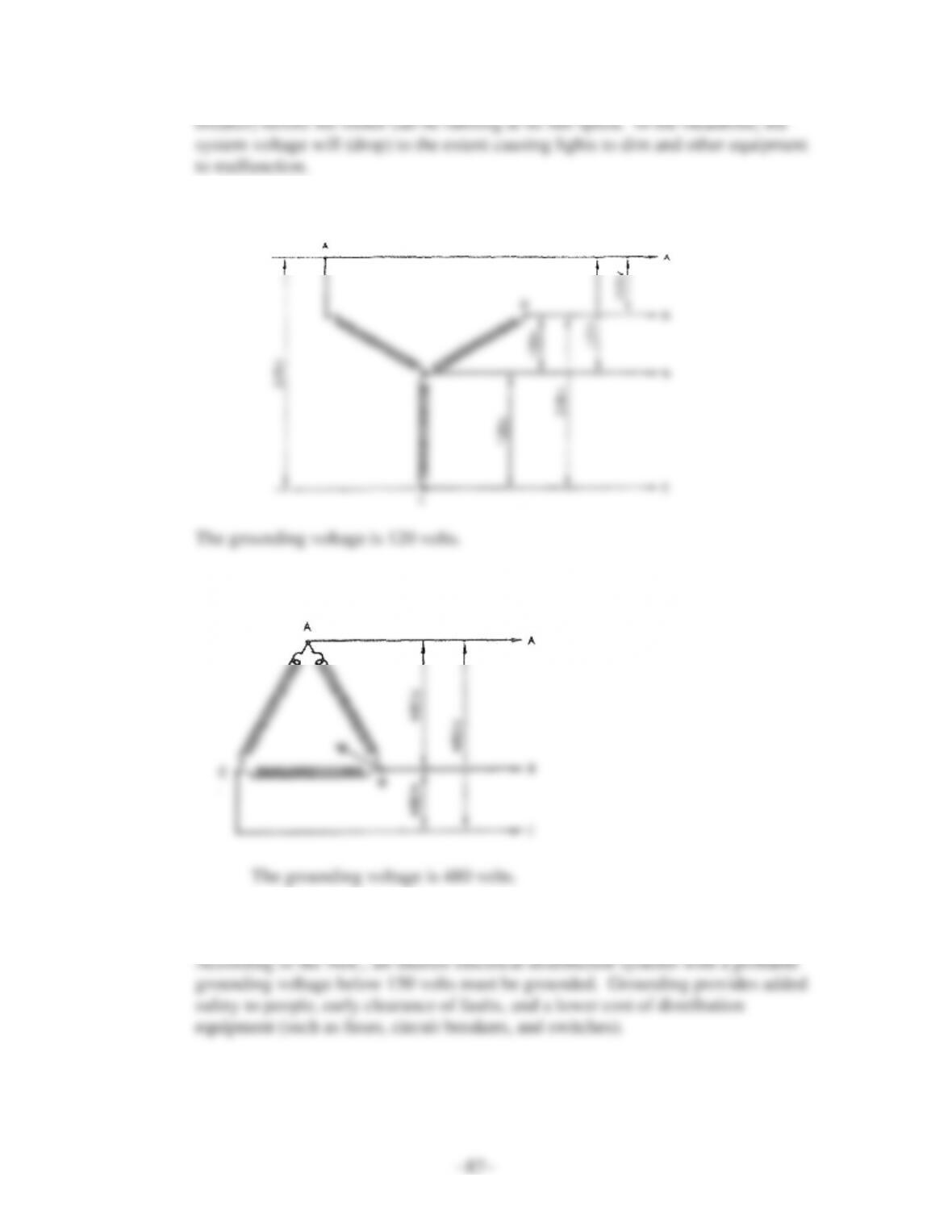
11.5 What is the grounding voltage of a 120/208 volt, 3-phase, 4-wire
system?
11.6 What is the grounding voltage of a 480 volt, 3-phase, 3-wire system?
11.7 Why should the interior electrical distribution system be grounded?
11.8 Must all electrical systems be grounded?
11.9 Should the interrupting capacity (IC) of the switchboard be rated higher or
lower than the available short circuit current (Is)?
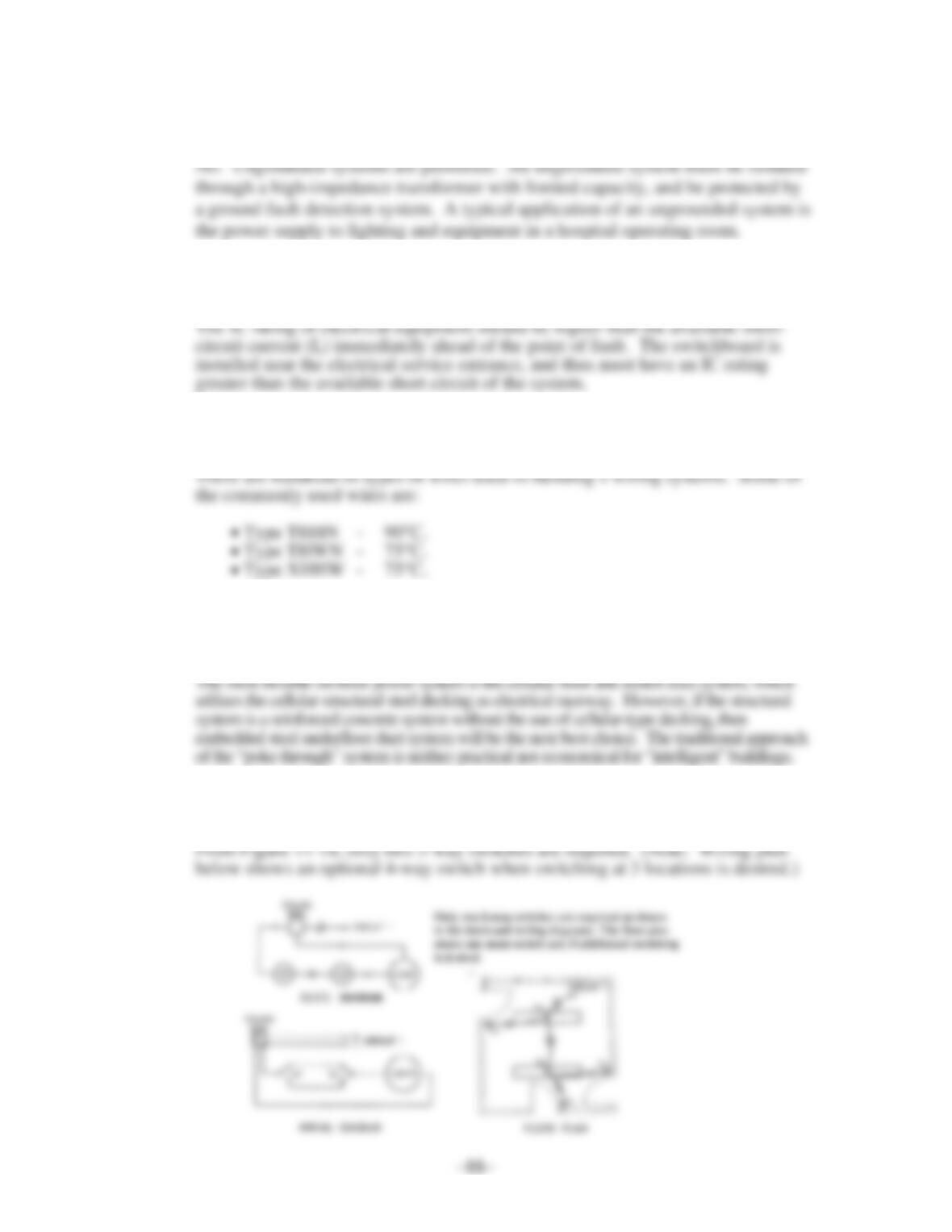
11.10 Name a few NEC classified wires for building interior wiring systems and
temperature ratings.
11.11 What on-floor power system would you recommend for a high-rise office
building designed for flexibility and capability of using PC computers and
electronic equipment?
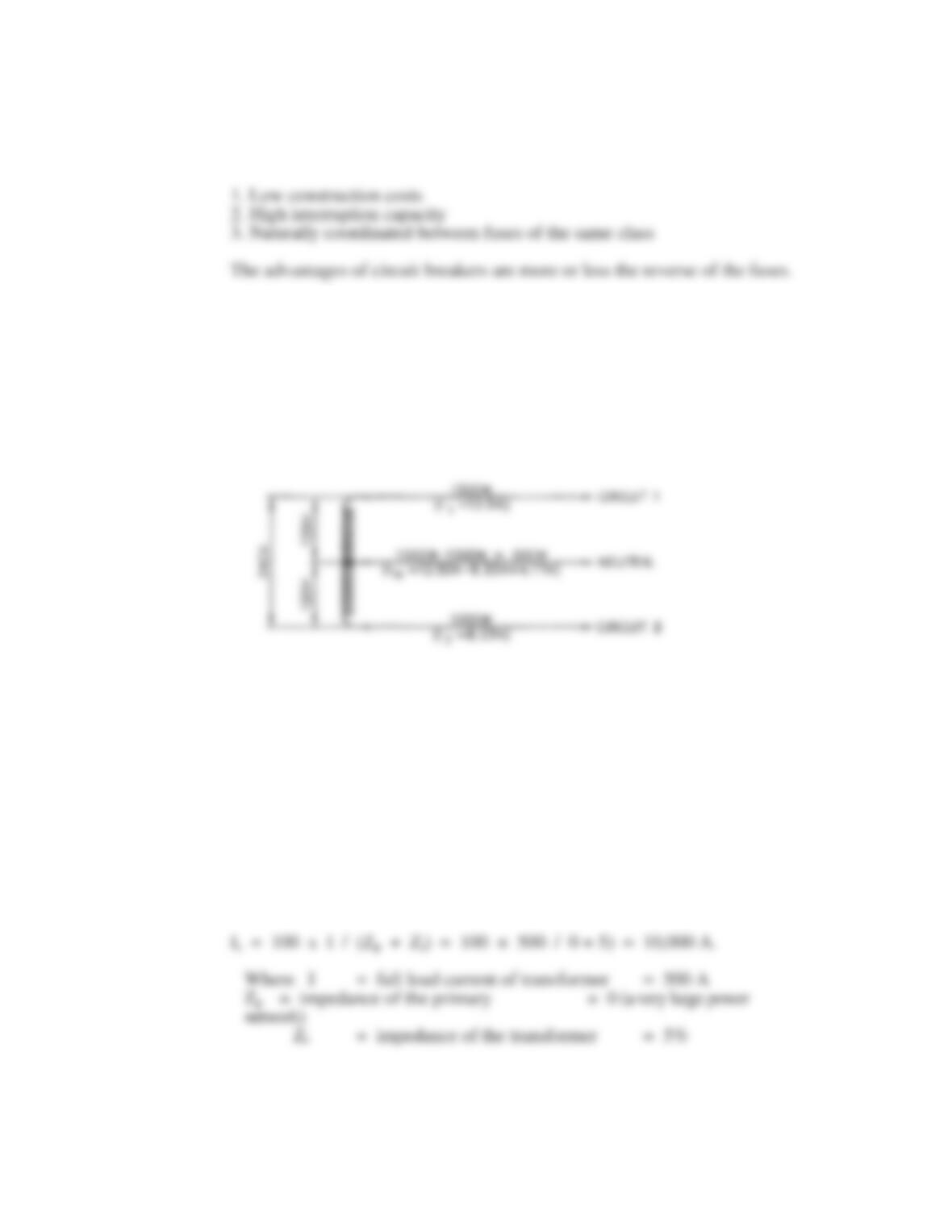
11.12 If you wish to control a bank of lights in the room from two different
locations, how many 3-way and 4-way switches shall be used?
89
11.13 Name several advantages of fuses. Advantages of circuit breakers?
The advantages of fuses over circuit breakers are:
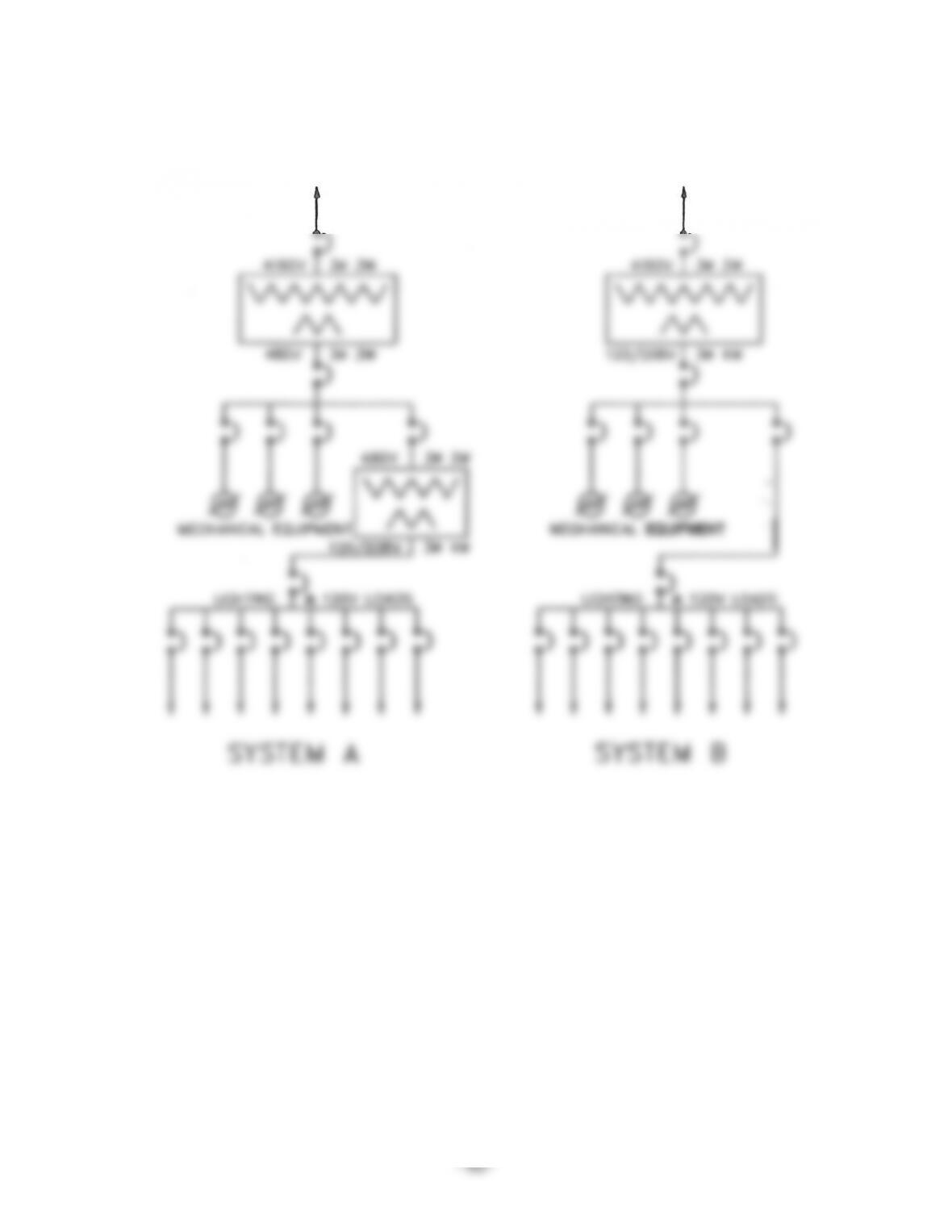
11.14 A 120/240 volt, single-phase system is a system with its center tap as the
neutral point. (See drawing below). If the load of circuit No. 1 connected
between Line 1 and neutral is 1500 watts and that of circuit No. 2 between
Line 2 and neutral is 1000 watts, what is the current in amperes carried by
each circuit and the combined neutral?
The flow of current in line 1, line 2, and the neutral are illustrated in the diagram.
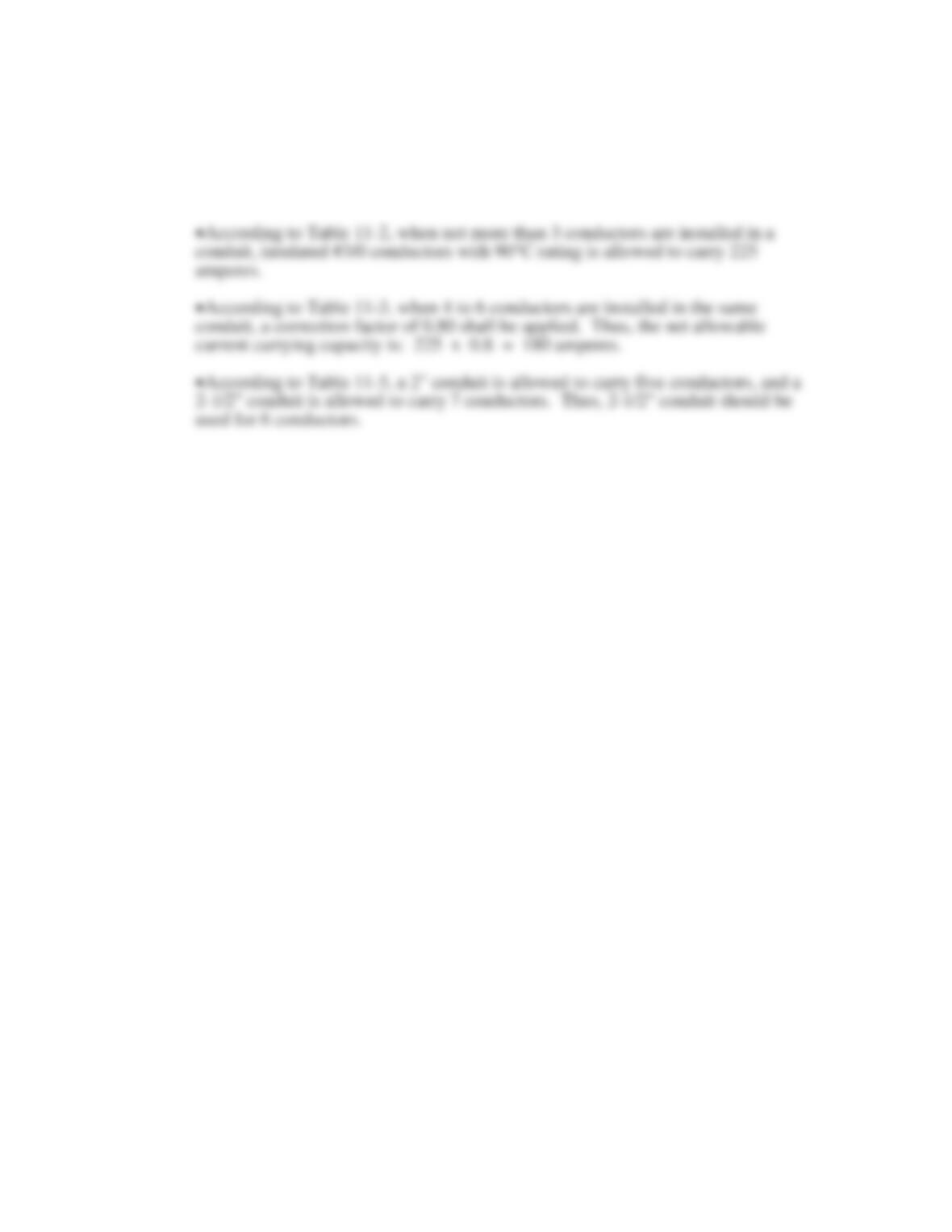
11.15 If the full load current of a transformer having 5% impedance is 500
amperes, what could be the expected short-circuit current at the main
switchboard?
(Note: For simplicity, a conservative approach is to assume that the utility
power network serving this transformer is sufficiently large enough to have
practically zero impedance during a fault.)
According to equation 11-1:
91
11.16 According to NEC, what is the allowable (maximum) current that
can be carried by a single #3/0, 90
q
C rated conductor in conduit? Six
conductors in conduit, and what conduit size shall be used?
The allowable current carrying capacity is calculated as follows:
92
11.17 A 20,000 sq ft school building has the following estimated demand loads:
ˍLighting 20,000 watts 120 volt, 1-phase
ˍMechanical equipment 100 HP* 480 volt, 3-phase
ˍConvenience power 1 W/sq ft 120 volt, 1-phase
What power distribution system or systems would you choose?
11.18 What is the standard frequency and the utilization voltage for branch
circuits in Europe?
11.19 If the line-to-neutral voltage of a 3 phase 4 wire system is 220 volt, what is the
Line-to-line voltage? Similarly, for a 2400-volt line-to-neutral voltage, what
is the line-to-line voltage?
93
11.20 Determine the maximum short current in amperes of an electrical power
system having one main transformer rated at 300 kva, 480 volt, 3 phase. The
transformer impedance is 3%.
11.21 If the system secondary voltage is 240 volt in lieu of 480 volt, what will be the
maximum short circuit value?
11.22 What should be the interrupting capacity rating of the two systems in 11.20
and 11.21?
11.23 Describe the three alternate power sources that can be used for buildings.
(a) Tape ahead of main switch – only used for residences or small businesses
11.24 What is the difference between K4 and K13 rated transformers?
11.25 Explain why large electrical cables are stranded.
11.26 What is the difference between standby power and uninterruptible power?
11.27 How do K-type transformers, UPS, and TVSS differ in their functions with
regard to power quality management?
11.28 What are the pros and cons of placing a generator indoors vs. outdoors?