9.4.37.
(a)0
B
@
e2t0 0
0et0
0 0 1
1
C
A— scalings by a factor λ=etin the ydirection and λ2=e2tin the x
direction. The trajectories are the semi-parabolas x=c y2, z =dfor c, d constant, and
the half-lines x6= 0, y = 0, z =dand x= 0, y 6= 0, z =d. Points on the zaxis are left
fixed.
itive and negative zaxes, circles in the xy plane, and cylindrical spirals (helices) wind-
ing around the zaxis while going away from the xy pane at an exponentially increasing
rate. The only fixed point is the origin.
(e)0
B
@
cosh t0 sinh t
0 1 0
sinh t0 cosh t1
C
A— hyperbolic rotations in the xz plane, cf. Exercise 9.4.36(e). The
trajectories are the semi-hyperbolas x2−z2=c, y =d, and the rays x=±z, y =d.
The points on the yaxis are fixed.
9.4.38. (a)et:A=
♥9.4.39.
(a) Given c, d ∈R,x,y∈R3, we have
Lv[cx+dy] = v×(cx+dy) = cv×x+dv×y=cLv[x] + d Lv[y],
proving linearity.
(b) If v= ( a, b, c )T, then Av=0
B
@
0c−b
−c0a
b−a01
C
A=−AT
v.
♥9.4.40.
(a) The solution is x(t) = 0
B
@
x0cos t−y0sin t
x0sin t+y0cos t
z0
1
C
A, which is a rotation by angle taround the z
axis. The trajectory of the point ( x0, y0, z0)Tis the circle of radius r0=qx2
0+y2
0at
height z0centered on the zaxis. The points on the zaxis, with r0= 0, are fixed.
♥9.4.41.
(a) Since A=0
B
@
0c−b
−c0a
b−a01
C
A, we have A2=0
B
@−b2−c2ab a c
ab −a2−c2b c
ac bc −a2−b21
C
Awhile
A3=−(a2+b2+c2)A=−A. Therefore, by induction, A2m+1 = (−1)mAand
A2m= (−1)m−1A2for m≥1. Thus
9.4.42. None of them commute:
“ 2 0
0 0 !, 0 0
1 0 !#= 0 0
−2 0 !,“ 2 0
0 0 !, 0 3
−3 0 !#= 0 6
6 0 !,
259
2
6
40
B
@
2 0 0
0 1 0
0 0 0 1
C
A,0
B
@
0 0 1
000
0 0 0 1
C
A3
7
5=0
B
@
0 0 2
0 0 0
0 0 0 1
C
A,
2
6
40
B
@
200
0 1 0
0 0 0 1
C
A,0
B
@
0 0 −2
0 0 0
2 0 0 1
C
A3
7
5=0
B
@
0 0 −4
0 0 0
−4 0 0 1
C
A,
2
6
40
B
@
200
0 1 0
0001
C
A,0
B
@
010
−1 0 0
0011
C
A3
7
5=0
B
@
0 1 0
1 0 0
0 0 0 1
C
A,
2
6
40
B
@
2 0 0
0 1 0
C
A,0
B
@
0 0 1
0 0 0
C
A3
7
5=0
B
@
0 0 2
0 0 0
C
A,
9.4.43.
(a) If U, V are upper triangular, so are U V and V U and hence so is [ U, V ] = U V −V U.
(b) If AT=−A, BT=−Bthen
[A, B ]T= (AB −B A)T=BTAT−ATBT=B A −AB =−[A, B ].
(c) No.
♦9.4.44. The sum of
9.4.45. In the matrix system dU
dt =AU , the equations in the last row are dunj
dt = 0 for
j= 1, . . . , n, and hence the last row of U(t) is constant. In particular, for the exponen-
tial matrix solution U(t) = et A the last row must equal the last row of the identity matrix
U(0) = I , which is eT
n.
260
9.4.46. Write the matrix solution as U(t) = V(t)f(t)
g(t)w(t)!, where f(t) is a column vector, g(t)
a row vector, and w(t) is a scalar function. Then the matrix system dU
♦9.4.47. (a) x+t
y!: translations in xdirection. (b) etx
e−2ty!: scaling in xand ydirec-
9.5.1. The vibrational frequency is ω=q21/6≈1.87083, and so the number of Hertz is
ω/(2π)≈.297752.
9.5.3.
(a) Periodic of period π:
-2 2 46 8 10
-2
-1
1
2
(b) Periodic of period 2:
-2 2 46 8 10
-0.5
0.5
1
1.5
2
2.5
261
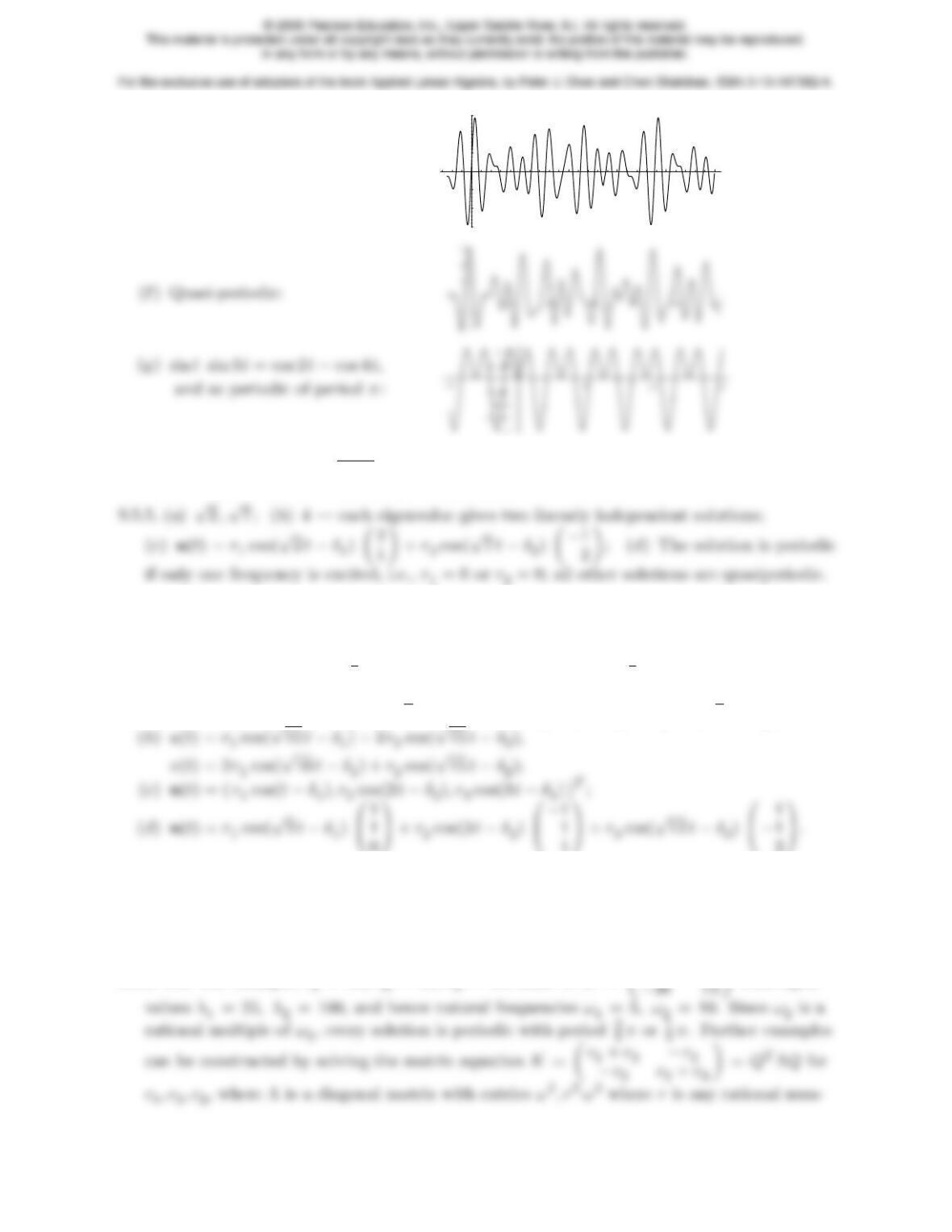
(e) Periodic of period 120π:
100 200 300 400 500
-3
-2
-1
1
2
3
9.5.4. The minimal period is π m
2k−1, where mis the least common multiple of qand s, while 2k
is the largest power of 2 appearing in both pand r.
9.5.6. (a) 5,10; (b) 4 — each eigenvalue gives two linearly independent solutions;
(c)u(t) = r1cos(5t−δ1) −3
4!+r2cos(10t−δ2) 4
3!; (d) All solutions are periodic;
when r16= 0, the period is 2
5π, while when r1= 0 the period is 1
5π.
9.5.7.
(a)u(t) = r1cos(t−δ1) + r2cos(√5t−δ2), v(t) = r1cos(t−δ1)−r2cos(√5t−δ2);
9.5.8. The system has stiffness matrix K= ( 1 −1 ) c10
0c2! 1
−1!= (c1+c2) and so the
dynamical equation is m¦¦
u+ (c1+c2)u= 0, which is the same as a mass connected to a
single spring with stiffness c=c1+c2.
9.5.9. Yes. For example, c1= 16, c2= 36, c3= 37,leads to K= 52 −36
262
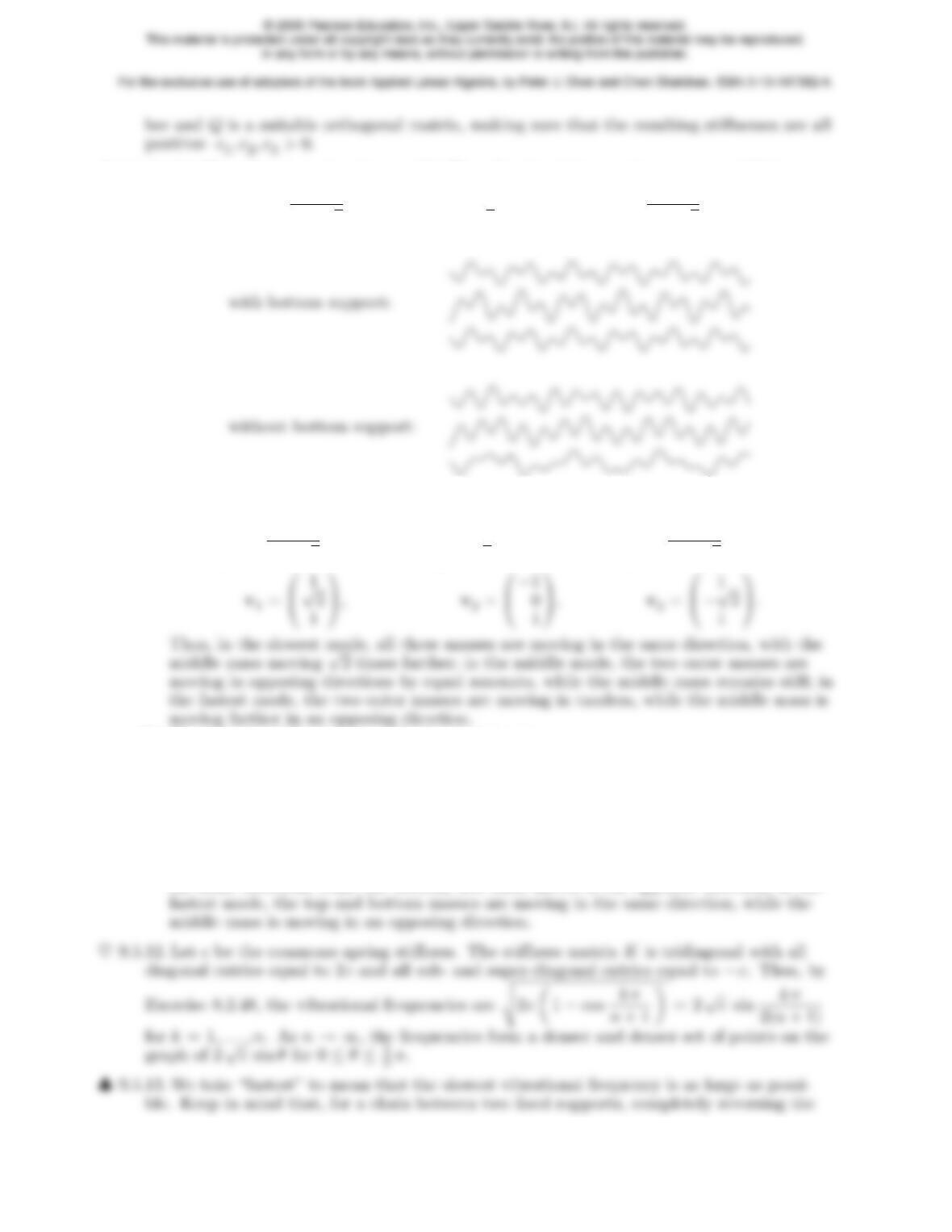
♠9.5.10. (a) The vibrations slow down. (b) The vibrational frequencies are ω1=.44504, ω2=
1.24698, ω3= 1.80194, each of which is a bit smaller than the fixed end case, which has
frequencies ω1=q2−√2 = .76537, ω2=√2 = 1.41421, ω3=q2 + √2 = 1.84776.
(c) Graphing the motions of the three masses for 0 ≤t≤50:
♠9.5.11.
(a) The vibrational frequencies and eigenvectors are
ω1=q2−√2 = .7654, ω2=√2 = 1.4142, , ω3=q2 + √2 = 1.8478,
(b) The vibrational frequencies and eigenvectors are
ω1=.4450, ω2= 1.2470, ω3= 1.8019,
v1=0
B
@
.3280
.5910
.7370 1
C
A,v2=0
B
@
.7370
.3280
−.5910 1
C
A,v3=0
B
@−.5910
.7370
−.32805 1
C
A.
Thus, in the slowest mode, all three masses are moving in the same direction, each slightly
farther than the one above it; in the middle mode, the top two masses are moving in
the same direction, while the bottom, free mass moves in the opposite direction; in the
263
order of the springs does not change the frequencies. For the indicated springs connecting
2 masses to fixed supports, the order 2,1,3 or its reverse, 3,1,2 is the fastest, with frequen-
cies 2.14896,1.54336. For the order 1,2,3, the frequencies are 2.49721, 1.32813, while for
1,3,2 the lowest frequency is the slowest, at 2.74616,1.20773. Note that as the lower fre-
quency slows down, the higher one speeds up. In general, placing the weakest spring in the
middle leads to the fastest overall vibrations.
For a system of nsprings with stiffnesses c1> c2>··· > cn, when the bottom mass
♣9.5.14. (a)d2u
dt2+0
B
B
B
B
B
@
3
2−1
2−1 0
−1
23
20 0
−1 0 3
21
2
0 0 1
23
2
1
C
C
C
C
C
A
u=0, where u(t) = 0
B
B
B
@
u1(t)
v1(t)
u2(t)
v2(t)
1
C
C
C
Aare the horizontal and
vertical displacements of the two free nodes. (b) 4; (c)ω1=r1−1
1
1
1
1
1
first mode, the left corner moves down and to the left, while the right corner moves up and
to the left, and then they periodically reverse directions; the horizontal motion is propor-
tionately 2.4 times the vertical. In the second mode, both corners periodically move up and
towards the center line and then down and away; the vertical motion is proportionately 2.4
times the horizontal. In the third mode, the left corner first moves down and to the right,
while the right corner moves up and to the right, periodically reversing their directions; the
quasiperiodic combination of all four normal modes.
9.5.15. The system has periodic solutions whenever Ahas a complex conjugate pair of purely
imaginary eigenvalues. Thus, a quasi-periodic solution requires two such pairs, ±iω1and
±iω2, with the ratio ω1/ω2an irrational number. The smallest dimension where this can
occur is 4.
9.5.16.
(c)u(t) = −2at −2b−1−√13
4r1cos r7+√13
2t−δ1!−1+√13
4r2cos r7−√13
2t−δ2!,
v(t) = −2at −2b+3−√13
4r1cos r7+√13
2t−δ1!+3+√13
4r2cos r7−√13
2t−δ2!,
w(t) = at +b+r1cos r7+√13
2t−δ1!+r2cos r7−√13
2t−δ2!.
The unstable mode is the term containing a; it will not be excited if the initial condi-
tions satisfy −2¦
u(t0)−2¦
v(t0) + ¦
w(t0) = 0.
9.5.17.
(a)Q=0
B
B
B
B
@
−1
√2
1
√20
0 0 1
1
√2
1
√20
1
C
C
C
C
A, Λ = 0
B
@
400
0 2 0
0021
C
A.
9.5.18.
(a)Q=0
B
B
B
B
@
1
√3−1
√2
1
√6
−1
√302
√6
1
√3
1
√2
1
√6
1
C
C
C
C
A, Λ = 0
B
@
3 0 0
0 2 0
0 0 0 1
C
A.
9.5.19. The solution to the initial value problem md2u
u(t0) = b, is
265
♠9.5.20.
(a) Frequencies: ω1=r3
2−1
2√5 = .61803, ω2= 1, ω3=r3
2+1
2√5 = 1.618034;
stable eigenvectors: v1=0
B
B
B
@
2−√5
−1
−2 + √5
1
C
C
C
A,v2=0
B
B
B
@
−1
−1
−1
1
C
C
C
A,v3=0
B
B
B
@
2 + √5
1
−2−√5
1
C
C
C
A; unstable
rate up and to the right.
(b) Frequencies: ω1=.444569, ω2=.758191, ω3= 1.06792, ω4= 1.757; eigenvectors:
B
.237270
1
C
B
−.122385
1
C
B
.500054
1
C
B
.823815
1
C
(c) Frequencies: ω1=ω2=r2
11 =.4264, ω3=r21
11 −3
11 √5 = 1.1399, ω4=r20
11 =
1.3484, ω5=r21
11 +3
11 √5 = 1.5871; stable eigenvectors:
0
1
0
1
0
1
♥9.5.21. If the mass–spring molecule is allowed to move in space, then the vibrational modes
and frequencies remain the same, while there are 14 independent solutions corresponding
to the 7 modes of instability: 3 rigid translations, 3 (linearized) rotations, and 1 mecha-
nism, which is the same as in the one-dimensional version. Thus, the general motion of the
molecule in space is to vibrate quasi-periodically at frequencies √3 and 1, while simultane-
ously translating, rigidly rotating, and bending, all at a constant speed.
♠9.5.22.
(a) There are 3 linearly independent normal modes of vibration: one of frequency √3, , in
1+v⊥
2+v⊥
3= 0 where v⊥
idenotes the angular component of the velocity vector with
respect to the center of the triangle.
(b) There are 4 normal modes of vibration, all of frequency √2, in which one of the edges
expands and contracts while the two vertices not on the edge stay fixed. There are 4
unstable modes: 3 rigid motions and one mechanism where two opposite corners move
towards each other while the other two move away from each other. To avoid exciting
the instabilities, the initial velocity must be orthogonal to the kernel; thus, if the ver-
tices are at ( ±1,±1 )Tand vi= ( vi, wi)Tis the initial velocity of the ith mode, we
require v1+v2=v3+v4=w1+w4=w2+w3= 0.
(c) There are 6 normal modes of vibration: one of frequency √3, in which three nonadja-
cent edges expand and then contact, while the other three edges simultaneously contract
♠9.5.23. There are 6 linearly independent normal modes of vibration: one of frequency 2, in
267
which the tetrahedron expands and contacts; four of frequency √2, in which one of the
edges expands and contracts while the opposite vertex stays fixed; and two of frequency
√2, in which two opposite edges move towards and away from each other. (There are three
different pairs, but the third mode is a linear combination of the other two.) There are
♥9.5.24. (a) When C= I , then K=ATAand so the frequencies ωi=qλiare the square roots
of its positive eigenvalues, which, by definition, are the singular values of the reduced inci-
dence matrix. (b) Thus, a structure with one or more very small frequencies ωi≪1, and
hence one or more very slow vibrational modes, is almost unstable in that a small perturba-
tion might create a null eigenvalue corresponding to an instability.
9.5.25. Since corng Ais the orthogonal complement to ker A= ker K, the initial velocity is
9.5.26.
(a)u(t) = r1cos „1
√2t−δ1« 1
2!+r2cos „q5
3t−δ2« −3
1!,
(b)u(t) = r1cos „1
√3t−δ1« 2
9.5.27. u1(t) = √3−1
2√3cos r3−√3
2t+√3+1
2√3cos r3+√3
2t,
u2(t) = 1
2√3cos r3−√3
2t−1
2√3cos r3+√3
2t.
268
♠9.5.29. The order does make a difference:
♣9.5.30.
(a) We place the oxygen molecule at the origin, one hydrogen at ( 1,0 )Tand the other at
( cos θ, sin θ)T= ( −0.2588,0.9659 )Twith θ=105
(b) We place the carbon atom at the origin and the chlorine atoms at
„2√3
3,0,−1
3«T, −√2
3,r2
3,−1
3!T
, −√2
3,r2
3,−1
3!T
,( 0,0,1 )T,
which are the vertices of a unit tetrahedron. There are four independent vibrational
chlorine atoms simultaneously move into and away from the carbon atom.
(c) There are six independent vibrational modes, whose fundamental frequencies are ω1=
2.17533, ω2=ω3= 2.05542, ω4=ω5= 1.33239, ω6= 1.12603. In all cases, the
269
9.5.31.
(a)
d2
dt20
B
B
B
@
x1
y1
x2
y2
1
C
C
C
A+0
B
B
B
@
2 0 −1 0
0 0 0 0
−1 0 2 0
0 0 0 0
1
C
C
C
A0
B
B
B
@
x1
y1
x2
y2
1
C
C
C
A=0
B
B
B
@
0
0
0
0
1
C
C
C
A.
Same vibrational frequencies: ω1= 1, ω2=√3, along with two unstable mechanisms
9.5.32.
(a)
d2
dt2
0
B
B
B
B
B
B
B
@
x1
y1
z1
x2
y2
z2
1
C
C
C
C
C
C
C
A
+
0
B
B
B
B
B
B
B
@
200−1 0 0
0 0 0 0 0 0
0 0 0 0 0 0
−1 0 0 2 0 0
0 0 0 0 0 0
0 0 0 0 0 0
1
C
C
C
C
C
C
C
A
0
B
B
B
B
B
B
B
@
x1
y1
z1
x2
y2
z2
1
C
C
C
C
C
C
C
A
=
0
B
B
B
B
B
B
B
@
0
0
0
0
0
0
1
C
C
C
C
C
C
C
A
.
Same vibrational frequencies: ω1= 1, ω2=√3, along with four unstable mechanisms
corresponding to motions of either mass in the transverse directions.
270
9.5.34.
(a) First, d2e
u
dt2=Nd2u
dt2=−N K u=−N K N −1u=−f
Ke
u.
Moreover, f
Kis symmetric since f
KT=N−TKTN−T=N−1KN−1since both Nand K
are symmetric. Positive definiteness follows since
♦9.5.35. Let v1,…,vkbe the eigenvectors corresponding to the non-zero eigenvalues λ1=ω2
1, . . . ,
λk=ω2
k, and vk+1,…,vnthe null eigenvectors. Then the general solution to the vibra-
tional system ¦¦
u+Ku=0is
k
X
n
X
9.5.36.
(a)u(t) = te−3t; critically damped.
(b)u(t) = e−t“cos 3t+2
9.5.37. The solution is u(t) = 1
4(v+5) e−t−1
4(v+1) e−5t, where v=¦
u(0) is the initial velocity.
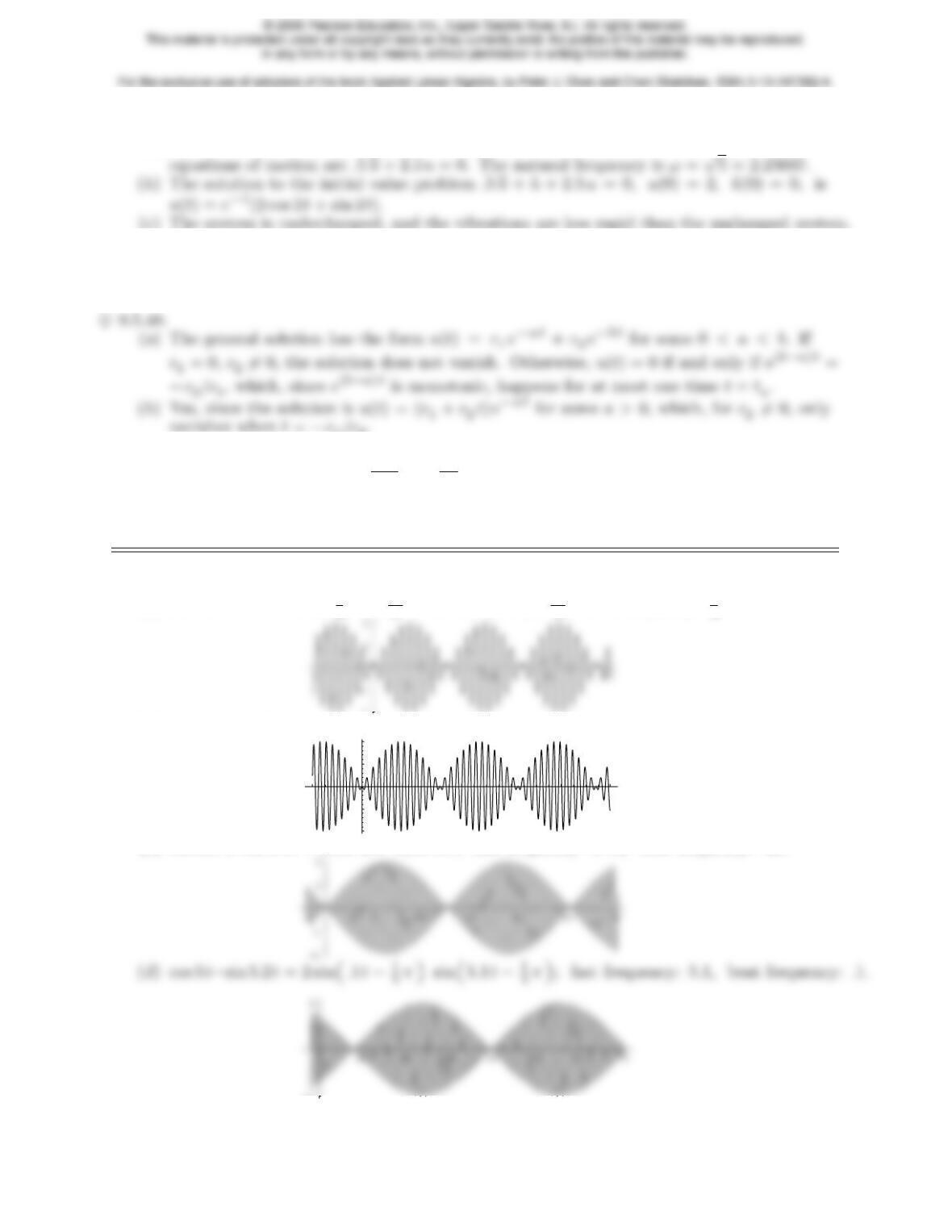
9.5.38.
(a) By Hooke’s Law, the spring stiffness is k= 16/6.4 = 2.5. The mass is 16/32 = .5. The
9.5.39. The undamped case corresponds to a center; the underdamped case to a stable focus;
the critically damped case to a stable improper node; and the overdamped case to a stable
node.
9.5.41. The general solution to md2u
dt2+βdu
dt = 0 is u(t) = c1+c2e−β t/m. Thus, the mass
approaches its equilibrium position u⋆=c1, which can be anywhere, at an exponentially
fast rate.
9.6.1.
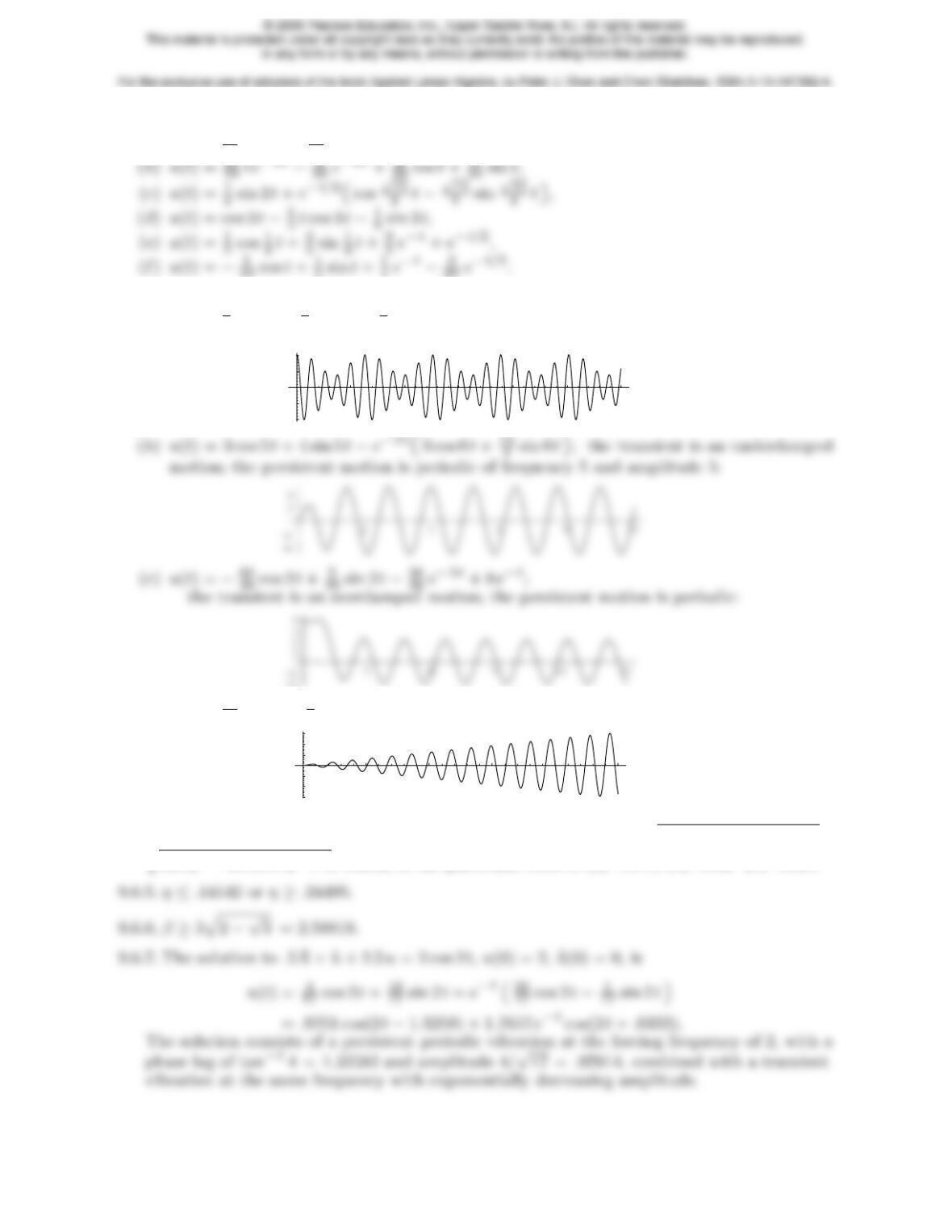
(a) cos 8t−cos 9 t= 2 sin 1
2tsin 17
2t; fast frequency: 17
2, beat frequency: 1
2.
-2
(b) cos 26t−cos 24 t=−2 sin tsin 25t; fast frequency: 25, beat frequency: 1.
-2 2 46 8 10
-2
-1
1
2
(c) cos 10t+ cos 9.5t= 2 sin .25 tsin 9.75t; fast frequency: 9.75, beat frequency: .25.
-2
272
9.6.2.
(a)u(t) = 1
27 cos 3t−1
27 cos 6t,
9.6.3.
(a)u(t) = 1
3cos 4t+2
3cos 5t+1
5sin 5t;
undamped periodic motion with fast frequency 4.5 and beat frequency .5:
510 15 20 25 30
-1
-0.5
0.5
1
-2
(d)u(t) = 1
32 sin 4t−1
8tcos 4t; resonant, unbounded motion:
510 15 20 25
-3
-2
-1
1
2
3
9.6.4. In general, by (9.102), the maximal allowable amplitude is α=qm2(ω2−η2)2+β2η2=
q625η4−49.9999 η2+ 1, which, in the particular cases is (a).0975, (b).002, (c).1025.
273
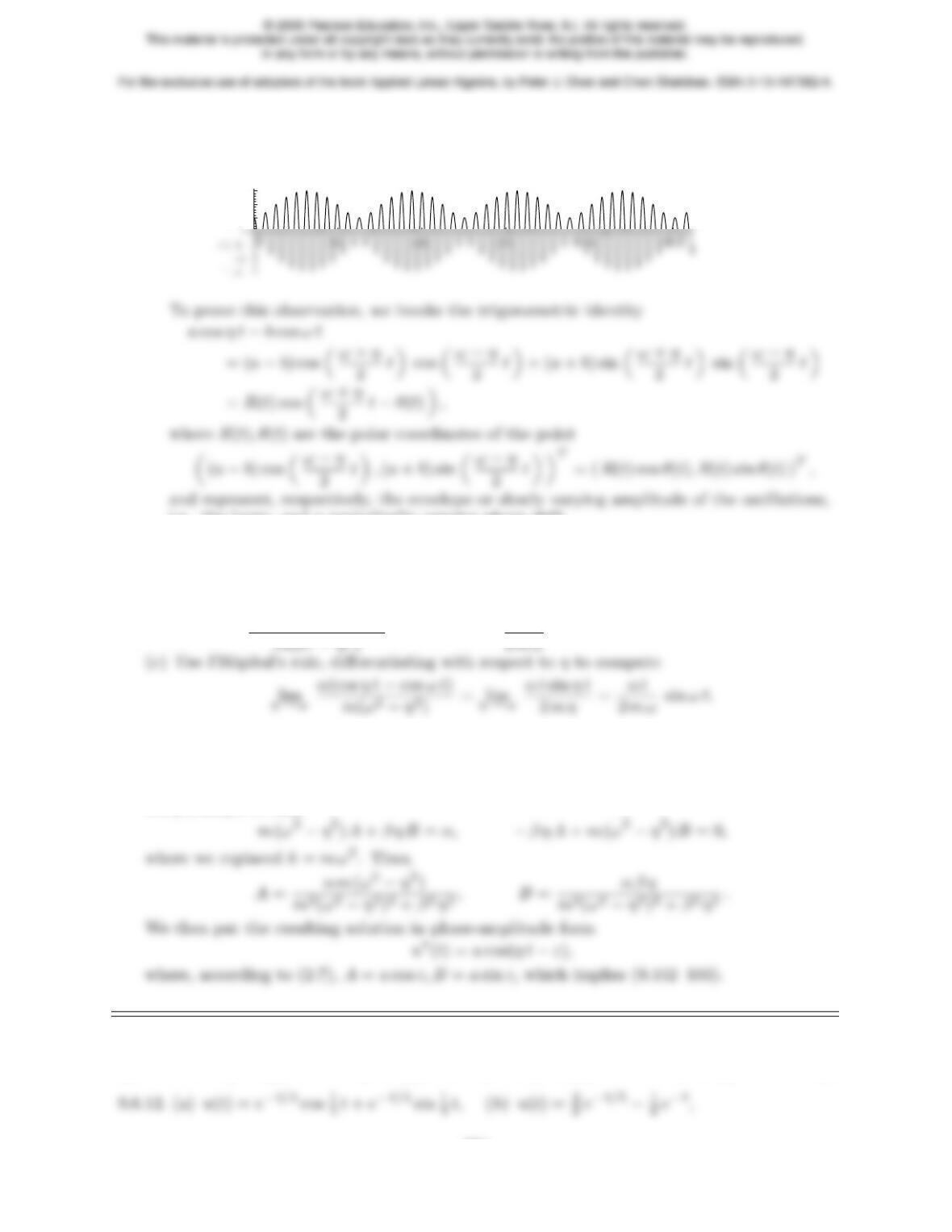
♠9.6.8.
(a) Yes, the same fast oscillations and beats can be observed graphically. For example, the
graph of cos t−.5 cos 1.1ton the interval 0 ≤t≤300 is:
0.5
1
1.5
i.e., the beats, and a periodically varying phase shift.
(b) Beats are still observed, but the larger |a−b|is — as prescribed by the initial condi-
tions — the less pronounced the variation in the beat envelope. Also, when a6=b, the
fast oscillations are no longer precisely periodic, but exhibit a slowly varying phase shift
over the period of the beat envelope.
♦9.6.9. (a)u(t) = α(cos η t −cos ω t)
♦9.6.10. Using the method of undetermined coefficients, we set
u⋆(t) = Acos η t +Bsin η t.
Substituting into the differential equation (9.101), and then equating coefficients of
cos η t, sin η t, we find
9.6.11.
(a) Underdamped, (b) overdamped, (c) critically damped, (d) underdamped, (e) underdamped.
274
9.6.13. u(t) = 165
41 e−t/4cos 1
4t−91
41 e−t/4sin 1
4t−124
41 cos 2t+32
41 sin 2t
= 4.0244 e−.25 tcos .25t−2.2195 e−.25 tsin .25t−3.0244 cos 2t+.7805 sin 2t.
9.6.14. The natural vibrational frequency is ω= 1/√RC. If η6=ωthen the circuit experiences
9.6.15. (a).02, (b) 2.8126, (c) 26.25.
9.6.18.
(a)u(t) = cos t 3
14
1
7!+r1cos(2√2t−δ1) −2
1!+r2cos(√3t−δ2) 1
2!,
17 1
(e)u(t) = cos t0
@
1
3
−1
31
A+ sin 2t0
@
1
6
−2
31
A+r1cos(q8
5t−δ1) −5
2!+r2cos( 1
√3t−δ2) 2
3!,
9.6.19.
(a) The resonant frequencies are r3−√3
2=.796225,r3+√3
2= 1.53819.
9.6.20. When the bottom support is removed, the resonant frequencies are √5−√17
2=.468213,
√5+√17
2= 1.51022.When the top support is removed, the resonant frequencies are
275
♣9.6.21. In each case, you need to force the system by cos(ω t)awhere ω2=λis an eigenvalue
and ais orthogonal to the corresponding eigenvector. In order not to excite an instability,
aneeds to also be orthogonal to the kernel of the stiffness matrix spanned by the unstable
mode vectors.
(a) Resonant frequencies: ω1=.5412, ω2= 1.1371, ω3= 1.3066, ω4= 1.6453;
(b) Resonant frequencies:
ω1=.4209, ω2= 1 (double), ω3= 1.2783, ω4= 1.6801, ω5= 1.8347; eigenvectors:
v1=
0
B
B
B
B
B
B
B
@
.6626
.1426
.6626
−.1426
.2852
0
1
C
C
C
C
C
C
C
A
,v2=
0
B
B
B
B
B
B
B
@
0
−1
0
1
1
0
1
C
C
C
C
C
C
C
A
,b
v2=
0
B
B
B
B
B
B
B
@
0
1
0
1
0
1
1
C
C
C
C
C
C
C
A
,v3=
0
B
B
B
B
B
B
B
@
−.5000
−.2887
.5000
−.2887
0
.5774
1
C
C
C
C
C
C
C
A
,v4=
0
B
B
B
B
B
B
B
@
.2470
−.3825
.2470
.3825
−.7651
0
1
C
C
C
C
C
C
C
A
,v5=
0
B
B
B
B
B
B
B
@
.5000
−.2887
−.5000
−.2887
0
.5774
1
C
C
C
C
C
C
C
A
;
no unstable modes.
(c) Resonant frequencies: ω1=.3542, ω2=.9727, ω3= 1.0279, ω4= 1.6894, ω5= 1.7372;
(d) Resonant frequencies: ω1=√32 = 1.22474 (double), ω2=√3 = 1.73205;
eigenvectors: v1=
0
B
B
B
B
B
B
B
B
B
B
B
B
@
1
2
−√3
2
1
2
√3
2
1
0
1
C
C
C
C
C
C
C
C
C
C
C
C
A
,b
v1=
0
B
B
B
B
B
B
B
B
B
B
B
B
@
−√3
2
−1
2
√3
2
−1
2
0
1
1
C
C
C
C
C
C
C
C
C
C
C
C
A
,v2=
0
B
B
B
B
B
B
B
B
B
B
@
0
−2
−√3
1
√3
1
1
C
C
C
C
C
C
C
C
C
C
A
;
276
eigenvectors: v1=0
B
@
1
0
−11
C
A,v2=0
B
@
1
−2
11
C
A; unstable mode: z=0
B
@
1
1
11
C
A.
To avoid exciting the unstable mode, the initial velocity must be orthogonal to the null
eigenvector: z·¦
u(t0) = 0, i.e., there is no net horizontal velocity of the atoms.
(f) Resonant frequencies: ω1= 1.0386, ω2= 1.0229;
277