CHAPTER 4
LINEAR PROGRAMMING SENSITIVITY ANALYSIS
SOLUTIONS TO PROBLEMS
4-10
(a) Increasing the unit profit for Y by $5 (to $10) exceeds the allowable increase for this OFC. A new
4-11
(a) Increasing the unit cost of Y to $9 is within the allowable increase for this OFC. The same corner
point remains optimal but the new objective increases to $132.
4-12
(a) Decreasing the unit profit of X by $3 (to only $1) exceeds the allowable decrease for this OFC. A
new corner point therefore becomes optimal. The value of X would be lower at the new optimal
4-13. We use the Sensitivity Report given in Screenshot 4-6 to answer the following questions.
(a) Each additional $ in radio advertising (up to $1,575) will increase the audience by 2.03. Hence, if
management approves an increase of $200, audience coverage will increase by 406 to 67,646.
(b) No. Since we are already placing 6.21 radio spots, this contractual agreement is not a binding
$6.90 or less (= $7.50 – $0.60) before it is worthwhile to include these individuals in the survey.
(b) Based on the shadow price for the total household constraint, each additional person who needs to be
included in the survey will cause the cost to increase by $5.98. Hence, if the sample size is increased
4-15. We use the Sensitivity Report given in Screenshot 4-8 to answer the following questions.
(a) If the daily allowance of protein is reduced to 2.9 units, the total cost will decrease by 0.1 x $0.038 =
$0.0038.
4-16. See file P4-16.XLS for the Excel solution and Solver Sensitivity Report.
(a) Four products (MoPhone, BoldPhone, LuxPhone4G, and Tap3G) are not included in the optimal
$135.50 to at least $274.138) before it becomes a viable product.
(b) The current production plan requires only 3,724.138 minutes of the available 6,000 minutes on test
(c) Each additional minute of time (up to 2,869.565 minutes) on test device 1 increases profit by $21.409.
This shadow price value, however, assumes that time on test device 1 costs only $15 per hour (or
4-17. See file P4-17.XLS for the Excel solution and Solver Sensitivity Report.
(a) Several of the allowable increase and allowable decrease values for the objective function coefficients
are zero. For example, see these values for the number of acres of wheat in the SE parcel. Also,
several variables (crops) that are currently not in the crop plan (for example, wheat in the NW parcel)
4-18. See file P4-18.XLS for the Excel solution and Solver Sensitivity Report.
(a) The decrease of $0.01 per pound is within the allowable decrease limit of $0.11 per pound. Therefore,
$0.114. Since this is beyond the allowable decrease limit, the current solution is no longer optimal.
4-19. See file P4-19.XLS for the Excel solution and Solver Sensitivity Report.
(a) Phosphorus is a non-binding constraint and therefore has a shadow price of zero. Each additional mg
of iron required in the diet will cause the meal cost to increase by $1.
4-20. We use the Sensitivity Report given in Screenshot 4-9 to answer the following questions.
(a) Each additional pound of material will increase profit by $0.5. The 2 pounds will therefore cause
profit to increase to $29.
4-21. See file P4-21.XLS for the Excel solution and Solver Sensitivity Report.
(a) The optimal solution is X = 15, Y = 10, with an objective of $125.
(b) The OFC for X can vary between 3.33 and 10, while the OFC for Y can vary between 2.5 and 7.5
We use the information in Screenshots 4-11A and 4-11B to answer questions in Problems 4-22 and 4-23.
4-22
(a) The optimal production plan is to produce 540 Standard suitcases and 252 Deluxe suitcases, for a
total profit of $7,668. The scarce resources are cutting and coloring time, and finishing time
(b) Given the optimal production plan, we can determine whether or not the new polishing process will
4-23. The profit contributions per unit for the two new products are:
Compact: $30 – $5 – 0.5 x $10 – 0.75 x $6 – 0.75 x $9 – 0.2 x $8 = $7.15
Kiddo: $37.50 – $4.50 – 1.2 x $10 – 0.75 x $6 – 0.5 x $9 – 0.2 x $8 = $10.40
However, we need to remember that a positive profit contribution is not a sufficient condition for making
follows:
We use the information in Screenshots 4-12A and 4-12B to answer questions in Problems 4-24 to 4-27.
4-24
(a) The optimal production plan is to make 100 TiniTote, 35 TubbyTote, and 90 ToddleTote strollers.
The resulting profit is $2,086.25. The following constraints are binding: fabrication time, minimum
4-25
(a) From the Sensitivity Report, the profit contribution of TiniTote can vary between $5.92 (= $9.25 –
$3.33) and $14.25 (= $9.25 + $5) without affecting the current optimal production mix. Assuming
4-26
(a) Each additional hour of fabrication time (up to 110.50 hours) will allow Strollers–to-Go to increase
profit by $3.60. Hence, the firm would be willing to pay a premium of up to $3.60 for each additional
4-27. The profit contribution per unit for the new products is: $86 – $7.10 – 4 x $8.25 – 2 x $8.50 – 2 x
$8.75 = $11.40. However, we need to remember that a positive profit contribution is not a sufficient
condition for making the new product. This is because resources allocated to make the new product will
We use the information in Screenshots 4-13A and 4-13B to answer questions in Problems 4-28 to 4-32.
4-28
(a) The objective function represents the total profit to be made from the sale of all of the tables and
chairs. The production plan includes all items in the product list: oak tables and chairs, cherry tables
and chairs, and pine tables and chairs.
4-29
(a) An increase of $8 (= $83 – $75) is beyond the allowable increase ($0) for this coefficient. Therefore,
we cannot evaluate the impact of this change with the current report.
4-30
(a) Increase in labor hours = 320 hours, which is within the allowable increase of 373.30. The production
mix will not change, albeit with different values for the non-zero decision variables. The profit will
4-31
(a) First, we check the 100% rule: (15/infinity) + (15/infinity) 1. Therefore, the current solution
remains optimal. The profit decreases by (3 + 3) x $15 = $90.
4-32
(a) Assume that the labor hours stated in the problem are the hours available per week. If the employee
(b) To determine whether this is a good trade, we first check the 100% rule: (30/37.21) + (900/1,250) =
1.53 > 1. This is well over the 100% rule, and the information on the current report may therefore not
(c) To determine whether this is a worthwhile product, we have to compare its profit contribution to the
We use the information in Screenshots 4-14A and 4-14B to answer questions in Problems 4-33 to 4-37.
4-33
(a) The optimal cost is $176.42 and requires Tiger Catering to make 10 tuna, 30 tuna and cheese, 10 ham,
12 ham and cheese, and 8 cheese sandwiches.
4-34
(a) The $0.50 increase is within the allowable increase. The solution remains optimal. The total cost
increases by $0.50 x 10 = $5.
(b) The $0.28 increase is beyond the allowable increase. Therefore, we cannot evaluate the impact of this
4-35
(a) The 20-oz. increase is within the allowable increase. The production mix will not change, albeit with
different values for the non-zero decision variables. The total cost decreases by $0.08 x 20 = $1.60.
(b) The 15-oz. decrease is within the allowable decrease. There would be no impact on the production
4-36
(a) First, we check the 100% rule: (0.35/0.99) + (0.35/0.66) = 0.88 1. The solution remains optimal,
and total cost decreases by $0.35 x (10 + 12) = $7.70.
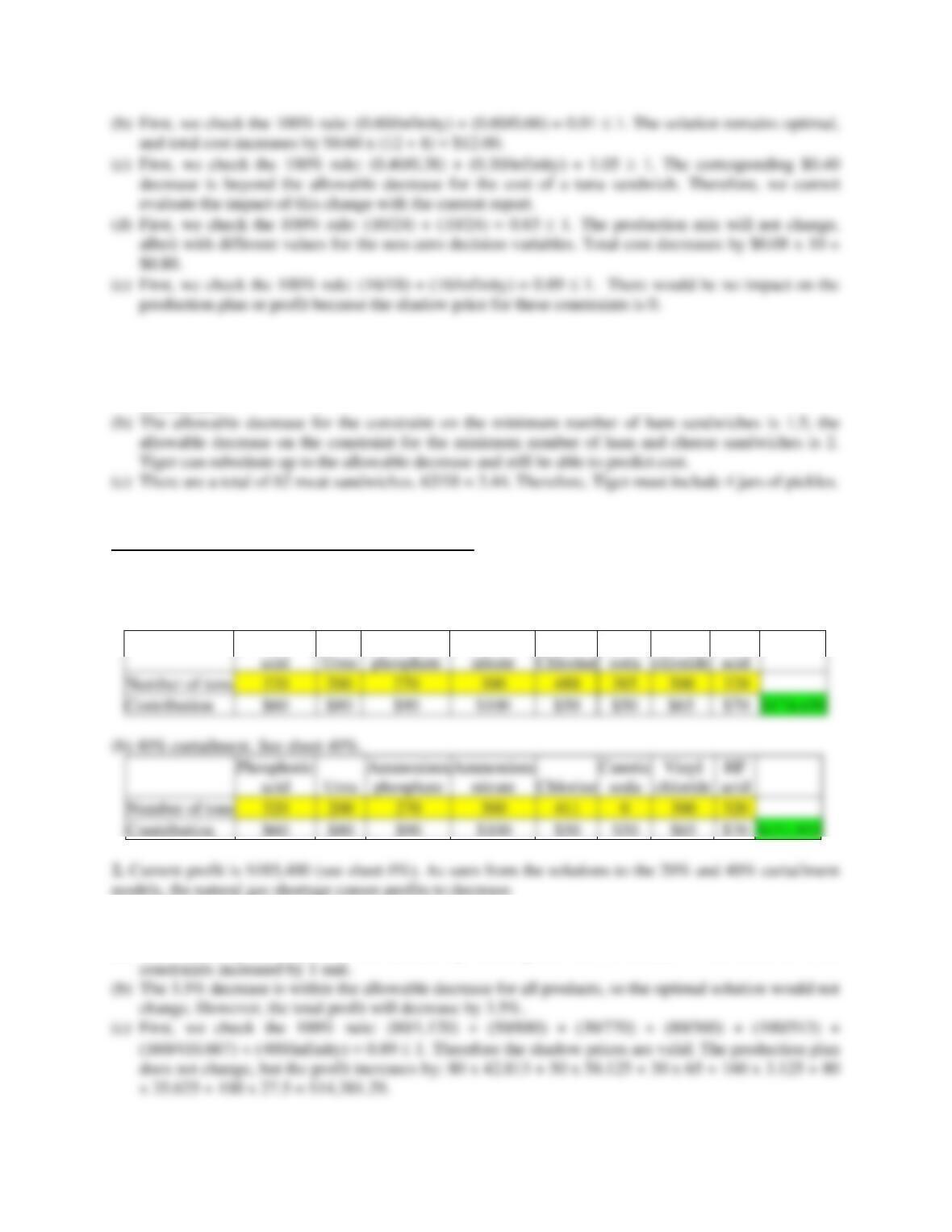
4-37.
(a) An additional pound of tuna (16oz.) would decrease cost by $1.28 (= $0.08 x 16). This deal is not
worthwhile.
Case: Coastal States Chemical and Fertilizers
See file P4-Coastal States.XLS for the solutions and Sensitivity Reports.
1.
(a) 20% curtailment. See sheet 20%.
Phosphoric
Ammonium
Ammonium
Caustic
Vinyl
HF
models, the natural gas shortage causes profits to decrease.
3. See sheet SR 20%
(a) The shadow prices represent the amount by which profit would increase if the RHS of these
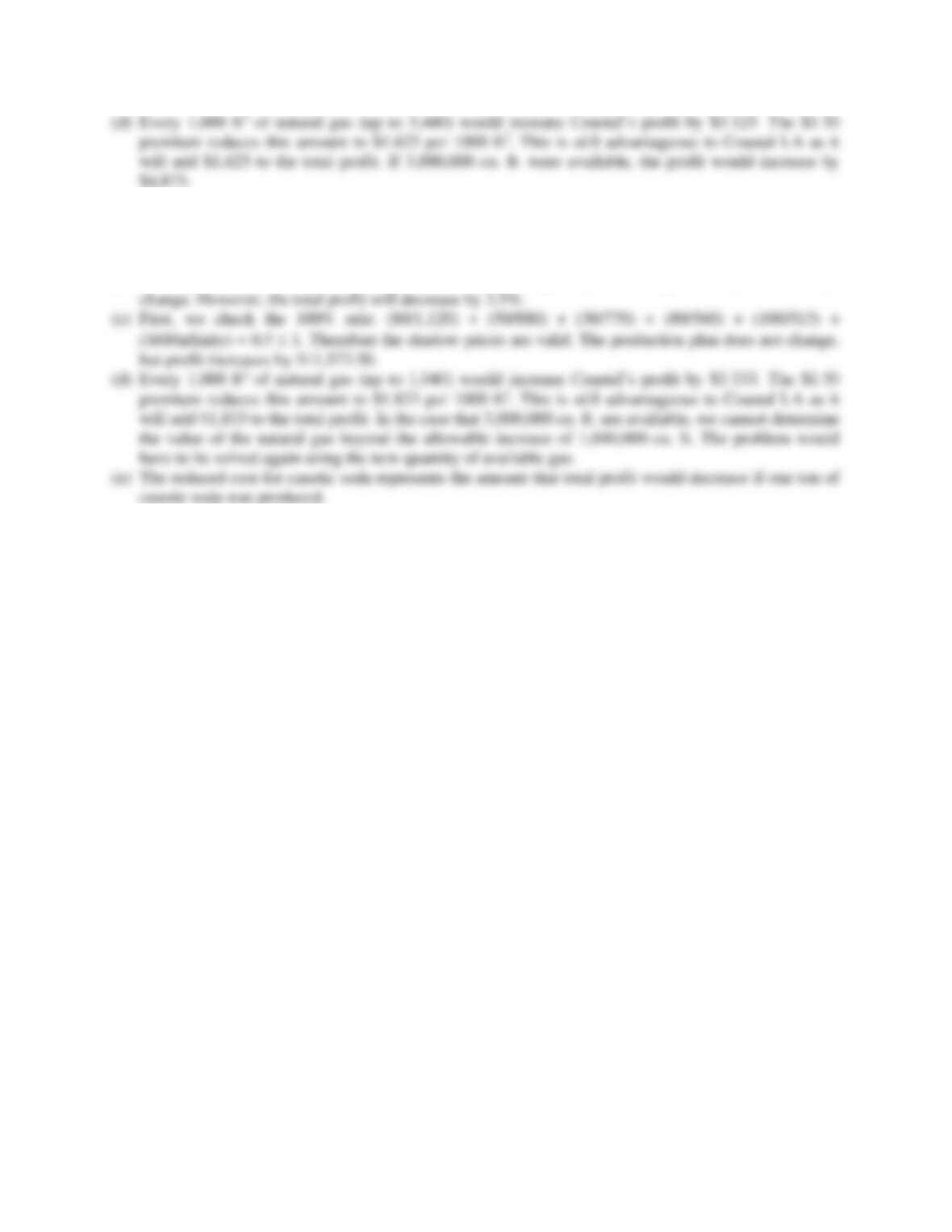
4. See sheet SR 40%
(a) The shadow prices represent the amount by which profit would increase if the RHS of these
constraints increased by 1 unit.
(b) The 3.5% decrease is within the allowable decrease for all products, so the optimal solution would not