Solutions — Chapter 3
3.1.1. Bilinearity:
hcu+dv,wi= (cu1+dv1)w1−(cu1+d v1)w2−(c u2+d v2)w1+b(c u2+dv2)w2
=c(u1w1−u1w2−u2w1+bu2w2) + d(v1w1−v1w2−v2w1+bv2w2)
=chu,wi+dhv,wi,
3.1.2. (a), (f) and (g) define inner products; the others don’t.
3.1.3. It is not positive definite, since if v= ( 1,−1 )T, say, hv,vi= 0.
3.1.4.
(a) Bilinearity:
hcu+dv,wi= (cu1+dv1)w1+ 2 (c u2+d v2)w2+ 3 (c u3+d v3)w3
=c(u1w1+ 2u2w2+ 3u3w3) + d(v1w1+ 2v2w2+ 3v3w3)
(b) Bilinearity:
hcu+dv,wi= 4(cu1+dv1)w1+ 2 (c u1+d v1)w2+ 2 (c u2+dv2)w1+
+ 4(cu2+dv2)w2+ (cu3+dv3)w3
=c(4u1w1+ 2u1w2+ 2u2w1+ 4u2w2+u3w3) +
+d(4v1w1+ 2v1w2+ 2v2w1+ 4v2w2+v3w3)
Positivity:
hv,vi= 4v2
1+ 4v1v2+ 4v2
2+v2
3= (2v1+v2)2+ 3v2
2+v2
3>0 for all v= ( v1, v2, v3)T6=0,
because it is a sum of non-negative terms, at least one of which is strictly positive.
(c) Bilinearity:
hcu+dv,wi= 2(cu1+dv1)w1−2 (c u1+d v1)w2−2 (c u2+d v2)w1+
+ 3(cu2+dv2)w2−(cu2+dv2)w3−(cu3+d v3)w2+ 2 (c u3+d v3)w3
Symmetry:
hv,wi= 2v1w1−2v1w2−2v2w1+ 3v2w2−v2w3−v3w2+ 2v3w3
= 2w1v1−2w1v2−2w2v1+ 3w2v2−w2v3−w3v2+ 2w3v3=hw,vi.
Positivity:
3.1.5. (a) ( cos t, sin t)T, cos t
√2,sin t
√5!T
, cos t+sin t
√3,sin t
√5!T
.
0.5
1
0.5
1
0.5
1
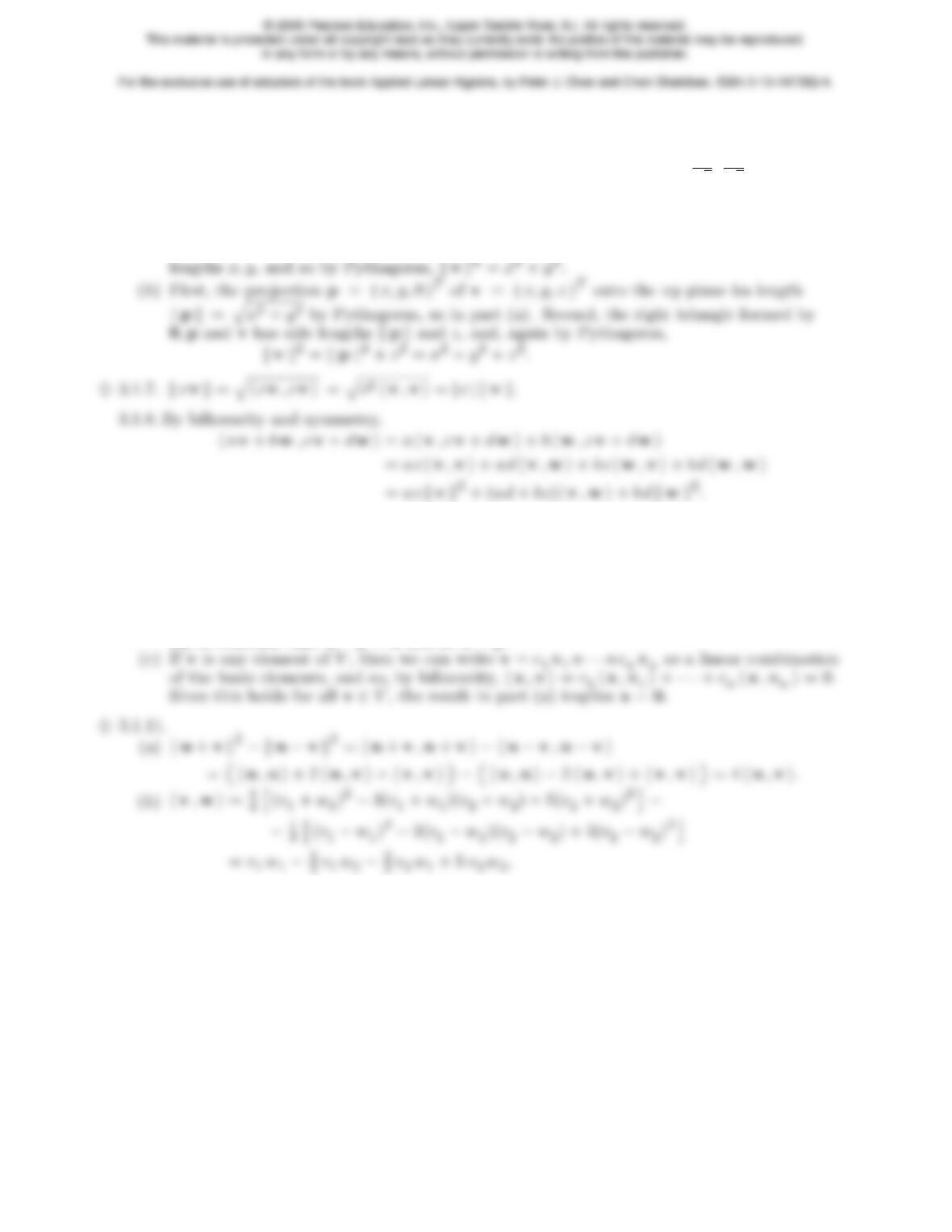
(b)Note: By elementary analytical geometry, any quadratic equation of the form
ax2+bxy +cy2= 1 defines an ellipse provided a > 0 and b2−4ac < 0.
Case (b): The equation 2v2
1+ 5v2
2= 1 defines an ellipse with semi-axes 1
√2,1
√5.
Case (c): The equation v2
1−2v1v2+4v2
2= 1 also defines an ellipse by the preceding remark.
♦3.1.6.
(a) The vector v= ( x, y )Tcan be viewed as the hypotenuse of a right triangle with side
♦3.1.9. If we know the first bilinearity property and symmetry, then the second follows:
hu, c v+dwi=hcv+dw,ui=chv,ui+dhw,ui=chu,vi+dhu,wi.
♦3.1.10.
(a) Choosing v=x, we have 0 = hx,xi=kxk2, and hence x=0.
(b) Rewrite the condition as 0 = hx,vi − hy,vi=hx−y,vifor all v∈V. Now use part
(a) to conclude that x−y=0and so x=y.
3.1.12.
(a)kx+yk2+kx−yk2=“kxk2+ 2 hx,yi+kyk2”+“kxk2−2hx,yi+kyk2”
= 2 kxk2+ 2 kyk2.
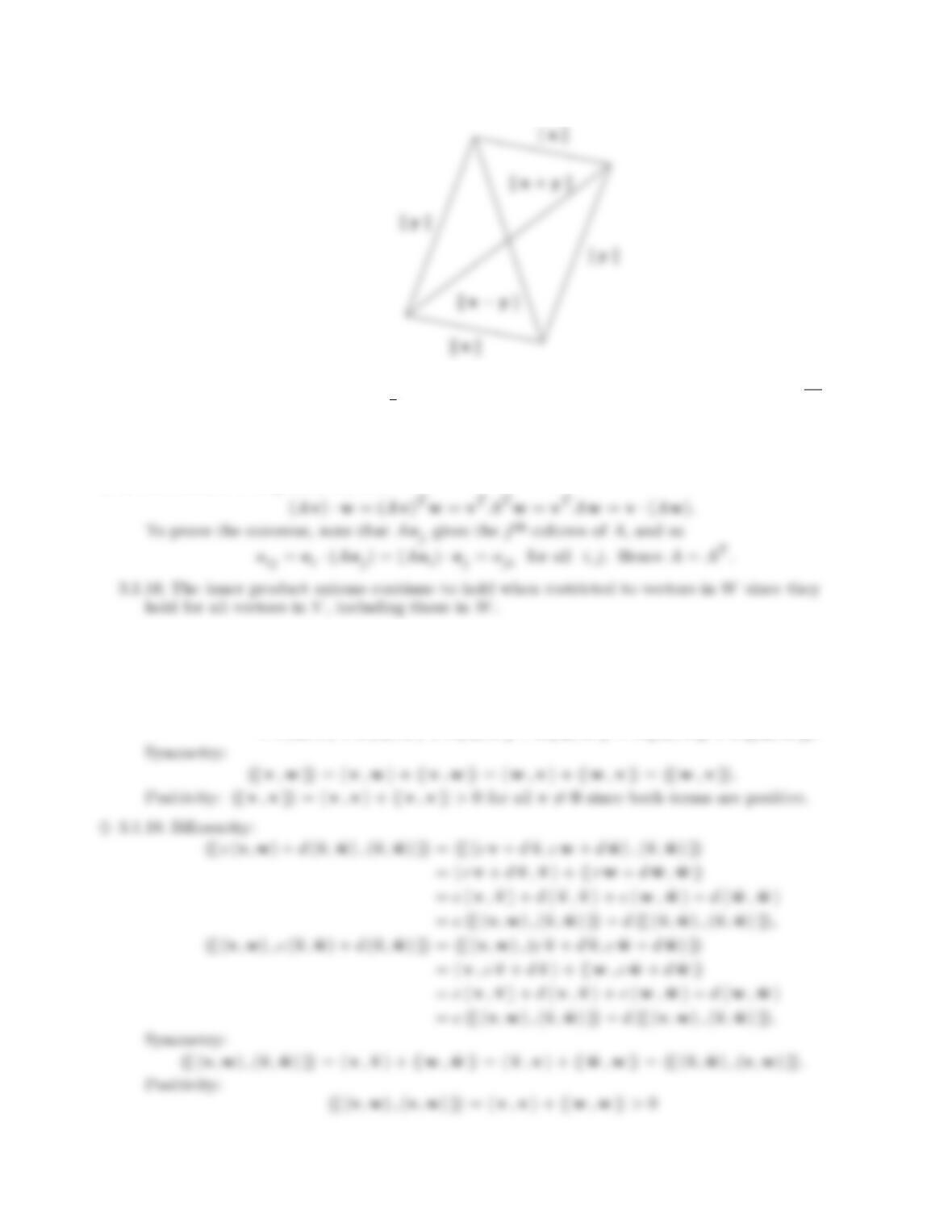
(b) The sum of the squared lengths of the diagonals in a parallelogram equals the sum of
the squared lengths of all four sides:
74
3.1.13. By Exercise 3.1.12, kvk2=1
2“ku+vk2+ku−vk2”− kuk2= 17, so kvk=√17 .
The answer is the same in all norms coming from inner products.
3.1.14. Using (3.2), v·(Aw) = vTAw= (ATv)Tw= (ATv)·w.
♦3.1.15. First, if Ais symmetric, then
3.1.17. Bilinearity:
hhhcu+dv,wiii =hcu+dv,wi+hhcu+dv,wii
=chu,wi+dhv,wi+chhu,wii +dhhv,wii =chhhu,wiii +dhhhv,wiii,
hhhu, c v+dwiii =hu, c v+dwi+hhu, c v+dwii
=chu,vi+dhu,wi+chhu,vii +dhhu,wii =chhhu,viii +dhhhu,wiii.
75
© 2006 Pearson Education, Inc., Upper Saddle River, NJ. All rights reserved.
This material is protected under all copyright laws as they currently exist. No portion of this material may be reproduced,
in any form or by any means, without permission in writing from the publisher.
For the exclusive use of adopters of the book Applied Linear Algebra, by Peter J. Olver and Cheri Shakiban. ISBN 0-13-147382-4.
for all (v,w)6= (0,0), since both terms are non-negative and at least one is positive be-
cause either v6=0or w6=0.
3.1.19.
(a)h1, x i=1
2,k1k= 1,kxk=1
√3;
(b)hcos 2πx , sin 2πx i= 0,kcos 2 πx k=1
√2,ksin 2πx k=1
√2;
3.1.22. If f(x) is any nonzero function that satisfies f(x) = 0 for all 0 ≤x≤1 then hf , f i= 0.
An example is the function f(x) = (x, −1≤x≤0,
0,0≤x≤1.However, if the function f∈C0[0,1 ]
3.1.23.
(a) No — positivity doesn’t hold since if f(0) = f(1) = 0 then hf , f i= 0 even if f(x)6= 0
for any 0 < x < 1;
3.1.24. No. For example, on [−1,1], k1k=√2 , but k1k2= 2 6=k12k=√2.
♦3.1.25. Bilinearity:
hcf +dg , h i=Zb
ah{cf(x) + dg(x)}h(x) + {cf(x) + dg(x)}′h′(x)idx
76
3.1.26.
(a) No, because if f(x) is any constant function, then hf , f i= 0, and so positive definite-
ness does not hold.
(b) Yes. To prove the first bilinearity condition:
hcf +dg , h i=Z1
−1hcf′(x) + dg′(x)ih′(x)dx
♦3.1.27. Suppose h(x0) = k > 0 for some a < x0< b. Then, by continuity, h(x)≥1
2kfor
a < x0−δ < x < x0+δ < b for some δ > 0. But then, since h(x)≥0 everywhere,
Zb
ah(x)dx ≥Zx0+δ
x0−δh(x)dx ≥k δ > 0,
which is a contradiction. A similar contradiction can be shown when h(x0) = k < 0 for
some a < x0< b. Thus h(x) = 0 for all a < x < b, which, by continuity, also implies
h(a) = h(b) = 0. The function in (3.14) gives a discontinuous counterexample.
♦3.1.28.
(a) To prove the first bilinearity condition:
77
grand is continuous, Exercise 3.1.27 implies that hf , f i= 0 if and only if f(x)2w(x)≡
0 for all x, and so f(x)≡0.
(b) If w(x0)<0, then, by continuity, w(x)<0 for x0−δ≤x≤x0+δfor some δ > 0. Now
choose f(x)6≡ 0 so that f(x) = 0 whenever |x−x0|> δ. Then
♥3.1.29.
(a) If f(x0, y0) = k > 0 then, by continuity, f(x, y)≥1
2kfor (x, y)∈D={ kx−x0k ≤ δ}
for some δ > 0. But then ZZΩf(x, y)dx dy ≥ZZDf(x, y)dx dy ≥1
2π k δ2>0.
(b) Bilinearity:
3.1.30. (a)hf , g i=2
3,kfk= 1, kgk=q28
45 ; (b)hf , g i=1
2π,kfk=√π,kgk=qπ
3.
♥3.1.31.
(a) To prove the first bilinearity condition:
(b) First bilinearity:
hhcf+dg,hii =Z1
0hcf(x) + dg(x),h(x)idx
=cZ1
0hf(x),h(x)idx +dZ1
0hg(x),h(x)idx =chhf,hii +dhhg,hii.
78
Symmetry:
hhf,gii =Z1
0hf(x),g(x)idx =Z1
0hg(x),f(x)idx =hhg,fii.
Positivity: hhf,fii =Z1
0kf(x)k2dx ≥0 since the integrand is non-negative. Moreover,
hf,fi= 0 if and only if kf(x)k2= 0 for all x, and so, in view of the continuity of
kf(x)k2we conclude that f(x)≡0.
3.2.1.
(a)|v1·v2|= 3 ≤5 = √5√5 = kv1k kv2k; angle: cos−13
5≈.9273;
3.2.2. (a)1
3π; (b) 0,1
3π, 1
2π, 2
3π, or π, depending upon whether −1 appears 0,1,2,3 or 4 times
in the second vector.
3.2.3. The side lengths are all equal to
k(1,1,0) −(0,0,0) k=k(1,1,0) −(1,0,1) k=k(1,1,0) −(0,1,1) k=··· =√2.
The edge angle is 1
3π= 60◦. The center angle is cos θ=−1
3, so θ= 1.9106 = 109.4712◦.
3.2.4.
3.2.5.
3.2.6. Set v= ( a, b )T,w= ( cos θ, sin θ)T, so that Cauchy–Schwarz gives
|v·w|=|acos θ+bsin θ| ≤ qa2+b2=kvk kwk.
3.2.7. Set v= ( a1,…,an)T,w= ( 1,1, . . . , 1 )T, so that Cauchy–Schwarz gives
|v·w|=|a1+a2+··· +an| ≤ √nqa2
1+a2
2+···+a2
n=kvk kwk.
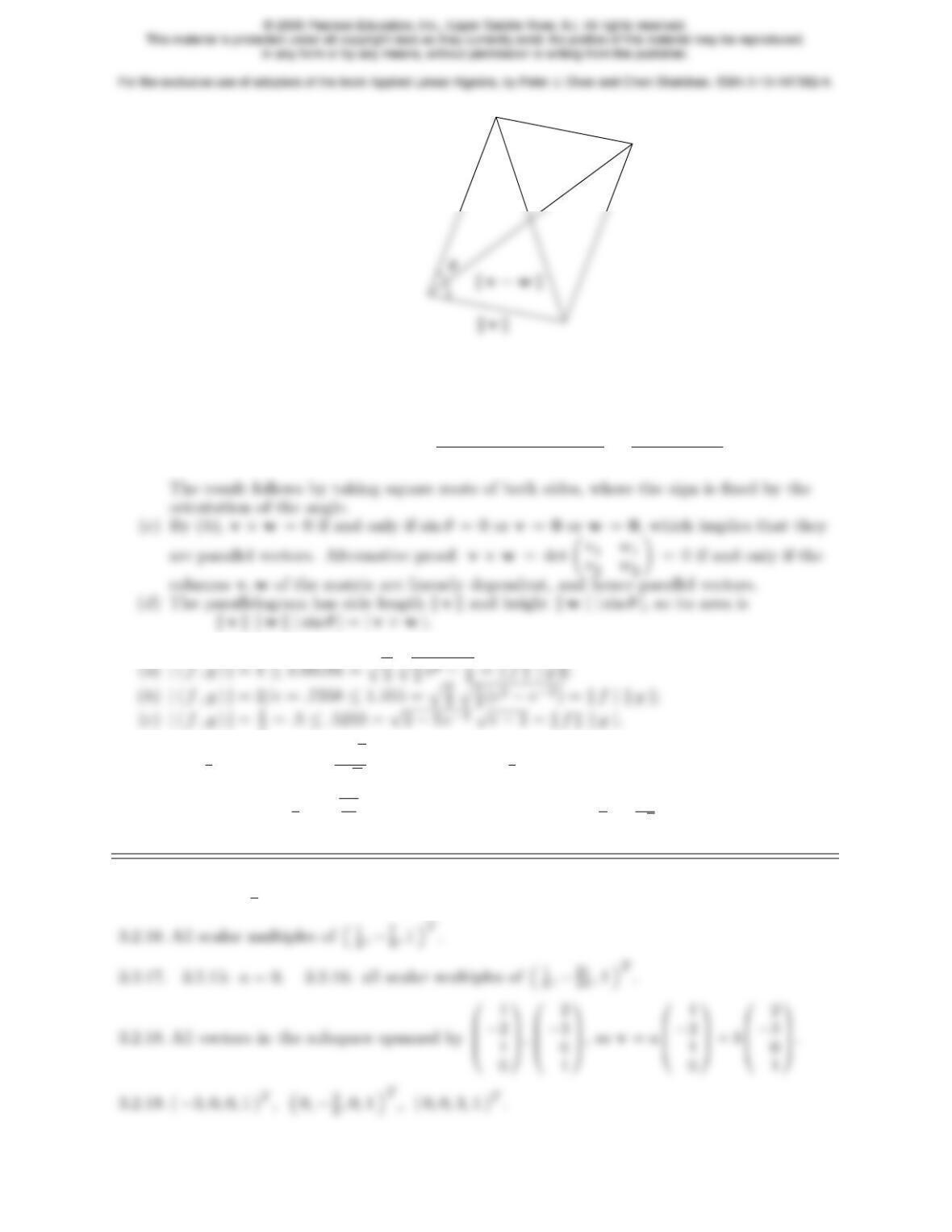
kwk
kv+wk
♥3.2.11.
(a) It is not an inner product. Bilinearity holds, but symmetry and positivity do not.
(b) Assuming v,w6=0, we compute
sin2θ= 1 −cos2θ=kvk2kwk2− hv,wi
kvk2kwk2=(v×w)2
kvk2kwk2.
3.2.12.
3.2.13. (a)1
2π, (b) cos−12√2
√π=.450301, (c)1
2π.
3.2.14. (a)|hf , g i| =2
3≤q28
45 =kfk kgk; (b)|hf , g i| =π
2≤π
√3=kfk kgk.
3.2.15. (a)a=−4
3; (b) no.
80
3.2.20. For example, u= ( 1,0,0 )T,v= ( 0,1,0 )T,w= ( 0,1,1 )Tare linearly independent,
whereas u= ( 1,0,0 )T,v=w= ( 0,1,0 )Tare linearly dependent.
♦3.2.25. If hv,xi= 0 = hv,yi, then hv, c x+dyi=chv,xi+dhv,yi= 0 for c, d, ∈R,
proving closure.
3.2.26. (a)hp1, p2i=Z1
0“x−1
2”dx = 0,hp1, p3i=Z1
0“x2−x+1
6”dx = 0,
hp2, p3i=Z1
0“x−1
2”“x2−x+1
6”dx = 0.
3.2.31. (a)θ= cos−15
√84 ≈0.99376 radians; (b)v·w= 5 <9.165 ≈√84 = kvk kwk,
kv+wk=√30 ≈5.477 <6.191 ≈√14 + √6 = kvk+kwk; (c)“−7
3t, −1
3t, t ”T.
3.2.32.
(a)kv1+v2k= 4 ≤2√5 = kv1k+kv2k;
3.2.33.
(a)kv1+v2k=√5≤√5 + √10 = kv1k+kv2k;
(b)kv1+v2k=√6≤3 + √19 = kv1k+kv2k;
(c)kv1+v2k=√12 ≤√13 + √43 = kv1k+kv2k.
3.2.34.
≤2.72093 ≈q2
3+q1
2(e2−e−2) = kfk+kgk;
(c)kf+gk=√2 + e−5e−1≈1.69673 ≤1.71159 ≈√2−5e−1+√e−1 = kfk+kgk.
3.2.35.
3.2.36.
(a)h1, x i= 0, so θ=1
2π. Yes, they are orthogonal.
3.2.37.
(a)˛˛˛˛˛Z1
3.2.38.
(a)˛˛˛˛˛Z1
0hf(x)g(x) + f′(x)g′(x)idx ˛˛˛˛˛≤sZ1
0hf(x)2+f′(x)2idx sZ1
0hg(x)2+g′(x)2idx;
sZ1
0h[f(x) + g(x)]2+ [f′(x) + g′(x)]2idx ≤sZ1
0hf(x)2+f′(x)2idx +rhg(x)2+g′(x)2i.
3.2.40. True. By the triangle inequality,
kwk=k(−v) + (w+v)k ≤ k−vk+kv+wk=kvk+kv+wk.
♥3.2.41.
(a) This follows immediately by identifying R∞with the space of all functions f:N→R
where N={1,2,3, . . .}are the natural numbers. Or, one can tediously verify all the
vector space axioms.
82
(b) If x,y∈ℓ2, then, by the triangle inequality on Rn,
n
X
k= 1
(xk+yk)2≤0
B
@v
u
u
u
t
n
X
k= 1
x2
k+v
u
u
u
t
n
X
k= 1
y2
k1
C
A
2
≤0
B
@v
u
u
u
t∞
X
k= 1
x2
k+v
u
u
u
t∞
X
k= 1
y2
k1
C
A
2
<∞,
and hence, in the limit as n→ ∞, the series of non-negative terms is also bounded:
∞
X
k= 1
(xk+yk)2<∞, proving that x+y∈ℓ2.
(h) First, we need to prove that it is well-defined, which we do by proving that the series is
absolutely convergent. If x,y∈ℓ2, then, by the Cauchy–Schwarz inequality on Rnfor
the vectors ( |x1|,…,|xn|)T,(|y1|,…,|yn|)T,
n
X
k= 1 |xkyk| ≤ v
u
u
u
t
n
X
k= 1
x2
kv
u
u
u
t
n
X
k= 1
y2
k≤v
u
u
u
t∞
X
k= 1
x2
kv
u
u
u
t∞
X
k= 1
y2
k<∞,
3.3.1. kv+wk1= 2 ≤2 = 1 + 1 = kvk1+kwk1;
kv+wk2=√2≤2 = 1 + 1 = kvk2+kwk2;
kv+wk3=3
√2≤2 = 1 + 1 = kvk3+kwk3;
kv+wk∞= 1 ≤2 = 1 + 1 = kvk∞+kwk∞.
3.3.2.
(a)kv+wk1= 6 ≤6 = 3 + 3 = kvk1+kwk1;
kv+wk2= 3√2≤2√5 = √5 + √5 = kvk2+kwk2;
√54 ≤23
√9 = 3
√9 + 3
√9 = kvk3+kwk3;
3.3.3.
(a)ku−vk1= 5, ku−wk1= 6, kv−wk1= 7, so u,vare closest.
(b)ku−vk2=√13, ku−wk2=√12, kv−wk2=√21, so u,ware closest.
(c)ku−vk∞= 3, ku−wk∞= 2, kv−wk∞= 4, so u,ware closest.
3.3.4. (a)kfk∞=2
3,kgk∞=1
4; (b)kf+gk∞=2
3≤2
3+1
4=kfk∞+kgk∞.
3.3.7.
(a)kf+gk1=3
4=.75 ≤1.3125 ≈1 + 5
16 =kfk1+kgk1;
3.3.8.
(a)kf+gk1=e−e−1≈2.3504 ≤2.3504 ≈(e−1) + (1 −e−1) = kfk1+kgk1;
(b)kf+gk2=q1
3.3.9. Positivity: since both summands are non-negative, kxk ≥ 0. Moreover, kxk= 0 if and
only if x= 0 = x−y, and so x= ( x, y )T=0.
Homogeneity:kcxk=|c x |+ 2 |c x −c y |=|c|“|x|+ 2 |x−y|”=|c| kvk.
Triangle inequality:kx+vk=|x+v|+ 2 |x+v−y−w|
≤“|x|+|v|”+ 2“|x−y|+|v−w|”=kxk+kvk.
3.3.10.
(a) Comes from weighted inner product hv,wi= 2v1w1+ 3v2w2.
(b) Comes from inner product hv,wi= 2 v1w1−1
2v1w2−1
2v2w1+ 2v2w2; positivity
3.3.11. Parts (a), (c) and (e) define norms. (b) doesn’t since, for instance, k( 1,−1,0 )Tk= 0.
(d) doesn’t since, for instance, k( 1,−1,1 )Tk= 0.
3.3.12. Clearly if v=0, then w=0since only the zero vector has norm 0. If v6=0, then
w=cv, and kwk=|c|kvk=kvkif and only if |c|= 1.
3.3.13. True for an inner product norm, but false in general. For example,
ke1+e2k1= 2 = ke1k1+ke2k1.
3.3.15. No — neither result satisfies the bilinearity property.
For example, if v= ( 1,0 )T,w= ( 1,1 )T, then
h2v,wi=1
4“k2v+wk2
1− k2v−wk2
1”= 3 6= 2 hv,wi=1
2“kv+wk2
1− kv−wk2
1”= 4,
h2v,wi=1
4“k2v+wk2
∞− k2v−wk2
∞”= 2 6= 2 hv,wi=1
2“kv+wk2
∞− kv−wk2
∞”=3
2.
1/p
♦3.3.18.
(a) Positivity follows since the integrand is non-negative; further,
kcf k1,w =Zb
a|cf(x)|w(x)dx =|c|Zb
a|f(x)|w(x)dx =|c| kfk1,w;
85
3.3.19.
(a) Clearly positive; kcvk= maxnkcvk1,kcvk2o=|c|maxnkvk1,kvk2o=|c| kvk;
kv+wk= maxnkv+wk1,kv+wk2o≤maxnkvk1+kwk1,kvk2+kwk2o
≤maxnkvk1,kvk2o+ maxnkwk1,kwk2o=kvk+kwk.
(b) No. The triangle inequality is not necessarily valid. For example, in R2set kvk1=
3.3.20. (a)0
B
B
B
B
@
1
√14
2
√14
−3
√14
1
C
C
C
C
A; (b)0
B
B
B
@
1
3
2
3
−1
1
C
C
C
A; (c)0
B
B
B
@
1
6
1
3
−1
2
1
C
C
C
A; (d)0
B
B
B
@
1
3
2
3
−1
1
C
C
C
A; (e)0
B
B
B
@
1
6
1
3
−1
2
1
C
C
C
A.
3.3.21.
(a)kvk2= cos2θcos2φ+ cos2θsin2φ+ sin2θ= cos2θ+ sin2θ= 1;
3.3.22. 2 vectors, namely u=v/kvkand −u=−v/kvk.
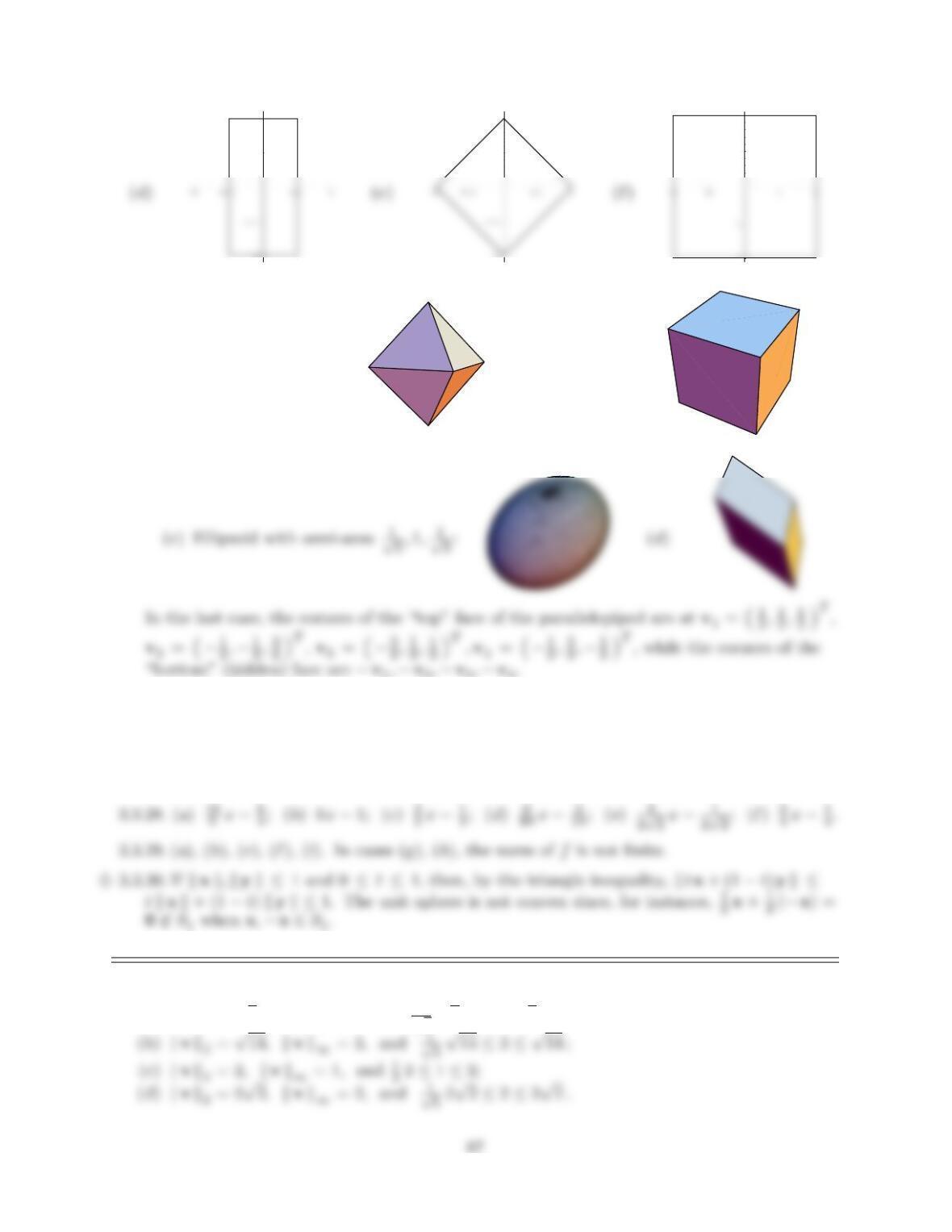
3.3.23. (a)
-1 -0.5 0.5 1
-0.5
0.5
1
(b)
-1 -0.5 0.5 1
-0.5
0.5
1
(c)
-1 -0.5 0.5 1
-0.5
0.5
1
86
-1
0.5
1
-1
0.5
1
-2
1
2
3.3.25.
(a) Unit octahedron: (b) Unit cube:
3.3.26. Define |kxk| =kxk/kvkfor any x∈V.
3.3.27. True. Having the same unit sphere means that kuk1= 1 whenever kuk2= 1. If v6=0
is any other nonzero vector space element, then u=v/kvk1satisfies 1 = kuk1=kuk2,
and so kvk2=kkvk1uk2=kvk1kuk2=kvk1. Finally k0k1= 0 = k0k2, and so the
norms agree on all vectors in V.
3.3.31.
(a)kvk2=√2, kvk∞= 1, and 1
√2√2≤1≤√2 ;
© 2006 Pearson Education, Inc., Upper Saddle River, NJ. All rights reserved.
This material is protected under all copyright laws as they currently exist. No portion of this material may be reproduced,
in any form or by any means, without permission in writing from the publisher.
For the exclusive use of adopters of the book Applied Linear Algebra, by Peter J. Olver and Cheri Shakiban. ISBN 0-13-147382-4.