3.3.32. (a)v= ( a, 0 )Tor ( 0, a )T; (b)v= ( a, 0 )Tor ( 0, a )T;
(c)v= ( a, 0 )Tor ( 0, a )T; (d)v= ( a, a )Tor ( a, −a)T.
3.3.33. Let 0 < ε ≪1 be small. First, if the entries satisfy |vj|< ε for all j, then kvk∞=
maxn|vj|o< ε; conversely, if kvk∞< ε, then |vj| ≤ kvk∞< ε for any j. Thus, the
3.3.34. If |vi|=kvk∞is the maximal entry, so |vj| ≤ |vi|for all j, then
kvk2
∞=v2
i≤ kvk2
2=v2
1+··· +v2
n≤nv2
i=nkvk2
∞.
3.3.35.
n
X
2
n
X
n
X
1=
i= 1 |vi|2+ 2 X
i<j |vi| |vj| ≤ n
i= 1 |vi|2=nkvk2
2.
3.3.36.
(i)kvk∞≤ kvk1≤nkvk∞.
3.3.37. In each case, we minimize and maximize k( cos θ, sin θ)Tkfor 0 ≤θ≤2π:
(a)c⋆=√2, C⋆=√3 ; (b)c⋆= 1, C⋆=√2 .
3.3.38. First, |vi| ≤ kvk∞. Furthermore, Theorem 3.17 implies kvk∞≤Ckvk, which proves
the result.
3.3.40. If C=kfk∞, then |f(x)| ≤ Cfor all a≤x≤b. Therefore,
kfk2
2=Zb
af(x)2dx ≤Zb
aC2dx = (b−a)C2= (b−a)kfk2
∞.
88
♥3.3.41.
(a) The maximum (absolute) value of fn(x) is 1 = kfnk∞. On the other hand,
kfnk2=sZ∞
−∞ |fn(x)|2dx =sZn
−ndx =√2n−→ ∞.
(b) Suppose there exists a constant Csuch that kfk2≤Ckfk∞for all functions. Then, in
particular, √2n=kfnk2≤Ckfnk∞=Cfor all n, which is impossible.
♥3.3.42.
(a) We can’t use the functions in Exercise 3.3.41 directly since they are not continuous. In-
stead, consider the continuous functions fn(x) = (√n(1 −n|x|),−1
n≤x≤1
n,
0,otherwise,
3.3.43. First, since hv,wiis easily shown to be bilinear and symmetric, the only issue is posi-
tivity: Is 0 <hv,vi=αkvk2
1+βkvk2
2for all 06=v∈V? Let†µ= min kvk2/kvk1over
all 06=v∈V. Then hv,vi=αkvk2
1+βkvk2
2≥(α+β µ2)kvk2
1>0 provided α+β µ2>0.
Conversely, if α+β µ2≤0 and 06=vachieves the minimum value, so kvk2=µkvk1, then
hv,vi ≤ 0. (If there is no vthat actually achieves the minimum value, then one can also
allow α+β µ2= 0.)
89
3.4.2. For instance, q(1,0) = 1, while q(2,−1) = −1.
♦3.4.3.
(a) The associated quadratic form q(x) = xTDx=c1x2
1+c2x2
2+··· +cnx2
nis a sum of
squares. If all ci>0, then q(x)>0 for x6=0, since q(x) is a sum of non-negative terms,
at least one of which is strictly positive. If all ci≥0, then, by the same reasoning, D
is positive semi-definite. If all the ci<0 are negative, then Dis negative definite. If D
has both positive and negative diagonal entries, then it is indefinite.
(b)hv,wi=vTDw=c1v1w1+c2v2w2+··· +cnvnwn, which is the weighted inner
product (3.10).
3.4.6. First, (cK)T=cKT=cK is symmetric. Second, xT(c K)x=cxTKx>0 for any
x6=0, since c > 0 and K > 0.
♦3.4.7. (a)xT(K+L)x=xTKx+xTLx>0 for all x6=0, since both summands are strictly
positive. (b) For example, K= 2 0
♦3.4.10.
(a) Since K−1is also symmetric, xTK−1x=xTK−1K K−1x= (K−1x)TK(K−1x) = yTKy.
(b) If K > 0, then yTKy>0 for all y=K−1x6=0, and hence xTK−1x>0 for all x6=0.
♦3.4.11. It suffices to note that K > 0 if and only if cos θ=v·Kv
kvk kKvk=vTKv
kvk kKvk>0 for
all v6=0, which holds if and only if |θ|<1
90
3.4.14.
(a) The quadratic form for K=−Nis xTKx=−xTNx>0 for all x6=0.
3.4.15. xTKx= ( 1 1 ) −1
1!=0, but Kx= 1−2
−2 3 ! 1
1!= −1
1!6=0.
♦3.4.18.
(a)x2−y2= (x−y)(x+y) = 0:
-1 -0.5 0.5 1
-1
-0.5
0.5
1
♦3.4.19.
(a) First, kii =eT
iKei=eT
iLei=lii, so their diagonal entries are equal. Further,
kii + 2kij +kjj = (ei+ej)TK(ei+ej) = (ei+ej)TL(ei+ej) = lii + 2lij +ljj ,
and hence kij =kji =lij =lji, and so K=L.
91
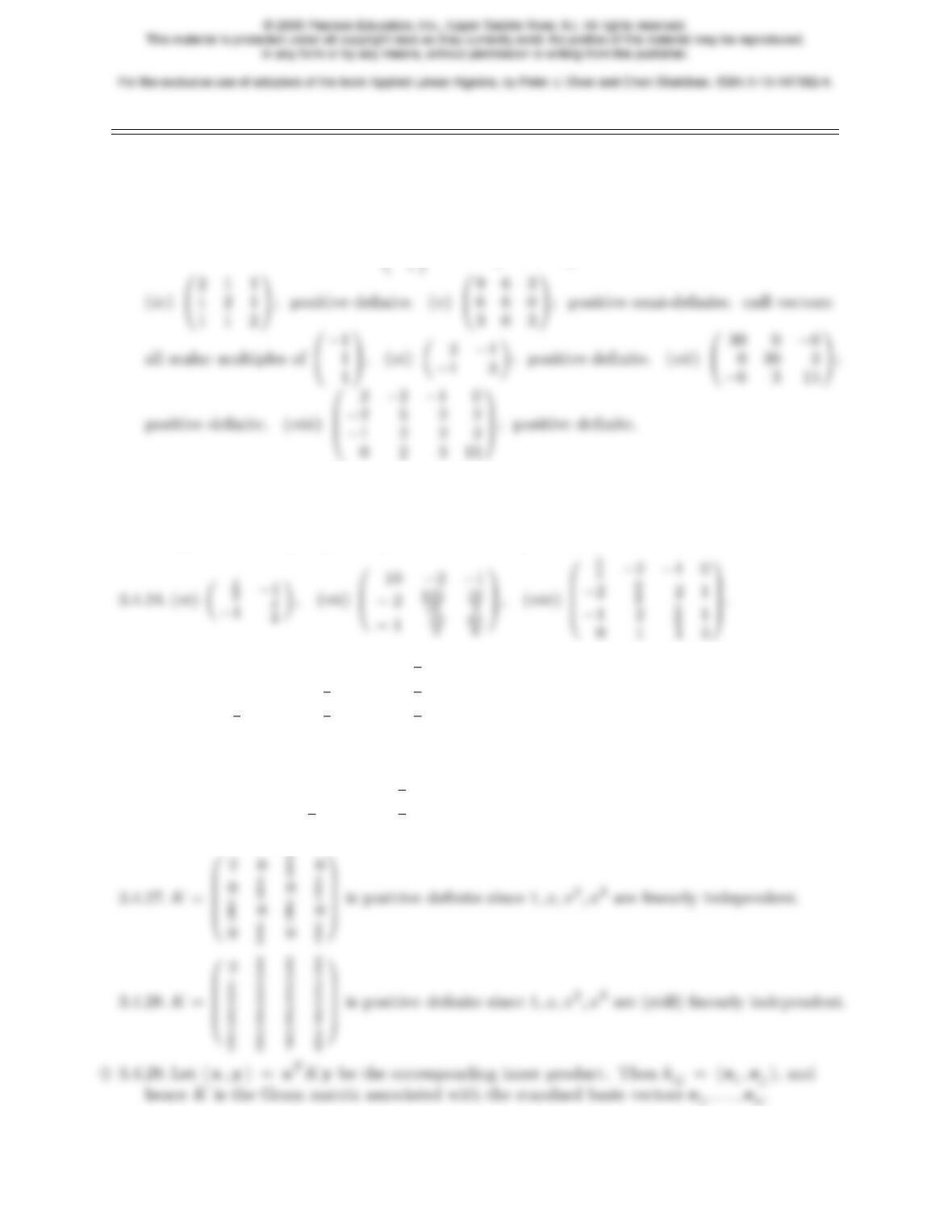
3.4.22. (i) 10 6
6 4 !; positive definite. (ii)0
B
@
5 4 −3
4 13 −1
−3−1 2 1
C
A; positive semi-definite; null
vectors: all scalar multiples of 0
B
@
5
−1
C
A. (iii) 6−8
−8 13 !; positive definite.
3.4.23. (iii) 9−12
−12 21 !, (iv)0
B
@
3 1 2
1 4 3
2 3 5 1
C
A, (v)0
B
@
21 12 9
12 9 3
9 3 6 1
C
A. Positive definiteness doesn’t
change, since it only depends upon the linear independence of the vectors.
3.4.25. K=0
B
B
B
@
1e−11
2(e2−1)
e−11
2(e2−1) 1
3(e3−1)
1
2(e2−1) 1
3(e3−1) 1
4(e4−1)
1
C
C
C
A
is positive definite since 1, ex, e2xare lin-
early independent functions.
3.4.26. K=0
B
B
@
1−1/e 1e−1
1e−11
2(e2−1)
e−11
2(e2−1) 1
3(e3−1)
1
C
C
Ais also positive definite since 1, ex, e2xare
(still) linearly independent.
92
♦3.4.30.
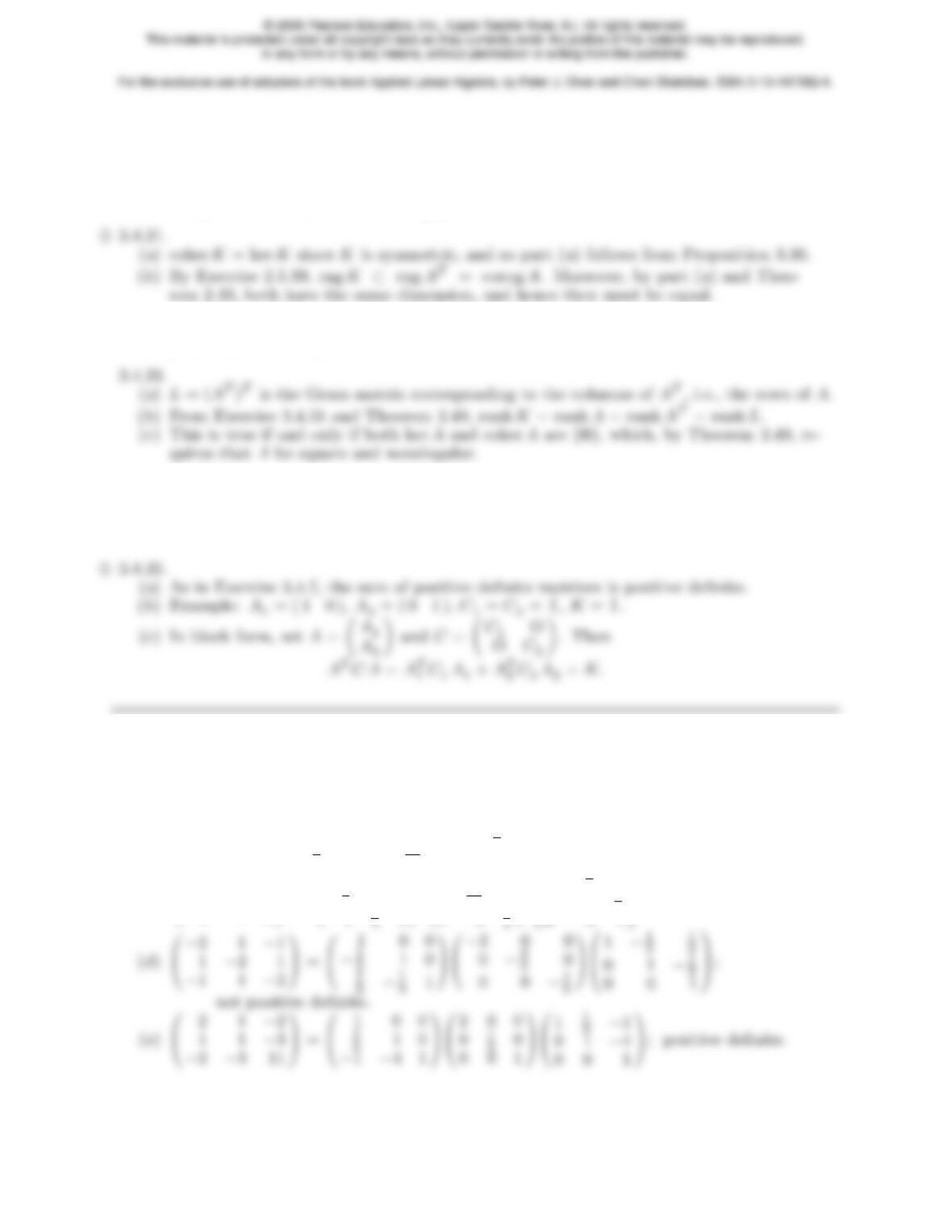
(a) is a special case of (b) since positive definite matrices are symmetric.
(b) By Theorem 3.28 if Sis any symmetric matrix, then STS=S2is always positive semi-
definite, and positive definite if and only if ker S={0}, i.e., Sis nonsingular. In partic-
ular, if S=K > 0, then ker K={0}and so K2>0.
3.4.32. 0 = zTK z =zTATC A z=yTCy, where y=Az. Since C > 0, this implies y=0, and
hence z∈ker A= ker K.
3.4.34. A Gram matrix is positive definite if and only if the vector space elements used to con-
struct it are linearly independent. Linear independence doesn’t depend upon the inner
product being used, and so if the Gram matrix for one inner product is positive definite,
so is the Gram matrix for any other inner product on the vector space.
3.5.1. Only (a), (e) are positive definite.
3.5.2.
(a) 1 2
2 3 != 1 0
2 1 ! 1 0
0−1! 1 2
0 1 !; not positive definite.
(b) 5−1
−1 3 != 1 0
−1
51! 5 0
014
5! 1−1
5
0 1 !; positive definite.
(c)0
B
@
3−1 3
−1 5 1
3 1 5 1
C
A=0
B
@
1 0 0
−1
31 0
13
1
C
A0
B
@
3 0 0
014
30
0 0 8
1
C
A0
B
B
@
1−1
31
0 1 3
7
1
C
C
A; positive definite.
93
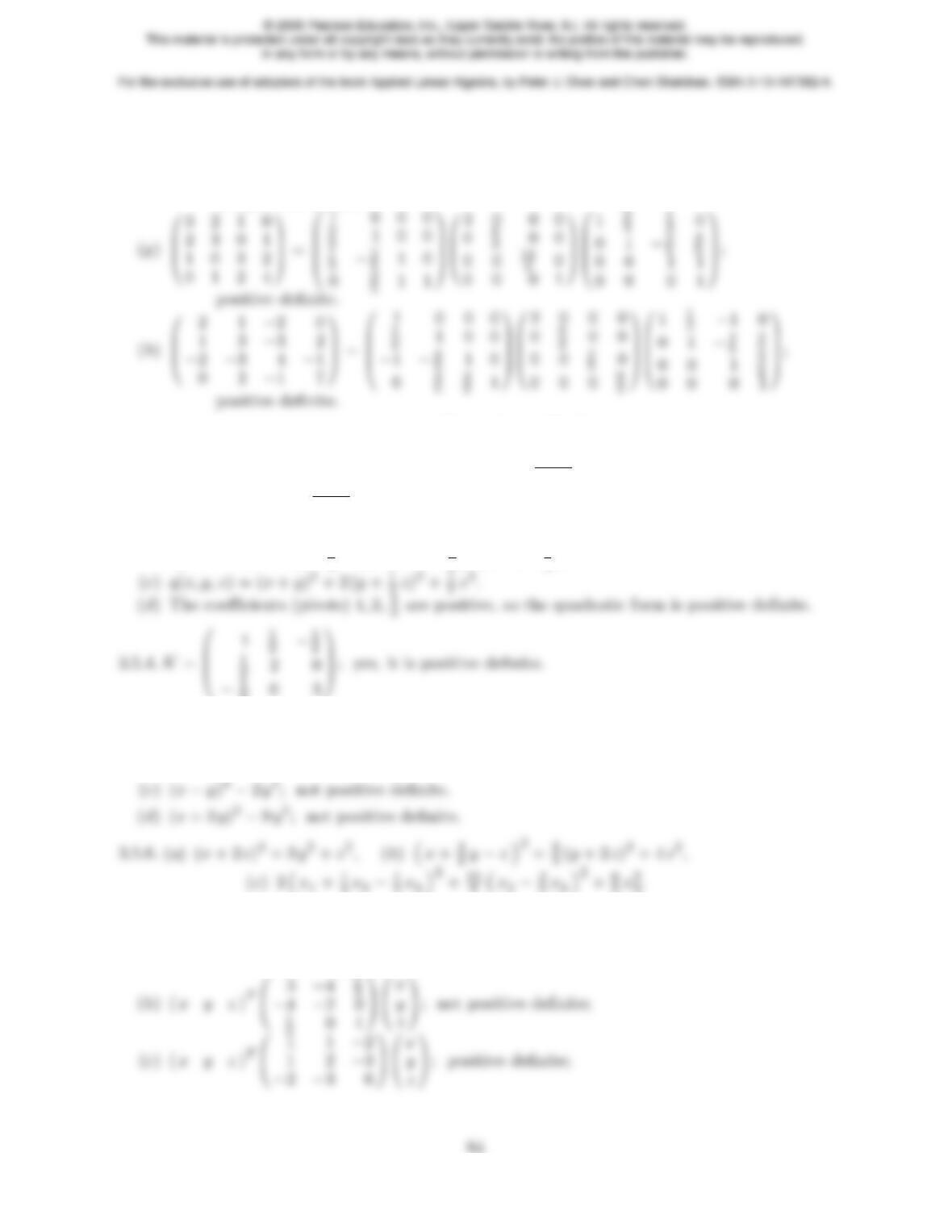
(f)0
B
B
B
@
1 1 1 0
1 2 0 1
1 0 1 1
0 1 1 2
1
C
C
C
A
=0
B
B
B
@
1 0 0 0
1 1 0 0
1−1 1 0
0 1 −2 1
1
C
C
C
A
0
B
B
B
@
1 0 0 0
0 1 0 0
0 0 −1 0
0 0 0 5
1
C
C
C
A
0
B
B
B
@
1 1 1 0
0 1 −1 1
0 0 1 −2
0 0 0 5
1
C
C
C
A
;
not positive definite.
3.5.3.
(a) Gaussian Elimination leads to U=0
B
B
@
1 1 0
0c−1 1
0 0 c−2
c−1
1
C
C
A;
the pivots 1, c −1,c−2
c−1are all positive if and only if c > 2.
(b)0
B
@
110
1 3 1
0111
C
A=0
B
@
1 0 0
1 1 0
01
211
C
A0
B
@
1 0 0
0 2 0
0 0 1
2
1
C
A0
B
@
1 1 0
0 2 1
0 0 1
2
1
C
A;
20 3
3.5.5.
(a) (x+ 4y)2−15y2; not positive definite.
(b) (x−2y)2+ 3y2; positive definite.
3.5.7.
(a) ( x y z )T0
B
@
1 0 2
0 2 4
2 4 12 1
C
A0
B
@
x
y
z1
C
A; not positive definite;
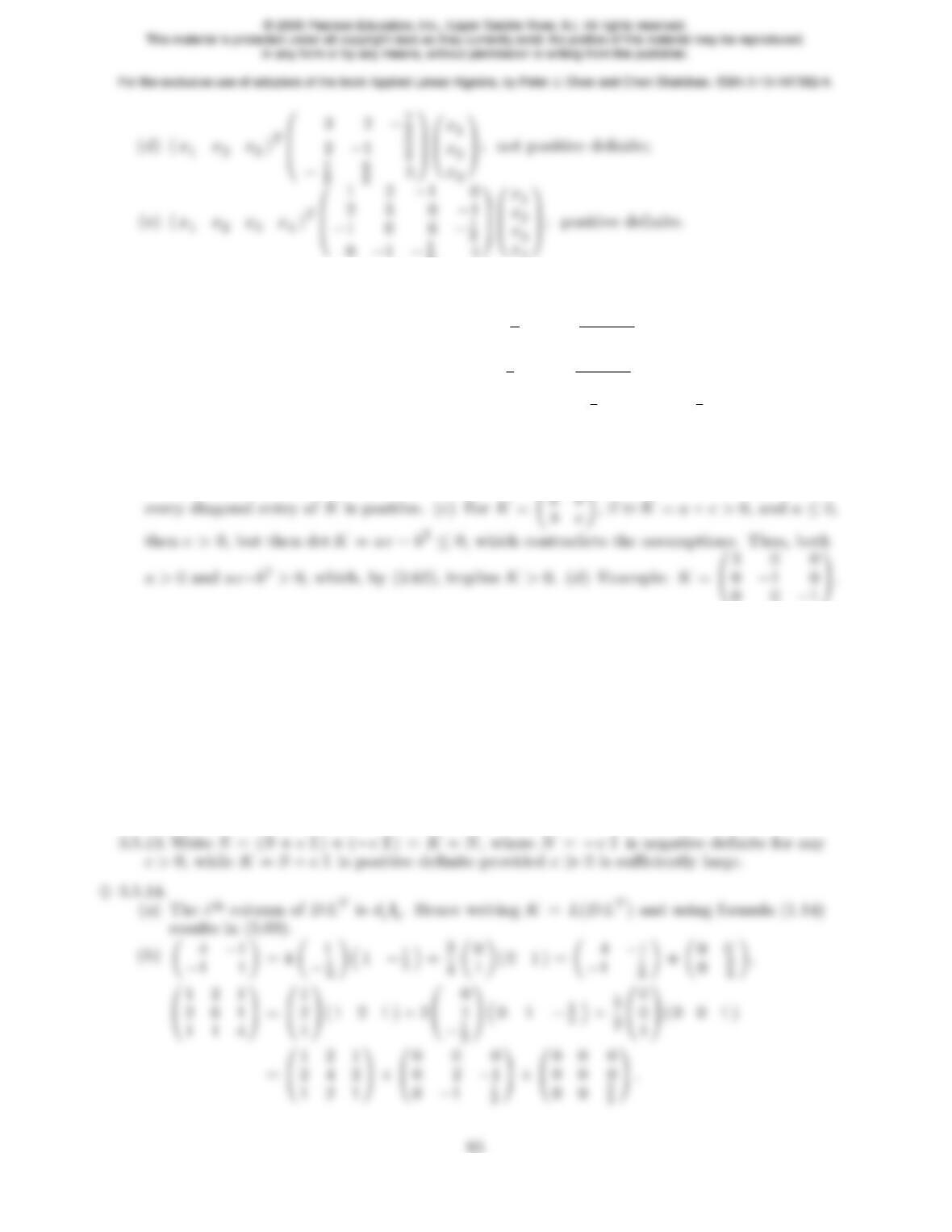
24
3.5.8. When a2<4 and a2+b2+c2−abc < 4.
3.5.9. True. Indeed, if a6= 0, then q(x, y) = a x+b
ay!2
+ca −b2
ay2;
if c6= 0, then q(x, y) = c y+b
cx!2
+ca −b2
cx2;
while if a=c= 0, then q(x, y) = 2 b x y =1
2b(x+y)2−1
2b(x−y)2.
3.5.10. (a) According to Theorem 1.52, det Kis equal to the product of its pivots, which are
all positive by Theorem 3.37. (b) tr K=
n
X
i= 1
kii >0 since, according to Exercise 3.4.4,
3.5.11. Writing x= x1
x2!∈R2nwhere x1,x2∈Rn, we have xTKx=xT
1K1x1+xT
2K2x2>0
for all x6=0by positive definiteness of K1, K2. The converse is also true, because
xT
1K1x1=xTKx>0 when x= x1
0!with x16=0.
3.5.12.
(a) If x6=0then u=x/kxkis a unit vector, and so q(x) = xTKx=kxk2uTKu>0.
(b) Using the Euclidean norm, let m= min{uTSu|kuk= 1 }>−∞, which is finite since
q(u) is continuous and the unit sphere in Rnis closed and bounded. Then uTKu=
uTSu+ckuk2≥m+c > 0 for kuk= 1 provided c > −m.
♥3.5.15. According to Exercise 1.9.19, the pivots of a regular matrix are the ratios of these suc-
cessive subdeterminants. For the 3×3 case, the pivots are a, ad −b2
a, and det K
ad −b2. There-
fore, in general the pivots are positive if and only if the subdeterminants are.
3.5.19.
(a) 3−2
−2 2 !=0
@
√3 0
−2
√3
√2
√31
A0
B
@
√3−2
√3
0√2
√3
1
C
A,
(b) 4−12
2
2
0 0 0 √5
2
3.5.20. (a) 4−2
−2 4 != 2 0
−1√3! 2−1
0√3!,
√20 0 0
0
√21
1
3.5.21.
(a)z2
1+z2
2, where z1= 4x1, z2= 5x2;
96
(b)z2
1+z2
2, where z1=x1−x2, z2=√3x2;
(c)z2
1+z2
2, where z1=√5x1−2
√5x2, z2=r11
5x2;
3.6.1. The equation is eπi+ 1 = 0, since eπi= cos π+ i sin π=−1.
3.6.2. ek π i= cos k π + i sin k π = (−1)k=(1, k even,
−1, k odd.
3.6.3. Not necessarily. Since 1 = e2k π ifor any integer k, we could equally well compute
3.6.5. (a) i = eπi/2; (b)√i = eπi/4=1
√2+i
√2and e5πi/4=−1
√2−i
√2.
(c)3
√i = eπi/6, e5πi/6, e3πi/2=−i ; 4
√i = eπi/8, e5πi/8, e9πi/8, e13 πi/8.
3.6.6. Along the line through zat the reciprocal radius 1/r = 1/|z|.
3.6.7.
(a) 1/z moves in a clockwise direction around a circle of radius 1/r;
(b)zmoves in a clockwise direction around a circle of radius r;
(c) Suppose the circle has radius rand is centered at a. If r < |a|, then 1
zmoves in a
3.6.11. If z=r e iθ, w =s e iϕ6= 0, then z/w = (r/s)ei (θ−ϕ)has phase ph (z/w) = θ−ϕ=
ph z−ph w, while zw=r s e i (θ−ϕ)also has phase ph (z w) = θ−ϕ= ph z−ph w.
3.6.14.
(a) By Exercise 3.6.13, for z=x+ i y, w =u+ i v, the quantity Re (zw) = x u +y v is equal
to the dot product between the vectors ( x, y )T,(u, v )T, and hence equals 0 if and only
3.6.16.
(a)e2 i θ= cos 2θ+ i sin 2θwhile (eiθ)2= (cos θ+ i sin θ)2= (cos2θ−sin2θ) + 2 i cos θsin θ,
and hence cos 2θ= cos2θ−sin2θ, sin 2 θ= 2 cos θsin θ.
(b) cos 3θ= cos3θ−3 cos θsin2θ, sin 3θ= 3 cos θsin2θ−sin3θ.
3.6.20.
(a) cosh(x+ i y) = cosh xcos y−i sinh xsin y, sinh(x+ i y) = sinh xcos y+ i cosh xsin y;
(b) Using Exercise 3.6.19,
cos i z=e−z+ez
2= cosh z, sin i z=e−z−ez
2 i = i ez−e−z
2= i sinh z.
98
♥3.6.21.
(a) If j+k=n, then (cos θ)j(sin θ)k=1
2nik(eiθ+e−iθ)j(eiθ−e−iθ)k.When multiplied
out, each term has 0 ≤l≤nfactors of eiθand n−lfactors of e−iθ, which equals
ei (2 l−n)θwith −n≤2l−n≤n, and hence the product is a linear combination of the
indicated exponentials.
♦3.6.22. xa+ i b=xaeiblog x=xacos(blog x) + i xasin(blog x).
♦3.6.23. First, using the power series for ex, we have the complex power series eix=∞
X
( i x)n
n!.
♦3.6.24.
(a)d
dx eλ x =d
dx “eµ x cos ν x + i eµ x sin ν x ”= (µeµ x cos ν x −ν eµ x sin ν x) +
+ i (µeµ x sin ν x +ν eµ x cos ν x) = (µ+ i ν)“eµ x cos ν x + i eµ x sin ν x ”=λ eλ x.
(b) This follows from the Fundamental Theorem of Calculus. Alternatively, one can calcu-
late the integrals of the real and imaginary parts directly:.
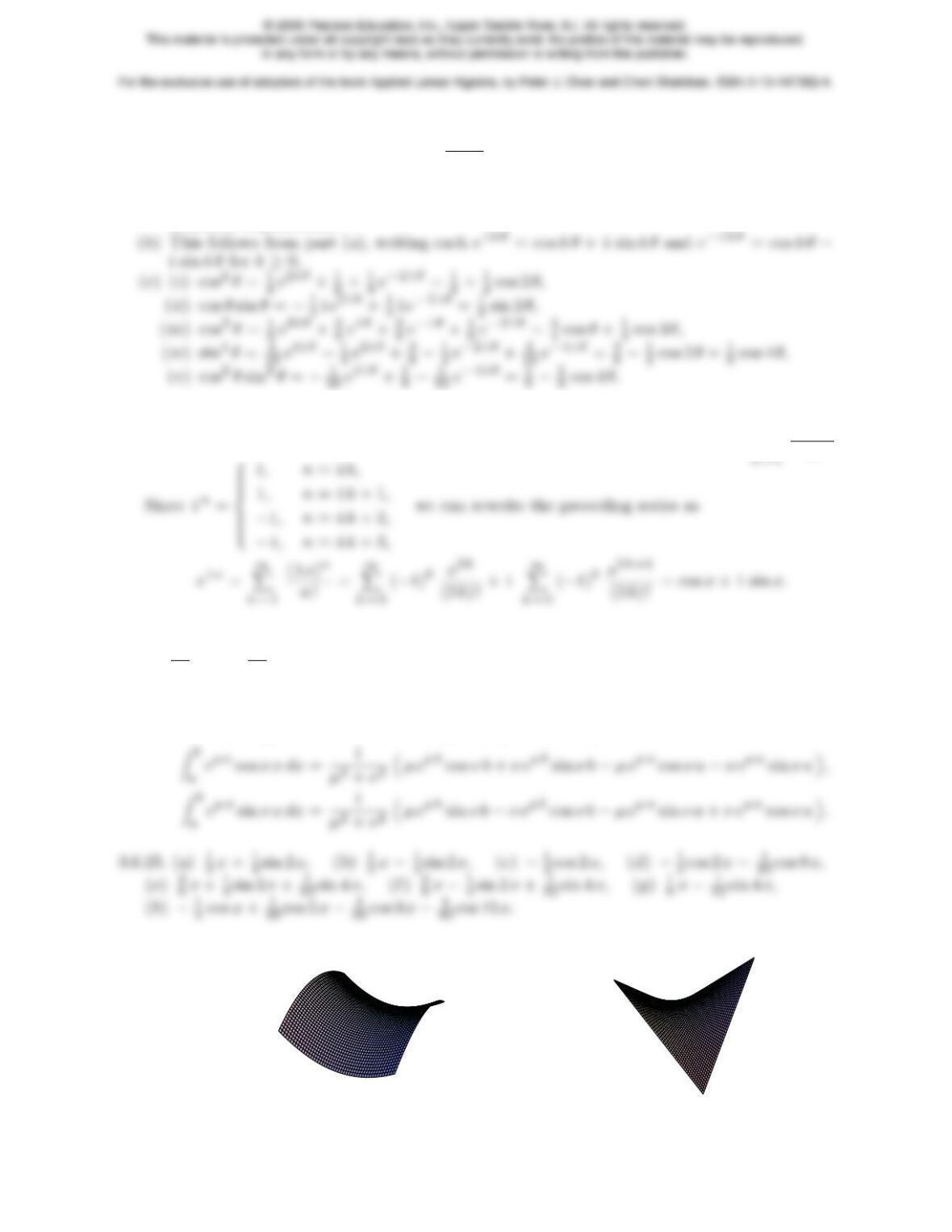
♠3.6.26. Re z2:Im z2:
Both have saddle points at the origin,
99
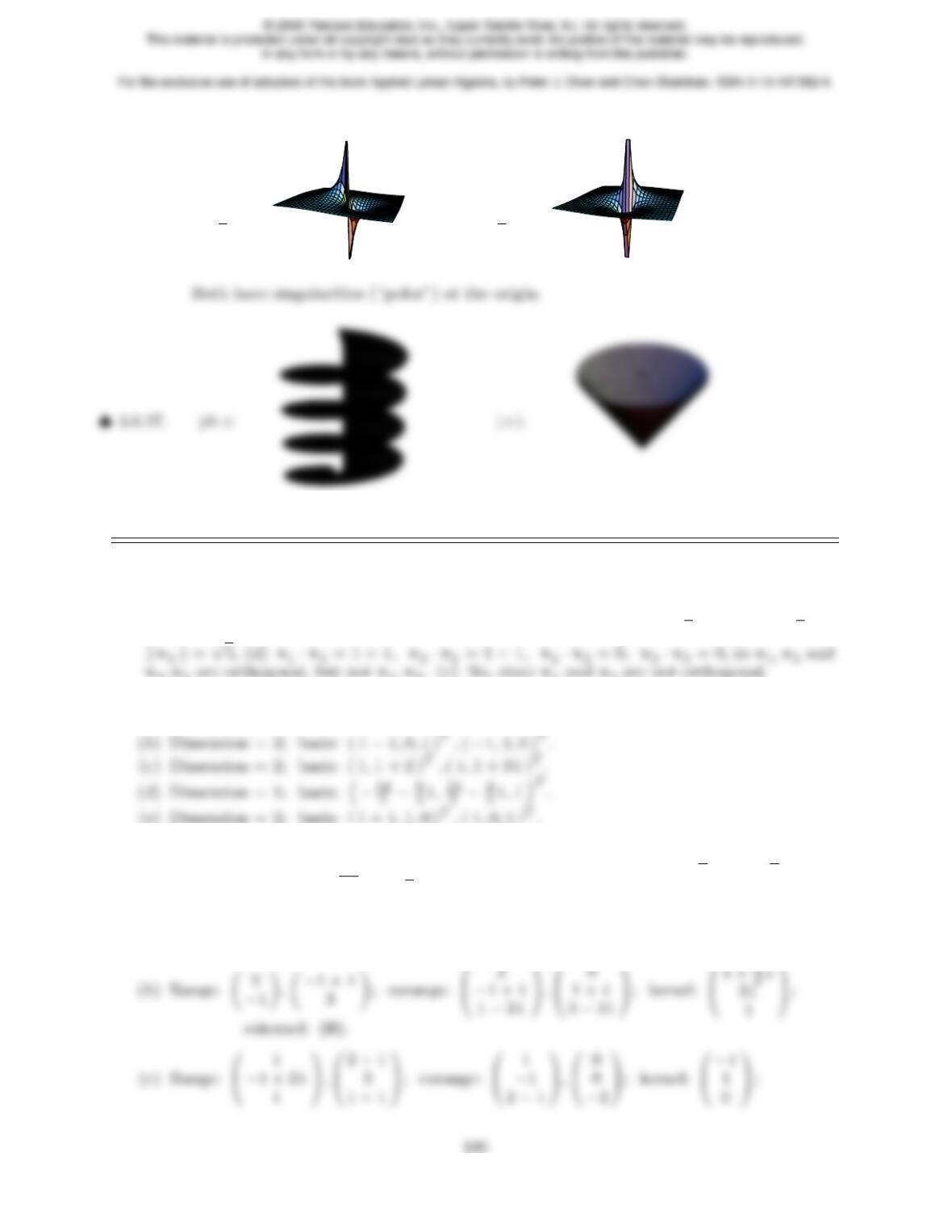
Re 1
z:Im 1
z:
3.6.28. (a) Linearly independent; (b) linearly dependent; (c) linearly independent; (d) linearly
dependent; (e) linearly independent; (f) linearly independent; (g) linearly dependent.
3.6.29. (a) Linearly independent; (b) yes, they are a basis; (c)kv1k=√2,kv2k=√6,
3.6.30.
(a) Dimension = 1; basis: ( 1,i,1−i )T.
3.6.31. False — it is not closed under scalar multiplication. For instance, i z
z!= iz
iz!is
not in the subspace since iz=−iz.
3.6.32.
(a) Range: i
−1!; corange: i
2!; kernel: 2 i
1!; cokernel: −i
1!.
cokernel: 0
B
B
@
1−3
2i
−1
2+ i
1
1
C
C
A.
3.6.33. If cv+dw=0where c=a+ i b,d=e+ i f, then, taking real and imaginary parts,
(a+e)x+ (−b+f)y=0= (b+f)x+ (a−e)y. If c, d are not both zero, so v,ware
linearly dependent, then a±e, b ±fcannot all be zero, and so x,yare linearly dependent.
Conversely, if ax+by=0with a, b not both zero, then (a−ib)v+(a+ i b)w= 2(ax+by) =
0and hence v,ware linearly dependent.
(e) doesn’t belong.
3.6.38.
(a) Sesquilinearity:
hcu+dv,wi= (cu1+dv1)w1+ 2(cu2+d v2)w2
=c(u1w1+ 2u2w2) + d(v1w1+ 2v2w2) = chu,wi+dhv,wi,
hu, c v+dwi=u1(cv1+dw1) + 2u2(cv2+dw2)
3.6.39. Only (d), (e) define Hermitian inner products.
♦3.6.40. (Av)·w= (Av)Tw=vTATw=vTAw=vTAw=v·(Aw).
101
3.6.41.
(a)kzk2=
n
X
j= 1 |zj|2=
n
X
j= 1 “|xj|2+|yj|2”=
n
X
j= 1 |xj|2+
n
X
j= 1 |yj|2=kxk2+kyk2.
(b) No; for instance, the formula is not valid for the inner product in Exercise 3.6.38(b).
3.6.44. kvk=kcvkif and only if |c|= 1, and so c=eiθfor some 0 ≤θ < 2π.
♦3.6.45. Assume w6=0. Then, by Exercise 3.6.42(a), for t∈C,
0≤ kv+twk2=kvk2+ 2Re thv,wi+|t|2kwk2.
3.6.46.
(a) A norm on the complex vector space Vassigns a real number kvkto each vector v∈V,
subject to the following axioms, for all v,w∈V, and c∈C:
(i)Positivity:kvk ≥ 0, with kvk= 0 if and only if v=0.
(ii)Homogeneity:kcvk=|c| kvk.
(iii)Triangle inequality:kv+wk ≤ kvk+kwk.
(b)kvk1=|v1|+···+|vn|;kvk2=q|v1|2+··· +|vn|2;kvk∞= max{|v1|, . . . , |vn|}.
3.6.47. (e) Infinitely many, namely u=eiθv/kvkfor any 0 ≤θ < 2π.
♦3.6.48.
♦3.6.49.
(a) The entries of Hsatisfy hji =hij ; in particular, hii =hii, and so hii is real.
(b) (Hz)·w= (Hz)Tw=zTHTw=zTHw=z·(Hw).
(c) Let z=
n
X
i= 1
ziei,w=
n
X
i= 1
wieibe vectors in Cn. Then, by sesquilinearity, hz,wi=
n
X
i,j = 1
hij ziwj=zTHw, where Hhas entries hij =hei,eji=hej,eii=hji, proving
that it is a Hermitian matrix. Positive definiteness requires kzk2=zTHz>0 for all
z6=0.
(d) First check that the matrix is Hermitian: hij =hji. Then apply Regular Gaussian
Elimination, checking that all pivots are real and positive.
3.6.51.
(a) (i)h1, e iπx i=−2
πi , k1k= 1, keiπx k= 1;
(ii)|h1, e iπx i| =2
π≤1 = k1k keiπx k,k1 + eiπx k=√2≤2 = k1k+keiπx k.
3.6.52. w(x)>0 must be real and positive. Less restrictively, one needs only require that
w(x)≥0 as long as w(x)6≡ 0 on any open subinterval a≤c < x < d ≤b; see Exercise
3.1.28 for details.
103