Solutions — Chapter 11
11.1.1. The greatest displacement is at x=d
α+1
2, with u(x) = α
8+d
2+d2
2a, when d < 2α, and
at x= 1, with u(x) = d, when d≥2α. The greatest stress and greatest strain are at x= 0,
with v(x) = w(x) = α
2+d.
11.1.3.
(a)u(x) = b+8
<
:−1
2x2,0≤x≤1
2ℓ,
1
4ℓ2−ℓx +1
2x2,1
2ℓ≤x≤1,for any b.
<
2ℓ,
11.1.4.
u(x) = log(x+ 1)
log 2 −x, v(x) = u′(x) = 1
log 2(x+ 1) −1, w(x) = (1 + x)v(x) = 1
log 2 −1−x.
0.08
0.3
0.4
0.4
11.1.5. u(x) = 2 log(x+ 1) −x, v(x) = u′(x) = 1−x
1 + x, w(x) = (1 + x)v(x) = 1 −x.
0.3
0.8
1
0.8
1
Maximum displacement at x= 1. Maximum strain at x= 0.
11.1.6. There is no equilibrium solution.
11.1.7. u(x) = x3−3
2x2−x,v(x) = 3x2−3x−1.
0.1
0.2
0.6
0.8
1
break.
11.1.8. u(x) = 8
<
:
7
8x−1
2x2,0≤x≤1,
1
4+3
8x−1
4x2,1≤x≤2,v(x) = 8
<
:
7
8−x, 0≤x≤1,
3
8−1
2x, 1≤x≤2.
0.3
0.6
0.8
4.
11.1.9. The bar will stretch farther if the stiffer half is on top. Both boundary value problems
have the form
−d
dx c(x)du
dx != 1,0< x < 2, u(0) = 0, u′(2) = 0.
−1
4+ 2x−1
2x2,1≤x≤2,with u(2) = 7
11.1.10. −((1 −x)u′)′= 1, u(0) = 0, w(1) = lim
x→1(1 −x)u′(x) = 0.
The solution is u=x. Note that we still need the limiting strain at x= 1 to be zero,
w(1) = 0, which requires u′(1) <∞. Indeed, the general solution to the differential equa-
tion is u(x) = a+blog(1−x)+x; the first boundary condition implies a= 0, while u′(1) <∞
is required to eliminate the logarithmic term.
316
11.1.12. Displacement uand position x: meters. Strain v=u′: no units. Stiffness c(x): N/m =
kg/sec2. Stress w=c v′: N/m = kg/sec2. External force f(x): N/m2= kg/(m sec2).
11.2.2.
(a)ϕ(x) = δ(x); Zb
aϕ(x)u(x)dx =u(0) for a < 0< b.
(b)ϕ(x) = δ(x−1); Zb
aϕ(x)u(x)dx =u(1) for a < 1< b.
11.2.3.
(a)x δ(x) = lim
n→ ∞
nx
π“1 + n2x2”= 0 for all x, including x= 0. Moreover, the functions
11.2.4.
(a)ϕ(x) = lim
n→ ∞ 2
4n
π“1 + n2x2”−3n
π“1 + n2(x−1)2”3
5;
(b)Zb
aϕ(x)u(x)dx =u(0) −3u(1), for any interval with a < 0<1< b.
♦11.2.5.
(a) Using the limiting sequence, (11.31)
317
aδ(x).
11.2.6.
(a)f′(x) = −δ(x+ 1) −9δ(x−3) + 8
>
>
<
>
>
:
2x, 0< x < 3,
1,−1< x < 0,
0,otherwise.
-2 -1 1 2 3 4
-6
-4
-2
2
4
6
-1.5
(c)h′(x) = −e−1δ(x+ 1) + 8
>
>
<
>
>
:
πcos π x, x > 1,
−2x, −1< x < 1,
ex, x < −1.
-3 -2 -1 1 2 3 4
-4
-2
2
4
11.2.7.
(a)f′(x) = 8
>
>
>
<
>
>
>
:
1,−1< x < 0,
−1,0< x < 1,
0,otherwise,
=σ(x+ 1) −2σ(x) + σ(x−1),
11.2.8.
−2,−1< x < 0,.
(d)f′(x) = 4 δ(x+ 2) −4δ(x−2) + 8
<
:
1,|x|>2,
−1,|x|<2,
= 4 δ(x+ 2) −4δ(x−2) + 1 −2σ(x+ 2) + 2 σ(x−2),
f′′(x) = 4 δ′(x+ 2) −4δ′(x−2) −2δ(x+ 2) + 2 δ(x−2).
11.2.9.
(a) It suffces to note that, when λ > 0, the product λx has the same sign as x, and so
σ(λx) = (1, x > 0,
0, x < 0,=σ(x).
♦11.2.11.
(a) First, by the definition of mn, we have
Zℓ
0e
gn(x)dx =Zℓ
0gn(x−y)dx
mn
= 1.
319
♥11.2.12.
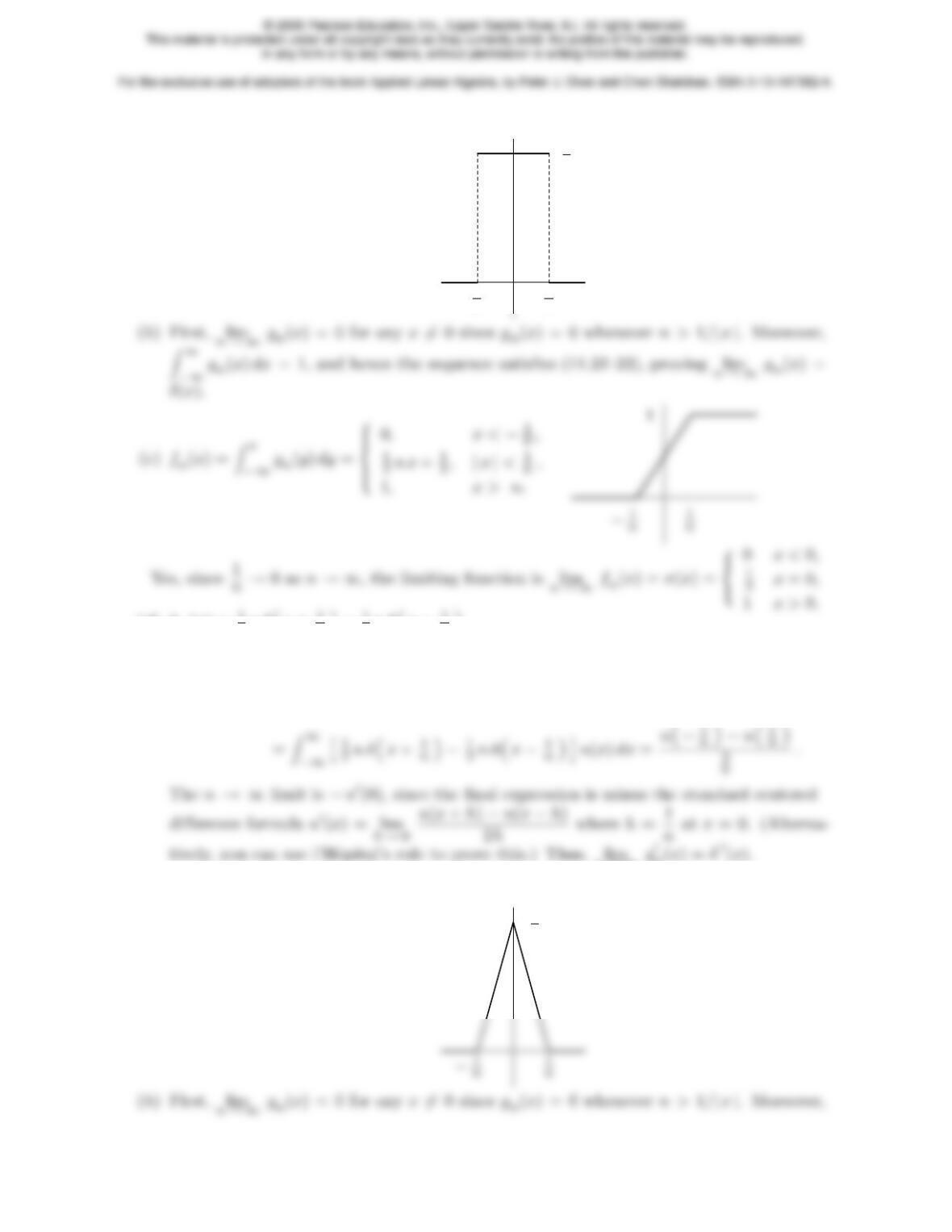
(a)
1
n
−1
n
1
2n
(d)hn(x) = 1
2n δ“x+1
n”−1
2n δ“x−1
n”.
(e) Yes. To compute the limit, we use the dual interpretation of the delta function. Given
any C1function u(x),
hhn, u i=Z∞
−∞ hn(x)u(x)dx
n→ ∞ g′
n(x) = δ′(x).
♥11.2.13.
(a)
1
2n
320
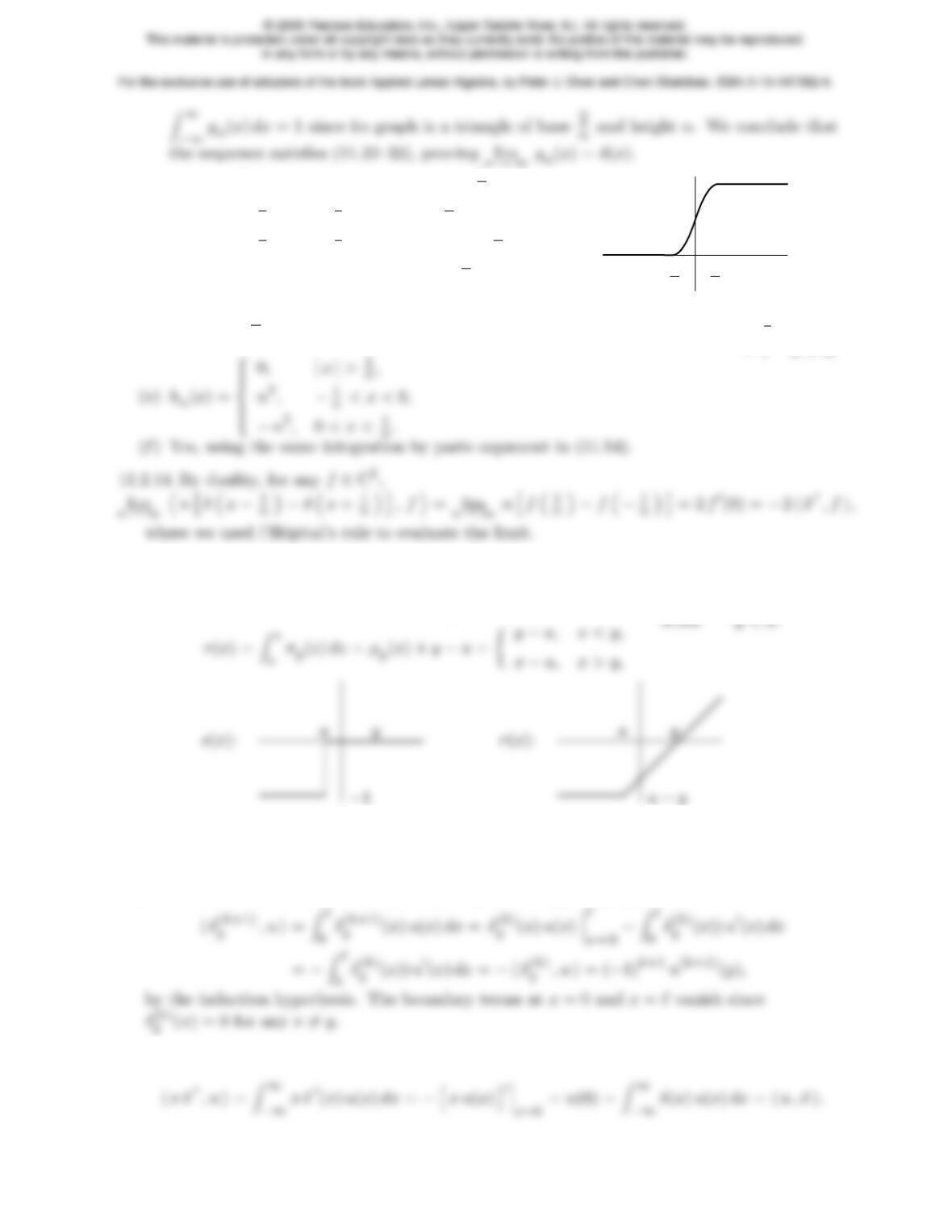
(c)fn(x) =
8
>
>
>
>
>
>
>
<
>
>
>
>
>
>
>
:
0, x < −1
n,
1
2+nx +1
2n2x2,−1
n< x < 0,
1
2+nx −1
2n2x2,0< x < 1
n,
1, x > 1
n.1
n
−1
n
1
(d) Yes, since 1
n→0 as n→ ∞, the limiting function is lim
n→ ∞ fn(x) = σ(x) = 8
>
<
>
:
0x < 0,
1
2x= 0,
1x > 0.
11.2.15.
s(x) = Zx
aδy(t)dt =−σy(x) = 8
<
:
0, x > y,
−1, x < y,
11.2.16. hδy, u i=Zℓ
0δy(x)u(x)dx =u(y), while hσy, u′i=Zℓ
yu′(x)dx =u(ℓ)−u(y) = −u(y)
provided u(ℓ) = 0.
11.2.17. Use induction on the order k. Let 0 < y < ℓ. Integrating by parts,
11.2.18. x δ ′(x) = −δ(x) because they both yield the same value on a test function:
321
11.2.19. The correct formulae are
(f(x)δ(x))′=f′(x)δ(x) + f(x)δ′(x) = f(0) δ′(x).
Indeed, integrating by parts,
♦11.2.20.
(a) For any text function,
11.2.21.
(a)ϕ(x) = −2δ′(x)−δ(x), Z∞
−∞ ϕ(x)u(x)dx = 2u′(0) −u(0);
(b)ψ(x) = δ′(x), Z∞
♦11.2.23. Suppose there is. Let us show that δy(z) = 0 for all 0 < z 6=y < ℓ. If δy(z)>0 at
some z6=y, then, by continuity, δy(x)>0 in a small interval 0 < z −ε < x < z +ε < ℓ.
We can further assume ε < |z−y|so that ydoesn’t lie in the interval. Choose u(x) to be
a continuous function so that u(z)>0 for z−ε < x < z +εbut u(x) = 0 for all 0 ≤x≤ℓ
322
11.2.25. .5 mm — by linearity and symmetry of the Green’s function.
11.2.26. To determine the Green’s function, we must solve the boundary value problem
−c u′′ =δ(x−y), u(0) = 0, u′(1) = 0.
boundary value problem is not positive definite, and so there is not a unique solution.
11.2.28.
(a)G(x, y) = 8
>
>
>
>
<
>
>
>
>
log(1 + x) 1−log(1 + y)
log 2 !, x < y,
♥11.2.29.
(a)u(x) = 9
16 x−1
2x2+3
16 x3−1
4x4, w(x) = u′(x)
1 + x2=9
16 −x;
323
g(x⋆) = 1
3occurs at the solution x⋆=3
q1 + √2−1
3
q1 + √2
=.596072 to
g′(x) = 1 −3
2x+x2−2x3−1
2x5= 0.
11.2.30. (a)G(x, y) = ((1 + y)x, x < y,
y(1 + x), x > y;(b) all of them;
♥11.2.31.
(a)un(x) = 8
>
>
>
>
<
>
>
>
>
:
x(y−1),0≤x≤y−1
n,
1
4n−1
2x+1
4nx2−1
2y+“1−1
2n”xy +1
4ny2,|x−y| ≤ 1
n,
x(1 −y), y +1
n≤x≤1.
11.2.32. Use formula (11.64) to compute
u(x) = 1
cZx
0y f(y)dy +1
cZ1
xxf(y)dy,
u′′(x) = −1
324
♠11.2.34. Yes. For a system of nmasses connected to both top and bottom supports by n+ 1
springs, the spring lengths are ∆x=1
n+ 1 , and we rescale the incidence matrix Aby di-
♦11.2.35. Set
I(x, z, w) = Zw
∂F
11.3.1. (a) Solution: u⋆(x) = 5
2x−5
2x2. (b)P[u⋆] = −25
24 =−1.04167,
11.3.2. (i)u⋆(x) = 1
6x−1
6x3, (ii )P[u] = Z1
0h1
2(u′)2−xu idx, u(0) = u(1) = 0,
11.3.3.
(a) (i)u⋆(x) = 1
18 x6+1
12 x4−5
36 ,
(ii )P[u] = Z1
−12
4(u′)2
2(x2+ 1) +x2u3
5dx, u(−1) = u(1) = 0,
(iii )P[u⋆] = −.0282187,
(iv )Ph−1
325
11.3.4.
(a) Boundary value problem: −u′′ = 3, u(0) = u(1) = 0;
solution: u⋆(x) = −3
2x2+3
2x.
11.3.5.
(a) Unique minimizer: u⋆(x) = 1
2x2−2x+3
2+log x
2 log 2 .
(b) No minimizer since xis not positive for all −π < x < π.
11.3.6. Yes: any function of the form u(x) = a+1
4x2−1
6x3satisfies the Neumann boundary
value problem −u′′ =x−1
2, u′(0) = u′(1) = 0.Note that the right hand side satisfies
the Fredholm condition D1, x −1
2E=Z1
0“x−1
2”dx = 0; otherwise the boundary value
problem would have no solution.
11.3.7. Arguing as in Example 11.3, any minimum must satisfy the Neumann boundary value
problem −(c(x)u′)′=f(x), u′(0) = 0, u′(1) = 0.The general solution to the differential
♦11.3.8. 1
2kD[u]k2=1
2kvk2=Zℓ
0
1
2c(x)v(x)2dx =Zℓ
0
1
2v(x)w(x)dx =1
2hv , w i.
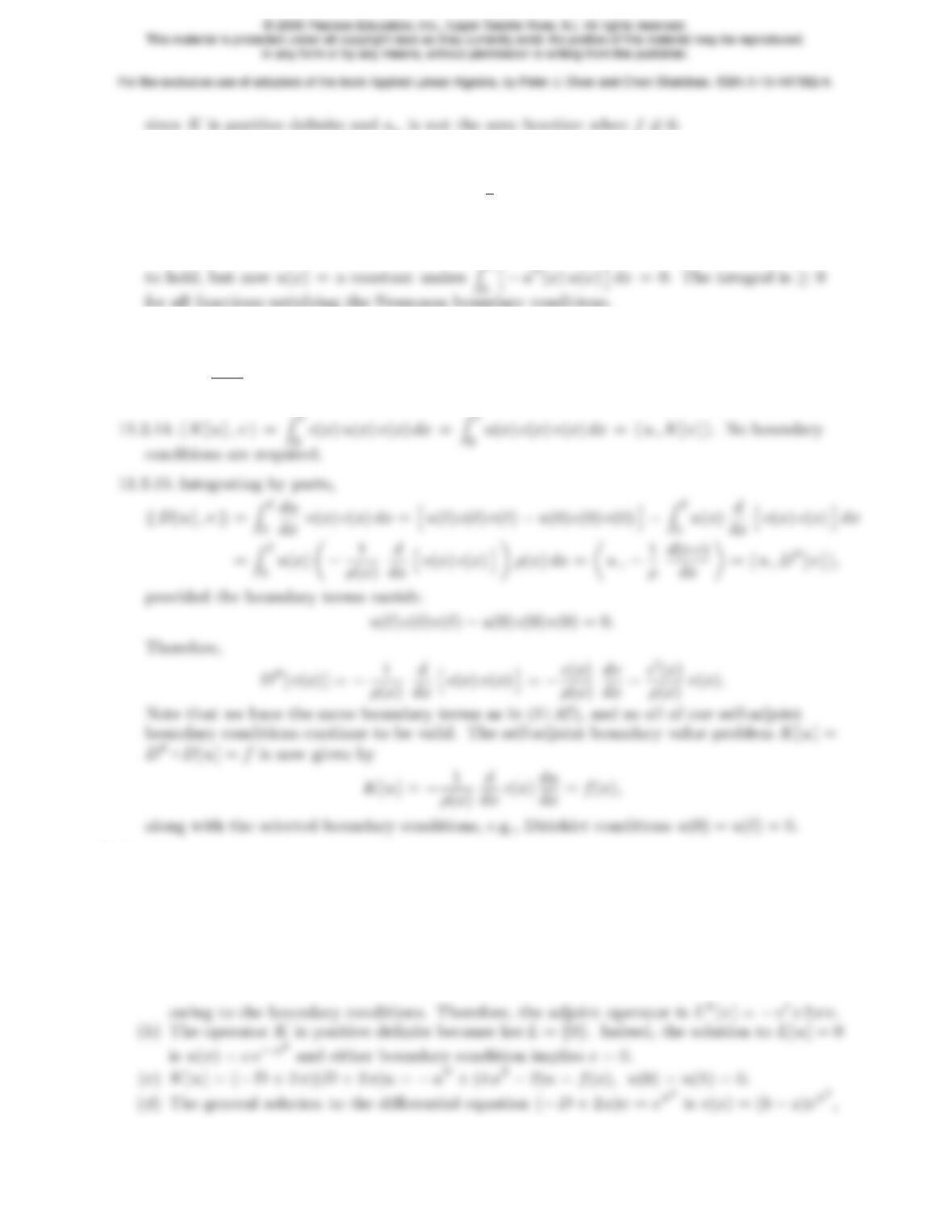
11.3.9. According to (11.91–92) (or, using a direct integration by parts) P[u] = 1
2hK[u], u i −
11.3.10. Yes. Same argument
11.3.11. u(x) = x2satisfiess Z1
0u′′(x)u(x)dx =2
3. Positivity of Z1
0−u′′(x)u(x)dx holds only
for functions that satisfy the boundary conditions u(0) = u(1).
11.3.12. No. The boundary terms still vanish and so the integration by parts identity continues
11.3.13. hh I [u], v ii =Zℓ
0u(x)v(x)c(x)dx =Zℓ
0u(x)v(x)ρ(x)dx =hu , I∗[v]i, provided
I∗[v] = c(x)
ρ(x)v(x) is a multiplication operator.
♥11.3.16.
(a) Integrating the first term by parts, we find
hhL[u], v ii =Z1
0hu′(x)v(x) + 2xu(x)v(x)idx
=hu(1) v(1) −u(0) v(0) i+Z1
0h−u(x)v′(x) + 2xu(x)v(x)idx
=hu , −v′+ 2xv i=hu , L∗[v]i,
327
0e2y2
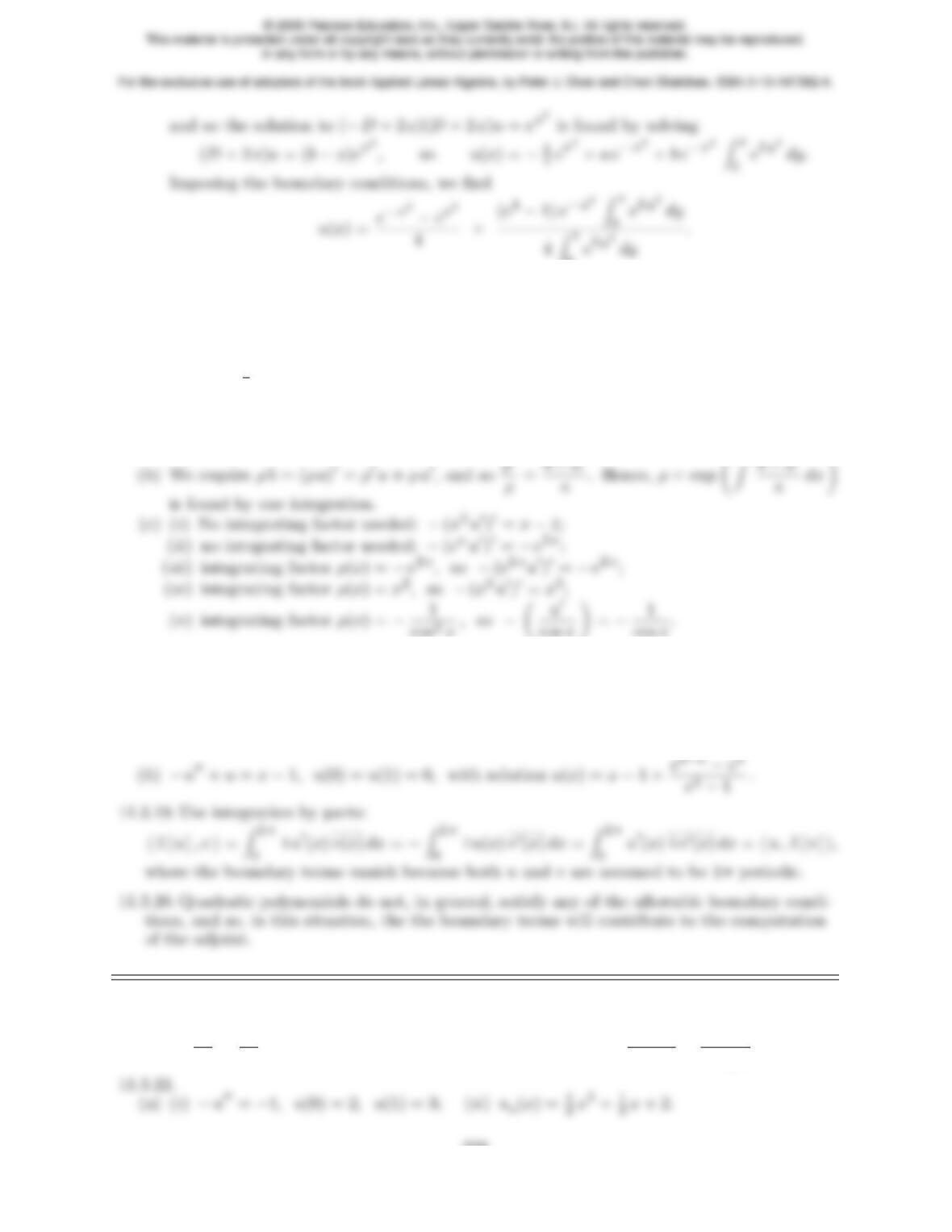
(e) Because the boundary terms u(1) v(1) −u(0) v(0) in the integration by parts argu-
ment are not zero. Indeed, we should identify v(x) = u′(x) + 2xu(x), and so the cor-
rect form of the free boundary conditions v(0) = v(1) = 0 requires u′(0) = u′(1) +
2u(1) = 0. On the other hand, although it is not self-adjoint and so doesn’t admit a
minimization principle, the free boundary value problem does have a unique solution:
u(x) = −1
4e2“1 + e−x2”.
♥11.3.17.
(a)a(x)u′′ +b(x)u′=−(c(x)u′)′=−c(x)u′′ −c′(x)u′if and only if a=−cand
b=−c′=a′.
cos2x, so − u′
cos x!=−1
cos x.
11.3.18.
(a) Integrating the first term by parts and using the boundary conditions,
hhL[u],vii =Z1
0hu′v1+uv2idx =Z1
0uh−v′
1+v2idx =hu , L∗[v]i,
and so the adjoint operator is L∗[v] = −v′
1+v2.
11.3.21. Solving the corresponding boundary value problem
−d
dx (xdu
dx ) = −x2, u(1) = 0, u(2) = 1,gives u(x) = x3−1
9−2 log x
9 log 2 .
328
11.3.23.
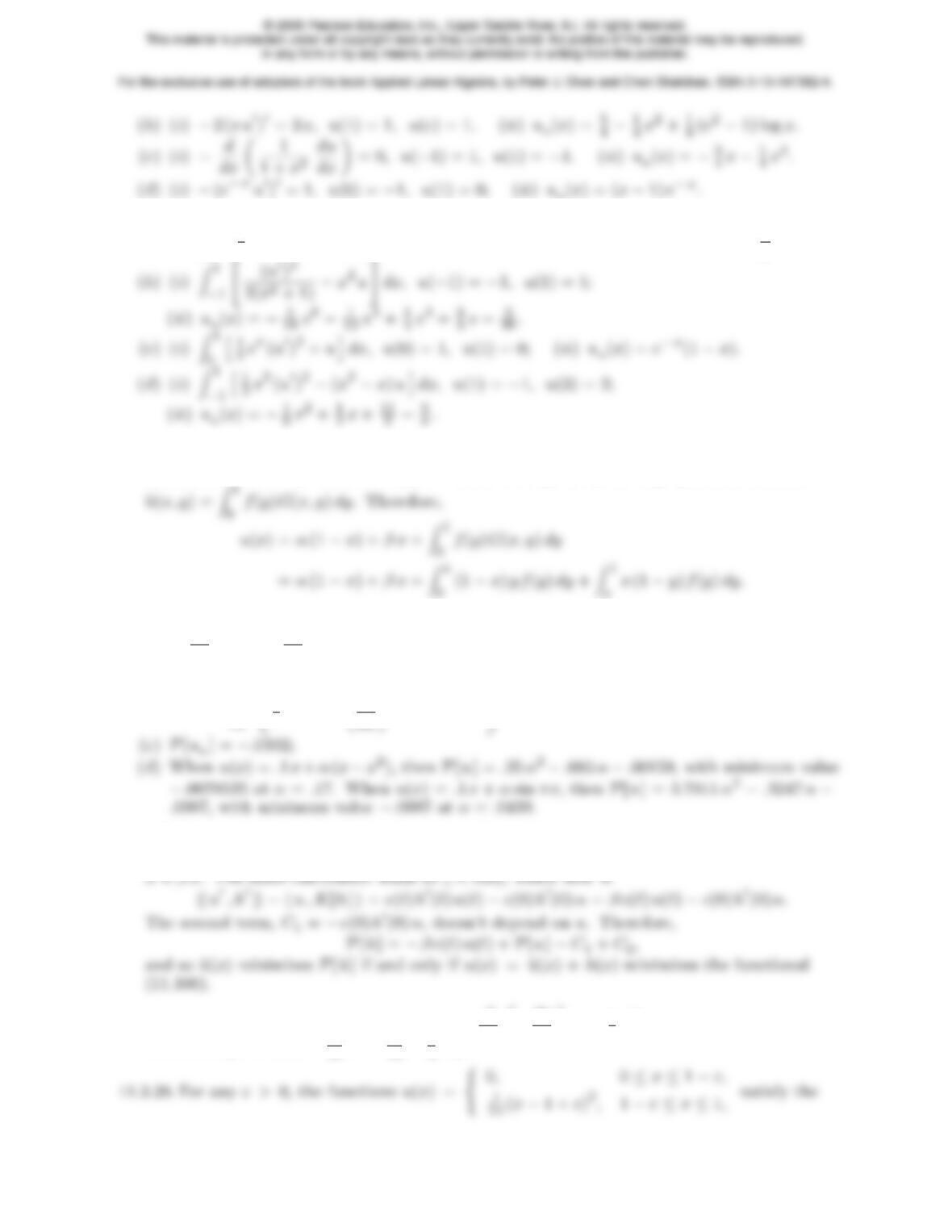
(a) (i)Zπ
0h1
2(u′)2−(cos x)uidx, u(0) = 1, u(π) = −2; (ii )u⋆(x) = cos x−x
π.
11.3.24. The function e
u(x) = u(x)−hα(1 −x) + β x isatisfies the homogeneous boundary
conditions −e
u′′ =f, e
u(0) = e
u(1) = 0, and so is given by the superposition formula
11.3.25.
(a)−d
dx “(1 + x)du
dx #= 1 −x, u(0) = 0, u(1) = .01;
solution: u⋆(x) = .25x2−1.5x+ 1.8178 log(1 + x);
(b)P[u] = Z1
00
@1
2(1 + x) du
−(1 −x)u1
Adx;
♦11.3.26. We proceed as in the Dirichlet case, setting u(x) = e
u(x) + h(x) where h(x) is any
function that satisfies the mixed boundary conditions h(0) = α, h′(ℓ) = β, e.g., h(x) =
11.3.27. Solving the boundary value problem −d
dx xdu
dx !=−1
2x2with the given boundary
conditions gives u(x) = 1
18 x3+17
18 −4
3log x.
329
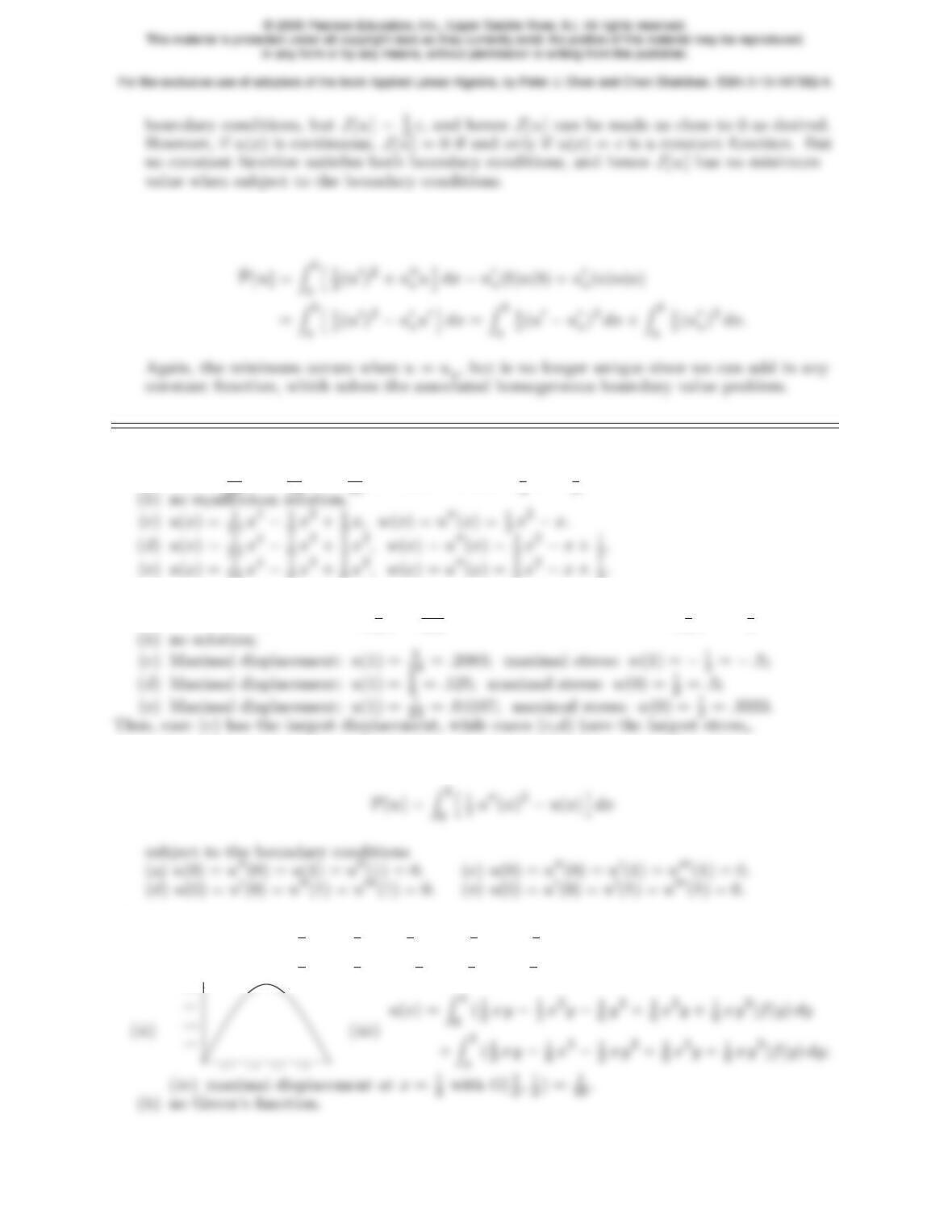
♦11.3.29. The extra boundary terms serve to cancel those arising during the integration by parts
computation:
11.4.1.
(a)u(x) = 1
24 x4−1
12 x3+1
24 x, w(x) = u′′(x) = 1
2x2−1
2x.
24 x4−1
6x3+1
6x2, w(x) = u′′(x) = 1
2x2−x+1
3.
♥11.4.2.
(a) Maximal displacement: u“1
2”=3
384 =.01302; maximal stress: w“1
2”=−1
8=−.125;
11.4.3. Except in (b), which has no minimization principle, we minimize
11.4.4.
(a) (i)G(x, y) = 8
<
:
1
3xy −1
6x3−1
2xy2+1
6x3y+1
6xy3, x < y,
1
3xy −1
2x2y−1
6y3+1
6x3y+1
6xy3, x > y;
0.02
330
(c) (i)G(x, y) = 8
<
:
xy −1
6x3−1
2xy2, x < y,
xy −1
2x2y−1
6y3, x > y;(ii )
0.2 0.4 0.6 0.8 1
0.05
0.1
0.15
0.2
(iii )u(x) = Zx
0(xy −1
6x3−1
2xy2)f(y)dy +Z1
x(xy −1
6x3−1
2xy2)f(y)dy;
(iv ) maximal displacement at x= 1 with G(1,1) = 1
3.
0.1
12 .
♥11.4.5. The boundary value problem for the bar is
−u′′ =f, u(0) = u(ℓ) = 0,with solution u(x) = 1
2f x(ℓ−x).
The maximal displacement is at the midpoint, with u“1
2ℓ”=1
8f ℓ2.The boundary value
problem for the beam is
u′′′′ =f, u(0) = u′(0) = u(ℓ) = u′(ℓ) = 0,with solution u(x) = 1
24 f x2(ℓ−x)2.
The maximal displacement is at the midpoint, with u“1
2ℓ”=1
384 f ℓ4.The beam displace-
ment is greater than the bar displacement if and only if ℓ > 4√3.
11.4.7.
(a) The differential equation is u′′′′ =f. Integrating once, the boundary conditions u′′′(0) =
u′′′(1) = 0 imply
u′′′(x) = Zx
0f(y)dy with Z1
0f(y)dy = 0.
331
11.4.8.
(a) The differential equation is u′′′′ =f. Integrating once, the boundary condition
u′′′(0) = 0 implies u′′′(x) = Zx
0f(y)dy. Integrating again, the boundary conditions
u′′(0) = u′′(1) = 0 imply that
11.4.9. False. Any boundary conditions leading to self-adjointness result in a symmetric Green’s
function.
11.4.10.
u=1
6Zx
0y2(1 −x)2(3x−y−2xy)f(y)dy +1
6Z1
xx2(1 −y)2(3y−x−2xy)f(y)dy,
♥11.4.11. Same answer in all three parts: Since, in the absence of boundary conditions, ker D2=
{ax +b}, we must impose boundary conditions in such a way that no non-zero affne func-
tion can satisfy them. The complete list is (i) fixed plus any other boundary condition; or
(ii ) simply supported plus any other except free. All other combinations have a nontriv-
ial kernel, and so have non-unique equilibria, are not positive definite, and do not have a
Green’s function.
11.4.12.
(a) Simply supported end with right end raised 1 unit; solution u(x) = x.
332