Solutions — Chapter 1
1.1.1.
(a) Reduce the system to x−y= 7,3y=−4; then use Back Substitution to solve for
x=17
3, y =−4
3.
(b) Reduce the system to 6u+v= 5,−5
2v=5
2; then use Back Substitution to solve for
11 , x2=2
11 , x3=2
11 , x4=3
11 .
1.1.2. Plugging in the given values of x, y and zgives a+2 b−c= 3, a−2−c= 1,1+2 b+c= 2.
Solving this system yields a= 4, b = 0,and c= 1.
♥1.1.3.
(a) With Forward Substitution, we just start with the top equation and work down. Thus
2x=−6 so x=−3. Plugging this into the second equation gives 12 + 3y= 3, and so
y=−3. Plugging the values of xand yin the third equation yields −3 + 4(−3) −z= 7,
(d) For the systems in Exercise 1.1.1, the method works in all cases except (c) and (f).
Solving the reduced system by Forward Substitution reproduces the same solution (as
it must):
(a) The system reduces to 3
2x=17
2, x + 2y= 3.
(b) The reduced system is 15
1
1.2.2. (a)0
B
@
1 2 3
456
7 8 9 1
C
A, (b) 1 2 3
1 4 5 !,(c)0
B
@
1 2 3 4
4 5 6 7
7 8 9 3 1
C
A,(d) ( 1 2 3 4 ),
(e)0
B
@
1
2
31
C
A,(f) ( 1 ).
1.2.4.
(a)A= 1−1
1 2 !,x= x
y!,b= 7
3!;
(b)A= 6 1
3−2!,x= u
v!,b= 5
5!;
1.2.5.
(a)x−y=−1,2x+ 3y=−3.The solution is x=−6
5, y =−1
5.
(b)u+w=−1, u +v=−1, v +w= 2.The solution is u=−2, v = 1, w = 1.
1.2.6.
(a) I = 0
B
B
B
@
1 0 0 0
0 1 0 0
0 0 1 0
0 0 0 1
1
C
C
C
A,O = 0
B
B
B
@
0 0 0 0
0 0 0 0
0 0 0 0
0 0 0 0
1
C
C
C
A.
2
1.2.8. Only the third pair commute.
1.2.9. 1,6,11,16.
1.2.11. (a) True, (b) true.
♥1.2.12. (a) Let A= x y
z w !. Then AD = ax by
az bw != ax ay
bz bw !=D A, so if a6=bthese
1.2.13. We need Aof size m×nand Bof size n×mfor both products to be defined. Further,
AB has size m×mwhile B A has size n×n, so the sizes agree if and only if m=n.
1.2.14. B= x y
0x!where x, y are arbitrary.
1.2.15. (a) (A+B)2= (A+B)(A+B) = AA +AB +BA +BB =A2+ 2AB +B2, since
AB =BA. (b) An example: A= 1 2
0 1 !,B= 0 0
1 0 !.
1.2.19. False: for example, 1 0
0 0 ! 0 0
1 0 != 0 0
0 0 !.
1.2.20. False — unless they commute: A B =B A.
1.2.21. Let vbe the column vector with 1 in its jth position and all other entries 0. Then Av
1.2.22. (a)Amust be a square matrix. (b) By associativity, AA2=AAA =A2A=A3.
(c) The na¨ıve answer is n−1. A more sophisticated answer is to note that you can com-
1.2.23. A= 0 1
0 0 !.
1.2.25. The same solution X= −1 1
3−2!in both cases.
1.2.26. (a) 4 5
1 2 !, (b) 5−1
−2 1 !. They are not the same.
♦1.2.29.
(a) The ith entry of Azis 1 ai1+1 ai2+···+1 ain =ai1+· · ·+ain, which is the ith row sum.
(b) Each row of Whas n−1 entries equal to 1
nand one entry equal to 1−n
nand so its row
♦1.2.30. Assume Ahas size m×n,Bhas size n×pand Chas size p×q. The (k, j) entry of B C
is
p
X
bklclj , so the (i, j) entry of A(B C) is
n
X
aik 0
@
p
X
bklclj 1
A=
n
X
p
X
aikbklclj .
♥1.2.31.
(a) We need AB and B A to have the same size, and so this follows from Exercise 1.2.13.
(b)AB −B A = O if and only if AB =B A.
(iii)h[A, B ], C i= (A B −B A)C−C(A B −B A) = A B C −B AC −C AB +C B A,
Summing the three expressions produces O.
♦1.2.32. (a) (i) 4, (ii) 0, (b) tr(A+B) =
n
X
i= 1
(aii +bii) =
n
X
i= 1
aii +
n
X
i= 1
bii = tr A+ tr B.
♦1.2.33. If b=Ax, then bi=ai1x1+ai2x2+· · · +ainxnfor each i. On the other hand,
cj= (a1j, a2j, . . . , anj )T, and so the ith entry of the right hand side of (1.13) is
x1ai1+x2ai2+· · · +xnain, which agrees with the expression for bi.
♥1.2.34.
(a) This follows by direct computation.
(b) (i)
−2 1
3 2 ! 1−2
1 0 != −2
3!( 1 −2 ) + 1
2!( 1 0 ) = −2 4
3−6!+ 1 0
2 0 != −1 4
5−6!.
(ii) 1−2 0
−3−1 2 !0
B
@
2 5
−3 0
C
A= 1
−3!( 2 5 ) + −2
−1!(−3 0 ) + 0
2!( 1 −1 )
♥1.2.35.
(a)p(A) = A3−3A+ 2 I , q(A) = 2A2+ I .(b)p(A) = −2−8
4 6 !, q(A) = −1 0
0−1!.
(c)p(A)q(A) = (A3−3A+ 2 I )(2A2+ I ) = 2A5−5A3+ 4A2−3A+ 2 I , while
5
♥1.2.36.
(a) Check that S2=Aby direct computation. Another example: S= 2 0
0 2 !. Or, more
generally, 2 times any of the matrices in part (c).
♥1.2.37. (a) M has size (i+j)×(k+l). (b)M=0
B
B
B
B
B
@
1 1 −1
3 0 1
1 1 3
−2 2 0
1 1 −1
1
C
C
C
C
C
A
. (c) Since matrix addition is
done entry-wise, adding the entries of each block is the same as adding the blocks. (d)X
has size k×m,Yhas size k×n,Zhas size l×m, and Whas size l×n. Then A X +B Z
1.3.1.
(a) 1 7
−2−9˛˛˛˛˛
4
2!2R1+R2
−→ 1 7
0 5 ˛˛˛˛˛
4
10 !. Back Substitution yields x2= 2, x1=−10.
(b) 3−5
2 1 ˛˛˛˛˛
−1
8!−2
3R1+R2
−→ 3−5
013
3˛˛˛˛˛
−1
26
3!. Back Substitution yields w= 2, z = 3.
6
(e)0
B
B
B
@
1 0 −2 0
0 1 0 −1
0−3 2 0
−4 0 0 7
˛˛˛˛˛˛˛˛˛
−1
2
0
−5
1
C
C
C
Areduces to 0
B
B
B
@
1 0 −2 0
0 1 0 −1
0 0 2 −3
0 0 0 −5
˛˛˛˛˛˛˛˛˛
−1
2
6
15
1
C
C
C
A.
1.3.2.
(a) 3x+ 2 y= 2,−4x−3y=−1; solution: x= 4, y =−5,
(b)x+ 2y=−3,−x+ 2 y+z=−6,−2x−3z= 1; solution: x= 1, y =−2, z =−1,
1.3.5.
(a) Regular: 2 1
1 4 !−→ 2 1
07
2!.
(b) Not regular.
1.3.6.
(a) −i 1 + i
1−i 1 ˛˛˛˛˛
−1
−3 i !−→ −i 1 + i
0 1 −2 i ˛˛˛˛˛
−1
1−2 i !;
use Back Substitution to obtain the solution y= 1, x = 1 −2 i .
7
(d)0
B
@
1 + i i 2 + 2 i
1−i 2 i
3−3 i i 3 −11 i ˛˛˛˛˛˛˛
0
0
61
C
A−→ 0
B
@
1 + i i 2 + 2 i
0 1 −2 + 3 i
0 0 −6 + 6 i ˛˛˛˛˛˛˛
0
0
61
C
A;
solution: z=−1
2−1
2i, y =−5
2+1
2i, x =5
2+ 2 i .
♠1.3.9.
Back Substitution
start
set xn=cn/unn
1.3.10. Since a11 a12
0a22 ! b11 b12
0b22 != a11b11 a11b12 +a12b22
0a22b22 !,
1.3.11. Clearly, any diagonal matrix is both lower and upper triangular. Conversely, Abeing
lower triangular requires that aij = 0 for i < j;Aupper triangular requires that aij = 0 for
i > j. If Ais both lower and upper triangular, aij = 0 for all i6=j, which implies Ais a
diagonal matrix.
♦1.3.12.
(a) Set lij =(aij , i > j,
0, i ≤j, ,uij =(aij , i < j,
0, i ≥j, dij =(aij , i =j,
0, i 6=j.
♦1.3.13.
(a) By direct computation, A2=0
B
@
001
0 0 0
C
A, and so A3= O.
8
by the jth column of Ak, whose first j−k−1 entries are non-zero, and all the rest are
zero, according to the induction hypothesis; therefore, if i > j −k−1, every term in the
1.3.14.
(a) Add −2 times the second row to the first row of a 2 ×nmatrix.
(b) Add 7 times the first row to the second row of a 2 ×nmatrix.
(c) Add −5 times the third row to the second row of a 3 ×nmatrix.
0 0 1 1
0 0 0 1
0 0 0 1
0−2 0 1
1.3.16. L3L2L1=0
B
@
1 0 0
2 1 0
0−1
211
C
A6=L1L2L3.
211
211
since its entries are the same as the corresponding entries of the Ei.
1.3.18.
(a) Suppose that Eadds c6= 0 times row ito row j6=i, while e
Eadds d6= 0 times row kto
row l6=k. If r1,…,rnare the rows, then the effect of e
E E is to replace
(i)rjby rl+cri+drkfor j=l;
1.3.19. (a) Upper triangular; (b) both special upper and special lower triangular; (c) lower
triangular; (d) special lower triangular; (e) none of the above.
1.3.20. (a)aij = 0 for all i6=j; (b)aij = 0 for all i > j; (c)aij = 0 for all i > j and aii = 1
for all i; (d)aij = 0 for all i < j; (e)aij = 0 for all i < j and aii = 1 for all i.
and so all entries above the diagonal in L M are zero.
(b) The ith diagonal entry of LM is the product of the ith diagonal entry of Ltimes the ith
diagonal entry of M.
(c) Special matrices have all 1’s on the diagonal, and so, by part (b), does their product.
1.3.22. (a)L= 1 0
−1 1 !, U = 1 3
0 3 !,(b)L= 1 0
3 1 !, U = 1 3
0−8!,
(c)L=0
B
@
1 0 0
−110
1 0 1 1
C
A, U =0
B
@
−1 1 −1
0 2 0
0 0 3 1
C
A,(d)L=0
B
@
1 0 0
1
21 0
1
C
A, U =0
B
@
2 0 3
0 3 −1
2
1
C
A,
2
7−5
22 1
0 0 0 35
22
1.3.23. (a) Add 3 times first row to second row. (b) Add −2 times first row to third row.
(c) Add 4 times second row to third row.
1.3.24.
B
1 0 0 0
2 1 0 0
1
C
♦1.3.25. See equation (4.51) for the general case.
1 1
t1t2!= 1 0
t11! 1 1
0t2−t1!
0
B
@
1 1 1
t1t2t3
t2
1t2
2t2
3
1
C
A=0
B
@
1 0 0
t11 0
t2
1t1+t21
1
C
A0
B
@
1 1 1
0t2−t1t3−t1
0 0 (t3−t1)(t3−t2)1
C
A,
10
1.3.26. False. For instance 1 1
1 0 !is regular. Only if the zero appear in the (1,1) position
does it automatically preclude regularity of the matrix.
♦1.3.29. The matrix factorization A=LU is 0 1
1 0 != 1 0
a1! x y
0z!= x y
ax ay +z!.
This implies x= 0 and ax = 1, which is impossible.
♦1.3.30.
(a) Let u11, . . . , unn be the pivots of A, i.e., the diagonal entries of U. Let Dbe the diago-
nal matrix whose diagonal entries are dii = sign uii. Then B=A D is the matrix ob-
tained by multiplying each column of Aby the sign of its pivot. Moreover, B=L UD =
Le
U, where e
U=UD, is the L U factorization of B. Each column of e
Uis obtained by
multiplying it by the sign of its pivot. In particular, the diagonal entries of e
U, which are
(c)0
B
@
−2 2 1
101
4 2 3 1
C
A=0
B
@
1 0 0
−1
21 0
−2 6 1 1
C
A0
B
@
−2 2 1
0 1 3
2
0 0 −41
C
A,
1.3.31. (a)x= −1
2
3!, (b)x=0
@
1
4
1
41
A, (c)x=0
B
@
0
1
01
C
A, (d)x=0
B
B
B
@
−4
7
2
7
5
7
1
C
C
C
A, (e)x=0
B
@
−1
−1
5
2
1
C
A,
1
1
1.3.32.
(a)L= 1 0
−3 1 !, U = −1 3
0 11 !;x1=0
@−5
11
2
11 1
A,x2= 1
1!,x3=0
@
9
11
3
11 1
A;
(b)L=0
B
@
1 0 0
−1 1 0
1 0 1 1
C
A, U =0
B
@
−1 1 −1
0 2 0
0 0 3 1
C
A;x1=0
B
@
−1
0
01
C
A,x2=0
B
B
B
@
−1
6
−3
2
1
C
C
C
A;
(e)L=0
B
B
B
@
1 0 0 0
0 1 0 0
−13
21 0
0−1
2−1 1
1
C
C
C
A, U =0
B
B
B
B
@
1 0 −1 0
0 2 3 −1
0 0 −7
2
7
2
0 0 0 4
1
C
C
C
C
A;x1=0
B
B
B
B
B
@
5
4
−1
4
1
4
1
1
C
C
C
C
C
A
,x2=0
B
B
B
B
B
@
1
14
−5
14
1
14
1
1
C
C
C
C
C
A
;
1.4.1. The nonsingular matrices are (a), (c), (d), (h).
1.4.2. (a) Regular and nonsingular, (b) singular, (c) nonsingular, (d) regular and nonsingular.
1.4.3. (a)x1=−5
3, x2=−10
3, x3= 5; (b)x1= 0, x2=−1, x3= 2;
1.4.5.
(a) Suppose Ais nonsingular. If a6= 0 and c6= 0, then we subtract c/a times the first row
from the second, producing the (2,2) pivot entry (ad −b c)/a 6= 0. If c= 0, then the
1.4.6. True. All regular matrices are nonsingular.
12
♦1.4.7. Since Ais nonsingular, we can reduce it to the upper triangular form with nonzero diago-
nal entries (by applying the operations # 1 and # 2). The rest of argument is the same as
in Exercise 1.3.8.
1.4.9. (a)P1=0
B
B
B
@
1 0 0 0
0 0 0 1
0 0 1 0
0 1 0 0
1
C
C
C
A, (b)P2=0
B
B
B
@
0 0 0 1
0 1 0 0
0 0 1 0
1 0 0 0
1
C
C
C
A,
0 0 0 0 1
1.4.11. The (i, j) entry of the following Multiplication Table indicates the product PiPj, where
P1=0
B
@
1 0 0
0 1 0
C
A, P2=0
B
@
0 1 0
001
C
A, P3=0
B
@
0 0 1
1 0 0
C
A,
The commutative pairs are P1Pi=PiP1,i= 1,…,6, and P2P3=P3P2.
P1P2P3P4P5P6
P1P1P2P3P4P5P6
P2P2P3P1P6P4P5
13
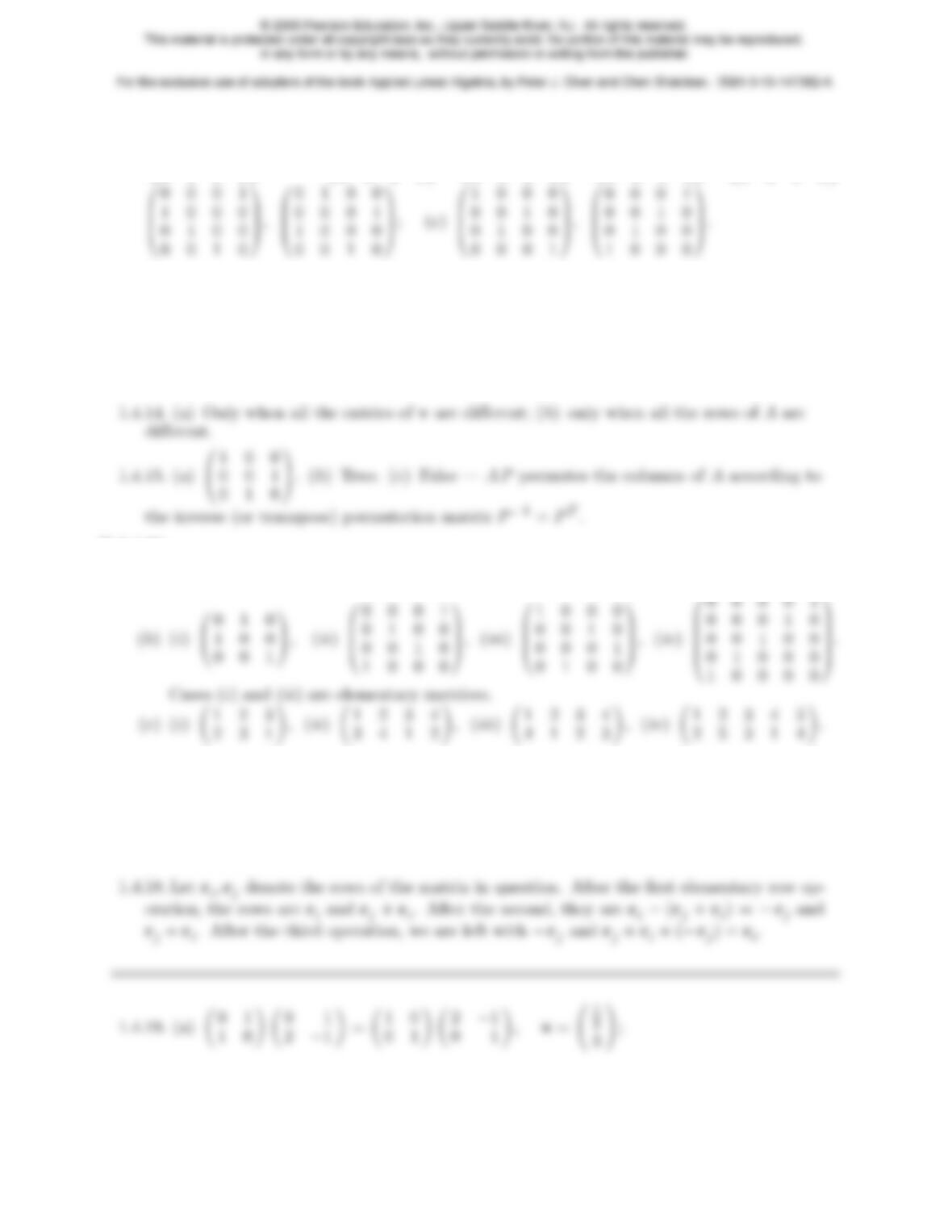
0
B
B
B
@
1 0 0 0
0 0 0 1
0 0 1 0
0 1 0 0
1
C
C
C
A; (b)0
B
B
B
@
0 1 0 0
1 0 0 0
0 0 0 1
0 0 1 0
1
C
C
C
A,0
B
B
B
@
1 0 0 0
0 0 0 1
0 1 0 0
0 0 1 0
1
C
C
C
A,0
B
B
B
@
0 0 0 1
0 1 0 0
1 0 0 0
0 0 1 0
1
C
C
C
A,0
B
B
B
@
1 0 0 0
0 1 0 0
0 0 0 1
0 0 1 0
1
C
C
C
A,
1.4.13. (a) True, since interchanging the same pair of rows twice brings you back to where
you started. (b) False; an example is the non-elementary permuation matrix 0
B
@
0 0 1
1 0 0
0 1 0 1
C
A.
(c) False; for example P= −1 0
0−1!is not a permutation matrix. For a complete list of
such matrices, see Exercise 1.2.36.
♥1.4.16.
(a) If Phas a 1 in position (π(j), j), then it moves row jof Ato row π(j) of P A, which is
enough to establish the correspondence.
1
♦1.4.17. The first row of an n×npermutation matrix can have the 1 in any of the npositions, so
there are npossibilities for the first row. Once the first row is set, the second row can have
its 1 anywhere except in the column under the 1 in the first row, and so there are n−1
possibilities. The 1 in the third row can be in any of the n−2 positions not under either of
the previous two 1’s. And so on, leading to a total of n(n−1)(n−2) · · · 2·1 = n! possible
permutation matrices.
14
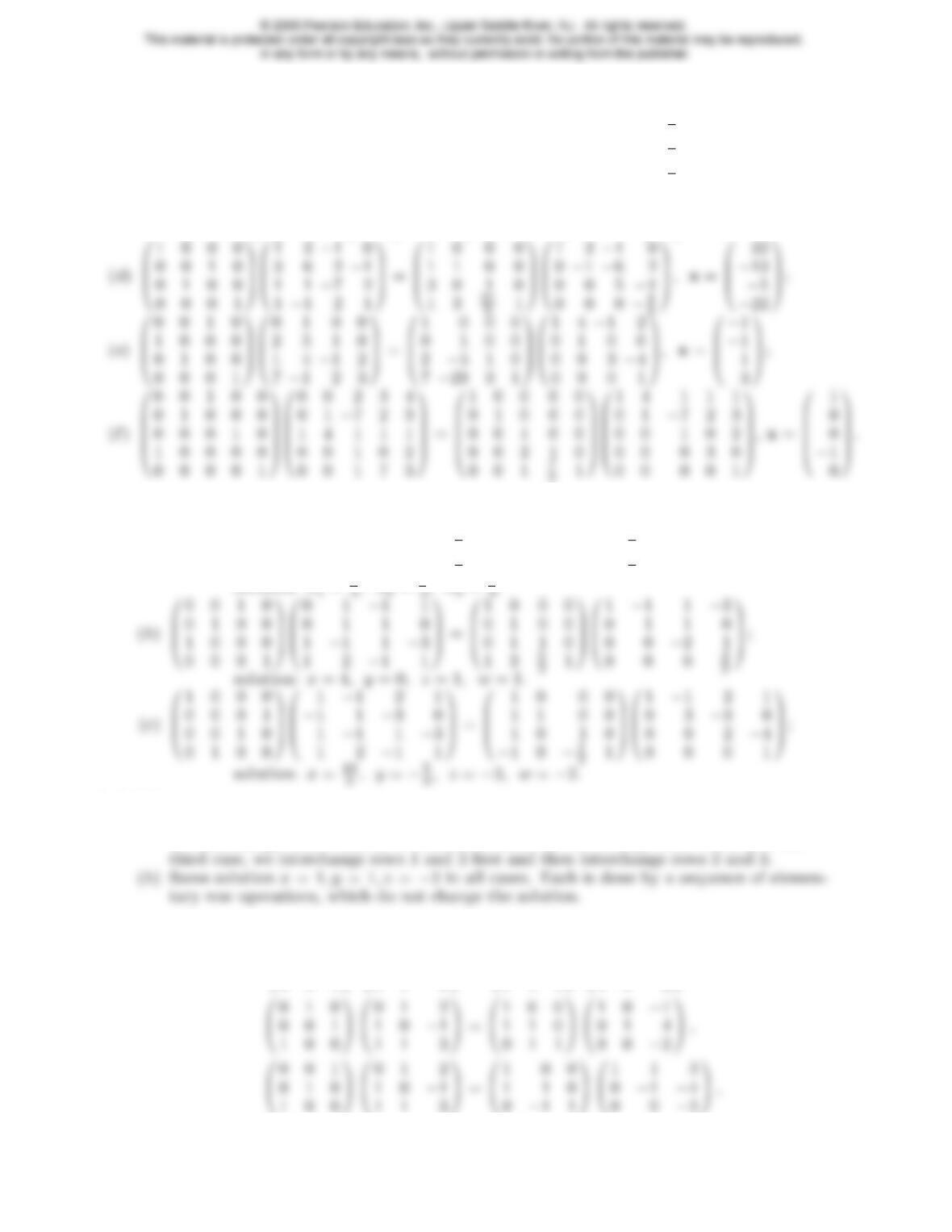
(b)0
B
@
0 1 0
001
1 0 0 1
C
A0
B
@
0 0 −4
1 2 3
0 1 7 1
C
A=0
B
@
1 0 0
0 1 0
0 0 1 1
C
A0
B
@
1 2 3
0 1 7
0 0 −41
C
A,x=0
B
B
B
@
5
4
3
4
−1
4
1
C
C
C
A;
(c)0
B
@
0 0 1
1 0 0
0 1 0 1
C
A0
B
@
0 1 −3
0 2 3
1 0 2 1
C
A=0
B
@
100
0 1 0
0211
C
A0
B
@
1 0 2
0 1 −3
0 0 9 1
C
A,x=0
B
@
−1
1
01
C
A;
1.4.20.
(a)0
B
@
100
0 0 1
0101
C
A0
B
@
4−4 2
−3 3 1
−3 1 −21
C
A=0
B
B
@
1 0 0
−3
41 0
−3
40 1
1
C
C
A0
B
B
@
4−4 2
0−2−1
2
0 0 5
2
1
C
C
A;
solution: x1=5
♦1.4.21.
(a) They are all of the form P A =LU, where Pis a permutation matrix. In the first case,
we interchange rows 1 and 2, in the second case, we interchange rows 1 and 3, in the
1.4.22. There are four in all:
0
B
@
0 1 0
100
0 0 1 1
C
A0
B
@
0 1 2
1 0 −1
1 1 3 1
C
A=0
B
@
1 0 0
0 1 0
1 1 1 1
C
A0
B
@
1 0 −1
0 1 2
0 0 2 1
C
A,
15
For the exclusive use of adopters of the book Applied Linear Algebra, by Peter J. Olver and Cheri Shakiban. ISBN 0-13-147382-4.
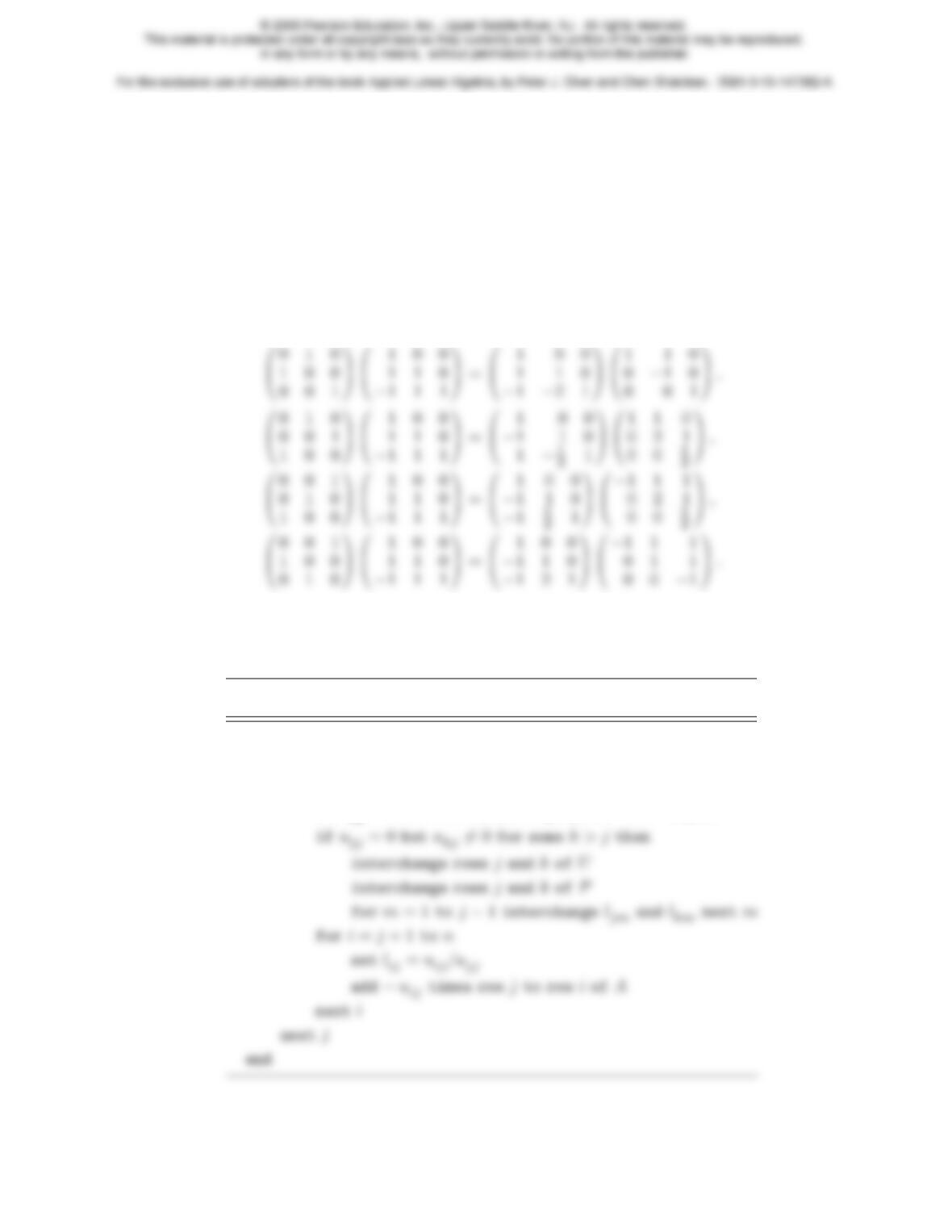
0
B
@
0 0 1
1 0 0
0 1 0 1
C
A0
B
@
0 1 2
1 0 −1
1 1 3 1
C
A=0
B
@
1 0 0
0 1 0
1−1 1 1
C
A0
B
@
1 1 3
0 1 2
0 0 −21
C
A.
The other two permutation matrices are not regular.
1.4.23. The maximum is 6 since there are 6 different 3 ×3 permutation matrices. For example,
0
B
@
1 0 0
1 1 0
−1 1 1 1
C
A=0
B
@
100
1 1 0
−1111
C
A0
B
@
1 0 0
010
0 0 1 1
C
A,
0
B
@
100
0 0 1
0101
C
A0
B
@
100
1 1 0
−1111
C
A=0
B
@
100
−1 1 0
1111
C
A0
B
@
1 0 0
0 1 1
0 0 −11
C
A,
1.4.24. False. Changing the permuation matrix typically changes the pivots.
♠1.4.25.
Permuted LU factorization
start
set P= I ,L= I ,U=A
for j= 1 to n
if ukj = 0 for all k≥j, stop; print “Ais singular”
16
1.5.1.
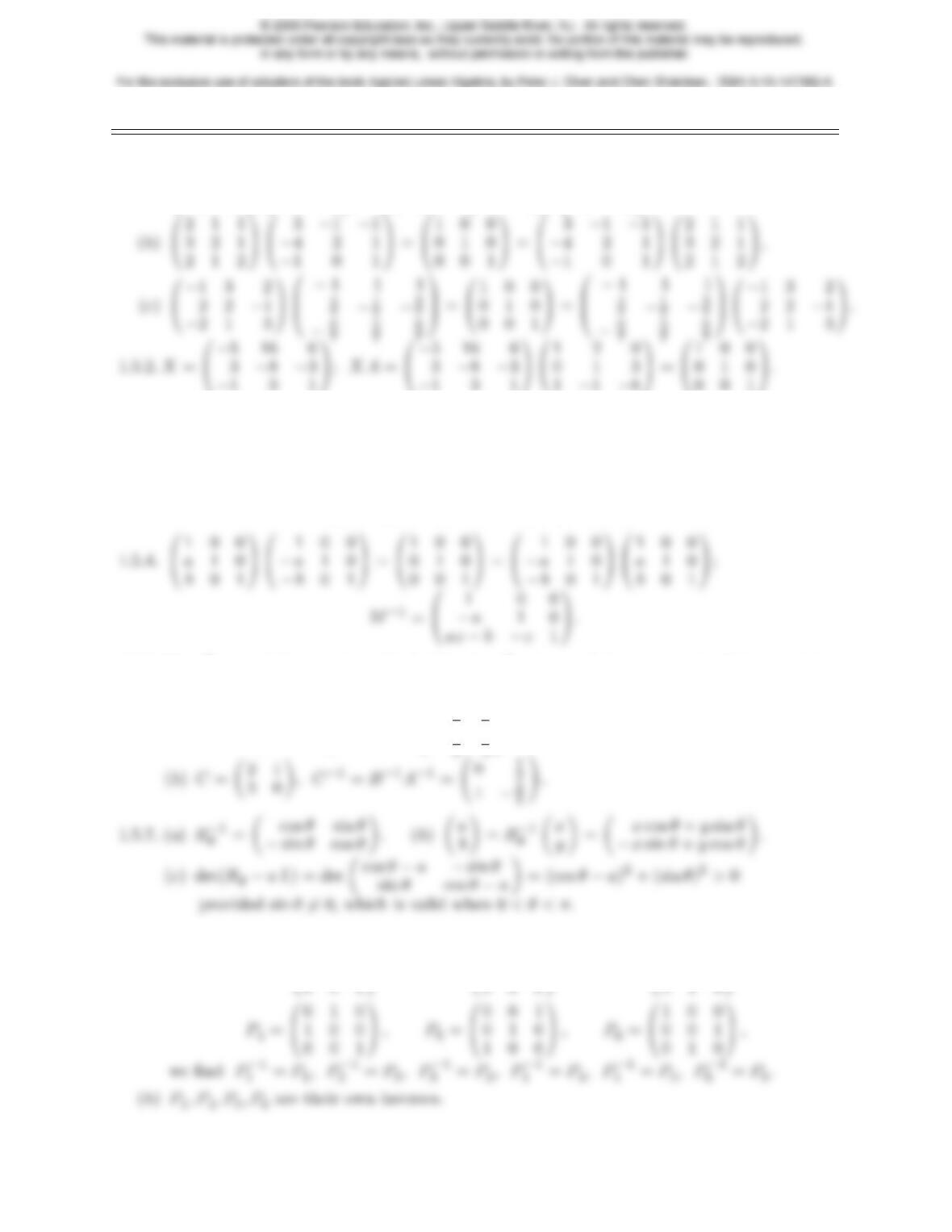
(a) 2 3
−1−1! −1−3
1 2 != 1 0
0 1 != −1−3
1 2 ! 2 3
−1−1!,
1.5.3. (a) 0 1
1 0 !, (b) 1 0
−5 1 !, (c) 1 2
0 1 !,
(d)0
B
@
1 0 0
013
0 0 1 1
C
A, (e)0
B
B
B
@
1 0 0 0
0 1 0 0
0−6 1 0
0 0 0 1
1
C
C
C
A, (f)0
B
B
B
@
0 0 0 1
0 1 0 0
0 0 1 0
1 0 0 0
1
C
C
C
A.
1.5.5. The ith row of the matrix multiplied by the ith column of the inverse should be equal 1.
This is not possible if all the entries of the ith row are zero; see Exercise 1.2.24.
1.5.6. (a)A−1= −1 1
2−1!,B−1=0
@
2
3
1
3
−1
1
A.
1.5.8.
(a) Setting P1=0
B
@
100
0 1 0
C
A, P2=0
B
@
0 1 0
001
C
A, P3=0
B
@
001
1 0 0
C
A,
17
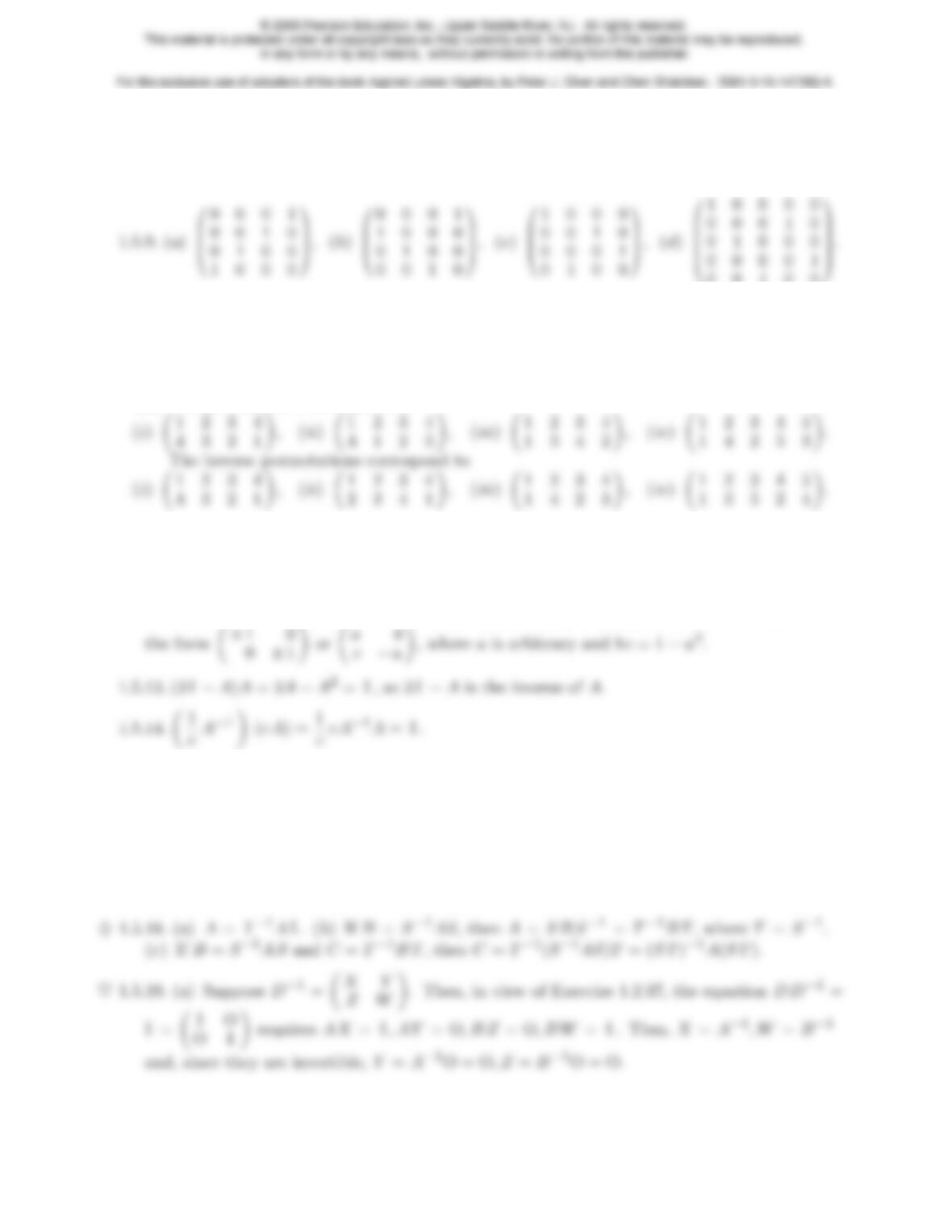
(c) Yes: P=0
B
B
B
@
0 1 0 0
1 0 0 0
0 0 0 1
0 0 1 0
1
C
C
C
Ainterchanges two pairs of rows.
0 0 1 0 0
1.5.10.
(a) If iand j=π(i) are the entries in the ith column of the 2 ×nmatrix corresponding to
the permutation, then the entries in the jth column of the 2 ×nmatrix corresponding to
the permutation are jand i=π−1(j). Equivalently, permute the columns so that the
second row is in order 1,2,…,n and then switch the two rows.
(b) The permutations correspond to
1.5.11. If a= 0 the first row is all zeros, and so Ais singular. Otherwise, we make d→0 by
an elementary row operation. If e= 0 then the resulting matrix has a row of all zeros.
Otherwise, we make h→0 by another elementary row operation, and the result is a matrix
with a row of all zeros.
1.5.12. This is true if and only if A2= I , and so, according to Exercise 1.2.36, Ais either of
1.5.15. Indeed, (An)−1= (A−1)n.
1.5.16. If all the diagonal entries are nonzero, then D−1D= I . On the other hand, if one of
diagonal entries is zero, then all the entries in that row are zero, and so Dis not invertible.
1.5.17. Since U−1is also upper triangular, the only nonzero summand in the product of the ith
row of Uand the ith column of U−1is the product of their diagonal entries, which must
equal 1 since U U−1= I .
18
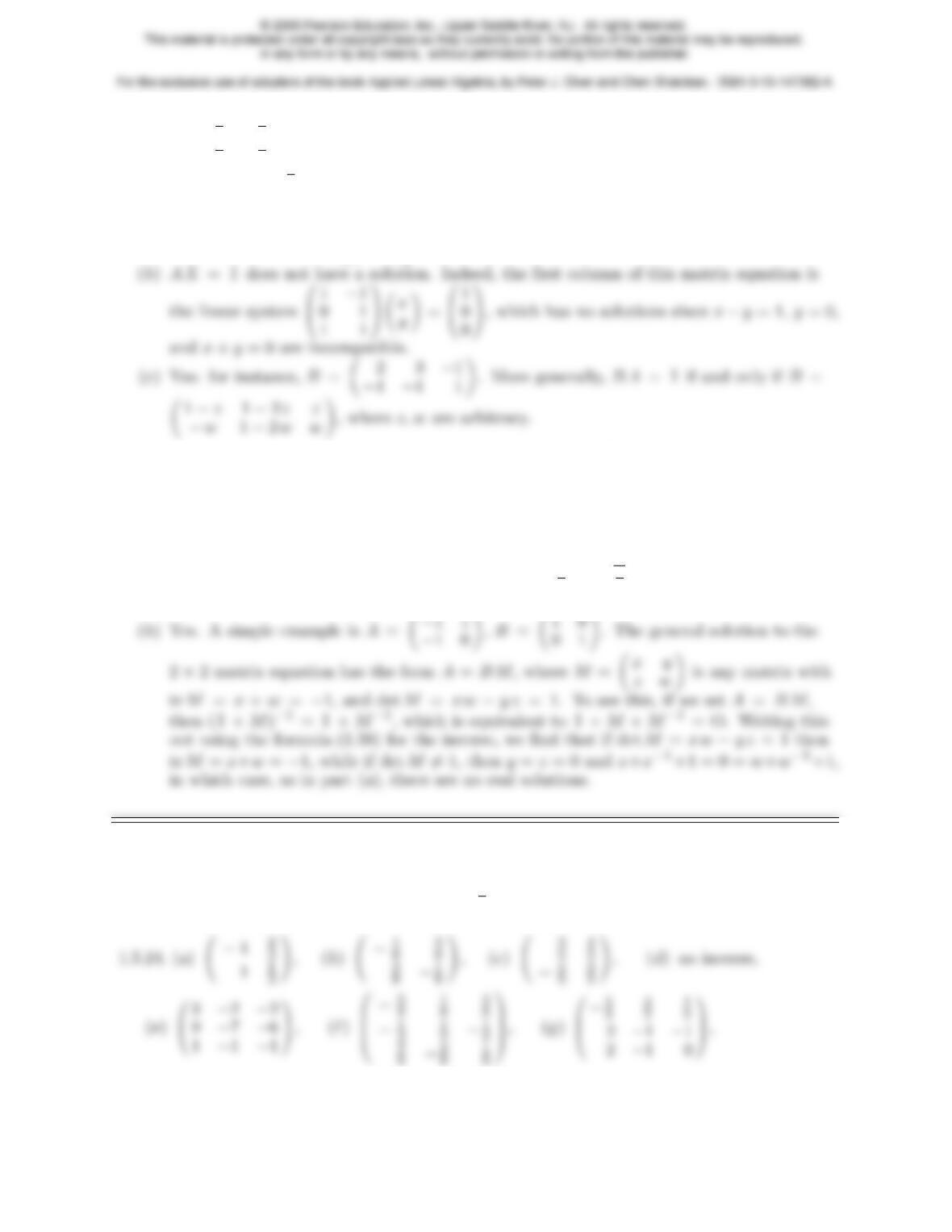
(b)0
B
B
B
@
−1
3
2
30
2
3−1
30
0 0 1
3
1
C
C
C
A,0
B
B
B
@
−1 1 0 0
−2 1 0 0
0 0 −5 3
0 0 2 −1
1
C
C
C
A.
1.5.20.
(a)B A = 1 1 0
−1−1 1 !0
B
@
1−1
0 1
1 1 1
C
A= 1 0
0 1 !.
1.5.21. The general solution to AX = I is X=0
B
@
−2y1−2v
y v
−1 1 1
C
A, where y, v are arbitrary.
Any of these matrices serves as a right inverse. On the other hand, the linear system
Y A = I is incompatible and there is no solution.
1.5.22.
(a) No. The only solutions are complex, with a=„−1
2±iq2
3«b, where b6= 0 is any
nonzero complex number.
1.5.23. E=0
B
B
B
@
1 0 0 0
0 1 0 0
0 0 7 0
0 0 0 1
1
C
C
C
A, E−1=0
B
B
B
@
1 0 0 0
0 1 0 0
0 0 1
70
0 0 0 1
1
C
C
C
A.
19
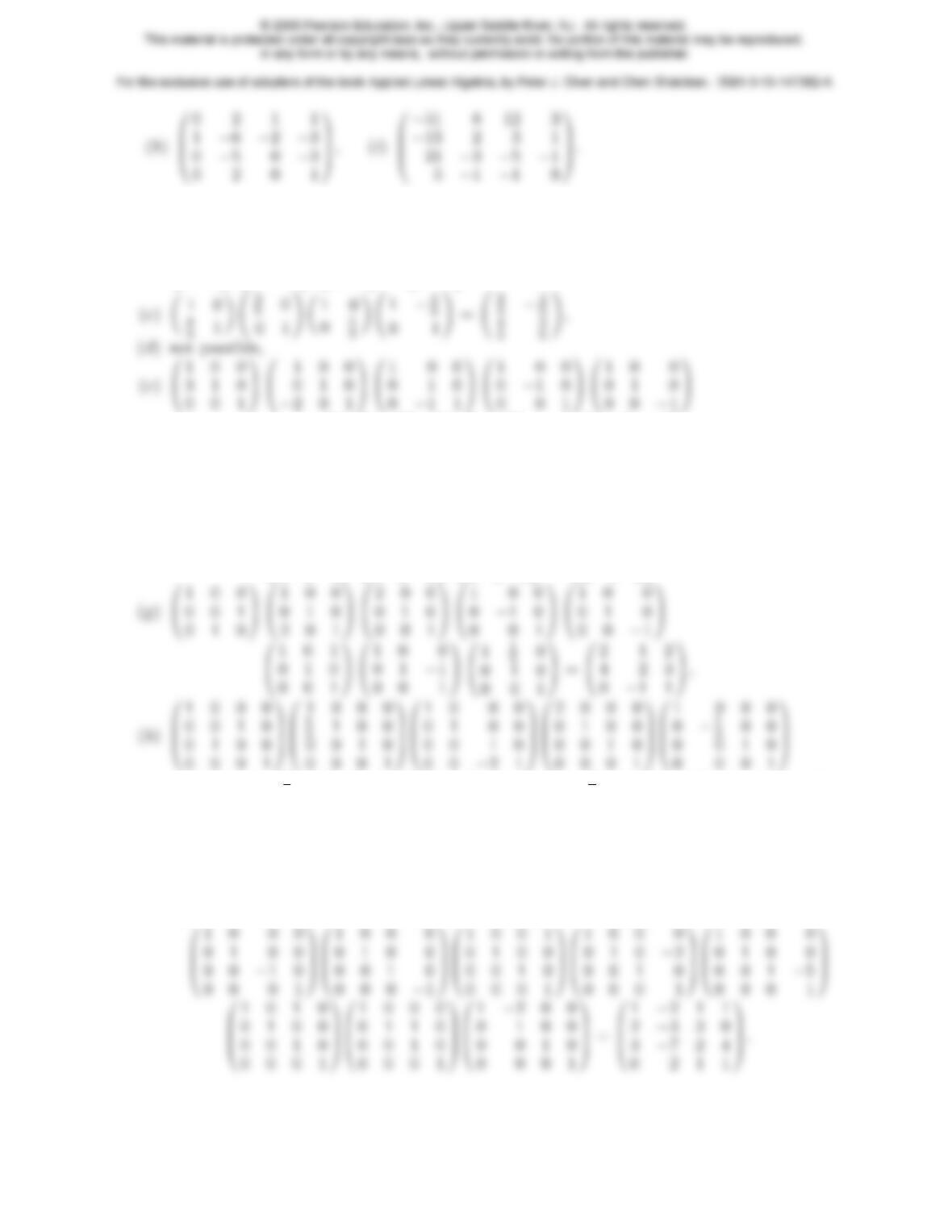
1.5.25.
(a) 1 0
3 1 ! 1 0
0 3 ! 1−2
0 1 != 1−2
3−3!,
(b) 1 0
3 1 ! 1 0
0−8! 1 3
0 1 != 1 3
3 1 !,
0
B
@
1 0 −2
0 1 0
0 0 1 1
C
A0
B
@
1 0 0
0 1 −6
0 0 1 1
C
A=0
B
@
1 0 −2
3−1 0
−2 1 −31
C
A,
(f)0
B
@
1 0 0
3 1 0
0 0 1 1
C
A0
B
@
1 0 0
0 1 0
2 0 1 1
C
A0
B
@
100
0 1 0
0311
C
A0
B
@
1 0 0
0−1 0
0 0 1 1
C
A0
B
@
1 0 0
010
0 0 8 1
C
A
0
B
@
1 0 3
010
0 0 1 1
C
A0
B
@
100
0 1 4
0 0 1 1
C
A0
B
@
1 2 0
0 1 0
0 0 1 1
C
A=0
B
@
1 2 3
355
2 1 2 1
C
A,
0
B
B
B
@
1 0 0 1
2
0 1 0 0
0 0 1 0
0 0 0 1
1
C
C
C
A0
B
B
B
@
1 0 0 0
0 1 0 3
0 0 1 0
0 0 0 1
1
C
C
C
A0
B
B
B
@
1 0 0 0
0 1 0 0
0 0 1 3
0 0 0 1
1
C
C
C
A0
B
B
B
@
11
20 0
0 1 0 0
0 0 1 0
0 0 0 1
1
C
C
C
A=0
B
B
B
@
2 1 0 1
0 0 1 3
1 0 0 −1
0 0 −2−5
1
C
C
C
A,
(i)0
B
B
B
@
1 0 0 0
0 1 0 0
0 0 0 1
0 0 1 0
1
C
C
C
A0
B
B
B
@
1 0 0 0
2 1 0 0
0 0 1 0
0 0 0 1
1
C
C
C
A0
B
B
B
@
1 0 0 0
0 1 0 0
0 0 1 0
3 0 0 1
1
C
C
C
A0
B
B
B
@
1 0 0 0
0 1 0 0
0 2 1 0
0 0 0 1
1
C
C
C
A0
B
B
B
@
1 0 0 0
0 1 0 0
0 0 1 0
0−1 0 1
1
C
C
C
A
20