Typical Syllabi with Instructor Notes
Introduction to Business-to-Business Marketing
Different semester/quarter schedules necessitate some selectivity of materials from
Business-to-Business Marketing: Analysis and Practice
(BtBMAP). Below is a
standardized syllabus based on a 16-week schedule as well as a typical 16-week
schedule, a 12-week, 3 class meetings per week schedule and a 12-week, 2 class
Typical 16-Week Syllabus
Bus 131A – Business to Business Marketing
Tuesday & Thursday, BBC 320
(Note that general items that are required by San Jose State University policy have been removed for
clarity.)
Instructor Information
Course Objectives:
Business-to-Business Marketing requires recognition of the needs of a complex customer organization,
knowledge of how to approach this complexity and creation of an organization that supports this effort.
In this course we will examine the nature of business–to-business markets, the organizational buying
process, and strategic alternatives to approach these markets. The theoretical approach will be
developed and contrasted to practical viewpoints and applications.
Typical Syllabi with Instructor Notes 2
Course Requirements & Grading Criteria
1. Two exams, 100 points each
200 points
29%
3. Final exam: Note that this is a comprehensive exam.
150 points
21%
class activities.
2. Case Study Assignments. There will be three written case assignments during
TOTAL POSSIBLE POINTS
700
100
%
Case Study Assignments
All written cases are group efforts and must include an Executive Summary followed by a Table of
Contents. The 1st case length should not exceed 5 pages, the 2nd – 7 pages, and the 3rd – 8 pages. The
Grading Standards: The tests and assignments in this course are designed to be administered with a
“curved” grading process. Grades are, to some extent, dependent on the overall performance of the
Policy on Professionalism, Participation and Class Conduct
You are expected to conform to generally accepted notions of professionalism typical of the business
world. The following is an illustrative list of items to which you explicitly agree upon remaining enrolled
in the course. Failure to conform can be grounds for appropriate action, including but not limited to
expulsion from the classroom and an “F”in the course.
Electronic Devices: Turn off all electronic devices (headsets, MP3 players, pagers, cell phones, etc.),
before entering class. If a pager, cell phone, or other such device goes off during class the class may
Academic Integrity: Faculty make every reasonable effort to foster honest academic conduct, secure
exams and their answers so that students cannot have prior access to them, and proctor examinations
Typical Syllabi with Instructor Notes 3
Assignments: Class Discussion: You are expected to have read and be prepared, on the date
Writing Format: (Note that format will be graded!) All written assignments, unless otherwise
indicated, must comply with the following guidelines:
$ Written case assignments that do not follow the noted format may not be accepted for credit or may
be subject to at least a one-letter grade penalty.
$ Unless otherwise noted, electronic copies of assignments are NOT acceptable.
Additional Information:
$ Use ink for all in-class writings and essay exams.
$ There are no makeups for quizzes, papers or other class exercises.
$ Cases and other assignments are due when collected in class on the date indicated. A late
Exams:
$ During exams, if you have a need to leave the room, you must hand in your exam before leaving.
That will conclude your exam session.
Final Exam: Must be taken on the day assigned. Note the date and time of the final exam now–avoid
early holiday departures that may conflict with the schedule.
Prerequisites and grade regulations:
Prerequisites will be enforced. Grade regulations (A, B, C, D, F, I, W, WU) are as described in the
Typical Syllabi with Instructor Notes 4
Comments Regarding the Syllabus Above:
This syllabus is somewhat conventional with two possible exceptions:
• Grading is Curved
This latitude is provided because business-to-business marketing is often
culturally “foreign’ to many students. Additionally, at San Jose State
Comments & Suggestions Regarding the 16-week Schedule–Below
Weeks 1 & 2:
Combined with administrative items, Chapter 1 usually takes two class sessions. The
Week 3:
Our experience is that most Business Law courses do not cover antitrust and pricing,
Weeks 4 & 5:
Business strategy (“resource allocation”) is emphasized in our course. The linkages
Weeks 6 & 7:
Our experience has been primarily with essay exams. A typical exam will consist of six
Typical Syllabi with Instructor Notes 5
©2011 Pearson Education, Inc. publishing as Prentice Hall Business-to-Business Marketing
Weeks 8 – 10:
Ample time is provided to complete integration of product development and
Weeks 11 & 12:
You may find some of the material in Chapter 11 more suitable for graduate classes.
Weeks 13 – 15:
Chapters 12 and 14 and Chapters 13 and 15 contain many common themes and are
Week 15 – End:
The schedule flexibility offered by the topics covered in weeks 13 to 15 assist in the
avoidance of running out of time before Business Ethics can be discussed.
Typical Syllabi with Instructor Notes 6
Final Exam:
Our final exam is a “generally” cumulative exam. By that we mean, without an
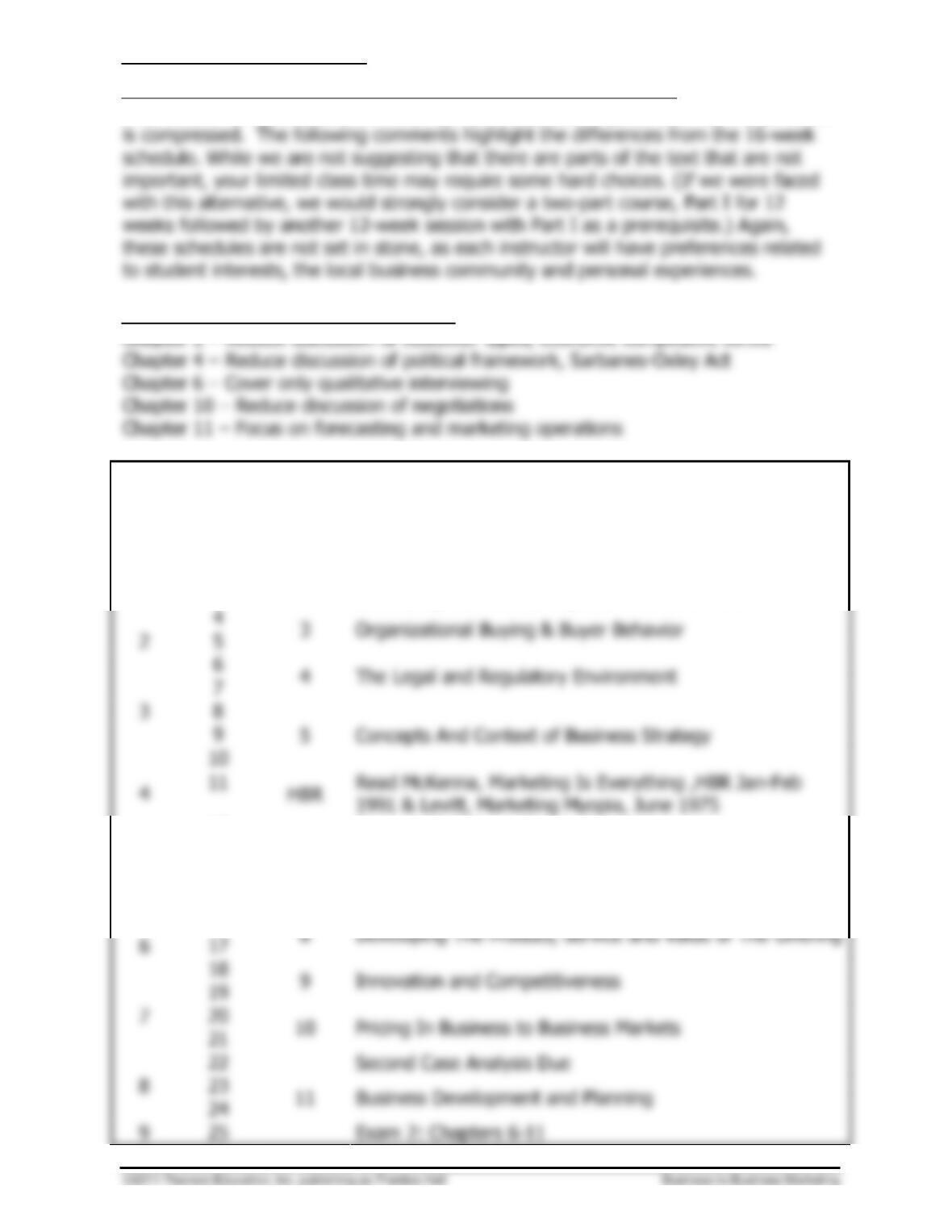
Typical 16-Week Schedule
16 Chapters, Three Case Analyses, Two Exams plus Final Exam
Week
Class
Chapter
Topics, Cases and Reading Assignments
1
1
1
Introduction to Business-to-Business Marketing
2
2
3
2
Classifying Customers, Organizations and Markets
4
3
Organizational Buying & Buyer Behavior
3
6
4
7
5
Concepts And Context of Business Strategy
8
5
9
10
11
Exam 1: Chapters 1-5
12
6
Market Research and Competitive Analysis
7
13
First Case Analysis Due
14
7
Segmenting, Targeting and Positioning
5
4
The Legal and Regulatory Environment
8
15
8
Developing The Product, Service and Value of The Offering
16
9
17
9
Innovation and Competitiveness
18
19
Pricing In Business to Business Markets
20
Second Case Analysis Due
21
Business Development and Planning
22
23
Exam 2: Chapters 6-11
24
Business To Business Selling
25
26
Business To Business Branding
27
Channel Relationships and Supply Chains
28
Third Case Analysis Due
29
Communicating With The Market
Final Exam
Typical Syllabi with Instructor Notes 7
Comments & Suggestions Regarding the 12-week Schedules–Below
The number of class sessions in each 12-week schedule impacts the way the schedule
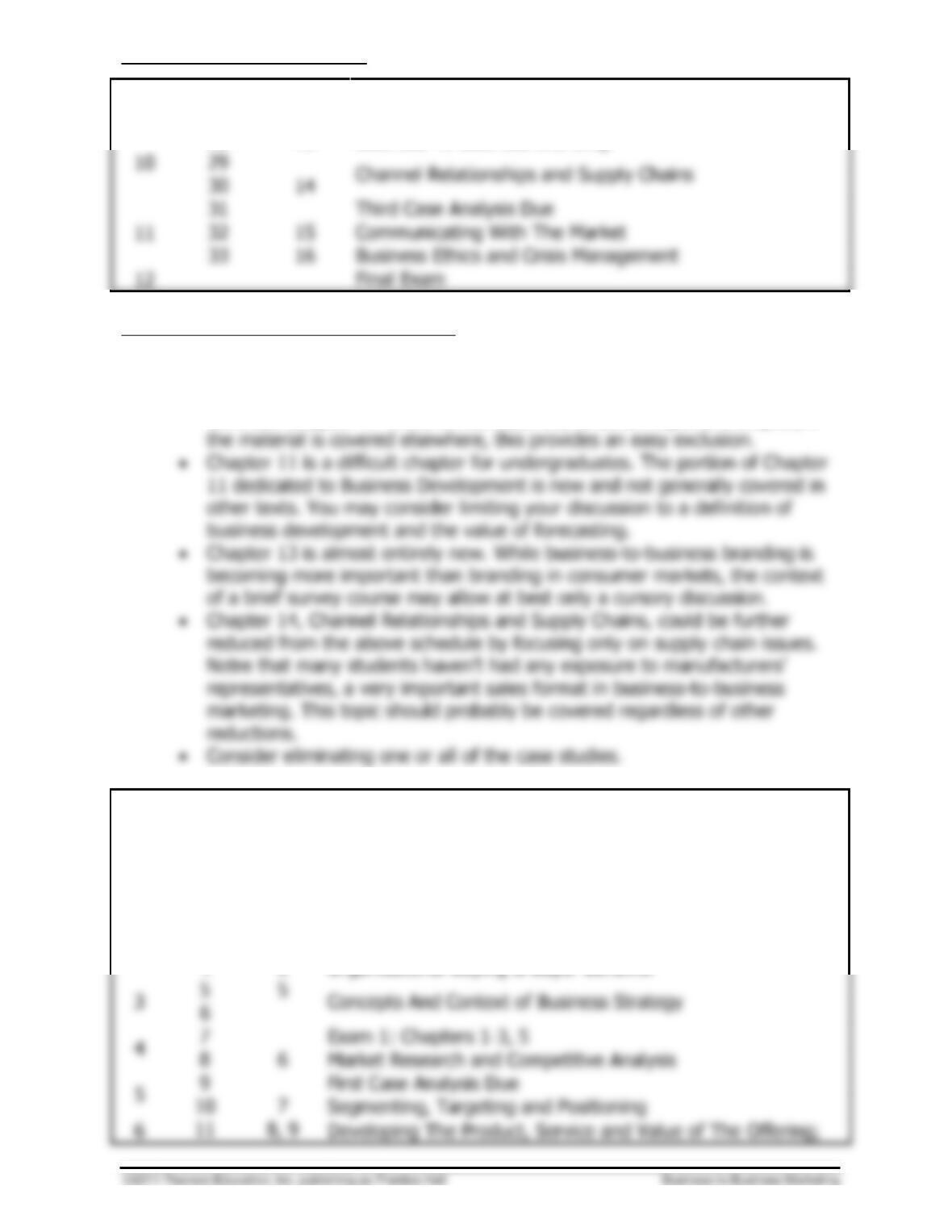
12-Week, 3 Class Meetings/Week–Below
Typical 12-Week Schedule, 3 Class Meetings/Week
16 Chapters, Three Case Analyses, Two Exams plus Final Exam
Week
Class
Chapter
Topics, Cases and Reading Assignments
1
1
1
Introduction to Business-to-Business Marketing
2
3
2
Classifying Customers, Organizations and Markets
2
4
5
6
4
The Legal and Regulatory Environment
3
7
8
9
12
Exam 1: Chapters 1-5
5
13
6
Market Research and Competitive Analysis
14
First Case Analysis Due
15
7
Segmenting, Targeting and Positioning
6
8
17
18
9
7
19
20
21
8
22
23
24
25
16
Typical Syllabi with Instructor Notes 8
26
12
Business To Business Selling
27
29
30
31
Third Case Analysis Due
32
15
Communicating With The Market
33
16
Business Ethics and Crisis Management
Final Exam
28
13
Business To Business Branding
12-Week, 2 Class Meetings/Week–Below
Consider the following reductions:
• If your students have access to a Marketing Law course, or your program of
study covers pricing and antitrust regulations in another course, you may
eliminate Chapter 4. While we consider this to be an important chapter, if
Typical 12-Week Schedule – 2 Class Meetings/Week
14 Chapters, Three Case Analyses, Two Exams plus Final Exam
Wee
k
Class
Chapte
r
Topics, Cases and Reading Assignments
1
1
1
Introduction to Business-to-Business Marketing
2
2
3
2
Classifying Customers, Organizations and Markets
4
3
Organizational Buying & Buyer Behavior
3
5
Concepts And Context of Business Strategy
6
4
7
Exam 1: Chapters 1-3, 5
8
6
Market Research and Competitive Analysis
5
9
First Case Analysis Due
7
Segmenting, Targeting and Positioning
Typical Syllabi with Instructor Notes 9
12
Innovation and Competitiveness
7
13
14
10
Pricing In Business to Business Markets
8
15
11
Second Case Analysis Due
16
Business Development and Planning – portion
9
17
Exam 2: Chapters 6-11
18
12
Business To Business Selling – portion
19
14
20
15
21
22