Case-Oriented Syllabus
Vietnam: Market
Entry Decisions
597020
13p
TN 598081
Vietnam,
adhesives/athletic
footwear/toys,
1996
Three U.S. multinationals must decide
whether to enter the Vietnam market and,
if so, how.
15p
TN 598086
consumer
products, 1996
is reviewing his 1996 marketing plan and
considering whether the pace of market
development and mix of product sales can
be impacted by the level and type of
Gillette expenditures in the market.
Market Entry
Chapter 22: Managing a Holistic
Marketing Organization
WingspanBank.
com (A)
600035
21p
Wilmington, DE,
financial services,
1999
One’s First USA division.
Wells Fargo
Online Financial
Services (A)
198146
18p
TN 199058
California,
banking, 1997
Describes how Wells Fargo, the industry
leader in electronic banking, implemented
a Balanced Scorecard in its online
financial services (OFS) group to track
and measure performance.
employees, 1997
how the marketing department can most
effectively and efficiently help the
company maintain its competitive edge in
an increasingly competitive and complex
market.
Describes the new product development
process for WingspanBank.com, an
Internet-only financial services
infomediary created by a team from Bank
Cunard Line Ltd.:
Managing
Integrated
Marketing
Communications
594046
25p
TN 595028
U.S., cruise lines,
1992
Cunard, the world’s oldest luxury line
company, is confronted with several key
issues involving its marketing and
marketing communications strategy. One
concerns the balance between
image/positioning advertising and short-
term promotional
advertising/communications on behalf of
each Cunard ship (i.e., pull vs. push
communications). Related to this is the

Case-Oriented Syllabus
overall mix of marketing communications
tools used by Cunard—media advertising,
direct marketing, etc.

Case-Oriented Syllabus
MARKETING MANAGEMENT
FALL SEMESTER
Instructor:
Email: Web Site:
Campus:
OFFICE HOURS
Or by Appointment at Either Location
Course Credits: 3 (Three)
Class:
REQUIRED MATERIALS
Marketing Management, 14th edition, by Kotler/Keller, Prentice-Hall 2012, ISBN 0-13-
600998-0 and The Marketing Plan Handbook with Marketing Plan Pro, by Wood, Prentice-
Hall 2008, 0-13-513628-8.
COURSE PREREQUISITES:
COURSE DESCRIPTION
The characteristics and management of markets are described in topics that include the
COURSE PERSPECTIVE
The course focuses on formulating and implementing marketing management strategies and
policies, a task undertaken in most companies at the strategic business unit level. The marketing
Case-Oriented Syllabus
Accordingly, the course emphasizes the following:
• Primary and changing perspectives on marketing management in the New Economy.
The course is intended for:
• Marketing concentration students who wish to deepen their understanding of marketing
management in a strategy-planning context.
COURSE GOALS
To further disseminate and develop the knowledge and skills in the essential aspects of
marketing management, marketing strategy, and emerging New Economy marketing
applications, with a focus on the development and execution of programs, audits, and plans.
COURSE OBJECTIVES
This course is concerned with the development, evaluation, and implementation of marketing
management in complex environments. The course deals primarily with an in-depth analysis of a
variety of concepts, theories, facts, analytical procedures, techniques, and models. The course
addresses strategic issues such as:
• What business should we be in?
• What are our long-term objectives?
Case-Oriented Syllabus
throughout this course especially those principles that you have learned in Marketing MAR
XXX.
LEARNING OBJECTIVES
To become familiar with the range of decisions implicit in strategic marketing management and
planning. In addition, to develop skill in using a variety of analytical frameworks for making
such decisions. To develop an understanding of how markets contrast in terms of:
COURSE STRUCTURE
Semester-Long Marketing Plan Project
An effective way to help students learn about marketing management is the actual creation of a
marketing plan for a product or service. This project is designed to accomplish such a task.
Chapter Material Exams
In addition to the semester long marketing plan project, we will have two exams (see schedule).
Students are responsible for all of the material covered from the textbook, lectures, outside
speakers, and any videos/DVDs shown.
Case-Oriented Syllabus
METHOD OF INSTRUCTION
The course is highly interactive between the class and the instructor. Through case
studies/presentations, problems, and specific company client activities, students will have the
opportunity to use the concepts, ideas, and strategies presented in class. Problem-solving
sessions occur in both individual (primarily) and team (occasionally) settings.
Note that occasionally, changes in the schedule of the course, or in the assignments, are
announced during class. It is your responsibility to ensure that you have received all of the
changes and you will still be responsible for this information.
EVALUATION
Evaluation will be based on two examinations, the submission of all of the marketing plan
material and your final group oral and written presentation. Exams # 2 and # 3 (the final exam)
will consist of: 50–75 multiple choice, true/false, and short-answer questions. You will need a
Brown Scantron and a University ID card or driver’s license.
The weightings for the individual components are as follows:
1) Exam # 2 @ 100 points 100 points
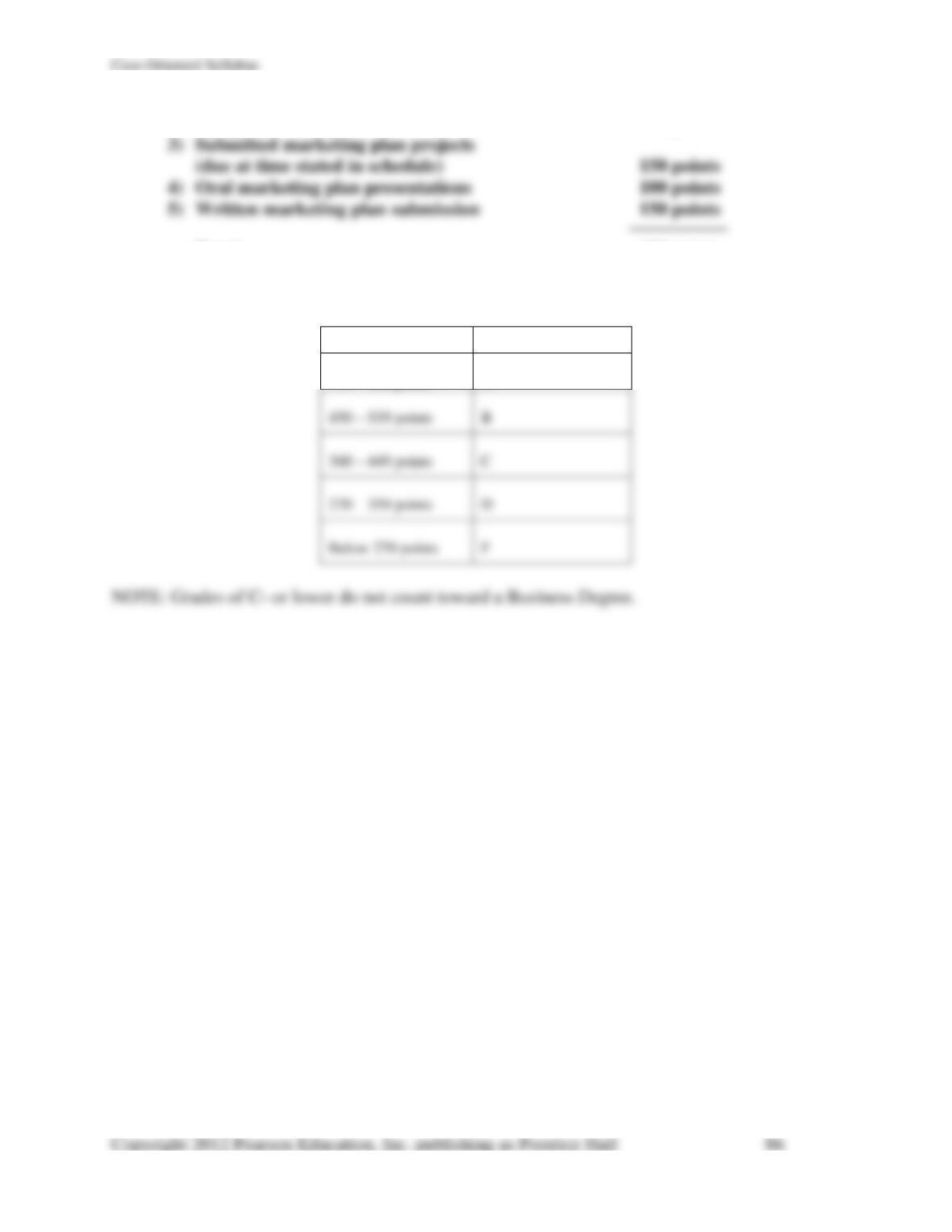
2) Exam # 3 @ 100 points 100 points
Total: 600 points
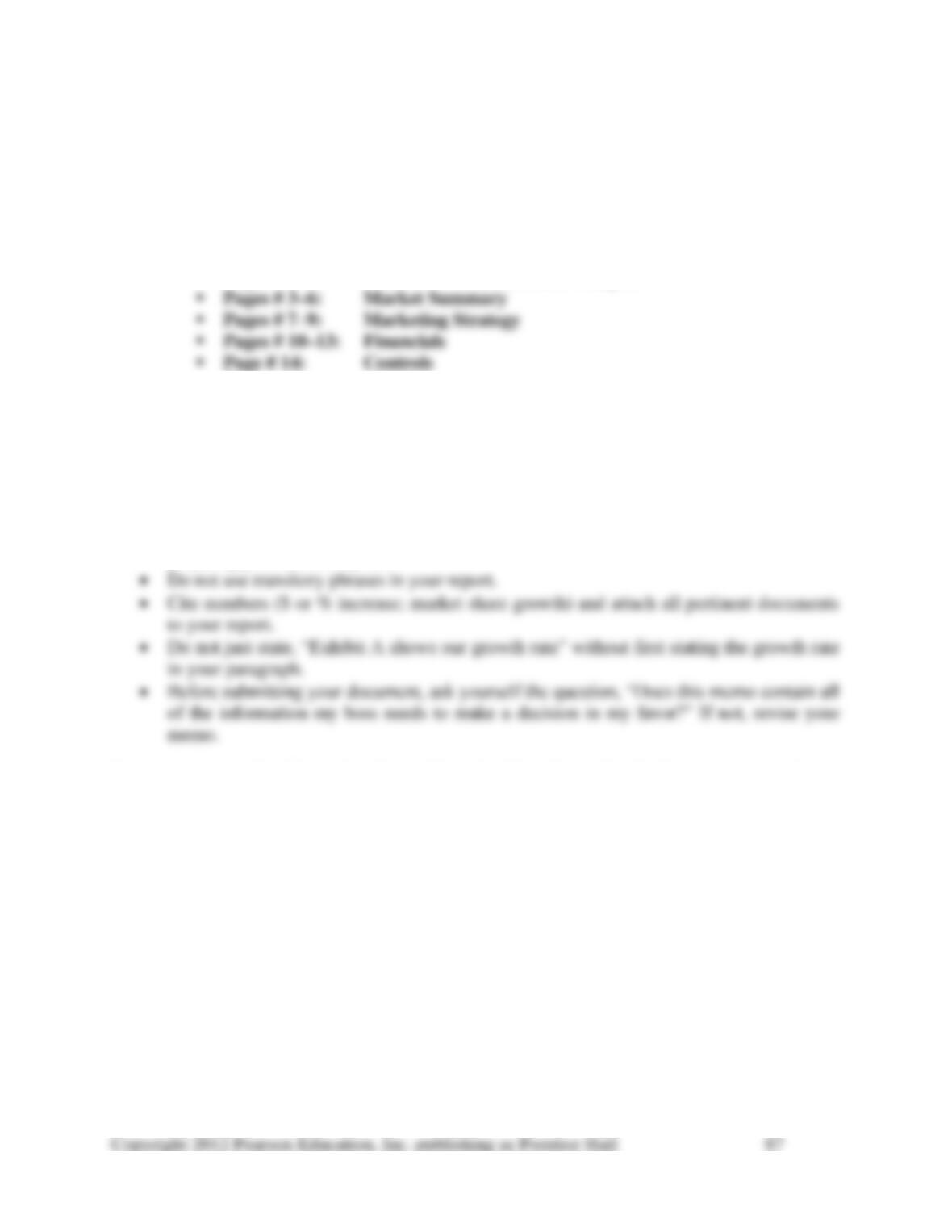
Grading for this course is as follows:
Numerical Grade
Letter Equivalent
540 – 600 points
A
Case-Oriented Syllabus
MARKETING PLAN PRESENTATION’S WRITTEN FORMAT
Your marketing plan is to be submitted using Marketing Plan Pro’s format and all exhibits and
spreadsheet reports, double-spaced, with 1-inch margins on all sides of the paper, using 12 point
Times New Roman font. This written report is worth 150 points.
▪ Page # 1: Executive Cover Memo
▪ Pages # 2–4: Situation Assessment and Analysis
There is no limit as to the number of pages to be submitted; completeness of your
marketing plan is what is important for your overall grade.
Some “hints” to use in writing an Executive Cover Memo:
• Do not use terms such as “increase,” “decrease,” implement as soon as possible,” and
other non-specific and non-analytical language; use very specific language when
preparing your case analyses.
See the example of an Executive Cover Memo in this syllabus for the format to be used.
Case-Oriented Syllabus
Executive Cover Memo Format (1 Page Limit)
To:
From: (list your name and/or the names of all members of your student group. Initial in pen)
Subject: (list the case name)
Date: (class date)
(Your wording for each of these sections will vary according to the case but you must use these
headings and a limit of one page.)
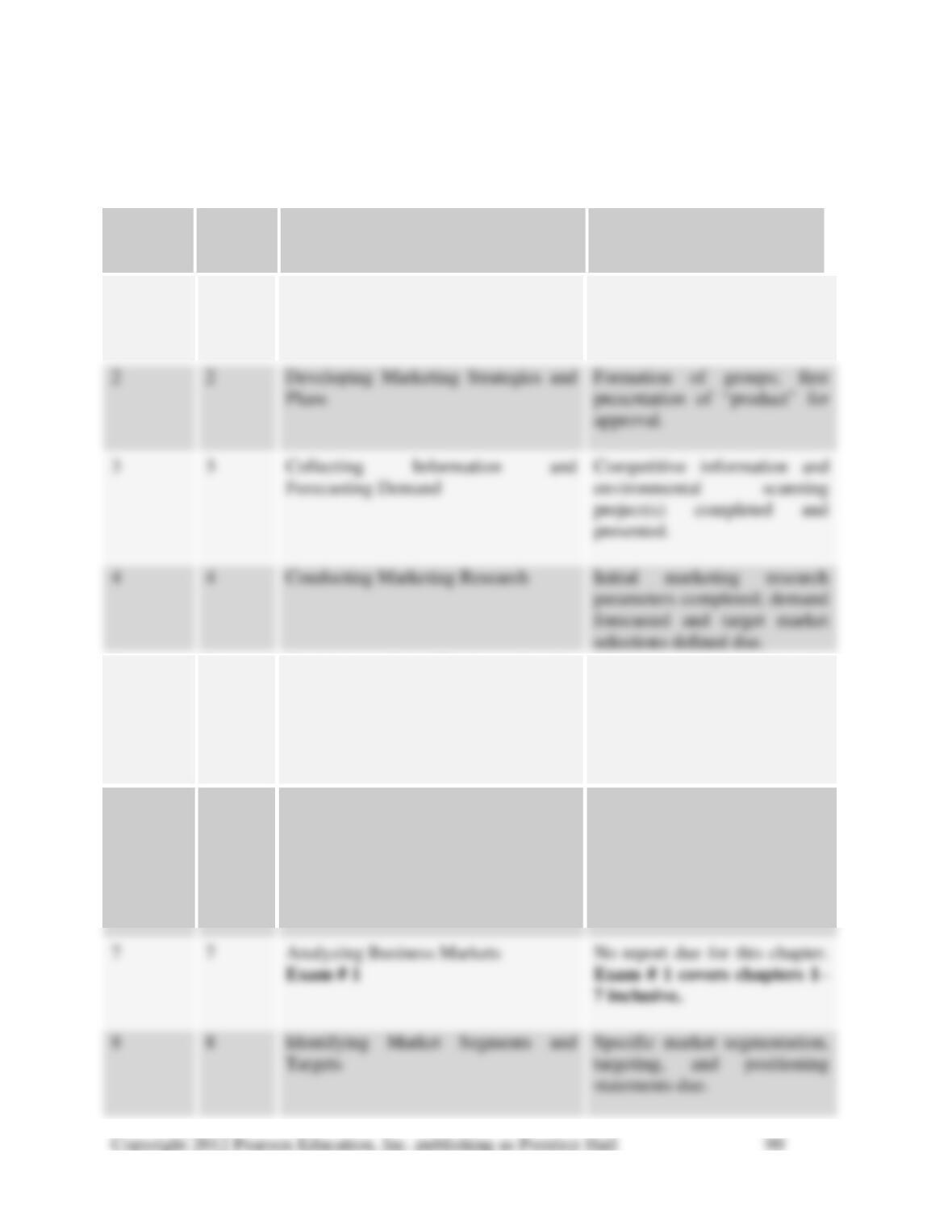
This is to recommend the immediate construction of two additional campus-parking garages that
will benefit from very fast economic paybacks to the University.
BACKGROUND
Currently, the University campus has an enrollment of 32,000 with an annual growth rate of
RECOMMENDATION
A fourth and fifth parking garage should be constructed in sufficient time to be online for the
2004-2005 academic years. At a completed, turnkey cost of $3.5 million and with a capacity of
NEXT STEPS
The same engineering/architecture plans will be employed as were used with the first three
garage facilities. Serial revenue bonds will be issued as soon as approved. Site locations will be
EXAMPLE ONLY

Case-Oriented Syllabus
CASE PRESENTATION’S ORAL PRESENTATION RUBRIC
Individual presentations will be graded based upon the following set of criteria:
• Content (45 possible points)
Included here is whether the student has substantially and fully examined all of the issues,
• Presentation Itself (30 possible points)
Included here are the layout, content, and readability of the slides or other forms for
• Completeness (25 possible points)
Includes the correctness of answering questions from the instructor and/or audience
members, as well as preparation by the student member to all of the relevant facts, figures,
assumptions, recommendations, and strategies of the student.
Case-Oriented Syllabus
TENTATIVE COURSE SCHEDULE
MARKETING MANAGEMENT
FALL SEMESTER
Class
Period/
Date
Read
Chapter
Chapter Topic
Assignment Due
Beginning of Class
1
1
Defining Marketing for the 21st
Century
Group formation and begin the
process of selecting the
product or service.
2
Developing Marketing Strategies and
Plans
Formation of groups; first
approval.
3
Collecting Information and
Forecasting Demand
Competitive information and
environmental scanning
project(s) completed and
presented.
5
5
Creating Long-Term Loyalty
Relationships
Value proposition for the
fictional product, defined how
they will deliver satisfaction
and maintain customer loyalty
due.
6
6
Analyzing Consumer Markets
7
7
Analyzing Business Markets
No report due for this chapter.
Definitive data on the
consumer for the product/
service including all
demographic and other
pertinent information obtained
due.
Case-Oriented Syllabus
9
9
Creating Brand Equity
“Branding” strategy developed
due.
brand positioning.
service strategy due.
13
13
Designing and Managing Services
Those students who have
selected a “service” idea for
the marketing plan must
submit their offering. Students
whose project is a “product
based” component do not have
anything to submit for this
chapter.
Programs
the fictional product/service
Networks and Channels
getting their product or service
to the consumer due.
demand and capacity issues.
Case-Oriented Syllabus
17
17
Designing and Managing Integrated
Marketing Communications
Integrated marketing
communications matrix due.
18
Managing Mass Communications:
media decisions, sales, and
promotional materials due.
Direct Marketing, Word of Mouth,
analysis due. All other groups
outline the specifics (including
financials) for this option.
20
20
Introducing New Market Offerings
A brief write up by the
students as to the consumer–
adoption process for their new
product is due.
21
21
Tapping into Global Markets
should begin their
presentations to the class.
Organization
presentations of the project.
Students should ensure that
If the project is to be exported
to another country, then
students’ submissions
regarding how the product is to
be distributed should be