
1
PART VI
SALES CALL ROLE-PLAYS
2
Guidelines
Answers to seven SALES (Student Application Learning Exercises) for each
module within each role-play have been created to help guide you in understanding
the possible answers. For example, role-play 1 has only one product, whereas role–
play 4 has 4 products. You and your students will come up with different and
better answers. The seven SALES are found at the end of chapters 3, 5, 7, 9, 10,
11, and 12.
The information for the role-plays was based upon information furnished by
companies. Sales personnel answered many of the SALES. We have used role-
plays 1 and 4 in our classes with hundreds of students.
Sample SALES Answer
Role-play Three: Business–to-Business (p. 506)
Sale 1 — Chapter 3
Now you are ready to begin developing your sales presentation. To make Sale 1:
2. Briefly describe the individual and/or organization to which you will sell.
Travel Xpress (TX) is a personalized travel agency located in your town. Chris Hammond –
Owner.
TX has been in business since 2008. Chris bought the agency from the original owner in 2014.
He worked at the agency as a part-time (college student) employee since its beginning. He makes
3. List three features of your product with each feature’s main advantage and
benefit. Refer back to Chapter 4 for FAB definitions. These FABs would
3
Feature
Advantage
Benefit
22 copies per minute
Less time spent on printing
More profitable printer – higher
output in less time
copier repairs in the next 10
years
maintenance expenses
4. Now create a SELL Sequence for each FAB. Label each of the components of
the SELL Sequence using parenthesis.
“The Minolta copier produces 22 copies per minute [feature]. This means that there is less time
spent on printing [advantage]. The bottom line for you is a more profitable printer [benefit].
Now that’s what you’re interested in, right [trial close]?”
Name: Instructor
Role-play One: Consumer Sales
Sale 1—Chapter 3
Now you are ready to begin developing your sales presentation.
To make Sale 1:
5. State what you will sell: Ready–to-eat (RTE) cereal
6. Briefly describe the individual and/or organization to which you will sell.
Amy – cereal buyer for ABC Grocery Store
7. List three features of your product with each feature’s main advantage and
benefit. Refer back to Chapter 4 for FAB definitions. These FABs would
4
discuss your product, not your marketing plan or business proposition. We’ll do
that later.
Feature
Advantage
Benefit
93% of consumers will buy
your cereal in addition to
their normal cereal
consumers will buy more
boxes of cereal each time
they shop
more sales, increased profits
attracts its key customer
more sales, increased profits
8. Now write a SELL Sequence for each FAB. Label each of the components of
the SELL Sequence using parenthesis as shown on page 99-100.
“93% of consumers will buy X Brand cereal in addition to their normal cereal [feature], which
means that consumers will buy multiple boxes of cereal each time they shop [advantage]. This
5
Sale 2—Chapter 5: ABC Grocery Stores
Regular Cost
Per Case
$33.24
Less Allowance
$13.56
Deal Cost
Per Case
$19.68
Deal Margins
Regular S.R.P.*
@ 3.40
19%
1.79
Feature Price @
1.99
18%
Deal
Feature Price @
8%
Total
Investment
$15,945.60
Total Gross
Sales
$19,087.20
Total Gross
$3,141.60
R.O.I.
16%
6
SALE 2
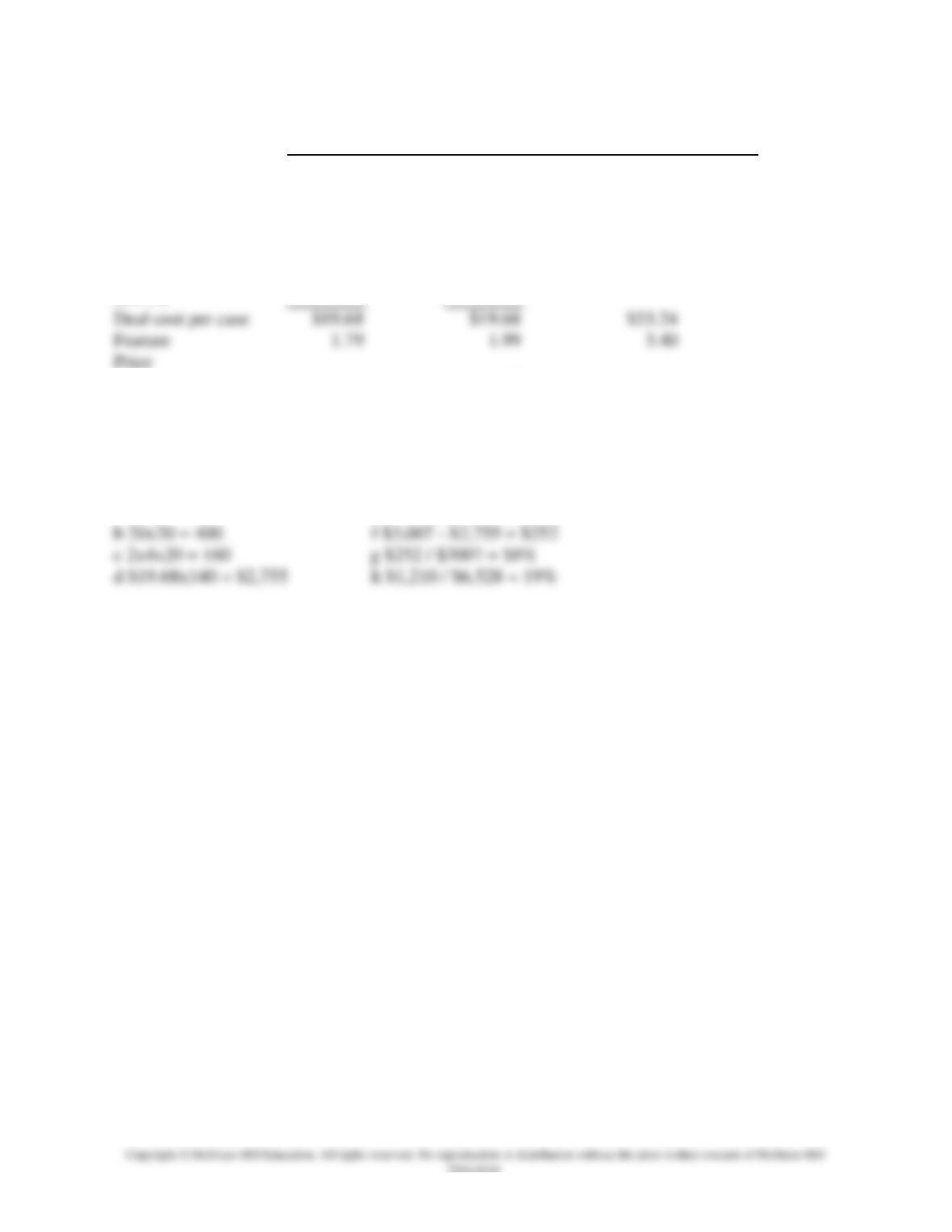
Like Exhibit 6A-4
$2.77
=
Regular cost of each unit ($33.24/12 = $2.77)
-1.13
=
Special promotion allowance ($13.56/12 = $1.13)
$1.64
=
Deal cost
$3.39
=
Manufacturer’s suggested selling price
$3.40
=
Normal retail selling price
19%
=
Normal Profit ($3.40 – $2.77 = $0.63) then ($0.63 / $3.40 = .1852 = 19% markup)
$1.79
=
3-day special price suggested for retailer to advertise product.
8%
=
3-day sale profit margin ($1.79 – $1.64 = $0.15) (0.15 / 1.79 =.084 = 8% markup)
$1.99
=
promotion.
18%
=
After-sale profit margin ($1.99 – $1.64 = $0.35) then (0.35 / 1.99 = 18% markup)
19%
=
Normal Profit ($3.40 – $2.77 = $0.63) then ($0.63 / $3.40 = 19% markup)
2-week special price suggested for in-store
7
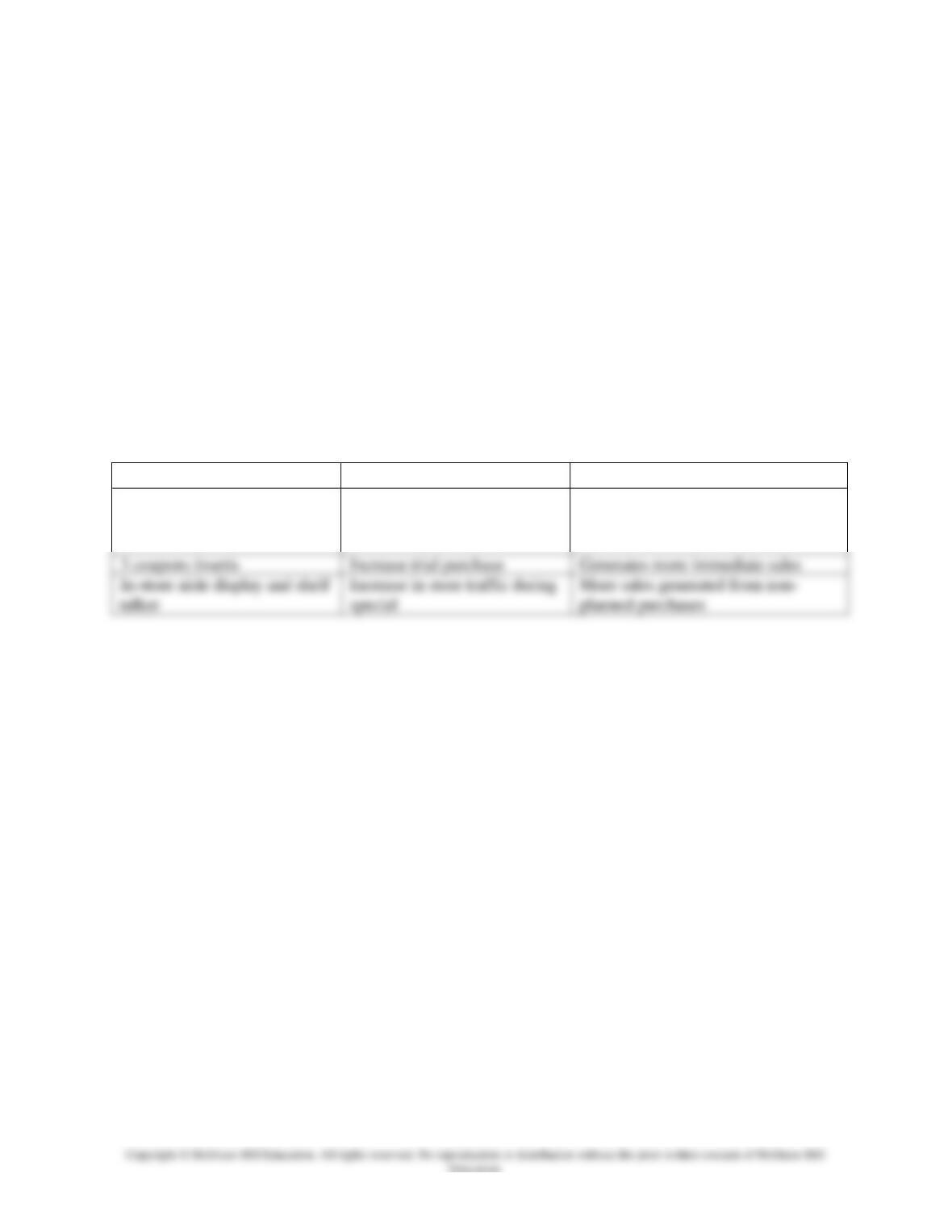
Like Exhibit 6A-5
3-Day Special
2-Week Special
Normal
Total stores
20
20
20
Deal
dates
pricing available 2 months from today
Regular cost per case
$33.24
$33.24
$33.24
Less allowance
($1.13)
-13.56
-13.56
Deal cost per case
$19.68
$19.68
$33.24
Feature
Price
Cases purchased
140a
400b
160c
Total investment
$2,755d
$7,872
$5,318
Total gross sales
$3,007e
$9,552
$6,528
Total Gross profit
$252f
$1,680
$1,210
Return on investment
(ROI)
8%g
18%
19%h
a 7×20 = 140 e 140x12x$1.79 = $3,007
8
Name: Instructor
Sale 3—Chapter 7
In planning the sales presentation, it is necessary to create a marketing plan.
Review the section on page 261 entitled ” Customer Benefit Plan: What It’s All
About.” The marketing plan is described in Step 2 on page 261. Stop your study
on page 265 at the discussion of “The Prospects Mental Steps.”
Carefully study Exhibits 7-6, 7-7, and 7-8. Review the advertising and sales
promotion sections contained in pages 171-174. To make Sale 3,
1. List three FAB‘s you could discuss in your marketing plan.
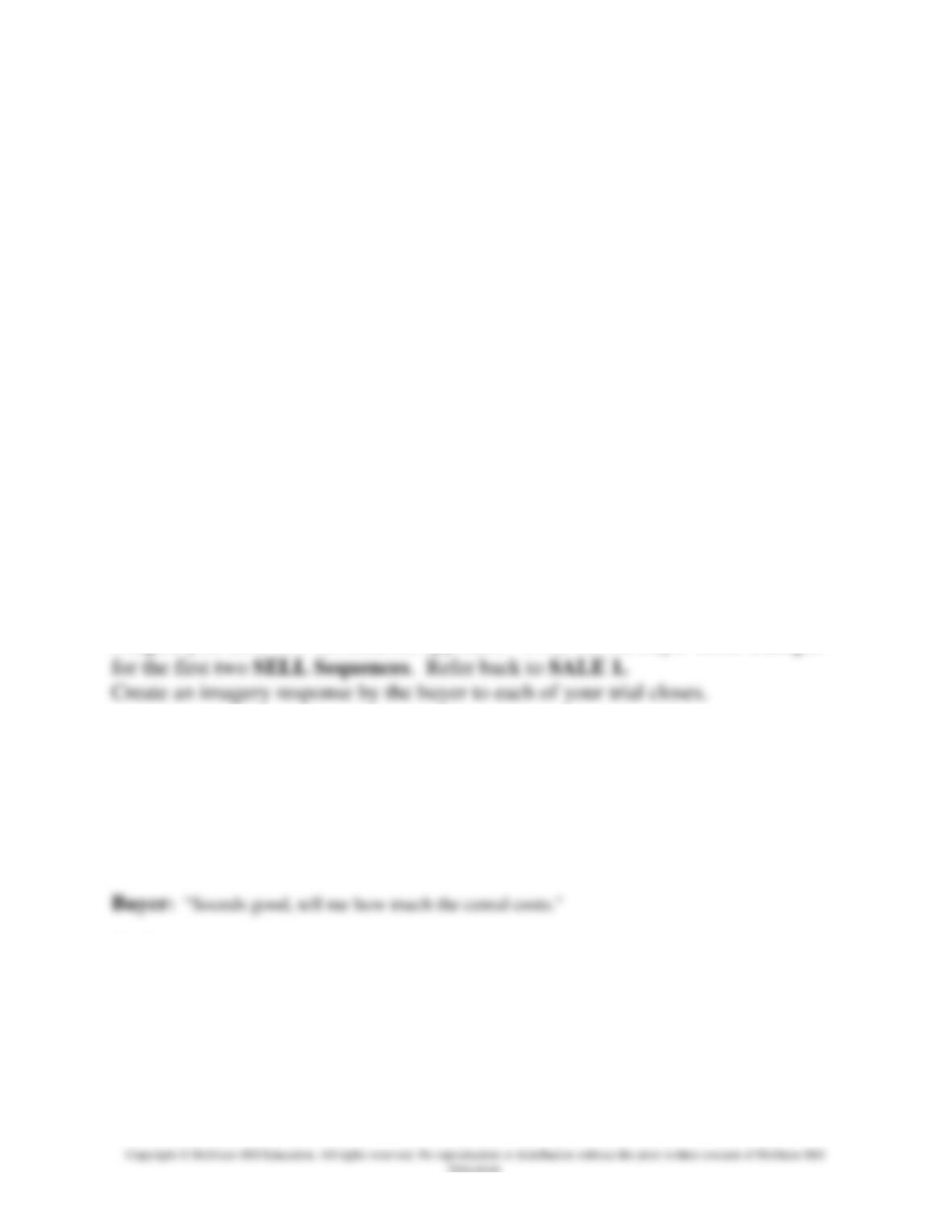
Feature
Advantage
Benefit
Prime time TV advertising
blitz for 2 and a half months
Increase in brand awareness
before product is on shelves
Drives sales of product
2. Write out one SELL Sequence using each of the FABs. Label each of
the components of the SELL Sequence using parenthesis as shown on
page 100.
“X Brand Cereal will begin a two and a half month Prime Time TV advertising blitz in the next
month [feature]. This will increase brand awareness and drive traffic to your store [advantage].
Ultimately, our goal is to drive more of our product’s sales within your store [benefit]. What are
your thoughts on this advertising strategy [trial close]?”
“FSI coupons will appear in local papers [feature]. This will increase trial purchase as it reduces
consumer risk of trying a new product [advantage]. For your store, this means consumers will
be searching for the product and looking to make immediate purchases, thereby increasing the
sales within your category [benefit]. How does that align with your current objectives for the
cereal category [trial close]?”
“Aisle displays with a creative positioning and communication message [feature] will be used to
increase store traffic and generate immediate awareness during the 3-day special sales
[advantage]. This will generate more in-store sales and more quickly move the inventory of
your product [benefit]. What are your thoughts on this quality promotion [trial close]?”
9
Name: Instructor
Sale 4 of 7—Chapter 9
To make SALE 4 first select the method you will use for your presentation. Please
review Chapter 8. Next, write down the name of the approach technique you will
use for this presentation method. Please review Exhibit 9.5.
Presentation method:
__________________________________________________
Presentation method: Need Satisfaction
Approach technique: Customer Benefit Approach
Now write out what you will actually say in your approach, including what the
buyer should say. Relate your approach to your FABs developed in SALE 1 so
you have a smooth transition into discussing your product.
Seller: “Amy, would you be interested in a new brand of cereal that will increase store sales
and profit?”
Buyer: “You bet, tell me more!”
Imagine you have now finished the approach. Write out the buyer-seller dialogue
SELL 1
Seller: “X Brand Cereal contains 7 essential vitamins and minerals [feature].
This essential mix aligns with health trends and appeals to those families
that care about their health—which will create more sales this cereal
[advantage]. This means more store sales within your category [benefit]. How
does that sound to you [trial close]?”
SELL 2
Seller: “Our boxes are larger than the average cereal box [feature]. This means more
cereal is in each box [advantage]. This will appeal to your customers as they will
receive more cereal for the dollar [advantage]. This packaging initiative should
drive sales within your category [benefit]. What’s your level of interest in our new
product [trial close]?”
10
Buyer: “You bet it is. Profit is important.”
Name: Instructor
Sale 5 of 7—Chapter 10
An important part of consultative selling is the use of questions to uncover the
customer’s needs. You have planned some of your questions in constructing your
SELL Sequences. SELL Sequences should be contained in your discussion of
the product, marketing plan, and business proposition.
Every important sales presentation should contain most—if not all—of the
presentation mix ingredients shown in Exhibit 10-5 on page 364. To make SALE
5:
1. Construct and write out one SELL Sequence. After your trial close, the buyer
questions what you have just said. The buyer sounds as if unsure what you are
saying is true. Create a proof statement that shows your claim is true. See pages
368-370.
SELL Sequence: “To help stores sell the new offering, Golden Grahams, we at
General Mills have launched an advertising and promotion campaign [feature], which is
sure to be seen and recognized by consumers all across age groups [advantage]. This
would prompt customers to try Golden Grahams and hence increase purchases and sales
at your store [benefit].”
Buyer’s skeptical remark: “But all major cereal manufacturers launch similar ad
campaigns at the time of the new product launch and they all make such claims.”
Proof statement: “A study conducted by A.C. Nielsen states that 95% of adults 18-49
2. Describe a demonstration you could do of one of your product’s benefit. If
possible, add dramatization. Remember, simply showing the product is not a
demonstration.
Take the store manager out onto the sales floor and conduct a taste test, where in,
people at random are requested to taste the product along with a range of other
breakfast cereals and prove that a majority of the persons tasting the cereal appreciate
11
4. Describe three visual aids you could use in your presentation. Flip charts and
notebooks are easy to develop, or you can place your visuals in a folder and pull
one at time out as you discuss it.
Visual 1: Slides with actual test market results and data gathered by A.C. Nielsen, which
could be used to convince the store manager (a product visual).
Visual 2: Videos showing the advertisements and describing how they are assured
of bringing in future sales or how they are directed at each class of buyers (a
marketing plan visual).
Visual 3: Close with a profit forecaster demonstrating the store’s ROI and
highlighting the margins involved (a business proposition visual).
12
Name: Instructor
Sale 6—Chapter 11
Sales objections are defined as opposition or resistance from the buyer. To make
Sale 6:
1. List three objections a buyer might give you. See example of various types of
objections on page 403. Make certain you use objections that relate to your
product. Do not use general objections, such as “I do not like it.” The objection
should be specific, such as “I do not like the color.”
Objection 1:
“No, I’m not interested. I’ve heard your cereal won’t fit on the shelves.”
Objection 2:
Objection 3:
“Your price is higher than your competition.”
2. Now, write the actual process (i.e. dialogue) for handling each of the above
objections. The process and examples for handling objections are on Exhibits
11.3 and 11.13, pages 399 and 422, respectively.
Dialogue 1:
Dialogue 2:
Dialogue 3:
3. Write the buyer-seller dialog for each objection. State the buyer’s objection and
then your response to it. Each time you respond to an objection use a trial
close, see page 423, to determine if you have overcome the objection or
correctly answered the buyer’s concern or question. After your trial close, label
it using parentheses (Trial Close).
Buyer’s objection 1:
BUYER: “No, I’m not interested. I’ve heard your cereal won’t fit on the shelves.”
SELLER: “I can understand. No one would want to buy cereal that won’t fit on her shelves. Is

13
that the only reason you won’t buy?”
BUYER: “Yes, and that’s enough!”
SELLER: “Whoever told you that wasn’t aware of our new design. Our box holds more cereal,
but is the same size as other boxes.”
BUYER: “Really?”
SELLER: “Are you interested in a box that holds more cereal [trial close]?”
BUYER: “Yes”
Buyer’s objection 2:
BUYER: “I don’t think so. The design on the box is too colorful.”
SELLER: “I can understand that. You want a design that is going to get the message across and
sell more ”
BUYER: “You Bet!”
SELLER: “Brand X cereal is colorful, but is targeted towards kids and their families. This
colorful box is what kids are used to. That’s what you had in mind wasn’t it?”
BUYER: “Yes Sir!”
Buyer’s objection 3:
BUYER: “Your price is higher than your competitors!”
SELLER: “Yes, it is slightly higher, but our cereal offers a promotional discount for over 2
weeks. This saves you money and increases profits in the long run. That sounds good to me,
wouldn’t you agree?”
BUYER: “I sure would.”
Role-play the buyer giving you the above objections and your response. If
possible, use a tape recorder to play back the dialogue. Does what you say sound
natural and conversational to you? If not, adjust it. If it does, go with it.

14
Name: Instructor
Sale 7 of 7—Chapter 12
Now it’s time to ask for the order! Frequently, questions and objections arise when
you ask someone to buy. Thus, you should anticipate questions and/or objections
and be prepared to use several different closing and objections handling
techniques. To make Sale 7
1. List the main benefits discussed in your presentation.
Increased sales, increased profits
2. Select a closing technique, such as the summary–of-benefits close on pages 442.
Write out your close and label it with the name of the closing technique in
parentheses. Use a trial close after completing the close to verify these are
important benefits to the buyer. Write out your trial close and label it using
parentheses as shown on pages 102–103 (Trial Close).
Summary of Benefits Close.
Seller: “Amy, you say you like the opportunity to increase store sales and profit. Is that right?”
[Summary of Benefits and trial close].
Buyer: “You bet!”
Seller: “Based on your past cereal sales and our promotional discount, I suggest you buy 700
cases. This will allow you to greatly reduce your reordering costs and take advantage of our
promotional discount. I can have the delivery to you in 4 days.” [Silent and wait]
3. Create a visual aid showing your suggested order. See page 376 for an
example. This visual aid maybe similar to the same one you developed for
discussing your price(s).
4. Now you are ready to construct your multiple-closing sequence. First
carefully study Exhibit 12-3 on page 436. Now look at the example of a
multiple-closing sequence on page 456. The multiple-closing sequence
should be composed of the following:
A. Your summary-of-benefits close.
B. Your trial close.
15
C. Your suggested order.
D. Use the assumptive or alternative close.
E. Have the buyer ask a question or give an objection.
F. Respond using another objection handling technique.
G. Ask a trial close to see if you successfully handled the objection.
5. To complete Sale 7 write-up the above A-I in a script format. Role-play
this dialogue until it sounds natural to you. This may require replacing
the used techniques with new ones. Once the script is finalized, type up
and turn in to your instructor.
Seller: “Amy, you say you like the opportunity to increase store sales and profit. Is that right?”
[Summary of Benefits and trial close].
Buyer: “You bet!”
Seller: “Based on your past cereal sales and our promotional discount, I suggest you buy 700
cases. This will allow you to greatly reduce your reordering costs and take advantage of our
promotional discount. I can have the delivery to you in 4 days.” [Silent and wait] [assumptive
close]
Buyer: “Well, what you mentioned is important, but your price is a little higher than the
competition.” [objection]
Seller: “Yes, it is slightly higher, but our cereal offers a promotional discount for over 2 weeks.
This saves you money and increases profits in the long run. That sounds good to me, wouldn’t
you agree?”
BUYER: “I sure would.”
Seller: “Amy, you said you’d like to increase cereal sales, right?”
Buyer: “Yes”
Seller: “And you like the chance to increase your profit, correct?”
Buyer: “You bet.”
Salesperson: “Our X Brand Cereal is designed for families, comes with a promotional discount,
and will increase your profits in the long run. According to your store traffic, I recommend 700