videos and guest speaker materials. Chapter One’s Appendix entitled
“The Core Principles of Professional Selling as Told by a Salesperson” is also
on this test.
Apr. 21: Thursday. Class evaluation. Please bring a #2 pencil. Discussion of
The Greatest Salesperson in the World. Turn in your Shadow Bonus Project.
Apr. 28: Thursday. Discussion and test
over book.
May 3: Tuesday. Redefined day, students attend their Friday classes.
May 5: Thursday. No class. Reading day.
Spring semester final examinations days and times:
May 10, Tuesday 1—3 p.m. for 3:35—5:10 p.m. class.
May 11, Wednesday 8—10 a.m. for 12:45—2 p.m. class.
Salesperson (Student) Information Sheet
Professional Selling Course
Name__________________________ ………………….. • Student number:____________________
• When will you graduate?________ ………………….. • Permanent address:_________________
• Local address:
__________________________________________________________________
• Telephone number: ____________ • Cell phone number:________________
• Major:______________________ • E-mail:___________________________
• Overall grade point:___________ • Grade point in major:_______________
I give Professor Futrell permission to use my full nine digit student identification number when
posting grades and to return graded assignments with my name and grade on them as described
in class. Also I give permission to send my resume to organizations:
Signed: __________________________
• Check if you have taken Professor Futrell’s Mktg. 335 personal selling class: ____
• High school activities:
• TAMU activities:
• Are you presently working? ___Yes ___No If yes, where?___________________
• What work experience have you had?
• What are your top three (3) ideal full-time jobs you would like to have after graduation?
Please place in order of first choice, second, third:
• Are any of your relatives in sales? What is name of company?
What is their job title?
• Why are you in this course?
• Are you interested in a sales career? ____Yes ____No ____Maybe
• If yes or maybe, what type of sales job are you interested in?
• If offered a B2B outside sales job what are the chances you would take it? Circle one
No Way Maybe Absolutely
0% 10 20 30 40 50 60 70 80 90 100%
• If offered an inside sales position what are the chances you would take it? Circle one
No Way Maybe Absolutely
0% 10 20 30 40 50 60 70 80 90 100%
• Other information you would like to share with me
• What grade do you have to make in this class? ___A ___B ___C ___D. Why?
• What are topics you want covered in this course?

Sales Presentation Guidelines
1. As a salesperson, it is your responsibility to develop your own presentation—not your
manager’s responsibility. Thus, I will not be available to comment on what specifically
you should do to develop your presentation. I am available to explain the project. By
listening in class, reading your text, visiting the library, contacting companies, and by
your own ability, you will research, develop, and deliver a presentation that SELLS.
2. Presentation time limit = 8 minutes maximum; your buyer is a busy person.
3. The buyer’s grade will be based upon the video presentation the seller selects to be
graded for his/her product sales presentation.
4. Go to Wehner 101 15 minutes or more before your appointment time.
5. You must create and turn in for grading an original typed, double-spaced paper. It will
not be returned to you. Please keep a copy. This paper is very important to your grade
on this project. The paper should contain:
A. A cover sheet.
B. The “calling card” you create. Using a piece of typing paper, create your card.
Make it the size of a business card. It does not need to be professionally done.
C. Customer analyses: (1) description of the customer—the individual— you are
calling on. (2) internet road map and direction (3) internet weather (On page of its
own with title at top of page).
D. Your sales call objectives. (On page of its own with title).
E. On a page of its own with a title of “customer profile and planning sheet” (see
Chapter 7 for example) containing:
1. Name of company.
2. Address of company.
3. Type of business.
4. Name of buyer.
5. People who influence buying decision or aid in using or seeing your
product.
6. Buying hours and best time to see buyer.
7. Receptionist’s name.
8. Buyer’s personality type — See Chapter 3.
9. Buyer’s important buying needs.
F. Competitive analysis. (On page of its own with title).

G. Customer benefit plan (FABs). (On page of its own with title).
H. Marketing plan. (On page of its own with title).
I. Business proposition, including “profit forecaster.” (On page of its own with
title).
J. Suggested order. (On page of its own with title).
K. Copy of your visuals.
L. Sales presentation containing buyer and seller dialogue. Note: A through K
goes before L. Yes, some information is repeated in L.
Major sections of your script dialogue must have these headings:
• Approach
• Product using SELL Sequences
• Marketing Plan using SELL Sequences
• Business Proposition using SELL Sequences
• Close
• If Does Not Buy
Note: Graders will look for your use of the stated techniques when grading your video
presentation.
6. See the “tentative schedule” for date to turn in your paper.
7. Note: When you turn in your video for grading, also include a one page typed critique
of your sales presentation. Include both improvements needed and things you did well.
It should be no longer than one page. Important: Type your name and lab day and time
at the top of the page. Fold the paper and insert it inside the video’s carton.
8. The “key” to making a high grade (“C” or better) is to incorporate the selling techniques
we discuss in class into your presentation. For example, creative demonstrations are a
“must”; techniques to overcome objections are essential; the use of questions are
extremely important; and you cannot make the grade without great visuals.
9. The page entitled “Format of Sales Presentation” outlines the minimum elements and
correct order you should use in your presentation.
10. One very important thing I am looking for you to do is tie together the buyer’s needs
uncovered in the preapproach, approach, and SELL Sequences to form your presentation,
handling of objections, and closes. I am very interested in how your approach,
presentation, and close are related to each other.
11. One letter grade will be deducted from the salesperson’s presentation grade if any one of

the following is done:
A. the paper is not typed.
B. the paper is not written, typed, and presented in a manner of a professional
salesperson.
C. you do not have the appearance, mannerism, and attitude adhered to by a
professional salesperson during your presentation.
D. you do not title the selling techniques you will use.
E. within buyer-seller dialogue, sections of presentation not clearly labeled.
F. do not have “If Do Not Sell Prospect” in script dialogue — see example.
G. you do not have a sales demonstration of a major benefit in your presentation.
Showing your product is not a demonstration.
12. Ten points deducted for each day your paper(s) is late.
13. Three letter grades will be deducted from your presentation grade if you read or follow an
outline in any manner.
14. Even though you may select your buyer, he/she will be given instructions as to the basic
attitude toward you and your proposition. In general, the attitude will be one of the
following:
A. No, will not buy no matter what; must give a minimum of two objections. You will
need to have prepared at least two closes.
B. Appears not to want to buy but does buy; must give a minimum of two objections
and two times to say “will not buy.”
Important: You should plan for the no buy situation. Thus, you are prepared for both
the buy and no buy customer.
15. The buyer will be given several “extra” actions to do during the presentations.
16. After your presentation, you and your buyer should quietly leave the lab area.
17. You will be given the opportunity to do two product presentations. One of these you will
select to be graded.

Shadow Bonus Project – Working With A Salesperson
In the past, students have benefited from going on sales calls with salespeople. It is the best way
to relate what we do in this course to salespeople’s jobs. If you would like to work with a sales
person this semester and write a paper based on the experience, you can earn up to 50 “bonus”
points. If you earn the maximum amount of points, it is like earning an additional 50 points on a
test. Here is how the project will be graded:
* 50 points for 3 sales calls with a salesperson.
* 40 points for 2 sales calls with a salesperson.
* 30 points for 1 call with a salesperson.
You will create a typed paper which is graded on neatness and how well you prepare the paper.
The paper should include:
1. A cover page
2. Salesperson’s name, calling card. Letter from salesperson on company letterhead
stationary stating that you actually worked with the person and the number of customers
seen.
3. Brief background on:
A. Company
B. Products sold and to whom
C. Salesperson
Your paper must include the above information. The remainder of the paper’s content is up to
you. Here are questions you might ask the salesperson. The salesperson’s answers will help you
learn about the sales job and write your paper.
A. What does it take to be successful in sales?
B. Description of initial product knowledge, getting product knowledge and selling
skills training.
C. How do you prepare for a sales call?
D. How do you prepare for a sales presentation?
E. Does nonverbal communication play a part in sales?
F. What’s the best way to start a presentation?

G. What’s involved in giving a good presentation?
H. How do you handle objections?
I. What’s the best way to ask for the order?
J. Is follow-up service important? Why?
The salesperson must be an “outside” salesperson that makes calls on customers selling business-
to-business. You cannot shadow direct store delivery salespeople such as bread, soft drinks and
beer, nor can you shadow a salesperson selling to individuals.
Two or more students cannot work with the same salesperson. You cannot work with a relative.
Past experience does NOT count for this project.
The paper length is totally up to you.
Here’s an Idea
You are responsible for finding a company that will allow you to work with a salesperson. Pick
a company which you might like to work for when you graduate and contact them. This is a
great way to get your “foot in the door.” It is also helpful when you are interviewing for a job. It
is a great story to tell recruiters. Do not get discouraged if it is hard to find a sponsor. Don’t give
up!
Talk to Buyers
If possible, interview one or more buyers on the sales call(s). Get approval from the salesperson
you are working with to ask her/his buyer questions. Find out:
1. Why they buy from one company rather than another?
2. What are the main benefits they look for when buying?
3. How does the salesperson influence their buying decision?
4. What makes for a good salesperson?
5. Ask other questions.
Marketing 335 Sales Challenge
Professional salespeople have a demanding job. It requires excellent product knowledge and
communication skills. Today’s consultative salesperson needs to create a sales presentation that proves
the buyer with all needed information upon which to make an educated purchase decision.
Today’s organizational buyers are busy people. They see several hundred salespeople a month. To do
one’s job, the salesperson must create a sales presentation allowing him/her to tell the entire story. An
effective approach and demonstration within the presentation can mean the difference between a “no” sale
and getting the buyer’s business.
Your sales trainer challenges you to create an approach and demonstration within your presentation that
will set you apart from the rest of the salespeople. Your management team has thus created a contest
whereby you are eligible to earn a bonus. Here are the guidelines for the sales challenge:
The sales challenge takes place October 21 and 22. That is the week you can do the bonus “approach—
close” video role-play. Immediately after you complete the “approach—close” bonus exercise in room
101, tell your TA that you want to compete for the approach and/or the demonstration challenge. You
will be videoed doing the approach and/or demonstration.
After everyone who wants to participate has completed the sales challenge, the TAs will view and select
the top three sellers from each section. You must tell the TA your lecture section—12:45 or 2:20. Bonus
point awards for each section will be earned as follows:
• Top approach wins 30 bonus points
• Second place wins 20 bonus points
• Third place wins 10 bonus points
• Top demonstration wins 30 bonus points
• Second place wins 20 bonus points
• Third place wins 10 bonus points
You are in competition with each other. You cannot work with another student taking Marketing 435.
Approaches and demonstrations that are the same or similar are subject to disqualification. Anyone who
competes in the Sales Challenge cannot communicate to anyone in any manner what he or she did in their
approach and/or demonstration. Management invokes the “Aggie Code of Honor” for this project.
Winners will be announced in room 113 on December 2 during class in room 113.

Sales Diary Bonus Project
As a second option, you may choose to keep a sales diary of selling encounters that you have with
“salespeople” in a variety of jobs. For this project, we are defining a salesperson as anyone who
interfaces with customers and influences a monetary transaction.
The object of this project is to be alert to selling tactics that are prevalent everywhere! If you elect to
keep a diary this semester, you can earn up to 50 bonus points. If you earn the maximum points, the 50
points will be added as if you earned 50 additional points on the exam.
You will submit a written report based on a “sales” diary you are to keep from September 30-November
15. In this diary, you should document your sales encounters. For each encounter, you must record
factual information (where, when, nature of, and reason for encounter) and your assessment of each
salesperson and his/her use of the selling techniques discussed in class and in your textbook. Submit your
diary along with your written report.
In your report, write about the worst encounter as documented in your diary. Try to determine if it was
due to the salesperson (e.g., “Just not motivated”), or the organization’s training (or lack thereof). Be
creative, seek out other salespeople in the organization, and ascertain whether there are any patterns in
their use of sales techniques. If in fact, they have used sales techniques, provide examples of their
techniques and label the techniques used by the salesperson. Make specific recommendations as to how
the salesperson could have made his/her presentation better, and/or how the organization can improve its
sales training. Describe the problem(s) based on the diary input and present a logical plan for
improvement. Be selective and focus on the most critical aspects of the encounter. You will be limited to
eight typewritten pages (double-spaced, one-inch margins).
Criteria for grading your report include how effectively you incorporate concepts from the text and
The following are examples of questions that should be addressed in your paper (this is the minimum that
should be included):
Background
1. Salesperson’s name, calling card, organization the salesperson works for, type of sales job, and
products sold. Did you buy?
2. Nonverbal – what image did the salesperson(s) project? Were they dressed appropriately? Did
they appear courteous and helpful? Did they appear motivated? How would you classify the
salesperson’s personality style? A Thinker? Intuitor? Feeler? Sensor?
Communication
3. Did the salesperson appear knowledgeable about his/her products, company, market, etc? Did
s/he listen to you more than talk?
4. How did the salesperson open the presentation? What type of sales approach technique did s/he
use?
5. Did the salesperson use any visual aids? How did the salesperson demonstrate the product’s
features, advantages and benefits? Did the salesperson cross sell?
6. Did the salesperson trial close? Did he ask for the order?

7. What techniques did the salesperson use to handle your objections?
8. Did the salesperson set a follow-up call with you? Was there any follow-up at all?
Recommendations
9. What specific changes would you make in the sales presentation if you were the salesperson?
10. Briefly describe how you would develop and implement a sales program with the employer.
Best Types of Sales Encounters
Many sales encounters do not work well in this project. These are usually sales encounters where you are
buying inexpensive items such as groceries, gas, or fast food.
Shopping for jewelry, expensive clothes, cars, trucks, computers, televisions, stereos, etc. do work well
for this project. No more than two sales encounters can be done with another student. This should be a
male-female couple.
Cover Sheet
Please have a cover sheet with the following typed upon it:
A. Title of assignment,
B. Your name,
C. Marketing 435,
D. Section number,
E. Lab day and time.
Role-Playing: An Overview
Role-playing is regularly used in sales classes and training, though not always effectively (such sessions
can be difficult to conduct). However, its value is great. Role-playing could be used as an integral part of
the class.
Why Role-Play?
Developing, refining, and practicing a skill in a live situation may put a salesperson’s credibility and
confidence (and the sale) at risk. Role-playing, despite its limitations, is one of the most effective
methods of enhancing skill and confidence, subject only to the trainer creating and maintaining a
supportive, risk-free learning environment.
Role-playing can, however, fail to achieve its objectives. The most common causes seem to be:
· over awareness of the camera
· overacting to the camera
· a belief that role-playing means acting
· the difficulty of selling in front of one’s peers
· poor role-play examples or exercises
· weak management of the role-play
· incomplete feedback after the role-play
· those not role-playing are given nothing to do.
All role-plays should be organized to achieve the following objectives:
· reproduce real life as closely as possible
· provide an opportunity to practice difficult situations
· provide an opportunity to practice new skills
· develop confidence
· enhance learning by building on success

My Instructions to Each Buyer Immediately Before Video-Taping Begins for the Class
We choose the products for the students. The more quality product/service information the better the
opportunity for the student. A number of quality role plays exist within the textbook. Students develop
their own scripts, and rehearse it outside of class. At the beginning of a semester, a few students seem to
feel this exercise is not totally realistic.
However, it is realistic in that companies require their new salespeople to develop sales presentation and
role-play it before contacting a customer. So, to help improve the realism, I have each buyer insert 2 or 3
unplanned comments or actions into the role play. I give them to the buyer, changing them from section–
to-section, day-to-day.
This makes students nervous. I explain why I’m doing it and always say, “You can handle it!”
Here is how it works. It is the beginning of the class. All sellers are in their “waiting room” and all
buyers are in their “lounge.”
I walk into the buyer’s lounge and say, “Pick a number – 1 or 2. Everyone can have a 1 or 2.” Each tells
me their number. Then I say, “2 is a buyer and 1 is a no–buy.”
Then I say, “Your grade is dependent upon how well you follow my instructions. If you follow them, you
generally receive a 20 out of 20. Remember you must give 3 objections and say ‘no’ 3 times even if you
eventually ‘buy’ and even if your script does not have 3 objections or 3 no’s. Now here is the unplanned
part.” Then I tell buyers what to do and where to do it. Here are some examples:
1. Ask “How much is this going to cost?” after the buyer’s first SELL sequence (or early in the
presentation).
2. Instead of responding to a positive opening question, respond negatively. You might say, “No,
I’m really not interested.”
3. After a major benefit is presented, say something like:
A. “Can you prove that to me?” and/or
4. Someone walks into the room and gets something or asks the buyer a question.
5. After the third close, have the buyer say, “I’ll buy if you’ll reduce the price 16%.” If a “yes” is
6. Buy and then change mind.
I also stress to buyers the need for them to be cheery when the seller walks into the room in order to help
the seller off to a good start. A few sellers forget what they want to say and there can be periods of
silence. I tell the buyer to help the seller out by asking a question or saying something that will help the
seller get back on track.

Remember, if it’s in the written script, but left out of the presentation, I don’t take off for that. I try to do
everything I can to make this a positive experience for each student.
This is not an easy assignment. They can’t do it overnight. Pressure is placed upon each person. Done
correctly, this is one of the most involved and challenging assignments a student may have in school. I
realize that, so I constantly act a “cheerleader.” You can do it. Others have done it. Think positive.
Pump yourself up. Get mentally prepared.”
Students will look to you for positive feedback and leadership. Many of us find this course to be fun and
intrinsically rewarding. You can “see” that students have learned. For example, I’ll have 30 percent or so
of my students, on their own:
· Go to a quantity discount when asked to reduce price.
· Postpone the price question.
· Rotate the order of their presentation. The buyer asks “Prove it” and the seller responds with a
proof statement planned to be used later in the presentation.
When I see these things happen in a pressure situation, I feel students have internalized the material and
true learning has taken place. What other course does this happen in for you?
Develop Your Own Video Examples
We urge you to create a video containing examples of what you expect of your students or keep past
examples of good and bad presentations. We like to show these throughout the course.
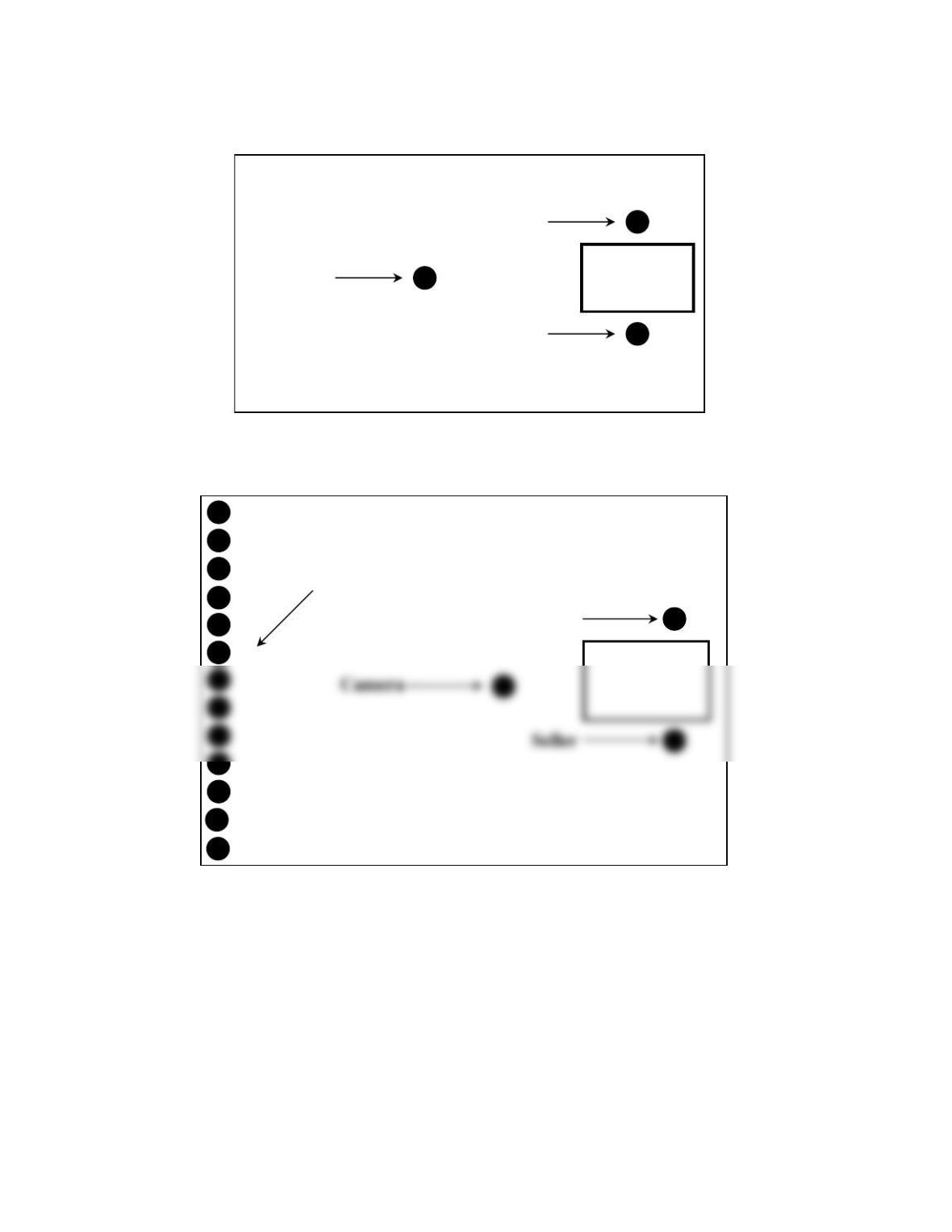
Typical Classroom Arrangements
(Without Class Watching or In A Sale Lab)
(With Class Watching – Camera Optional)
Buyer
Class Watching
Camera
Buyer
Seller

Alternative Role-playing Personal Selling Assignments in a
Classroom Setting
by Norm Clark
Instructor: this exercise takes place in the class with other class member observing.
It can be used with or without videotaping.
Purpose:
To give students an opportunity to demonstrate the selling techniques they have learned in a
realistic setting while other students learn by observing and critiquing the role-play assignments.
Objectives:
1. Increase the confidence of students by using the techniques they have learned
2. Increase the confidence of students by presenting in front of a group
3. Allow students to learn from observing and critiquing the performance of their peers
4. Create an active and supportive learning environment in which students are comfortable
participating
Getting Started:
1. Ask students to form groups of three in which they will work for the entire semester. (This
exercise is most effective with class sizes of 48 or fewer.)
3. Ask each group to provide the following information to the instructor regarding their
product:
❑ description of what is being sold
❑ target market
❑ potential needs/problems of prospects for which solutions may be provided
❑ your competition
❑ advantages you have to offer over your competition
Situation: the salesperson’s first sales call (Assignments 1 and 2) is to gather information to take
back to his/her office to prepare the main sales presentation (Assignment 3).
Assignment 1 – Prepare, submit to the instructor in written form a role-play script/dialogue
between seller and buyer, and present to the class in role-play format, what you will say and do
during the first 3-5 minutes of your sales interview. You should establish credibility with your
prospect and help him/her to see the value of spending some time with you. Buyer has very little
to say. Time required about 3 minutes. Buyer is one of group
Assignment 2 – Prepare, submit to the instructor in written form a role-play script/dialogue
between seller and buyer, and present to the class in role-play format, the questions you will ask
to identify the needs/problems of your prospects. Record the responses to your questions during
the role-play exercise and use this information to develop your presentation in Assignment 3.
Time required about 7 minutes.

Assignment 3 – Prepare, submit to the instructor in written form, and present to the class in role-
play format, a presentation of your product that provides solutions to the needs/problems that
were identified in Assignment 2. The presentation may include trial closes, answers to
objections asking for the business. Time required about 5 minutes.
Recommendations:
1. Have students work as a group to prepare each assignment. They all receive the same grade
for the assignment regardless of who makes the presentation.
2. Have each student in a group take the lead role—the role of the salesperson—in one
assignment so that each member of the group has an opportunity to be the presenter.
3. Have a separate grade for presentation/participation determined by combining the instructor’s
4. As each group makes their presentation, ask each of the observing class members to write
down one thing he/she likes about the presentation and one thing that would make the
presentation to be more effective. Ask several observers to share their comments after each
presentation.
Example of Assignment 1
During the first 3 to 5 minutes of your initial meeting with a prospect, it is critical that you
deliver your lines very professional to establish credibility and give your prospect a reason to
listen.
1. PLEASENTRIES
2. QUESTION:
At this point, how familiar are you with CableRep Advertising?
3. TRANSITION TO INTRODUCTORY STATEMENT:
Let me give you a brief overview about who we are, without going into a whole lot of detail
right now, that way you’ll know why I’ll be asking some of the questions I’ll be asking, if
that’s all right?
4. INTRODUCTORY STATEMENT:
We’re one of the largest Cable Television Advertising Companies in the country. What this
means is, we partner with your local cable company to help businesses—like yours—find
affordable ways to advertise on television. Our group specializes in working with business in
small to medium sized communities. As a matter of fact, right now we have local offices in
about 550 markets in 36 states. In this market we reach about 114,000 people. The statistic

This is done through long- term image building, which is frequent and consistent advertising
on powerful networks like CNN, ESPN, TBS—the networks you and your customers are
familiar with.
5. BENEFIT STATEMENT:
6. PERMISSION TO ASK QUESTIONS:
At this point I don’t know enough about your business to make any promises; could I ask you
just a few quick questions to see what kind of an impact we may be able to have on your
business? Or