Detailed Marketing Mini Sim Descriptions with Suggested
Implementation Strategies
Planning and the Marketing Mix
This Marketing Mini Sim provides a walkthrough of the basic elements of a Marketing Mini Sim and
it is HIGHLY RECOMMENDED that this Marketing Mini Sim be the first that is assigned.
Suggested Pre-Requisite: None
LEARNING OBJECTIVES
After completing this assignment, you should be able to:
* Navigate key sections of the Marketing Application-Based Activities environment
* Discuss the importance of the Marketing Mix (Four P’s) on developing a successful strategy
ACHIEVING THE MISSION GOALS
As the introductory mission, this simulation offers the most complete walk through of the various
aspects of the Marketing Mini Sim. Should a student not succeed on the first turn, they will be given
quite detailed walk-throughs of some of the post-turn analytical tools that are available to them.
Tips to Achieving the Mission Goals
Since this sim acts as a walkthrough of the entire environment, it may take students a bit more
than the typical 30 minutes to complete. If they are careful, read the prompts, they should be
able to discern the clues that will lead to successful completion on the first or second try.
• The Backpack: Rachel, Director of Product Development, provides the basic recipe for the
perfect backpack for this segment, if they follow her directions they will be headed in the
right direction. It should have: Rounded Top Shape, Basic Straps, Synthetic Material,
Cartoon Graphic and Water Bottle for Features, and its Color should be Red.
• Advertising: Phillip, Director of MarComm, should have helped them to find the right
Second/Third Turn Strategies
Because this mission goal is a Profitability Hurdle, this is one of the few mission goals that is
cumulative. That means it does become harder to make the goal if they fail on the first or second
try.
On the second turn, a price of $32 or $33 should be enough to make the profit hurdle as long as
WRITING PROMPTS
• Discuss (briefly) how each of the four P’s played a role in your overall marketing plan.
• Were you able to achieve the Profit Goal of the Mission? Which aspect of the Marketing
Mix proved to be key to your success/failure? Explain.
Buyer Behavior
Suggested Pre-Requisite: Planning and the Marketing Mix
LEARNING OBJECTIVES
After completing this assignment, you should be able to:
* Describe the stages of the buying process
* Explain how consumers perceive value
ACHIEVING THE MISSION GOALS
This is one of several missions that focuses on achieving a game mechanic called “Feature
Desirability” through attentive product development and design. While this simulation attempts
to cover a range of different influences on Buyer Behavior, the interactive mission aims to get
students to understand that a strong design is central to this effort.
Tips to Achieving the Mission Goals
The key aspect behind creating a successful product is to include those components that align
most closely with customer preferences. In the Outdoor Enthusiast segment, the two key
Preferences are:
• Shape: Large Rectangular
• Straps: Advanced Support
Second/Third Turn Strategies
Unlike goals that focus on Profit, Sales, Awareness, or Market Share, the Feature Desirability goal is
a straightforward threshold goal that is not influenced by the cumulative effects of other turns.
Also, unlike later missions which require students to operate within a certain production budget,
this sim has no such restriction. Any of the following features will have a positive impact on Feature
Desirability:
WRITING PROMPTS
• Discuss (briefly) the stages of the buying process. What role does successful Product
Development play in each stage? Are there some stages where it plays a more crucial
role?
Using Market Research
Suggested Pre-Requisite: Planning and the Marketing Mix
LEARNING OBJECTIVES
After completing this assignment, you should be able to:
* Explain the differences between primary and secondary data sources
* Describe common types of market research data
ACHIEVING THE MISSION GOALS
This simulation focuses on Feature Desirability and the Product Development process. The most
common goal-type among the Marketing Application-Based Activities, this and other missions
which share this focus encourage students to align product features with customer preferences.
Tips to Achieving the Mission Goals
If you assigned the Buyer Behavior Sim, one of the first things you may have noticed about this sim
is that it has an additional Market Share Goal. This encourages students to think in terms of
competing against other market entries, but does not require students to limit their production
costs as yet.
Since Comfort is the key Preference among this group, students will want to select attributes which
align with that:
Second/Third Turn Strategies
Some students may try to limit their production costs as the average purchase price for this
segment is $70. While this is a factor in later simulations, students need not worry about that here
so they should be sure to include the designer tag feature, which will ensure a high desirability
score.
WRITING PROMPTS
• Explain the differences between primary and secondary data sources and some common
types of market research data.
• Explain how the needs/wants of the Luxury Market differ from other segments you have
encountered thus far.

Understanding Segmentation & Its Impact on Marketing
Suggested Pre-Requisite: Planning and the Marketing Mix
LEARNING OBJECTIVES
After completing this assignment, you should be able to:
* Navigate the various segment options and discuss their differences
* Explain the impact segment choices have on the 4 P’s
ACHIEVING THE MISSION GOALS
This simulation focuses on Feature Desirability and the Product Development process. The most
common goal-type among the Marketing Application-Based Activities, this and other missions
which share this focus encourage students to align product features with customer preferences.
Tips to Achieving the Mission Goals
Since Comfort is the key Preference among this group, students will want to select attributes which
align with that:
• Shape: Teardrop
Second/Third Turn Strategies
Unlike goals that focus on Profit, Sales, Awareness, or Market Share, the Feature Desirability goal is
a straightforward threshold goal that is not influenced by the cumulative effects of other turns.
Also, unlike later missions which require students to operate within a certain production budget,
this sim has no such restriction. Any of the following features will have a positive impact on Feature
Desirability:
• Laptop Sleeve (best impact on desirability for this segment)
WRITING PROMPTS
• Explain how segment choices impact the Four P’s of the Marketing Mix.
• Pick any two market segments and illustrate how they are “Differentiable” within the
overall backpack market.
Successful Product Development
Suggested Pre-Requisite: Planning and the Marketing Mix
LEARNING OBJECTIVES
After completing this assignment, you should be able to:
* Discuss how product development is the foundation of the 4 P’s
ACHIEVING THE MISSION GOALS
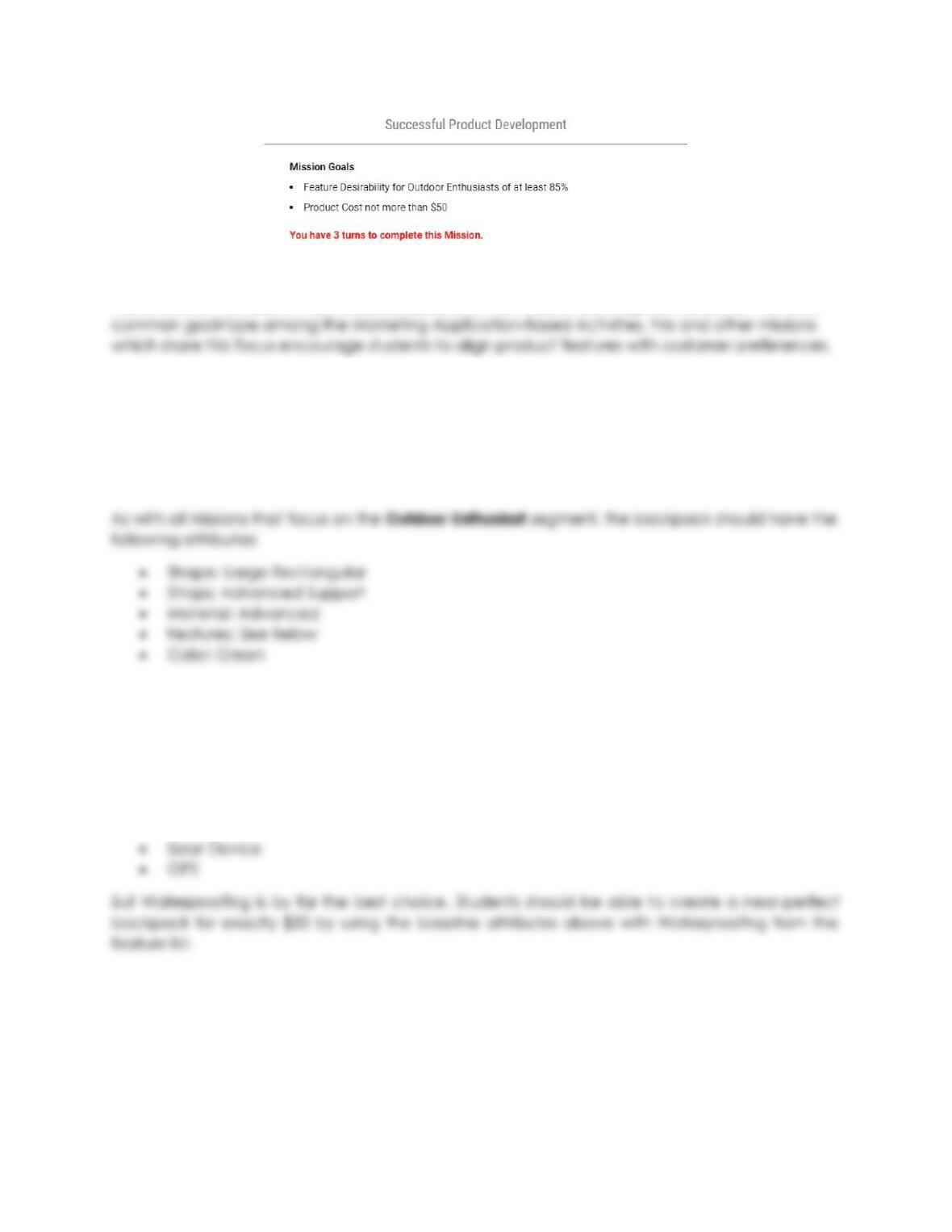
This simulation focuses on Feature Desirability and the Product Development process. The most
Tips to Achieving the Mission Goals
If you assigned the Buyer Behavior or Segmentation sims, one of the first things you may have
noticed about this sim is that it has an additional Product Cost Goal. This encourages students to
think in terms of weighing the cost/benefit tradeoffs of product development.
In the Outdoor Enthusiast segment, the two key Preferences are Capacity and Waterproofing.
Second/Third Turn Strategies
Unlike goals that focus on Profit, Sales, Awareness, or Market Share, the Feature Desirability goal is
a straightforward threshold goal that is not influenced by the cumulative effects of other turns.
Any of the following features will have a positive impact on Feature Desirability:
• Waterproofing (most important)
• Water Bottle
WRITING PROMPTS
• Some marketers maintain that strong product development is the foundation of the 4 P’s.
Why (or why not) do you think that is true?
• Successful product development always involves weighing the balances between
customer approval and the costs of production. How did you balance these concerns in
this mission?
How Price Impacts Sales
Suggested Pre-Requisite: Planning and the Marketing Mix
LEARNING OBJECTIVES
After completing this assignment, you should be able to:
* List factors that influence price setting
ACHIEVING THE MISSION GOALS
This advanced simulation includes three mission goals, but if the product model is strong and
price is strategically chosen, then students should have no problems achieving all three goals.
The key to this simulation is understanding that an extremely high-quality product can demand a
price far in excess of the segment average.
Tips to Achieving the Mission Goals
As with all missions that focus on the Outdoor Enthusiast segment, the backpack should have the
following attributes:
• Shape: Large Rectangular
• Straps: Advanced Support
• Material: Advanced
• Features: Waterproofing
• Color: Green
Second/Third Turn Strategies
Because the goals on this mission are cumulative over each turn, this mission becomes
progressively harder if one does not succeed on the first try. Some experimentation will be needed.
WRITING PROMPTS
• Various factors come into play when setting price. Discuss the importance of customer
value on maximizing profit.
Retail Strategy
Suggested Pre-Requisite: Planning and the Marketing Mix
LEARNING OBJECTIVES
After completing this assignment, you should be able to:
* Describe the variety of channels of distribution available for products
* Explain the pros and cons of each channel including their impact on margin
ACHIEVING THE MISSION GOALS
This advanced simulation includes two mission goals, including targets for both profit and gross
margin. The key to this simulation is understanding that retail channels have an impact on
margin (and thus profit) which varies from channel to channel. Also, price has an impact on the
availability of channels since certain retail channels only accept products within a specific price
range.
Tips to Achieving the Mission Goals
Rachel will provide your students with the recipe for the backpack for this mission. Their job will be
to pick the right price and the right channels. With a production cost of $24 and an average retail
Second/Third Turn Strategies
Because the goals on this mission are cumulative over each turn, this mission becomes
progressively harder if one does not succeed on the first try. Some experimentation will be needed.
If the student has cleared one of the goals and just needs a little boost on profitability, a slight
WRITING PROMPTS
• Retail channels add sales opportunities for your products but also impact your margin.
Discuss the pros and cons of adding certain channels to your retail strategy.
• Whether or not you were successful at this mission, you likely discovered the critical
difference that raising your price had on adding the High End Outdoor channel. Analyze
Integrated Marketing Communications
Suggested Pre-Requisite: Planning and the Marketing Mix
LEARNING OBJECTIVES
After completing this assignment, you should be able to:
* Describe the elements of an integrated marketing communications effort
* Explain the impacts of a consistent strategy and implementation
ACHIEVING THE MISSION GOALS
This advanced simulation focuses on the mission goal of awareness. Awareness is generated by
game mechanics responding to student selections for a positioning message and media
vehicles that together constitute the student’s ad campaign. In an effort to highlight the rising
Tips to Achieving the Mission Goals
As mentioned, if your students follow the directions they will not win on the first attempt. This will
prompt a follow up discussion and a new round that looks more closely at Internet media.
Second/Third Turn Strategies
and your student will clear the awareness goal.
WRITING PROMPTS
• Describe the elements of an integrated marketing communications effort. What is the role
of the positioning message vs the role of media vehicles?
Marketing Metrics
Suggested Pre-Requisite: Planning and the Marketing Mix
LEARNING OBJECTIVES
After completing this assignment, you should be able to:
ACHIEVING THE MISSION GOALS
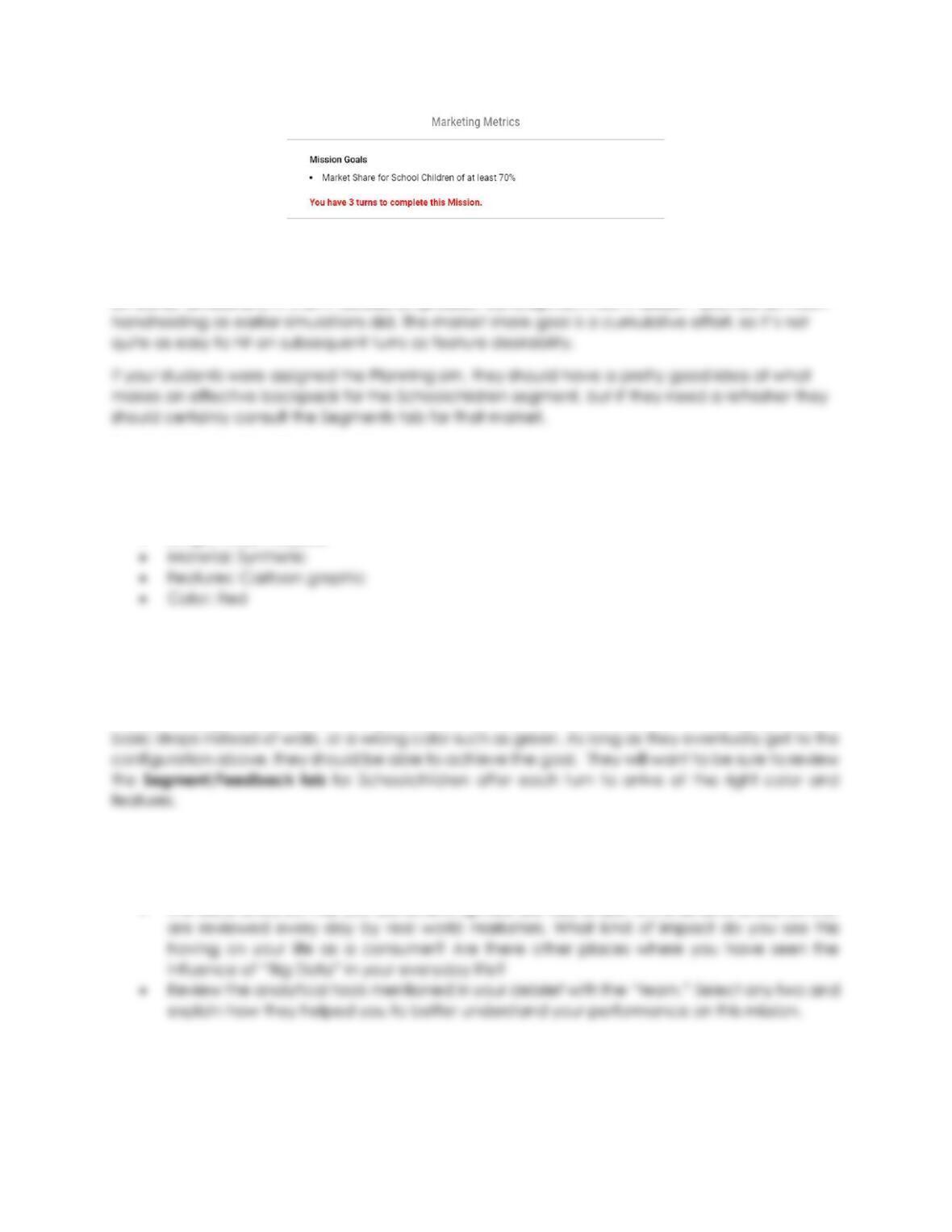
This advanced simulation focuses on a single mission goal of 70% market share. This is a variation
on earlier simulations in that it focuses on product development, but it doesn’t provide as much
Tips to Achieving the Mission Goals
The winning backpack design consists of:
• Shape: Rounded Top
• Straps: Wide Padded
Second/Third Turn Strategies
As long as the student’s selections are somewhat close to those above, they should eventually be
able to succeed at this mission.
“Close” configurations include using features such as water bottle instead cartoon graphic, and
WRITING PROMPTS
• How many turns did it take you to achieve the goal? Which analytical tools did you consult
along the way to refine your approach? How did they influence your decisions?
• The data analytics that you are reviewing here are very similar to the kinds of analytics that
Sample Course Schedule
This is a sample schedule of an integrated use of Marketing Mini Sim followed by Practice
Marketing:
Class Date TOPICS
#1 09/01 Course Introduction
#2 09/08 Strategy and Planning
IN CLASS 09/08 MARKETING MINI SIM – PLANNING
DUE 10/20 MARKETING MINI SIM – PRICING
IN CLASS 10/20 PRACTICE MARKETING – PRACTICE ROUND
#9 10/27 Channels
DUE 10/27 PRACTICE MARKETING – ROUND #1
#10 11/03 IMC
DUE 11/03 PRACTICE MARKETING – ROUND #2
#11 11/10 Promotion
Contact Customer Support :
McGraw-Hill’s Customer Experience Group
Online (chat, email) mpss.mhhe.com
Phone 1.800.331.5094
Sunday: 12 PM to 12 AM EST