on platform iis πsi−Mi
s−fwhere siis the share of consumers subscribed to
platform i,Mi
sis the price the developer has to pay to access the platform, and f
is a fixed cost which constitutes the type of the developer. We assume that there
are potential developers of mass Fwith fixed costs funiformly distributed on
[0, F ] with Fsufficiently large such that always some developers do not become
active. Consider only situations such that there is full market coverage on the
consumer side.
1. Given prices M1
s, M2
s, M1
b, M2
b, determine the indifferent consumer bxand
the numbers of developers on each platform, ni, as a function of these
prices.
2. In the symmetric equilibrium, the fees charged by the platforms are given
by
M1∗
b=M2∗
b=M∗
b=τ−π(u+M∗
s)
and
M1∗
s=M2∗
s=M∗
s=πτ −uM∗
b−uπ2
4τ−3πu .
Determine equilibrium prices M∗
b, M∗
sand equilibrium profits of platforms
Π∗. (In particular, the expression you obtain for M∗
sshould be very simple
and only depend on π−u.)
3. Suppose now that product piracy affects the industry. The level of piracy
is parametrized by λ∈[0,1]. As a consequence of piracy retail prices fall
even though consumers copying costs may be above the software devel-
opers’ marginal costs and the quality of a pirated product may be lower.
However, suppose that the social surplus generated by an active developer
increases in the level of piracy, i.e. π(λ) + u(λ) is increasing in λ. Piracy
also affects the rent distribution between developer and consumer: π(λ) is
decreasing in λwhile u(λ) is increasing in λ. Given your results in (2),
analyze whether or not software platforms gain from an increased level in
piracy. Explain your findings. (Note that due to the reduced form in u
and πyou may obtain ambiguous results and may not be able to express
your results as restrictions on parameters.)
4. Using the results obtained in (2) analyze whether or not developers gain
from piracy. Discuss your findings. The same remarks as in (3) apply.
5. In the public debate content providers and platform providers sometimes
appear to express different views on the effects of piracy. Can the present
model contribute to this debate? Discuss!
Solution to Exercise 9
19
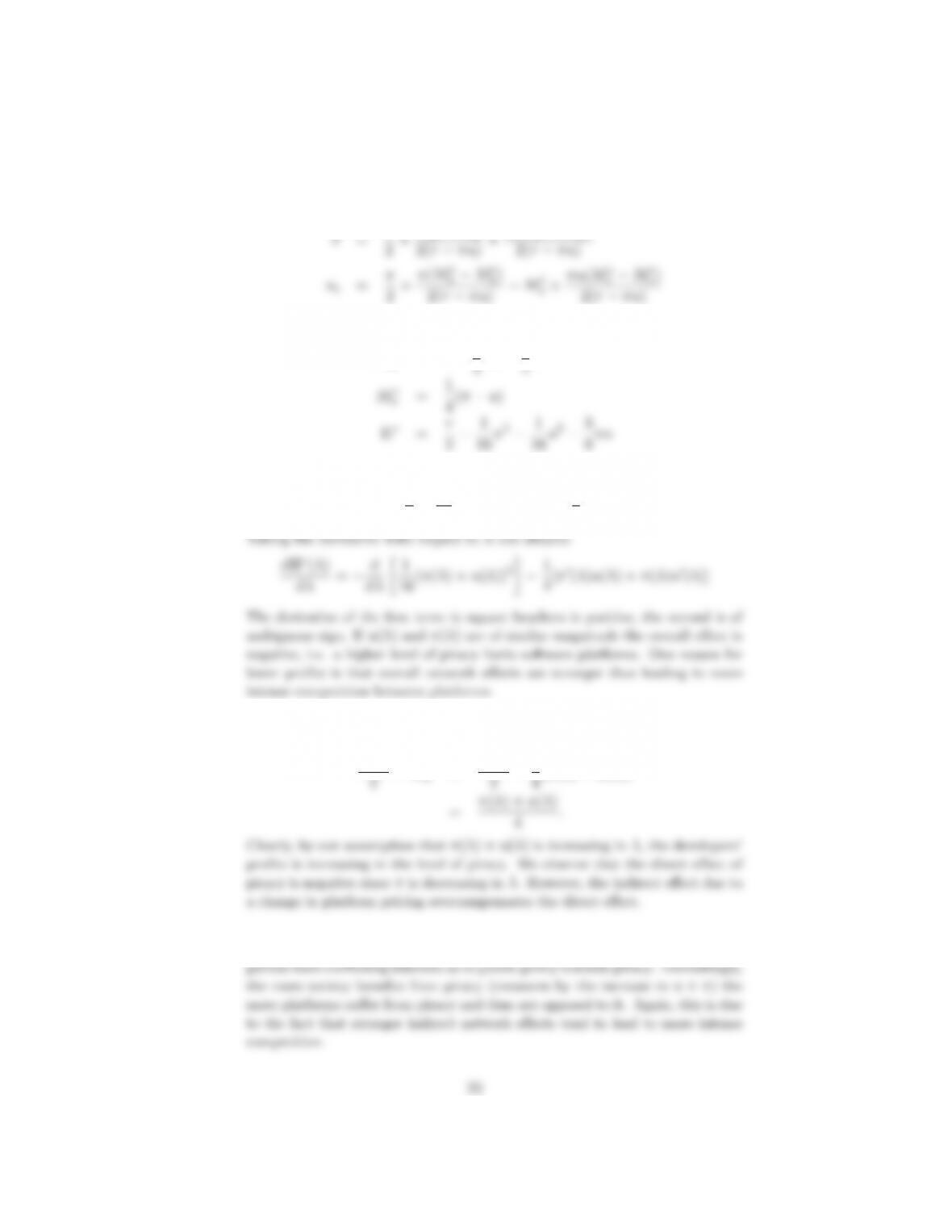
1.
b−M1
b
s−M1
s)
2.
M∗
b=τ−3
3. We can rewrite platform profits as
Π∗(λ) = τ
2−1
16(π(λ) + u(λ))2−1
4π(λ)u(λ).
4. In equilibrium, a developer’s profit gross of its fixed cost when joining a platform
is
π(λ)
s=π(λ)
5. In our setting developers always gain from piracy, while the effect on platform
profits is ambiguous (it is negative if uand πare of similar size). Thus these
Exercise 10 Strategies in platform markets
Refer to Section 22.3 to analyze the strategies that have been deployed in
the video-game industry in 2007, as described in the following two texts. From
the observed strategies, what can you infer about the nature of this two-sided
market? Is there singlehoming or multihoming on each side of the market?
Which side do you think (i) is the most sensitive to price, (ii) exerts the strongest
indirect network effects on the other side? Discuss.
“In the competition among the makers of video-game consoles,
momentum for the Wii from Nintendo is building among crucial al-
lies: game developers and publishers. Inspired by the early success
of the Wii, the companies that create and distribute games are be-
ginning to shift resources and personnel toward building more Wii
games, in some cases at the expense of the competing systems, the
21

Exercise 11 Experts and credence goods5[included in 2nd edition of the book]
Consider a unit mass of consumers. Each consumer has a problem that can
be major or minor. Two treatments are available: a minor treatment can only
solve a minor problem while a major treatment can solve both types of problem.
Let vdenote the gross gain of a consumer when his problem is solved; otherwise
he gets 0. The consumer knows that he has a problem but he does not know
the type of this problem. Ex ante, each consumer expects that his problem is
major with a probability hand minor with a probability (1 −h).
An expert can detect the true type of the problem only by conducting a
proper diagnosis. Without diagnosis, the expert cannot supply an appropriate
treatment and can only choose to always supply a minor treatment or a major
one. The cost of a major treatment is c, and the cost of a minor treatment is c,
with c > c. If a diagnosis is performed, the expert bears a cost dthat is charged
to the consumers.
In the first period of the game, the expert posts prices pand prespectively
for a major and a minor treatment, and commits to conducting a diagnosis or
not. Consumers observe these actions and decide, in the second period, whether
to visit the expert or not. In the third period, nature determines the type of the
consumer’s problem (major or minor). In the fourth period, the expert conducts
a diagnosis or not, recommends a treatment, charges for it and provides it. The
action of making a diagnosis is observed by the client but the result of this
diagnosis is not.
1. Show that the equilibrium prices (p, p) satisfy:
(a) p−c=p−cwith p=v−d+(1 −h)(c−c) for d≤min{(1 −h)(c−c),
h(v−(c−c))},
(b) p−c > p −cwith p=vfor d≥(1 −h)(c−c) and v≥(c−c)/h,
(c) p−c < p−cwith p= (1−h)vfor d≥h(v−(c−c)) and v≤(c−c)/h.
2. Does the asymmetric information lead the expert to bias his behavior?
3. Suppose now that consumers are risk-averse. In particular, when the ex-
pert posts prices (p, p) that ensure p−c=p−c, the consumer incurs
a positive risk premium δ(due to differentiated prices according to the
treatment), and when the expert posts prices that always lead to a mi-
nor treatment (i.e. p−c<p−c), the consumer incurs a positive risk
premium γ(due to the risk of an insufficient treatment). Show that with
risk-averse consumers the asymmetric information leads the expert to bias
his behavior towards an inefficient treatment for:
d∈min (1 −h)(c−c),
h(v−(c−c)) + γ−δ, min (1 −h)(c−c),
h(v−(c−c)) + γ.
4. Based on the previous questions, explain why full insurance and informa-
tion disclosure are not compatible strategies for the expert.
Solution to Exercise 11
1. Under equal markup prices (i.e., p−c=p−c) and diagnosis committed, the
consumer is provided honestly and its expected utility is: h u(v−p−d) +
2. The consumers are efficiently served when they are served as in an environment
with symmetric information on the diagnostic outcome. The expert that pro-
vides an overtreatment (resp. an undertreatment) does not conduct a diagnosis,
3. Since consumers are risk-averse, the maximal profit per customer for a monop-
olist is: πAT ≡v−d−δ−c−h(c−c)under equal markup, πO≡v−c
under overtreatment, and πU≡(1 −h)v−γ−cunder undertreatment. It
is easy to see that (1) πAT ≥πOiff d≤(1 −h) (c−c)−δ, (2) πAT ≥πU
iff d≤h(v−(c−c)) + γ−δ, and (3) πO≥πUiff v≥(c−c−γ)/h.
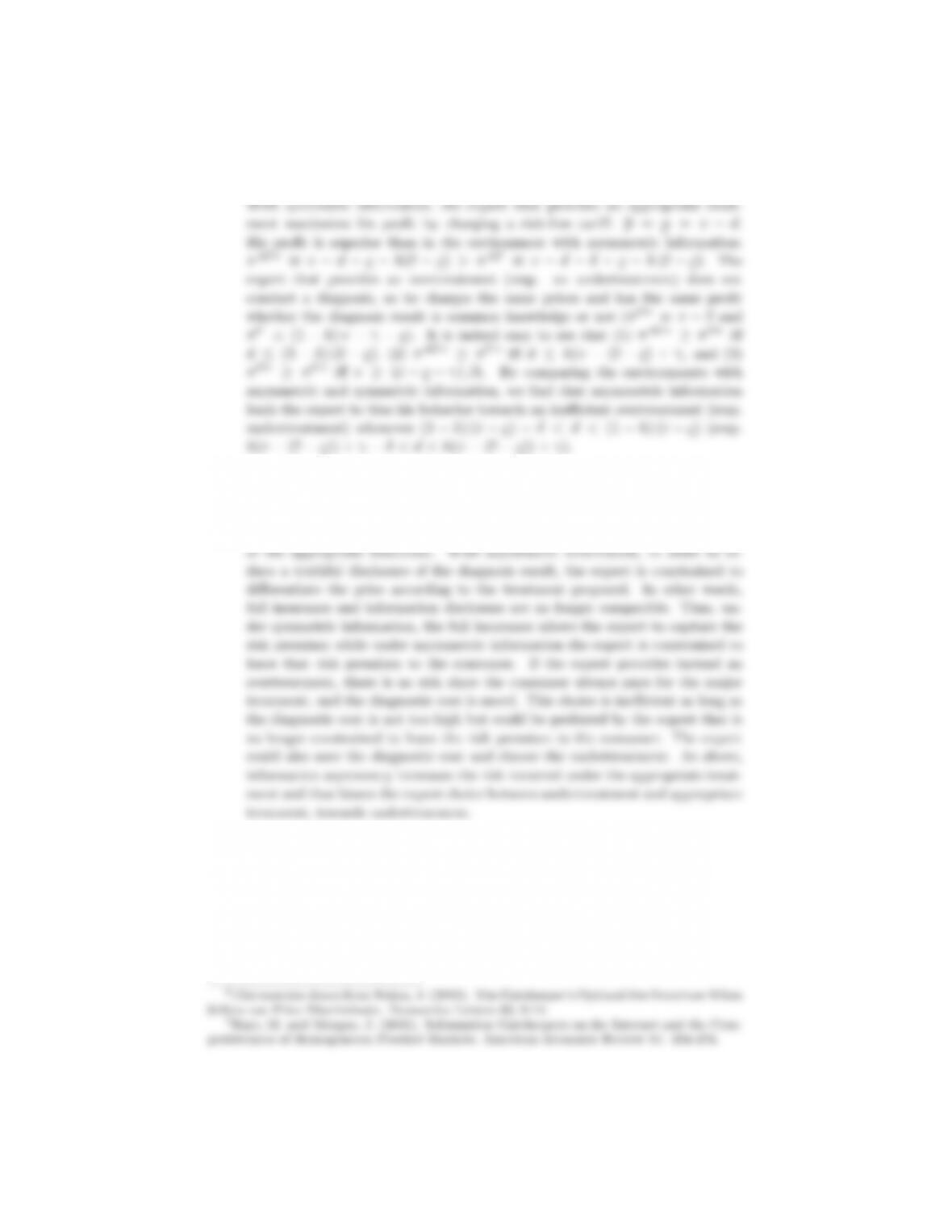
4. With symmetric information on the diagnostic outcome, if the expert under-
takes the diagnosis, he chooses the same price for both treatments and then
provides the appropriate treatment. The information symmetry on the diag-
nostic outcome allows the combination of a risk-free tariff and the completion
Exercise 12 Competition in search markets6[included in 2nd edition of the
book]
In Section 23.1.2, we developed a simplified version of Baye and Morgan
(2001).7Let us recall the main assumptions of the model. Suppose there are
two local markets. On each market, there is a single firm and a unit mass of
24
consumers. The two firms sell identical products at a constant marginal cost
which, for simplicity, is supposed to equal zero (the cost of delivering goods to
consumers is also zero). Each consumer has a demand function q(p) = 2−p. The
two local markets are completely segmented: consumers in local market ionly
have access to firm i. Therefore, the expected profits of firm iwhen it charges
a price pto consumers in its local market is π(p) = p(2 −p); the monopoly
price is easily computed as pm= 1. It costs a consumer 0 < z < 1
2to visit a
local store. The assumption that z < 1
2ensures that a consumer who is charged
the monopoly price pmobtains sufficient surplus to make a visit worthwhile.
The consumer surplus at some price pis indeed computed as v(p) = 1
2(2 −p)2;
hence, v(pm)−z=1
2−z > 0. The internet makes it possible for an intermediary
to open a virtual marketplace and, thereby, eliminate geographic boundaries
between the two local markets. In the absence of such a virtual marketplace,
each firm simply charges the monopoly price to all of its local consumers to earn
profits of π(1) = 1. In contrast, the creation of a virtual marketplace allows
firms and consumers to globally transmit and access price information. The
intermediary runs the flows of information by charging an access fee, Ms≥0,
to firms posting their price on the website, and a subscription fee, Mb≥0, to
consumers accessing price information from the website.
In Section 23.1.2, we assumed that firms were not able to price discriminate
among consumers. In particular, firms had to charge the same price to all cus-
tomers regardless of whether they purchase through the intermediary. There ex-
ist, however, situations where sellers can price discriminate between consumers
who visit them directly and those who visit them through an intermediary.
We take this alternative assumption in this exercise and we analyze the
following game: in the first stage, the intermediary announces the fees Msand
Mb; in the second stage, given the fees, consumers decide whether or not to
subscribe to the website; firms choose their prices for the product and decide
whether or not to post a price on the website; finally, consumers shop. The
game is solved for its symmetric subgame perfect equilibria.
1. Show that the following constitutes a subgame perfect equilibrium of the
game:
(a) The intermediary sets Mb=v(0) −v(pm) = 1.5 and Ms= 0.
(b) All consumers subscribe to the intermediary.
(c) Both firms post their price on the website with probability one.
(d) Both firms advertise a price of c= 0 on the website and charge the
monopoly price pm= 1 in their local market.
2. Show that this full participation equilibrium entails not only the socially
optimal allocation but also the highest profit for the intermediary.
Solution to Exercise 12
25
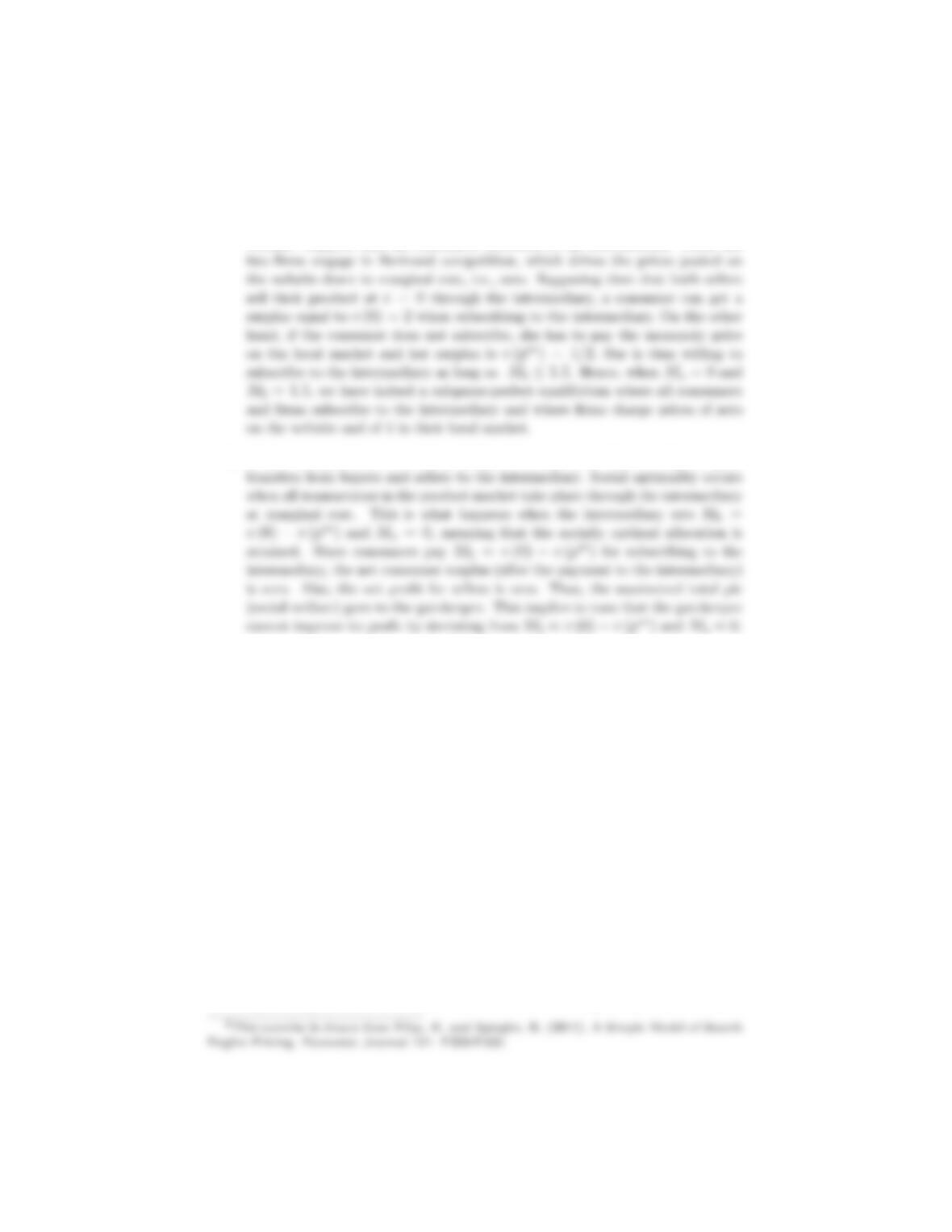
1. (We adapt here the proof of Proposition 1 in Nahm, 2003). When Msis zero,
it is a weakly dominant strategy for sellers to post a price on the intermediary’s
website. Suppose that all consumers subscribe to the intermediary. Then, the
2. (This is Proposition 2 in Nahm, 2003). Note first that Mband Msare pure
Exercise 13 Search engine pricing8[included in 2nd edition of the book]
Consider a market consisting of a continuum of consumers, a continuum of
firms and a monopolistic search engine. A firm is identified by a parameter q
that measures its ‘relevance’ for the consumers. That is, when a consumer is
matched with a firm of type q, there is a probability qthat the match delivers
a positive value to the consumer, i.e., that the consumer is willing to pay an
amount v≥0 for the firm’s product. We assume that vis randomly drawn
(independently across all matches) from a uniform distribution over the unit
interval.
We analyze the following two-stage game. In the first stage, the search
engine posts a ‘price-per-click’, r, which firms have to pay to the search engine
each time a consumer visits the firm (whether or not the consumer eventually
transacts with the firm); only firms that accept the posted price-per-click are
admitted into the search pool. In the second stage, market interaction takes
place. As for firms, they simultaneously decide whether or not to pay the price-
per-click rand if so, which price to set for their product. As for consumers, they
correctly anticipate the set of firms that enter the search pool and form a belief
26

about the distribution of prices in the market; they follow a sequential-search
process with a search cost of sper round (i.e., a consumer samples a first firm
for free, learns the value of the match and this firm’s price, and then decides
whether or not to pay the search cost sand draw a new sample).
1. Consider first the market interaction at the second-stage of the game.
Let E(q) denote the expectation of qwith respect to the population of
firms in the search pool (which is given at this stage). Characterise a
uniform-price equilibrium, which is defined as a price p∗and a stopping
rule for consumers, which satisfy the following properties: (i) given that
all firms charge p∗, the consumers’ stopping rule is optimal; (ii) given the
consumers’ stopping rule and the belief that all firms charge p∗, no firm
has an incentive to deviate to a different price. Note that a stopping rule
is a function that specifies the realised match values and prices, (v∗, p∗),
for which the consumer stops searching.
2. Express the equilibrium ‘conversion rate’ for a firm of type q(i.e., the equi-
librium probability that a consumer who clicks on this firm will buy from
it); denote it CR∗(q). From there, express the equilibrium gross profit-
per-click that a firm of type qearns at equilibrium as π∗(q) = p∗CR∗(q).
Express also the consumer’s ex ante expected surplus from searching in
the pool (i.e., the expected value of the item that will ultimately be pur-
chased, minus its equilibrium price minus the expected search costs; denote
it S∗). Under which condition do consumers find it optimal to enter the
market and face the uniform-price equilibrium (i.e., what is the condition
for S∗≥0)?
3. Assume that the search engine incurs no cost. The search engine then
maximizes its revenue, which is defined as the price-per-click rmultiplied
by the expected number of clicks (i.e., the expected number of samples
that consumers draw in the uniform-price equilibrium induced by r, or
equivalently the inverse of the expected conversion rate).
(a) Determine q∗as the type of the firm that is just indifferent between
entering the search pool or not for a given price-per-click r. That
is, π∗(q∗) = r. Using this definition and the results obtained in (2),
show that the search engine’s profit can be expressed as
Π = √2sq∗
[E(q)]3/2,
where E(q), the average relevance in the pool, should now be writ-
ten more precisely as EG(q|q≥q∗), with Gbeing the cumulative
distribution function according to which qis distributed.
(b) Suppose that qis distributed as follows: q=qH= 1 with probability
αand q=qL<1 with probability 1 −α. Establish under which
condition the search engine finds it optimal to contaminate the search
27
pool with firms of relatively low relevance; that is, the search engine
sets rso that q∗=qLand all low-type firms enter. Discuss this
result.
Solution to Exercise 13
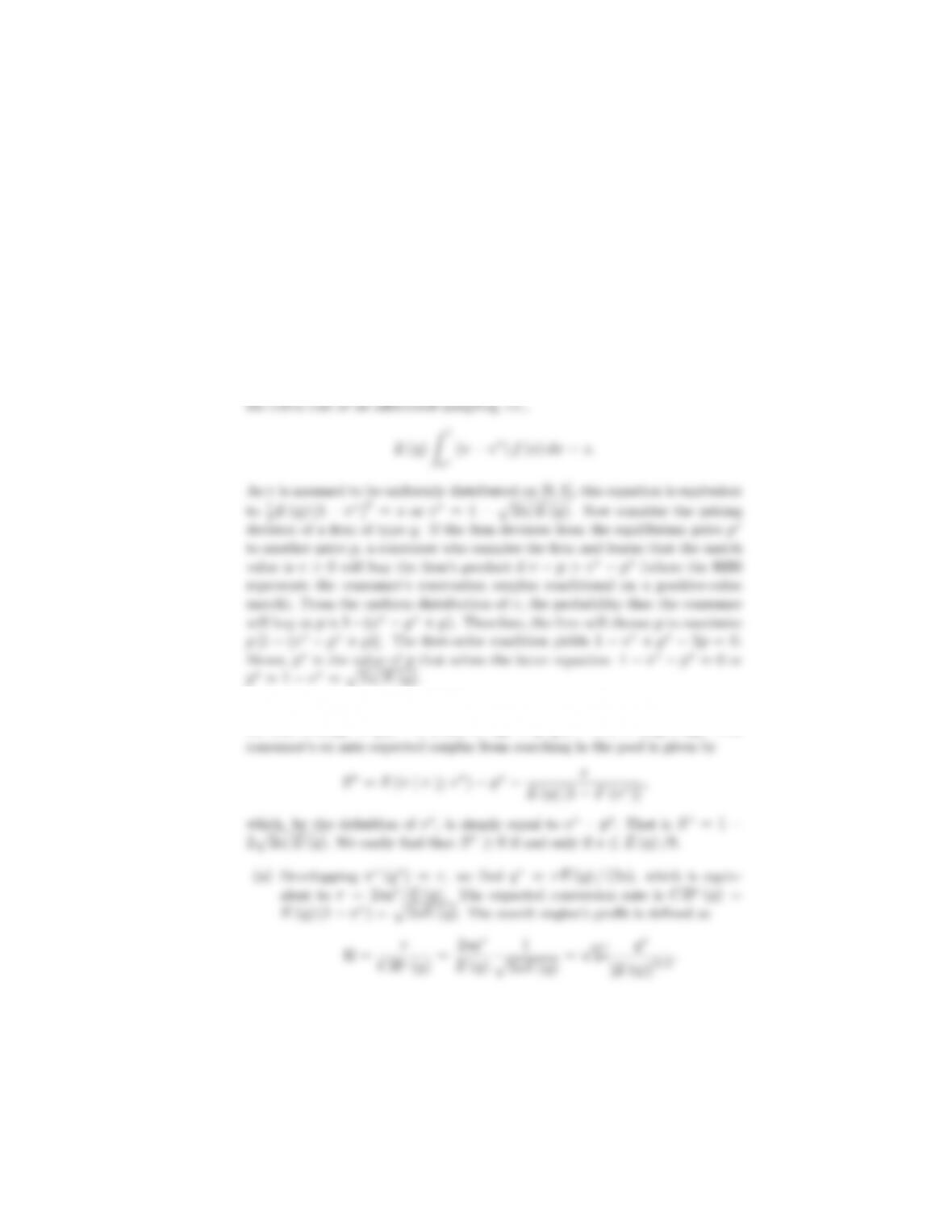
1. We start with the consumers’ stopping rule. Their stopping obeys a cutoff rule
because of the stationary environment that they face (as all firms charge the
same price p∗). In other words, there exist v∗in [0,1] such that in equilibrium,
consumers stop searching if and only if the current match value vis at least as
large as v∗. The cutoff v∗is found by equating the extra expected benefit and
2. We find that CR (q) = q[1 −F(v∗)]. As vis uniformly distributed on [0,1],
we have CR (q) = q(1 −v∗)and π∗(q) = p∗q(1 −v∗) = 2sq/E (q). The
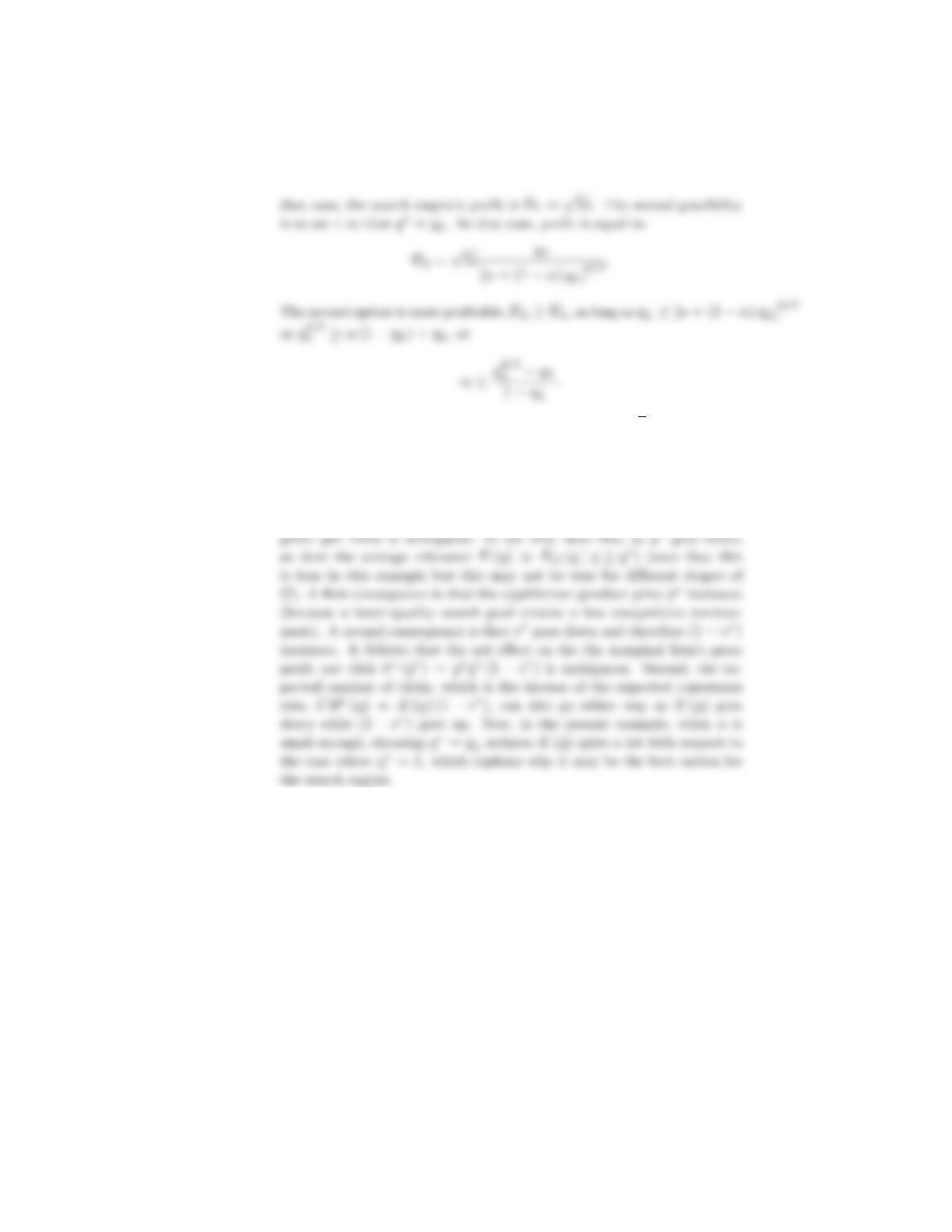
(b) Given the distribution of q, the search engine has two possibilities. The
first possibility is to set rso that the cutoff q∗is arbitrarily close to 1,
meaning that the search engine admits only the highest quality firms. In
28
1−qL
For instance, with qL= 1/2, the condition is α≤3
√2−1 = 0.260.
To understand this result, let us decompose the effects on the search en-
gine’s profit of setting rin a way that effectively reduces the search pool’s
marginal relevance q∗. Recall that the search engine’s profit is the prod-
uct of the price-per-click and the expected number of clicks. First, the ef-
fect on the the price-per-click (which is equal to the marginal firm’s gross
Exercise 14 Media competition and advertising
Two media companies compete for viewers by proposing horizontally differ-
entiated content. To model this horizontal differentiation, we use the Hotelling
model. We assume that media 0 is located at point 0, and media 1 at point 1. A
mass 1 of viewers are uniformly distributed along the unit line. They consume
at most one unit of content from at most one media (think of viewing a TV
show, or visiting a web page). They incur a disutility of 10 per unit of distance
between their location and the location of the media that they choose to view.
More precisely, the net utility for a viewer located at x∈[0,1] is
U0(x) = v−10x−p0if viewing media 0,
U1(x) = v−10 (1 −x)−p1if viewing media 1,
29
where vis the intrinsic valuation of viewing media and piis the price of viewing
media i. We assume that vis large enough so that all viewers consume some
media at equilibrium. We also assume that the marginal cost of providing
content is zero for the two companies.
1. Derive the equilibrium of the price competition game. Express the equi-
librium prices and profits for the two media companies.
2. Suppose now that media company 0 contemplates changing its business
model: instead of selling its content, it will give it away for free (i.e.,
it commits to set p0= 0), and will finance its operations by selling ad-
vertising space to advertisers. We assume that there is a unit mass of
advertisers with utility Ua=αn0−pa−y, where αis the revenue per
viewer that an advertiser can achieve, n0is the mass of viewers attracted
by media 0, pais the price per ad set by media 0 and yis the opportunity
cost of the advertiser (with yuniformly distributed between 0 and 1). In
what follows, we set α= 5. We also assume that the viewers’ utility is
affected by the presence of advertising in the media; their (net) utility
from viewing media 0 becomes Ua
0(x) = v+λna−10x, where nais the
number of ads present on media 0, and λis the viewer’s valuation of an
additional ad present on media 0; if λis positive (resp., negative), we say
that viewers are ‘ad-lovers’ (resp., ‘ad-haters’) as additional ads increase
(resp., decrease) their utility. In what follows, we assume that λ < 4
to ensure that the maximization problems of the two companies are well
defined.
(a) Derive the demand for advertising given a price paand a viewership
n0(we assume that each advertiser places one ad on the media):
na(pa;n0). Derive also the demands for the contents of the two media
given a price p1and a number of ads na:n0(p1;na) and n1(p1;na).
(b) As nadepends on n0, and n0and n1depend on na, you need now
to solve this system of equations to express the various demands as
a function of prices only, i.e., na(pa, p1), n0(pa, p1) and n1(pa, p1).
How do demands depend on prices? Why is it important to assume
that λ < 4?
(c) Solve now for the Nash equilibrium prices of the two media compa-
nies. Media 0 chooses pato maximize π0=pana(pa, p1), while media
1 chooses p1to maximize π1=p1n1(pa, p1). Express the condition
for media 1 to stay in business. Express the equilibrium profits of
the two medias when media 1 stays in business and when it does not.
3. Comparing your answers to questions 1 and 2, show that a necessary
(but not sufficient) condition for media 0 to adopt the ad-based business
model is that it can induce media 1 to leave the business. Explain the
intuition behind this result. (Hint: It is quite challenging to prove the
30
result analytically; so, you can use excel or any other software to prove
the result numerically.)
Solution to Exercise 14
1. This is nothing but the usual Hotelling game. It is well known that in
this particular configuration, equilibrium prices are equal to the sum of
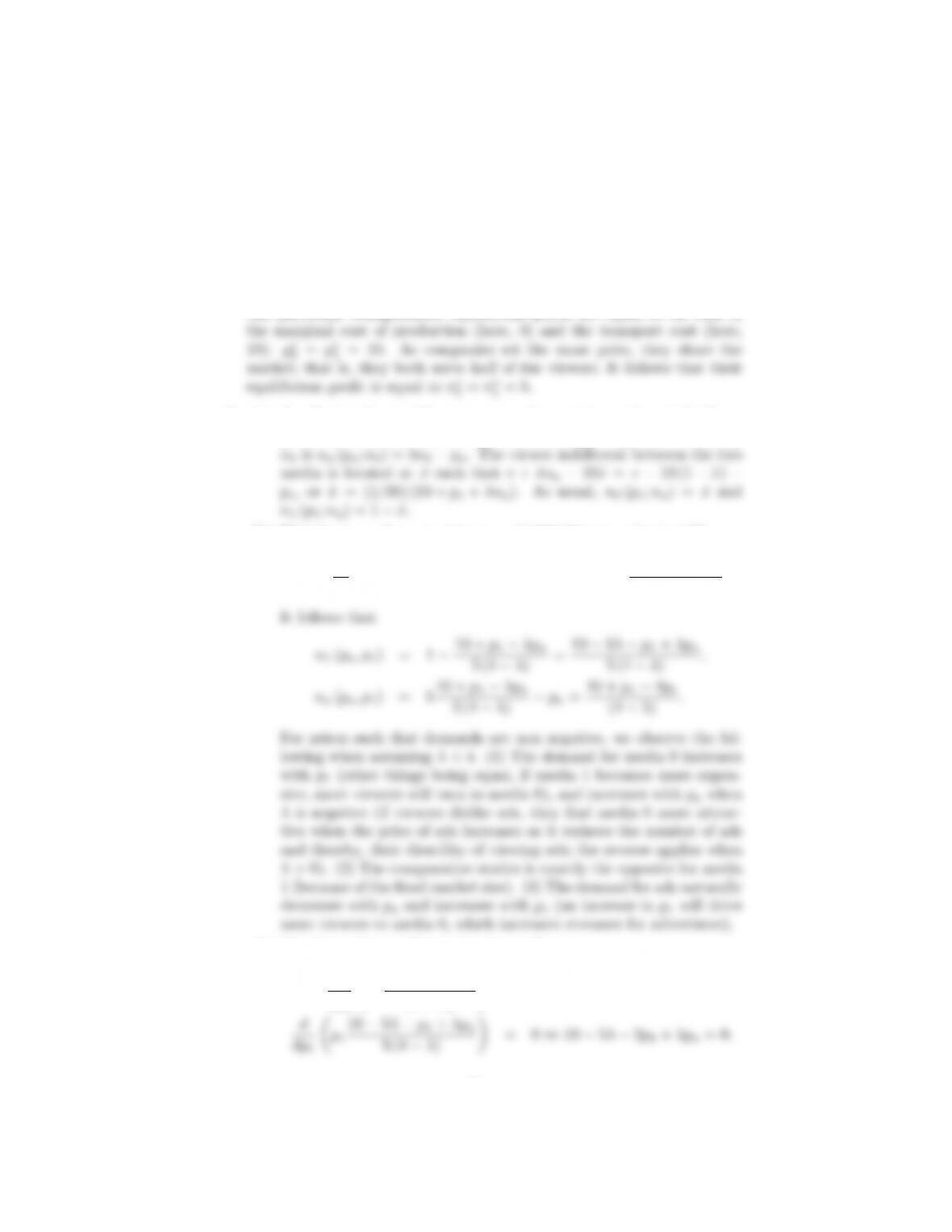
2. (a) As all advertisers with an opportunity cost lower than ˆydecide to
place their ad, the total number of ads at price paand viewership
(b) Plugging na= 5n0−painto n0= (1/20) (10 + p1+λna) yields
n0=1
20 (10 + p1+λ(5n0−pa)) ⇔n0(pa, p1) = 10 + p1−λpa
5 (4 −λ).
(c) The first-order conditions for the medias are
d
dpapa
10 + p1−4pa
(4 −λ)= 0 ⇔10 + p1−8pa= 0,
31
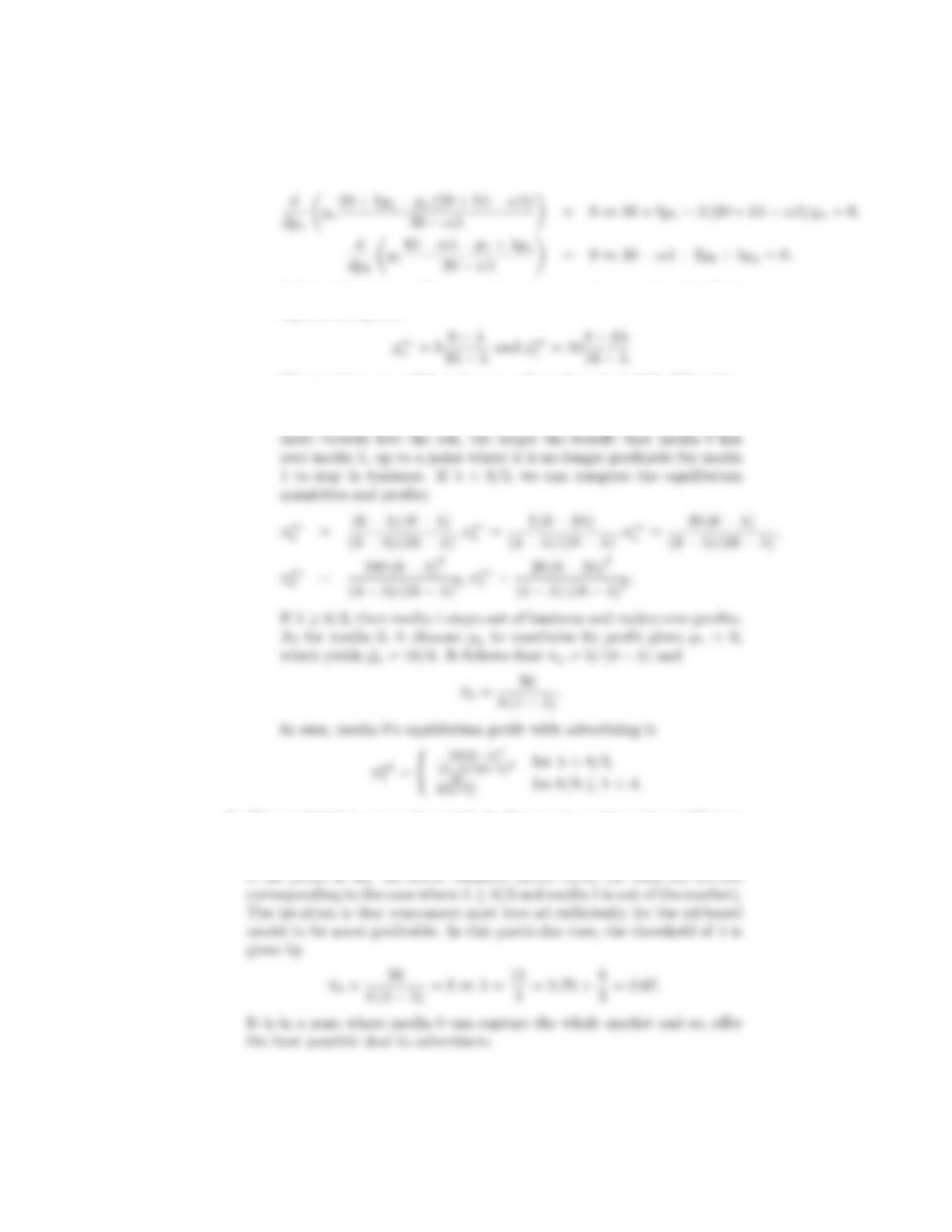
Solving this system of two equations in two unknowns gives the Nash
equilibrium prices:
These prices are valid as long as p∗∗
1≥0 or λ < 8/3. Otherwise,
media 1 would prefer to stay out of business (as its price would not
cover its marginal cost of production). The intuition is clear: the
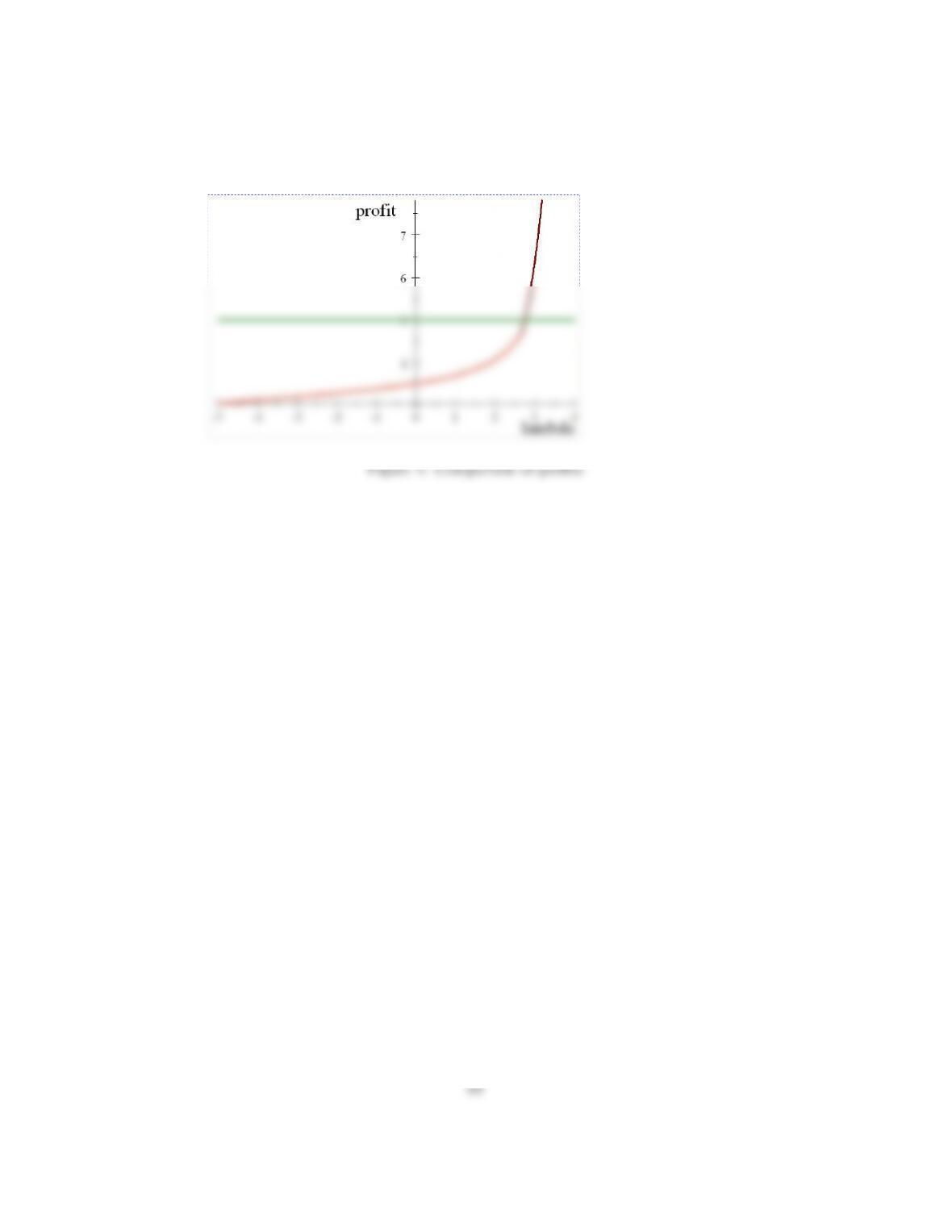
3. The graph below proves the result. In this graph, we draw the equilibrium
profits in the two cases for all admissible values of λ. The curve in green
is the profit in the ‘pricing’ business model (π∗
0= 5), and the curve in red
32
Exercise 15 Monopoly two-sided platform
Consider a monopoly platform serving two distinct groups of users. Each
group i=a, b comprises a unit mass of users who interact on the platform.
The platform charges (possibly different) membership fees for the two groups,
Maand Mb. The constant marginal cost of attracting users on the platform
is normalized to zero. A user of group ienjoys the following net utility when
interacting on the platform with users of the other group:
Ui=ui+γinj−Mi,
where uiis the intrinsic value of being on the platform, γimeasures the indirect
network effect provided by an additional member of side jon each member of
side i,njis the number of members of side jon the platform. We assume
that uiis drawn from a uniform distribution on [0, vi]. As for indirect network
effects, we assume that they are positive on both sides (γa, γb>0).
1. Derive the number of participating users on side ias a function of the
number of participating users on the other side.
2. Solve for the system of equations that you derived in the previous question
so as to express the number of participating users on the two sides as a
function of the two membership fees. Why is it legitimate to assume that
γaγb<1? Discuss your answer.
3. Suppose now that γa=γ(with 0 < γ < 1) and γb= 0; that is, users on
side awelcome more users on side bwhereas users on side bare unaffected
by any change in participation on side a. To simplify the analysis, set va=
vb= 1. Use your answers to question 2 to solve the profit-maximization
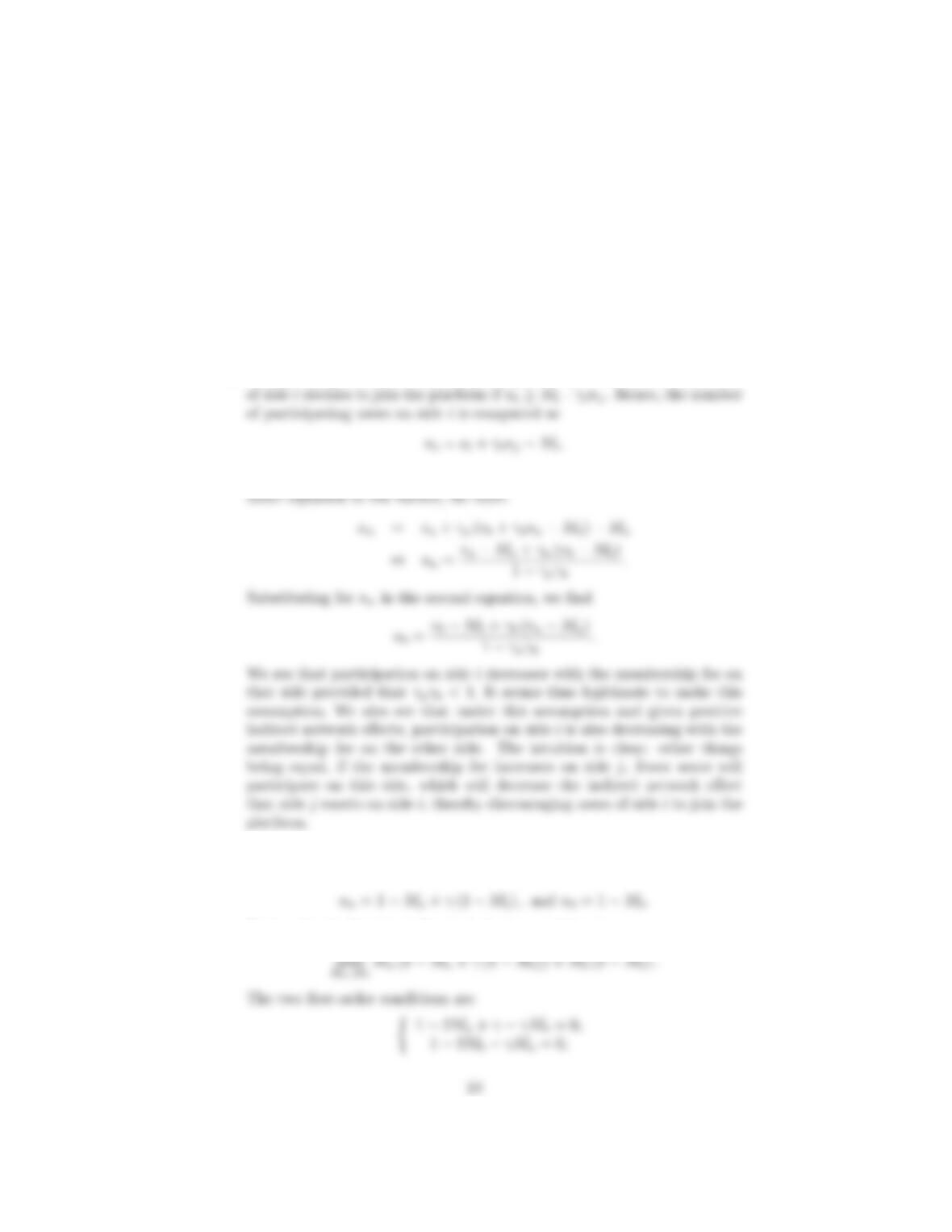
problem of the monopoly platform. Express the membership fees as well
as the profit at the optimum.
4. Interpret the results that you obtained at the previous question. Which
side is charged the largest membership fee? Why? How do membership
fees and the platform’s profit evolve with the strength of indirect network
effects? Explain the economic intuition.
Solution to Exercise 15
1. Facing a membership fee Miand participation njon the other side, a user
2. We have na=va+γanb−Maand nb=vb+γbna−Mb. Inserting the
3. Under the new assumptions, the participation levels derived in question 2
can now be rewritten as:
Hence, the platform’s profit-maximization problem is
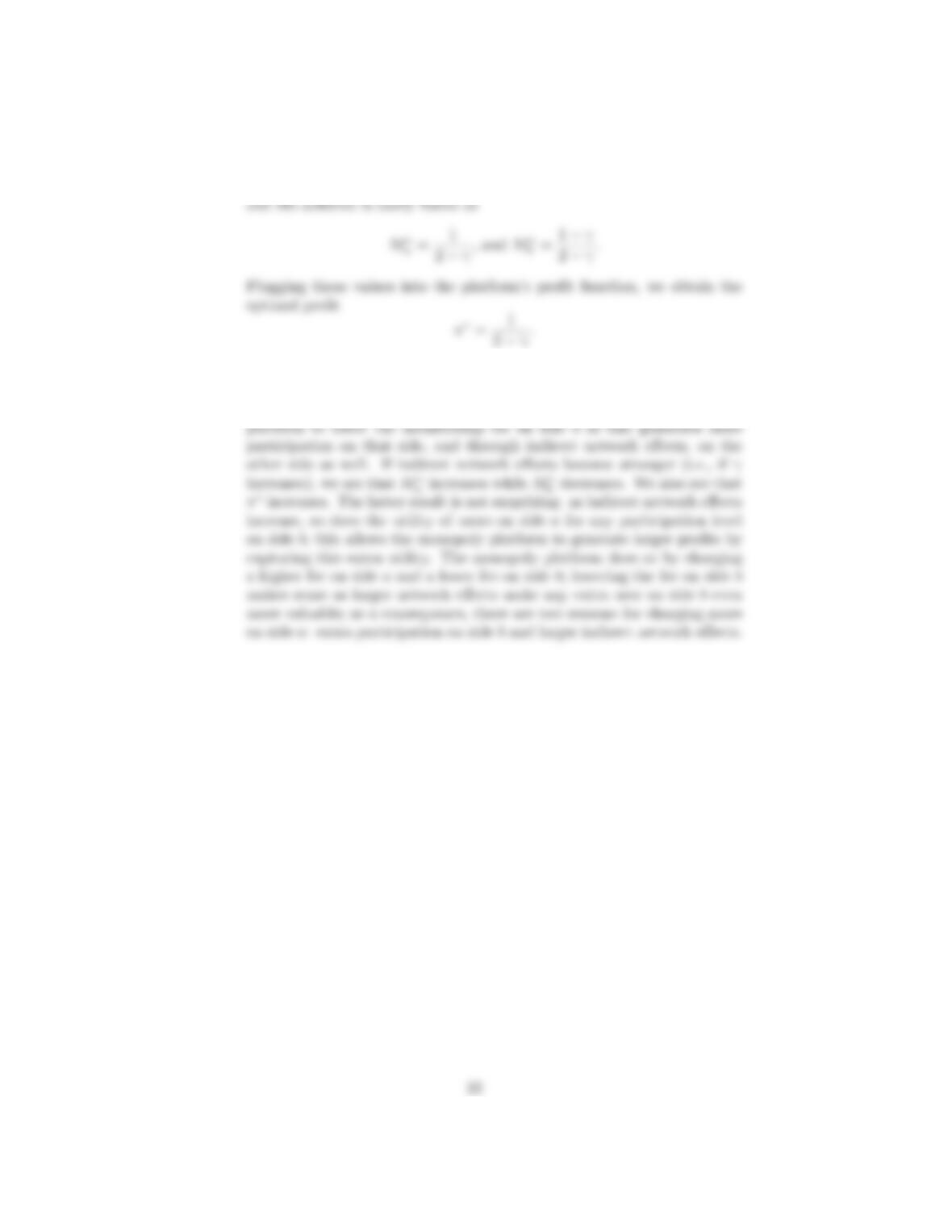
4. We clearly see that M∗
a> M∗
b, meaning that the platform charges a lower
membership fee on side b. This is logical as side bexerts a positive indirect
network effect on side a, while the reverse does not hold; it pays the