Industrial Organization: Markets and Strategies
Paul Belleflamme and Martin Peitz
published by Cambridge University Press
Part IX. Market intermediation
Exercises & Solutions
Exercise 1 Dealer vs pure platform operator [included in 2nd edition of the
book]
Repeat the analysis of Section 21.1.2 under the following assumptions. There
is a unit mass of sellers and a unit mass of buyers. Each seller produces a totally
differentiated good at a constant unit cost c, which is assumed to be uniformly
distributed over [0, γ]. Buyers have unit demand for each good; they buy if
they are offered a price below or equal to their reservation price v, which is also
assumed to be uniformly distributed over [0, β].
The difference with Section 21.1.2 is that we allow now for β6= 1 and/or
γ6= 1. Show that in spite of this difference, the main result still holds, namely
that the intermediary is indifferent between the roles of dealer and platform
operator.
Solutions to Exercise 1 Suppose first that the intermediary acts as a dealer who
makes take-it-or-leave-it offers to both sides of the market. That is, the intermediary
buys the goods from the sellers and sells them to the buyers. It seeks to maximize its
profit by setting a retail price or “ask price” pfor the buyers and a wholesale price
or “bid price” (p−P)for the sellers. Here, the transaction fee Pcorresponds to the
1
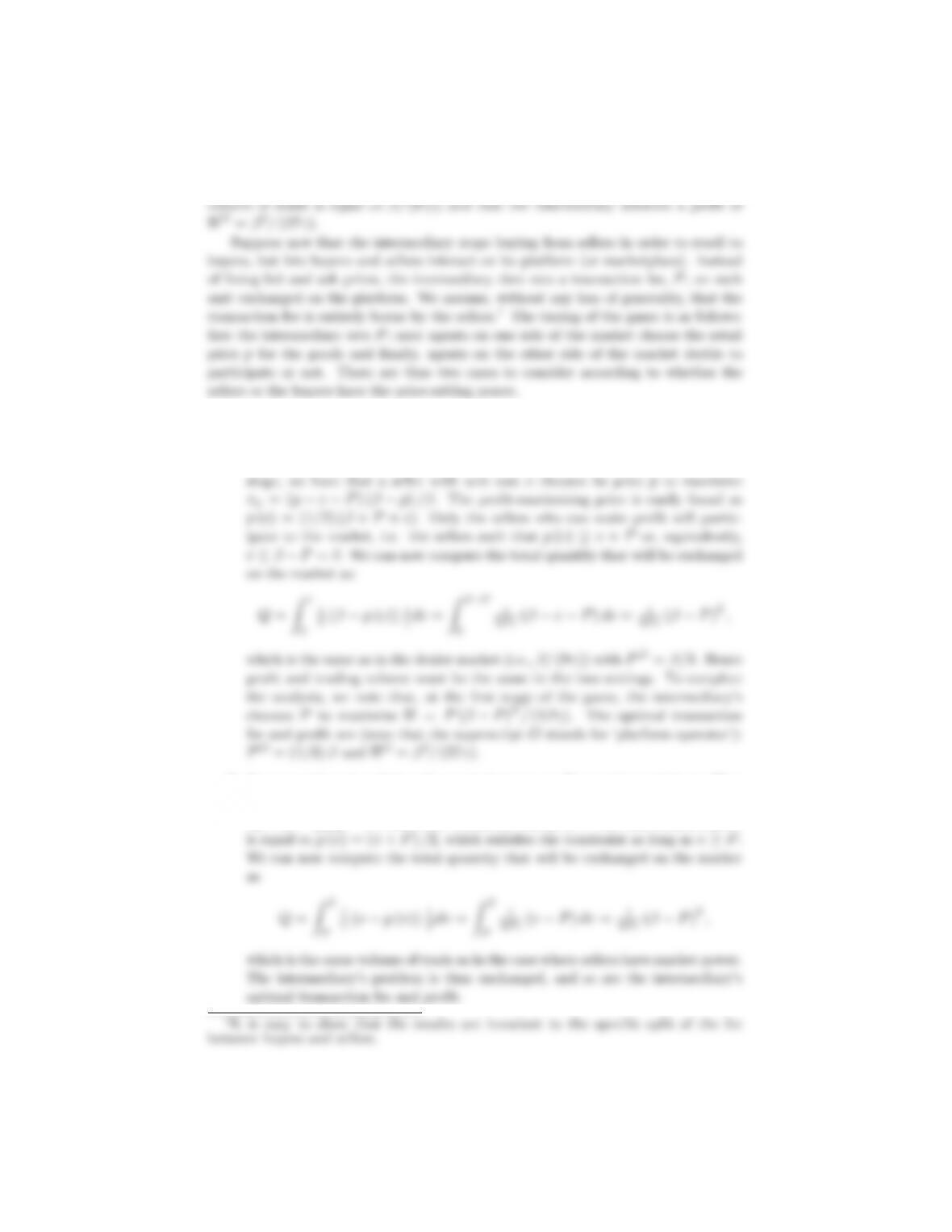
1. Sellers set the price. At the last stage, buyers decide to purchase if their reser-
vation price is larger than the price pset by the sellers. Therefore, each seller
faces a demand q(p) = (β−p)/β for its product. Moving to the second
2. Buyers set the price. Only sellers such that p > c+Paccept to participate. That
is, each buyer faces a supply equal to p−Pand hence, chooses pto maximize
ub= (v−p) (p−P)under the constraint that p≤v. The uncontrained price
2
Comparing the previous results, we observe that, in the special case of the uniform
distribution, the intermediary is indifferent between the two forms of intermediation
Exercise 2 Intermediation in a random matching market
Consider a homogeneous product market with two types of buyers and two
types of sellers in which each seller can sell one unit and each buyer has unit
demand. Buyer Hhas valuation vHfor the product and buyer Lhas valuation
vLwith vH> vL. Seller Hhas opportunity cost cHand seller Lhas cLwith
cH> cL. There is a unit mass of each buyer and each seller type. Consider the
parameter restriction vH> cH> vL> cL. Suppose that buyers and sellers are
randomly matched once. Suppose furthermore that buyers and sellers bargain
efficiently and that joint surplus from a match is split equally. If the joint
surplus is negative within a buyer-seller pair no trade occurs between the two.
1. Determine the expected allocation and the expected surplus for each buyer
and seller. Write one or two sentences describing the outcome.
3. An intermediary enters the market and offers to trade on its trading plat-
form. The intermediary charges a fee P > 0 to the seller whenever a
transaction occurs. If at least one seller and at least one buyer join the in-
termediary, they are randomly matched. Buyers and sellers decide whether
to remain in the non-intermediated matching market or to move to the
intermediated market. A randomly matched pair splits the net surplus
from trade evenly. Do there exist transaction fees P > 0 such that trade
on the intermediated platform occurs and thus the intermediary makes
strictly positive profits? Can trade of one unit via the intermediary be
supported in equilibrium? Is the non-intermediated matching market ac-
tive in equilibrium (i.e., does trade take place both on the intermediary’s
platform and outside)?
4. In the model with an intermediary from above, what can you say about
the efficiency properties of the equilibria characterized in part 3 of the
exercise?
Solutions to Exercise 2
1. In the non-intermediated matching market, buyer Hhas an expected net surplus
of (vH−cL+cH
2)/2, while buyer Lhas an expected net surplus of (vL−cL)/4.
3
2. The resulting allocation is inefficient whenever a buyer His matched to a seller
Hand a buyer Lis matched to a seller Hbecause both units are traded. Social
3. We construct an equilibrium in which buyers Hand sellers Ltrade through
the intermediary, while buyers Land sellers Hdo not join the intermediary
and are thus by default outside the intermediary. Then, a high-value buyer has
no incentive to deviate if (vH−cL−P)/2≥(vH−cH)/2or, equivalently,
P≤cH−cL. Similarly, a low-cost seller has no incentive to deviation if
4. The equilibrium in which all Hbuyers and Lsellers join the intermediary and
Exercise 3 Price-setting by a monopoly intermediary on a two-sided platform
Suppose that an intermediary faces a certain number of buyers and sell-
ers. The intermediary sets usage prices Psand Pbto be paid, respectively, by
sellers and buyers whenever there is an interaction between a particular seller
and buyer. Interaction can only take place on the platform owned by the in-
termediary. (The exact nature of this interaction is not specified. It is simply
postulated that a buyer’s gross surplus can be expressed in a reduced form that
depends only on the number of sellers, and that a seller’s surplus can be ex-
pressed in a reduced form that depends only on the number of buyers; that is,
positive indirect network effects are present). Let nband nsdenote the number
of buyers and sellers who decide to interact on the platform. Suppose that the
intermediary does not incur any cost. Hence, the intermediary chooses Pband
Psto maximize total revenues, R=nbns(Pb+Ps), where nbnsis the total
number of transactions conducted on the platform and (Pb+Ps) is the sum of
usage fees paid per transaction.
1. Suppose first that there are 3 buyers and 3 sellers (so nb, ns∈ {0,1,2,3})
and that the net surplus of buyers and sellers are as follows: all buyers
enjoy a net surplus of ub= (2 −Pb)ns; seller i(i= 1,2,3) enjoys a net
surplus of ui
s= (i−Ps)nb.
(a) Find the price Pbthat maximizes revenues on the buyers’ side.
(b) Given your answer at (a) and the corresponding buyers’ participation,
find the price Psthat maximizes revenues on the sellers’ side.
(c) Show that the intermediary can increase its revenues by setting a
lower price than the one you found at (b) and find the prices P∗
band
P∗
sthat maximize total revenues.
2. Suppose now that there are 6 buyers and 6 sellers, with the net surplus
of buyers and sellers being given by: all buyers enjoy a net surplus of
ub= (6 −Pb)ns; seller i(i= 1,…,6) enjoys a net surplus of ui
s=
(i−3−Ps)nb.
(a) Repeat steps (a) to (c) of the previous question and show that the
intermediary finds it optimal to subsidize sellers’ participation in this
case.
(b) Find the welfare-maximizing prices.
(c) Using your answers, explain the intuition behind the next three state-
ments: (i) The profit-maximizing price structure of an intermediary
reflects price elasticities and the sizes of the indirect network effects
on the two sides of the market. (ii) A profit-maximizing intermediary
may subsidize one side of the market so as to generate a higher vol-
ume of trade and thus, higher profits on the other side of the market.
(iii) While a profit-maximizing intermediary may decide to subsidize
one side of the market, the subsidy is too low from a social point of
view.
Solutions to Exercise 3
1. 3 buyers, 3 sellers
5
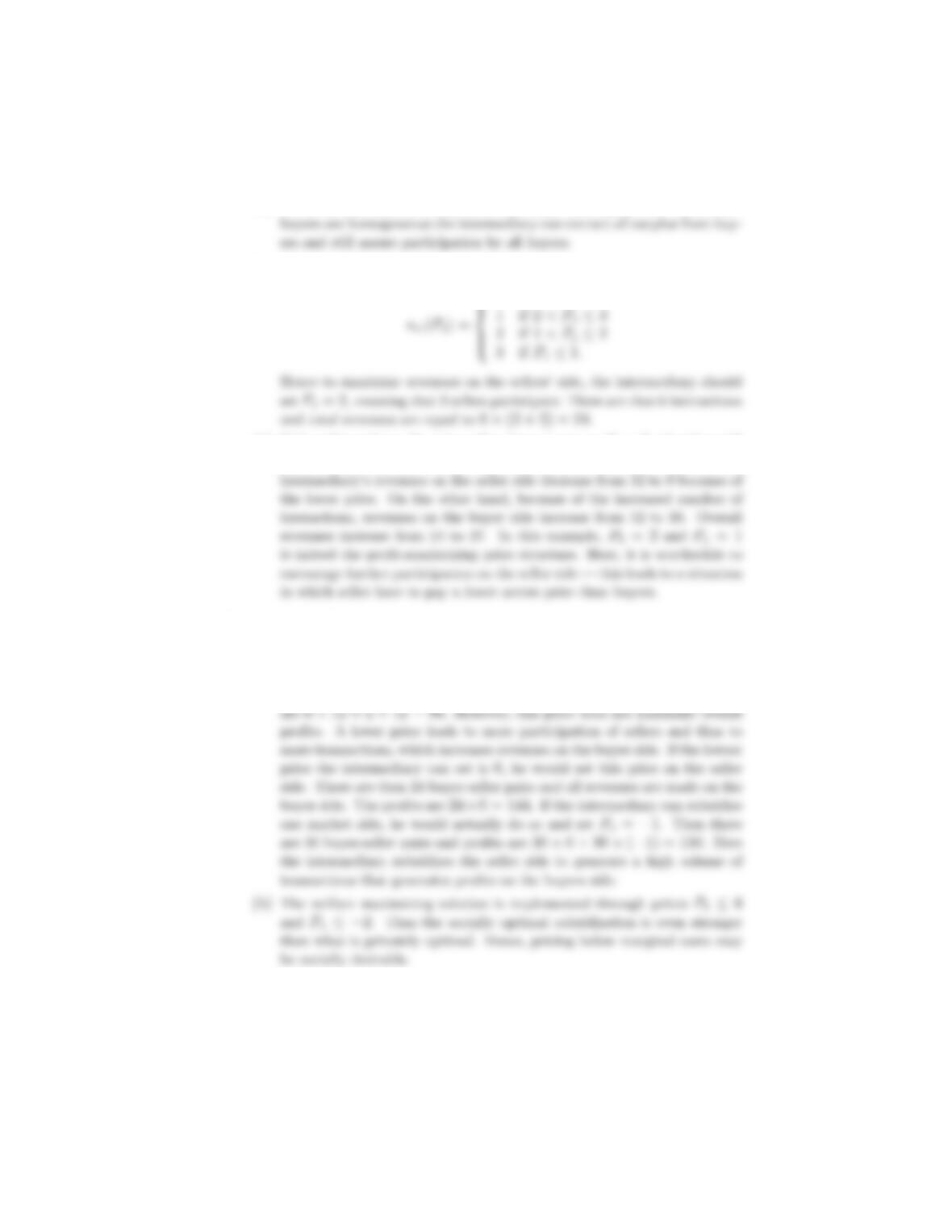
(a) The intermediary sets the price on the buyer side equal to 2. Here, since
(b) Given nb= 3, revenues on the sellers’ side are Rs= 3ns(Ps)Ps, with
0 if Ps>3
(c) If the seller reduces the price sellers have to pay to Ps= 1, all sellers will
join. Then there are 9 buyer-seller interactions. On the one hand, the
2. 6 buyers, 6 sellers
(a) On the buyer side the profit-maximizing price is obviously Pb= 6. Given
that all buyers participate, the price that maximizes profits on the seller
side is Ps= 2. In this case, there are 12 buyer-seller pairs overall profits
Exercise 4 Number of active two-sided platforms
Suppose there are two buyers (band ˜
b), two sellers (sand ˜s) and two inter-
mediaries (1 and 2) operating separate platforms. Buyers and sellers can only
6

be on one or the other platform (they cannot be on both at the same time, i.e.,
they singlehome). Hence, transactions can only take place between sellers and
buyers who are present on the same platform.
Sellers do not incur any opportunity costs. The buyers’ willingnesses to pay
for the two products are indicated in Table 1. In each cell, the first entry tells
how many monetary units a particular buyer is willing to pay for a particular
product. The number in parentheses is the net gain from trade. It is assumed
that any gains from trade are split evenly between buyer and seller. So, for
instance, buyer bis willing to pay 4 for the product of seller sand 2 for the
product of seller ˜s. If buyer btransacts with seller s, the net gain (gross of any
charges set by the intermediary) is thus equal to 2; it is equal to 1 when buyer
btransacts with seller ˜s. In this example each buyer has his preferred product,
but the consumption of the other product also increases utility. Thus there are
positive indirect network effects as a buyer’s utility increases with the number
of sellers who are active on her platform (and vice versa).
Product of sProduct of ˜s
Buyer b4 (2) 2 (1)
Buyer ˜
b2 (1) 4 (2)
Table 1: Willingnesses to pay and net gains from trade
Let us consider the following two-stage interaction. First, the two intermedi-
aries simultaneously set a uniform price that applies to all transactions and both
market sides of the platform. This implies that we impose a particular price
structure with the property that the intermediary cannot or does not bother to
check the identity of the parties involved in a transaction. Second, buyers and
sellers observe the prices P1
b=P1
s≡P1and P1
b=P1
s≡P2that are set at the
platforms and decide to which platform to go.
1. Suppose that the two platforms are equally attractive for all buyers and
sellers.
(a) Show that there does not exist an equilibrium such that both platform
have a positive volume of transactions (i.e., each platform attracts
one buyer-seller pair) and that has the property to be robust against
pairwise deviations (of one buyer and one seller).
(b) Characterize the equilibrium where all buyers and sellers go to the
same platform. Show that in this equilibrium, the active intermediary
can make positive profits (equal to 4) provided that all buyers and
sellers cannot perfectly coordinate their actions.
2. Suppose now that platforms are differentiated: buyer band seller sprefer
platform 1 while buyer ˜
band seller ˜sprefer platform 2; moreover, each
market participant incurs a utility loss (or transportation cost) of twhen
going to their less preferred platform.
7
(a) Consider first the case that the differentiation is not too strong; in
particular, assume that t < 1. Show that it is still true that only one
platform remains active in equilibrium.
(b) Consider next the case where platforms are more differentiated (t >
1). Show that, in this case, both platforms are active at equilibrium.
(Remark. As often in models with discrete types–here on the buyer
and seller side–, we cannot analyze Nash equilibria but strategy com-
binations that are stable in the following sense: first, no intermediary
can lower its price such that it increases profit and second, interme-
diaries choose among strategies that are robust to such attempts).
Solutions to Exercise 4
1. Undifferentiated platforms
(a) Note first that at any prices P1=P2<1, it is optimal for each buyer-
seller pair to deviate to the other platform. Network effects are of course
the underlying reason: they lead to a utility gain of 2in total for each
transaction. We can also exclude prices P1=P2≥1as a possible equi-
(b) Suppose for instance that all buyers and sellers go to platform 1and that
they have to pay a price P1= 1/2per transaction. Each buyer and seller
2. Differentiated platforms
(a) For t < 1, it is still true that only one platform remains active in equilib-
rium because indirect network effects are sufficiently strong compared to
the differentiation between platforms. Because of the utility loss by some
(b) Suppose that buyer band seller sincur a utility loss greater than 1 if they
visit platform 2. The same is supposed to hold for buyer ˜
band seller ˜s
if they visit platform 1. In this case, a single intermediary can no longer
Exercise 5 Pricing by a monopoly platform [included in 2nd edition of the book]
Consider a monopoly platform serving two distinct groups of users. Each
group i=a, b comprises a unit mass of users who interact on the platform.
The platform charges (possibly different) membership fees for the two groups,
Maand Mb. The constant marginal cost of attracting users on the platform
is normalized to zero. A user of group ienjoys the following net utility when
interacting on the platform with users of the other group:
Ui=ui+γinj−Mi,
9
where uiis the intrinsic value of being on the platform, γimeasures the indirect
network effect provided by an additional member of side jon each member of
side i,njis the number of members of side jon the platform. We assume
that uiis drawn from a uniform distribution on [0, vi]. As for indirect network
effects, we assume that they are positive on both sides (γa, γb>0).
1. Derive the number of participating users on side ias a function of the
number of participating users on the other side.
2. Solve for the system of equations that you derived in the previous question
so as to express the number of participating users on the two sides as a
function of the two membership fees. Why is it legitimate to assume that
γaγb<1? Discuss your answer.
3. Suppose now that γa=γ(with 0 < γ < 1) and γb= 0; that is, users on
side awelcome more users on side bwhereas users on side bare unaffected
by any change in participation on side a. To simplify the analysis, set va=
vb= 1. Use your answers to question 2 to solve the profit-maximization
problem of the monopoly platform. Express the membership fees as well
as the platform’s profit at the optimum.
4. Interpret the results that you obtained at the previous question. Which
side is charged the largest membership fee? Why? How do membership
fees and the platform’s profit evolve with the strength of indirect network
effects? Explain the economic intuition.
Solution to Exercise 5
1. Facing a membership fee Miand participation njon the other side, a user of
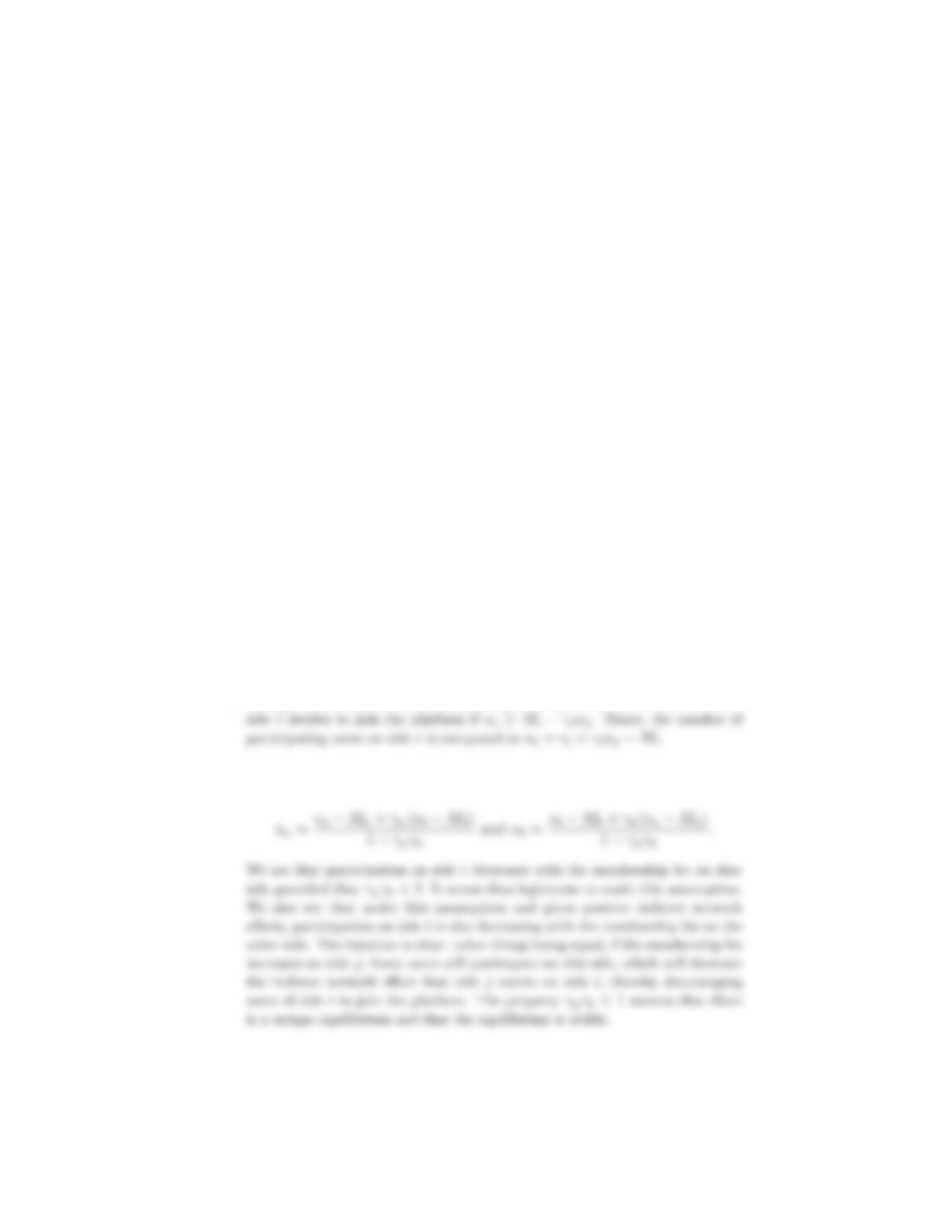
2. We have na=va+γanb−Maand nb=vb+γbna−Mb. Solving this system
for naand nb, we find
10
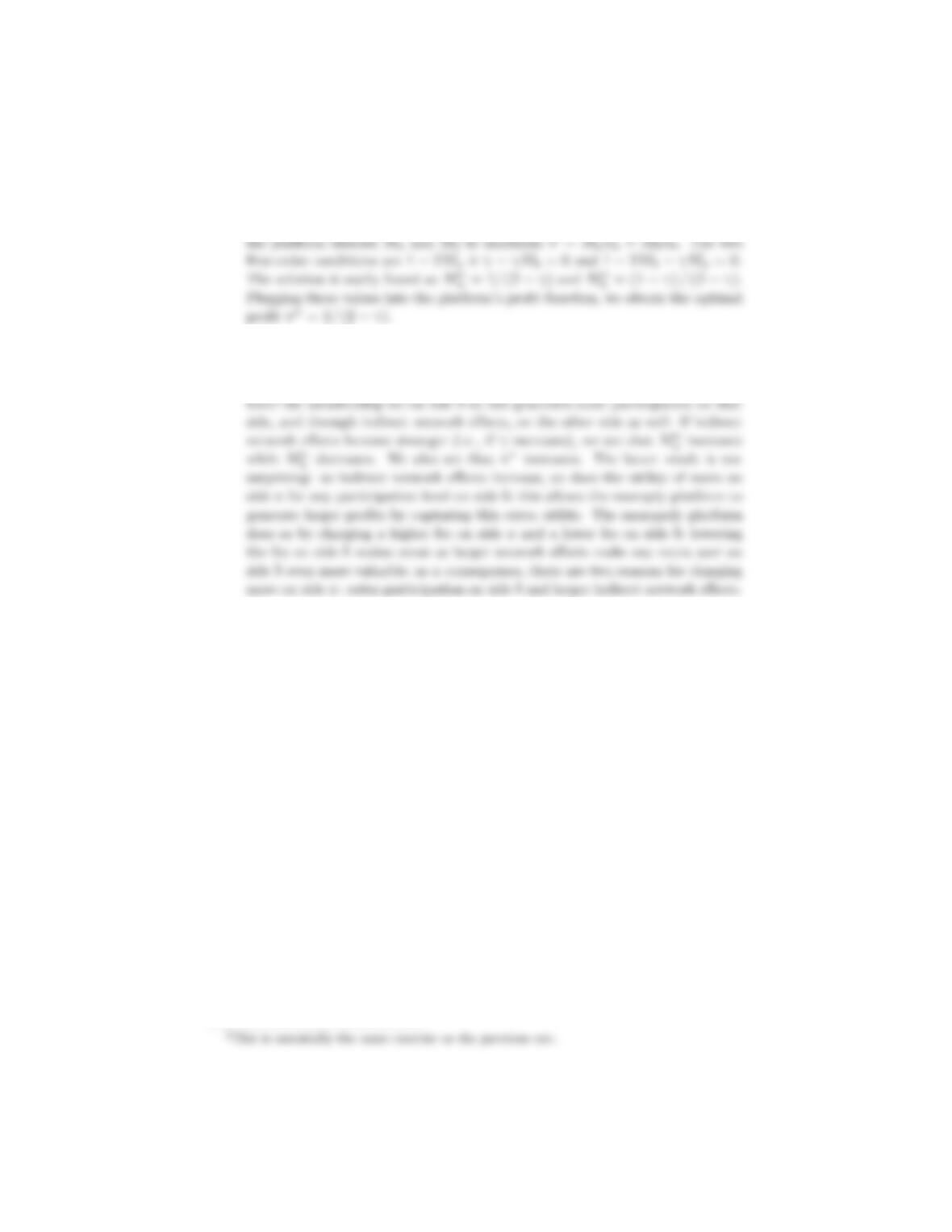
3. Under the new assumptions, the participation levels derived in question 2 can
now be rewritten as na= 1 −Ma+γ(1 −Mb),and nb= 1 −Mb.Hence,
4. We clearly see that M∗
a> M∗
b, meaning that the platform charges a lower
membership fee on side b. This is logical as side bexerts a positive indirect
network effect on side a, while the reverse does not hold; it pays the platform to
Exercise 6 Pricing by a monopoly platform II2
Suppose that a unit mass of buyers and a unit mass of sellers have the
possibility to interact on a monopoly platform. Sellers sell independent products
and buyers have a demand for one unit from each seller. Each seller makes a
profit per buyer of πand each buyer derives utility uper seller. Then surplus
of a seller who joins the platform is
vs=nbπ−Ms+rs−τs,
where nbis the number of buyers on the platform, Msis the membership fee
for sellers, rsis the stand-alone benefit that a seller derives when using the
platform, and τsis the opportunity cost that a seller incurs when joining the
platform. Sellers are heterogeneous with respect to the latter cost; we assume
that τsis uniformly distributed on the unit interval.
Similarly, the surplus of a buyer who joins the platform is
vb=nsu−Mb+rb−τb,
where nsis the number of buyers on the platform, Mbis the membership fee
for buyers, rbis the stand-alone benefit that a buyer derives when using the
11
platform, and τbis the opportunity cost that a buyer incurs when joining the
platform, which is uniformly distributed on the unit interval.
We normalize to zero the utility of any buyer or any seller who stays out
of the platform. We also assume that the platform does not incur any cost for
running the platform and for registering buyers and sellers. Finally, we assume
that (A1) uπ < 1.
1. Determine the number of buyers and sellers on the platform by the free
entry condition. How are these numbers affected by the two membership
fees? Discuss your answer.
2. Find the profit-maximizing membership fees M∗
band M∗
s. Compute the
intermediary’s profit at these fees.
3. Under which condition do buyers pay a lower fee than sellers? Interpret
this condition.
4. Set π= 1 and show that for any value of uthat satisfies (A1), buyers are
subsidized (M∗
b<0) if and only if they have a lower stand-alone benefit
than sellers (rb< rs).
Solution to Exercise 6
1. The seller who is indifferent between joining the platform or not is identified
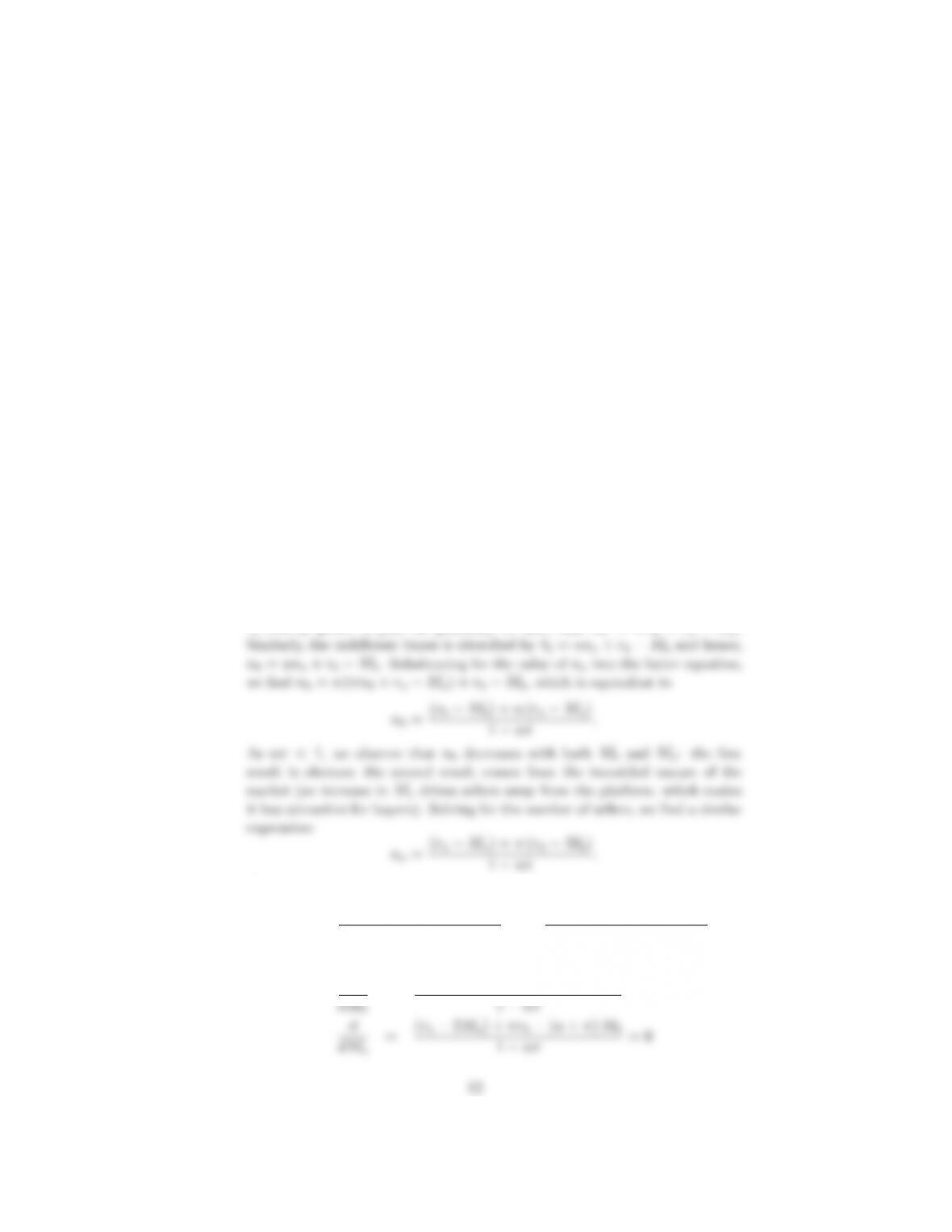
by ˆτs=πnb+rs−Ms. As all sellers with a lower opportunity cost than
ˆτsstrictly prefer to join the platform, we have that ns=πnb+rs−Ms.
2. The intermediary’s profit-maximization program is
max
Mb,Ms
Mb
(rb−Mb) + u(rs−Ms)
1−uπ +Ms
(rs−Ms) + π(rb−Mb)
1−uπ .
The FOC yield
d
=(rb−2Mb) + urs−(u+π)Ms
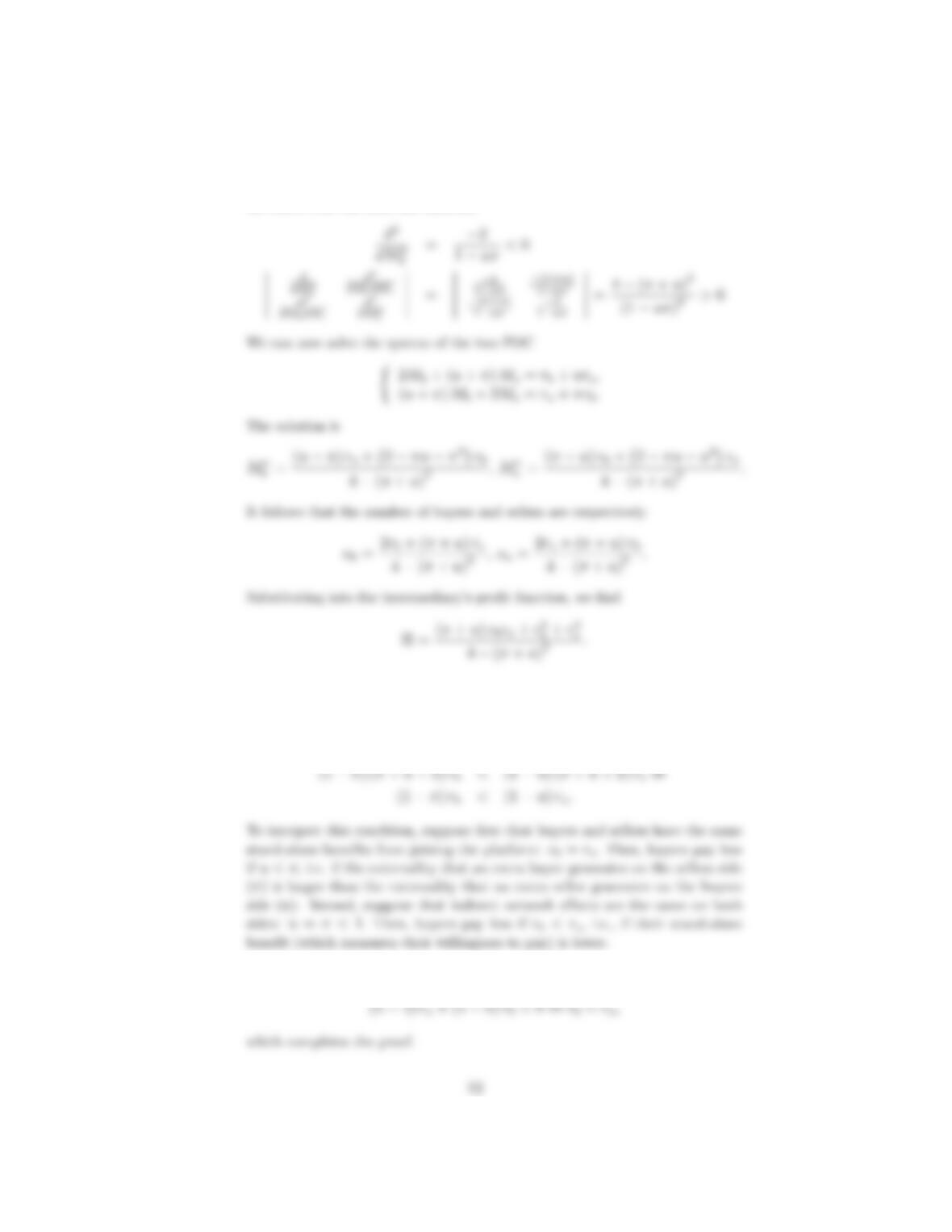
We check that the SOC are satisfied:
3. Buyers pay a lower fee than sellers (i.e., M∗
b< M∗
s) if and only if
(u−π)rs+2−πu −π2rb<(π−u)rb+2−πu −u2rs⇔
2−πu −π2−π+urb<2−πu −u2−u+πrs⇔
4. With π= 1, we must have u < 1. On the other hand, M∗
b<0is equivalent to

Exercise 7 Does advertising lower the price of newspapers to consumers?3[in-
cluded in 2nd edition of the book]
A monopoly editor sells a newspaper to two groups of agents: readers and
advertisers. Readers are of different types. Readers of type thave a willingness
to pay for the newspaper equal to 1 −t, with tuniformly distributed on the unit
interval. At each point tof [0,1], there is unit mass of readers that divides into
two subsets: 5/6 of the readers are ‘advertising-lovers’ and 1/6 of the readers
are ‘advertising-avoiders’. Advertising-lovers (resp. avoiders) gain (resp. loose)
in utility when the editor sells a larger surface of the newspaper to advertisers.
In particular, the utility of a reader of type twhen buying the magazine at price
pis 1 −t−p+βd if the reader is an advertising-lover, or 1 −t−p−βd if the
reader is an advertising-avoider, where 0 ≤d≤1 is the share of the newspaper
devoted to ad spots and where βmeasures the intensity of ad-attraction when
a reader is ad-lover or of ad-repulsion when he is ad-avoider. In what follows,
we assume that 0 < β < 15/16.
As for advertisers, there is a unit mass of them with unit demand (i.e., they
buy a single ad or do not buy). As advertisers are interested in eyeballs, it is
assumed that the utility of buying an ad in the newspaper increases propor-
tionately with the size of its readership. More precisely, an advertiser of type
θ, with θuniformly distributed on the unit interval, has utility of buying an ad
in the newspaper at a rate sgiven by θD −s, where Dis the readership of the
editor (i.e., the demand for the newspaper on the reading side).
1. Show that the demand on the reading side has the following form:
D(p, d) =
1 if 0 ≤p≤2
3βd,
1−p+2
3dβ if 2
3βd ≤p≤1−βd,
5
6(1 −p+βd) if p≥1−βd.
2. Derive the demand function d(s, D) on the advertising side. Suppose that
the editor faces zero costs on each side of the market. Then, the editor’s
objective is to choose pand sso as to maximize the following revenue
function: R(p, s) = pD (p, d) + sd (s, D). Show that given a readership
D, the revenue-maximizing rate is s∗=D/2, which implies a proportion
d∗= 1/2 of the newspaper devoted to ad spots.
3. Using the expression of D(p, d) and the previous findings that d∗= 1/2
and s∗d(s∗, D) = D/4, rewrite the revenue function as a function of p
only.
4. Show that the optimal price is p∗= (4β+ 9) /24.
5. Compare the optimal price p∗with the price p0that the editor would
choose if she was not operating in the advertising market. Show that
14
p∗< p0for 0 < β < 3/4 and p∗≥p0for 3/4≤β < 15/16, meaning
that advertising serves as a subsidy to readers as long as the ad-attraction
parameter is not too large. Discuss the intuition behind this result.
Solution to Exercise 7
1. Defined by tλ(p, d)and tα(p, d)the consumer-type for which, respectively,
the ad-lovers and ad-avoiders of this type are indifferent between buying the
newspaper or not at price p, when the proportion of the newspaper’s surface
2. The advertiser who is indifferent between buying an ad at rate sor not buying is
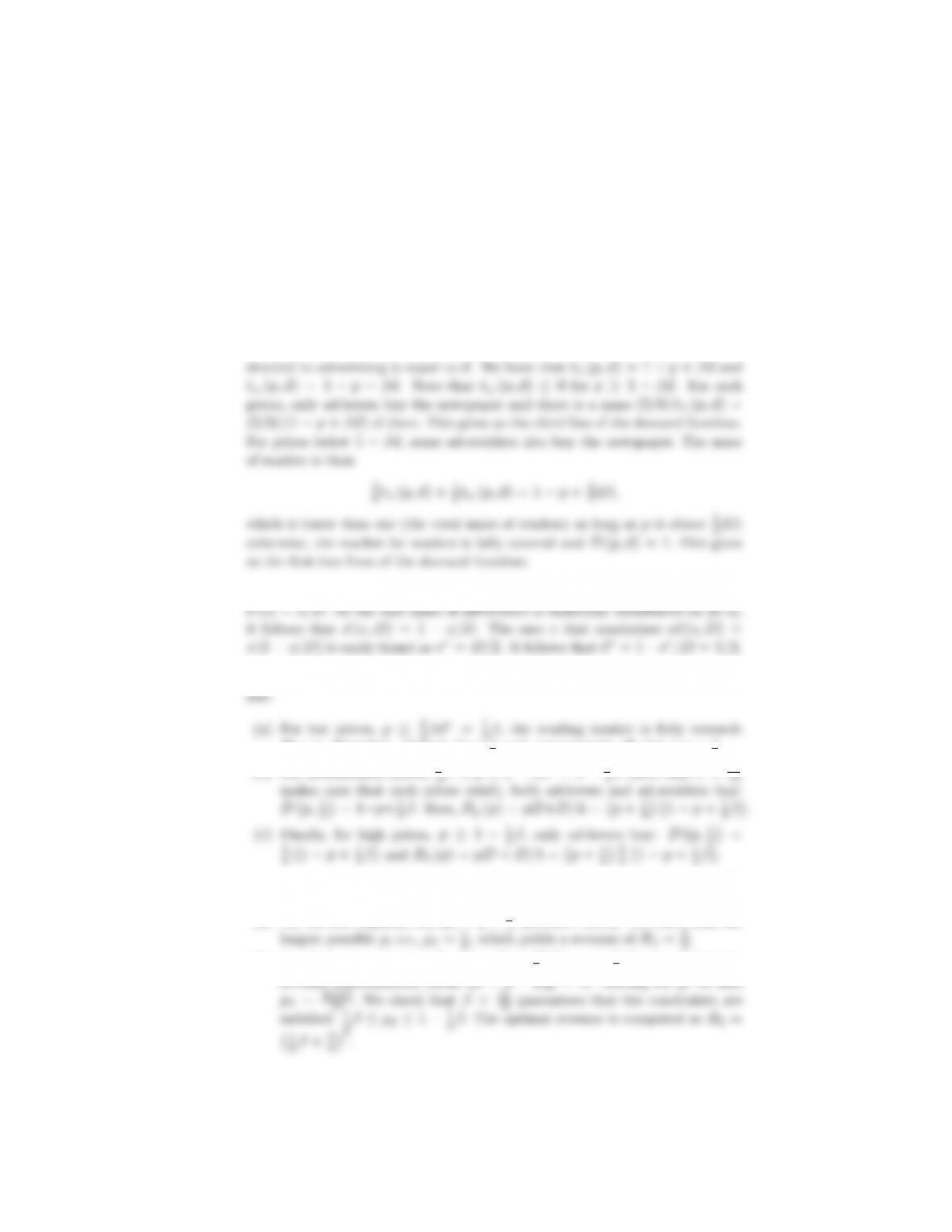
3. We need to consider separately the three segments of the demand on the reading
D= 1. Therefore, s∗d(s∗,1) = 1
4and, consequently, R1(p) = p+1
4.
(b) For intermediate prices, 1
4. We have to examine separately the three segments of the revenue function.
(a) On the first segment, R1(p) = p+1
(b) On the second segment, R2(p) = p+1
41−p+1
3β. The F.O.C. for
revenue maximization yields 4β+ 9 −24p= 0. Solving for p, we find
15
(c) On the third segment, R3(p) = p+1
45
61−p+1
2β. The F.O.C.
for revenue maximization yields 2β+ 3 −8p= 0. Solving for p, we find
(d) It is easily checked that R2> R1and R2> R3, which establishes that
5. If the editor does not operate on the advertising market, we have d= 0 and
all readers of type thave the same utility 1−t−p. Revenue is then given by
Exercise 8 Platform competition with multihoming sellers
Consider the model of platform competition of Section 22.3.2. There are
two sides of the market, the buyer side and the seller side. Suppose that each
side is of mass 1, so that the total number of buyers adds up to 1, n1
b+n2
b= 1,
and also the total number of sellers adds up to one, n1
s+n2
s= 1. A buyer at
platform ibuys one unit from each seller at the same platform. Hence, buyer
and seller surplus gross of any opportunity cost of visiting a platform are
vi
s=ni
bπ−Mi
sand vi
b=ni
su−Mi
b,
where Mi
band Mi
sare the membership fees set by intermediary i. Suppose
sellers and buyers are uniformly distributed on the unit interval and that plat-
forms are located at the extreme point of the unit interval. Sellers and buyers
are assumed to incur an opportunity cost of visiting a platform that increases
linearly in distance at rates τband τs, respectively. We furthermore assume that
participation is sufficiently attractive such that all buyers and sellers participate
in the market.
In Section 22.3.2, we assumed that each seller and each buyer could only go
to either one of the two platforms 1 and 2; i.e., both sides were supposed to
multihome. Here, we assume that sellers have the possibility to multihome (i.e.,
to visit both platforms), while consumers continue to singlehome.
On the buyer side of the market, we still have that the numbers of buyers
visiting the two platforms correspond to the standard Hotelling specification.
16

On the seller side, let s10 (resp. s20) denote the seller who is indifferent between
visiting platform 1 (resp. 2) and not visiting any platform (thereby getting a
utility of zero):
v1
s−τss10 = 0 ⇔s10 =v1
s
τs
,
v2
s−τs(1 −s20) = 0 ⇔s20 = 1 −v2
s
τs
.
Because sellers now have the possibility to multihome, they are divided into
three groups: those located between 0 and s20 visit platform 1 only, those
located between s20 and s10 visit both platforms, and those located between s10
and 1 visit platform 2 only.
Hence, we derive the number of buyers and sellers visiting each platform
respectively as
ni
b=1
2+vi
b−vj
b
2τb
and ni
s=vi
s
τs
,
or equivalently, using the expressions for buyer and seller surplus, as
ni
b=1
2+
uni
s−nj
s−Mi
b−Mj
b
2τb
and ni
s=ni
bπ−Mi
s
τs
.
1. Solve this system of four equations in four unknowns to derive the buyers’
and sellers’ demands for access to the two platforms as functions of the
membership fees: ni
b(Mi
b, Mj
b, Mi
s, Mj
s) and ni
s(Mi
b, Mj
b, Mi
s, Mj
s).
2. Set to zero the platforms’ cost per buyer and per seller. Each platform i
solves the problem maxMi
b,Mi
sΠiwhere
Πi=Mi
bni
b(Mi
b, Mj
b, Mi
s, Mj
s) + Mi
sni
s(Mi
b, Mj
b, Mi
s, Mj
s).
Assuming that 8τbτs> π2+u2+ 6πu, show that the fees at the symmetric
Nash equilibrium are
M∗
b≡M1∗
b=M2∗
b=τb−π
4τs(3u+π),
M∗
s≡M1∗
s=M2∗
s=1
4(π−u).
Comment on these prices.
Solution to Exercise 8
1. The solution to the system of equations is
s−Mi
s) + τs(Mj
b−Mi
b)
2. Firm’s best responses are implicitly defined by the first-order conditions, which
can be expressed as
s+uM2
s+τsM2
b−πu +τbτs
Exercise 9 Platform competition and piracy4
Consider the following market of two competing software platforms: Platform
1 is located at 0, platform 2 at 1 on the Hotelling line. Consumers are uniformly
distributed on the [0,1] interval. Consumers derive utility from the services
offered by the platform ras well as the number of applications nithat are
offered on platform i. The utility a consumer x∈[0,1] derives from buying
access to platform 1 is r+un1−M1
b−τx. Here uis the net benefit consumers
derive per software application, M1
bis the price the consumer has to pay to
access platform 1 and τis the standard disutility parameter in the Hotelling
model. The corresponding utility for platform 2 is r+un2−M2
b−τ(1 −x).
Developers decide whether to be active on none, one, or both platforms.
Suppose that developers make a net profit πper consumer. A developer’s profit
18