
Industrial Organization: Markets and Strategies
Paul Belleflamme and Martin Peitz
published by Cambridge University Press
Part VIII. Networks, standards and systems
Exercises & Solutions
Exercise 1 Network effects and fulfilled expectations [included in 2nd edition
of the book]
Consider the market for a single network good and suppose that consumers
differ in their valuation of both the stand-alone and the network benefits (it can
indeed be argued that it is more plausible that a user who has a higher value
for the stand-alone component of a technology also assigns more importance
to the size of its network.) To capture this idea, write the consumer’s utility
function for joining the network as U() = (a+ne), where ais the stand-
alone benefit, > 0measures the network effect, neis the expected number of
users joining the network, and is uniformly distributed on the unit interval.
1. Identify the indifferent consumer for a given price pand a given expected
network size ne.
2. Express the willingness to pay for the nth unit of the good when neunits
are expected to be sold; check that the ‘law of demand’ effect conflicts
with the ‘network expansion’effect.
3. Express the fulfilled-expectations demand curve and draw it. In particu-
lar, show that for a, the fulfilled-expectations demand is decreasing
everywhere and there is a single equilibrium for all pa. On the other
hand, for > a, show that the fulfilled-expectations demand has both an
increasing and a decreasing portion; characterizes the range of prices for
which two levels of demand satisfy the equilibrium condition.
Solutions to Exercise 1
2. As all consumers with a value of larger than ^
choose to buy, the mass of
buyers is n= 1 ^
. Replacing ^
by its value and solving for p, we find:
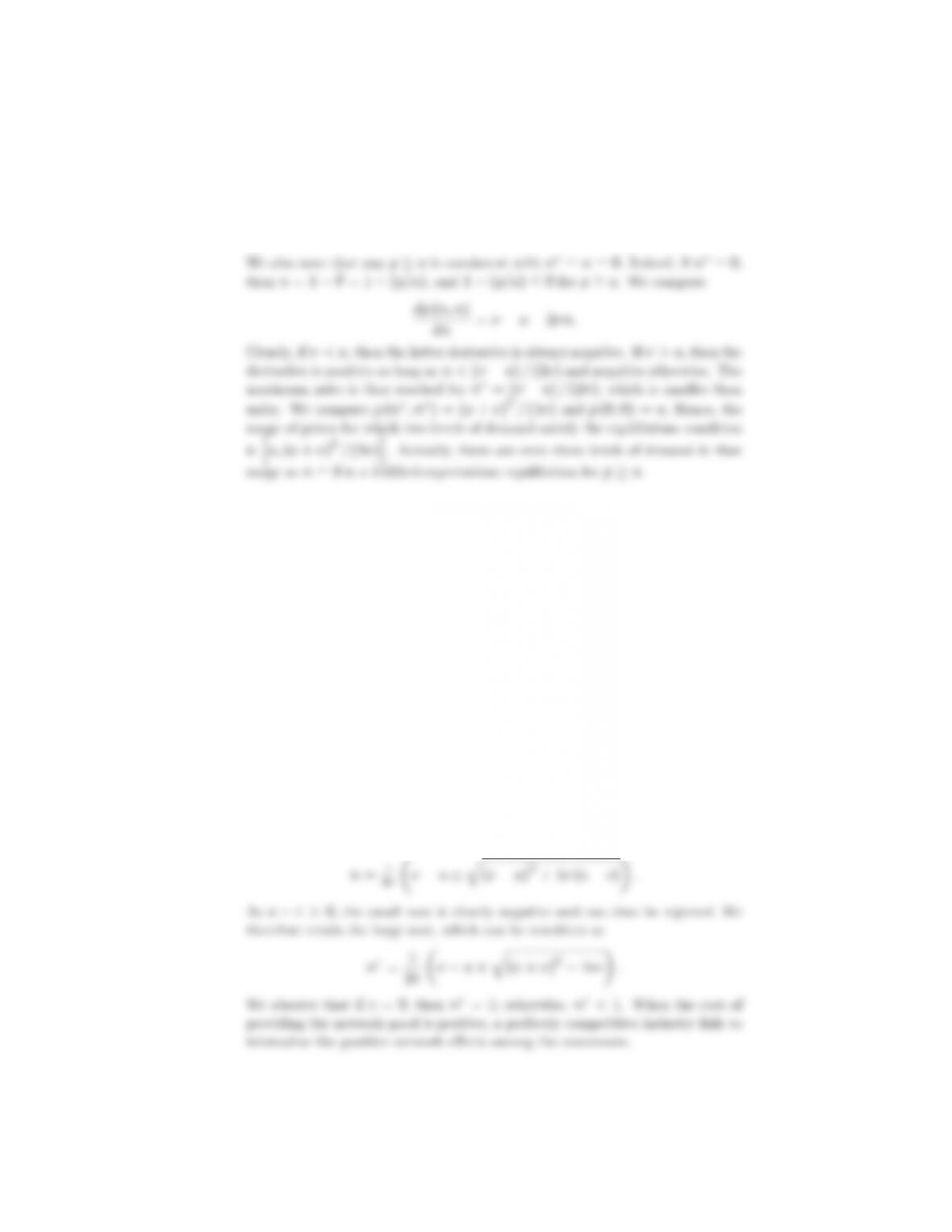
3. To find the fulfilled-expectations demand curve, we set ne=nin (1):
p(n; n) = (a+n) (1 n):
Exercise 2 Network eff ects and coverage [included in 2nd edition of the book]
Consider the situation of the exercise 20.1, where users are heterogeneous
in terms of both network and stand-alone benefits. Demand is then given by
p(n; n) = (a+n) (1 n).
1. Check that under perfect competition, there is a unique equilibrium net-
work size for p=c < a, which is strictly lower than one unless c= 0.
2. Compute the monopolist’s profit-maximizing network size and show that
it is strictly comprised between 0and 1for all a; > 0.
3. Compare the network size that is provided under perfect competition and
monopoly. Which one is larger and why?
Solutions to Exercise 2
1. As the price is driven down to marginal cost under perfect competition, we have
p(n; n) = (a+n) (1 n) = c. The latter equation defines a second-degree
polynomial in n:n2(a)n(ac) = 0. The two roots are
2
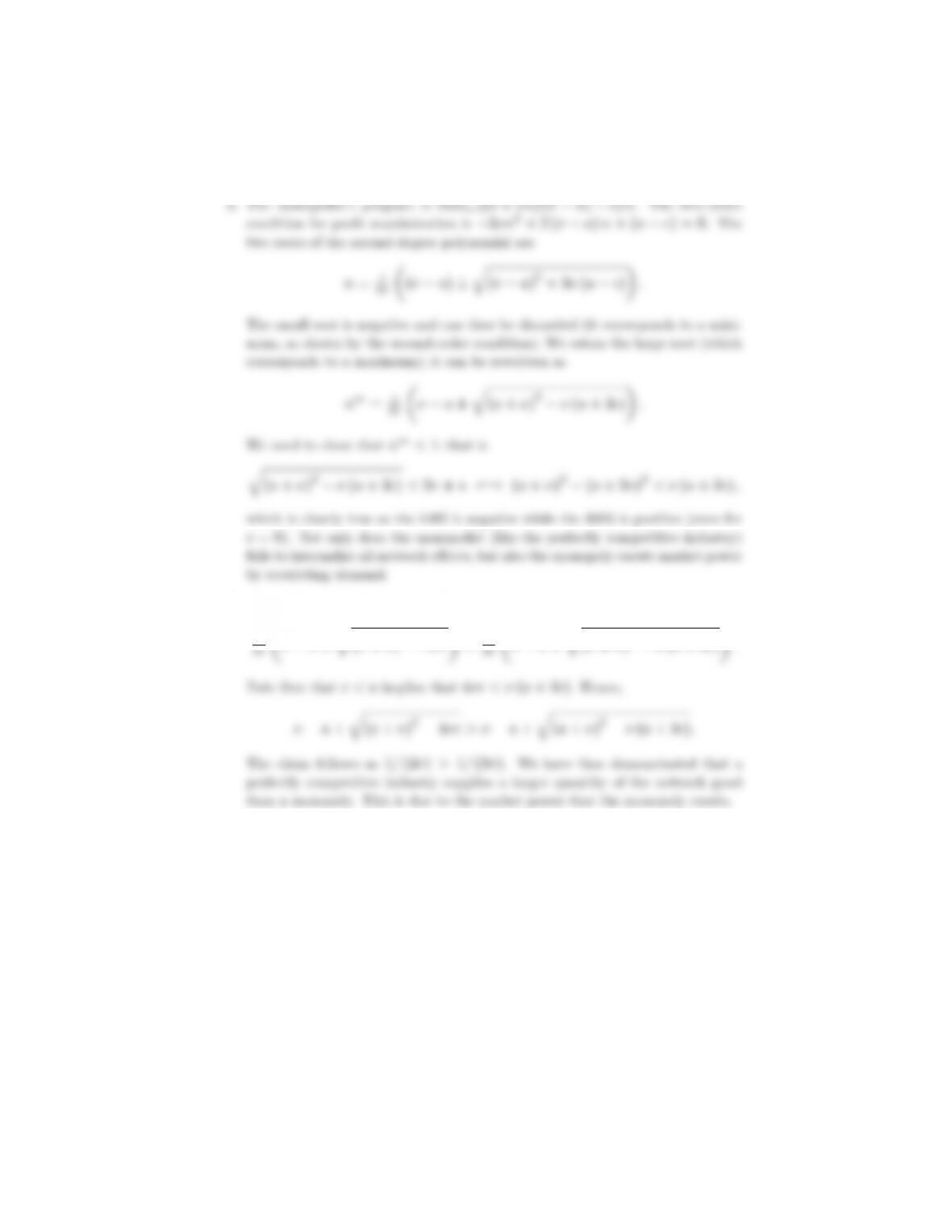
3. We want to show that nc> nm. This is so if
1
Exercise 3 Monopoly with network effects
Consider a monopoly market in which consumers’opportunity cost xis uni-
formly distributed on the unit interval; i.e., x2[0;1]. A consumer’s utility of
consuming one unit of the good offered by the monopolist relative to the outside
option is 1=4 + ne=2px, where pis the price set by the monopolist and
neis the expected number of fellow buyers of the good. There is mass one of
consumers. The monopolist’s marginal costs are zero.
1. Suppose that consumers believe that ne= 1. Determine the monopoly
solution under these consumer believes.
3
2. Suppose that consumers form beliefs nebefore observing price pand that
these beliefs are confirmed in equilibrium— i.e., ne=n. Determine the
monopoly solution under these consumer beliefs.
3. Suppose that consumers first observe price and then form beliefs ne(p)
and that beliefs are self-fulfilling; i.e., they are confirmed in the monopoly
solution. Determine the monopoly solution under these consumer beliefs.
4. Compare your findings in parts 2 and 3. Explain what is going on.
5. Suppose that there is a second group of consumers (of mass 1) who also
have an opportunity cost xthat is uniformly distributed on the unit inter-
val. The utility of consumer xin this second group is 1=4+ne
1(p1)=2p2x,
where ne
1(p1)is the expected number of consumers in the first group buy-
ing the product and price p2is the price charged to the second group of
consumers. Suppose that, similar to part 3, consumers of both groups
first observe prices and then form beliefs. Thus, a consumer xin the first
group has net utility 1=4+ne
1(p1)=2p1x. Suppose that consumers from
both groups hold self-fulfilling beliefs. Determine the monopoly solution
(prices and quantities) under these consumer beliefs.
6. Within the setting of part 5, suppose that the monopolist is forced to
charge the same price to both groups of consumers; i.e., p=p1=p2.
Determine the monopoly solution.
7. Explain your findings in parts 5 and 6. Does the monopolist have an
incentive to charge prices p16=p2? Why or why not is this the case?
Solutions to Exercise 3
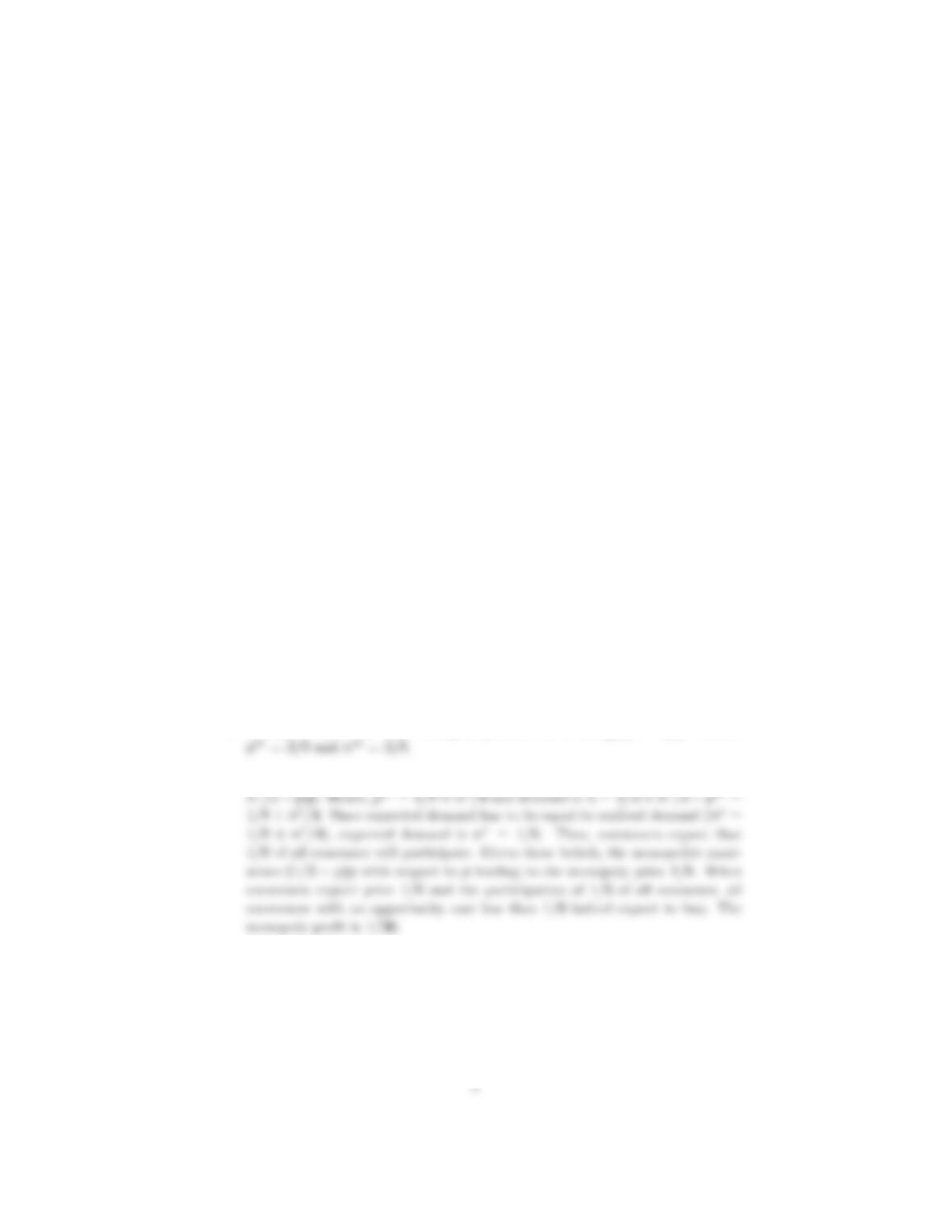
1. Demand is 3=4p. The monopoly problem for is maxp(3=4p)p. Hence,
2. Given beliefs ne, demand is 1=4+ne=2p. The monopoly problem is maxp(1=4+
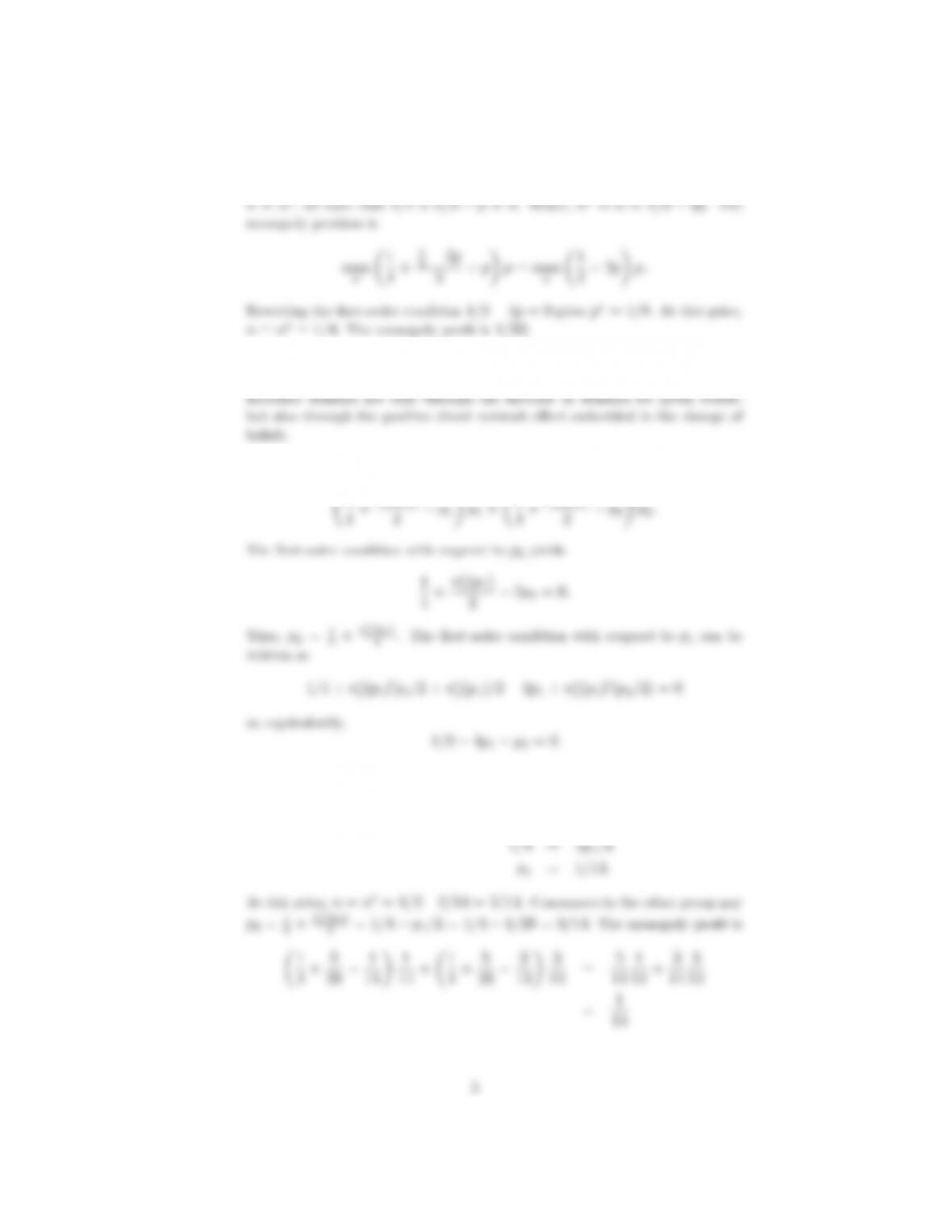
3. The monopolist can commit to a price p. Given price p, a consumer with an
opportunity cost xwill be indifferent between buying and not buying if and only
if 1=4 + ne=2p=x. Demand is n=x. Under self-fulfilling expectations,
4. In part 3, the monopolist can commit to a price. By setting a low price, it can
convince more consumers that participation is worthwhile. The price reduction
5. The monopolist sets prices p1and p2to maximize its profit
1
1(p1)
1(p1)
as ne
1(p1) = 1=22pand ne
1(p1)0=2. Using the rewritten first-order
condition w.r.t. p2— that is, p2= 1=8 + (1 4p1)=8 = 1=4p1=2— we have
1=24p11=4 + p1=2=0
6. The monopolist sets price pto maximize its profit
1
1(p)
1(p)
7. If the monopolist is allowed to set different prices to the distinct consumer
Exercise 4 Network effects in the Hotelling model1[included in 2nd edition of
the book]
Consider the Hotelling model with linear transport costs where two firms, 1
and 2, are located at the extreme points of the unit interval. There is a unit mass
of consumers who are uniformly distributed over this interval. Suppose that the
products offered by the two firms exhibit network effects. This is modelled as
follows: a consumer located at x2[0;1] has utility
rx p1+ne
1if she buys one unit of product 1,
r(1 x)p2+ne
2if she buys one unit of product 2, (2)
where ne
iis the expected mass of consumers buying product i(i= 1;2). We
assume that ris large enough so that each consumer buys one or the other
product; it follows that ne
1= 1 ne
2.
We look for the subgame perfect Nash equilibrium in pure strategies of the
following two-stage game: in the first stage, firms select their price pi; in the
second stage, given any pair of prices (p1; p2), consumers allocate themselves
between the two products (an equilibrium at this stage is a partition of con-
sumers between the two firms, (n1; n2), such that no consumer with utility
(1) is strictly better off by switching products; this is equivalent to say that
expectations must be fulfilled at equilibrium, i.e., ne
i=ni). To simplify the
computations, we assume that both firms produce at zero marginal cost.
1. Characterize the equilibrium consumer partitions at the second stage of
the game. In particular, establish and discuss the following two results:
(a) if > , then a unique equilibrium consumer partition obtains for
any pair of prices;
(b) if < , then there exist pairs of prices for which multiple equilibrium
consumer partitions coexist.
2. For the case where > , solve for the equilibrium prices at the first stage
of the game. Discuss the impact of the network effects on the equilibrium
prices and profits.
Solutions to Exercise 4
1. The consumer indifferent between the two products is identified as ^xsuch that
As the market is covered, all consumers located at the left (resp. right) of ^x
buy from firm 1 (resp. 2). Moreover, as expectations are fulfilled at equilibrium,
(b) Consider the case where < . Nothing changes for the conditions re-
garding C1 and C2 but the conditions for CS to be an equilibrium now
become
7
(CS) ^x > 0,p2p1<
2. Consider the case where > and suppose that prices are such that conditions
(2) are satisfied so that the equilibrium consumer partition is CS. The profit
function of firm ican be written as
From the F.O.C., e find firm i’s best-response function:
Exercise 5 Adoption of network technologies in oligopolies2[included in 2nd
edition of the book]
8

Consider the following two-stage game. In the first stage, a set of nfirms
choose simultaneously whether to adopt or not a network technology. The tech-
nology has the effect to reduce the firms’marginal cost of production; moreover,
because of network effects, the cost reduction grows larger as more firms adopt
the technology. Then, in the second stage, firms produce a homogeneous good
and compete on the market in a Cournot fashion. Note that each firm’s mar-
ginal cost at the second stage of the game depends on the size of the network,
which means that it depends not only on this firm’s first-stage adoption decision
but also on its rivals’decisions.
Specifically, suppose that inverse demand on the final market is given by
p= 1 Q, where Q=Pn
i=1 qiis the total quantity produced by the nfirms.
The technology is described in the following way. Firm i’s marginal cost of
production, ci, is equal to cif idoes not adopt the technology, or to ck if
iadopts the technology and the network size is k, with 0<c<1,1kn,
and 0< < c=n.
1. Derive the Cournot equilibrium at the second stage of the game.
(a) Express the firms’equilibrium profit when they have all adopted the
technology at stage one (k=n). Denote this profit by
in (n).
(b) Express the firms’equilibrium profit when none of them has adopted
the technology at stage one (k= 0). Denote this profit by
out (0).
(c) Suppose 0< k < n. Express the equilibrium profits (i) for the
firms that adopted the technology at stage one, and (ii) for those
that did not adopt the technology at stage one. Denote these profits
respectively by
in (k)and
out (k).
2. Suppose that k < n. Show that a technology adopter’s equilibrium profit
increases when an additional firm joins the network if and only if the
network comprises less than half of the population of firms (i.e., k < n=2).
Explain the intuition behind this result.
3. Derive the first-stage equilibrium. How many firms adopt the network
technology at the subgame-perfect equilibrium of this two-stage game?
4. Construct a numerical example (where you give values to the parameters
n,c, and ) showing that the total profit (i.e., the sum of the profits of
the nfirms) is not maximum at the subgame-perfect equilibrium of the
game. Discuss.
Solutions to Exercise 5
1. The standard analysis of a Cournot model with linear demand and costs yields
the second-stage equilibrium (where Cstands for Pn
j=1 cj):
(a) If all firms have adopted the technology, then ci=cn (8i) and C=
n+ 1 2
(b) If no firm has adopted the technology, then ci=c(8i) and C=nc. It
n+ 12
(c) Suppose that 0< k < n. If firm ihas adopted the technology, its marginal
cost is equal to ci=ck, while the sum of all firms’marginal costs is
2. We want to assess how a technology adopter’s equilibrium profit changes when an
additional firm joins the network. Supposing that k < n, simple computations
establish that the sign of
in (k+ 1)
in (k)is determined by the sign of
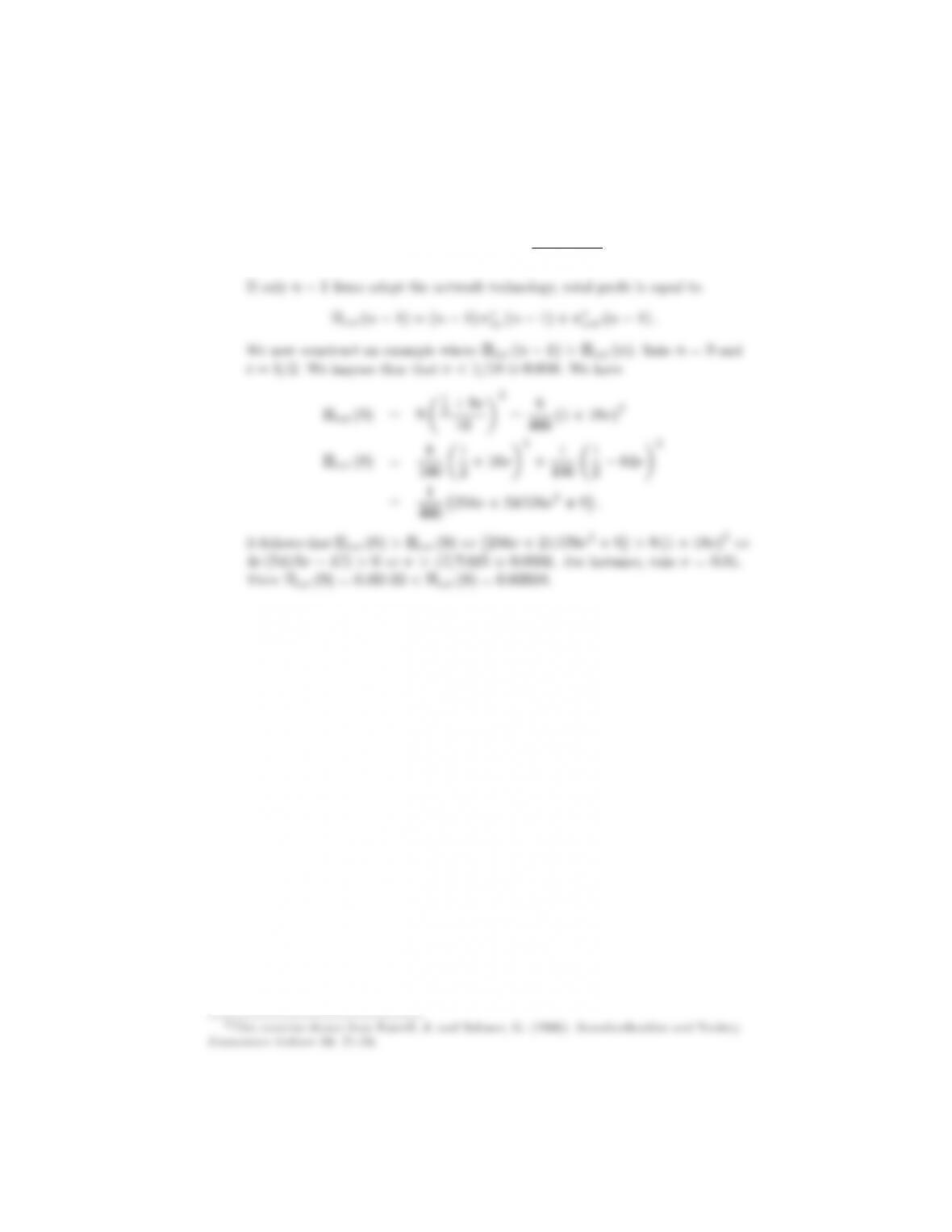
3. What is a firm’s best response when it assumes that kfirms (with 0k < n)
adopt the technology? The best response is to adopt the technology as well if and
4. Total profit at the subgame-perfect equilibrium of the game is
tot (n) = n
in (n) = n1c+n
n+ 1 2
:
Exercise 6 Standardization and variety3[included in 2nd edition of the book]
Suppose that two incompatible network technologies, 1 and 2, are compet-
itively supplied at zero marginal cost (as a result, we can ignore pricing deci-
sions). A unit mass of consumers is split into two homogeneous groups. The
first group is of mass n1, with 0< n1<1, and prefers technology 1; the other
group is of mass n2= 1 n1and prefers technology 2. The utility a consumer
gets from adopting a network technology depends on two additively separable
components: a network benefit and a stand-alone benefit. The network benefit
has the same form for the two technologies: x, where > 0measures the
strength of the network effect and xis the mass of consumers who adopt the
same technology. The stand-alone benefit is equal to ai>0when a consumer
of type i(i= 1;2) adopts her preferred technology and to zero otherwise.
Consumers simultaneously choose which technology to adopt. We are in-
terested in characterizing the equilibria of this game and in assessing their e¢ –
ciency. As consumers are identical within each group, three outcome can emerge
at equilibrium.
Incompatibility: consumers of group iadopt technology i, thereby getting
a utility of ai+ni; social surplus in this case is equal to n1(a1+n1) +
n2(a2+n2).
11

Standardization on technology 1 : all consumers adopt technology 1, thereby
getting network benefits of (n1+n2) = ; consumers of group 1 (resp.
group 2) get a stand-alone benefit of a1(resp. 0); social surplus in this
case is equal to +n1a1.
Standardization on technology 2 : all consumers adopt technology 2, thereby
getting network benefits of (n1+n2) = ; consumers of group 1 (resp.
group 2) get a stand-alone benefit of 0(resp. a2); social surplus in this
case is equal to +n2a2.
We make the following assumptions:
(A1) n1>1
2;
(A2) n1a1> n2a2:
According to Assumption (A1), group 1 is larger than group 2. Assumption (A2)
implies that standardization is socially more desirable on technology 1 than on
technology 2.
We say that an outcome is e¢ cient if it maximizes social surplus. We say
that it is an equilibrium if no consumer would wish to deviate unilaterally to
a different technology from the one she is meant to be getting. Note that each
consumer is infinitesimal in the market as a whole; as a result, the deviation
by an individual consumer has no measurable impact on the size of the two
networks.
1. Express the condition under which incompatibility is e¢ cient (express the
condition by isolating and by using n2= 1 n1).
2. Express the conditions for each outcome to be an equilibrium. Show that
there can be multiple equilibria for some parameter constellations.
3. Show that if incompatibility is e¢ cient, then it is an equilibrium.
4. Show that if standardization is the unique equilibrium, then it is also
e¢ cient. Discuss the intuition behind this result.
5. A consequence of the previous results is that when there are multiple equi-
libria, it is possible that one of them involves too much standardization.
Construct an example with an ine¢ cient standardization equilibrium. Dis-
cuss.
Solutions to Exercise 6
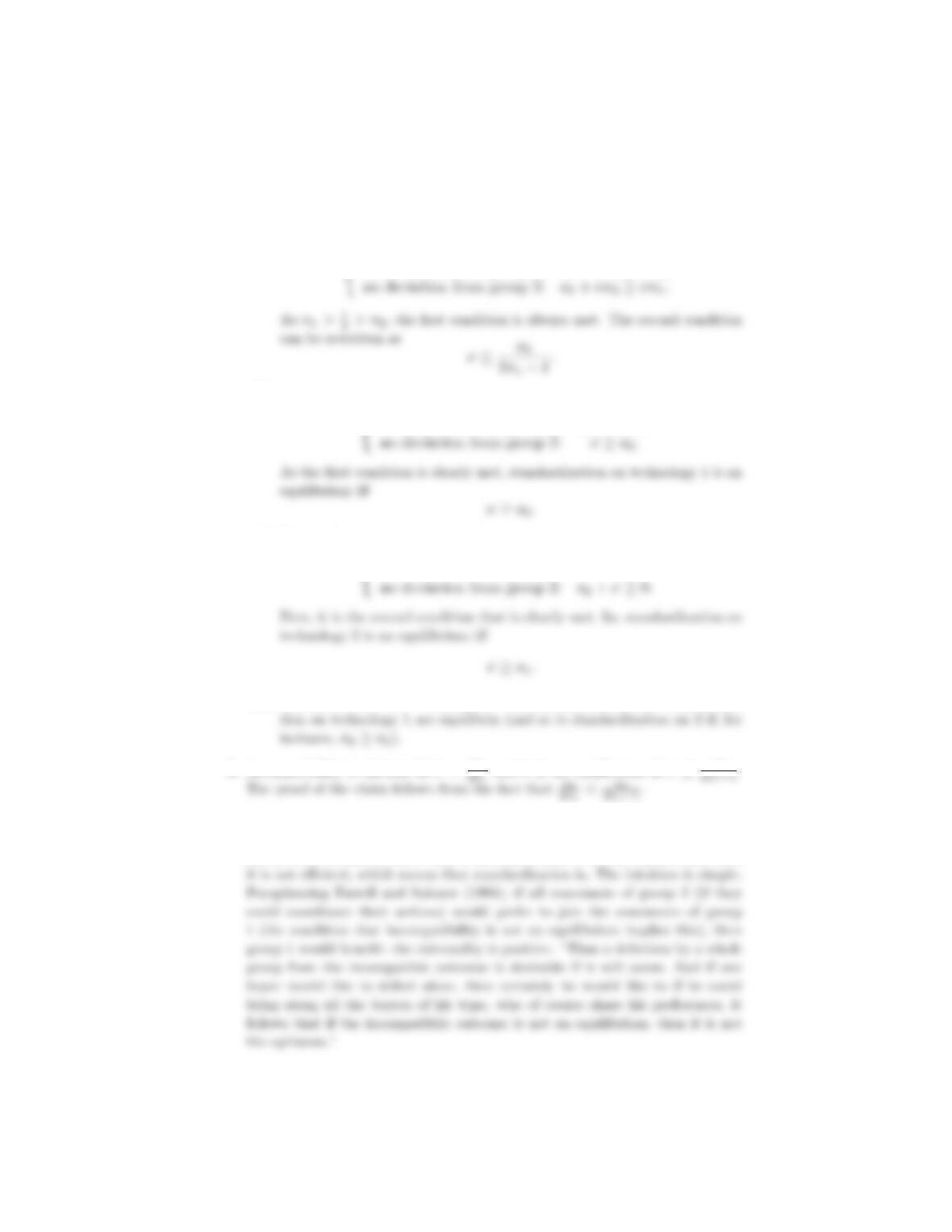
1. Incompatibility is e¢ cient if and only if
n1(a1+n1) + n2(a2+n2)> +n1a1
2. Equilibrium conditions
(a) Incompatibility
no deviation from group 1: a1+n1n2;
(b) Standardization on technology 1
no deviation from group 1: a1+0;
(c) Standardization on technology 2
no deviation from group 1: a1;
(d) Clearly, for a2a2=(2n11), incompatibility and standardiza-
3. Incompatibility is e¢ cient iff < a2
4. This claim is a corollary of the previous one. Indeed if standardization is the
unique equilibrium, then incompatibility is not an equilibrium. But, reversing
the previous claim, we know that if incompatibility is not an equilibrium, then
13
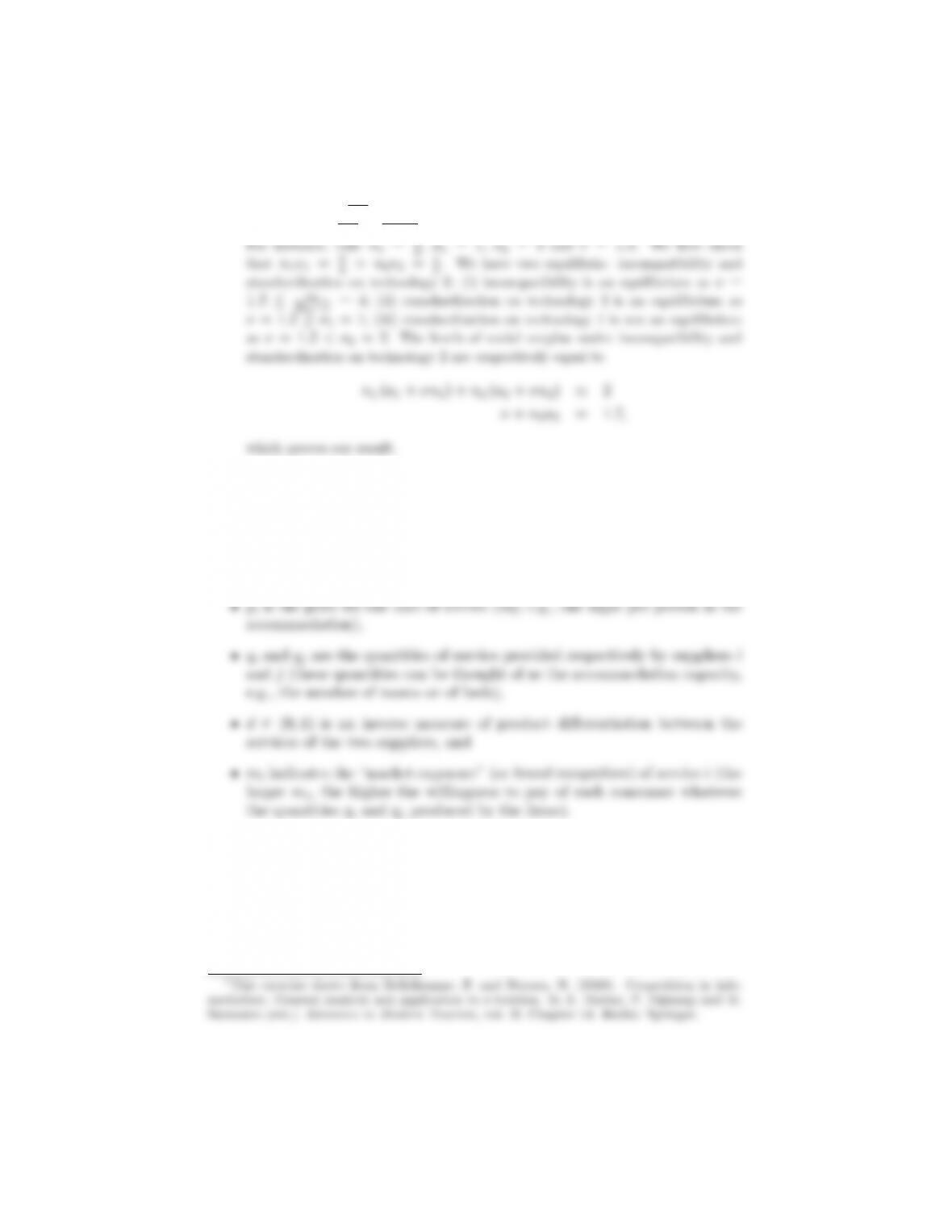
5. For a1 < a2
2n1, standardization on technology 2 is an equilibrium and is
ine¢ cient. As a2
2n1<a2
2n11, we also have that incompatibility is an equilibrium.
Exercise 7 Infomediation in the e-tourism sector4[included in 2nd edition of
the book]
Suppose there are two suppliers of B&B accommodation, noted 1and 2.
The inverse demand function for the service provided by supplier iis given by
pi= 1 + miqidqj(i6=j2 f1;2g) where
Market exposure can be obtained either through self-promotion or by using
the services of an intermediary. We analyze the following three-stage game:
first, the intermediary sets a registration fee F; second, the two B&B owners
simultaneously decide whether or not to register with the intermediary; third,
the two B&B owners compete à la Cournot on the product market.
Being listed on the intermediary’s website has the effect of increasing the
supplier’s market exposure (with respect to self-promotion via other means).
14

Moreover, infomediation generates network effects insofar as each supplier’s ex-
posure further increases when the other supplier also registers with the inter-
mediary. Such network effects can be justified by scale and scope economies
in promotional activities enjoyed by the intermediary, and because consumers
are willing to pay more for the two accommodations when they are given the
opportunity to compare them more easily. We translate this idea by assuming
that mi= 0 when supplier idoes not register with the intermediary, mi=m
when supplier iis the only supplier who registers with the intermediary, and
mi=Mwhen both suppliers register with the intermediary, with 0<m<M.
For simplicity, we assume that accommodation is supplied at zero marginal cost.
1. Solve for the Cournot equilibrium at the third stage of the game and
express the equilibrium profits of the two suppliers for any couple (mi; mj)
resulting from the second-stage decisions.
2. Consider now the second-stage of the game and assume that 2ddm > 0.
(a) Use your answer to question 1 to fill in the following matrix (where
Rstands for ‘register’and Nfor ‘not register’).
Register Not register
Register RR; RR RN ; N R
Not register NR; RN NN ; N N
(b) Show that although the infomediation services exhibit network ef-
fects, a supplier who registers with the infomediary may be worse off
when the other supplier registers too. Explain the intuition behind
this result.
(c) Set d= 1,M= 1 and suppose 3=5<m<1. Under these assump-
tions, characterize the equilibrium registration decisions.
3. Using your previous answers, determine the intermediary’s optimal regis-
tration fee at the first stage of the game.
Solutions to Exercise 7
1. Supplier i’s profit function can be written as i= (1+miqidqj)qi. Setting
to zero the derivative of profit with respect to qi, we derive supplier i’s reaction
4d2;
2. In the above expression, the exact values of (mi; mj)depend on the registration
decisions made by the suppliers at stage 2.
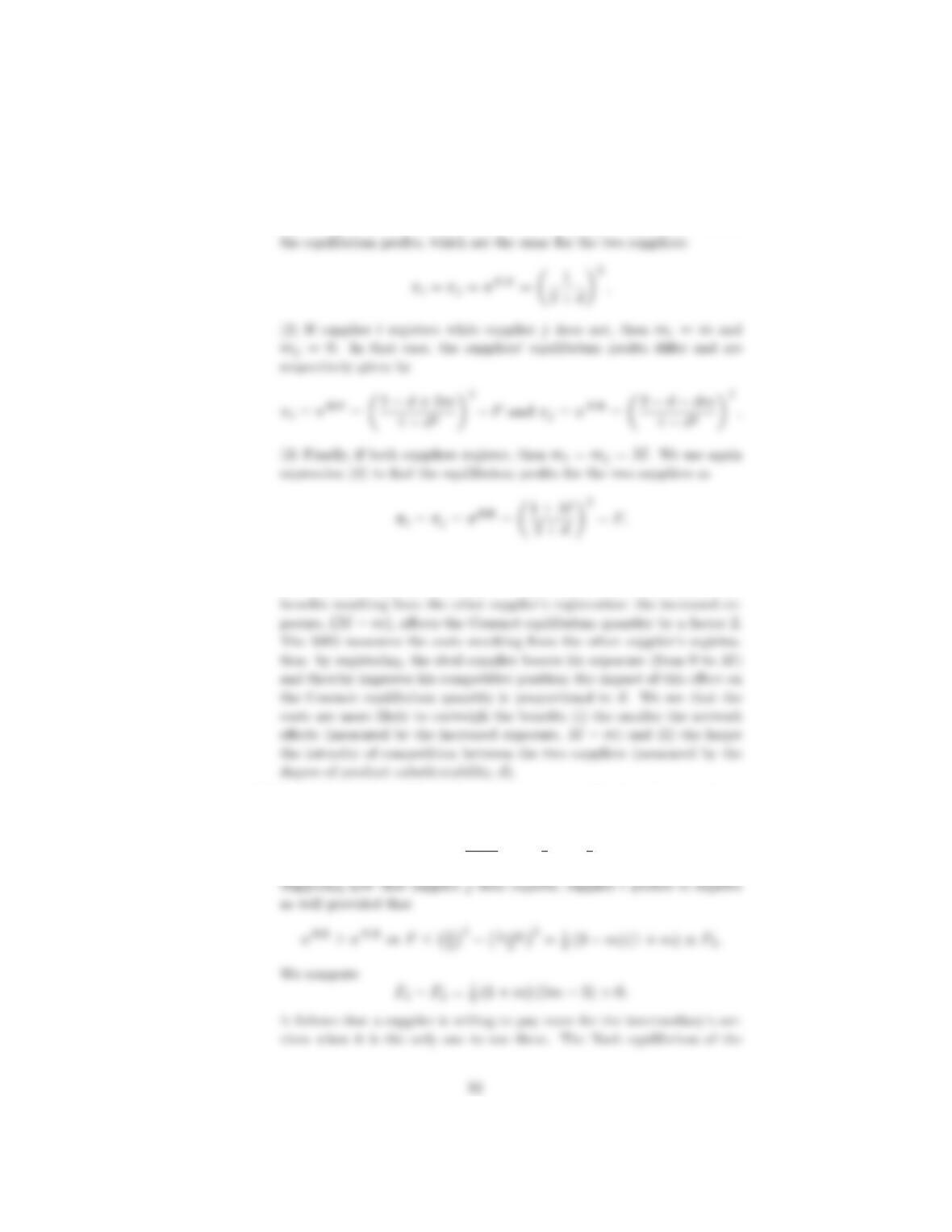
(a) There are three situations to consider. (1) If no supplier registers, then
mi=mj= 0. Substituting these values into expression (8), we obtain
2 + d2
(b) A supplier does not welcome the registration of the other supplier if RR <
RN , which is equivalent to 2 (Mm)< dM. The LHS measures the
(c) Supposing that supplier jdoes not register, supplier iprefers to register
provided that
RN NN ,F1+2m
321
32=4
9m(1 + m)F1:
3. The intermediary knows that to attract the two suppliers, it has to lower the
registration fee from F1to F2(as each supplier is willing to pay less when
Exercise 8 Network eff ects and piracy5
A monopoly producer of a software faces two groups of users, high-valuation
and low-valuation users, with respective masses (i.e., numbers) Nhand Nl.
Within each group, all users are identical and have a unit demand for the soft-
ware. In both groups, the user’s utility increases with the total number of users
of the software; that is, the software exhibits positive network effects. More pre-
cisely, supposing that Nusers consume the software, high-valuation users and
low-valuation users respectively derive net utilities Npand N p, where p
is the price of the software and 0< < 1. We assume that Nl<(1 )Nh,
which is equivalent to < Nh=(Nh+Nl).
1. Consider the following two-stage game. In the first stage, the firm chooses
its price pto maximize its profit; it is assumed that the software is pro-
duced at zero marginal cost (and that the fixed cost of production has
already been sunk). In the second stage, users decide whether to adopt
the software or not. We suppose that each user feels that she is individ-
ually small with respect to the size of the market (which is reasonable
if Nhand Nlare large numbers); as a result, users ignore their personal
contribution to the size of the network of software adopters when deciding
whether to adopt or not.
(a) Characterize the equilibrium at the second stage of the game (i.e.,
the users’ adoption decisions for a given price p). Show that there
are necessarily some prices for which multiple equilibria coexist.
(b) To solve the first stage of the game, we make the following assump-
tion: whenever multiple equilibria coexist, users are able to coordi-
nate on the equilibrium that yields the largest surplus to each group.
Under this assumption, find the profit-maximizing price for the soft-
ware producer.
17

2. Suppose that users are now able to download, for free, a pirated version of
the software. We assume that the pirated version has a lower quality than
the original version but generates the same network effects as the original
version. That is, supposing that Nusers consume the software (in either
version), the net utilities for high- and low-valuation users from consuming
the pirated version are, respectively, (1 )Nand (1 )N, where
measures the ‘degradation’of the pirated version (0< < 1; the larger
the lower the quality of the copy). We analyze the same two-stage game
as above.
(a) Characterize the equilibrium at the second stage of the game (i.e.,
the users’ adoption decisions for a given price p). Show that the
equilibrium is now unique for any price p.
(b) Solve for the profit-maximizing price of the monopolist.
3. To assess the effects of piracy on the firm’s conduct and profit, compare
your answers to questions 1 and 2.
(a) Show that under certain conditions the firm would choose to set a low
price (and sell to all users) when piracy is not possible, but would
choose to set a high price (and target high-valuation users) when
piracy is possible. Explain the intuition behind this result.
(b) Establish under which conditions piracy may increase the firm’s profit
(compared to the situation where piracy is not possible). Explain the
intuition behind this result.
Solutions to Exercise 8
1. (a) Given that users are homogeneous within each group and that high-valuation
users have a higher willingness to pay than low valuation users, there are
three possible equilibrium configurations: (1) all users adopt the software;
(2) only the high-valuation users adopt the software; (3) no user adopts the
18
(b) Using our previous results and the fact that Nl<(1 )Nh, we can
describe the second-stage equilibrium as follows: (i) for pNh, all
users adopt; for Nhp(Nh+Nl), either all users adopt, or only
the high-valuation users; (iii) for (Nh+Nl)pNh, only the high-
h> (Nh+Nl)2, which is equivalent to < N 2
h=(Nh+Nl)2.
(a) As in the previous question, three equilibrium configurations are possi-
ble. For all users to purchase the software, it must be that low-valuation
users prefer the original to the copy when the network size is equal to
(b) Again, the firm has two options. Either it sets the high price (Nh+Nl)
and only sells the software to the group of high-valuation users, yielding a
(a) As Nh=(Nh+Nl)<1, there exist values of such that N2
h=(Nh+Nl)2<
< Nh=(Nh+Nl)where the firm chooses to sell to all users when piracy
is not possible (which is its optimal conduct for > N2
h=(Nh+Nl)2) and
19
(b) Consider first the case where N2
h=(Nh+Nl)2< < Nh=(Nh+Nl).
As seen in 3.1, when piracy is not possible, the firm chooses to sell to all
users and makes a profit of N P =(Nh+Nl)2whereas, when piracy is
possible, it chooses to sell to high-valuation users only and makes a profit