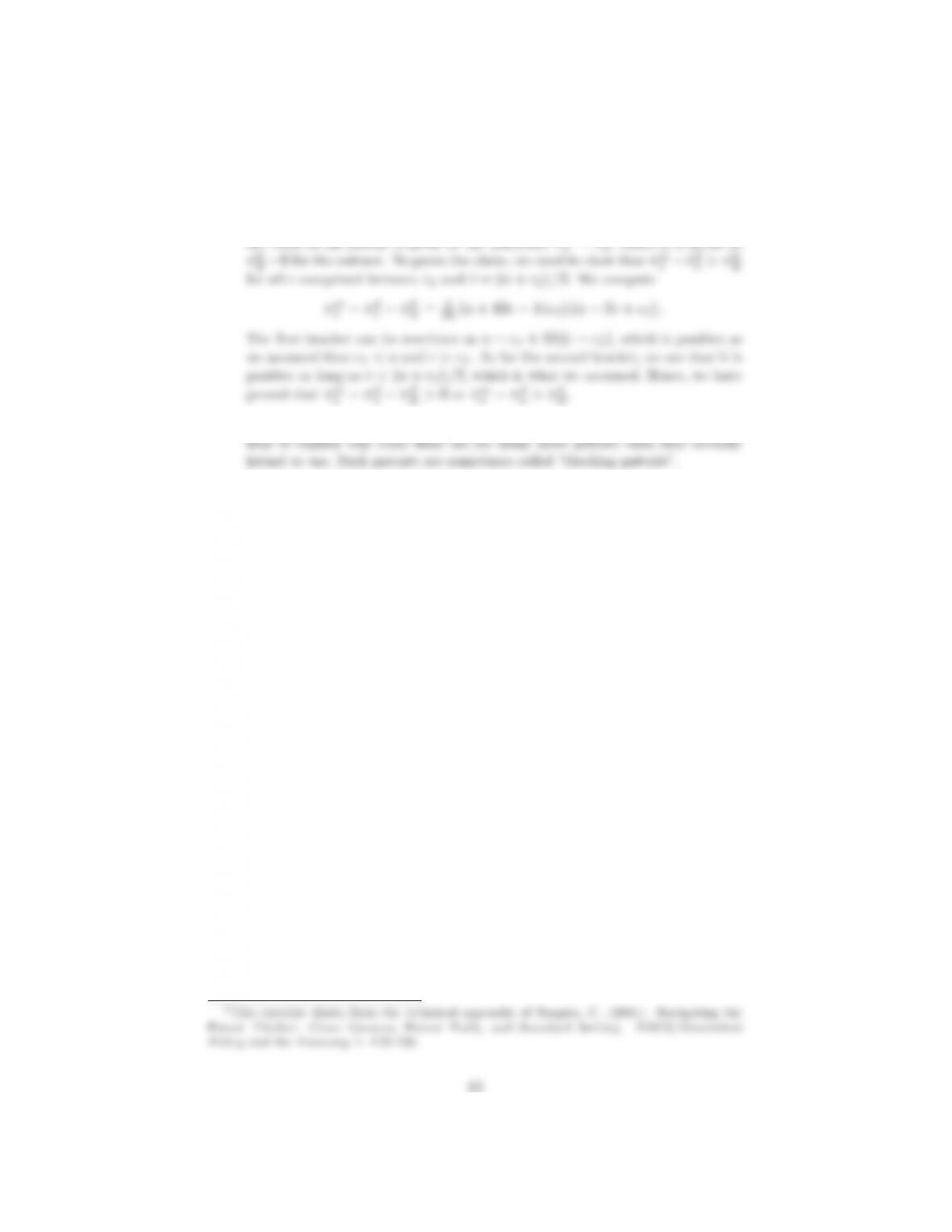
that d
I= (1=9) (a2cI+c)2and d
E= (1=9) (a2c+cI)2. We can now
compute the incentive to acquire the patent for each firm. For the incumbent,
the value of the patent is given by the difference m
3. The previous result can be seen as the evidence of strategic patenting. It may
Exercise 8 The patent thicket3
Suppose that Nfirms, i= 1; : : : ; N, each own a patent that is essential to
the production of a given product. For simplicity, we assume that there is a
competitive industry that produces this product, buying and assembling the
necessary components from each of these Nfirms. Firm isets a license fee for
the use of its patent by the competitive assembly industry. The cost to firm i
per unit (for licensing its patent to assemblers) is denoted by ci. For simplicity,
assume that ci= 0 8i. The license fee charged by firm iis denoted by pi. The
price of the final product is denoted by p. We assume that the assembly firms
incur no other assembly cost in addition to paying royalties. Competition in
the assembly industry therefore ensures that p=PN
i=1 pi. Demand for the final
product is given by q=ap.
1. Suppose that the Npatent holders set their license fee independently and
non cooperatively. Derive the Nash equilibrium in prices, compute (i) the
total license fee for the Npatents (denote it by ps) and (ii) the profit of
each patent holder at equilibrium (denote it by s).
2. Suppose now that all firms form a patent pool and choose a common
license fee pto maximize their joint profit. Assembly firms that pay p
have access to the whole pool of patents. Derive the optimal p. Supposing
that the pool’s profit is equally distributed among the Nfirms, compute
each individual firm’s profit (denote it by p).
3. Comparing your answers to the previous two questions, show that the
formation of the pool (i) reduces the total license fee (p<ps) and (ii)
increases each patent holder’s profit (p> s). Discuss.
4. Consider that kfirms, with 1< k < N , form a patent pool and coordinate
their pricing decision, while the other Nkfirms continue to set their fee
independently.
(a) Derive the equilibrium profit of each firm, independent and pool
member, at equilibrium.
(b) Suppose that N3and show that if the pool has to be formed
through simultaneous individual decisions, no pool is formed, i.e.,
it is a Nash equilibrium for all firms to set their fee independently.
Discuss.
Solutions to Exercise 8
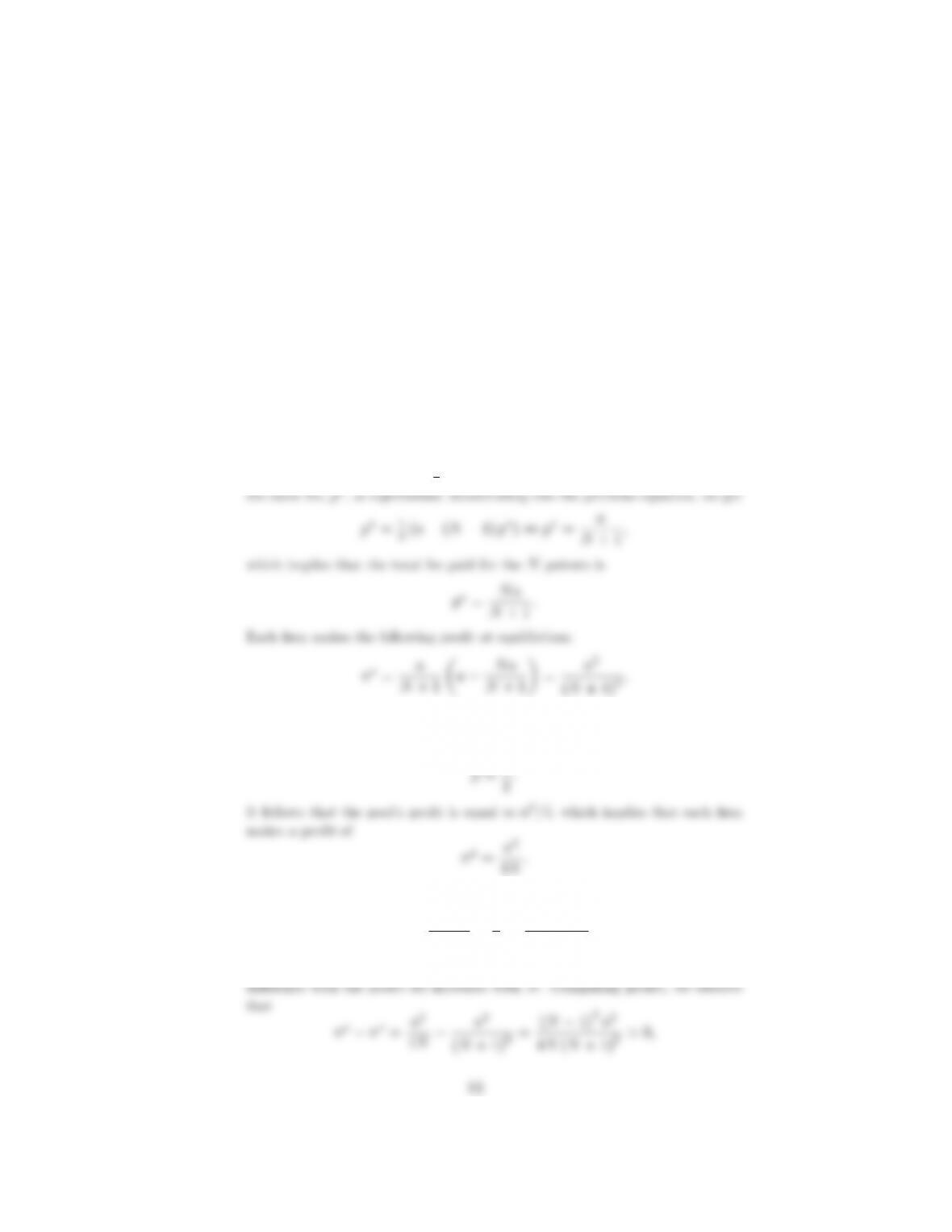
1. Firm i’s maximization program is maxpipi(apiPi), where Pidenotes
the sum of the license fees of all firms but i. The first-order condition yields the
reaction function pi(Pi) = 1
2(aPi). As firms are symmetric, they all set
2. The pool’s maximization program is maxpp(ap). From the first-order con–
dition, it is easily found that the optimal price is
3. Comparing total license fee, we observe that
psp=Na
N+ 1 a
2=(N1) a
2 (N+ 1) >0:
The total license fee is larger when firms set their fees independently. The
4. Pool formation
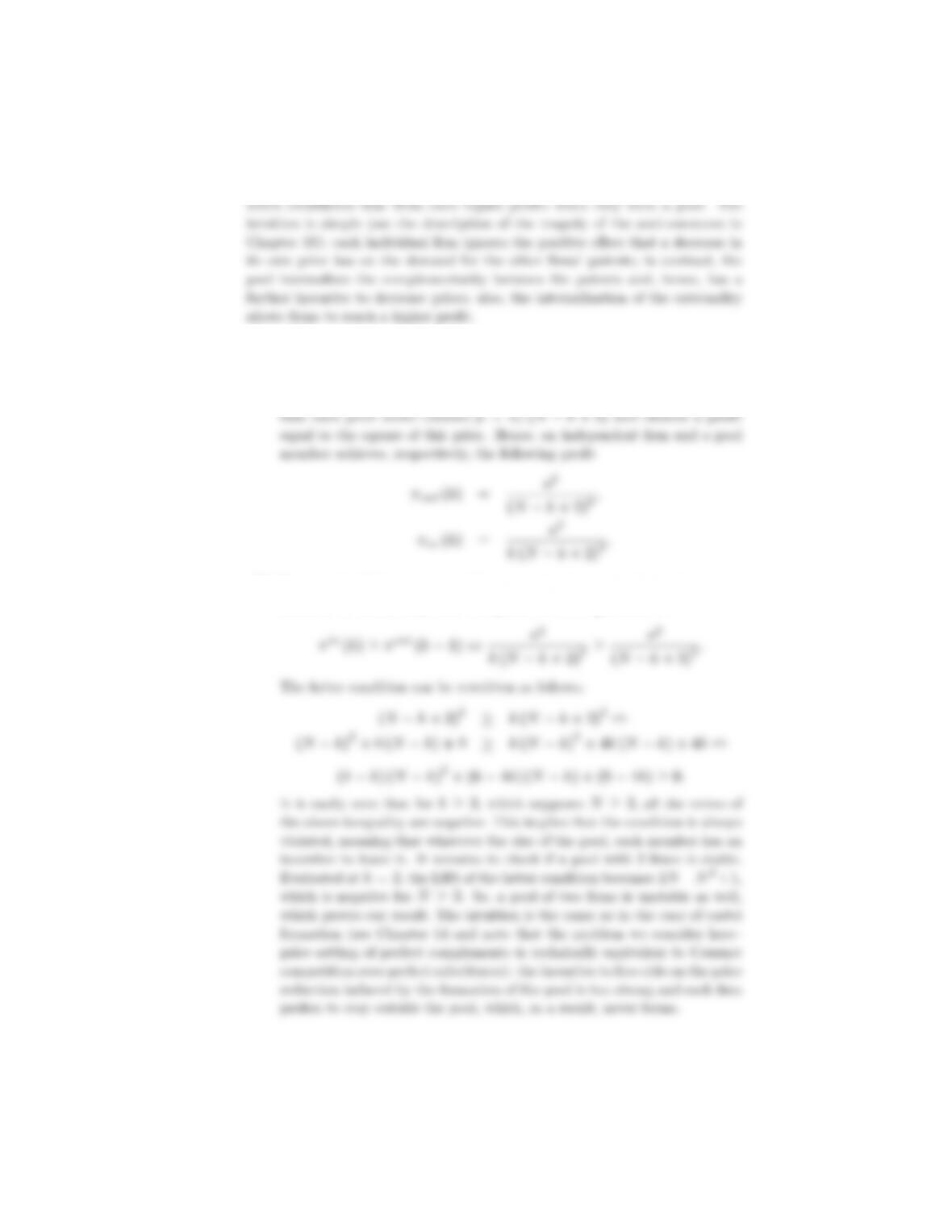
(a) There are now Nk+1 independent price setters (the Nkindependent
firms and the pool). Repeating the analysis of question 1, we easily find
(b) For a pool of kfirms to be stable, it must be that no pool member has an
incentive to unilaterally leave the pool, which is equivalent to
14
Exercise 9 Formation of patent pools [included in 2nd edition of the book]
Suppose that three firms (noted i= 1;2;3) each own a patent that is essential
to the production of a given final product. For simplicity, we assume that there is
a competitive industry that produces this final product, buying and assembling
the necessary components from each of these three firms. We assume that the
assembly firms incur no other assembly cost in addition to (i) paying royalties
for the use of the three essential patents, (ii) incurring transaction costs when
inquiring about the license fees. Regarding the latter transaction costs, it is
assumed that they are inversely related to the number of different license fees
that are set by the patent holders. Patent holders have indeed the possibility to
form so-called “patent pools” whereby they coordinate their decisions to set a
unique license fee that allows assembly firms to access two (or three, if all firms
join) patents at once. This is modeled as follows.
The price of the final product is denoted by p. Demand for the final
product is given by q=ap.
Competition in the assembly industry therefore ensures that pbe equal to
the the marginal cost of assembly, which depends on the patent pool that
patent holders may have formed. In particular, three options are possible:
p=8
<
:
r1+r2+r3+ 3; if no pool is formed,
rij +rk+ 2; if firms iand jform a pool,
rp+; if the three firms form a pool,
where 0 < a=3is the cost per transaction, riis the license fee set by
firm ifor accessing its patent, rij (resp., rp) is the common fee set by the
pool formed by firms iand j(resp., all firms) for accessing the bundle of
patents iand j(resp., all patents).
1. Suppose that the three patent holders set their license fee independently
and non cooperatively. Derive the Nash equilibrium in fees, compute (i)
the price of the final product (denote it ps) and (ii) the profit of each
patent holder at equilibrium (denote it s).
2. Repeat the previous analysis by assuming that firm iand jcoordinate
their decisions to set a common fee rij that has to be paid for acquiring
the right to use patents iand j. Firm k, on the other hand, still acts
separately and sets its license fee rk. Compute again the price of the
final product (denote it p2), as well as the equilibrium profits of the firms.
Denote the profit of firms iand j in (supposing that they divide their
joint profit equally) and the profit of firm k,out.
3. Suppose now that the three firms form a patent pool and choose a common
license fee rpto maximize their joint profit. Assembly firms that pay rp
have access to the whole set of patents. Derive the optimal rp. Supposing
that the pool’s profit is equally distributed among the three firms, compute
15
each individual firm’s profit (denote it by p). Compute also the price of
the final product (denote it pp).
4. Comparing your answers to the previous three questions, show that, even
in the absence of transaction costs (= 0), the more there are patents
in the pool, the smaller the price of the final product, and the larger the
sum of the patent holders’ profits. Discuss the economic intuition behind
these results.
5. Consider now the following pool formation game. Before they set the
license fees, patent holders simultaneously decide whether to join a patent
pool or not (only one pool can form). Set a= 120 and characterize the
Nash equilibrium of this game for all admissible values of the transaction
cost (i.e., 0 < 40). Discuss the economic intuition behind your
results.
Solutions to Exercise 9
1. Firm i’s maximization program is maxriri(ariri3), where ride-
notes the sum of the license fees of all firms but i. The first-order condition yields
the reaction function ri(ri) = 1
2. The pool formed by firms iand jand firm khave, respectively, the following
maximization programs are maxrij rij (a2rij rk)and maxrkrk(a2rij rk).
The first-order conditions yield the following reaction functions: rij (rk) =
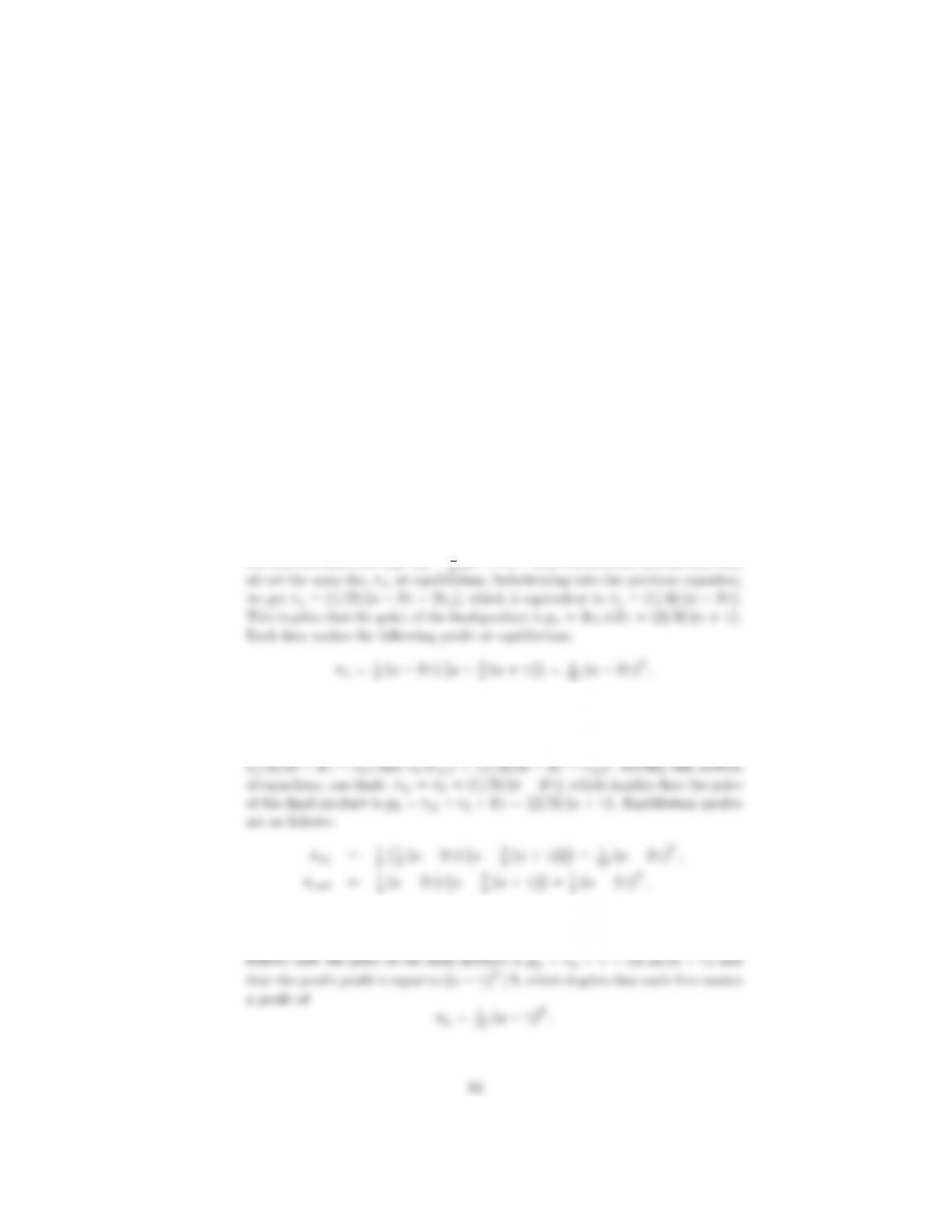
3. The pool’s maximization program is maxrprp(arp). From the first-order
condition, it is easily found that the optimal price is rp= (1=2) (a). It
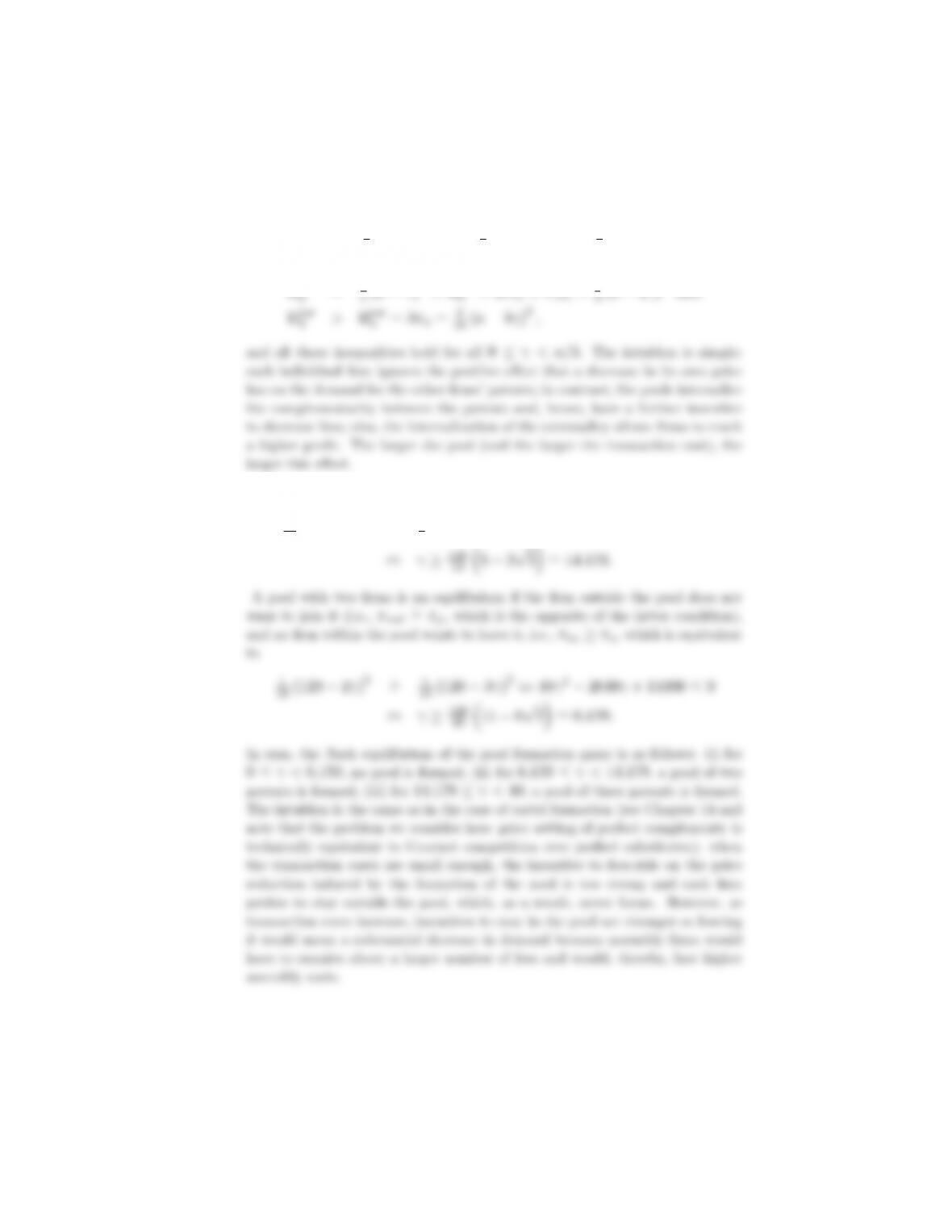
4. Comparing prices of the final product and total profits, we easily conclude:
pp=1
2(a+)< p2=2
3(a+)< ps=3
4(a+);
5. All three firms join the pool iff pout, which is equivalent to
1
12 (120 )21
9(120 2)2,1321200+ 14400 0
Exercise 10 Patent pools and mergers
17
Consider a vertical market structure with 2 upstream firms (A and B) and
2 downstream firms (a and b). The downstream firms require the input of each
of the upstream firms, who demand linear royalties (rA
a,rA
b,rB
a,rB
b) charged
for each unit the respective downstream firm sells. Downstream firms face the
inverse demand P(q) = abq; where q=qa+qb. Assume that the royalties
accruing to the upstream firms are the only costs that the downstream firms face
(i.e., downstream marginal costs are ca=cb= 0) and all costs of the upstream
firms are sunk.
1. Brie‡y explain in one or two sentences why perfectly complementary
upstream products are a good way to describe a set of complementary
patents.
2. Solve for the symmetric subgame-perfect Nash equilibrium in which the
upstream firms set non-discriminatory royalties (rI
i=rI
jrI) in the first
stage and downstream firms engage in Cournot-competition in the second
stage.
3. Now assume that firms Aand amerge (vertical merger) and maximize
joint profits. Solve for a subgame-perfect Nash equilibrium in which the
upstream firms set (non-discriminatory) royalties in the first stage and
downstream firms engage in Cournot-competition in the second stage.
How does the merger affect total royalties charged and quantities sold?
4. Starting from the original (separate) setup, now assume that firms A
and Bmerge (horizontal merger) and maximize joint profits. Solve for
a subgame-perfect Nash equilibrium in which the upstream firm(s) set
nondiscriminatory royalties in the first stage and downstream firms en-
gage in Cournot-competition in the second stage. How does the merger
affect total royalties charged and quantities sold?
Solutions to Exercise 10
1. If producing a certain product requires the use of multiple patented ideas, then
the producer needs to obtain licenses from each of the patentees. In most cases,
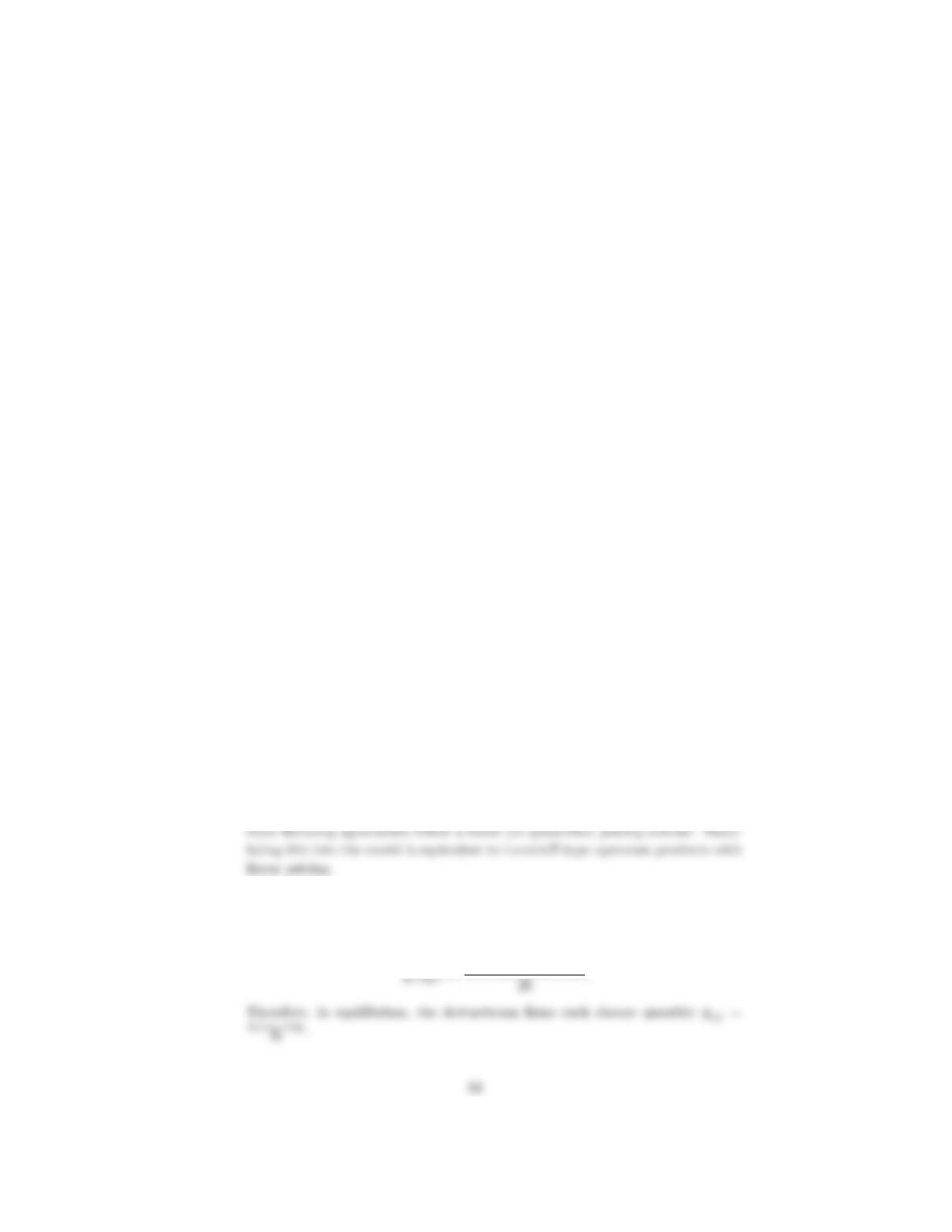
2. The downstream interactions are of standard Cournot-type. Downstream firms
individually maximize. In particular, a=qa(ab(qa+qb)rArB). One
obtains the reaction functions
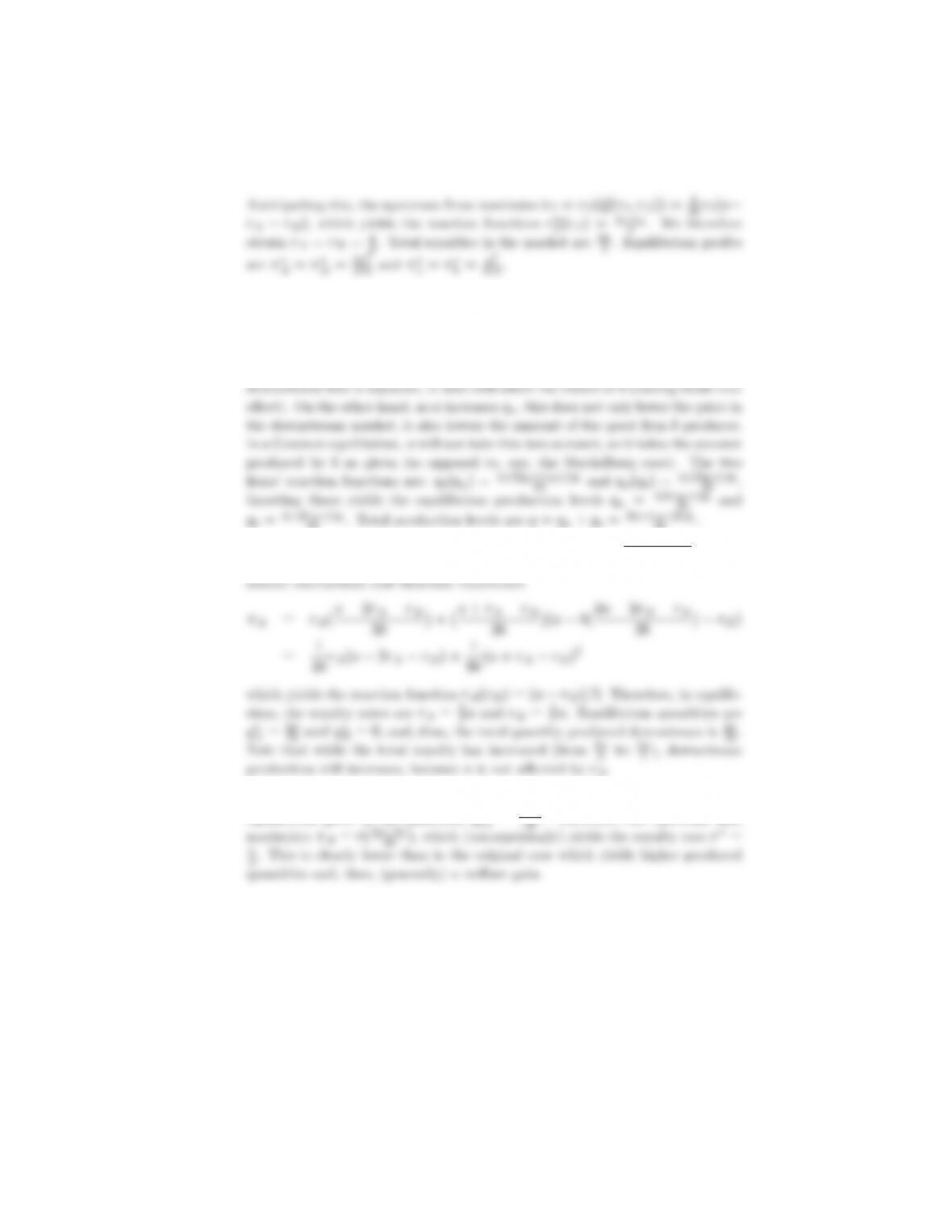
3. Denoting the profits of the merged firm as A, we get the following profit func–
tions (focusing on the internal solution; in the alternative possible solution A
sets rAso high to price bout of the market, and we would have a downstream
and an upstream monopoly): B=rBq,A=rAqb+qa(abq rB)and
b=qb(abq rArB). While rAdoes not affect the output decision of
3b. Total production levels are q=qa+qb=2arA2rB
3b.
Anticipating this, upstream firm Bmaximizes B=rB(2arA2rB
3b)which
yields the reaction function r
B(rA) = (2arA)=4. Firm Aanticipates down–
4. Now there is one upstream monopolist charging r. The downstream Cournot
equilibrium gives us the quantities qi;j =ar
Exercise 11 Optimal copyright length
“The Adelphi Charter on Creativity, Innovation and Intellectual Property
responds to one of the most profound challenges of the 21st century: How to
ensure that everyone has access to ideas and knowledge, and that intellectual
property laws do not become too restrictive. The Charter sets out new prin-
ciples for copyrights and patents, and calls on governments to apply a new
19
public interest test. It promotes a new, fair, user-friendly and efficient way of
handing out intellectual property rights in the 21st century. The Charter has
been written by an international group of artists, scientists, lawyers, politicians,
economists, academics and business experts.”
Here is what is written in the Adelphi Charter about the length of IP pro-
tection: “The ‘term’ – the period over which a copyright or patent is effective
– has always been limited – and for very good reasons. Now, however, there is
a disturbing trend towards lengthening terms, particularly in the area of copy-
right. [. . . ] The earliest ‘term’ of copyright, given as a right to authors, was
14 years, with the option of extending for an extra 14 years. The length of
copyright term has been continually extended, particularly since the 1960s. In
some jurisdictions, there is now pressure to lengthen terms to 90 or 120 years,
and a continual pressure for all governments to follow suit and ‘level-up’. There
are a number of problems associated with the lengthening copyright terms.”
(www.adelphicharter.org)
1. Set out the economic problem that a regulator must solve when choos-
2. Do you concur with the authors of the Adelphi Charter when they claim
that “there are a number of problems associated with the lengthening
copyright terms”? Use the framework you have just outlined to express
your opinion.
Solutions to Exercise 11
Exercise 12 “Pay-for-delay” and generic drugs
Under the “pay-for-delay” deal the patent holder of a drug pays a maker of
generic drugs to delay its launch of a cheap copy.
2. Model the market for drugs as a homogeneous Cournot market with lin-
ear demand (it would be straightforward to include asymmetries between
3. Some branded drug makers have decided to offer lower-priced “authorized”
generic version shortly before the patent expires. Note that the first (non-
4. Some generic drug makers now agree to delay their launch of their generic
Exercise 13 Licensing of process innovation under horizontal product differ-
entiation
Consider the Hotelling model with linear transport costs where two firms, 1
and 2, are located at the extreme points of the unit interval. There is a unit
mass of consumers who are uniformly distributed over this interval. A consumer
located at x2[0;1] has utility r x p1if she buys one unit of product 1,
or r(1 x)p2if she buys one unit of product 2. Consumers have unit
demands; we assume that ris large enough so that each consumer buys one or
the other product.
1. Initially, both firms produce at a constant marginal cost c0. Compute the
profit of the two firms at the Nash equilibrium of the pricing game.
2. Suppose that firm 1 has found a process innovation that decreases its cost
from c0to c0k, with k < c0and k < 3. Compute the the profit of the
two firms at the Nash equilibrium of the pricing game if firm 1 is the sole
user of the innovation.
3. Firm 1 could sell a license on its innovation to firm 2. Show that fixed-fee
licensing is not profitable but that royalty licensing is. Give the economic
intuition behind your result.
Solutions to Exercise 13
1. The indifferent consumer is identified by ^xsuch that r^xp1=r(1 ^x)
p2, or ^x= 1=2 + (p2p1)=(2). The mass of consumers with x^x(resp.
2. Now, firm 1 chooses p1to maximize 1= (p1c0+k) ^x, while firm 2 chooses
p2to maximize 2= (p2c0) (1 ^x). From the F.O.C. for profit maximiza–
tion, we find the two firms’ reaction function as p1= (c0k++p2)=2
21
2+k
32
2k
32
3. Under fixed-fee licensing, both firms operate at the same cost c0k. The
equilibrium of the pricing game is the same as in Question 1 (which means that
the cost reduction is entirely passed on to the consumers): both firms achieve
Consider now royalty licensing. Firm 1 sets the maximum royalty that is accept-
able for firm 2: r=k. Hence, firm 2’s cost is equal to c0k+r=c0. The