Industrial Organization: Markets and Strategies
Paul Belleflamme and Martin Peitz
published by Cambridge University Press
Part VII. R&D and intellectual property
Exercises & Solutions
Exercise 1 Incentives to innovate and competition
1. Take the linear demand P(q) = abq and establish the result that a
Exercise 2 Incentives to R&D and market structure [included in 2nd edition
of the book]
At a hotel in Munich in May 2007, Webasto, a German auto parts maker,
decided to license the rights to one of its best-selling products – a roof-top so-
lar panel for cars and trucks – to the highest bidder at a public auction. (See
International Herald Tribune, May 13, 2007). Firms coming from different in-
dustries attended this public auction. From which type of industry do you
think the highest bidder for Webasto’s products came from? From a concen-
trated (monopoly-like) industry? From a much more competitive industry with
numerous small players? Or from some intermediate (oligopoly-like) industry?
The following exercise will help you answering these questions.
Assume that the demand for trucks is p= 100 q(where qis the quan-
tity and pis the price), and that Webasto’s roof-top solar panel allows truck
manufacturers to reduce the constant marginal cost of production from 70 to
60.
1. Confirm that this is a nondrastic (or minor) innovation and that marginal
cost would have to be reduced to less than 40 for the innovation to be
drastic (or major).
2. Suppose that the industry is a monopoly (not threatened by entry). How
much is this firm willing to pay (per period of time) to acquire the inno-
vation?
3. Suppose that the industry is a Bertrand oligopoly. That is, there are n
firms (with n2) that compete in price. Before the innovation, all firms
have the same marginal cost of 70. After the innovation, one of them has
a lower cost of 60. Compute how much the latter firm is willing to pay for
the innovation.
4. Now assume that the market is served by Cournot duopolists who have
identical marginal costs of 70 before the innovation.
(a) Confirm that the pre-innovation price is 80 and that at this price
each firm has profits per period of 100.
(b) Suppose that one of these firms is granted use of the innovation.
Confirm that the price falls to 76.67, and compute the per period
profits of the two firms.
(c) How much is any of these duopolists willing to pay to acquire the
innovation?
5. Suppose that the industry is a monopoly threatened by entry. More pre-
cisely, with the existing technology, production at a marginal cost of 70
does not make entry profitable. However, by lowering the marginal cost
to 60, the new technology makes entry profitable. So, by acquiring the
innovation, the incumbent firms precludes entry: it remains a monopolist
and produces now at a marginal cost of 60. On the other hand, if the mo-
nopolist does not acquire the innovation, another firm does, which allows
it to enter the market. The market structure becomes thus an asymmetric
Cournot duopoly in which the incumbent firm has a marginal cost of 70,
while the entrant has a marginal cost of 60.
(a) How much is the incumbent firm willing to pay for the innovation?
(b) How much is the entrant willing to pay for the innovation?
(c) If the innovation goes to the highest bidder, what is the influence of
innovation on market structure? Discuss.
6. Finally, by collecting your answers to questions 1 to 5, rank the various
market structures according to the incentives to innovate that they convey
to firms. Comment your ranking.
Solutions to Exercise 2
1. Let cdenote the marginal cost. A monopolist chooses its quantity to maximize
profit = (100 q)qcq. The optimal quantity is easily found as qm(c) =
(100 c)=2and the corresponding price is pm(c) = 100qm= (100 + c)=2.
2. Using the analysis of the previous question, we can compute the monopoly
optimal profit for any given marginal cost: m(c) = qm(c) [pm(c)c] =
3. As the innovation is nondrastic, we know that the innovator’s optimal price
strategy is to set a price just below the marginal cost of the rival firms, i.e.,
4. Cournot duopoly
(a) Before the innovation, firm 1chooses its quantity q1to maximize 1=
(100 q1q2)70q1. The first-order condition yields: 302q1q2= 0.
We derive firm 1’s reaction function from the latter expression: q1(q2) =
(b) Let the innovator be firm 1. Its profit is now written as 1= (100 q1q2)
60q1. From the first-order condition for profit maximization, we derive firm
1’s reaction function: q1(q2) = 1
2(40 q2). As for firm 2, the marginal
5. Monopoly threatened by entry
(a) In case the incumbent gets the innovation, it remains a monopoly with
a marginal cost of 60. We know from (2) that its profit is then equal to
3
6. In this example, we observe P Iinc > P Ib> P Ient > P Ic> P Im. The fact
that P Ib> P Imis known as the replacement effect. The fact that P Iinc >
Exercise 3 Incentives to invest in product and process innovations1[included
in 2nd edition of the book]
Consider the following duopoly. Each firm i(i= 1;2) incurs a constant
marginal cost equal to ciand produces a differentiated product, qi, sold at price
pi. The demand system is obtained from the optimization problem of a rep-
resentative consumer. We assume a quadratic utility function which generates
the linear inverse demand schedule pi=aqiqjin the region of quantities
where prices are positive. The parameter 2[0;1] is an inverse measure of the
degree of product differentiation: the lower the more products are differenti-
ated (if = 1, products are perfect substitutes; if = 0, products are perfectly
differentiated). Firms compete à la Cournot on the product market.
Initially, both firms produce at cost ci=c. A new process innovation allows
firms to reduce the constant marginal cost of production from cto c0=cx
(with 0< x < c). We assume that the innovation is nondrastic. That is the
cost reduction does not allow the innovator to behave like a monopolist. A
sufficient condition is that the monopoly price corresponding to c0is larger than
the initial cost c; that is, (a+cx)=2> c. Equivalently, assuming without loss
of generality that the difference acis equal to unity, we assume: x < ac= 1.
1. Compute how much a duopolist is willing to pay for acquiring the inno-
vation and being its single user (i.e., compute the difference between the
profit a firm makes when it is the sole user of the innovation and the profit
it makes when no firm uses the innovation).
2. Suppose now that a product innovation allows firms to increase product
differentiation (i.e., to reduce the parameter ). Show that if the initial
4
degree of product substitution, , is larger than 2=3, then the adoption of
this product innovation always reduces the incentives to adopt the process
innovation (computed at the previous question).
Solutions to Exercise 3
1. We first derive the Cournot equilibrium for given c1and c2. Firm i’s prob–
lem is maxqi(aciqiqj)qi.From the FOC, we find firm i’s reac-
tion function as qi(qj) = 1
2(aciqj). Similarly, we have for firm j:
qj(qi) = 1
2. To measure the sensitivity of the incentive to innovate in the process innovation
with respect to a product innovation, we need to differentiate (post pre)
with respect to :
d
(2)2(2+)2= 4x4x+(32)(2)
(2)3(2+)3:
Exercise 4 Cumulative innovations [included in 2nd edition of the book]
Consider the following market structure. There are two firms, noted 1 and
2. In the first period, firm 1 exogenously makes a discovery. If it incurs costs
c1, it can turn this discovery into a new product. A mass 1 of consumers
5
has a valuation for this product of r1. In the second period (no discounting),
firm 2 exogenously makes a discovery if (and only if) firm 1 has developed the
product in period 1. Incurring costs c2, firm 2 can turn this discovery into a
competing product for which consumers have a valuation of r2. Assume that
consumers have unit demand and buy either one unit of product 1, one unit of
product 2 or nothing after the second period. Throughout the exercise, assume:
A1 : r2> c2+r1and A2 : r1> c1>0.
1. Briefly interpret A1and A2. Which investment decisions are made in the
subgame-perfect Nash equilibrium of the game without an allocation of
intellectual property rights, i.e., with standard competition in period 2?
Explain why this result may be inefficient from a welfare standpoint.
2. For the same parameter constellation, show that a license fee payable
from firm 2 to firm 1 for every unit of the good sold can induce a welfare
optimal allocation. (Assume the following timing of the game: first the fee
is set; then firm 1 makes the investment decision; finally firm 2 makes
the investment decision.) In which range must lie to be effective? What
happens if it is too high/too low?
3. Now let us further expand the game in the second period. (For this last
part of the problem, assume for simplicity that r1= 0.) Assume that
courts only enforce firm 1’s license claims against firm 2 with probability
p. Firm 2 can choose two types of monetary investment: ca
2increases the
value of the product for consumers, such that @r2=@ca
2>0, with r2(0) > r1
and @2r2=@ca
22<0. Parameter cb
2does not affect the value of the product
to consumers, but it reduces the probability that firm 2 would be required
to pay the license fee by a court, i.e. @p=@cb
2<0, with limcb
2!1 p > 0and
@2p=@cb
2
2>0. Find a subgame-perfect Nash equilibrium of the following
game. In the first stage, firm 1 chooses a fixed . In the second stage,
firm 2 chooses both its investment levels. In the third stage, consumers
make their purchase decisions and courts enforce the license fee with
probability p(cb
2). What changes if firm 1 can set as a share of r2
instead of a fixed fee?
Solutions to Exercise 4
1. The two assumptions state that (1) the development of product 2 is welfare
increasing given that product 1 has been designed and (2) the development of
product 1 as a stand-alone product (without the development of product 2) is
2. The license fee has to achieve the following: It must give firm 1 an incentive to
invest in the first period and firm 2 to invest in the second, while firm 2 sells
3. With its investment decisions, firm 2 maximizes 2=r2(ca
2)p(cb
2)ca
2cb
2.
This gives the first order conditions @r2
j= 1. Therefore the
Exercise 5 Cumulative innovations and the Human Genome Project
In the Human Genome News Archive Edition of November 2000, one can
read the following:
“The deluge of data and related technologies generated by the Hu-
man Genome Project (HGP) and other genomic research presents
a broad array of commercial opportunities. Seemingly limitless ap-
plications cross boundaries from medicine and food to energy and
environmental resources, and predictions are that life sciences may
become the largest sector in the U.S. economy.
Established companies are scrambling to retool, and many new ven-
tures are seeking a role in the information revolution with DNA at
its core. IBM, Compaq, DuPont, and major pharmaceutical com-
panies are among those interested in the potential for targeting and
applying genome data.
7
In the genomics corner alone, dozens of small companies have sprung
up to sell information, technologies, and services to facilitate basic
research into genes and their functions. These new entrepreneurs
also offer an abundance of genomic services and applications, includ-
ing additional databases with DNA sequences from humans, animals,
plants, and microbes.”
1. Innovations in the genomic field are in essence cumulative. Define two
different types of cumulative innovations.
2. For each type of cumulative innovations, describe the generic problem that
is likely to arise and discuss how the patent system could be complemented
in order to solve these problems.
3. What is your opinion about the fact that “dozens of small companies have
sprung up to sell information, technologies, and services to facilitate basic
research into genes and their functions”? Is this likely to foster, or rather
to impede, innovation in the genomic field?
Solutions to Exercise 5
2. The main problem with sequential innovations is the potential hold up problem;
ex ante licensing may be used to solve this problem. As for complementary in–
3. Small firms may foster innovation by increasing the tradability of technologies
Exercise 6 Secrecy versus patenting2
Consider an innovative environment where independent or nearly simulta-
neous discoveries are possible. More specifically, we assume that two firms are
engaged in R&D that results either in an innovation (with probability ) or
failure (with probability 1). It is assumed that the probability of success
() is independent across firms. Firms can protect their innovation either by
secrecy or by filing for a patent.
8
If the innovation is protected by secrecy, it leaks out with probability
1s, regardless of the number of successful firms. When this happens,
the innovation is publicly available and production is at the competitive
level, driving the innovator’s profits down to zero.
Patent protection is measured by the probability that a patent holder
can exclude competitors from using the innovation, which is denoted p.
Hence, with probality 1p, the innovation becomes public, resulting
again in zero profits for the innovator.
If only one firm succeeds in R&D and the innovation does not become public,
the firm earns monopoly profit m. If both firms succeed and their innovation
does not become public, each firm earns duopoly profit d< m. In the case
where both firms are successful and file for the patent, each firm obtains it with
probability 1=2.
The two firms have to decide whether to file for a patent (strategy noted P)
or resort to secrecy (strategy noted S). This decision has to be made before
learning whether the competitor has succeeded or not.
1. Using the above information, compute the firms’ expected profits for the
four combinations of strategies. Denote (a1; a2)the expected profit for
a firm when it chooses strategy a1and its opponent chooses strategy a2,
with a1and a22 fP; Sg. You are thus asked to compute (P; P ), (P; S),
(S; P ), and (S; S).
2. Suppose that p=s. That is, the innovation has the same probability
of becoming public whether it is protected by secrecy or by a patent (in
other words, patent and secrecy offer the same level of protection).
(a) Show that patenting is a dominant strategy. That is, show that both
(P; P ) (S; P )and (P; S) (S; S)are true.
(b) Show also that successful firms prefer the situation where they both
file for a patent over the situation where they both keep the innova-
tion secret. That is, show that (P; P ) (S; S)is true.
3. Suppose now that p6=s. To ease the computations, set m= 16,
d= 4, and = 1=2.
(a) Compute the values of (P; P ), (P; S), (S; P ), and (S; S)un-
der these assumptions.
(b) Characterize the Nash equilibrium (in pure strategies) of the game
for all p,s2[0;1]. Represent graphically the characterization of
the equilibrium in the plane (p; s).
(c) Show that both firms may choose to protect the innovation via a
patent even though patents offer a weaker protection than secrecy.
Explain the economic intuition behind this result.
9
Solutions to Exercise 6
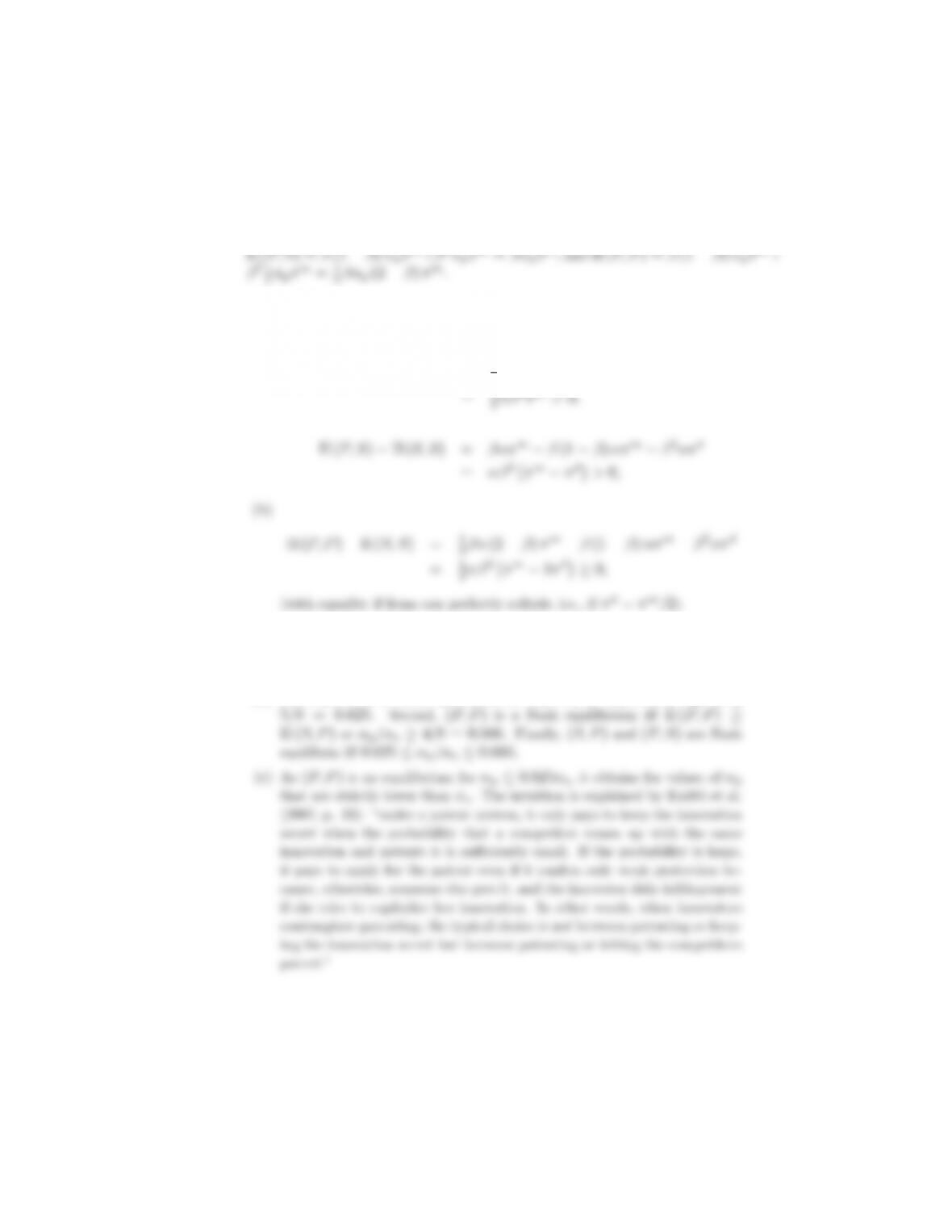
1. We find (S; S) = (1 )sm+2sd, (S; P ) = (1 )sm,
2. Let p=s=, then
(a)
(P; P ) (S; P ) = 1
2 (2 )m(1 )m
3. Let m= 16,d= 4, and = 1=2. Then,
(a) (S; S) = 5s, (S; P ) = 4s, (P; S) = 8p, (P; P ) = 6p.
(b) First, (S; S)is a Nash equilibrium iff (S; S) (P; S)or p=s
Exercise 7 Strategic patenting [included in 2nd edition of the book]
10
Consider a market where demand is given by P(q) = aq. An incumbent
firm has a proprietary technology with a constant marginal cost of cI(with
cI< a). One other firm could enter the market as a Cournot duopolist, but the
technology available to this firm does not allow it to make any positive profit if
it enters. Precisely, the marginal cost corresponding to the entrant’s technology,
cE, is such that cE= (a+cI)=2 = ~c.
1. Check that this condition implies the non positivity of the entrant’s quan-
tity at the Cournot-Nash equilibrium.
Suppose now that alternative technologies become available with a constant
marginal cost ccomprised between cIand ~c.
2. Show that, although the incumbent has no incentive to switch to any of
these technologies, it has a higher incentive to acquire a patent on them
than the entrant has.
3. What does the previous result tell you about firms’ motivations to file
patents? Discuss.
Solutions to Exercise 7
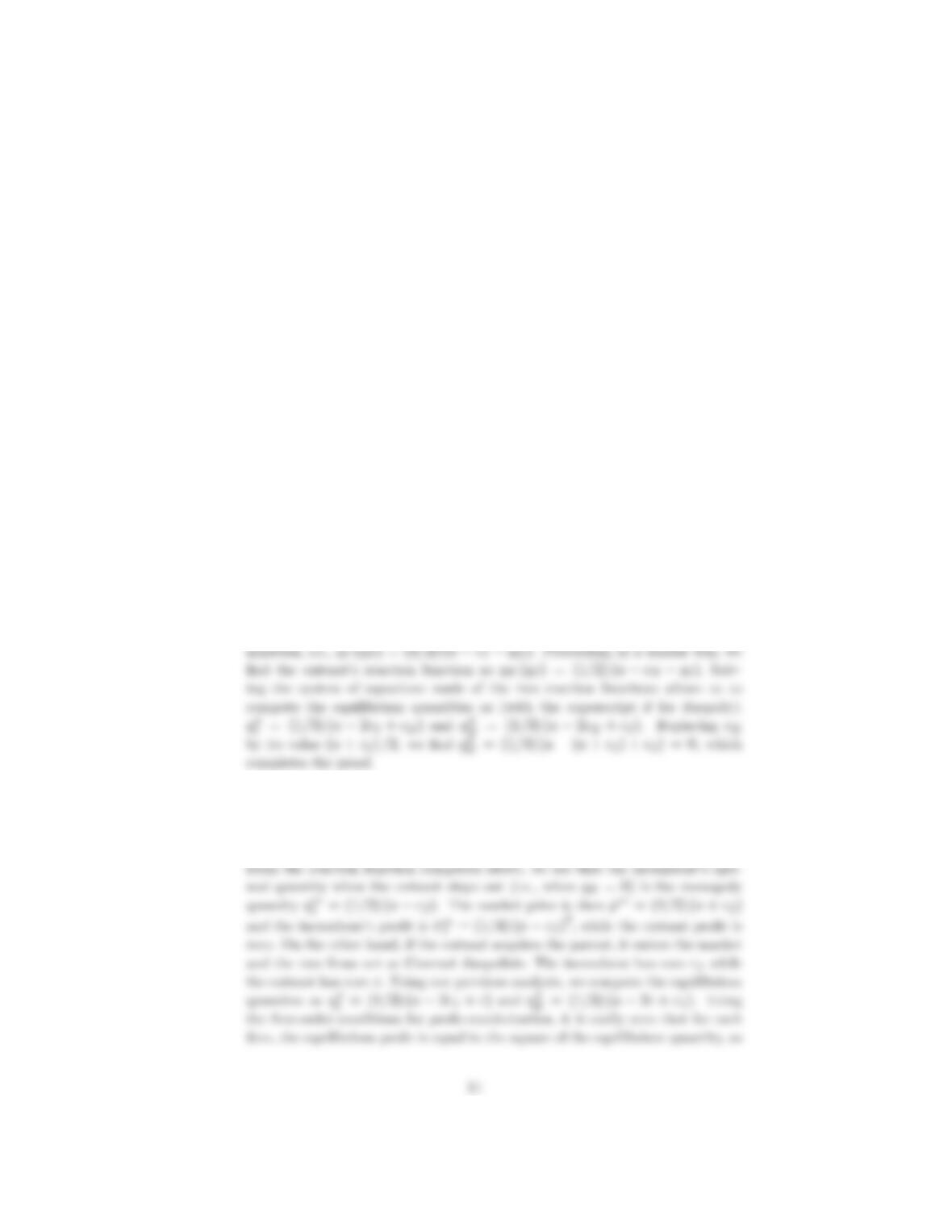
1. Suppose that the incumbent and the entrant compete as Cournot duopolists.
The incumbent chooses qIto maximize (aqIqEcI)qI. We derive the
incumbent’s reaction function from the first-order condition for profit maxi-
2. If the incumbent acquires the patent on the new technology, it remains a monop–
olist (since the entrant has no profitable way to enter). Naturally, the incumbent
prefers to keep on using its existing technology as the associated cost of pro-
duction is lower (cI< c). The incumbent’s profit is then computed as follows.