Industrial Organization: Markets and Strategies
Paul Belleflamme and Martin Peitz
published by Cambridge University Press
Part VI. Theory of competition policy
Exercises & Solutions
Exercise 1 Industries with cartels
Briefly describe and analyze a case of your choice concerning a price- or
quantity-fixing cartel (please not OPEC). The following questions may be useful
to bear in mind: What are the relevant characteristics of the industry? What
was the scope of the cartel? How was the cartel enforced? What were the effects
of the cartels? How did the competition authority or court argue and what was
the decision, if any?
Exercise 2 Collusion and pricing
Two (advertising-free) newspapers compete in prices for an infinite number
of days. The monopoly profits (per day) in the newspaper market are Mand
the discount rate (per day) is . If the newspapers compete in prices, they both
earn zero profits in the static Nash equilibrium. Finally, if the firms set the same
price, they split the market equally and earn the same profits.
On Sundays, the newspapers may sell a weekly magazine (that can be bought
without buying the newspaper). The monopoly (competitive) profits when sel-
ling the magazine are also M(zero).
1. Suppose that the newspapers do not sell a weekly magazine. They like to
collude on the monopoly price. Write down the strategies that the newspa-
pers could follow to achieve this outcome. Find the discount rates for which
they are able to sustain the monopoly price using these strategies.
2. From now on suppose that the newspapers sell a weekly magazine. For
which discount rates can the monopoly price be sustained only in the
market for magazines? (Write down the equation that characterizes the
solution.) Compare the solution found in question 1 and 2 and comment
briefly.
3. For which discount rates can the monopoly price be sustained both in the
market for newspapers and in the market for magazines? (Write down the
equation that characterizes the solution.)
1
Solution to Exercise 2
1. Suppose that firms use grim trigger strategies. We have
m
m
3. Most attractive deviation is on Sunday and gives Vd
i= 2m. Along the equili-
brium path, the present discounted value on Sunday is
Exercise 3 Collusion and pricing II [included in 2nd edition of the book]
Consider a homogeneous-product duopoly. The two firms in the market are
assumed to have constant marginal costs of production equal to c. The two
firms compete possibly over an infinite time horizon. In each period they simul-
taneously set price pi,i= 1;2. After each period the market is closed down with
probability 1.
Market demand Q(p)is decreasing, where p= minfp1; p2g. Suppose, fur-
thermore, that the monopoly problem is well defined, i.e. there is a solution
pM= arg maxppQ(p). If firms set the same price, they share total demand with
weight for firm 1 and 1for firm 2. Suppose that 2[1=2;1). Suppose that
firms use trigger strategies and Nash punishment.
1. Suppose that = 0. Derive the equilibrium of the game.
2. Suppose that > 0and = 1=2. Derive the condition according to which
firm 1and firm 2do not find it profitable to deviate from the collusive
price pM.
3. Suppose that > 0and > 1=2. Derive the condition according according
to which pMis played along the equilibrium path. Show that the condition
is the more stringent the higher .
2
4. Show that previous results in (3) also hold for any collusive price pC2
(c; pM).
5. Suppose that > 0and > 1=2and that firm 1 can only adjust its price
every periods. Derive the condition according to which pMis played
along the equilibrium path. How does the time span influence the con-
dition?
Solution to Exercise 3
2. Profit with collusive price pMis (1=2)M=(1 ), where MpMQ(pM).
3. Consider firm 2. The deviation profit is M. Profit with collusive price pM
4. As follows from the inequality (1 )e=(1 )efor any e2(0; M)the
same inequality holds.
Exercise 4 Collusion and pricing III
Four firms produce a homogeneous product at constant marginal costs ci=
1,i2 f1;2;3;4g. Market demand is given by 9p, where pis the lowest price
set by the firms. The price pis chosen from a discretized price set (where the
minimal price change “is arbitrarily small). When analyzing equilibria proceed
in two steps: Characterize the equilibrium for a given (small) “and then let “
turn to zero. If the lowest prices is set by more than one firm, the demand at
that price is split evenly among firms with the lowest price.
1. Determine Nash equilibrium price, quantity and profit of each firm of the
game in which firms simultaneously set price. Consider only symmetric
equilibria.
2. Suppose that firms coordinate their pricing decisions and implement the
monopoly solution. What is each firm’s profit if they jointly implement
the monopoly solution?
3. Consider a model of repeated interaction in which each firm sets its per-
period price in any discrete point in time t= 1;2; ::: over an infinite
time horizon. Firms discount future profits by < 1. The per-period
game is as described above. Characterize the subgame-perfect equilibrium
that implements the highest possible profit for the firms in the industry.
Determine the critical discount factor below which tacit collusion on the
monopoly price cannot be sustained.
4. Suppose now that firm 1 enjoys a marginal cost reduction to c1= 1=2.
Determine Nash equilibrium price, quantity and profit of each firm of the
one-shot game in which firms simultaneously set price under the assump-
tion that firms do not set prices below marginal costs.
5. Return to the infinitely repeated game in which, different from part 3,
firm 1 enjoys a cost advantage as specified in part 4. Argue whether there
a critical discount factor below 1such that tacit collusion on the collusive
outocome of part 2 of the exercise can be sustained. Compare your finding
with the one obtained in part 3. Note: You are not expected to derive an
explicit solution for the critical discount factor; an implicit characteriza-
tion is sufficient.
Solution to Exercise 4
1. This is an instance of Bertrand competition with homogeneous products. In
2. The monopoly price is arg maxp(9 p)(p1). The first-order condition of
profit maximization is 92p+ 1 = 0 and, thus, one obtains pM= 5. Total
3. Under tacit collusion each firm makes per-period profit of C= 4. The lowest
critical discount factor is obtained if firms play a grim trigger strategy of the
following form: they set the monopoly price as long as no firm has deviated in
4. Under the assumption that firms do not set price below marginal costs, in equi-
librium one of firms 2 to 4 sets the price equal to 1or 1 + “and all other firms
5. Under collusion, the same allocation as under part 2 can still be implemented
(although it no longer maximizes cartel profits, since firm 1 produces at lower
marginal cost). This implies that firm 1 continues to serve demand of 1. However,
it has lower marginal cost c1= 1=2and, thus, obtains profit 9=2. The deviation
Exercise 5 Parallel pricing and evidence of collusion
A competition policy authority has noticed that the firms in the Lysine
industry consistently charge very similar prices, and the suspicion is that they
are colluding. Do you think that parallel pricing is proof of collusion? If not,
what kind of evidence would you look for?
Solution to Exercise 5 The problem of using parallel pricing as evidence of
collusion is that firms can set similar prices both when they are colluding and when
Exercise 6 Collusion and quantity competition [included in 2nd edition of the
book]
Consider the following market: Two firms compete in quantities, i.e., they
are Cournot competitors. The firms produce at constant marginal costs equal
to 20. The inverse demand curve in the market is given by P(q) = 260 q.
1. Find the equilibrium quantities under Cournot competition as well as the
quantity that a monopolist would produce. Calculate the equilibrium pro-
fits in Cournot duopoly and the monopoly profits. Suppose that the firms
compete in this market for an infinite number of periods. The discount
factor (per period) is ,2(0;1).
5
2. The firms would like to collude in order to restrict the total quantity
produced to the monopoly quantity. Write down grim trigger strategies
that the firms could use to achieve this outcome.
3. For which values of is collusion sustainable using the strategies of ques-
tion (b)? [Hint: Think carefully about what the optimal deviation is.]
Solution to Exercise 6
3. We have that Ri(qj) = 120 qj=2. This implies that the optimal deviation to
Exercise 7 The European air cargo cartel [included in 2nd edition of the book]
Read the following press release of the European Commission (Brussels,
March 28, 2012): http://europa.eu/rapid/press-release_IP-12-314_en.htm. For
the sake of the exercise, we model the European air cargo market during the 72
months of the cartel existence as follows. First, only the 14 firms associated in
the cartel were active on the market; second, these firms were symmetric; they all
had the same constant marginal cost, c, for supplying airfreight services; third,
these firms competed ï¿1
2la Cournot (i.e., by choosing the quantity of airfreight
services); finally, the inverse demand for airfreight services (per month) was
given by p=a2q, where qdenotes the total quantity of airfreight services
supplied by the 14 firms.
As written in the text, the Commission fined the cartel members a total
of e169 million. Given that the cartel lasted for 72 months, this is roughly
equivalent to a fine of e2.35 million per month. This fine is meant to compensate
the European consumers for the surplus reduction that they suffered because of
the existence of the cartel.
1. Show that (ac)had to be equal to e3.89 million (per month) to justify
the fine of e2.35 million per month imposed by the Commission.
2. Set (ac)to e3.89 million. Assuming that the cartel profits were equally
shared among the 14 cartel members, show that any of these firms would
have been better off by unilaterally leaving the cartel (which would have
then counted only 13 members) and by acting independently. What does
this tell you about the stability of cartels? Discuss.
3. Continue to set (ac)to e3.89 million. Take now a tacit collusion per-
spective. Suppose that the 14 firms were following a grim trigger strategy
and were expecting to continue to compete indefinitely on that market.
Compute the minimum discount factor that allowed the 14 firms to sustain
full collusion (i.e., to behave as a cartel).
Solution to Exercise 7
1. We recall from the analysis of the symmetric Cournot oligopoly of Chapter
3 (with demand given by P(q) = abq and linear marginal cost c) that the
total quantity at the Nash equilibrium is q(n) = n(ac)=(b(n+ 1)). As
2. We also recall from Chapter 3 that the equilibrium profit is equal to
(n) = (ac)2=(b(n+ 1)2). Each cartel member receives a share 1=14
3. Again, the answer does not depend on the specific value of band (ac)
(you should nevertheless check this!). We can refer to Section 14.2.1:
Exercise 8 Cournot mergers: profitability and welfare properties
1. Suppose that firms simultaneously set quantities. Determine the equilibri-
um (price, quantities, profit, welfare).
2. The firms consider to merge although their production costs are not affec-
ted. Determine the solution to this problem. Is such a merger profitable?
What are the welfare effects of such a merger?
3. Suppose that the merger is efficiency enhancing, leading to marginal costs
cm< c. What are the welfare effects of such a merger. Do you possibly
have to qualify your answer in (2)?
4. Consider the possibility of firm entry after the merger (the entrant produ-
ces at marginal costs c= 3 and has entry cost e). Suppose first that the
merger is not efficiency-enhancing. Analyze such a market and comment
5. Many countries scrutinize merger and sometimes block them (or impose
remedies)? Discuss which factors should make the courts or the competi-
Exercise 9 Cournot mergers and synergies. [included in 2nd edition of the
book]
Consider a homogeneous-product Cournot oligopoly with 4 firms. Suppose
that the inverse demand function is P(q) = 64 q.
1. Suppose that firms incur a constant marginal cost c= 4. Characterize the
Nash equilibrium of the game in which all firms simultaneously choose
quantity.
2. Suppose that firms 1 and 2 consider to merge and that there are synergies
leading to marginal costs cm< c. Characterize the Nash equilibrium. At
which level cm(you may want to give an approximate number) are the
two firms indifferent whether to merge?
3. Is such a merger that just makes the two firms indifferent between merging
and non-merging consumer-welfare increasing?
4. At which level cmwould the merger be consumer-welfare neutral?
5. Suppose that instead firms 1,2, and 3 consider to merge. The new marginal
cost of the merged firms is cn< c. At which level cnare the three firms
indifferent whether to merge?
6. Compare your findings in (5) and (2). What can you say about incentives
to merge in this case?
Solution to Exercise 9
1. Since all firms have the same costs, they all choose the same quantity in equi-
2. The merged firm sets q
m= arg maxqm[(64 qmq3q4cm)qm]while
3. Consumer welfare before the merger was CSc= 1152. After the merger, con-
4cm)2
4. The merger will never be consumer welfare neutral because CSc=CSm,
5. Proceed as in (2) but with only two players left (the merged entity and one
6. A merger of 3 firms is already profitable for a smaller amount of synergies than
a merger of 2 firms. This is due to the fact that merger-specific synergies balance
Exercise 10 Cournot mergers with differentiated products
Consider an n-firm Cournot oligopoly in which each firm ifaces inverse
demand Pi(q1; q2; :::; qn) = 1 qiPj6=iqj, where 2(0;1). Suppose that all
firms have constant marginal costs of production c= 0.
1. Determine equilibrium quantities, prices and profits.
2. Suppose that n= 4 and = 1=2. Determine equilibrium quantities, prices
and profits in the case of a two-firm merger.
3. Suppose that n= 4 and = 1=2. Determine whether a two-firm merger
is profitable?
4. Describe the forces at play when considering the profitability of the merger.
What is the role of ?
5. Discuss the welfare effects of the merger.
9
Solution to Exercise 10
1. maxqi(qic)(1 qiPj6=iqj)
FOC:
12qiX
j6=i
qjc= 0:
2. Merger of firms with products 1 and 2:
maxq1;q2(q1c)(1 q1X
j6=1
qj) + (q2c)(1 q2X
j6=2
qj)
FOC w.r.t. q1:
10
Solving this linear system in two equations for = 1=2:
q=2
51c1cq
3
Price for product 1: p1= 1 6
26 (1 c)4
26 (1 c)4
26 (1 c)3
26 (1 c) =
9
26 +17
26 c=c+9
26 (1 c):
Price for product 3: p3= 1 8
3. We are now in a position to compare profits of the merged firm to those under
single-product oligopoly. Profit of each firm in the latter case is (1c)2
4. In contrast to a homogeneous good linear Cournot oligopoly, under product dif-
ferentiation a two-firm merger keeps its two products. As in the homogeneous
5. Prices for all products are higher under a two-firm merger. Hence, consumer
surplus would be lower after the two-firm merger. However, the two-firm merger
Exercise 11 Cournot mergers and demand
Consider the following Cournot merger game. In a homogeneous product
market each firm i, with i2 f1; :::; nghas constant marginal costs of production
cand produces quantity qi. The inverse demand function is of the form
P(q) = aq
where a > 0, > 0, and q=Pn
i=1 qiis the total quantity.
1. Discuss the shape of the inverse demand function depending on .
2. Determine the Cournot equilibrium profits in this set-up. [You can simply
use the first-order conditions without checking whether the solution is a
maximizer.]
3. Consider a merger among xfirms in an n-firm industry. Write down the
condition for the merger to be profitable. Check whether a 3-firm merger
is profitable in an industry with initially 4 firms for parameter values
2 f1;2;3g.
Solution to Exercise 11
1. For = 1 demand is linear, for < 1demand is strictly convex and, for > 1,
2. maxqiqi(a(qi+qi)c)
The first-order condition of profit maximization is
ac= (qi+qi)+qi(qi+qi)1
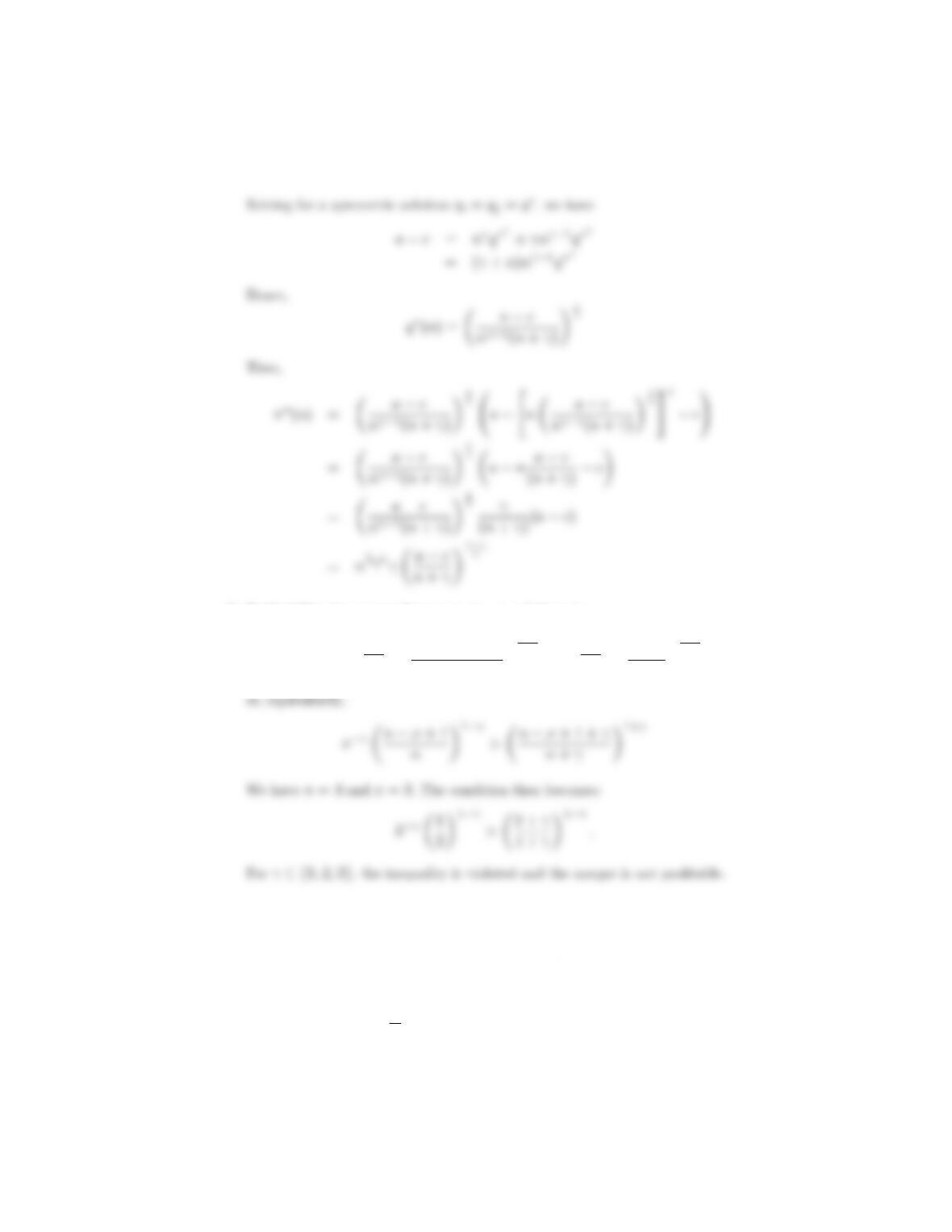
=n1
ac
n+1+
3. Profitability of a merger from nto nx+ 1 firms is
(nx+ 1)1
ac
nx+ 1 + 1+
> xn1
ac
n+1+
Exercise 12 Cournot mergers and asset complementarity [included in 2nd edi-
tion of the book]
Consider an nfirm symmetric homogeneous product Cournot oligopoly.
Each firm ihas a physical asset Ki=Knormalized to 1. Its cost function
is Ci(qi;Ki= 1) = q2
i+1
32 . The demand side of the market is given by an
inverse demand curve P(q) = 1 qwhere q=Piqi.
13
1. Determine equilibrium price, quantity, and profit of the nfirm Cournot
model specified above. What is the upper bound on nfor all firms in the
industry to make non-negative profits?
2. Consider now a merger between the two firms nand n1. Suppose first
that physical assets cannot be sold and that the assets of one of the mer-
ging partners are liquidated at zero cost, i.e. the cost function of the mer-
ged firm is Ci(qi; 1) = q2
i+1
32 . Determine equilibrium price, quantity, and
profit of the firm Cournot model after the merger. For which nare mergers
profitable? For which nare mergers consumer surplus increasing?
3. Consider again a two-firm merger, but suppose now that the merged firm’s
assets can be combined giving rise to the cost function Ci(qi;Ki) = 1
Kiq2
i,
i.e. the merged firm n1has cost function Cn1(qi; 2) = 1
2q2
i+1
16 . De-
termine equilibrium price, quantity, and profit of the firm Cournot model
after the merger. For which nare mergers profitable? For which nare
mergers consumer surplus increasing? [Hint: you may want to solve parts
3 and 4 together]
4. Consider once again a two-firm merger, but suppose now that the mer-
ged firm’s assets are complementary. More specifically, suppose that the
merged firm n1has cost function Cn1(qi; 2) = 1
4q2
i+1
16 . Determine
equilibrium price, quantity, and profit of the firm Cournot model after
the merger. For which nare mergers profitable? For which nare mergers
consumer surplus increasing? What happens when the complementary is
even stronger?
5. Based on your findings in parts 2-4 what are the policy conclusions for an
antitrust authority?
Solution to Exercise 12
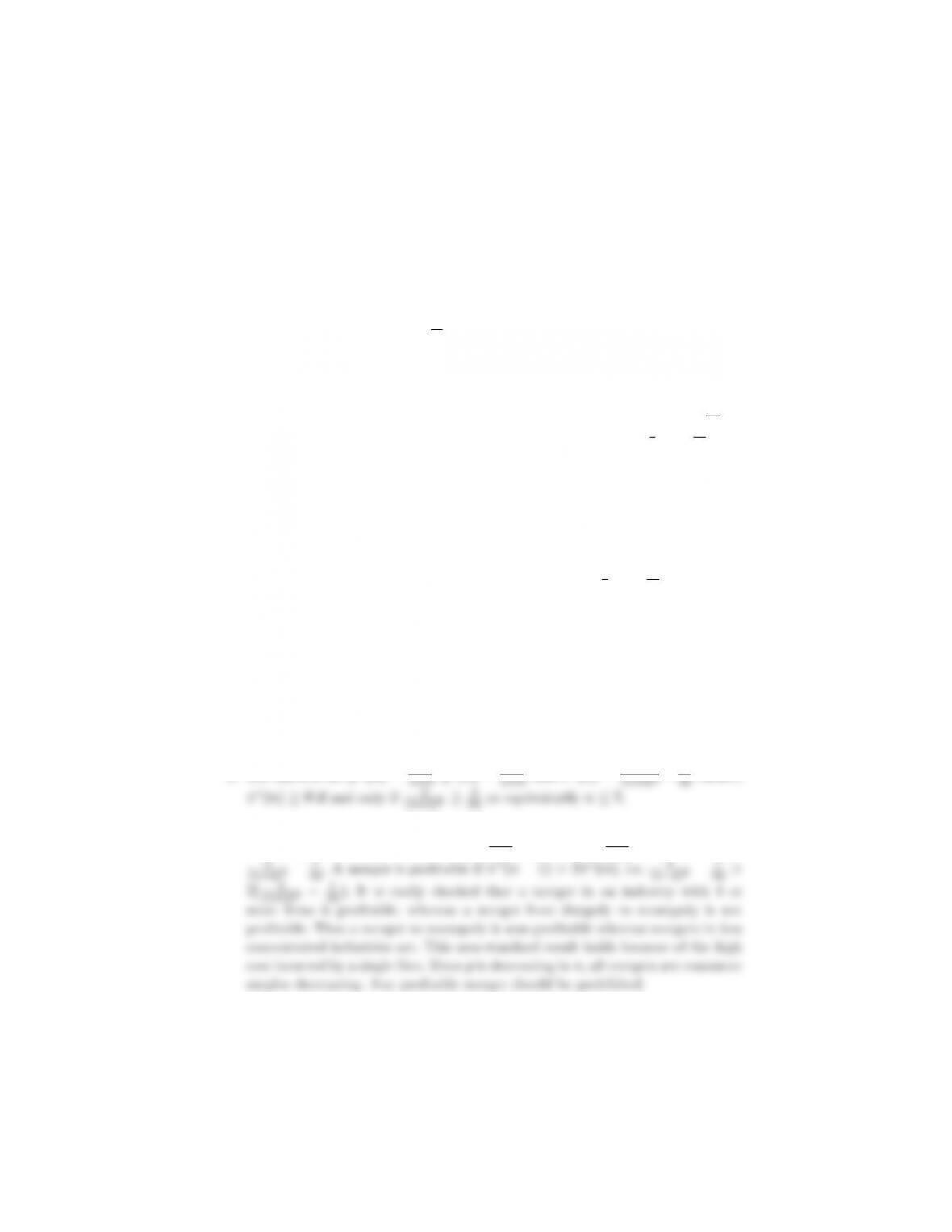
1. The answers are p(n) = 3
2. Firms are still symmetric after the merger. There are now n1firms left in the
market and one compute p(n1) = 3
n+2 ,q(n1) = 1
n+2 , and(n1) =
3. The merged firm n1is different from all other firms i= 1; :::; n2. Looking for
an equilibrium in which all non-merged firms set the same quantity (equilibrium
14
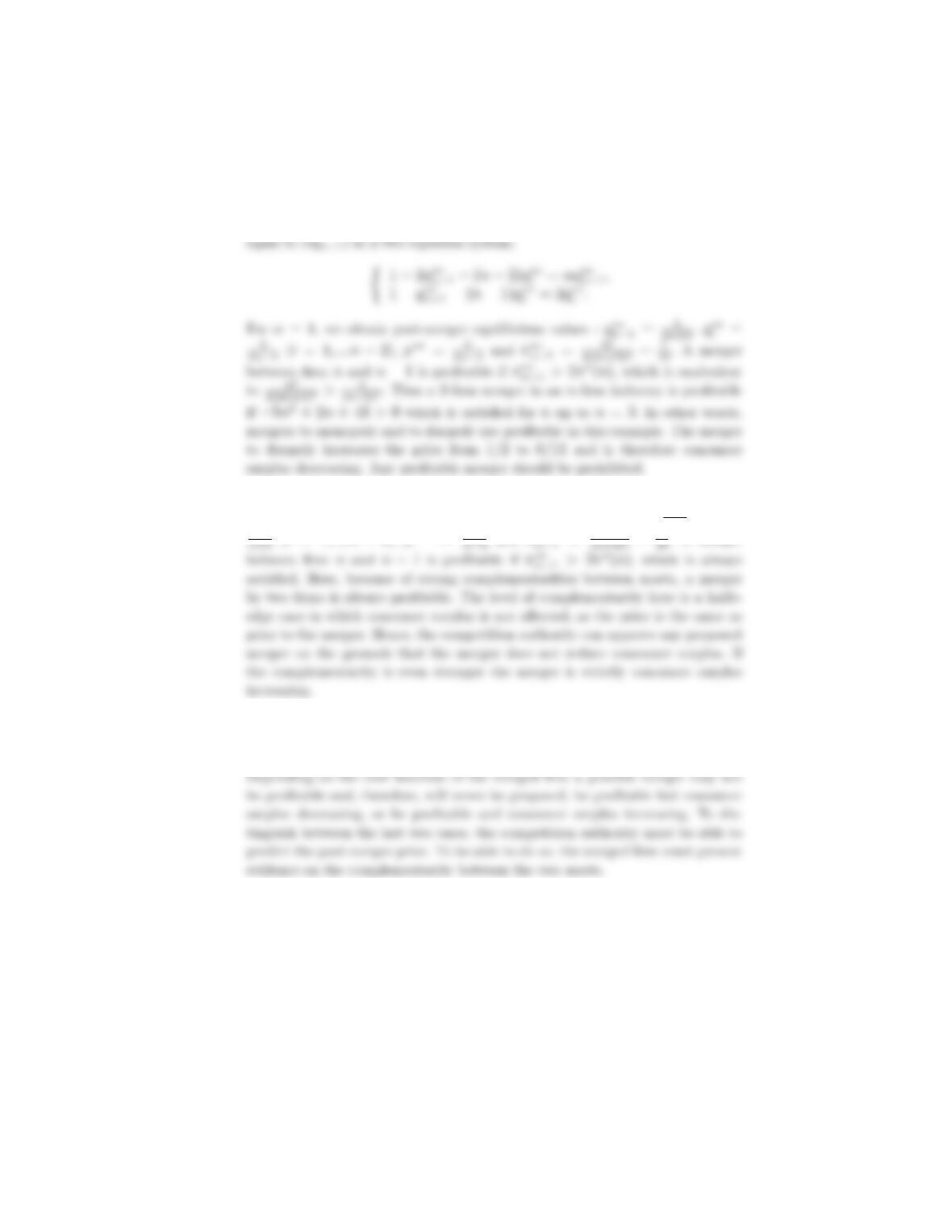
values are denoted by superscript ), we can rewrite the system of first-order
conditions of profit maximization (with marginal costs of the merged firm being
4. First-order conditions from part c with = 1=2apply. We denote equilibrium
values after the merger by superscript . We compute: q
n1=2
n+3 ,q
i=
1
5. If complementarities between merging firms are sufficiently strong such that the
post-merger price is lower than the pre-merger price, the competition authority
should approve any proposed merger based on the consumer surplus criterion.
Exercise 13 Mergers with price-setting firms
Consider a homogeneous product industry with three firms A; B; and C.
Firms have constant marginal costs of production cA> cB> cCand no fixed
costs. There is a unit mass of consumers with willingness to pay r > cA. Firms
simultaneously set prices to maximize profits. Suppose that, in parts 2 to 4 of
this problem, firms do not choose weakly dominated strategies. In case of a
15
merger, the merged entity has the lowest cost of the two firms consuming the
merger.
1. Characterize the full set of Nash equilibria—in particular, characterize
equilibrium demand and equilibrium prices (p
A; p
B; p
C). What is the Nash
equilibrium outcome if all firms do not choose weakly dominated strate-
gies?
2. Is a merger between firms Aand Bprofitable? What would be the consu-
mer surplus effect of such a merger?
3. Is a merger between firms Aand Cprofitable? What would be the consu-
mer surplus effect of such a merger?
4. Is a merger between firms Band Cprofitable? What would be the consu-
mer surplus effect of such a merger?
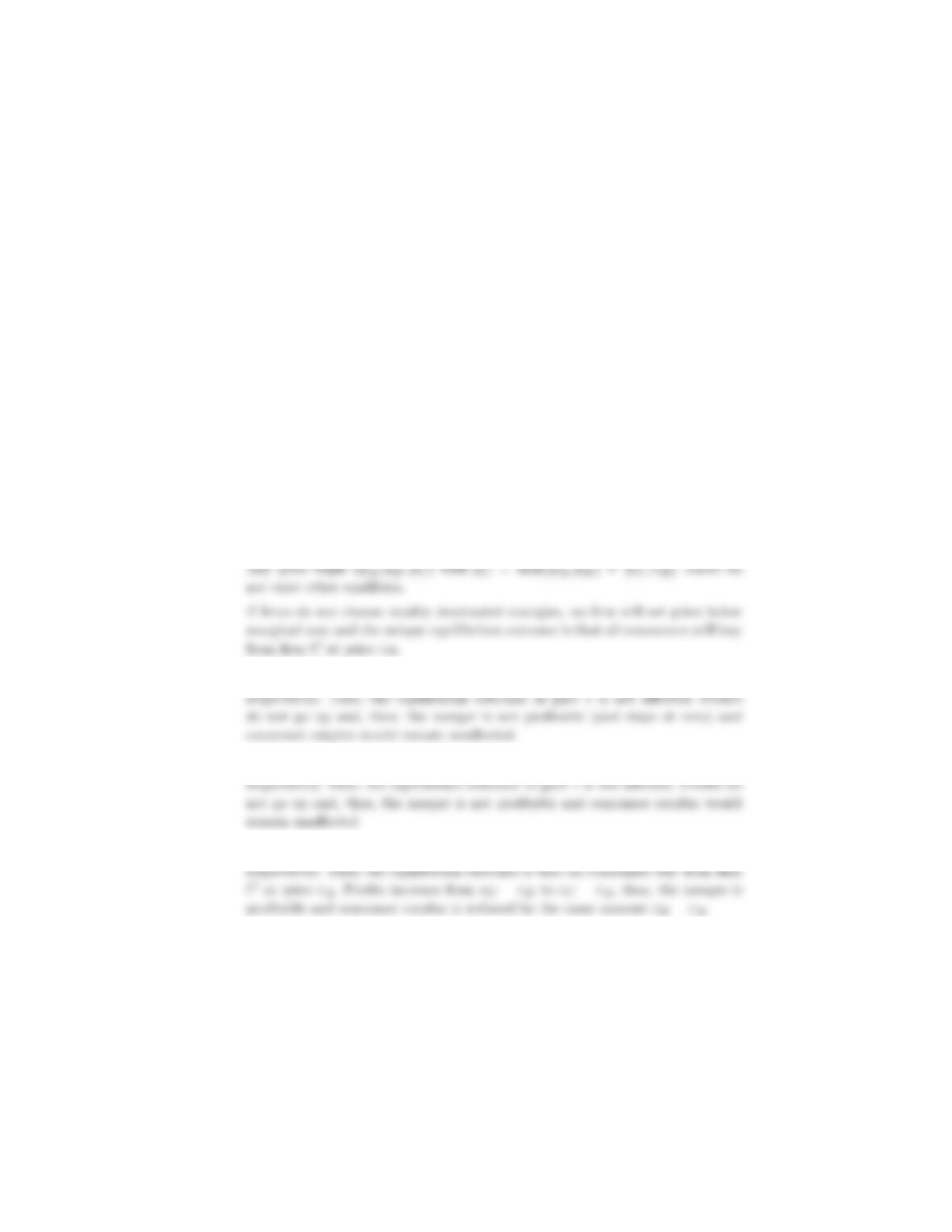
Solution to Exercise 13
1. In any equilibrium, firm Csells to all consumers. Any prices pC2[cC; cB]can
be supported as the equilibrium price, set by firm Cat which all consumers buy.
2. If Aand Bmerge, the remaining two firms have marginal costs cBand cC,
3. If Aand Cmerge, the remaining two firms have marginal costs cBand cC,
4. If Band Cmerge, the remaining two firms have marginal costs cAand cC,
Exercise 14 Mergers and free entry [included in 2nd edition of the book]
Consider a homogeneous product market with infinitely many quantity-
setting firms. The inverse demand function is given by P(q) = aqwhere
qis industry quantity. The cost function of each firm is Cs(qi) = csqi+Fsfor
16
qi>0and Cs(0) = 0. Suppose that parameters are such that, in any equi-
librium, more than one firm is active (Note: In the analysis below it is NOT
required to derive the parameter restriction which guarantees that this property
is satisfied.) For simplicity, the analysis below should be carried out under the
assumption that the number of firms is a real number.
1. Characterize the set of pure-strategy free-entry equilibria of the game in
which all firms simultaneously quantities. Determine equilibrium quantity
of each active firm, equilibrium price, industry quantity, number of firms,
and consumer welfare in equilibrium.
2. Consider a single merger between two firms. Suppose that the merged firm
has cost function Cm(qi) = cmqi+Fmfor qi>0and Cm(0) = 0 and that
cm=cs, while Fm2Fs. Derive the exact condition when a merger is
profitable when there is free entry before and after the merger.
3. In the setting of (2) is a profitable merger welfare-increasing? Or is a
profitable merger welfare-decreasing? Explain your findings.
4. Consider now a single merger after which the merged firm has costs with
cmcsand Fm=Fs. Derive the exact condition when a merger is
profitable when there is free entry before and after the merger.
5. In the setting of (4) is a profiable merger welfare-increasing? Or is a pro-
fitable merger welfare-decreasing? Explain your findings.
Solution to Exercise 14
1. Profit of firm iis i= (aqiqics)qiFs. FOCs can be written as qi=
(aqics)=2. In symmetric equilibrium with nfirms, we must have qi=q
i
2. The best response function of the merged firm is the same as non-merged firms.
Hence, we obtain the same aggregate output and the same total number of active
3. A profitable merger is always welfare-increasing. Consumer surplus is not affec–
4. Denote the newly merged firm as firm 1. Then q1= (aq1cm)=2and
qi= (aqics)=2for i6= 1. For the non-merged firms, in free-entry
equilibrium, (P(q
1+Pi6=1 q
i))q
i=Fs. Since the best response of firm iand
5. Since consumer surplus and outsider profits are not affected by the merger, the
Exercise 15 Burning ships
Hernan Cortéz, the Spanish conqueror (”conquistador”), is said to have bur-
Exercise 16 Quantity commitment [included in 2nd edition of the book]
Up to two firms are in a market in which quantities are the strategic variable.
There are two periods; in the first period firm 1 is a protected monopolist.
In each of the two periods t= 1;2the inverse demand function Ptis given
by Pt(xt) = 20 xt. In each period the cost function of firm iis given by
Ct
i(xt
i) = 9 + 4xt
i. Profits of a firm are the sum of its profits in each period (no
discounting). Firms maximize profits by setting quantities.
1. Determine the monopoly solution.
2. Because of technological restrictions firm 1 has to choose the same quantity
in each period (x1
1=x2
1). Observing x1
1, firm 2 is considering to enter in
period 2. Determine the profit maximizing x2
2given x1
1.
3. Assume that firm 2 will enter in period 2. What quantity will firm 1
produce? Determine equilibrium prices, quantities, and profits.
4. Firm 2 only enters in period 2 if it can make positive profits. Determine
the subgame perfect equilibrium of the two-period model.
18
Solution to Exercise 16
1. In the monopoly situation, we can analyze a single period (both periods are
2. Firm 2’s profit given q1is t=2
2= (20 q1q2)q294q2. We find firm 2’s
best response from the first-order condition: q2= 8 1
2q1. When playing this
best reposnse, firm 2 achieves the following profit:
3. Assuming that firm 2 enters, firm 1 has to consider both profits on the first and
second period in its decision (as q1can not be changed between the periods per
assumption):
4. To find the subgame-perfect equilibrium, we need to be determined whether
the incumbent firm 1 would prefer to accommodate entry of firm 2 in period
Exercise 17 Strategic quantity choice
Consider a market with two firms, Aand B. The firms produce homogenous
2. Assume from now that there is an entry cost of e. Firm Ais already
established in the market, and firm Bis considering whether to establish
3. Write down firm B’s profit function.
Exercise 18 Taxonomy of entry-related strategies I
Consider a market with differentiated products. In the first stage firm 1is
the incumbent firm and can invest an amount K10in reducing its marginal
costs, c(K1) = cK1=10. In stage two firm 2can decides about entering the
market with constant marginal costs of cand entry costs of e. In stage three if
entry takes place firms engage in price competition and face symmetric demand
functions given by Di(pi; pj) = Aapi+bpj(A > a > b > 0). If no entry takes
place, firm 1acts as a monopolist with demand, D1(p1) = Aap1.
1. Calculate the best response functions for both firms. Draw a graph.
Argue graphically from now on:
2. Does an increase in K1increase or decrease the profit of the entering firm?
Does an increase in K1make the incumbent tough or soft?
3. Does a marginal investment K1increase or decrease the profit of the in-
cumbent? (Assume that eis sufficiently low such that entry takes place
for K1close to zero. Moreover, assume A10)
4. Use your answer of (2): Is entry deterrence via cost reduction possible in
this setting? If your answer is YES, which numbers would you have to
compare to decide whether entry deterrence is optimal? If your answer is
NO, what do we have change in this model to induce entry deterrence?
5. Use your answer of (3): If entry accommodation is optimal how much
should firm 1invest in cost reduction?
6. How would you answer to (4) change if we consider a Cournot game ins-
tead?
7. How would you answer to (5) change if we consider a Cournot game ins-
tead?