Solution to Exercise 18
demand Di(Pi; Pj) = Aapi+bpj; A > a > b > 0
1. Best responses:
max i(pi;pj) = (pici)(Aapi+bpj)
FOC: a(pici) + Aapi+bpj
!
= 0
2api=A+aci+bpj
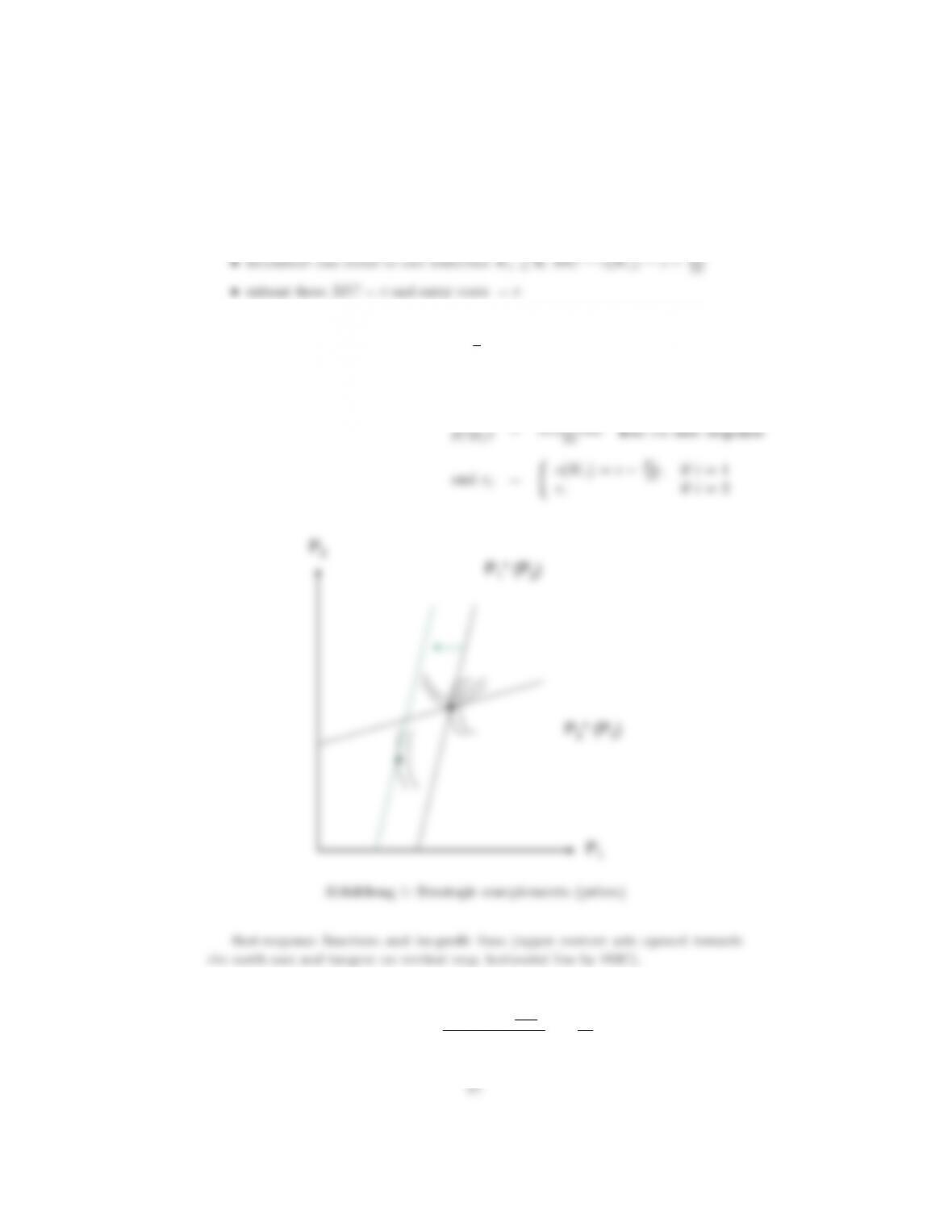
2. Graphical argument:
p1(p2) = A+a(cK1“
10 )
2a#+b
2apj
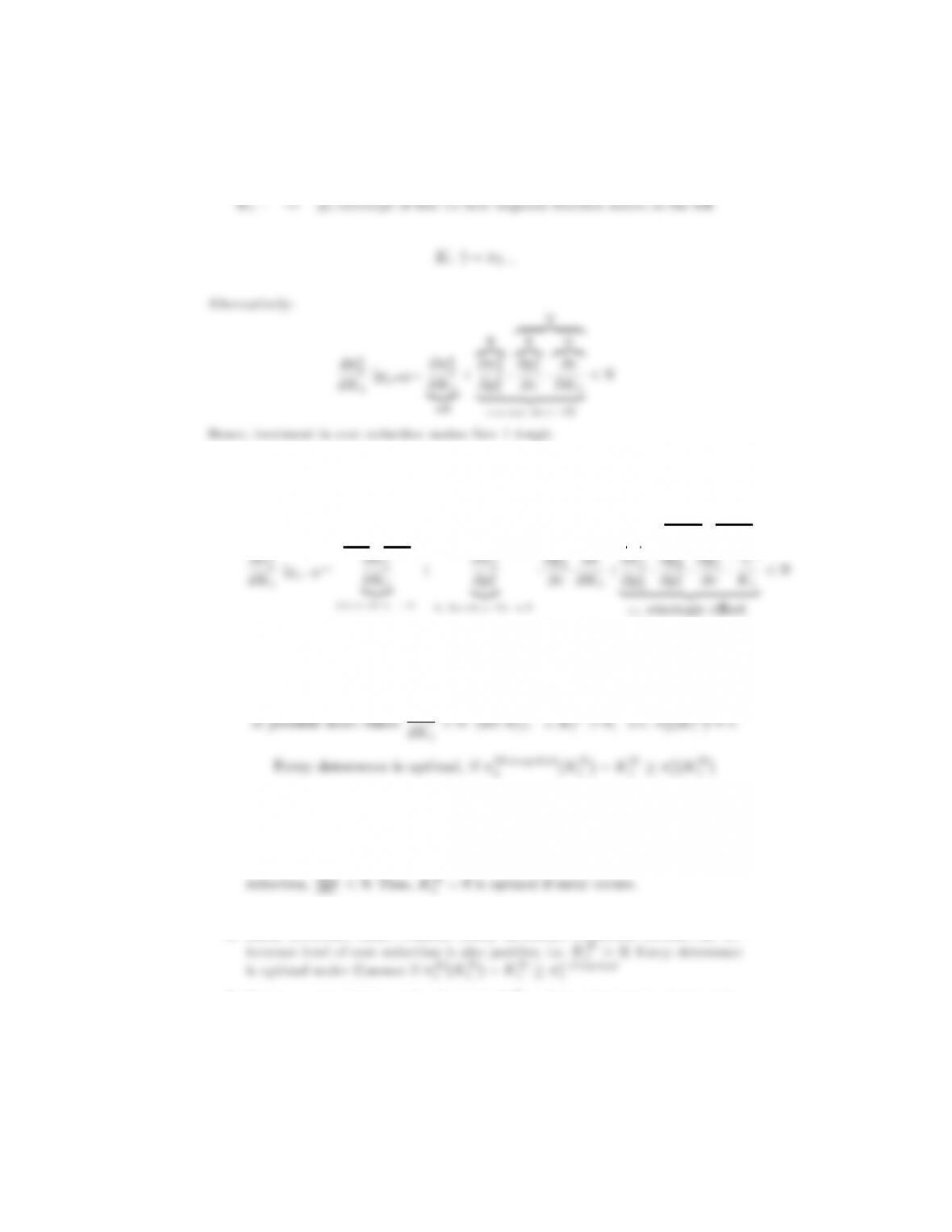
3.
z}| {
|{z}
d i r e c t e ff e c t !0
|{z}
b y E n v e l o p e T h . = 0
z}|{
z}| {
z}|{
z}|{
z}|{
|{z }
;strategic effect
4. Entry deterrence (D):
2
5. Entry accommodation (A); see (3):
Since the strategic effect is negative, firm 1’s profit decreases in the level of cost
1
6. Entry deterrence under Cournot: Entry deterrence is possible because the de-
7. Entry accommodation under Cournot: KA
1>0is optimal here, because the
strategic effect is positive under Cournot (and we implicitly assume it to be
22
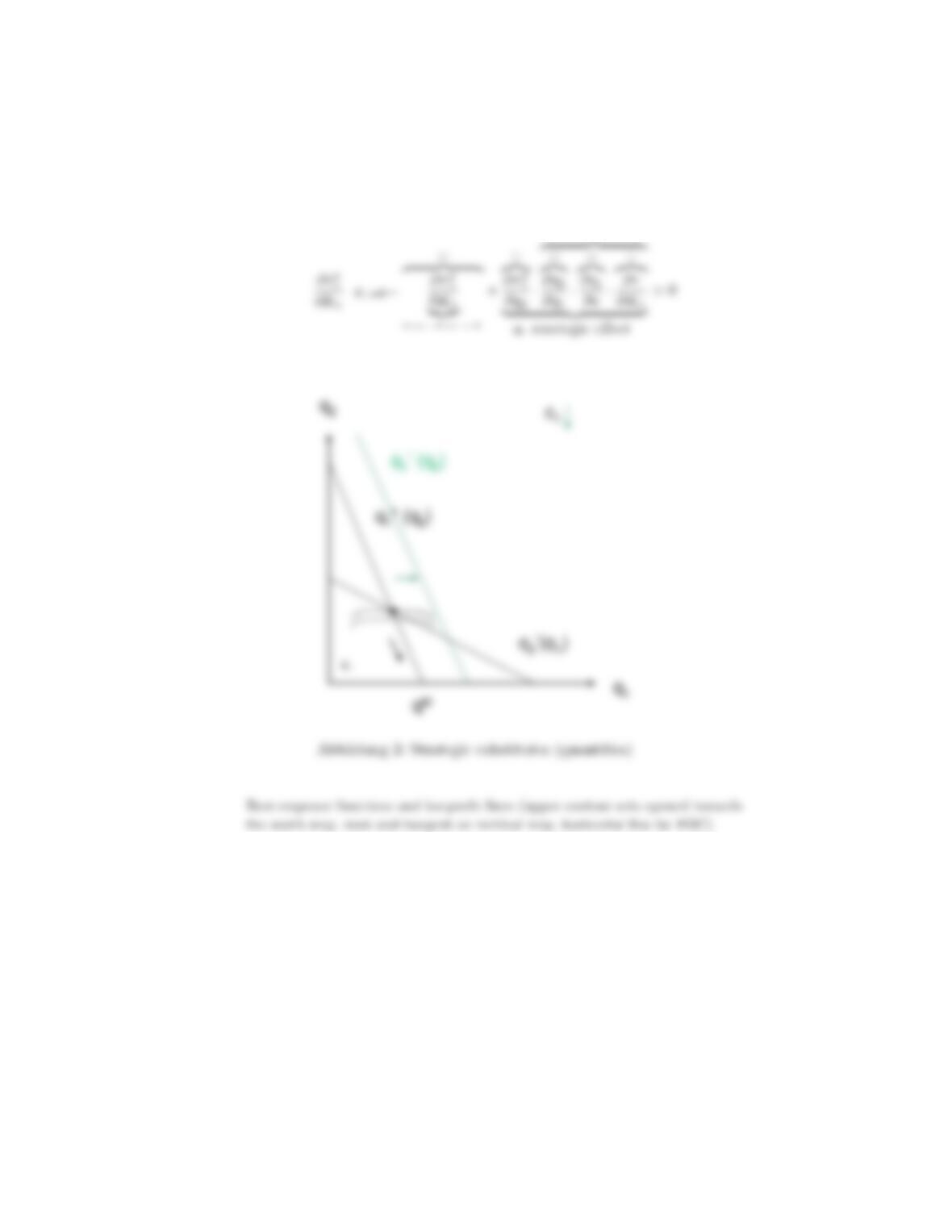
larger than the direct effect)
Exercise 19 Taxonomy of entry-related strategies II
Consider the market from the previous exercise again.
1. Use the best-response functions from the previous exercise to calculate
equilibrium prices for c16=c2in the Nash equilibrium in which firms set
prises.
2. Use your result from (1) to show that p
i= (A+ac)=(2ab), for i= 1;2,
if c1=c2=c.
23
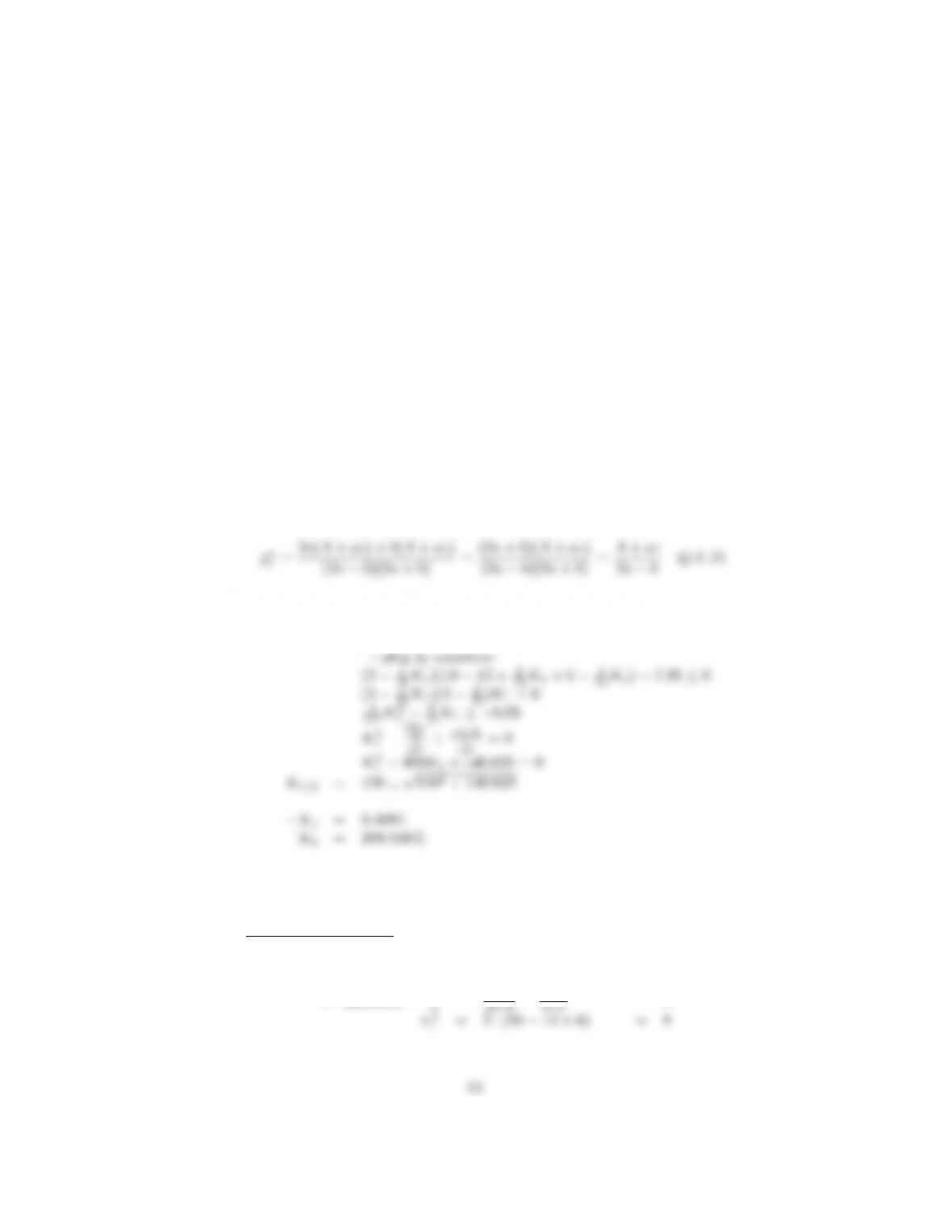
Now, use again that c1(K1) = c(K1=10) and c2=c.
Set c= 4,a= 2,b= 1,A= 10, and e= 7:95.
3. Show that the critical level of KD
1to deter entry is below 0:5.
4. Suppose that investment in cost reduction is restricted to half units, i.e.
K12 f0;0:5;1;1:5; : : :g. Will firm 1deter entry in a subgame perfect Nash
equilibrium? State firm 1’s optimal business strategy.
5. Reconsider your answer to (4) if firm 1as a monopolist faces a demand
of D1(p1) = Aap1+bp1=A(ab)p1.
Solution to Exercise 19
1. obvious
2. c1=c2)p
1=p
2:
3. Entry deterrence if 20:
2= (p2c)(Aap2+bp1)e0
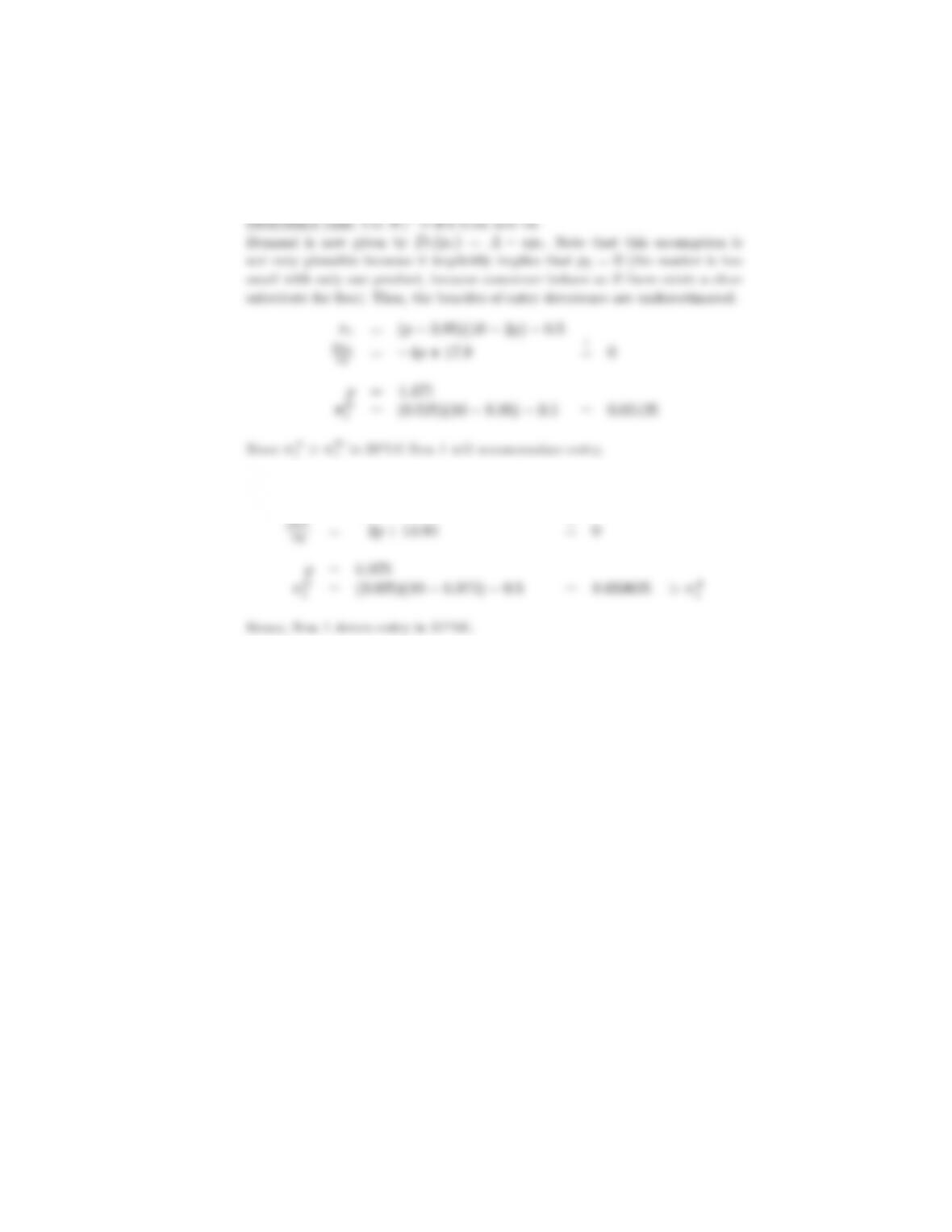
4. Compare profits under entry determination and entry accommodation:
Accommodation case: From the previous exercise we know KA
1= 0
1= (pc)(Aap +bp)
!numbers: p=A+ac
5.
D
1= (p3:95)(10 2p+p)0:5
Exercise 20 Sequential quantity choice and entry
Consider a market for a homogenous good with one incumbent firm (firm
1) and one potential entrant (firm 2). The interaction between the two firms
evolves in two stages. In stage 1, firm 1 chooses its quantity q1. In stage 2, after
observing q1, firm 2 decides whether or not to enter the market. If it enters,
it incurs an entry cost eand chooses its own quantity, q2. If firm 2 does not
enter then q2= 0 and firm 2 does not pay the entry cost e(firm 1 then is a
monopoly). Assume that the inverse demand for the good is P=a(q1+q2),
and that the cost of production of each firm iis C(qi) = q2
i=2.
1. Compute the range of efor which entry is blockaded. That is, compute
firm 1’s output when it operates as a monopolist, then given this quantity,
compute the highest profit that firm 2 can earn if it decides to enter, and
finally, compute the range of efor which entry is blockaded.
2. Now, suppose that eis su¢ciently low to ensure that entry is not blo-
ckaded. Compute the quantities and profits of each firm when entry is
accommodated. That is, compute the outputs that will be selected in a
Stackelberg equilibrium and the resulting profits. (Instruction: first, com-
pute firm 2’s best response function, br2(q1). Second, substitute for br2(q1)
25
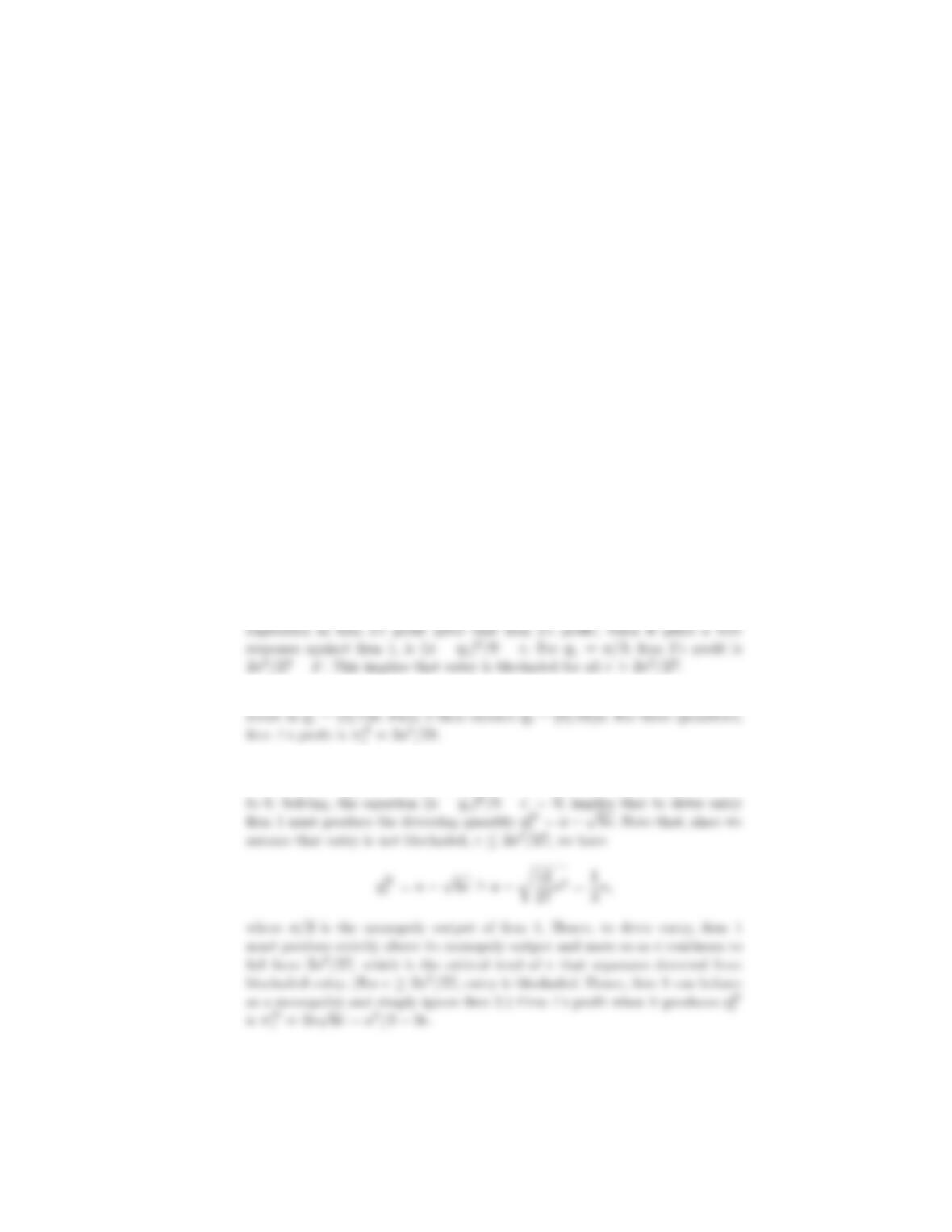
into firm 1’s profit function and compute firm 1’s profit-maximizing quan-
tity q
1. Third, find firm 2’s best response against q
1, using firm 2’s best
response function. Finally, given the pair of quantities you found, compute
the equilibrium profits).
3. Compute the lowest q1for which entry is deterred. Compute firm 1’s profits
at this output level.
4. Given your answer in (3), show firm 2’s best response function graphically
in the quantities space (recall that firm 2 may wish to stay out of the
market when q1is relatively high). Show on the same graph the Stackelberg
equilibrium you found in Section (3) and the lowest q1for which entry is
deterred.
5. Given your answers in (2) and (3), find the range of efor which entry
is accommodated, and the range of efor which it is deterred. Explain
in no more than 3 sentences the intuition for the result (i.e., why is it
natural to expect that entry is accommodated/deterred when eis relatively
low/high).
Solution to Exercise 20
1. If firm 1 is a monopolist it produces q1=a=3. Standard calculations reveal
that firm 2’s best response function is br2(q1) = (aq1)=3. Substituting this
2. If entry is accommodated, then firm 1 chooses q1subject to q2=br2(q1), which
3. and 4. As we saw in (1), firm 2’s profit, provided that it plays a best-response against
firm 1, is (aq1)2=6e. Entry is deterred if this profit is less than or equal
26
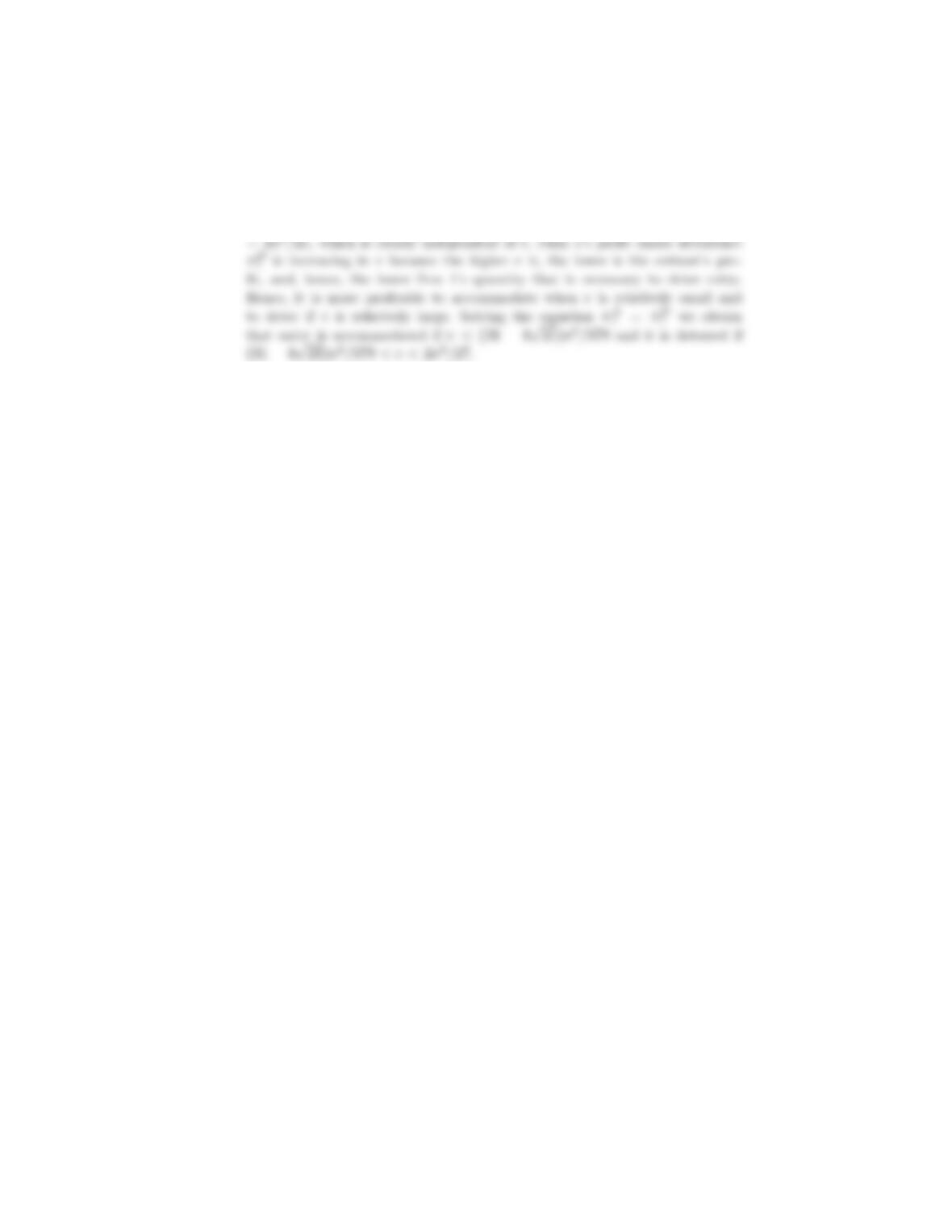
5. To solve this problem we need to compare the profit under accommodation
with the profit under deterrence. Firm 1’s profit under accommodation is A
1
Exercise 21 Capacity choice and entry [included in 2nd edition of the book]
Consider an industry for a homogenous product with a single firm (firm 1)
that can produce at zero cost. The demand function in the industry is given by
Q=ap. Now suppose that a second firm (firm 2) considers entry into the
industry. Firm 2 can also produce at zero cost. If firm 2 enters, firms 1 and 2
compete by setting prices. Consumers buy from the firm that sets the lowest
price. If both firms charge the same prices, consumers buy from firm 1.
1. Solve for the Nash equilibrium if firm 2 chooses to enter the industry.
Would firm 2 wish to enter if entry required some initial investment?
2. Now suppose that before it enters, firm 2 can choose a capacity, x2, and a
price p2(the capacity x2means that firm 2 can produce no more than q2=
x2units). Given q2and p2, firm 1 chooses its price and then consumers
decide who to buy from. Compute the Nash equilibrium in the product
market if firm 1 chooses to fight firm 2. What is firm 1’s profit in this
case? Show firm 1’s profit in a graph that has quantity on the horizontal
axis and price on the vertical axis. Would firm 2 choose to produce in that
case?
3. Now suppose that firm 1 decides to accommodate the entry of firm 2.
Compute the residual demand that firm 1 faces after firm 2 sells q2units,
and then write the maximization problem of firm 1 and solve it for p1.
What is firm 1’s profit if it decides to accommodate firm 2’s entry? Draw
firm 1’s profit in a graph that has quantity on the horizontal axis and price
on the vertical axis. Would firm 2 wish to enter in this case?
4. Given your answers to (2) and (3), compute for each p2the largest capacity
that firm 2 can choose without inducing firm 1 to fight it. (Hint: to answer
the question you need to solve a quadratic equation. The solution is given
by the small root).
5. Show that the capacity you computed in (4) is decreasing with p2. Explain
the intuition for your answer. Given your answer, explain how firm 2 will
choose its price. Computing p2is too complicated; you are just asked to
explain in words how firm 2 chooses p2.)
27
Solution to Exercise 21
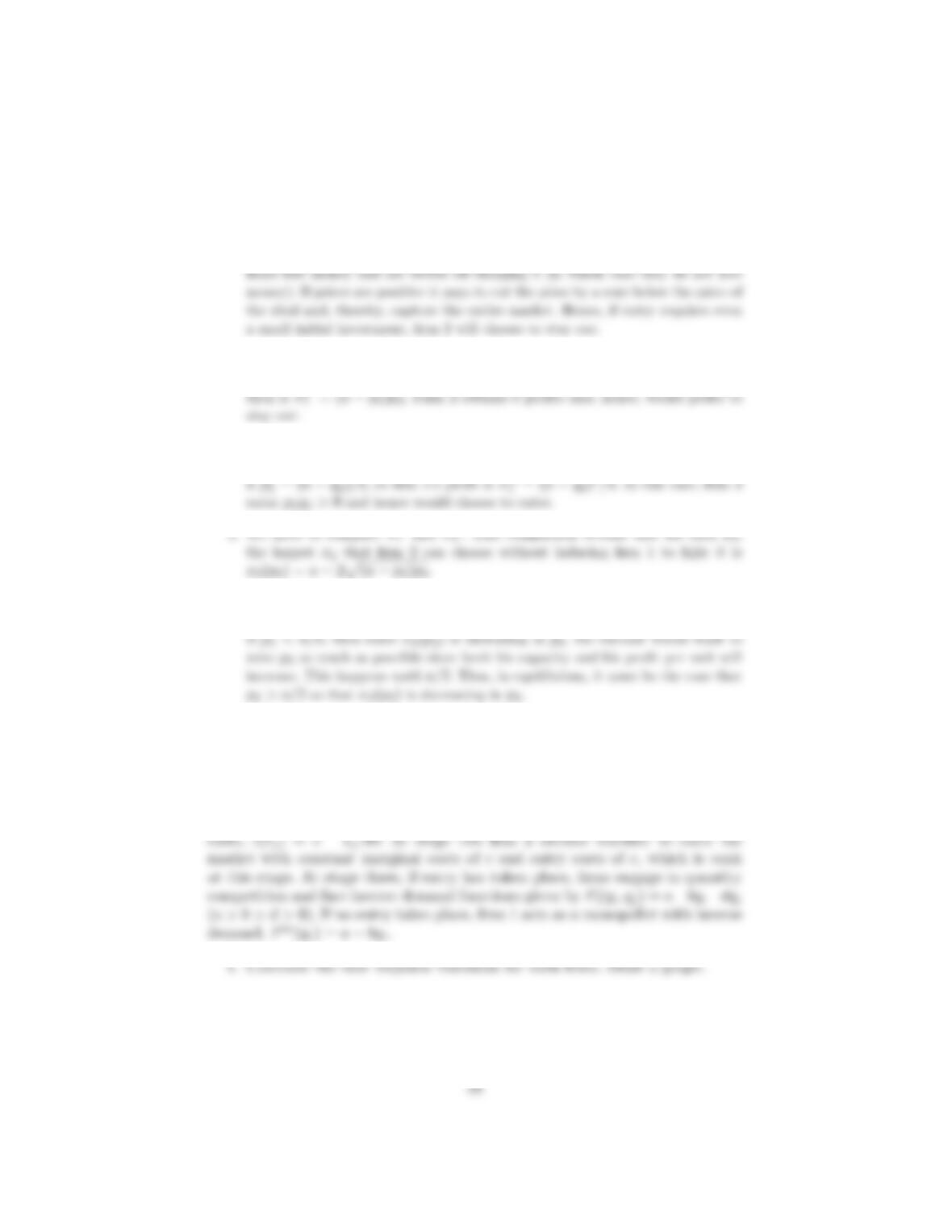
1. In a Nash equilibrium, both firms will charge prices equal to 0. This is the only
pair of prices for which no firm can benefit from deviation. If prices are negative,
2. If firm 1 fights it charges p2and captures the entire market because when both
firms set equal prices, all consumers prefer to buy from firm 1. Firm 1’s profit
3. If firm 1 accommodates firm 2, its residual demand is Q1=aq2p1. The
problem of firm 1 is to maximize p1Q1. The price that maximizes firm 1’s profit
5. x2(p2)is decreasing in p2if p2> a=2and increasing otherwise. To determine
whether p2is above or below a=2, note that the entrant’s profit is p2x2(p2).
Exercise 22 Investment and incumbency
Consider a differentiated product market. At the first stage firm 1is the
incumbent firm and can invest an amount I10in reducing its marginal
2. Does an increase in I1increase or decrease the profit of the entering firm?
Does an increase in I1make the incumbent tough or soft?
3. Does a marginal investment I1>0increase or decrease the profit of the
4. If entry accommodation is optimal how much should firm 1invest in cost
5. Is entry deterrence via cost reduction possible and profitable in this set-
Exercise 23 Competition and entry [partly included in 2nd edition of the book]
Consider a homogeneous good duopoly with linear demand P(q) = 1 q,
where qis the total industry output. Suppose that firms are quantity setters
and firms incur constant marginal costs of production ci.
1. Suppose that firms have constant marginal costs of production c. Deter-
mine the Nash equilibrium in quantities (report prices, quantities, profit,
welfare)
2. Reconsider your answer in (1) because of the following: A tabloid runs a
series on consumers paying “excessive” prices. The government considers
introducing a non-negative special sales tax t0per unit on this pro-
duct (and plans to use the revenues for some project from which nobody
benefits). Determine the welfare-maximizing tax rate (the government is
assumed to be able to commit to the tax; welfare is total surplus which in-
cludes tax revenues). Discuss your result. What would be your conclusion
if the government was considering subsidizing the firm?
3. Return to the case without taxes. Consider now the duopoly with c1= 0
and c2=c2[0;1]. Determine the equilibrium (price, quantities, profit,
welfare).
4. Consider now an extended model in which only firm 1 is necessarily pre-
sent. At stage 1, firm 1 can make an investment Iafter which firm 2’s
marginal costs is c2= 1=2instead of c2= 0. Afterwards, firm 2 observes
the investment decision of firm 1 and, at stage 2, decides whether to enter
at a negligible entry cost e > 0. At stage 3, active firms set quantities
simultaneously. Determine the subgame perfect equilibrium of this game.
Discuss your result in the light of what you have learnt reading about
entry-related strategies (max 3 sentences).
5. Consider now a different entry model. Both firms have zero marginal costs
of production but consumers have become accustomed to product 1 (even
if they did not consume it themselves). Therefore, consumers are willing
to pay 1=2money units less for product 2 than for product 1. The inverse
demand function P(q) = 1 qgives demand for product 1. At stage 1,
the potential entrant, firm 2, considers to enter the market at an entry
cost e > 0. (There is no investment stage in this game.) At stage 2,
firms set quantities simultaneously. Report the profit function for each
firm. Determine the equilibrium in case firm 2 has entered (report prices,
quantities, profit, welfare). Determine the subgame perfect equilibrium
and comment on your result. You may want to reuse some of the results
derived above.
Solution to Exercise 23
1. maxqi(1 qc)qi
foc: 12qiqjc= 0.
symmetric equilibrium: 13q
ic= 0.
2. maxqi(1 qtc)qi
q(t) = 2(1 ct)=3
p(t) = P(q) =1
3+2
3(c+t)
30
3. Suppose that firm 2 is active:
First-order condition of firm 1: 12q1q2= 0. Hence, q1=1q2
2:
First-order condition of firm 2: 1cq12q2= 0. Hence, q2=1cq1
2:
Substitute from above:
4. Solve by backward induction. The investment will lead to q
2= 0. Thus firm 1
makes (monopoly) profit 1=4. If firm 1 does not invest it will make profit 1=9
5. Given q1and q2, prices are p1=P(q1+q2) = 1 q1q2and p2=P(q1+
q2)1=2 = 1=2q1q2.
First-order condition of firm 1: 12q1q2= 0.
31
Exercise 24 Deterrence under price competition
Consider a Hotelling market in which consumers are uniformly distributed
on the [0;1]-interval (i.e., xU[0;1]) and have unit demand. When buying one
unit from firm Aconsumer xobtains utility rAxpA, while buying one unit
from firm Bgives rB(1 x)pB. In those expressions riis the stand-alone
utility provided by product iand piis the price set by firm i. Firms have zero
marginal costs of production. Suppose that ris su¢ciently large such that the
outside option is never a relevant option.
1. Determine the price equilibrium (please report prices and quantities) un-
der parameter constellations such that each firm has strictly positive de-
mand in equibrium.
2. Suppose that firm Ahas an additional instrument and can invest in rA.
Both firms offer a base utility r, but firm Acan increase its stand-alone
utility by rat cost C(r) = (c=4)(r)2. Thus, rA=r+rand rB=r.
Consider the simultaneous-move game in which firm Asets (r; pA)and
firm Bsets pB. Determine the Nash equilibrium under the parameter re-
striction on csuch that each firm has strictly positive demand in equibrium
(i.e., you can assume that cis su¢ciently large such that the equilibrium
is interior).
3. Consider the same setting as in part 3, but suppose that firm Asets
rat a prior stage. This choice becomes common knowledge and, at a
subsequent stage, firms compete in prices. Determine the subgame-perfect
Nash equilibrium under the parameter restriction on csuch that each firm
has strictly positive demand in equibrium.
4. Compare your results in parts 3 and 4. Explain your findings.
5. Consider the same timing as in part 4, but assume that, different from
what was the choice variable in this part, firm Acan decrease the stand-
alone utility of its competitor by rat cost C(r) = (c=4)(r)2. (The
stand-alone utility of firm Ais here always r.) Determine the subgame-
perfect Nash equilibrium under the parameter restriction on csuch that
each firm has strictly positive demand in equibrium.
6. Provide two real-world interpretations about how a firm may be able to
reduce a competitor’s stand-alone utility (up to half a page of text).
32
7. Discuss how your findings in parts 4 and 6 can become relevant in the
context of entry deterrence.
8. Consider the same timing as in part 4, but assume that, in addition to
increasing its own stand-alone utility from rto r+ rAat cost C(rA) =
(c=4)(rA)2, firm Acan decrease the stand-alone utility of its competitor
by rBat cost C(rB) = (c=4)(rB)2. Determine the subgame-perfect
Nash equilibrium under the parameter restriction on csuch that each firm
has strictly positive demand in equibrium. Comment on your findings
compared to those in parts 4 and 6 regarding the equilibrium difference
rArB.
Solution to Exercise 24
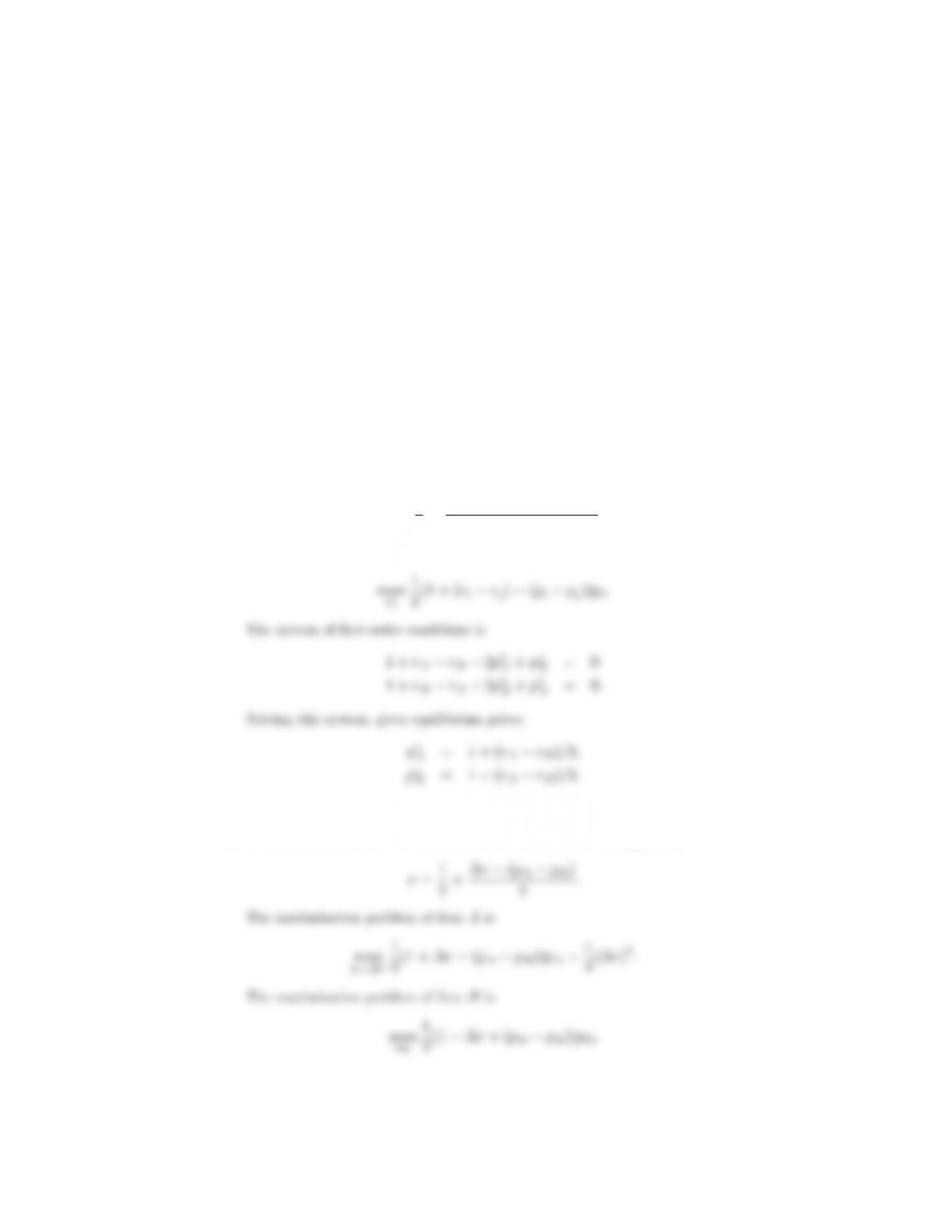
1. The indifferent consumer solves rApAx=rBpB(1 x). Solving for
xgives an explicit expression for x,
x=1
2+(rArB)(pApB)
2:
Hence, the profit maximization problem of firm iis
1
Equilibrium demand for firm Ais 1=2 + (rArB)=6.
2. In this situation, rA=r+ rand rB=r. Demand is then given by
33
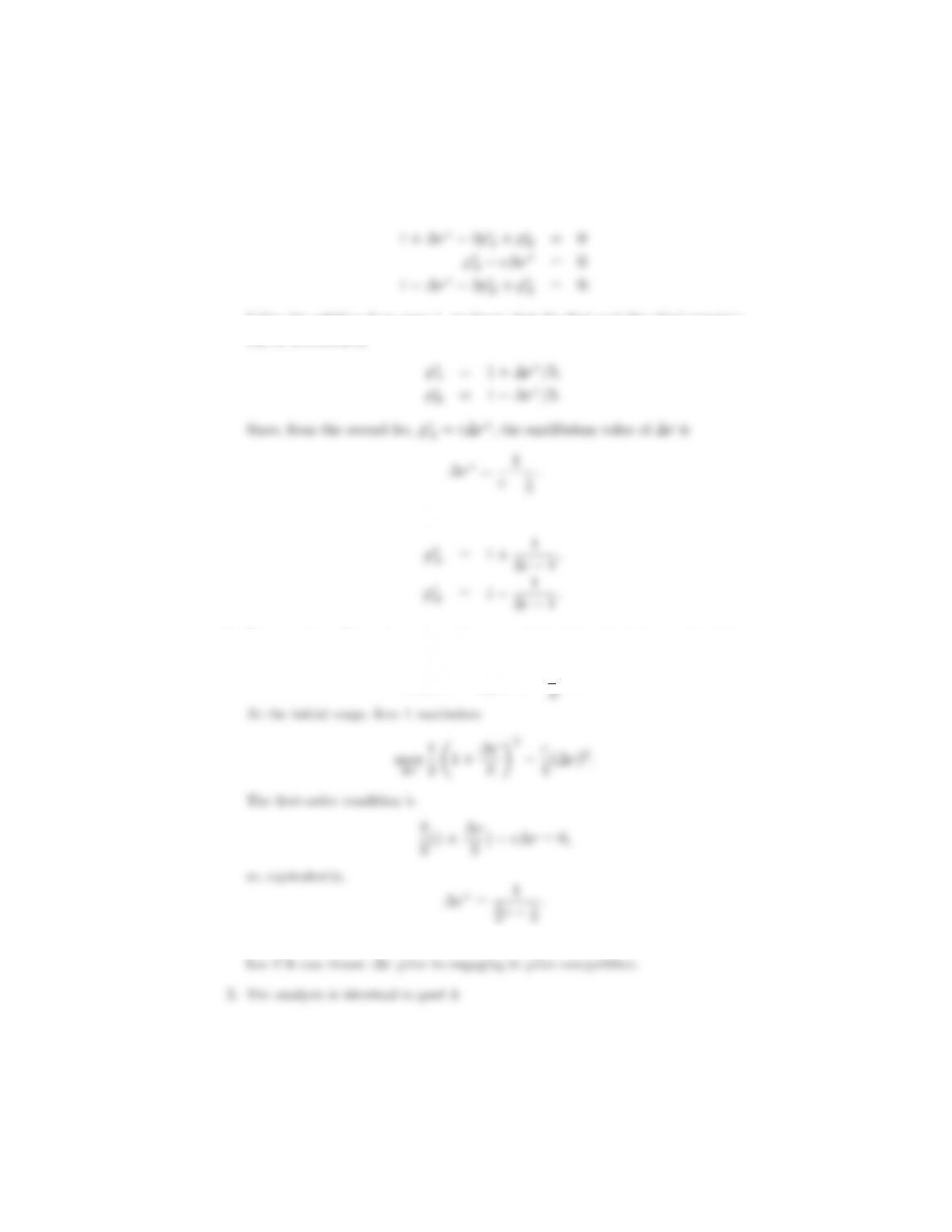
The system of first-order conditions is
Using the solution from part 1, we know that the first and the third equation
can be rewritten as
c1
3
Thus, equilibrium prices are
3. For any given r=rArB, price competition gives the outcome of part 1.
Thus, we have
p
A(r)p
B(r) = 2
3
2c1
3
4. Comparing the equilibrium values in parts 2 and 3, we see that firm Ainvests
34