6. The stand-alone utility may be affected through negative advertising about the
competitor. Another interpretation can be provided in a setting in which firm
7. Firm Amay overinvest in its own quality to deter entry; even worse for society,
it may overinvest in reducing the stand-alone utility of its competitor to deter
8. maxrA;rB
1
21 + rA+rB
32c
4(rA)2c
4(rB)2. First-order conditions
are 2
Exercise 25 Upstream merger
Consider an industry with two symmetric upstream firms Aand Band one
downstream firm D. The downstream firm may sell the product of none, one,
or both upstream firms. Total industry profits are a function of the number
of upstream firms selling through D, denoted by V(n),n2 f0;1;2g, which is
assumed to be increasing in n. The outside option for each firm of not selling is
zero. Thus, V(0) = 0.
Rents are the outcome of Nash bargaining between any pair of one upstream
firm and the downstream firm (equal sharing of the surplus within the pair above
the profits that would occur if this pair did not agree).
35
1. What will be the profits of firms A,Band Dif Dsells both products?
2. Suppose that the two upstream firms merge (and become a two-product
firm) and that function Vcontinues to apply—an interpretation of the
latter property is that prices are set by independent profit centers within
the merged firm. Then, Nash bargaining takes place between the merged
upstream firm and the downstream firm. What will be the profits of the
merged upstream firm AB and the downstream firm D?
3. Provide the exact condition for the merger to be profitable.
4. Explain your findings.
Solution to Exercise 25
1. Suppose that there is an agreement between Band D. If Aand Ddo not reach
an agreement, neither Anor Dobtain any profit from product 1. The additional
2. The industry profit is shared equally between both firms, AB =V(2)=2and
3. The merger is profitable if AB > A+B, which is equivalent to V(2)=2>
4. Prior to the merger, any pair with one upstream and the downstream firm
Exercise 26 Non-linear pricing in the supply chain
A monopolist produces a good with constant marginal cost equal to c,c <
1. Assume for now that all consumers have the demand Q(p) = 1 p. The
population is of size 1.
1. Suppose that the monopolist cannot discriminate in any way among the
consumers and has to charge a uniform price, pU. Calculate both the price
that maximizes profits and the profits that correspond to this price.
2. Suppose now that the monopolist can charge a two-part tariff (m; p)where
mis the fixed fee and pis the price per unit. Expenditure then is m+pq.
Calculate the two-part tariff that maximizes profits and the profits that
correspond to this tariff. Compare pUand pand comment brie‡y.
36
3. Compare the situation with a uniform price and a two-part tariff in terms
of welfare (a verbal argument is sufficient).
4. Assume now instead that there are two types of consumers. The consumers
of type 1 have the demand Q1(p) = 1 p, and the consumers of type 2
have the demand Q2(p) = 1 p=2. The population is of size 1 and there
are equally many consumers of the two types. Finally, it is assumed in this
question that c= 1=2. Calculate the two-part tariff that maximizes the
profits of the monopolist. Compare, for c= 1=2, the two-part tariff found
found here with the one in question (2) and comment brie‡y.
Solution to Exercise 26
2. Consumer surplus is R1
p(1 x)dx m= (1 p)2=2m. The problem is now
3. The two-part tariffs implements the first best, as it sets the unit price equal
4. The monopolist can decide to serve one group or both groups. If it only serves
the high-demand group, it faces inverse demand P(q) = 2 2q. Consumer
37
Exercise 27 Two-part tariffs with downstream competition
Suppose that an upstream monopolist has constant marginal costs of produc-
tion cand sells to symmetric Cournot duopolist in the downstream market at a
two-part tariff (wi; Fi), where i2 f1;2gis the identity of the downstream firm.
Here, wirefers to the linear wholesale price and Fithe fixed fee to be paid by
downstream firm i. Downstream firms have zero marginal costs and face market
demand P(q) = aq. Suppose that a > c > 0. Consider the timing according to
which, at the first stage, the upstream firms set tariffs in the wholesale market
and, at the second stage, downstream firms simultaneously set quantities in the
downstream market.
1. Suppose that the upstream monopolist has to set Fi= 0 and publicly
posts the wholesale prices wi. Calculate the subgame perfect equilibrium
and comment on your findings.
2. Suppose that the upstream monopolist publicly posts two-part tariffs
(wi; Fi). Characterize the subgame perfect equilibria when the upstream
firm is restricted to offer a non-discriminatory offer (w; F )to both down-
stream firms.
3. Suppose that the upstream monopolist cannot publicly post two-part
tariffs—i.e., the two-part tariff that applies to firm iis private information
in the duopoly game at stage 2. Furthermore, suppose that downstream
firms hold passive beliefs—i.e., no matter which contract is offered, a down-
stream firm expects its competitor to be offered the equilibrium tariff. Is
the equilibrium outcome obtained under (2) also an equilibrium outcome
in this case? Explain your finding.
Solution to Exercise 27
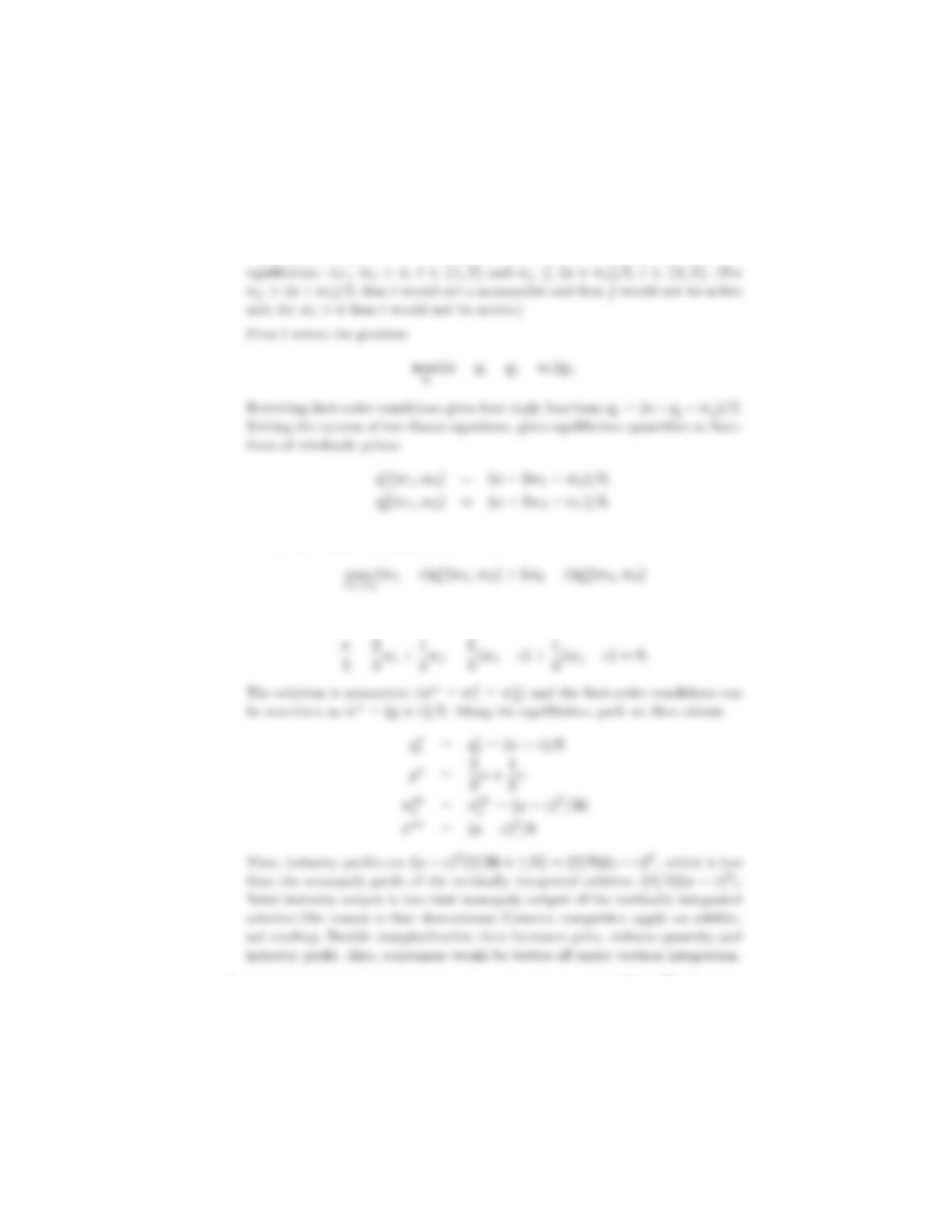
1. We solve the game by backward induction. Downstream firms take prices w1,
w2as given. Suppose that these prices are such that both firms are active in
At the first stage, the upstream firm solves
w1;w2
First-order conditions are
2. The upstream firm publicly posts a non-discriminatory tariff (w; F ). One pos-
sibility is offer a tariff with w=cand Fequal to the downstream monopoly
profit at w=c(F= (ac)2=4). In this case the upstream firm extracts the
full monopoly profit in the downstream segment. This is an equilibrium because
39
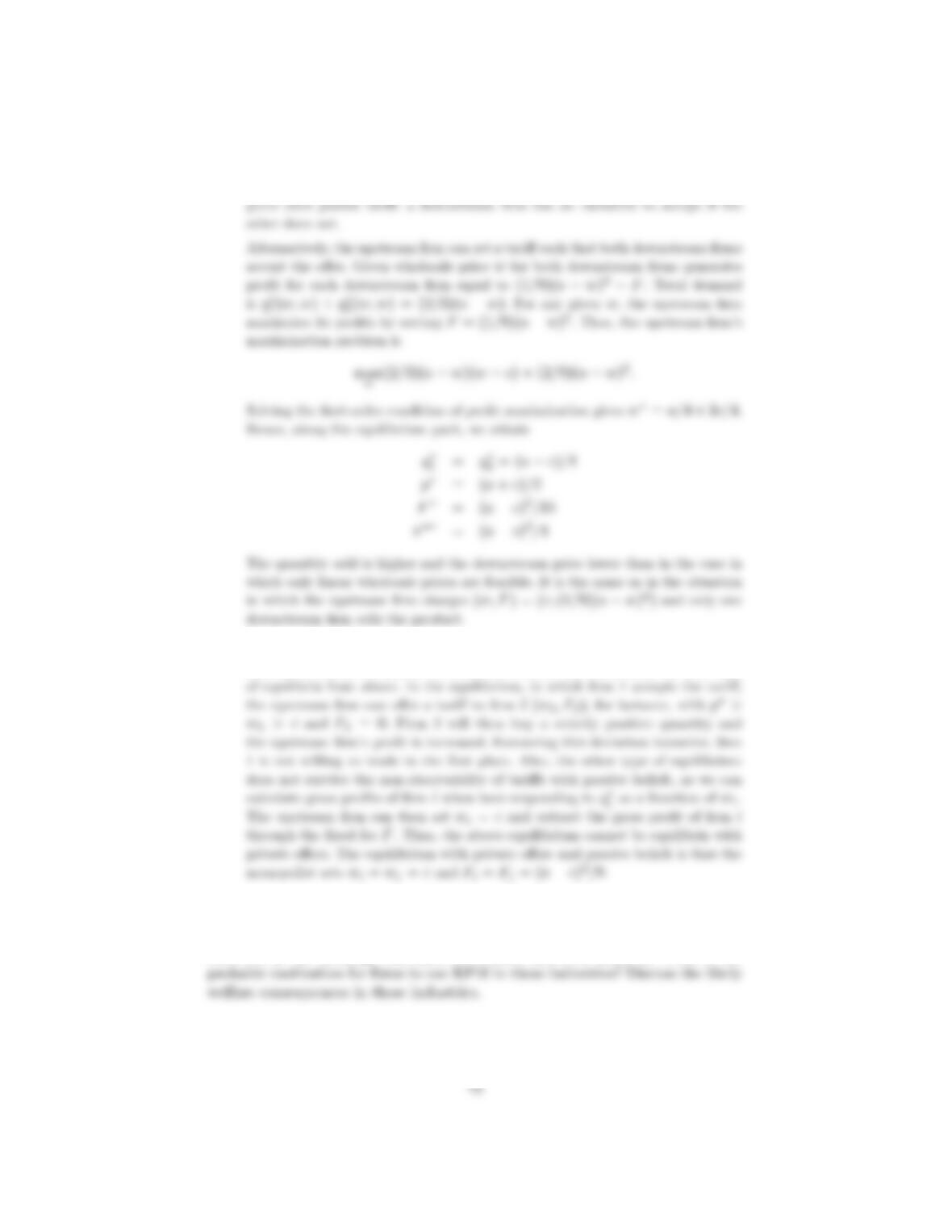
3. Public observability is essential to support either of the equilibria above. Under
non-observability and passive beliefs, it is obvious how to destroy the first type
Exercise 28 RPM
RPM was common in a number of industries. In particular, it could be
observed in the clothing, consumer electronics, and food industry. What is the
Exercise 29 Vertical contracting [included in 2nd edition of the book]
A buyer wants to buy one unit of a good from an incumbent seller. The
buyer’s valuation of the good is 1, while the seller’s cost of producing it is
1/2. Before the parties trade, a rival seller enters the market and his cost, c, is
distributed on the unit interval according to a distribution function with density
g(c). The two sellers then simultaneously make price offers and the buyer trades
with the seller who offers the lowest price. If the two sellers offer the same price,
the buyer buys from the seller whose cost is lower.
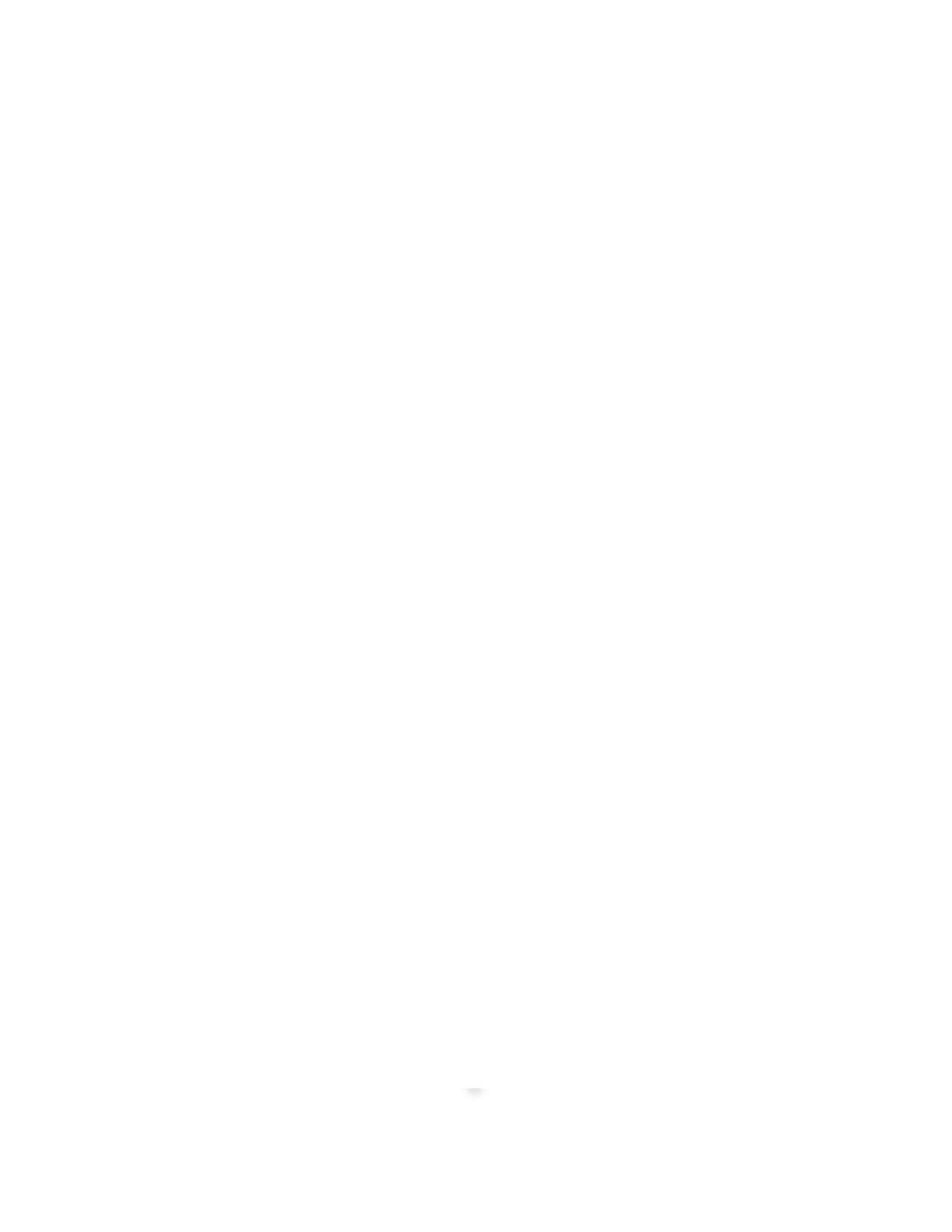
1. Determine the price that the buyer pays in equilibrium, p, as a function
of c. Given p, write the payoffs of the expected payoffs of the buyer and
the two sellers.
2. Suppose that the distribution of cis uniform. Show pand the expected
payoffs of the parties graphically (put con the horizontal axis and the
equilibrium price function on the vertical axis and show the payoffs by
pointing out the appropriate areas in the graph).
3. Now suppose that the incumbent seller offers the buyer a contract before
the entrant shows up. The contract requires the buyer to pay the incum-
bent seller the amount mregardless of whether he buys from him or from
the entrant, and gives the buyer an option to buy from the incumbent at a
price of p(this is equivalent to giving the buyer an option to buy at a price
m+pand requiring him to pay liquidated damages of mif he switches
to the entrant). If the buyer rejects the contract things are as in part (1).
Given pand c, what is the price that the buyer will end up paying for the
good? Using your answer, write the expected payoffs of the buyer and the
two sellers as a function of pand m.
4. Explain why the incumbent seller will choose pby maximizing the sum of
his expected payoff, I, and the buyer’s expected payoffs, u.
5. Write the first-order condition for pand show that the profit-maximizing
price of the incumbent seller, p, is such that p <1=2. Also show that
if g(0) >0then p >0.
6. Explain why the contract is socially inefficient. Is the outcome in part (1)
socially efficient? Explain the intuition for your answer.
7. Compute p assuming that the distribution of cis uniform, and show the
expected payoffs of the parties and the social loss graphically (again, put
con the horizontal axis and the equilibrium price function on the vertical
axis).
8. Compute p under the assumption that G(c) = c, where > 0. How
does p vary with ? Give an intuition for this result.
Solution to Exercise 29
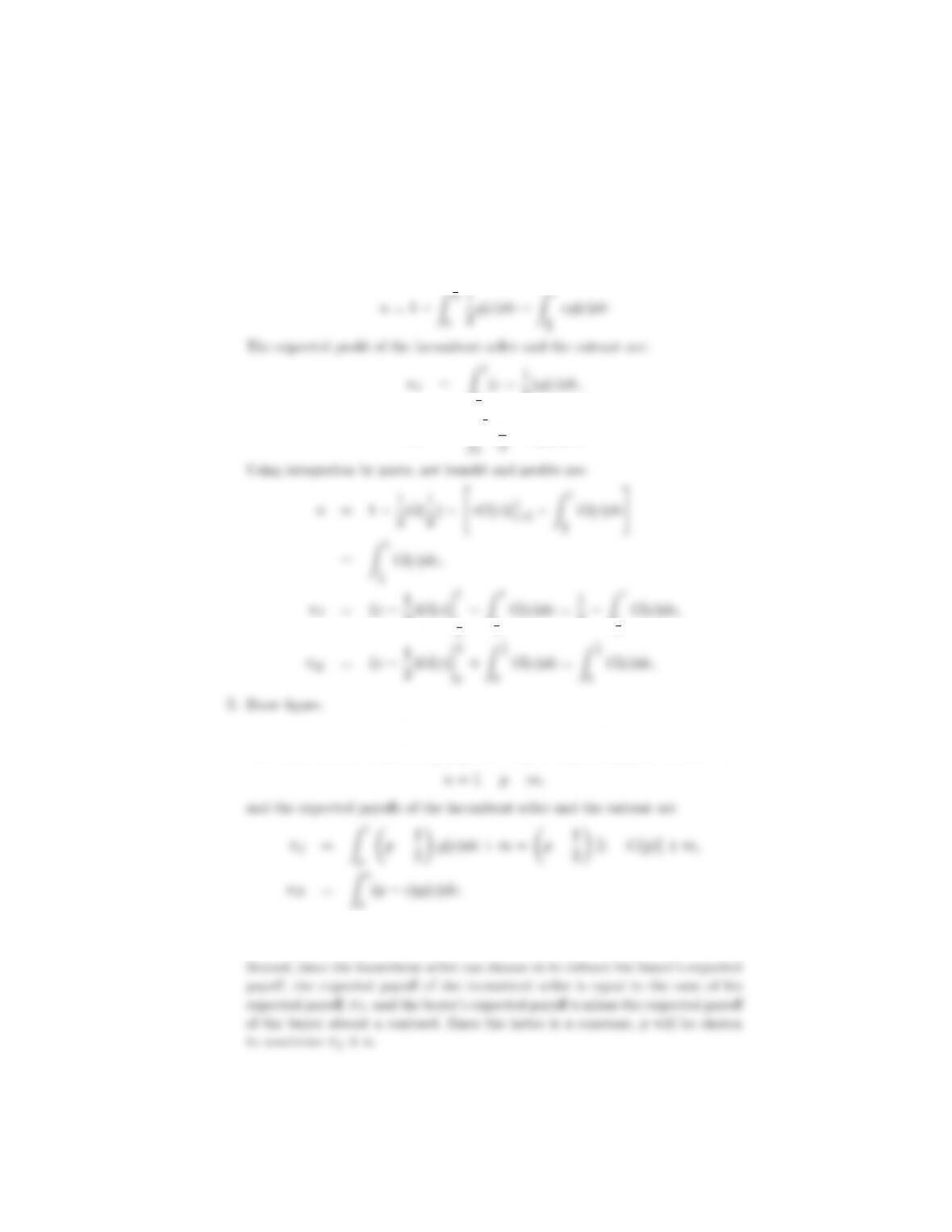
1. In equilibrium, the price is p = 1=2if c1=2(hence, the buyer buys from the
entrant), and p =c, otherwise (hence, the buyer buys from the incumbent).
Given this price, the buyer’s expected benefit is
2
1
1
2
2)g(c)dc;
E=Z1
2
(1
3. Given pand c, the buyer will buy from the entrant if cpand from the incum–
bent seller otherwise and will pay p. The buyer’s expected payoffs is therefore
0
4. First, note that the contract must be designed so as to ensure the buyer the
same expected payoff as in Part 1, otherwise the buyer will reject the contract.
42
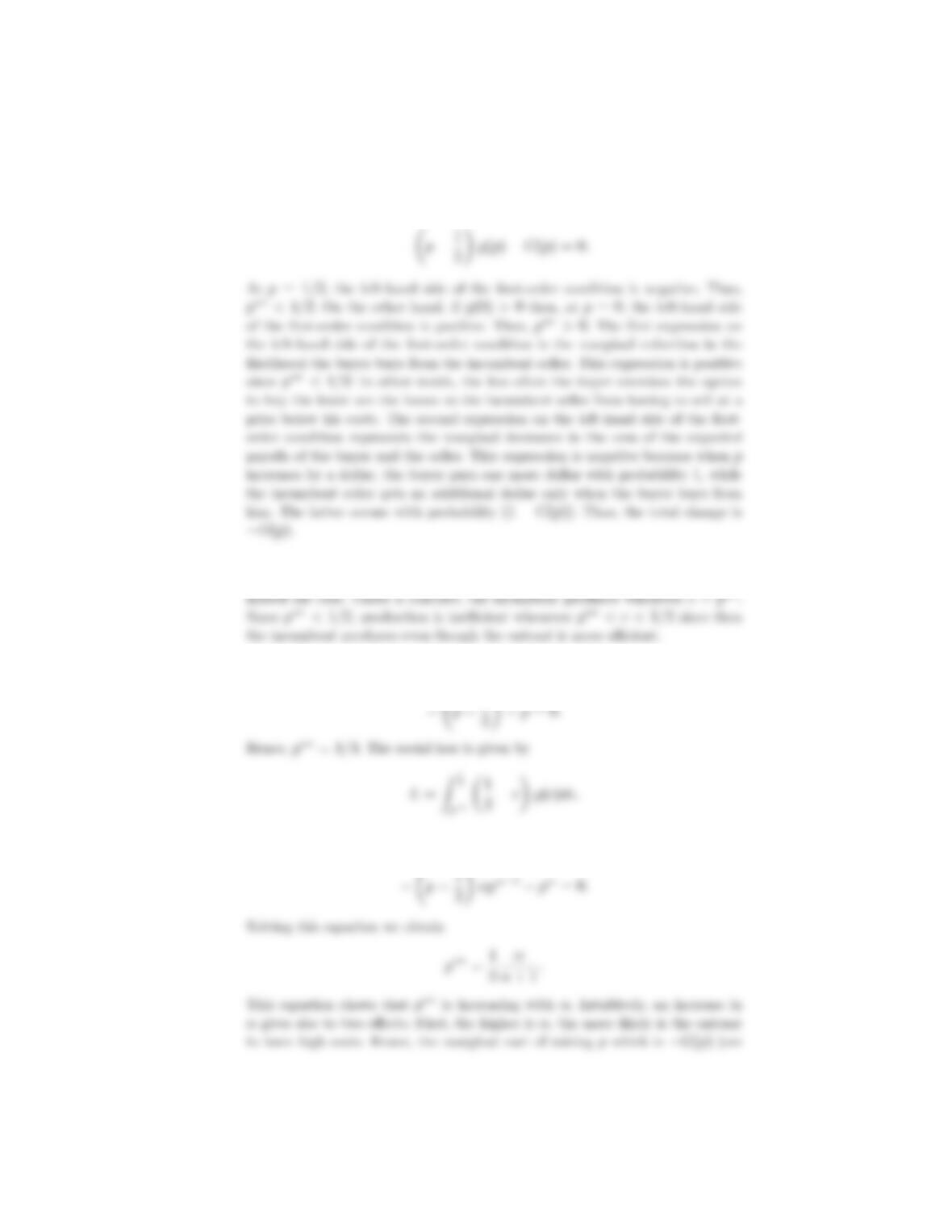
5. Differentiating I+u, the first-order condition for p is given by
6. Since the buyer always buys the good, efficiency is achieved if and only if the
lowest cost seller produces the good. In Part 1 competition ensured that this is
7. When cis distributed uniformly on the unit interval, the first-order condition
for p becomes
8. When G(c) = c, the first-order condition for p becomes
43
Exercise 30 Franchising
A monopolistic manufacturer produces a good that is sold to three retailers.
The manufacturer has constant marginal cost equal to c < 1=2. The retailers are
monopolists in three different cities. The marginal cost of the retailers is equal
to the wholesale price of the good. Each of the retailers faces a demand function
1. Let w < 1=2and take fas given. Find the price that a retailer sets as a
function of b. Who earns the highest profit, retailers with b= 1 or b=z?
2. Assume in the rest of the exercise that z= 2. Suppose first that the
manufacturer knows the value of bin all three cities and that z= 2. What
3. Find the optimal franchise fee as a function of the wholesale price w.
4. Find the optimal wholesale price as a function of c. Is the wholesale price
greater or less than c?
5. Can the manufacturer extract all profits by setting wand foptimally?
Exercise 31 Exclusive dealing [included in 2nd edition of the book]
44
Suppose that two firms produce at constant marginal costs c. There are two
periods and mbuyers. Each buyer has an inverse demand curve: P(qI+qE) =
1(qI+qE)where qIis the quantity sold by the incumbent and qEis the quantity
sold by the entrant. In the first period, there is only the incumbent in the
market. Thus, the incumbent produces the monopoly quantity. The incumbent
has marginal cost equal to cI. In the second period, an entrant with constant
marginal cost equal to zero enters into the market. The entry is foreseen by the
buyers. After entry, the two firms compete ï¿ 1
2la Cournot. In the first period,
the incumbent offers the buyers a fee for an exclusive dealing agreement (take-
it-or-leave-it). If a buyer accepts the offer, she cannot buy from the entrant in
the second period.
1. Suppose that the incumbent and entrant are equally efficient, i.e. cI=
0. What is the maximal fee for an exclusive dealing agreement that the
incumbent is willing to offer to a buyer? What is the minimum fee that a
buyer is willing to accept for signing an exclusive dealing agreement? Will
there be exclusive dealing in equilibrium?
2. Consider a general marginal cost of the incumbent cI. For which values of
cIwill exclusive dealing arise in equilibrium?
Solution to Exercise 31 The value an exclusive dealing is worth VI= 1=4(1
cI)21=9(1 2cI)2to the incumbent. A buyer accepts if she is offered a payment of,
Exercise 32 Long-term contracts, upgrades, and exclusion
Consider a market for a base good that is sold over two periods. In period 2,
also an upgrade may become available. For simplicity, set the mass of consumers
equal to 1 and marginal costs equal to zero. Firm 1can be active in periods
1 and 2, firm 2can only be active in period 2. At the beginning of period 2,
firms decide simultaneously whether to upgrade. Suppose that firms maximize
the sum of profits in periods 1 and 2.
The willingness-to-pay without upgrades is Vper consumer in each period.
An upgrade by firm 1leads to a surplus of r+1, while an upgrade by firm
45
2 would lead to a surplus of r+2. Firm 2 is assumed to be more efficient,
2> 1. The upgrading cost is C. Suppose furthermore that 1> C. This
assumption means that upgrading is socially superior to not upgrading even if
it is done by the less efficient firm.
1. Characterize the equilibrium if firms can only offer short-term contracts,
i.e., firm 1, when selling to consumers in period 1, cannot make them sign
a contract that binds consumers to buy from it in period 2.
2. Characterize the equilibrium if firm 1 can offer a long-term contract that
does not allow consumers or prevents them from buying from firm 2. Dis-
cuss your result.
Solutions to Exercise 32
1. Bertrand competition in period 2 implies that consumers make a net surplus of
2. Alternatively, firm 1 could offer a long-term contract requiring the consumer not
to buy from the rival in period 2. Consumers are willing to take this option if
Exercise 33 Vertical integration. [included in 2nd edition of the book]
1. Suppose that two downstream retailers sell a homogeneous product in a
downstream market. They have to pay w < 1for each unit of the product
that they sell on to final consumers and do not incur any further variable
costs. The inverse downsteam market demand P(q) = 1 q, where q=
q1+q2. Determine the Nash equilibrium when both firms set quantities
simultaneously.
2. Suppose that there are many such downstream markets (to be precise,
a continuum of mass 1) and that prior to the quantity setting in those
downstream markets two upstream firms simultaneously set quantities xi.
For each unit they incur marginal costs c. Determine the subgame perfect
equilibrium of the two-stage game.
3. What would change if there is only one instead of a continuum of down-
stream markets? Is there any conceptual difference between those two
settings? Explain in at most three sentences.
4. Suppose that upstream firm 1 merges with downstream retailer 1 in each of
the many downstream markets. Suppose furthermore that firm 1 commits
neither to sell to any downstream retailer 2 nor to buy any units from
upstream firm 2. The timing of the game is that, at stage 1, upstream
firms simultaneously set xiand that, at stage 2, retailers set qi. Determine
the subgame-perfect equilibrium of this two-stage game.
5. Compare your results in (2) and (4). Does the vertical merger increase the
input price for non-integrated downstream firms? Does the vertical merger
make consumers better off? Explain in one or two sentences.
Solutions to Exercise 33
1. The profits of each downstream firm is D
i= (1 qiqjw)qi. Solving the
2. Since q=x, the inverse demand in the upstream market is w= 1 3x=2.
3. With a continuum of downstream markets the demand by each downstream firm
4. At stage 2, downstream firm 2 obtains the input at wholesale price w2, whereas
downstream firm 1 obtains the input through internal production and, thus, at
5. The wholesale price paid by the non-integrated firm is less than without the
vertical merger. This may sound surprising as upstream firm 2 exerts monopoly
Exercise 34 Exclusive dealing and vertical integration.
Consider a vertical duopoly with exclusive dealing contracts in place, i.e.,
upstream firm ionly sells to downstream firm {,i= 1;2. Suppose that, at stage
47
1. Characterize equilibrium upstream and downstream prices.
0).
3. Are there incentives for vertical integration (for b=d= 1)? Discuss your
48