
Industrial Organization: Markets and Strategies
Paul Belleflamme and Martin Peitz
published by Cambridge University Press
Part V. Product quality and information
Exercises
Exercise 1 Lemons problem
Consider the following version of the lemons problem. There is a continuum
of buyers and sellers in the market; the total mass of each group is 1. Each
seller has one car to sell and each buyer wishes to buy at most one car, but only
sellers know the quality of their cars before trading. It is common knowledge
however that the quality of cars, denoted s, is drawn from a uniform distribution
on the interval [0;1] (hence, the probability that a car’s quality is below some
number xis equal to xif 0x1and is equal to 1if x1). It is also
common knowledge that a fraction the sellers are of type 1 and have a payoff
U1=ps=8if they sell their cars and 0 otherwise, and a fraction 1of the
sellers are of type 2 and their payoff is U2=ps=4if they sell their cars and
0 otherwise, where pis the price of the car (note that the two types of sellers
differ only with respect to their payoffs but not with respect to the quality of
cars they have to sell). There is a continuum of risk-neutral buyers: the payoff
of a type-buyer if he buys a car whose quality is sis U() = s p, where
is distributed uniformly on the unit interval. If a buyer does not buy a car his
payoff is 0. The buyers cannot observe the quality of cars before they buy nor
can they observe the type of seller they face.
1. Compute the supply of cars by type 1 sellers, type 2 sellers, and the
aggregate supply of cars (i.e., compute the fraction of cars that will be
supplied at a given price by each type of sellers and then add the two to
obtain the aggregate supply). Show your answer in a figure.
2. Let bs(p)denote the average quality of cars supplied on the market as a
function of p. Using your answer to (1), compute bs(p). How does bs(p)
vary with pand with ? Explain the intuition for this.
3. Assume that buyers correctly anticipate bs(p)and compute the demand
for cars (i.e., the fraction of buyers that will wish to buy a car at a given
price) and show your answer in the figure you drew in Part (1). Explain
the shape of the demand function.
4. Assume that the market is perfectly competitive and solve for the equilib-
rium price, ppresuming that neither all sellers of type 1 nor all sellers of
type 2 are active. How does affect p?
Solutions to Exercise 1
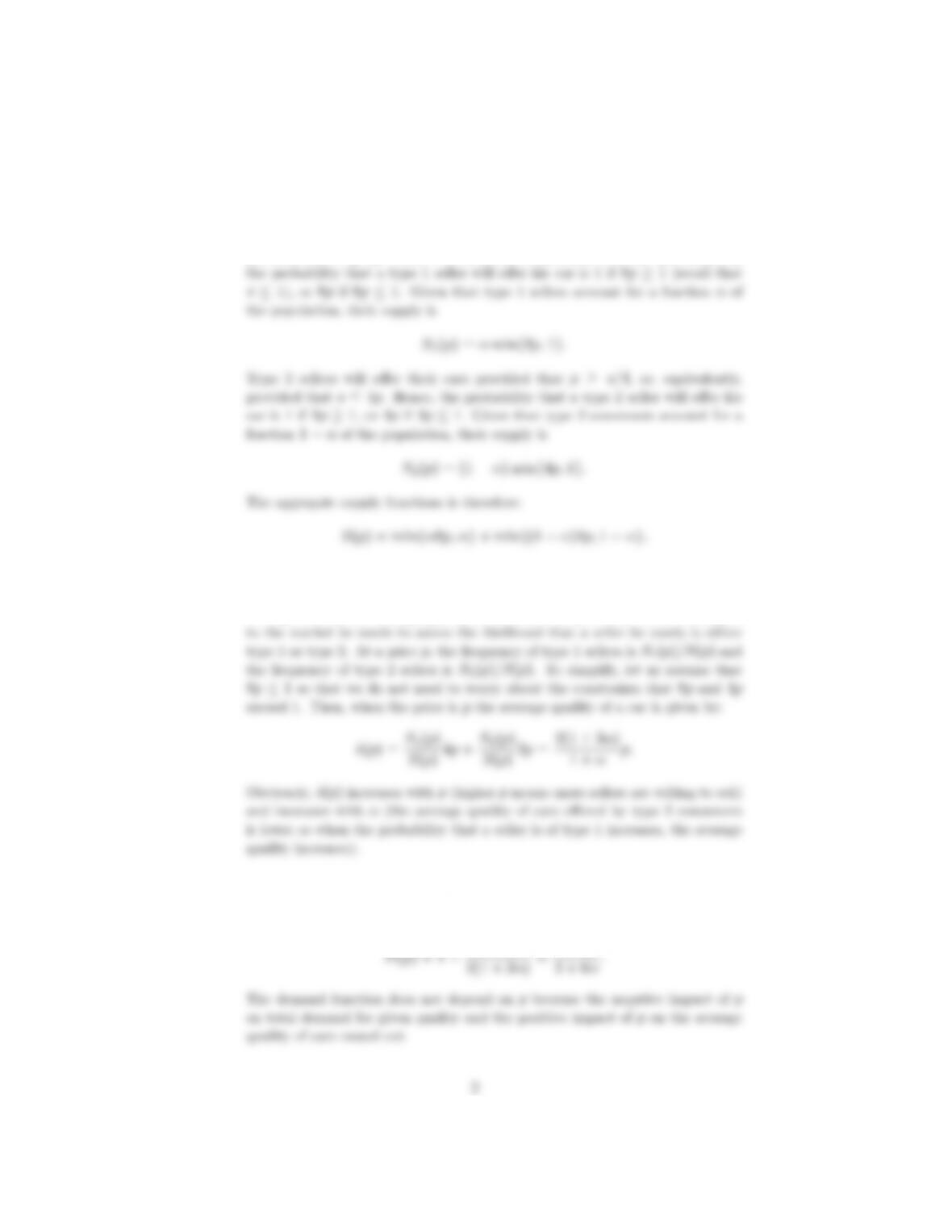
1. Type 1 sellers will offer their cars provided that ps=8, or, equivalently,
provided that s8p. Since sis distributed uniformly over the interval [0;1],
2. Given p, type 1 seller offer their cars provided that s8p. Hence, the average
quality of cars they offer is 4p. Type 2 sellers offer their cars provided that
s4p. Hence, the average quality of their cars is 2p. When a consumer goes
3. A buyer with valuation will buy a car provided that ^s(p)p, or p=^s(p).
Since is distributed uniformly on [0;1], the likelihood that p=^s(p)is
1p=^s(p). Hence, the demand for cars is
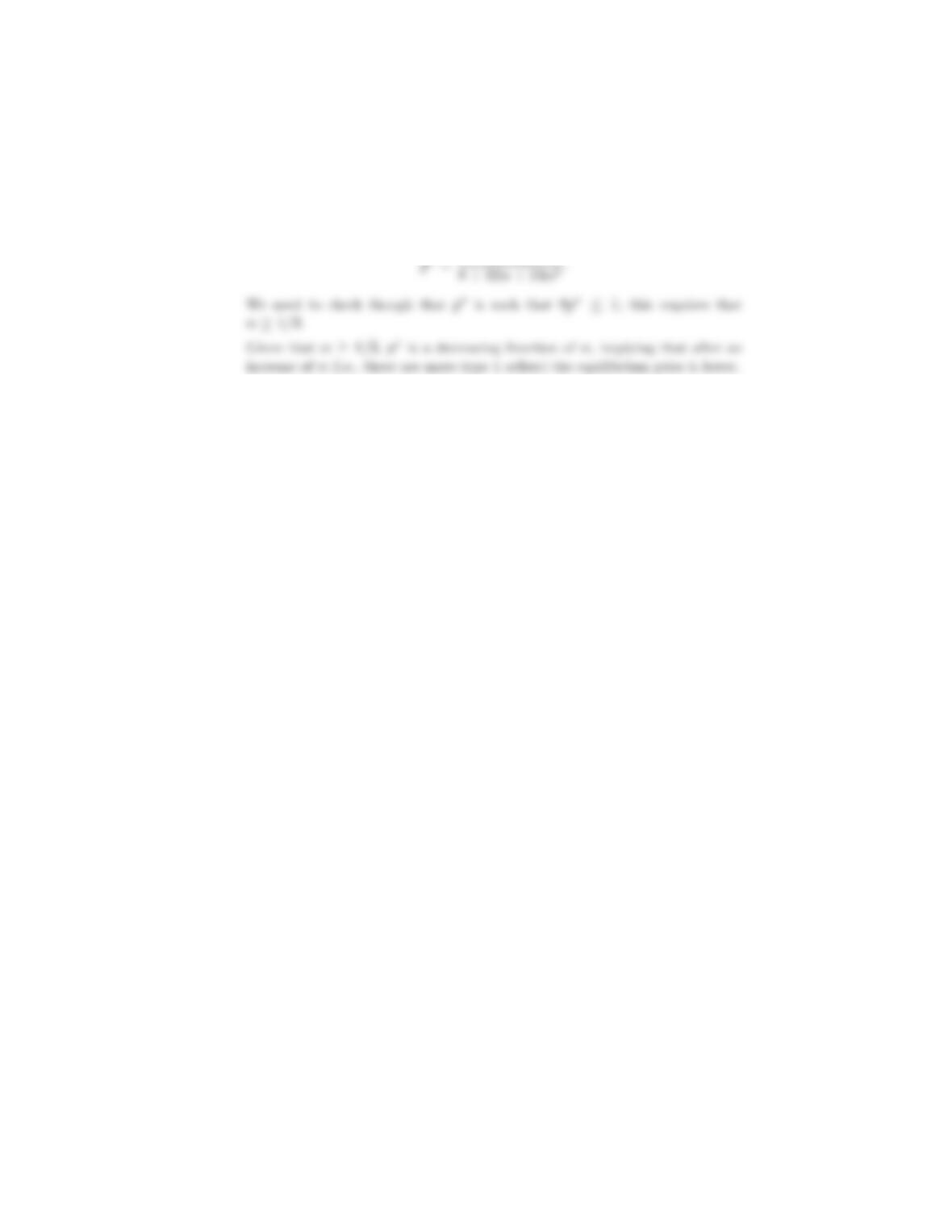
4. In a perfectly competitive market, the equilibrium price, p, is given by the
solution to S(p) = D(p). Solving the equation yields:
Exercise 2 Quality and information
A firm sells a product which may be of high or low quality, sHor sL, re-
spectively. High quality is to occur with probability and low quality with
probability 1. There is a unit mass of consumers with unit demand and the
same willingness-to-pay for the product of a particular quality. Consumers like
high quality more than low quality—i.e., consumer valuations (= willingness-
to-pay) satisfy rH> rL. The consumer valuation for high quality is larger than
costs c, which is independent of quality. The marginal cost is assumed to satisfy
that rH+ (1 )rL> c.
There are two groups of consumers. A share is informed about product
quality and a share 1is uninformed; there is no communication between
informed and uninformed consumers. We consider the following situation: First,
Nature determines product quality. The quality is observed by the firm and a
share of consumers. Second, the firm sets the price of the product. Third,
uninformed consumers update beliefs and all consumers make their purchasing
decision.
1. Suppose that = 1. Characterize the equilibrium (price, allocation,
profit). Distinguish between case c < rLand c > rL.
2. Suppose that = 0. Characterize the equilibrium (price, allocation,
profit). Distinguish between case c < rLand c > rL.
3. Suppose that < 1and c < rL. Do there exist parameter constellations
under which the same allocation as under (1) can be supported? If your
answer is negative give a proof that shows that the outcome in (1) cannot
be replicated for < 1. Otherwise, give the exact parameter range for
for which the outcome in (1) can be replicated.
4. Suppose that > 0and c > rL. Do there exist parameter constellations
under which the same allocation as under (2) can be supported? If your
answer is negative give a proof that shows that the outcome in (2) cannot
be replicated for > 0. Otherwise, give the exact parameter range for
for which the outcome in (2) can be replicated.
3
5. Comment on what is happening in this market.
6. What kind of government interventions would matter in such a maket with
< 1? Discuss the welfare consequences of such government interventions
(try to refer to (2)-(4)).
Solutions to Exercise 2
1. rL> c: high quality: p=rH, low quality: p=rL
3. H=rHc
4. H=rH+(1 )rLc
0
H=(rHc)
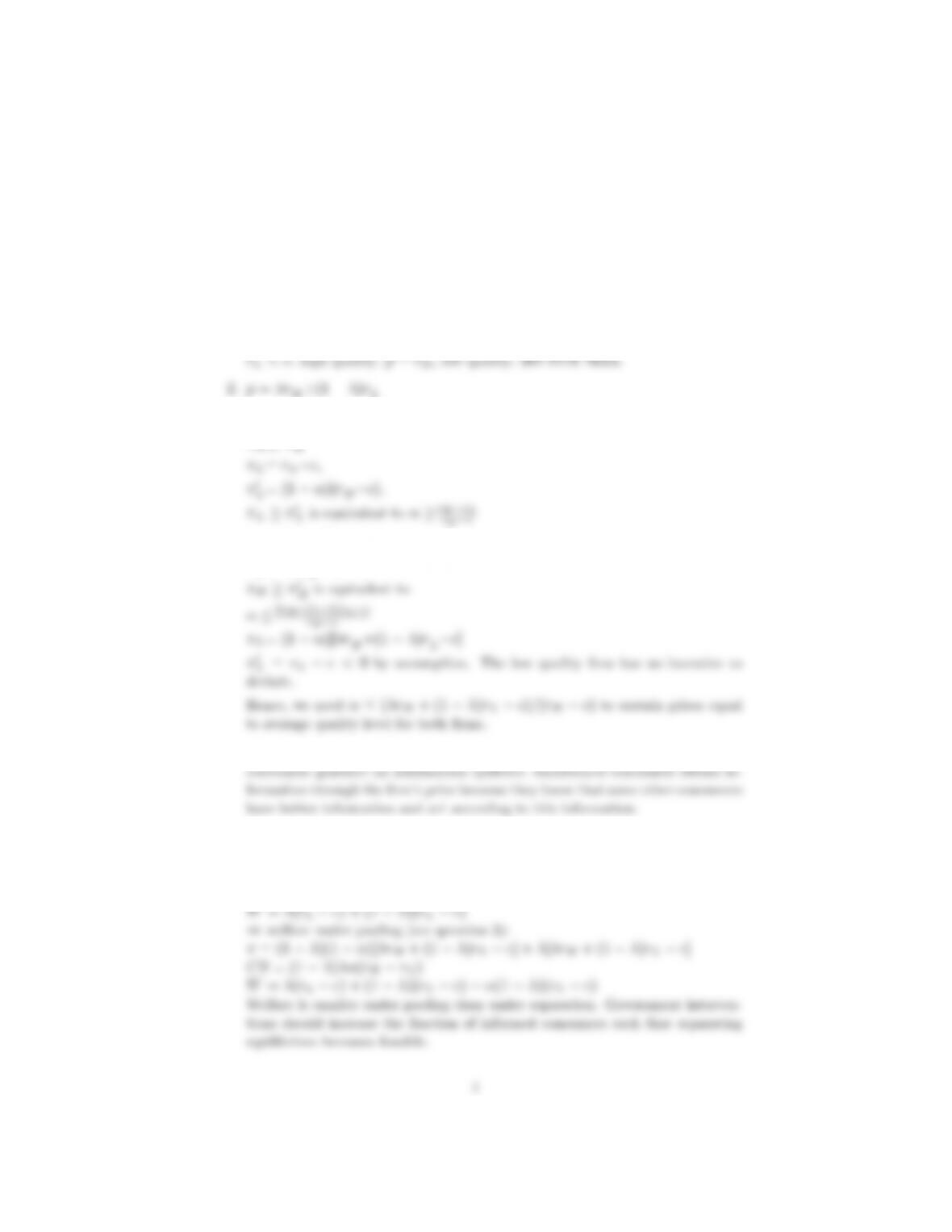
5. Price signalling is viable if a share of consumers is fully informed. Informed
6. Suppose that c < rL. Welfare under full information as under full separation
(see question 2):
=(rhc) + (1 )(rLc)
CS = 0
Exercise 3 Intertemporal pricing under asymmetric information
Consider a market that opens for two periods. A monopolist offers one unit
to a consumer in each period and maximizes the sum of first-period and second-
period profit. The product is of high or low quality (each occurs with prior
probability 1=2); the quality realization is privately observed by the firm, but
initially not observed by the consumer. In the first period, the firm sets price
p1and the consumer decides whether or not to buy it. If she purchases the
product in the first period, she observes its quality and becomes fully informed
when deciding whether to continue to buy the product in the second period.
Otherwise, she updates beliefs about product quality. In the second period,
the firm sets price p2and the consumer decides whether or not to buy it. A
high-quality product gives valuation vand a low-quality version valuation 0(the
product is non-durable and only gives a consumption benefit in the respective
period). Production costs are cHand cL, respectively.
1. Assume that v > cH> v=2> cL>0and vcH> cHv=2(or,
equivalently, assume that (3=4)v > cH> v=2> cL>0). Describe the
perfect Bayesian equilibrium that gives maximal profit to the high-quality
monopolist in terms of prevailing prices, allocation, and consumer beliefs.
2. What is different if v > cH> cL> v=2>0and vcH> cHcL(or,
equivalently, if (v+cL)=2> cH> cL> v=2>0)? Describe the equilibrium
outcome in terms of prevailing prices, allocation, and consumer beliefs.
Solutions to Exercise 3
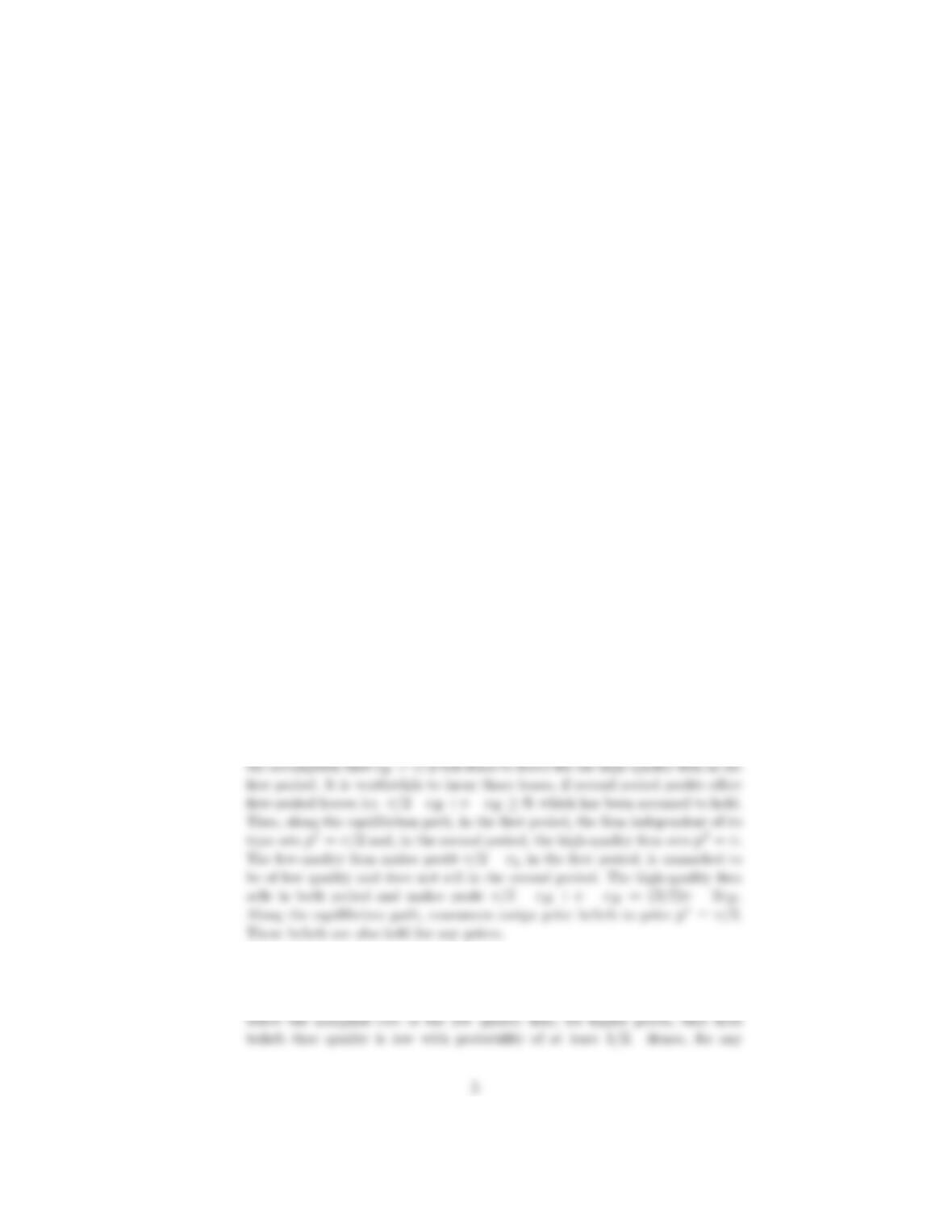
1. Depending on parameter values, the first-period price involves pooling of low
and high quality or low quality does not participate. Consider first the pooling
situation. Here, the high-quality firms sets its price to extract the expected
surplus from consumers in the first periods. This expected surplus is v=2. Under
2. In this alternative configuration, the low-quality firm would make losses under
pooling (such that at first-period price v=2consumers hold prior beliefs). How-
ever, consumers hold beliefs that a firm must be of high quality if the price is
Exercise 4 Prices as a signal of quality [included in 2nd edition of the book]
A firm has either a high quality or a low quality product (the firm cannot
choose the quality of its product). The firm faces a continuum of consumers
with a total mass one. Each consumer wishes to buy at most one unit. There
are 2 types of consumers: 2=5of the consumers are of type 1 and their utility
is 10 pif they buy a high quality product and 5pif they buy a low quality
product; 3=5of the consumers are of type 2 and their utility is 6pif they
buy a high quality product and 3pif they buy a low quality product. Both
types of consumers obtain a utility of 0 if they do not buy. The per unit cost
of production is 2 if the firm has a high quality product and 0 if it has a low
quality product.
1. Suppose that consumers can tell the quality of the product before they
buy. Determine the prices that each type of firm would charge. (Hint:
note that if quality is high, the firm can sell only to type 1 consumers if
p > 5but to all consumers if p5; likewise, if quality is low, the firm can
sell only to type 1 consumers if p > 3but to all consumers if p3.)
2. Suppose now that consumers cannot tell the quality of the product before
they buy and can only infer it from the price that the firm charges. Show
that there exists a separating equilibrium in which high- and low-quality
firms behave differently and therefore consumers can infer the quality of
the product from the price that the firm charges. In this equilibrium, a
low-quality firm behaves as in (1). What is the price that the high-quality
firm needs to charge in order to separate itself from the low-quality firm?
Show that charging this price is profitable for the high quality firm. Does
the high-quality firm signal its quality by charging a high price or a low
price? Provide an intuition.
Solutions to Exercise 4
1. If consumers can tell the product’s quality, then the firm will charge either 10
or 6 if quality is high and 5 or 3 if quality is low. To see which price the firm
will charge, suppose quality is high. If the firm charges 10, it will serve only
2. If the low quality firm behaves as in (1), then it charges a price of 3 and serves all
consumers. Its profit therefore is 3. If the high-quality firm charged 6 as in (1),
then the profit of the low quality firm from mimicking would be 6 since it has
no cost and a price of 6 would allow it to serve all consumers (who will believe,
incorrectly, that the firm is a high quality firm). Hence, to separate itself, the
Exercise 5 Advertising as a signal of quality [included in 2nd edition of the
book]
A firm produces a single product whose quality is either high or low (the firm
knows the quality but cannot choose it) and sells it to consumers in each of two
periods. The marginal cost of production is 4 if quality is high and 3 if quality is
low. In each period there are Nconsumers, each of whom is interested in buying
at most one unit in each period and is willing to pay 10 if quality is high and
5 if quality is low. However, consumers cannot tell the product’s quality before
they consume it in period 1. Suppose that the firm can advertise its product on
TV in period 1. Although advertising itself does not convey direct information
about the product’s quality, it can serve as a signal – consumers might be able
to infer the product’s quality from the fact that the firm was willing to spend
7
money on advertising. Suppose that the cost of a TV ad is Aif quality is low
and A if quality is high, where < 1(e.g., it is cheaper to design an ad for a
high quality product). The intertemporal discount factor is .
1. What is the minimum amount of TV ads that the firm needs to sponsor
in order to signal that its product’s quality is high?
2. How does your answer depend on the discount factor ? How does it
depend on ? How does it depend on N? Explain your answer in detail.
Solutions to Exercise 5
1. Suppose that consumers believe that if the firm sponsors xTV ads, then its
quality is high. If the low quality firm does not advertise, consumers will agree
to pay at most 5 for its product. Hence, the profit of the low quality firm will
be
N(5 3)(1 + ) = 2N(1 + ):
If the low quality firm advertises, consumers will pay 10 in the first period and
2. The answer does not depend on since the second period profits are completely
independent of advertising. Intuitively this is because the firm’s quality becomes
common knowledge in period 2 regardless of what happened in period 1.
Exercise 6 Advertising and information
Consider a monopolist who has one unit of a product. The outside option of
not selling the product is c. This product has high quality sHwith probability
and low quality sLwith probability 1. There are two consumers, each of
whom has valuation vHfor high quality and vLfor low quality. We assume that
vH> c > vL. Furthermore, we assume that vH+ (1 )vL> c. Consumers
bid for the object using a second-price auction. Suppose that the firm learns its
quality, but that consumers are initially uncertain about product quality.
1. Determine the equilibrium price of the game in which the firm first decided
whether to post the item and consumers then make their bids.
2. Consider a two-period extension in which quality is constant over time.
Suppose that consumers learn the quality after period 1—i.e., quality be-
comes public information—and that they bid for a second unit of the
product (both consumers are also identical in period 2) in period 2. Char-
acterize the equilibrium of the two-period game in which in period 1a
Nature draws quality, in 1b the firm becomes privately informed about
quality and decides whether to offer its product, and in 1c consumers bid
for the period-1 product and in period 2a consumers learn the true quality,
in 2b the firm decides whether to offer the product, and in 2c consumers
bid for the period-2 product. Compare your findings to (1).
3. Consider a modified model in which consumers are ex ante uninformed
also about the existence of the product. Suppose that the firm can make
the advertising expenditure A()at the beginning of period 1, where
is the probability that both consumers are informed about the existence
of the product. A()is assumed to be continuously differentiable and
strictly convex with the appropriate limit properties such that you can
restrict attention to interior solutions. Note that either both or none of
the consumers become informed. Consider the game from (2) with the
addition that when the firm decides whether to offer the product it also
chooses and consumers observe A(). A consumer can only buy in
period 2 if she has become informed about the existence of the product in
period 1. Characterize the separating equilibrium that gives the highest
profit to the high-quality firm.
9
4. Compare your result in (3) to a situation in which consumers observe the
quality ex ante (but which is otherwise the same as in part 3).
Solutions to Exercise 6
1. Solved by backward induction. Consumers will bid according to their valuation
in the second stage (because of the second-price auction). Since they do not
2. Solved by backward induction. Consumers will bid according to their valuation
in the second stage. Hence, in period 2, they bid vHif the product is of high
1.
3. In a separating equilibrium where only the high quality type advertises, con–
sumers believe that the product is of high quality if they see an advertisement
(i.e. a positive amount of advertising expenditures). Then, the low quality
4. Under full information about product quality, the high quality type will choose
the profit-maximizing level of advertising expenditures:
Exercise 7 Prices and advertising as signals of quality
A monopoly operates for two periods and produces a homogenous good
whose quality is either high or low (the monopoly cannot choose the quality
of the good). In the first period, the quality of the good is unobserved by
consumers and their demand is q1=s1p1, where s1is the perceived quality of
10
the good and p1is the price in period 1. In the second period, the quality of the
good becomes common knowledge and the demand for the good is q2= 4 p2
if the quality is high and q2= 2 p2if the quality is low, where p2is the price
in the second period. The per unit cost of production is 1 in the first period,
and 1q1in the second period, where is a positive constant that reflects a
learning-by-doing effect: the more the firm produces in period 1, the lower is its
per unit cost in period 2. Assume that = 1=4if the monopoly produces a high
quality product and = 1=2if the monopoly produces a low quality product.
For simplicity, assume that there is no discounting.
1. Solve the monopoly’s problem in period 2 and compute the monopoly’s
profit at the optimum, taking q1as given (recall that q1determines the
per-unit cost of production in period 2).
2. Write out the sum of the monopoly’s profits in periods 1 and 2 as a function
of p1, given the monopoly’s type, assuming that consumers believe that
(i) s1= 4, and (ii) s1= 2.
3. Now suppose that in period 1 the monopoly chooses a price, p1, and a
level of uninformative advertising, A. Solve for the strategy of a low type
monopoly in a separating equilibrium.
4. Let A(p1)define, for each period 1 price p1, the minimal amount of adver-
tising required by a high quality monopoly in order to deter a low quality
monopoly from mimicking it. Given your answers to parts (2) and (3),
compute A(p1)and show it in a figure. Moreover, compute the prices at
which A(p1)crosses the horizontal axis. Explain the meaning of these
crossing points.
5. Solve for the price that a high quality monopoly will charge in a Pareto
undominated separating equilibrium (one where a high quality monopoly
advertises just enough to induce separation, or more precisely, one where
consumers believe that the monopoly must be of a high quality if they
observe a pair (p1; A)which is a weakly dominated strategy for a low
quality monopoly) and compute the amount of advertising that it will
choose.
6. Compare your answer in part (5) to the optimal strategy of a high qual-
ity monopoly in the full information case (the case where the quality is
common knowledge even in period 1). Does the monopoly underprice or
overprice in equilibrium, relative to the full information case? Explain why
the price distortion could serve as a signal for quality in this particular
case.
Solutions to Exercise 7
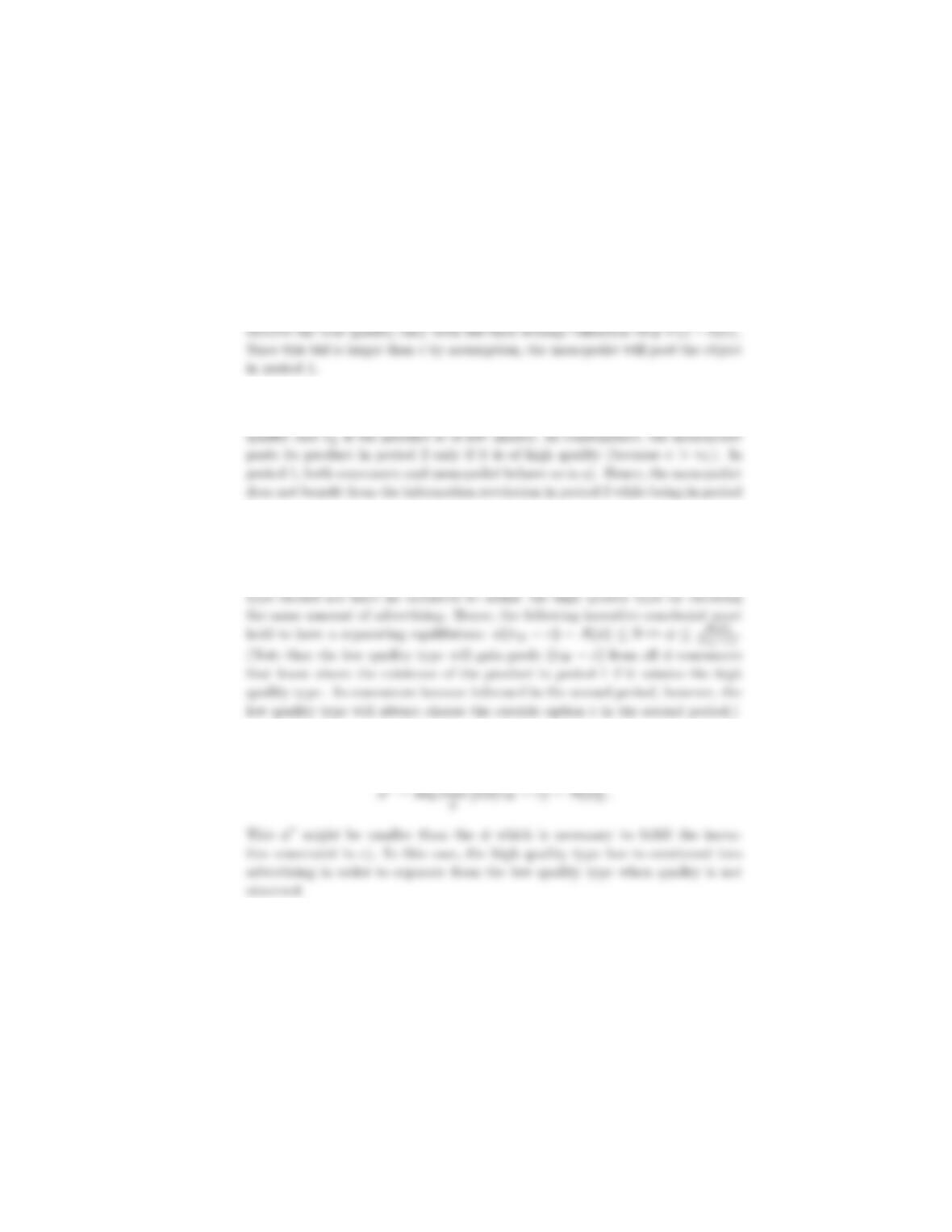
1. In period 2, the quality of the good is common knowledge. Hence, the maxi-
mization problem of the monopoly when the quality of the good is s2 f2;4gis
11
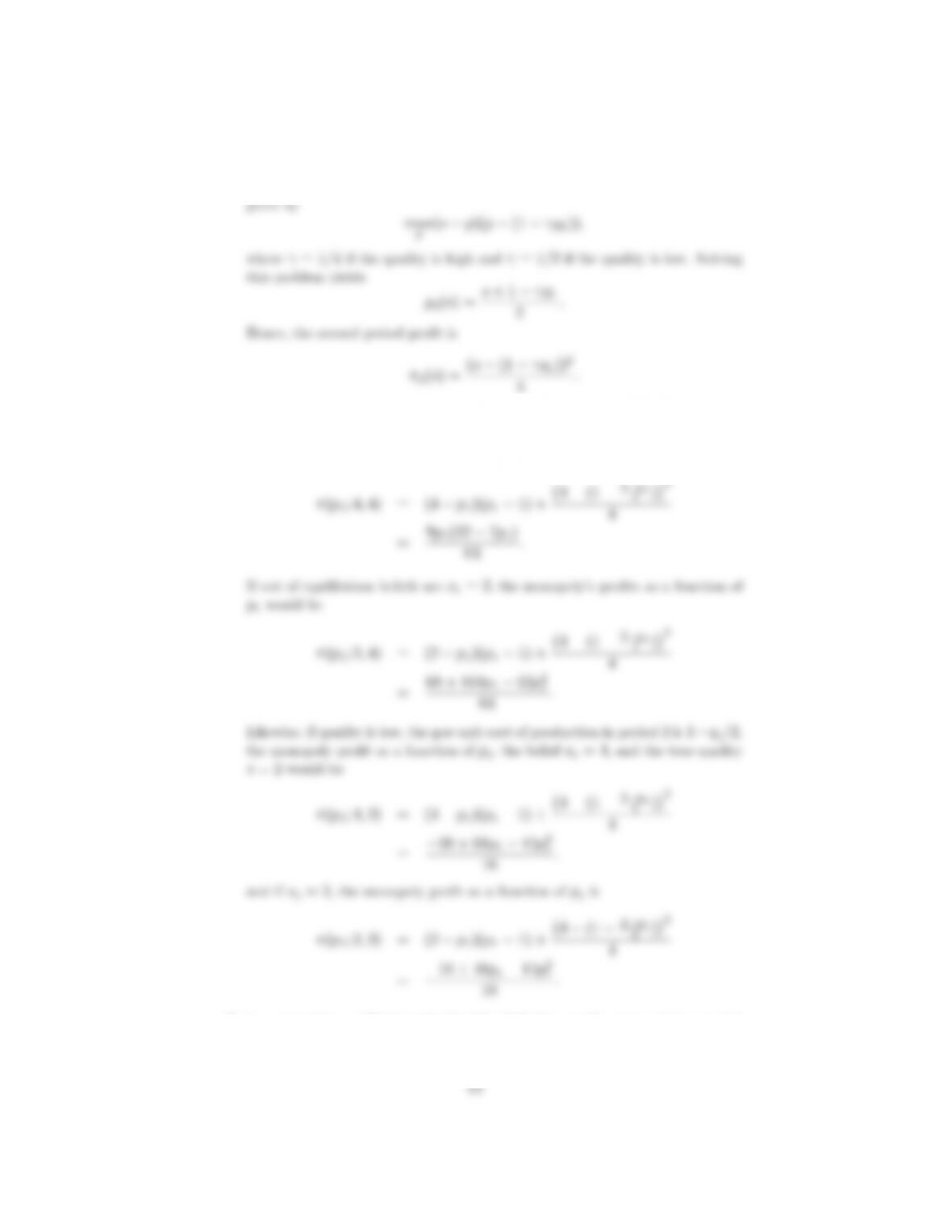
2. Suppose that the quality is high. Then, the per-unit cost of production in period
2 is 1q1=4, so the monopoly’s profit as a function of p1, the belief s1= 4,
and the true quality s= 4 is
4)2
3. In a separating equilibrium, the identity of the low quality monopoly is revealed
so it will obviously choose zero advertising A
L= 0 (no need to advertise if
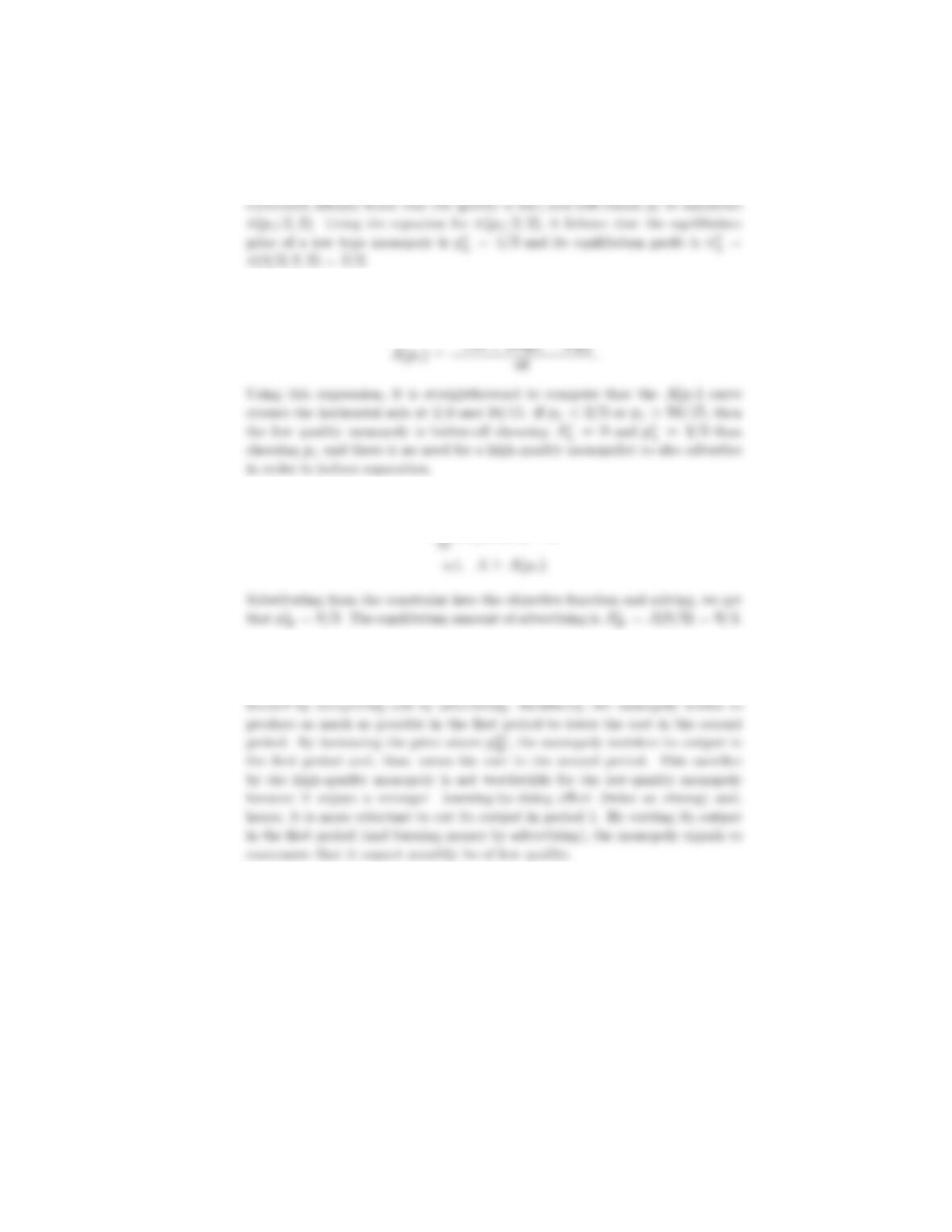
4. The A(p1)curve is defined implicitly by the solution to the equation (p1; 4;2)
A=
L. Using the equation for (p1; 4;2) we get:
1
5. The strategy of a high quality monopoly in a separating equilibrium is given by:
max
(p1; 4;4) A
6. In the full information case the monopoly does not need to advertise so A
H= 0.
The profit-maximizing price is p
H= arg maxp1(p1; 4;4) = 16=7. This price
is less than the price in a separating equilibrium so the monopoly separates
Exercise 8 Pricing and quality information
Suppose there are two groups of consumers, group 1 of size and group
2 of size 2. Consumers have unit demand. Consumers in group 1 have
willingness-to-pay for a high-quality good equal to 3and for a low-quality good
equal to 2. Consumers in group 2 have willingness-to-pay equal to 2independent
of the quality of the good.
13
1. Determine profit-maximizing prices for each type of the firm under the
2. Suppose now that consumers only observe price but not quality prior to
3. What happens if = 3=2? Does a separating equilibrium exist? If your
Exercise 9 Content Advertising1[included in 2nd edition of the book]
Consider a monopolist who sells a product that contains two attributes A
and B. Each of these attributes can be of high or of low quality. Low quality
gives utility ui= 0 and high quality utility ui= 1=2,i=A; B. The willingness
to pay for the product is the sum of the attributes’ utilities plus some small,
positive fixed value, u0>0—i.e., u0+uA+uB. Nature draws high and low
quality with probability 1=2each, independently across attributes. The cost
of production is equal to zero. The realization of the two qualities is private
information of the firm. The firm can advertise that the product exists at zero
costs. The firm chooses its marketing strategy, consisting of its advertising
strategy and its price.
1. Suppose that the monopolist can reveal the quality of both attributes at
zero cost. What is the equilibrium outcome?
2. Suppose that the monopolist can at most truthfully advertise the quality
of one of the two attributes. What is the equilibrium outcome of such a
game?
3. Consider the situation in (2), but suppose that, after the advertising deci-
sion, consumers can search at cost zto receive noisy information about the
quality of one of the attributes. Clearly, consumers may only search for the
quality of an attribute whose quality has not been discloses. Specifically,
suppose that consumers learn with probability 3=4that a low-quality at-
tribute is indeed low quality. With the remaining probility 1=4they obtain
the same signal that they receive if the attribute is of high quality.
14
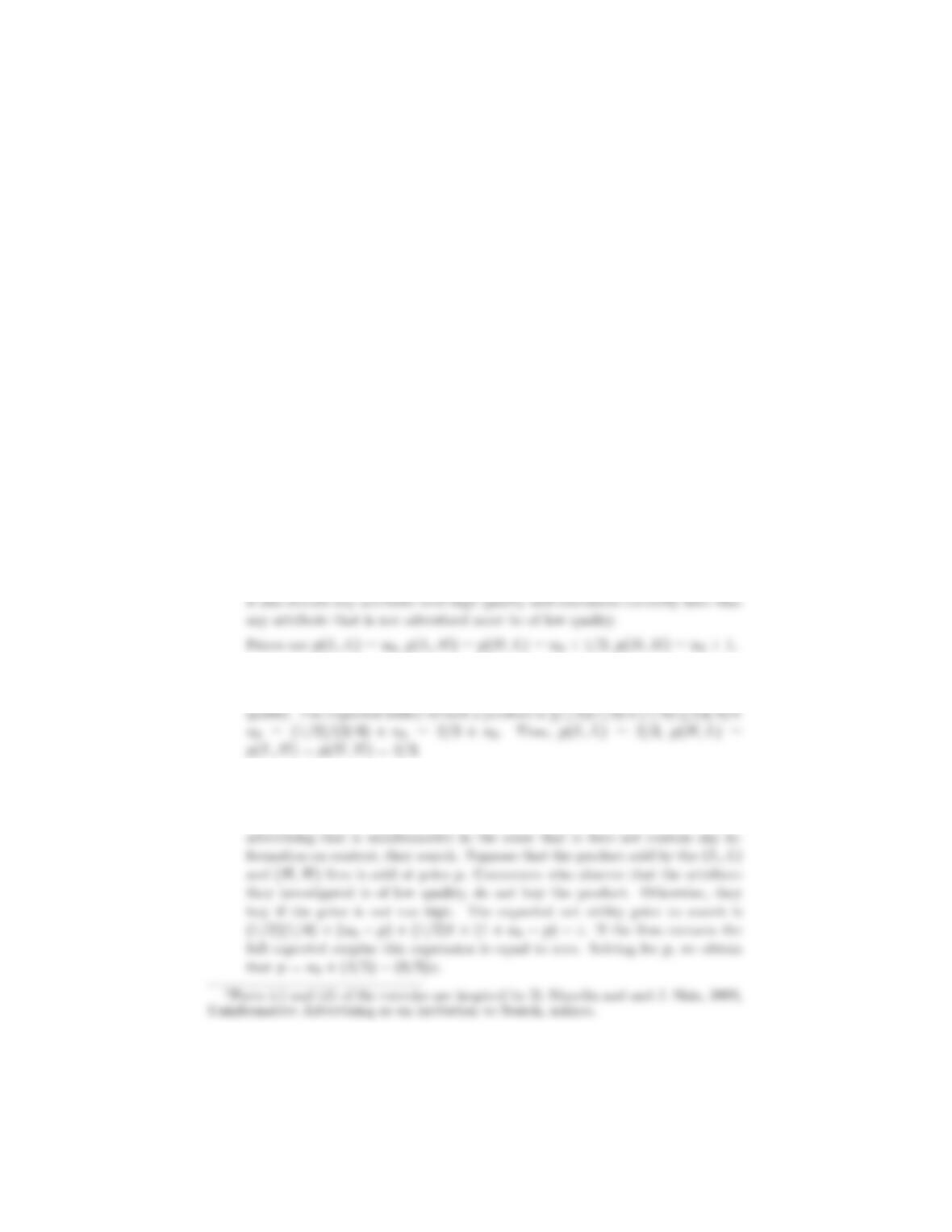
Show that there exists a semi-separating equilibrium in the which a prod-
uct with two high-quality attributes pools with a product with two low-
quality attributes by not revealing any attribute information. By contrast,
products (H; L)and (L; H)inform consumers through advertising about
the high quality of one of the attributes.
Characterize the equilibrium search behavior of the consumers.
Characterize the maximal equilibrium prices and profits that can be
supported along the equilibrium path.
Show that none of the firms has an incentive to deviate.
Give a condition on the level of the search cost such that the equi-
librium exists.
4. Discuss your result obtained in (3) with respect to the informativeness of
ads depending on product quality.
Solutions to Exercise 9
1. The firm advertises the existence of the product. By the unravelling argument,
2. The firm with two high-quality attributes pools with the firm with only one high–
quality attribute by informing consumers that one of their attributes is of high
3. 2All types advertise; the (H; L)and (L; H)-types choose informative advertis-
ing. If consumers see informative advertising they believe that, with probability
one, the other attribute is of low quality and do not search. If consumers see
15
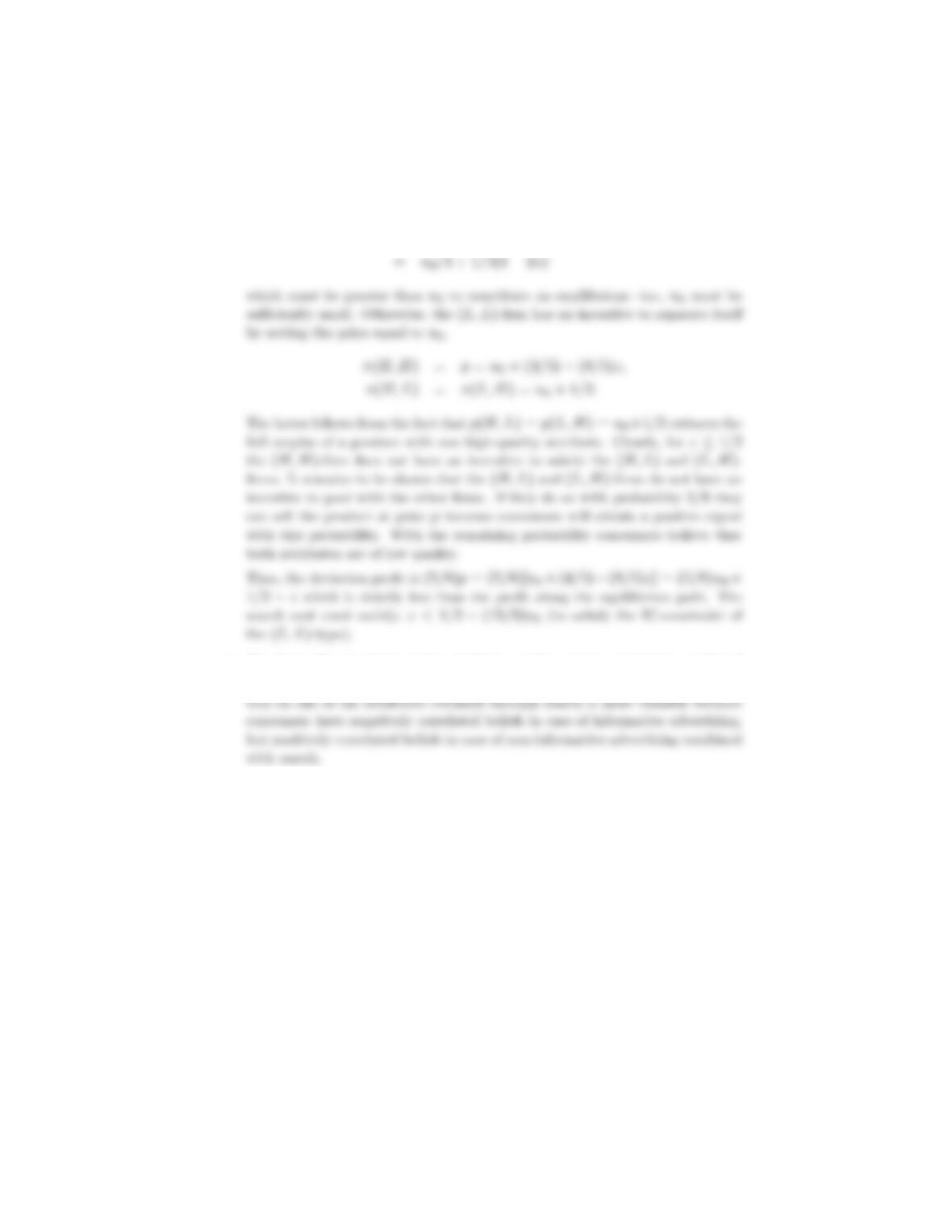
Hence,
(L; L) = (1=4)p= (1=4)[u0+ (4=5) (8=5)z]
4. The firm with two high-quality attributes prefers not to reveal high quality of
one of the attributes in order to invite consumers to search. The noisy informa-
Exercise 10 Quality of business school teaching
A business school offers an MBA program with two areas of specialization:
finance and marketing. For simplicity, suppose that the school is facing only
two potential students: one who is interested only in finance and his utility
from studying in the school is 2sFpand the other who is interested only in
marketing and his utility is sMp, where sFis the quality of the finance courses,
sMis the quality of the marketing courses and pis the tuition. If either one of
the two students decides not to enroll his utility is 0. (We can easily extend the
problem and consider many students of each kind but this will not change any
of the results). Suppose that the business school can choose the quality of the
finance and the marketing courses, but the cost is increasing with the quality of
the courses: The cost of finance courses for the school is (sF)2=2and the cost
16

of the marketing courses is (sM)2=2. For simplicity, assume that the tuition, p,
is determined by the government (the school cannot choose it) and is equal to
2. The objective of the school is to choose the quality of the finance and the
quality of the marketing courses in order to maximize its income from tuition
minus the cost of providing courses.
1. Suppose the students can tell the quality of the courses before they enroll.
What is the quality above which each student will decide to enroll.
2. Given your answer to (1), compute the quality of the courses that the
school will offer and the school’s profit. Explain what will happen if p > 2.
3. Which courses will have higher quality: finance or marketing? Which
student cares more about quality? Does the school provide efficient level
of quality or not?
4. Now suppose that the students cannot observe the quality of the courses
before they enroll. Compute once again the quality of the courses that
the school will offer and the school’s profit (note that the school chooses
the quality although the students cannot observe it before they enroll).
5. Now suppose that the students can only observe the average quality of
the courses provided by the school. That it, students only observe s
(sF+sM)=2but they cannot observe sFalone and sMalone. Suppose
that the students observe an average quality sand both enroll. What will
be the qualities sFand sMthat the school would like to choose? (Hint:
think about the combination of sFand sMthat produces a given sat a
minimum cost)
6. Now suppose that the students anticipate the quality choices that the
school makes. What is the value of sfor which both students will enroll?
7. Are the students better-off when they observe both sFand sMor are they
better off when they only observe s? What about the school: is the school
better off when the students observe both sFand sMor when they only
observe s? Explain the intuition for your answer in detail.
Solutions to Exercise 10 This problem is based on the paper “The Economics
of Quality Indexes” by Glazer and McGuire.
1. If the students can tell the quality of the courses before they enroll, each will
enroll if by doing so she gets a positive utility. Since the utility of the student
2. Since quality is costly, the school will offer the minimal quality that will induce