sM= 2 and its profit will be
= 2 212
222
2=3
2:
3. From (2) it is clear that the quality of the marketing courses will be twice as
much as the quality of the finance courses despite the fact that the finance
4. The school will now set sF=sM= 0. To see why, suppose that the students
believe that the quality is above 1 for finance and 2 for marketing and they are
5. Holding the average quality fixed, the school minimizes its cost by setting sF=
6. If the students anticipate that sF=sM=s, it must be the case that s2
7. When the students only observe s, the school will have to set sF=sM= 2 in
order to induce both students to enroll. The school’s profit will then be
= 2 222
222
2= 0:
Surely, the school is now worse off, the finance student is better off as he gets
attract the marketing students that the finance students gets higher quality).
Remark: Another option that the school has is to choose s= 1. Now the
students will correctly anticipate that the school chose sF=sM= 1. In that
case, only the finance student will enroll and the school’s profit will be:
= 1 212
Exercise 11 Warranties
Manufacturers issue warranties for their products, often beyond the manda-
tory minimum length. However, the warranty is restricted to require consumers
Exercise 12 Money-back guarantees
Consider a monopolist who sells a single unit of a product that may be
of high or low quality. Both events occur with probability 1=2. There are at
least two identical consumers. Consumers are willing to pay 1 for a functioning
1. Suppose that the monopolist has a cost of 0to produce and sell the product
2. Suppose now that the firm incurs a cost of c > 0for high quality (and 0
for low quality). This cost is incurred if the firm decides to produce the
3. Return to the case in which the firms’ costs are zero. Suppose now that,
at the stage between entering and consumer bidding, the monopolist can
commit to a money-back guarantee. This money-back guarantee has the
4. The monopolist is considering to advertise its product by spending Aafter
entering (instead of offering a money-back guarantee). Discuss the effect of
Exercise 13 Warranties as signal of quality [included in 2nd edition of the
book]
Consumers wish to buy a product and get a utility 10 if the product is of
high quality and is working, and a utility of 4 if the product is of low quality
and is working. If a product does not work, then the utility from having it
is 0 irrespective of its quality. Ex ante, only the firm knows the quality of
its product (but cannot choose it). Consumers expect that the product is of
high/low quality with equal probabilities. The likelihood that a high quality
will not work is 1/5 and the likelihood that a low quality product will not work
is 4/5. The cost for the firm of replacing a product that does not work is c(this
cost is independent of the product’s quality)
1. Suppose the firm does not offer a warranty. What is the price that con-
sumers will pay for the product?
2. Suppose that the firm does offer a warranty. What are the conditions on
csuch that offering a warranty can serve as a signal of high quality?
3. What happens if the conditions you found in (2) are violated?
4. Compare the profits of firms in (2) and in (3). Comment on your findings.
20
Solutions to Exercise 13
2. Suppose the firm offers a warranty and consumers believe that its quality is
high. Hence, they agree to pay 10 if there is a warranty. If there is no warranty,
consumers believe that the product is of low quality (because if quality was high
3. Suppose that c < 11:5. Then, even a low quality firm finds it profitable to offer
a warranty, so offering one is not enough to convince consumers that quality is
high. In that case, consumers will offer 4:4for the product. It is reasonable to
assume that in this case, firms will not offer warranties since offering one does
4.4 for the product.
4. In (2), the high-quality firm earns 10 c=5while in (3) it earns 4.4 (assuming
that in equilibrium no warranties are offered). If c > 5:65 = 28, the firm
Exercise 14 Quality inspection [included in 2nd edition of the book]
A monopolist sells a product whose quality is unknown to consumers before
they buy. It is common knowledge however that the product’s quality, s, is
drawn from a uniform distribution on the unit interval. There is continuum of
consumers with a total mass of 1. Each consumer is interested in buying at
most 1 unit and gets a utility of spif he buys and 0 otherwise. The monopoly
can send its product to inspection before consumers buy. The cost of inspection
is c. The inspection perfectly reveals sto consumers with probability . With
probability 1, it reveals nothing in which case consumers cannot tell whether
the monopolist has sent its product to inspection or did not.
1. Write out the monopoly’s profit if it sends its product to inspection and
if it does not.
2. Prove that the monopoly will send its product to inspection if and only if
sis above some threshold bs.
3. Compute the expected quality of the monopoly’s product if consumer
do not see the inspection results (hint: you should compute a weighted
average of two conditional expected values: one for cases in which s < bs
and one for s > bs; the weights depend on the probability that s < bsand
the probability that s > bsand that the inspection reveals nothing).
4. How does the expected quality that you computed in (3) vary with ?
Explain the intuition.
5. Given your answer to (3), compute the threshold bs.
6. How does svary with cand with ? Explain the intuition.
Solutions to Exercise 14
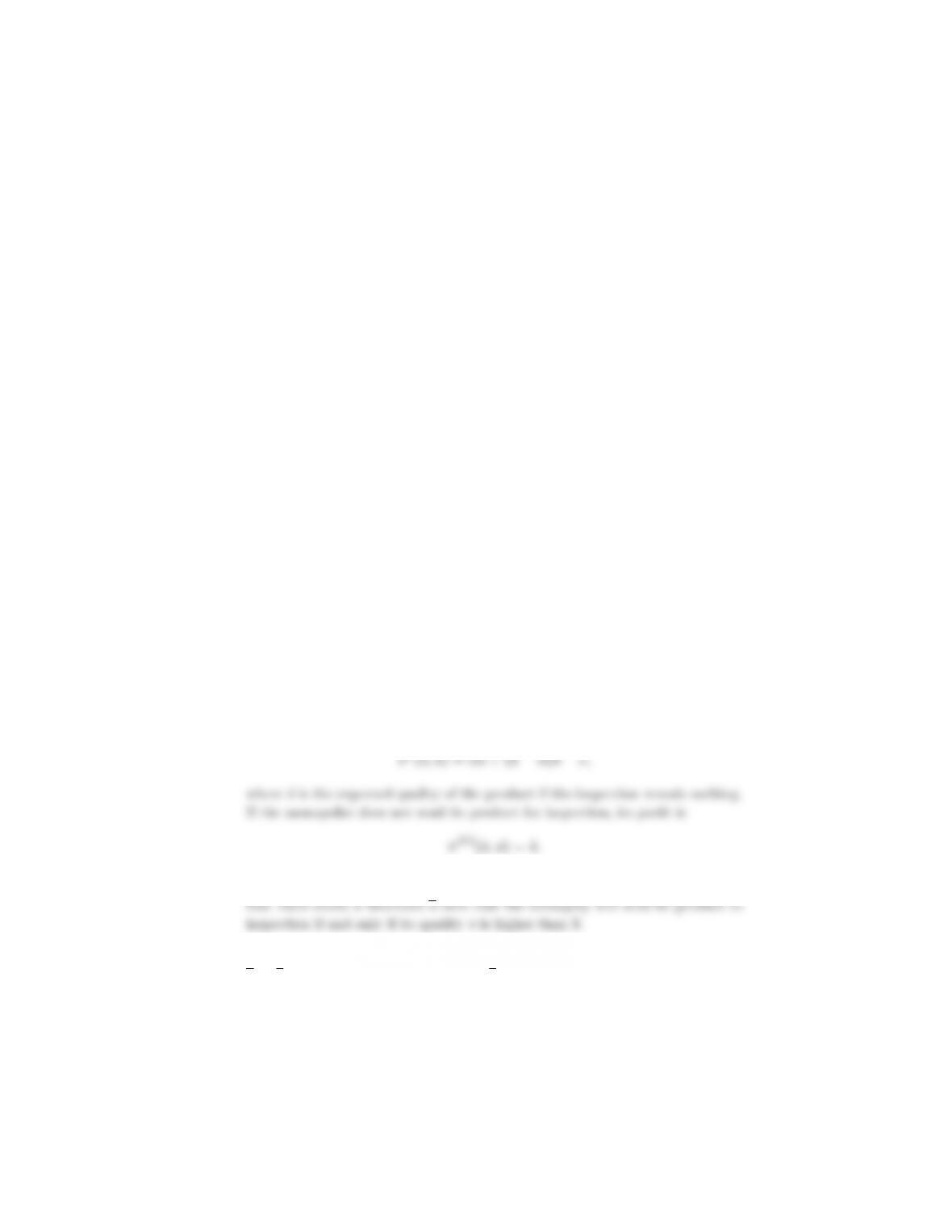
1. The monopolist will set a price equal to the maximal willingness of consumers
to pay. Hence, if it sends its product for inspection, its profit is
2. Since N I (^s; s)is independent of swhile I(^s; s)increases in s, it is clear
3. Since sis distributed uniformly on the unit interval, the probability that s <
sis sand the probability that s > s and the inspection reveals nothing is
22
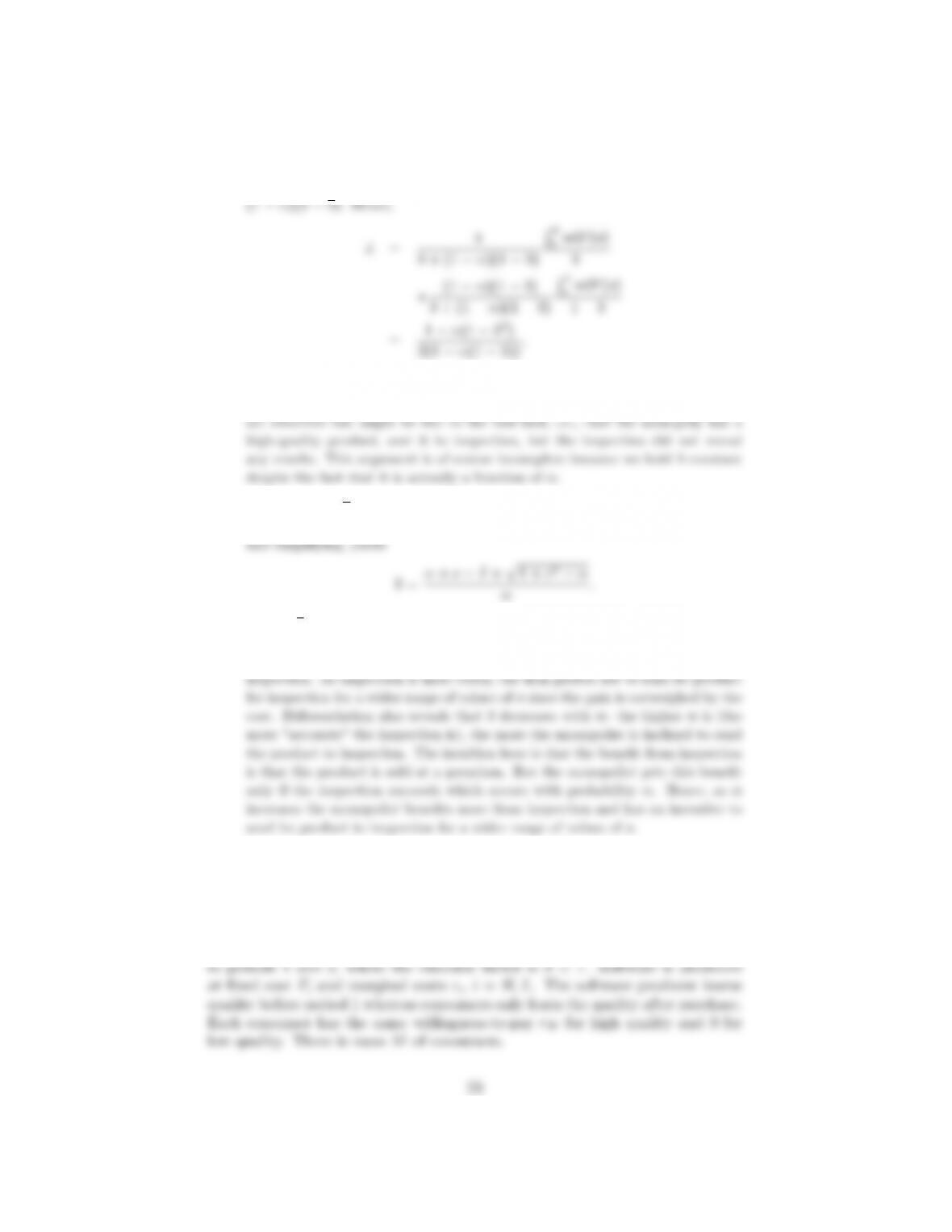
4. Differentiating ^swith respect to reveals that it falls with . Intuitively,
when increases there is a smaller likelihood that when no inspection results
5. The threshold sis defined implicitly by the equation NI (^s; s) = I(^s; s).
Substituting for ^sinto this equation, using the profit function we wrote in (1),
6. Clearly sincreases with c. The reason is that when by revealing the product’s
quality the monopolist can sell the product at a premium (above the average
price), but unless sis high, this premium is not big enough to cover the cost of
Exercise 15 Quality information and testing
Consider a monopolist selling computer software. Software is of high or low
quality and is chosen by Nature: quality is high with probability and low with
probability 1. Consumers can buy the software in period 1 and consume it
2. Suppose now that consumers can copy the software at an opportunity cost
pcand value the copy at rc
iwith rH> rc
H> rc
L= 0, i.e., copies of high-
quality software are an imperfect substitute for the original. Suppose that
3. Discuss what would happen if the firm could choose the degree of copyright
Exercise 16 Information disclosure
Consider a market in which firms have private information about their qual-
ity s2[0;1]. Quality is drawn from the uniform distribution on the 0-1 interval;
2. Suppose now that the firm can reveal information at zero cost. Character-
3. Suppose now that there is a dislosure costs k > 0. Characterize the
4. Above which level of kwill the firm never disclose private information?
Exercise 17 Mandatory disclosure rules
Consider as above a market in which firms have private information about
their quality s2[0;1]. Quality is drawn from the uniform distribution on
the 0-1 interval; this is common knowledge among firm and consumers. After
observing its type the firm decides whether to reveal its quality to consumers
(it has the choice whether or not to reveal its quality but not to mislead; a
2. Discuss your result in light of the resuts obtained in the previous exercise.
Exercise 18 Product quality and repeated interaction
Consider an industry in which firms produce an experience good and sell it
to a continuum of consumers with a total mass of one (i.e., we normalize the
number of consumers to 1). There are infinitely many periods. In every period,
each consumer is willing to buy at most one unit of the good provided that its
quality is high. Consumers know that firms can choose every period whether
to produce a high quality good at a cost of 10 per unit or a low quality good
at a cost of 4 per unit. Suppose that consumers adopt a boycott strategy and
never buy from a firm that sold a low quality good in the past. Let be the
intertemporal discount factor.
1. Compute the lowest price that guarantees the production of high quality
in every period.
2. Now suppose that each period, there is a probability 1that a superior
good will be invented and that the current period will be the last. Repeat
your answer to part (1) and explain how the lowest price that guarantees
the production of high quality in every period depends on . Make sure
you explain in detail the economic intuition for your answer. (Hint: in the
presence of , the expected discounted value of 1 dollar tomorrow from
today’s point of view is ).
3. Now suppose that each period, the number of consumer grows at a rate of
gso that there are 1 + gconsumers in the period 2, (1 + g)2consumers in
period 3, (1 + g)3consumers in period 4 and so on (note that in period t
there (1 + g)t1consumers). Repeat your answer to part (1) and explain
25

how the lowest price that guarantees the production of high quality in
every period depends on g. Once again, make sure you explain in detail
the economic intuition for your answer. (Hint: in the presence of g, the
expected discounted value of 1 monetary unit tomorrow from today’s point
of view is (1 + g)).
4. Suppose that = 1 and g= 0 (the case we considered in part (1)) and
assume that there are nfirms in the industry and that these firms are
competing by setting prices. Consumers buy from the lowest price firm
(provided that buying at this low price is better than not buying at all!); if
several firms charge the same low price, then consumers pick one of them
at random and buy from it. What will be the price that firms will set
in equilibrium (i.e., when no firm can improve its profit by changing its
price)? Compute the per-period profit of each firm and the discounted
infinite sum of its per-period profits (i.e., the “net present value” of the
firm).
5. Given your answer in (3), how many firms will enter the industry in the
first place if entry requires a one-time investment of 18? (Hint: if a firm
stays out of the market its profit is 0; entry makes sense only if a firm can
earn a positive profit).
6. How does the number of firms that you computed in (4) vary with ? That
is, are there more or less firms in the industry when is higher? Explain
the intuition for this.
7. Consider two geographical markets, Aand B, that behave according to
the model described in this question. Assume that the two geographical
markets are the same in every respect, save for which is higher in market
A than in market B. Which market will have more firms? Which market
will have higher prices? If you compare the two markets by observing the
number of firms and the prices in each market what will you conclude
about the correlation between the number of firms and prices: Is there
a positive or a negative correlation (i.e., are more firms associated with
higher or lower prices)? What is the intuition for the correlation you find?
8. On the basis of your previous answers, would you expect more or less
firms in a fast growing market relative to stagnant markets? Explain your
answer in detail and explain the intuition.
Solutions to Exercise 18
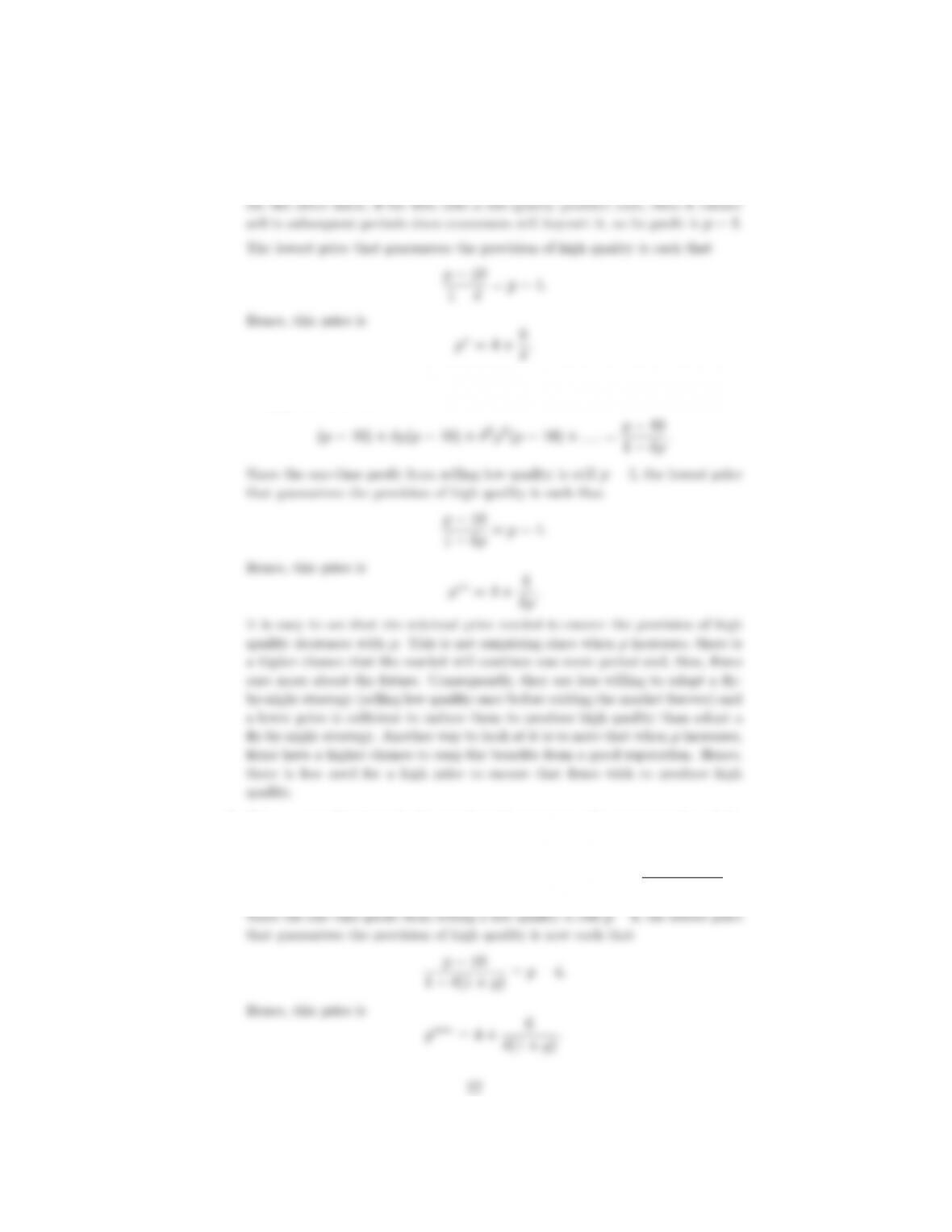
1. If a firm produces high quality in every period then it can sell at a price of p
forever. The present value of the firm’s profits is
2. Now, the present value of the firm’s profits if it sells a high-quality product in
every period becomes
3. Given a growth rate gin the number of consumers, the present value of the
firm’s profits if it sells a high quality product in every period becomes
(p10) + (1 + g)(p10) + 2(1 + g)2(p10) + : : : =p10
1(1 + g):
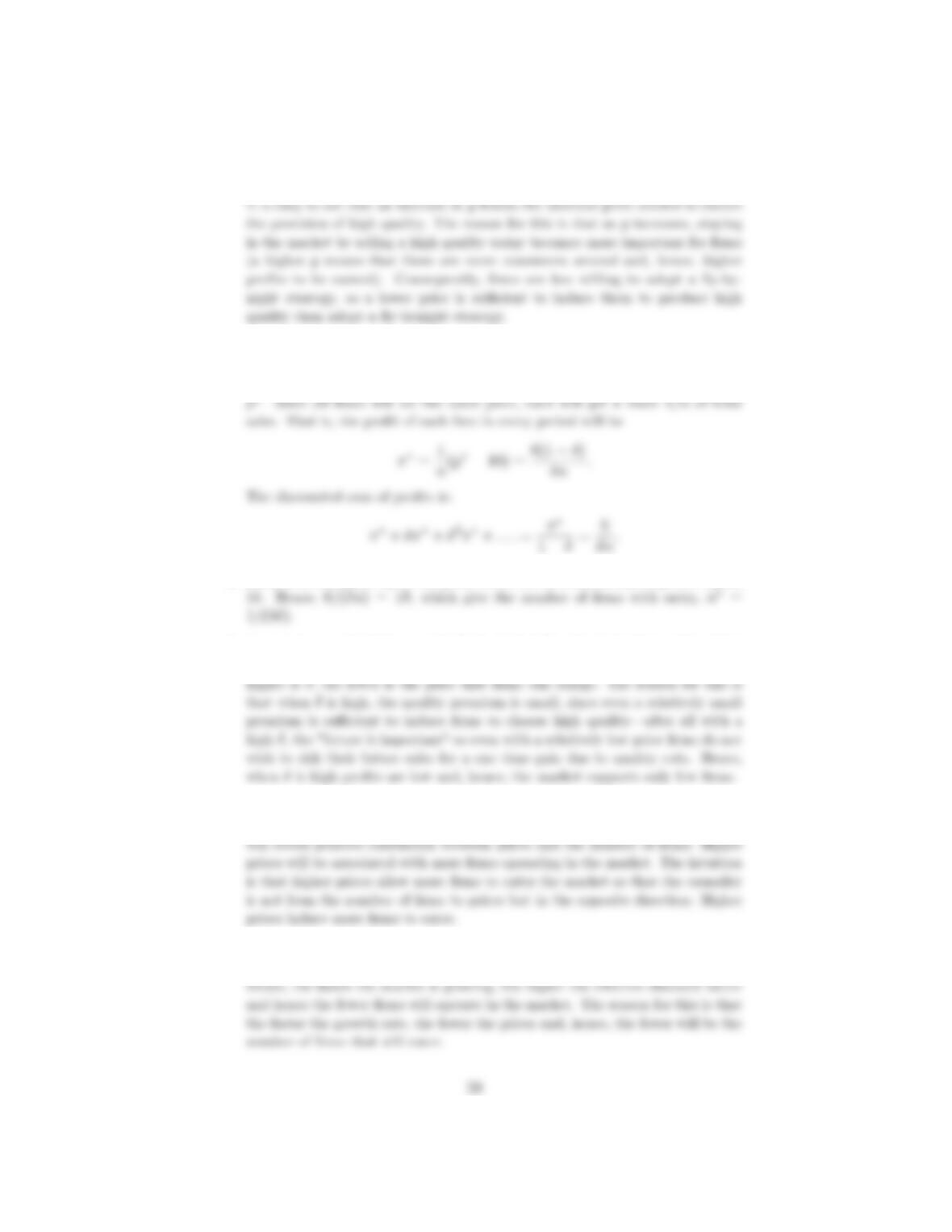
4. Competition among firms will induce them to cut prices in order to get a higher
market share. Yet, firms cannot lower their prices below potherwise consumer
will expect them to provide low quality. Hence, the equilibrium price must be
5. Entry will take place up to the point where the discounted sum of profits equals
6. As we can see, ndecreases with : the higher is, the fewer firms will operate
in the industry. To see why, note that pfalls when increases: that is, the
7. From part (1) we know that pdecreases with and from part (6) we know
that ndecreases with . Hence, the comparison between markets A and B
8. The higher is, the fewer firms will operate in the industry. In part (3) we
saw that when the market is growing, the effective discount becomes (1 + g).

Exercise 19 Moral hazard and reputation
A firm operates for two periods and sells in each period an experience good.
There is a continuum of consumers with a total mass of one. Each consumer
wishes to buy at most one unit. The utility of a consumer who buys the good at
a price p, is Vpif the quality of the good is high and pif the quality is low,
where V > 0. If a consumer does not buy his utility is 0. The firm can choose
in each period whether to produce high or low quality. It costs c > 0to produce
a high quality good and 0 to produces a low quality good. The intertemporal
discount factor is .
1. Solve for the quality and pricing decisions in the second period.
2. Using your answer in (1), solve for the quality and pricing decisions in the
first period.
3. Now suppose that with probability , the firm believes that it is morally
wrong to produce low quality and it therefore produces only the high
quality good no matter what. With probability 1the firm is as before
and can choose the quality of its good in every period. Only the firm knows
its type. Consumers only know that with probability the firm will only
produce high quality and they also know in period 2 which quality the
firm sold in period 1. Restate your answer to (1). (Hint: in order to solve
for the optimal price, you should distinguish 3 possible cases depending
on the type of quality consumers have bought in period 1 and depending
on whether consumers believe that a firm that can choose the quality will
provide high or low quality in period 1).
4. Given your answer to (3), find a condition on that ensures that a firm
which can choose the quality of its good will provide a high quality product
in period 1. (Hint: think about the options that the firm has: it can either
sell a low quality in period 1 in which case its identity is known in period
2 or sell a high quality in period 1 in which case consumers cannot tell its
type in period 2). Discuss 3 factors that make this condition more likely
to be satisfied and explain why.
5. Solve for the equilibrium quality and pricing decisions in period 1 assuming
that the condition you found in (4) holds.
6. Explain what you think happens when the condition you found in (4)
fails (you are not required to solve for this case since the solution is quite
involved; you are expected to think about what might happen even if you
cannot fully characterize the outcome).
Solutions to Exercise 19
2. The firm will provide low quality in both periods and will charge them 0 since
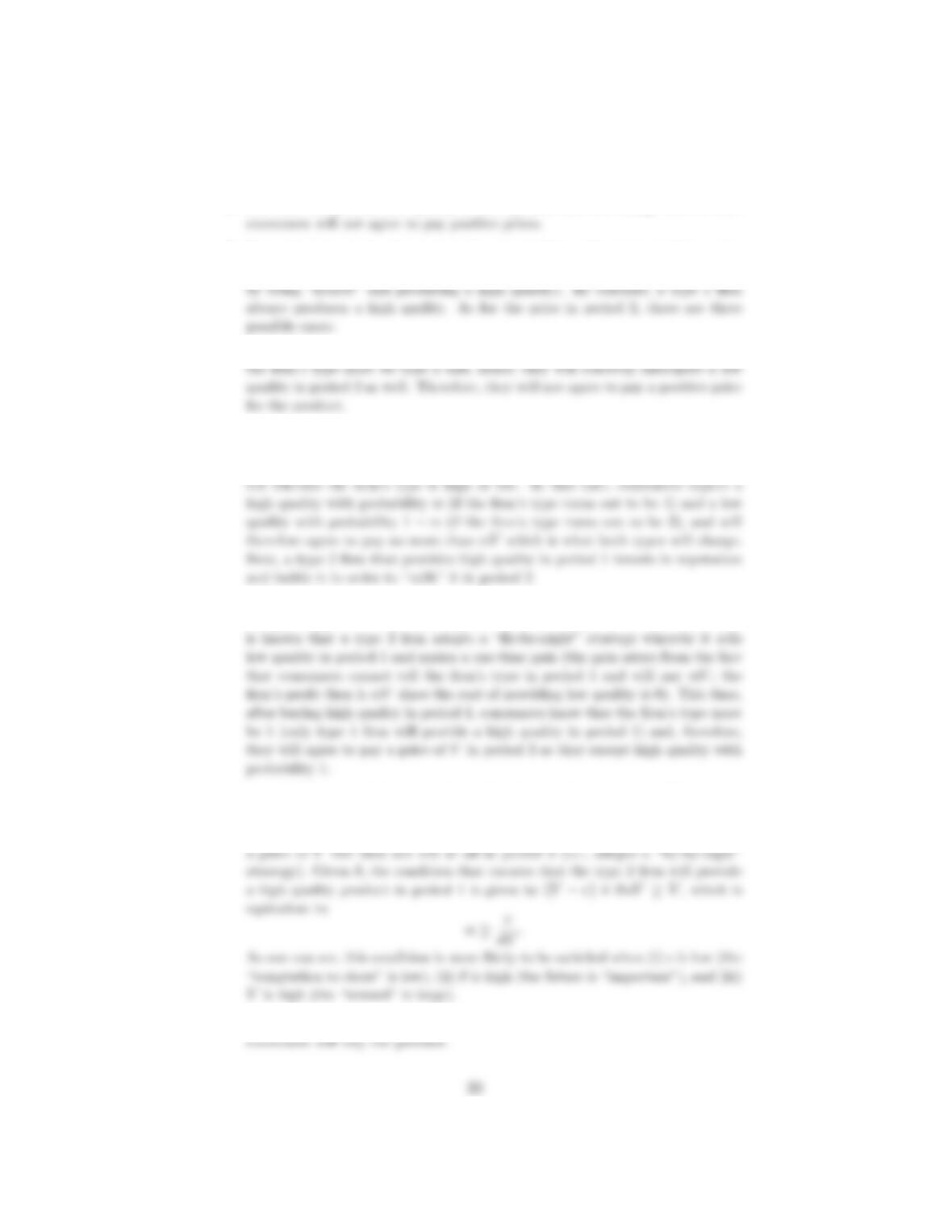
3. Since the game ends after period 2, a type 2 firm will surely produce a low
quality in period 2 (there is no future after period 2 so there is nothing to gain
Case 1: If consumers bought a low quality in period 1, then they know that
Case 2: If consumers bought a high quality in period 1 and it is known that
a type 2 firm can benefit from offering a high quality in period 1 (i.e., it pays
a type 2 firm to build a good reputation in period 1), then consumers cannot
Case 3: This case is similar to case 2 except that now it is known that it does
not pay a type 2 firm to build a good reputation in period 1. That is, now it
4. In period 1, a type 2 firm can either sell a high quality at a price of Vin which
case it can sell low quality in period 2 at a price of V (i.e., the firm’s strategy
is to build reputation in order to “milk” it later), or can sell a low quality at
5. If c=(V ), then both types will provide a high quality, will charge V, and
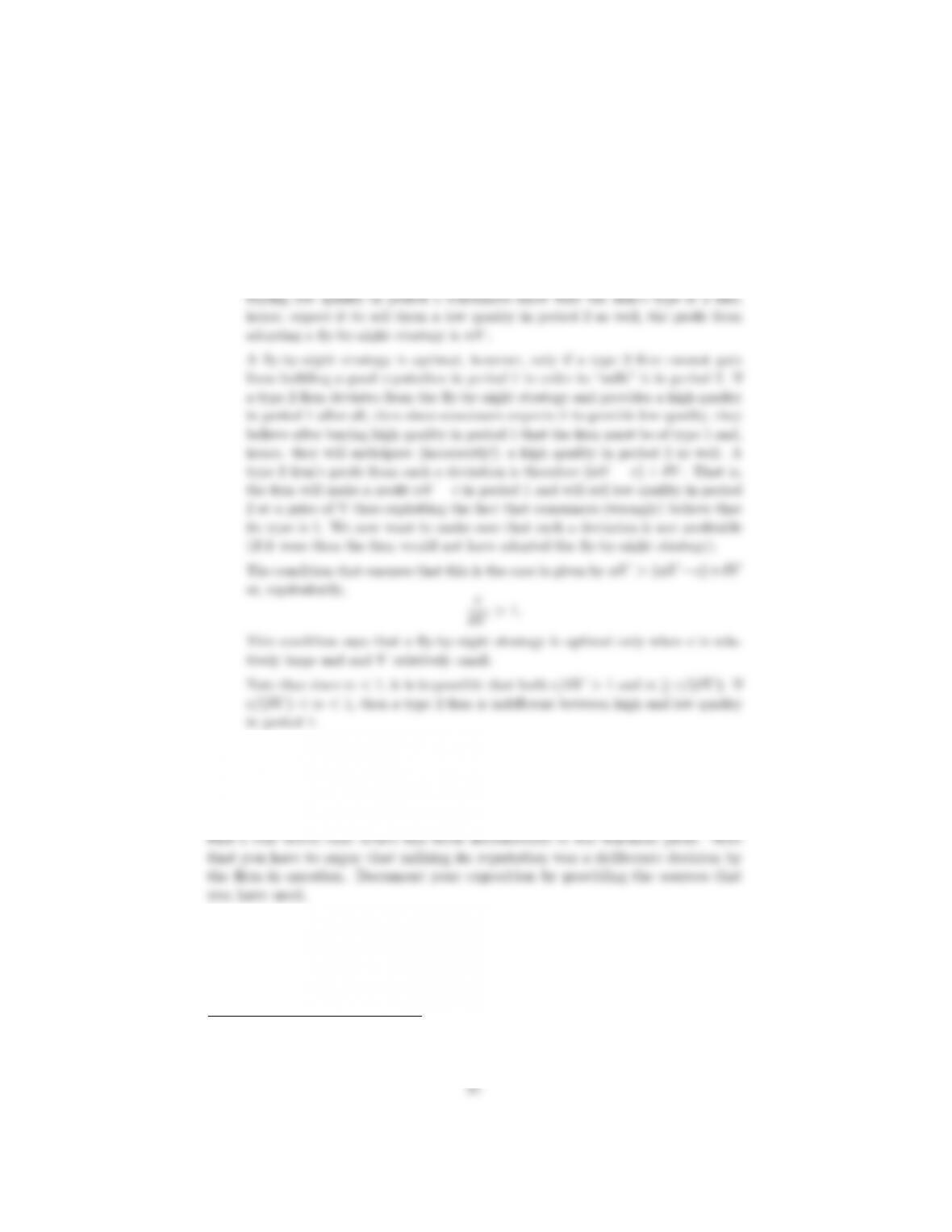
6. Things are more complex when < c=(V ). In that case it is possible to find
a condition that will ensure that a type 2 firm will adopt a ‡y-by-night strategy
by producing a low quality in period 1. To find this condition, note that if
consumers expect that a type 2 firm will sell a low quality in period 1, then in
period 1 they will not agree to pay more than Vfor the product. Since after
Exercise 20 Milking reputation
Give an example in which a firm “milks its reputation” over time. Ideally you
Exercise 21 Umbrella branding3[included in 2nd edition of the book]
Suppose that a single firm sells two products of potentially different qualities.
Qualities are described by numbers Hand L, measuring the willingness to pay
3This exercise is largely inspired by Hakenes and Peitz (2009), Umbrella Branding and
Exgternal Certification, European Economic Review 53, 186–196.
of all consumers. By definition, consumers are willing to pay more for high than
for low quality, H> L. Qualities, viewed as random variables, are assumed to
be independent across products: Each product is of high quality with probability
p. The realized product quality is observed by the firm but not always by
consumers: The product is tested with probability by a third party, in which
case quality realization is truthfully communicated to consumers. Before these
tests are performed, the firm has to take several decisions. It decides which
products to offer in the market. It may not want to offer a low-quality product
on the market because the revenues from selling low quality may not recover
the sunk cost f. Suppose that selling low quality is socially undesirable, i.e.,
Lf < 0, but privately profitable if low quality is wrongly percieved to be of
low quality if not tested, i.e., L+ (1 )Hf > 0.
The firm can sell its products under an umbrella brand at a cost k. The
timing of the game is as follows:
Stage 1: Nature chooses the quality of both products as independent draws
from a pool in which high quality occurs with probability p. The product
qualities are observed by the firm but not by consumers.
Stage 2: The firm decides which products to offer on the market and pays
the associated fixed cost per product f. It also decides whether to use umbrella
branding at a cost k.
Stage 3: Consumers observe whether products are sold under an umbrella
brand. They also observe the true quality of a product with probability (where
the underlying random variables are independent across products). Consumers
update their beliefs and bid for the two products.
Consider perfect Bayesian equilibria (PBE) of this game and suppose that
consumers bid their expected surplus. Provide conditions under which a firm
with two high-quality products uses umbrella branding to signal its quality to
consumers.
Solutions to Exercise 21
Suppose that umbrella branding may signal product quality and is used by a firm
with two high-quality products but not by a firm of a different type. Then a firm
with only one high-quality product cannot distinguish itself from a firm with two low-
quality products in the event that product quality is not detected. We will now provide
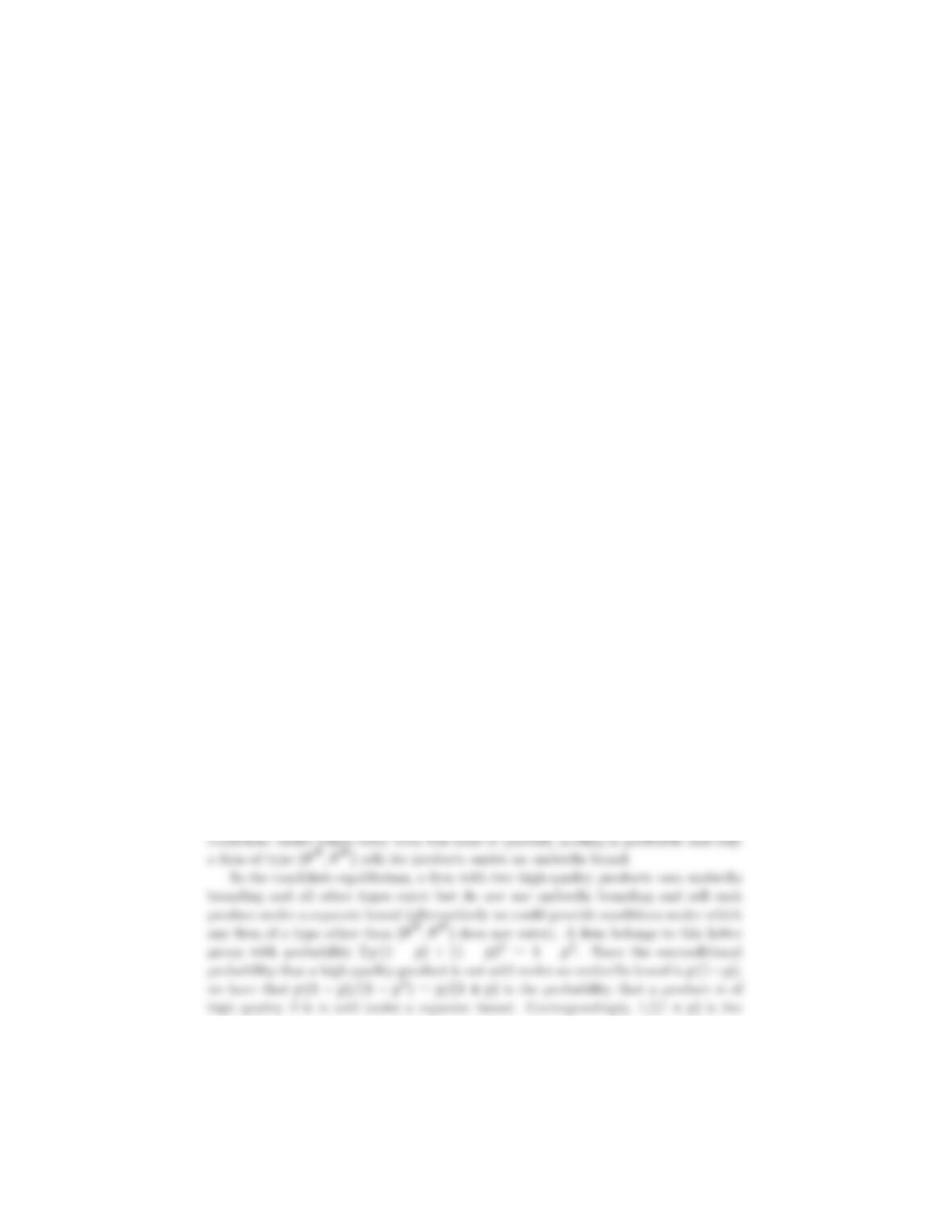
probability that a product is of low quality if it is sold under a separate brand. Along
32
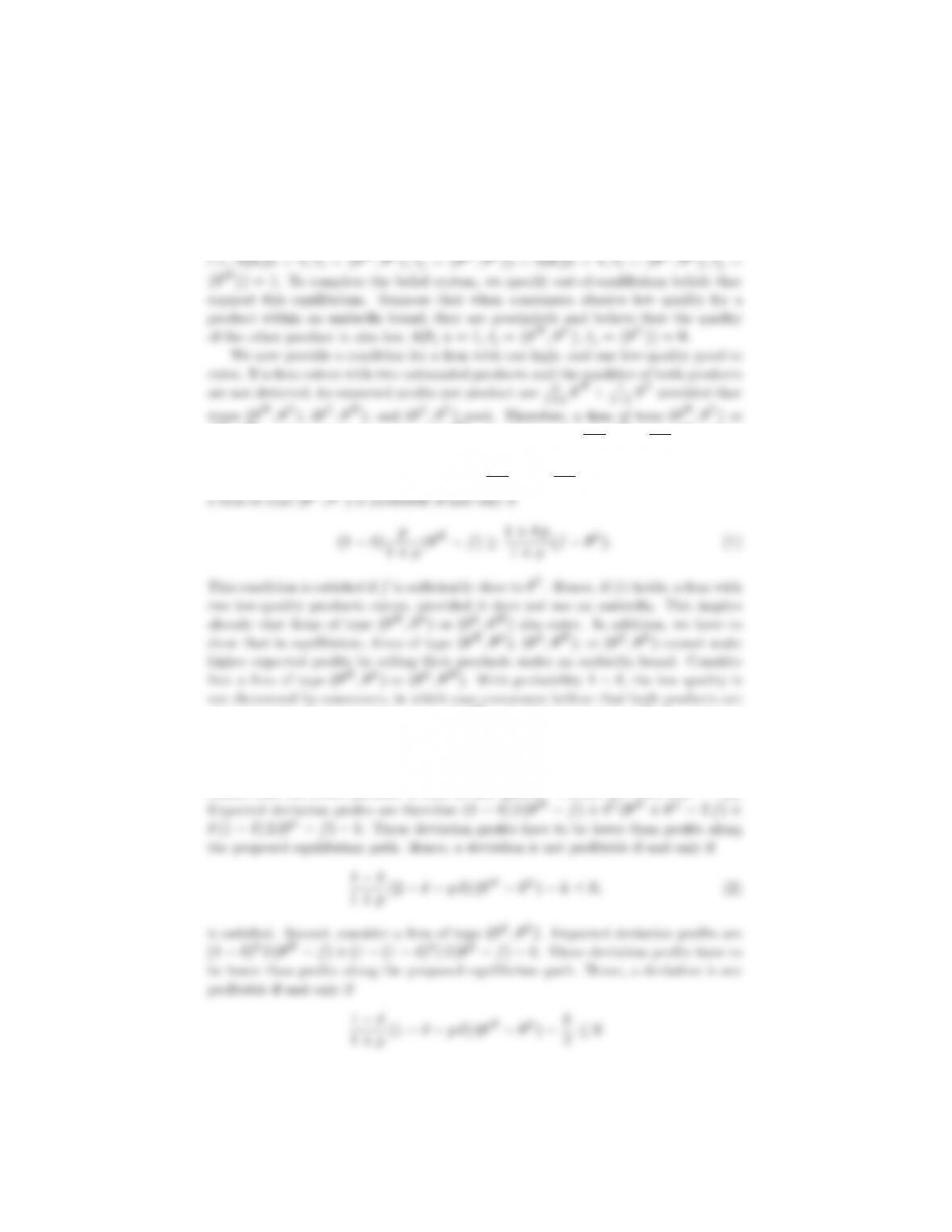
the equilibrium path we thus have the following conditional beliefs: b(iju= 0; Ii=
fH; Lg; Ij) = 1=(1 + p)for all Ij. In addition, two products that are sold under an
umbrella brand are believed to be of high quality unless there is contradictory evidence,
(L; H)makes expected profits of (Hf) + 2 (1 )p
1+pH+1
1+pLf+
(Lf). A firm of type (L; L)obtains lower profits as both of its products can
be of low quality, 2(Lf) + 2 (1 )p
1+pH+1
1+pLf. Participation of
of high quality. Profits in this case are 2 (Hf). With probability 2, the quality of
both products is observed. Profits in this case are H+L2f. With the remaining
probability (1 ), consumers only obtain the information that one of the products
under the umbrella is of low quality. In this case we have imposed out-of-equilibrium
beliefs that the other product is also of low quality. Profits are then 2 (Lf).
33
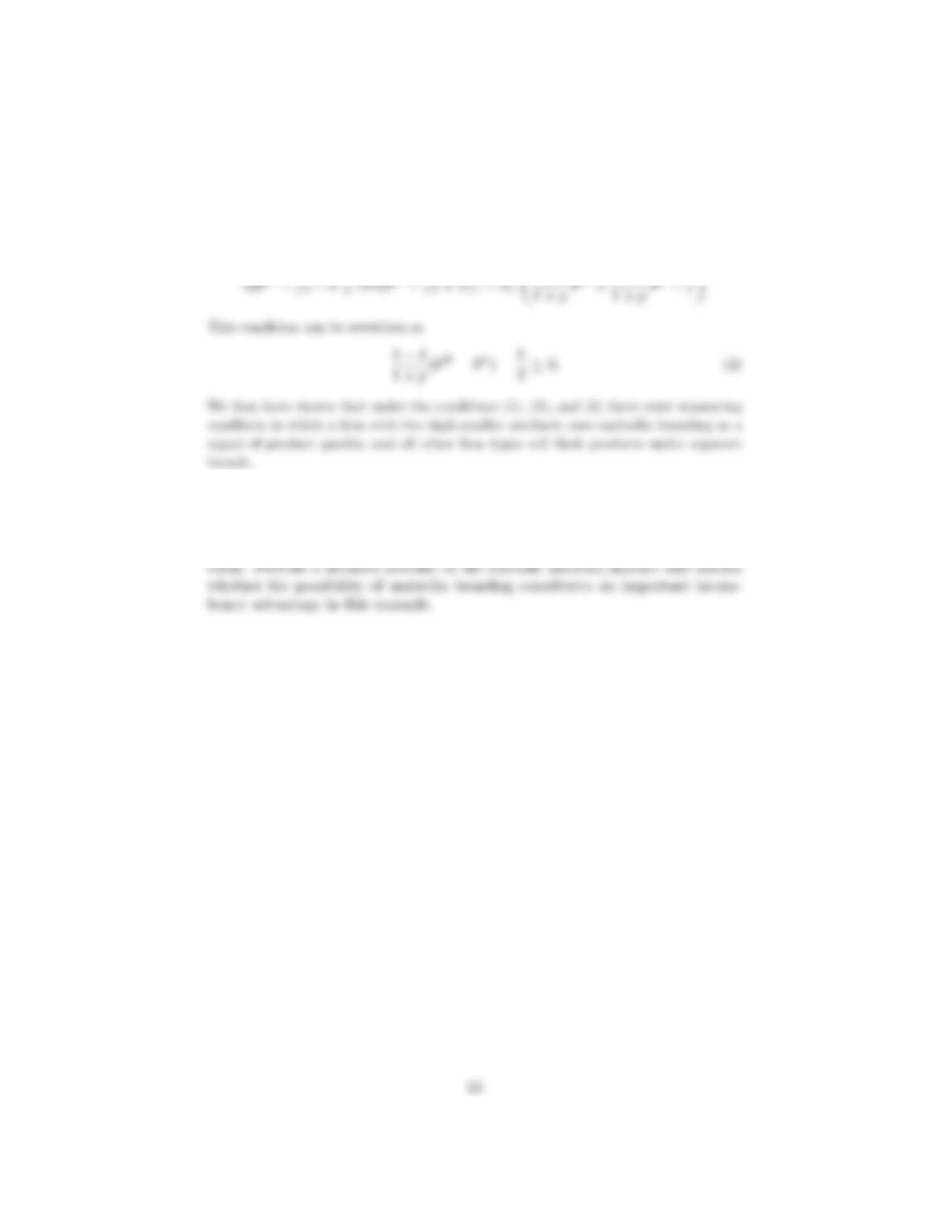
This inequality is implied by (2). Finally, a firm of type (H; H)must have an
incentive to actually use the umbrella. The non-deviation constraint of the firm of
type (H; H)is
Exercise 22 Discussion of umbrella branding
Give an example of a firm using umbrella branding using reputation con-