about the price charge to consumers who protect their personal data; they are
(1=2+“)(3=4“=2), which is less than 1=2, for “small with erroneous consumer
Exercise 9 Markets with damaged goods
Some firms incur costs to offer a lower quality: i) Intel dismantled the ma-
thematical coprocessor in some versions of the 486 CPU, ii) IBM has developed
software to make some of their printers slower, and iii) Sony deliberately limited
Exercise 10 Damaged-good strategy [included in 2nd edition of the book]
A firm sells a product in a market where there are two types of consumers,
high and low-valuation consumers. There are equally many of the two types of
consumers, and the total number of consumers is normalized to 1. The product
has value 3 to the high-valuation consumers and value 1 to the low-valuation
consumers. All consumers have unit demand, i.e., they buy either one unit or
do not participate. The product is produced at constant marginal cost equal to
0.
1. Find the profit maximizing price and calculate the firm’s profit. The firm
considers introducing a damaged version of the product. The damaged
version is produced at constant marginal cost equal to 1/10. It results in
a utility of 5/10 to the low-valuation consumers and of 6/10 to the high
valuation consumers.
2. Find the optimal price of the normal and of the damaged version of the
product. Should the firm introduce the damaged version? What are the
welfare consequences of the introduction of the damaged version?
Solutions to Exercise 10
1. It is immediate that p= 3 and = 3=2(the alternative being p= 1, yielding
2. The damaged version is sold to the low valuation consumers and the normal ver-
sion to the high valuation consumers. Hence, pdamaged = 5=10. To satisfy the
3. Hence, the firm makes a higher profit by introducing the damaged version in spite
of the higher cost of production for this version. The high valuation consumers
Exercise 11 Non-linear pricing [included in 2nd edition of the book]
A monopolist produces a good with constant marginal cost equal to c,c <
1. Assume for now that all consumers have the demand Q(p) = 1 p. The
population is of size 1.
1. Suppose that the monopolist cannot discriminate in any way among the
consumers and has to charge a uniform price, pU. Calculate both the price
that maximizes profits and the profits that correspond to this price.
2. Suppose now that the monopolist can charge a two-part tariff (m; p)where
mis the fixed fee and pis the price per unit. Expenditure then is m+pq.
Calculate the two-part tariff that maximizes profits and the profits that
correspond to this tariff. Compare pUand pand comment brie‡y. Compare
the situation with a uniform price and a two-part tariff in terms of welfare
(a verbal argument is sufficient).
3. Assume now instead that there are two types of consumers. The consumers
of type 1 have the demand Q1(p) = 1 p, and the consumers of type 2
have the demand Q2(p) = 1 p=2. The population is of size 1 and there
are equally many consumers of the two types. Finally, it is assumed in this
question that c= 1=2. Calculate the two-part tariff that maximizes the
profits of the monopolist. Compare the two-part tariffs found in questions
(2) and (3) for c= 1=2and comment brie‡y.
Solutions to Exercise 11
1. The monopoly chooses pto maximize = (pc) (1 p). The profit-maximizing
2. Facing a tariff (m; p), the participation constraint of a consumer is CS (p)m
0, where CS (p)is the consumer surplsu at price p. With demand Q(p) = 1p,
we have CS (p) = (1=2) (1 p)2. As the monopolist’s best intersest is to set
3. Consumer surplus for agents of type 2 at any price p2is computed as
CS2(p) = (1=4) (2 p)2. We recall from (2) that CS1(p) = (1=2) (1 p)2
for any p1. For any price where the two types of consumers buy (i.e., p1),
Exercise 12 Multi-stop shopping2[included in 2nd edition of the book]
Suppose that a supermarket offers a product selection consisting of of pro-
ducts Aand B. Consumers are willing to pay 10 Euro for one unit of product
Aand 10 Euro for product B. Consumers have heterogeneous shopping cost z.
This shopping cost is uniformly distributed over the interval [0;10]. Consumers
are of mass 10. The firm has marginal cost of 6 for product Aand 0 for product
B.
1. Calculate the profit-maximizing prices pAand pB. How much profit can
the supermarket make.
2. Suppose that a discounter has entered the market who sells product A
at its (lower) marginal costs of 4 Euro. Now consumers can opt for one-
stop shopping at the supermarket, two-stop shopping at the supermarket
and the discounter, or not to shop at all. The shopping cost zapplies
to each stop. Determine the profit maximizing prices of the supermarket.
Determine the supermarket’s profit.
3. Compare your results in (2) to those in (1). Interpret your findings.
Solutions to Exercise 12
1. Profit-maximizing prices satisfy pA10 and pB10. Then consumers buy
either both products or do not buy at all. Denote the consumer who is indifferent
between not buying at all and buying both products by z2:z2= 20 pApB.
2. Consumers with low shopping cost buy product Afrom the discounter and pro–
duct Bfrom the supermarket. Denote the consumer who is indifferent between
this two-stop shopping and one-stop shopping at the supermarket by z1. This
3. The supermarket makes higher profit under competition from a more efficient
discounter than under monopoly. Product Acan be seen as a loss leader since
it is sold below marginal costs. Under competition the supermarket is better
Exercise 13 Ticket sales
Consider a monopoly which can sell up to 50 concert tickets in a small
town (at zero marginal costs); i.e., it may sell fewer tickets but cannot exceed
the capacity of 50. Consumers have unit demand. The inverse demand of all
consumers in this town is either 100 qor 160 q. Each of the corresponding
states of the world occurs with probability 1=2. Consumers know the state of
the world when making purchasing decisions.
1. Suppose that the firm knows the local demand conditions (i.e., the state
of the world) when it chooses its selling strategy. Determine the optimal
strategy to sell tickets at a uniform price. Calculate profit-maximizing
price and profits.
2. Suppose that the firm does not know local demand conditions (i.e., the
state of the world) when it chooses its selling strategy. Determine the opti-
mal strategy to sell tickets at a uniform price. Calculate profit-maximizing
price and profits.
3. Suppose that the firm does not know local demand conditions (i.e., the
state of the world), but consumers do and that the firm can sell tickes over
two periods. It can offer a certain number of tickets at price p1period 1
and all unsold tickets at price p2. It commits to prices and an upper limit of
tickets for sale in period 1, q1, prior to starting the ticket sales. Determine
the profits-maximizing firm strategy in a setting with random rationing.
(Choose the equilibrium that maximizes firm profits.)
4. Consider the same setting as in part 3 except that there is efficient ra-
tioning. What is the optimal firm strategy in this setting? (Choose the
equilibrium that maximizes firm profits.)
5. Comment on your findings in parts 1 to 4.
6. Consider the same setting as in part 4 with the only difference that the firm
cannot commit to p2prior to period 2. Determine the profit-maximizing
strategy of the firm and comment on your finding. (Choose the equilibrium
that maximizes firm profits.)
Solutions to Exercise 13 Denote the state of the world as hif P(q) = 160 q
and lif P(q) = 100 q.
1. If the state of the world is h, maximize q(160 q)s.t. q50 with respect to q.
Thus, qh= 50 and ph= 110. If the state of the world is l, maximize q(100q)
3. If p1> p2it will be consumers with a rather high willingness to pay who buy
in the first period. If the price is such that not all units are sold in period 1,
4. The optimal selling policy in part 3 is also optimal under efficient rationing and
leads to the same profit.
22
5. In this example, when the monopolist does not know the state of the world
and sells over two periods, both random and efficient rationing generate the
same maximal expected profit implemented by the same selling strategy, as full
6. In this example, when the monopolist does not know the state of the world and
sells over two periods, price commitment does not affect profits using the profit-
Exercise 14 Price discrimination among sequentially arriving consumers and
fixed supply [included in 2nd edition of the book]
Suppose that a monopoly retailer has exactly 2 units of a perishable product
available. It cannot increase its stock in the relevant period. Customers have unit
demand and either a high or a low willingness to pay: 1 consumer is willing to
pay r= 10 and 2 consumers are willing to pay r= 6. Customers arrive in
random order at the shop. The retailer has to set a price for each of the 2 units.
The retailer’s opportunity cost of selling is zero.
1. What is the optimal pricing of the 2 units of the product if the retailer
has to set the same price for all units?
2. What is the optimal pricing of the 2 units of the product if the retailer is
allowed to set different prices for these units? What are the monopolist’s
expected profits?
3. Provide a profit comparison. Discuss your result. Is welfare larger or smal-
ler in (2) than in (1)?
Solutions to Exercise 14
1. The retailer’s profit-maximizing price is either p= 10 or p= 6. If it sets p= 10
2. The retailer’s optimal pricing is to sell 1 unit at p= 10 and the other unit
at p= 6. With probability 1=3the high valuation consumer arrives first, with
3. It is optimal for the retailer to offer the two units at different prices. The con–
sumer who arrives first buys the cheaper unit. Thus, the retailer has the risk
no to be able to sell one of the units. Otherwise, it is able to extract all sur-
Exercise 15 Dynamic pricing and consumer storage [included in 2nd edition
of the book]
Consider a monopolist providing a product over several periods. The mono-
polist has constant marginal costs of production of cin each period. Consumers
consider to consume one unit of a good in each period. The consumer population
is of mass 1. Half of all consumers have a high valuation rHfor the product,
which is the same in each period. The other consumers have a low valuation rL
with rH> rL> c. While high-type consumers have to buy the product in the
period in which they consume it, low-type consumers are assumed to be able
to store one unit for one period at no cost. The common discount factor is .
We assume that even a product which is consumed one period later generates
a value larger than production costs, rL> c.
24
1. Suppose that there is an infinite time horizon and that the monopolist
commits to a price path fptgt=1;2;::: before the market opens. Determine
the profit-maximizing price path under the constraint that the price has
to be the same in all periods. Determine the monopolist’s profits.
2. Consider the same setting as in (1) without the restriction that the prices
have to be constant over time. What is the profit-maximizing price path?
Under which conditions does the monopolist prefer non-constant prices
over constant prices? Determine the maximal profits of the monopolist?
Explain your result.
3. Consider now a two-period setting. Suppose that the monopolist cannot
commit to a price path. In particular, the monopolist sets p1and, after
selling in the first period, he sets p2at the beginning of the second period.
Are there parameter constellations such that the monopolist sets different
prices in the two periods? If your answer is negative provide a proof why
non-constant prices cannot be a subgame perfect Nash equilibrium. Other-
wise, characterize the set of parameters under which a subgame perfect
Nash equilibrium with non-constant prices is supported.
Solutions to Exercise 15
1. The profit-maximizing price is either p=rHor p=rL. If the monopolist
commits to set price p=rHin every period, he will make per-period profit of
2. If the monopolist can commit to a non-monotone price path, he can commit to
set p=rHin even periods and p=rLin uneven periods. At a price of rL,
low-type consumers are willing to store one unit to consume it the next period.
25
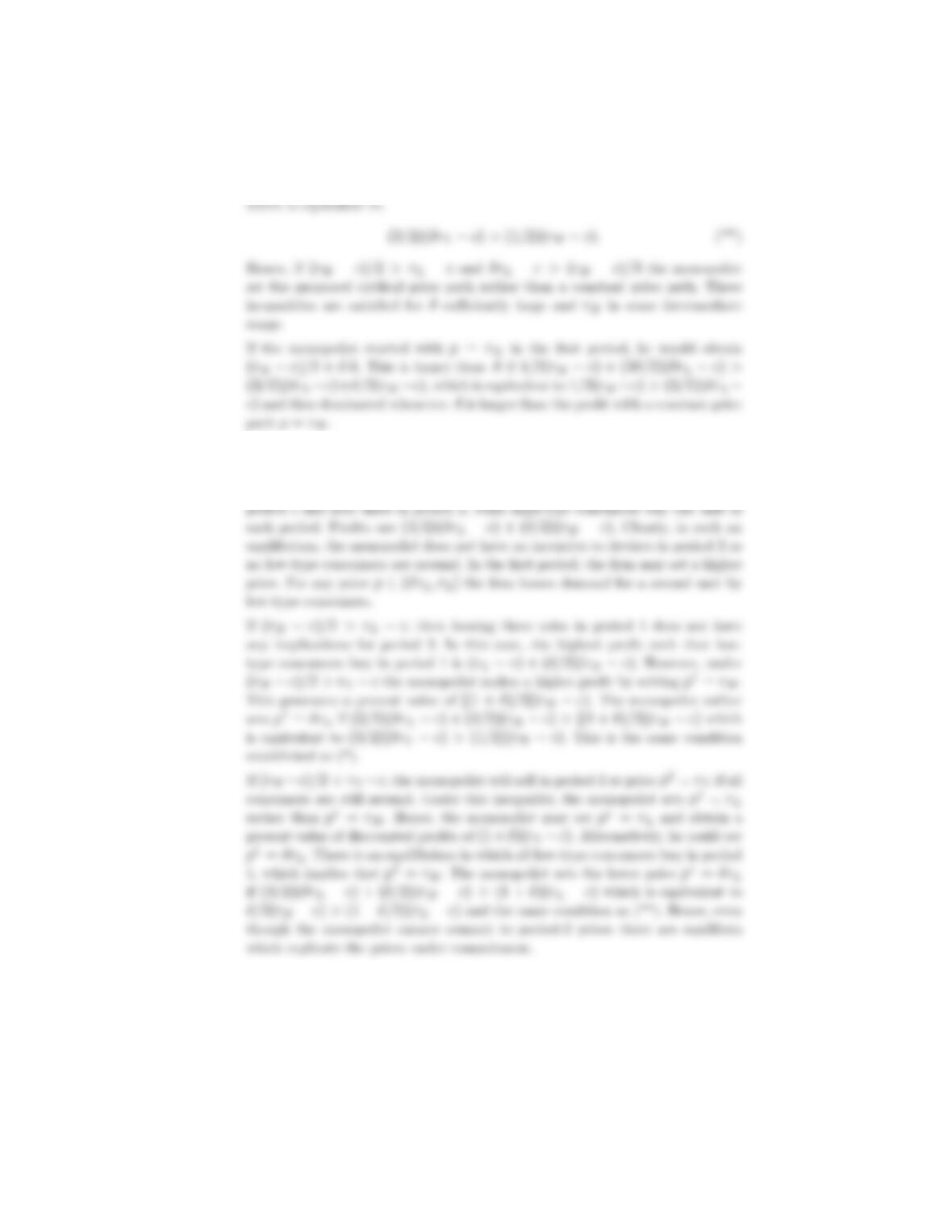
3. Consider now the two-period problem where the monopolist cannot commit
to the second-period price. We want to establish conditions for an equilibrium
with p1=rLand p2=rHto exist. Low-type consumers buy two units in
Exercise 16 Behavior-based price discrimination [included in 2nd edition of
the book]
26
Consider a market with network effects (i.e., a consumer’s utility depends on
the number of users of a product) in which each consumer has a willingness to
pay equal to xiwhere xiis the number of consumers buying product i= 1;2. The
products are functionally identical and thus consumers are indifferent between
any products in the market, given equal numbers of units sold. Suppose that
the incumbent firm has served mass 2=3of consumers in the previous period.
These old consumers already have experienced product 1 and are not willing
to consider product 2. There is mass 1=3of new consumers, who have not
previously experienced product 1. All costs are assumed to be equal to zero. In
(1) to (3) firms first set prices and after observing prices, consumers make their
purchasing decisions.
1. Suppose that the incumbent firm cannot distinguish between new and old
consumers and that firm 2 sets its price before firm 1. What is a subgame-
perfect Nash equilibrium that gives the highest profit for the incumbent
firm among all equilibria? Characterize this equilibrium.
2. Under the same circumstances as in (1), what is a subgame-perfect Nash
equilibrium that gives the highest profit for the entrant firm among all
equilibria? Characterize this equilibrium.
3. Suppose now that the incumbent firm can distinguish between new and
old consumers and that firm 2 sets its price before firm 1. What are the
highest profits that the entrant can make in any subgame-perfect Nash
equilibrium? Provide a formal justification of your answer.
4. Discuss the economics behind your results in (1) to (3).
Solutions to Exercise 16
1. It is easily found that p1= 1,p2= 0,x1= 1,x2= 0. Firm 1 makes profit
2. Here, p1= 2=3,p2= 1=9,x1= 2=3,x2= 1=3. Suppose there is an equilibrium
with x1= 2=3; x2= 1=3. In such an equilibrium firm 1 optimally sets p1= 2=3
and thus makes profit 4=9. A new consumer derives net utility 1=3p2if all
3. Firm 1 can set two different prices. Hence, it can always undercut the price
4. Behavior-based price discrimination allows firm 1 to respond more aggressively
Exercise 17 Software bundling [included in 2nd edition of the book]
A software company sells two applications, noted Aand B, that are totally
unrelated to one another. The marginal cost of production for each application
is constant and is equal to 10. The company faces four categories of potential
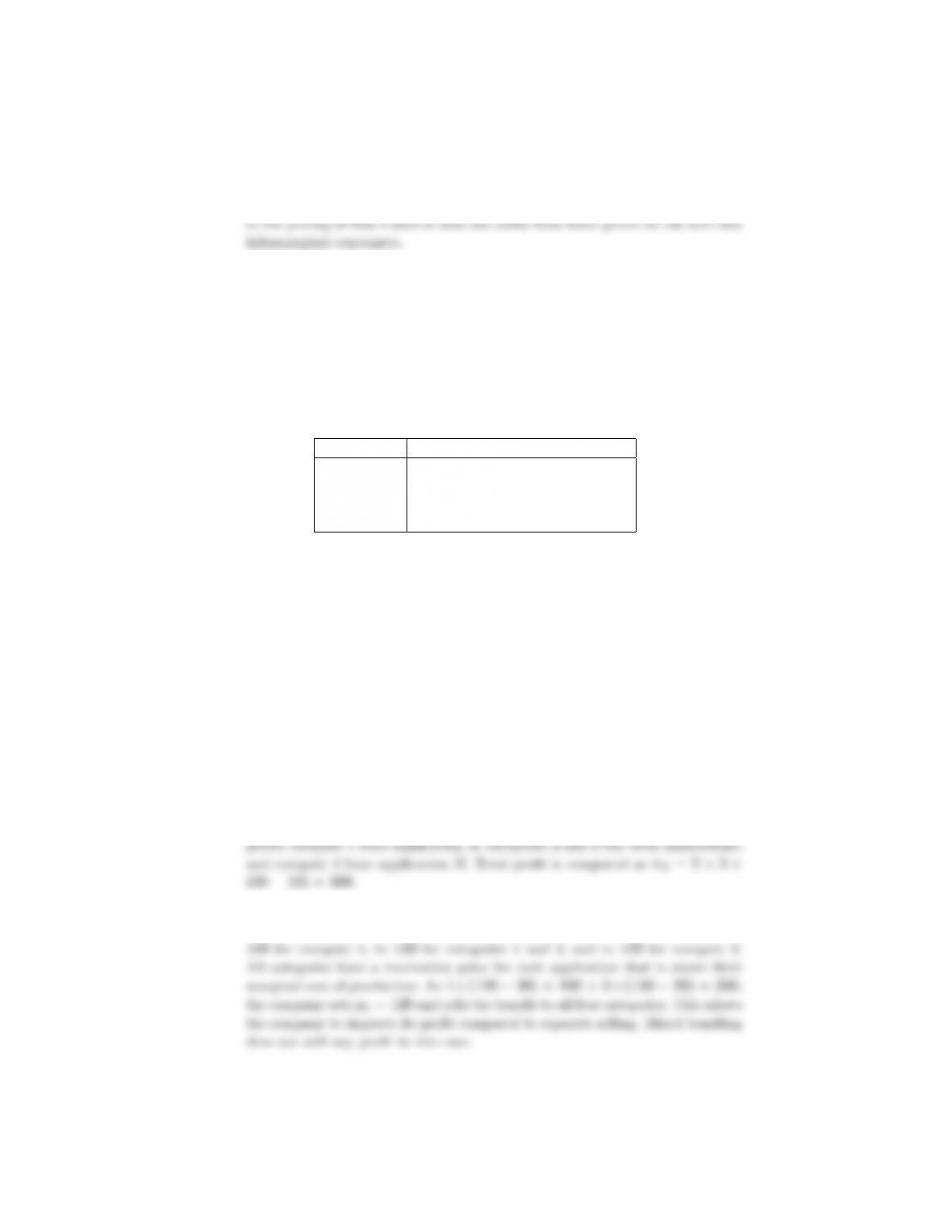
buyers, which are characterized by a pair of reservation prices as depicted in
the following table; it is assumed that each category counts the same mass of
consumers, which is set to 1.
Application AApplication B
Category 1 100 30
Category 2 80 80
Category 3 60 60
Category 4 30 100
1. What price should the company set for each application if it decides to
sell them separately? What profits will the company achieve in this case
and which categories of consumers will buy which application?
2. Suppose now that the company pursues a mixed bundling strategy. Which
price should it set for the bundle and for the separate applications? What
profits will the company achieve in this case and which categories of con-
sumers will choose which option? Is mixed bundling more profitable than
spearate selling? Discuss.
3. How would your answers to (1) and (2) change if the marginal cost of
production increased from 10 to 40?
Solutions to Exercise 17
1. The two applications have similar demand schedules. It is easily found that
for each application the profit-maximizing prices are pA=pB= 60; at these
2. The reservation price for the bundle is simply the sum of the reservation prices
for the two applications. Hence, the reservation price for the bundle is equal to
28
3. Under separate selling, the optimal prices are pA=pB= 80; at these prices,
category 1 buys application A, category 2 buys both applications, category 4
buys application B, and category 3 buys nothing. The corresponding profit is
Exercise 18 Monopoly bundling [included in 2nd edition of the book]
Suppose that a monopolist produces two products, product 1 and product
2. There is a mass 1 of consumers. A share of consumers are heterogeneous
among each other and are described by their type . This type is distributed
uniformly on the unit interval. The willingness-to-pay for product 1 is assumed
to be r1=and r2= 1 . A share (1 )=2of consumers has willingness
to pay r1= 2=3and r2= 0. The remaining share (1 )=2of consumers has
willingness to pay r1= 0 and r2= 2=3. The firm can sell products 1 and 2
independently at prices p1and p2, respectively. Alternatively, it may only sell
a bundle at price p. This is a situation referred to as pure bundling. A third
possibility is that the firm sells the bundle and the independent products, a
situation referred to as mixed bundling.
1. Suppose that = 1. Determine whether independent selling, pure or mixed
bundling are profit maximizing. Calculate associated prices and profits.
2. Suppose that > 0and characterize the solution under independent sel-
ling for all > 0.
3. Suppose that = 4=5. Characterize the profit-maximizing solution under
independent selling, pure bundling, and mixed bundling. Show which of
the selling strategies is profit-maximizing. Discuss your result.
4. Repeat the previous question with = 2=3.
Solutions to Exercise 18
1. Under independent selling, demand for product i(i= 1;2) is determined by
Qi= 1 pi; the optimal price are easily found as p
1=p
2= 1=2. Thus, profit
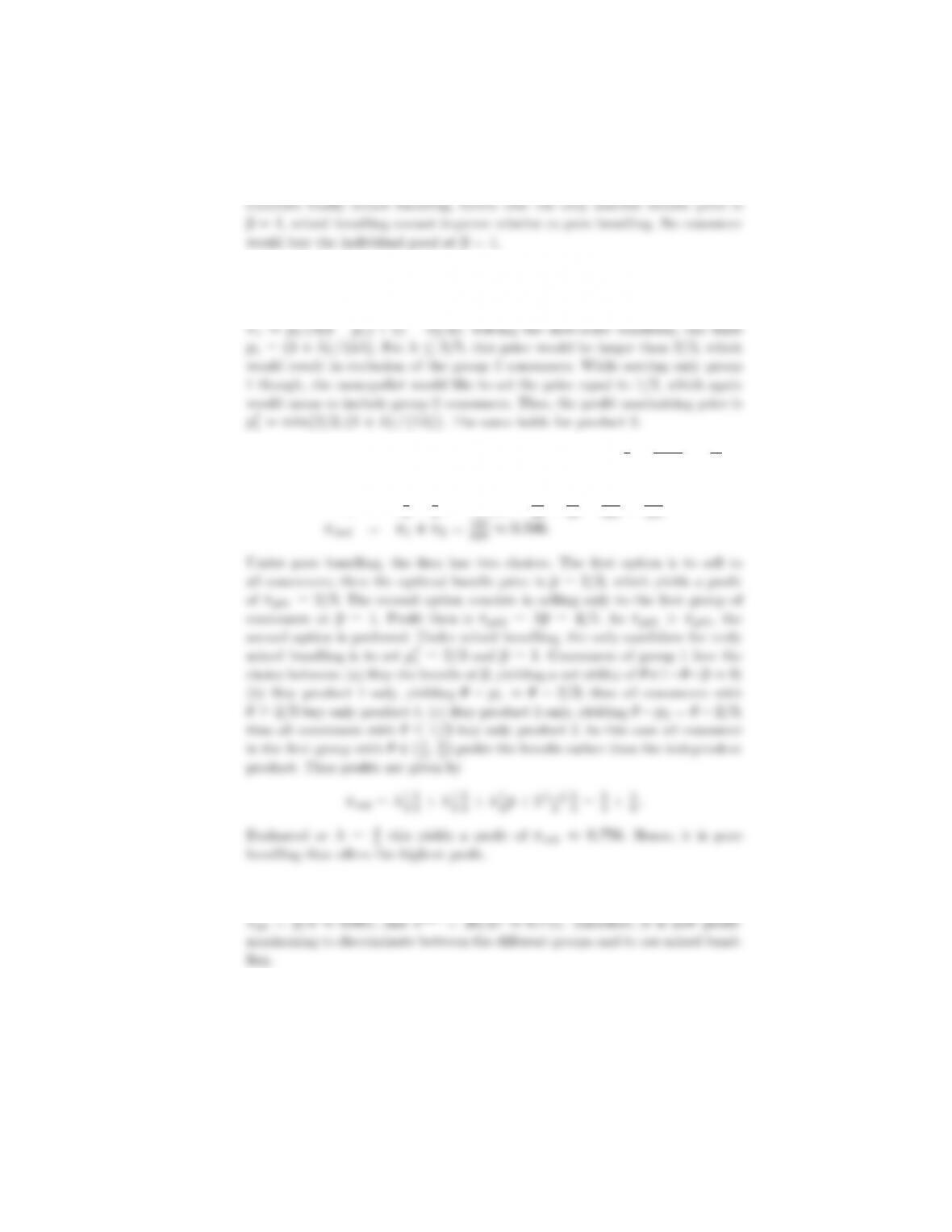
2. Consider product 1. If the firm sells to the first and the second group (i.e. as
long as p12=3), demand from the first group of consumers is (1 p1)
and from the second group (1 )=2. Thus, the firm chooses p1to maximize
3. Suppose = 4=5. Under independent selling, p1=p2=1
4+1
44=5=9
16
0:563. Then, profit for each product becomes
i= (1
2+1
2pi)pi=9
32 +9
40 81
320 =81
320
4. With = 2=3, you should obtain the following profits respectively for inde-
pendent selling, pure bundling and mixed bundling: ind = 25=48 0:521,
Exercise 19 Competitive bundling [included in 2nd edition of the book]
30
Suppose that, as in Section 11.3.2, each of two firms 1and 2provides two
components Aand B. The offerings of both firms are horizontally differentiated.
A consumer of type (A; B)2[0;1]2derives a net surplus rA(1 B)
p1
Ap2
Bif she buys component Afrom firm 1 at price p1
Aand component Bfrom
firm 2at price p2
B. Correspondingly, for other systems of Aand B. The gross
surplus is assumed to be zero if the consumer does not buy a system. Consider
only values of rsuch that the market is fully covered in equilibrium. Consumers
of mass 1 are uniformly distributed on the unit square.
1. Suppose that firm 1 incurs a constant marginal cost of zero for each com-
ponent and that firm 2 incurs a marginal cost of c(with c < 3). Thus, firm
1 is more efficient. Determine the profit function of each firm when each
firms sells each component separately. Determine equilibrium prices and
equilibrium profits in the setting in which firms simultaenously set prices
for both components.
2. Consider the same setting as before when both firms offer only a system
(pure bundling). Determine equilibrium prices and equilibrium profits in
the setting in which firms simultaneously set prices for their system.
3. Compare your results in (1) and (2). When is it more profitable for firm
1 to sell components in a bundle? When is it more profitable for firm 2 to
sell components in a bundle?
4. Suppose now that firm 1 is more efficient producing component Aand firm
2 is more efficient producing component B. In particular, suppose that, for
component A, firm 1 incurs a constant marginal cost of zero and that firm
2 incurs a marginal cost of c, while the reverse holds for component B.
Determine equilibrium prices and equilibrium profits under independent
selling and pure bundling. Discuss the profitability of pure bundling in
this setting.
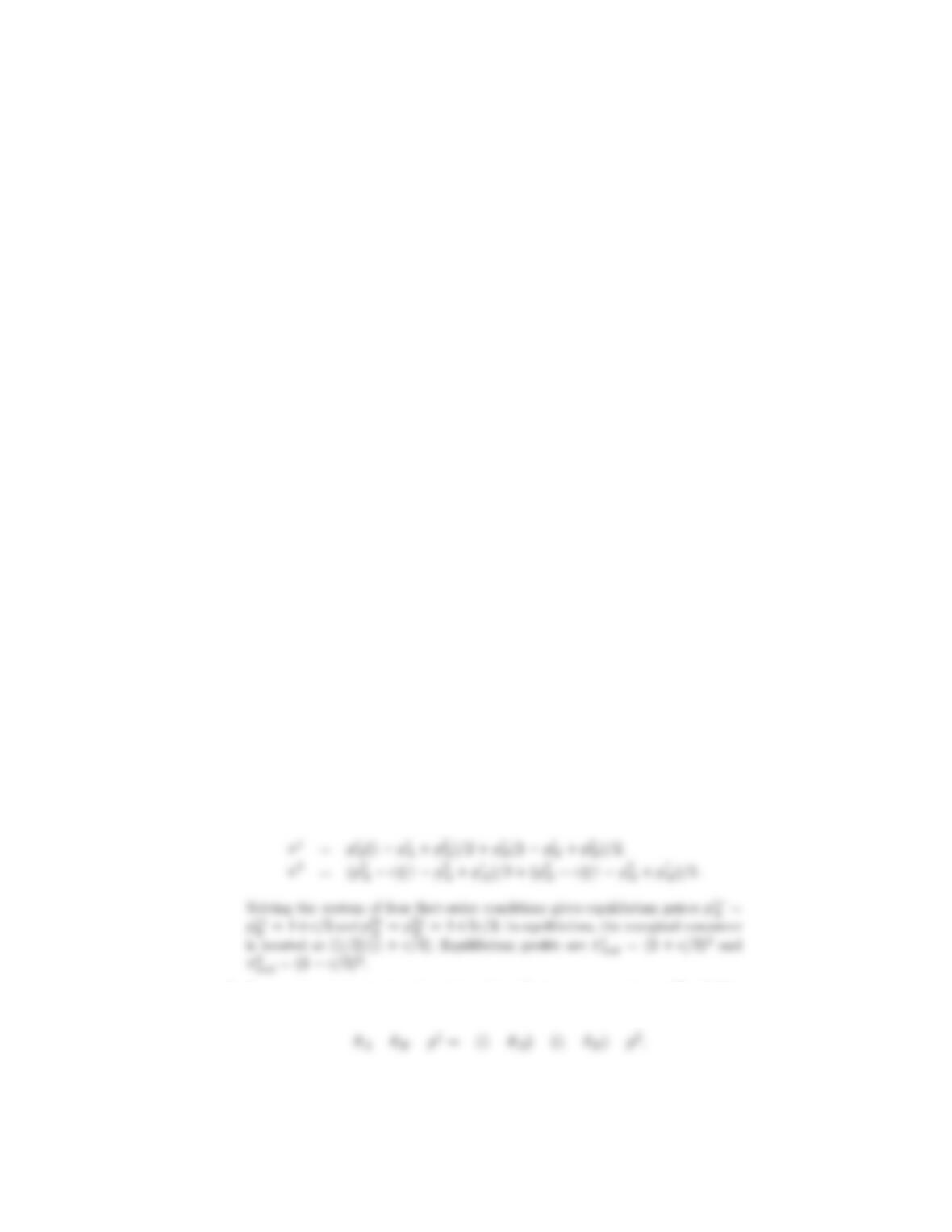
Solutions to Exercise 19
1. Under independent selling, firm ifaces Hotelling demand 1=2(pi
zpj
z)=2
for component z. The firms profits are
2. Denote the price of a bundle of firm iby pi. A consumer of type (A; B)is
indifferent between the two bundles if
31
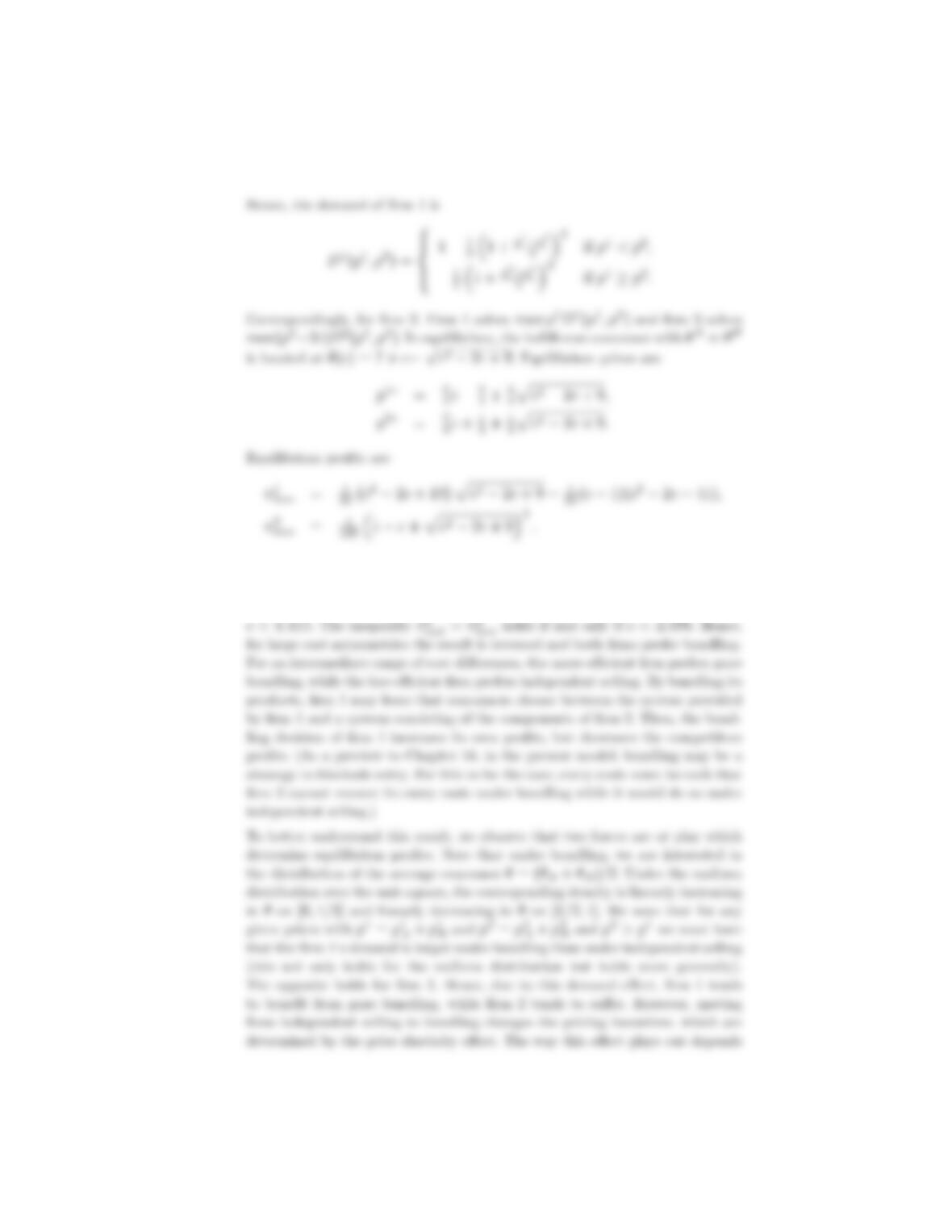
3. While calculations are somewhat tedious, we confirm the result that separate
selling dominates pure bundling under symmetry (c= 0) for small cost asym–
metries. It can be verified that the inequality 1
ind > 1
bun holds if and only if
32
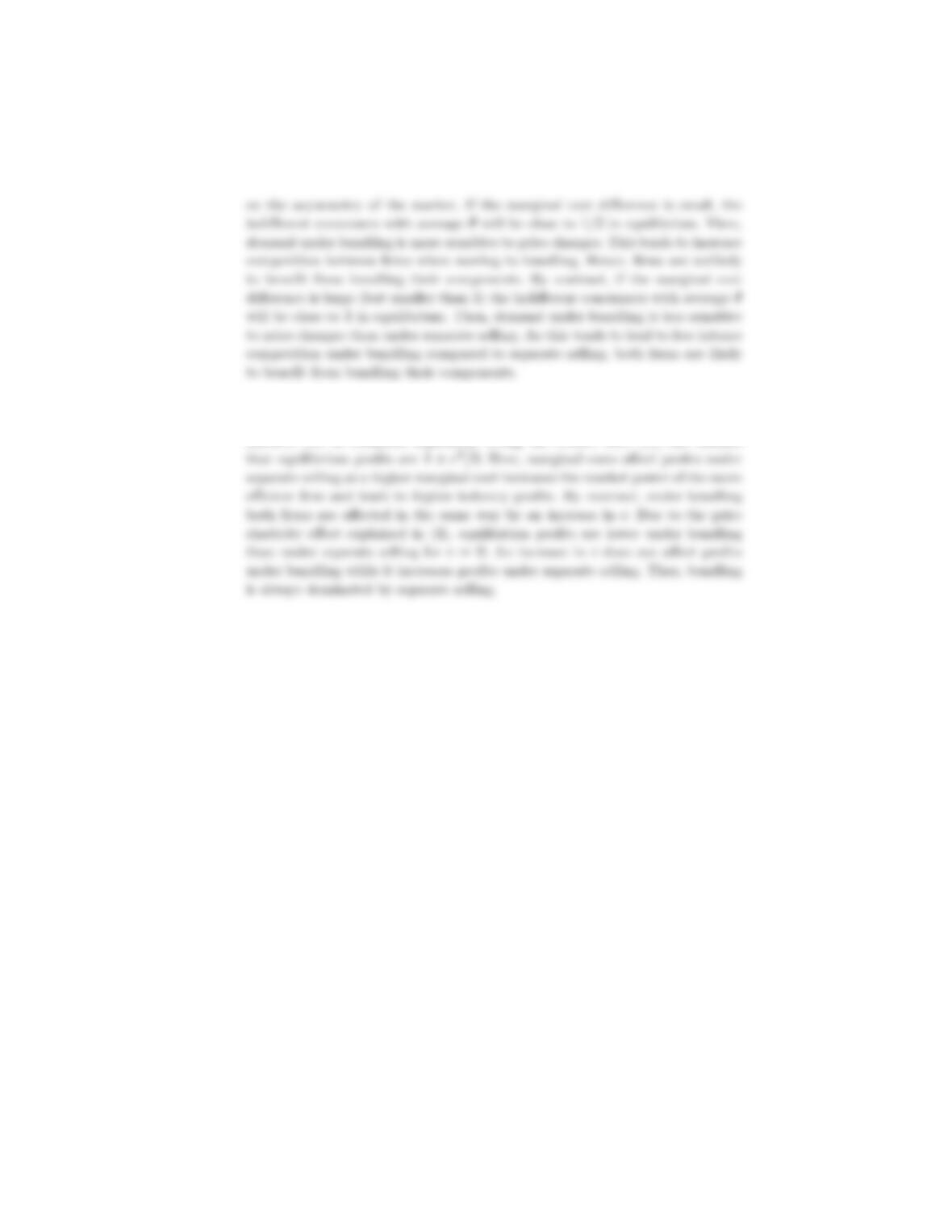
4. In this setting, firms are symmetric under bundling. Equilibrium prices are 1+ c
and equilibrium profits are 1=2. Under separate selling, the two component
markets can be analyzed separately. Using the results from (1), one obtains
33