Industrial Organization: Markets and Strategies
Paul Belle‡amme and Martin Peitz
published by Cambridge University Press
Part IV. Pricing strategies and market segmentation
Exercises
Exercise 1 Geographical pricing [included in 2nd edition of the book]
“Purple Dream”has the monopoly on the production of purple light-emitting
diodes (LEDs). It faces geographically separated markets, market 1 and 2. The
demands are qA= 1 pAand qB= 1=2pB, respectively. The transport and
production costs are set to zero.
1. Assume that the firm chooses to set a uniform price across the two markets.
What is the profit maximizing uniform price? What are the quantities sold
on the two markets at this price?
2. Assume that the firm uses third-degree price discrimination. What are the
profit maximizing prices and quantities on the two markets?
3. Calculate consumer surplus and profit under a uniform price and under
third-degree price discrimination. Compare the two situations and com-
ment on the result.
4. Does the result from question 3 hold generally? How would the results
change if qB= 1=3pB?
Solutions to Exercise 1 ‘Purple Dream’ has the monopoly on the production of
purple light-emitting diodes (LEDs). It faces geographically separated markets, noted
Aand B. The demands on these two markets are respectively given by qA= 1 pA
and qB= 1=2pB. The transport and production costs are set to zero.
1. When the firm sets a uniform price, it faces the following demand: q= 3=22pu
2. Here, the firm chooses pAto maximize A=pA(1 pA)and pBto maximize
3. Profits under uniform pricing and under third-degree price discrimination are
respectively equal to
1
4. The demand under a uniform price is now equal to q= 4=32pufor 0pu
1=3and q= 1 pufor 1=3pu1. On the first segment of the demand,
Exercise 2 Price discrimination and pharmaceuticals
Do you think that price discrimination between rich and poor countries is a
feasible solution for giving poor developing countries better access to patented
Exercise 3 Multi-product monopoly
A monopoly faces a continuum of consumers who are distributed uniformly
on the unit interval. The total mass of consumers is 1. Each consumer is inte-
rested in buying at most one unit. Consumers differ in the way they perceive
the monopoly’s output. Assuming for simplicity that the monopoly is located at
point 0, the utility of a consumer who is located at some point xbetween 0 and
1 if he buys from the monopoly is rptx2, where pis the monopoly’s price,
r > 0, and t > 0is the transportation cost per-unit of distance. If a consumer
does not buy, his utility is 0. The monopoly’s per-unit cost of production is c.
2. How high can pbe such that the market will be still covered (i.e., every
consumer will buy)?
3. Write the monopoly profit as a function of p(hint: distinguish the case
4. Show that if t < (rc)=3, then at the profit maximum, the monopoly will
choose a price that ensures that the market is covered. (Hint: this part
5. Suppose that the monopoly incurs a fixed cost Fwhenever it opens a
6. Now suppose that the monopoly opens a second plant at point 1. The
utility for the consumer who buys at this plant is rp2t(1 x)2,
7. Based on your answers in (5) and (6), compute the range of Ffor which
Solutions to Exercise 3
1. Given p, the “address” ^xof the consumer who is just indifferent between buying
2. For the market to be covered it must be the case that ^x1. This ensures that
3. The monopoly profit as a function of pis given by
3
4. First, as long as ^x > 1, the monopolist can raise its price without losing any
customers. Hence, among all prices for which ^x1, the best price from the
monopoly’s perspective is the one at which ^x= 1. From (2) we already know
5. Assuming that the market is fully covered, the monopoly price is determined by
6. If the monopolist opens a second plant at point 1, then its profit-maximizing
prices must be such that ^x= 1=2: The plant at 0 covers the left hand side
7. Comparing 1and 2reveals that if F < 3t=4, the monopolist will operate two
plants.
Exercise 4 Uniform vs. local pricing for a chain-store1[included in 2nd edition
of the book]
4

Consider a country that can be divided into two distinct markets of different
sizes: market 1 is small (in the sense that it can only accommodate one firm),
while market 2 is larger (in the sense that it can accommodate two firms). Two
firms are active in the country: firm Ais a national company that is active on
both markets; firm Bis a local company and is only active on market 2. Demand
conditions on the two markets are as follows. On market 1 (where only firm A
is active), inverse demand is given by
qA1=apA1:
On market 2 (where both firms are active and their products are seen as imper-
fect substitutes by the consumers), the system of inverse demands is
qA2=2
3(1620 2pA2+pB2)
qB2=2
3(1620 2pB2+pA2);
where qKi (resp. pKi) is the quantity demanded to (resp. the price set by) firm
Kin market i(K=A; B and i= 1;2). To translate the fact that market 2
is larger than market 1, it is assumed that a < 1620. Both firms produce at a
constant marginal cost, which is assumed to be equal to zero for simplicity.
1. Local pricing. Suppose that the national firm (firm A) chooses to adapt its
prices to the local market conditions. Firm Ahas thus two choice variables:
pA1and pA2. As for the local firm (firm B), it has, by definition only one
choice variable: pB2. Find the equilibrium prices of the two firms and then
compute their equilibrium profits.
2. National pricing. Suppose now that firm Acommits to set the same price
in the two local markets. Denote this price by pA. As for firm B, nothing
changes: it still sets its single price pB2. Find the equilibrium prices of the
two firms and then compute their equilibrium profits.
3. Compare your answers to questions 1 and 2 by taking three specific values
for the parameter a, namely a= 540,a= 1188, and a= 1260. In which
scenario(s) does firm Aprefer national pricing over local pricing? Explain
the intuition behind your results. In which scenario(s) does firm Bprefer
that firm Asets the same price in the two markets (national pricing)?
Explain the intuition behind your results.
Solutions to Exercise 4
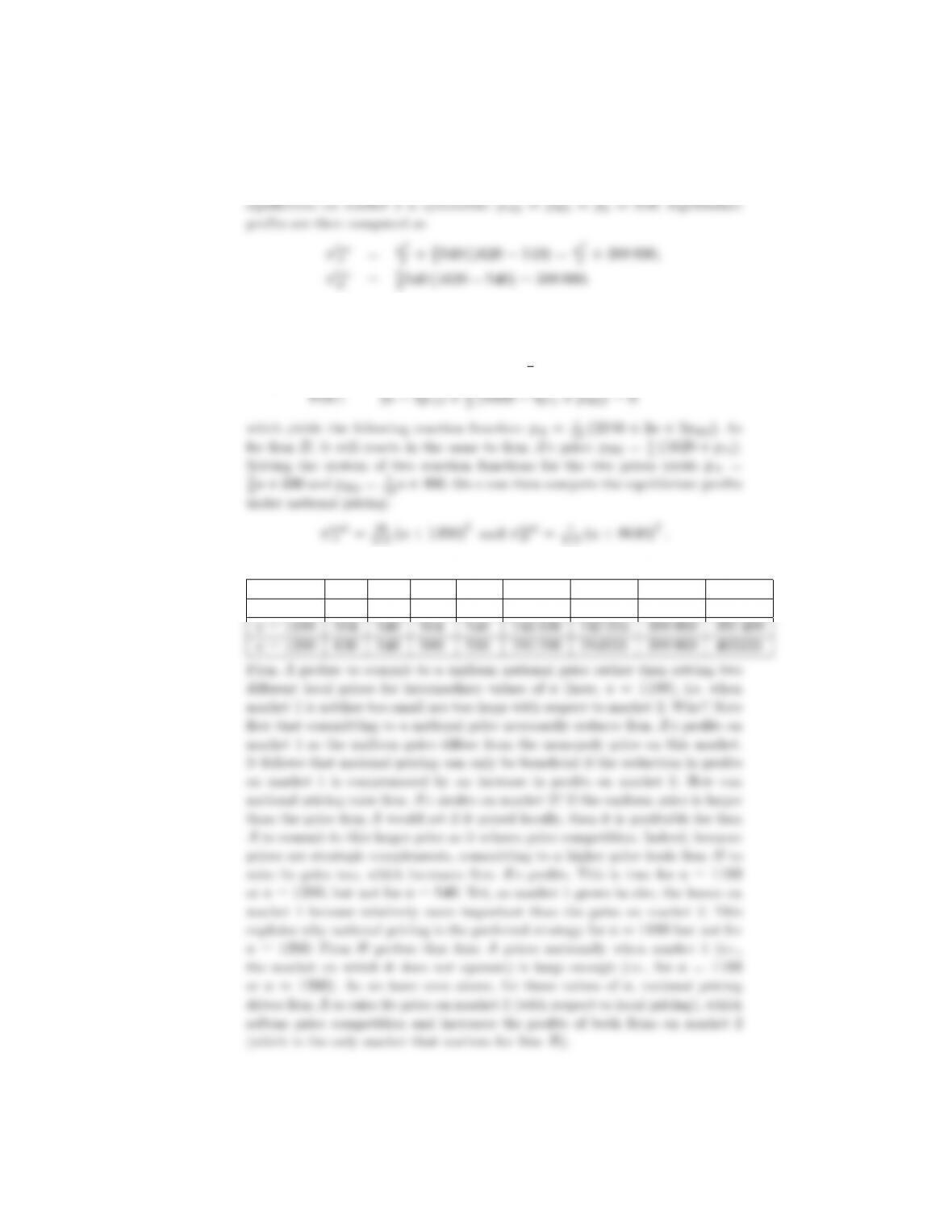
1. Local pricing. On market 1, firm A’s profit is given by pA1(apA1); the
optimal price is thus pA1=a=2. On market 2, firm A’s profit is given by
5
2. National pricing. Firm Achooses pAto maximize its joint profit on the two
markets; that is, firm A’s problem is
max
pA
pA(apA) + pA2
3(1620 2pA+pB2);
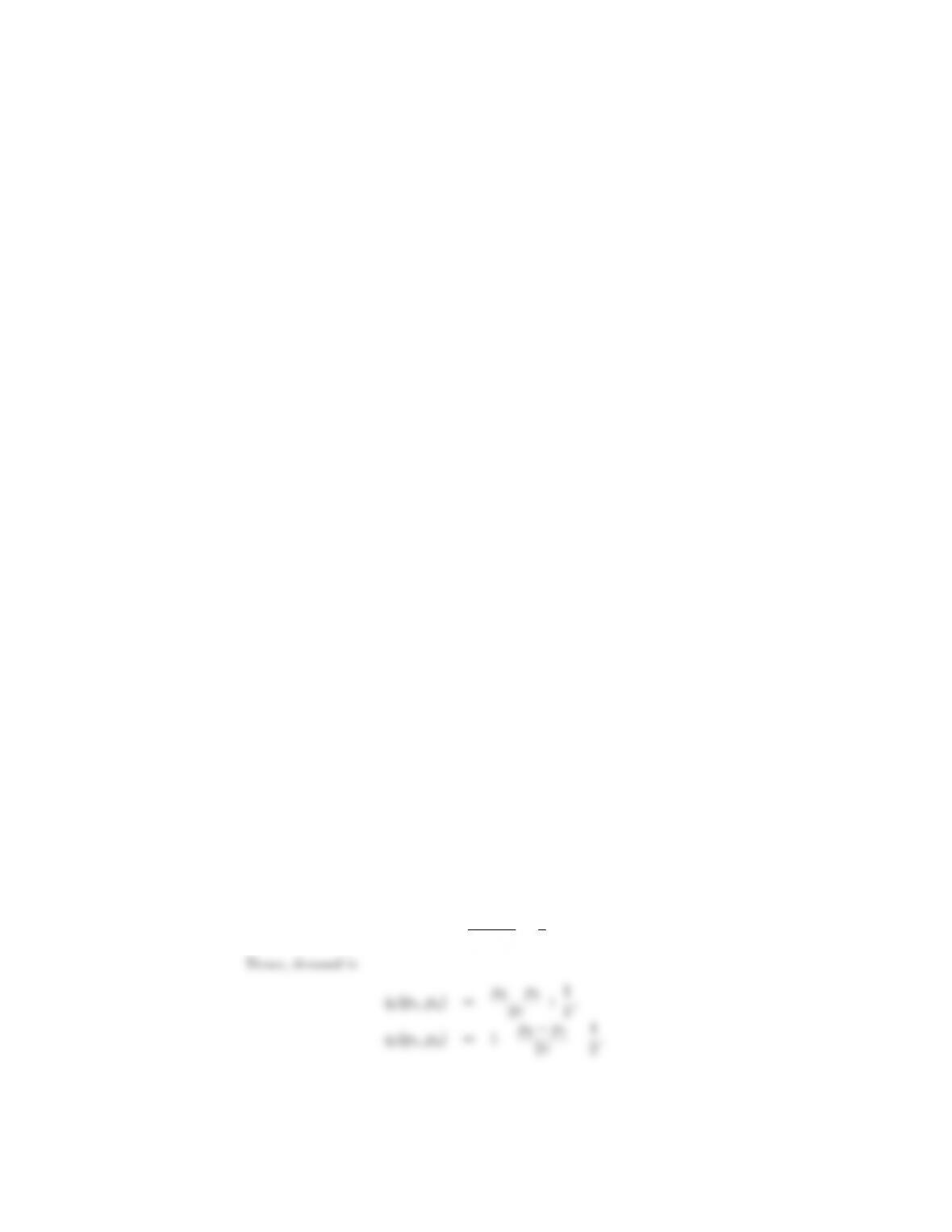
3. Comparisons
ploc
A1ploc
2pnat
Apnat
B2loc
Anat
Aloc
Bnat
B
a= 540 270 540 420 510 461 700 411 600 388 800 346 800
6
Exercise 5 Spatial market segmentation [part 2 and 3 of the exercise are in-
cluded in the 2nd edition of the book]
Consider a horizontally differentiated product market in which two firms are
located at points l1= 0 and l2= 1 on the line. Firms produce at marginal costs
c. There is a continuum of consumers of mass 1 who are uniformly distributed
on the unit interval. They have unit demand and have an outside utility of 1.
A consumer located at x2[0;1] obtains indirect utility v1=r(x)2p1if
she buys one unit from firm 1 and v2=r(1 x)2p2if she buys from firm
2. Firms have marginal costs equal to c.
1. Suppose that firms simultaneously set a uniform price for all consumers.
Characterize the equilibrium of the game. Determine equilibrium profits.
2. Suppose now that firms can price-discriminate between consumers located
on [0;1=2] (segment A) and [1=2;1] (segment B). Determine the profit
function of each firm. Characterize the pure-strategy Nash equilibrium of
the game in which firms simultaneously set prices. Note: You are allowed
to restrict attention to the part of the demand function, which is relevant
for the equilibrium analysis.
3. Compare your result in (2) to the game in which firms cannot discriminate.
In which environment obtain firms larger profits? Explain your findings.
4. Suppose now that firm 1 can discriminate between the two consumer seg-
ments and that firm 2 cannot. Characterize the Nash equilibrium of the
price game in which firm 1 sets a possibly different price for each consumer
segment, while firm 2 sets the same price to all consumers.
5. Compare the firms’ profits in situation (4) to those in situation (2).
6. Consider the possibility for firms to “invest” (non-negative number) into
the possibility to price discriminate between consumers in segments A
and Bat investment cost I. Characterize the equilibrium of the two-stage
game in which firms simultaneously decide whether to invest in stage 1
and simultaneously set prices in stage 2 depending on the level of the
investment cost I. Comment on your result.
Solutions to Exercise 5
1. The indifferent consumer is located at
bx=p2p1
2+1
2:
7
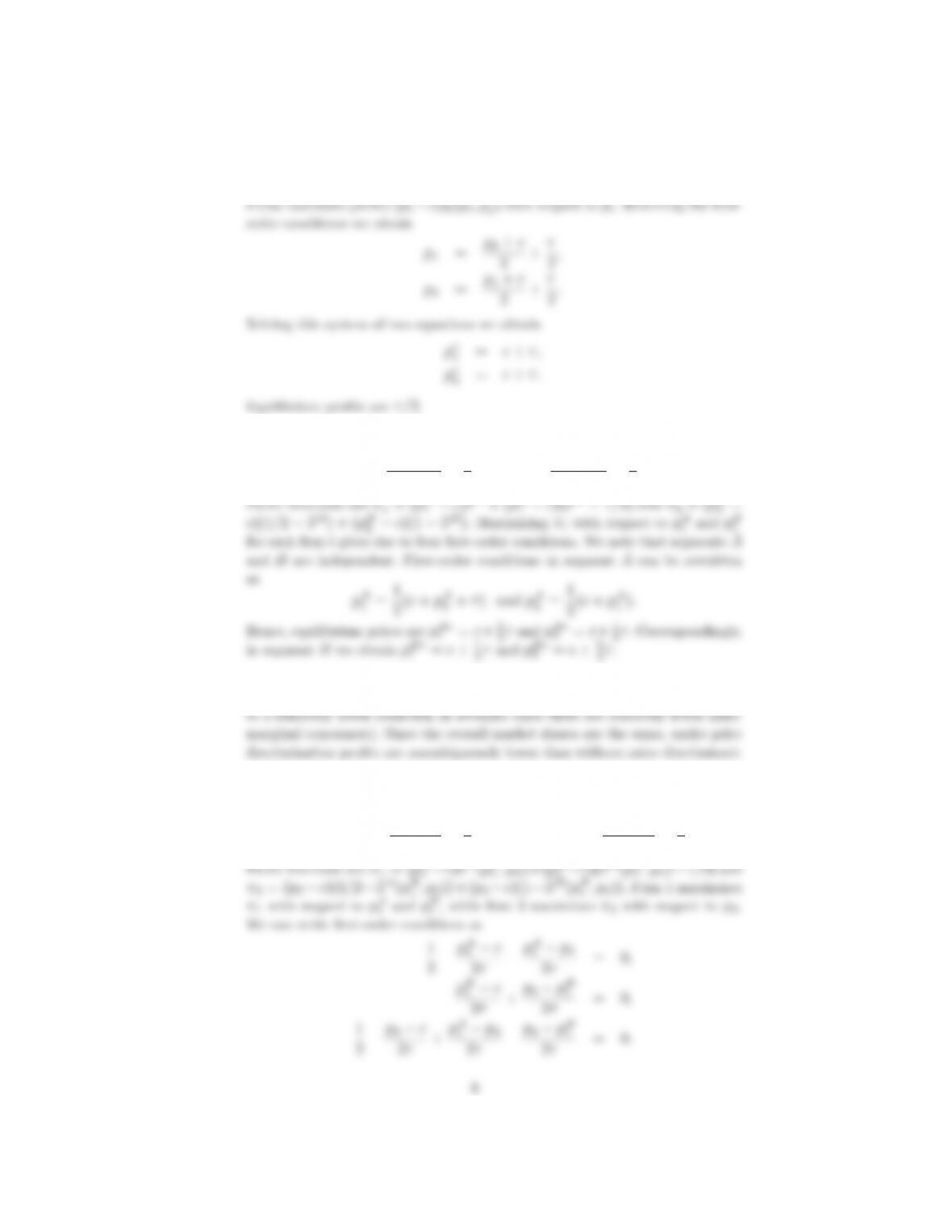
2. In each segment, there is an indifferent consumer,
bxA=pA
2pA
1
2+1
2and bxB=pB
2pB
1
2+1
2:
3. When firms can discriminate between the two segments they set lower prices
in equilibrium, as competition has become more intense (as a price cut leads
on.
4. There continues to be an indifferent consumer in each segment,
bxA(pA
1; p2) = p2pA
1
2+1
2and bxB(pB
1; p2) = p2pB
1
2+1
2:
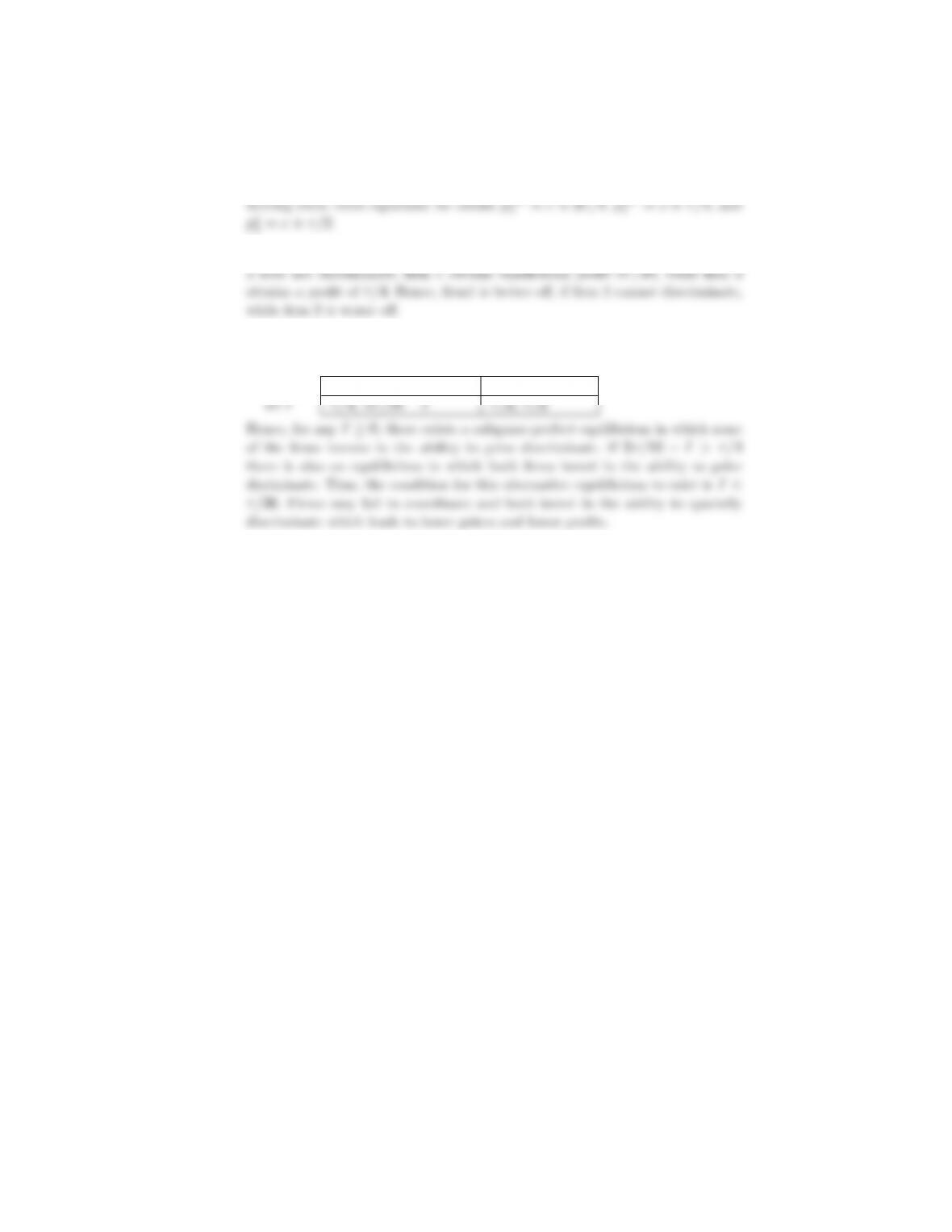
5. If both firms discriminate, each firm obtains equilibrium profit 5=18. If firm
6. Equilibrium profits without discrimination are =2. We thus have
Ino I
I
5=18 I,5 =18 I5 =16 I,=4
Exercise 6 Price discrimination in duopoly
Consider a duopoly market with two firms and a continuum of consumers.
Each firm i2 f1;2gsells its product at price piand incurs marginal costs equal
to zero. Consumers are of measure 1 and have unit demand. When buying one
unit of product ia consumer of type (t; x)obtains utility rtjxlij piwhere
liis the location of firm iand piis its price; if she does not buy her utility is
set equal to 1. Half of consumers belong to the group with type tAand half
of consumers to the other group with type tB;tAtB. Within each group,
consumers are uniformly distributed on the unit interval, x2[0;1]. Firms are
located at 0 and 1, respectively.
1. Suppose that tA=tB. Determine the demand function faced by the two
firms. Determine the equilibrium in the simultaneous-move price game.
Report equilibrium prices, outputs, and profits.
2. Suppose that tA> tB. Determine the demand function faced by the two
firms. Determine the equilibrium in the simultaneous-move price game.
Report equilibrium prices, outputs, and profits.
3. Suppose that tA> tB. Suppose furthermore that both firms observe con-
sumer type tand that they can condition their price on this type; i.e., firm
iset pi(t). (Consumers are assumed not to be able to trade among each
other). Determine the demand function faced by the two firms. Determine
the equilibrium in the simultaneous-move price game. Compare your re-
sult to the previous setting. Discuss whether firms benefit from regulation
that requires them to set uniform prices.
9
4. Suppose that tA> tB. Suppose now that only firm 1 observes consumer
type tand that it can condition its price on this type – i.e., firm 1set p1(t)
– whereas firm 2 has to charge the same price to all consumers. (Consumers
are assumed not to be able to trade among each other). Determine the
demand function faced by the two firms. Determine the equilibrium in the
simultaneous-move price game.
5. Suppose that tA= 2 > tB= 1. Consider the two-stage game in which,
in the first stage, firms acquire the ability to identify a consumer’s type
tat cost Cand, in the second stage, they compete in prices. Using your
insights from parts 2 to 4, characterize the subgame-perfect equilibria as
a function of C.
6. Discuss your findings.
Solutions to Exercise 6
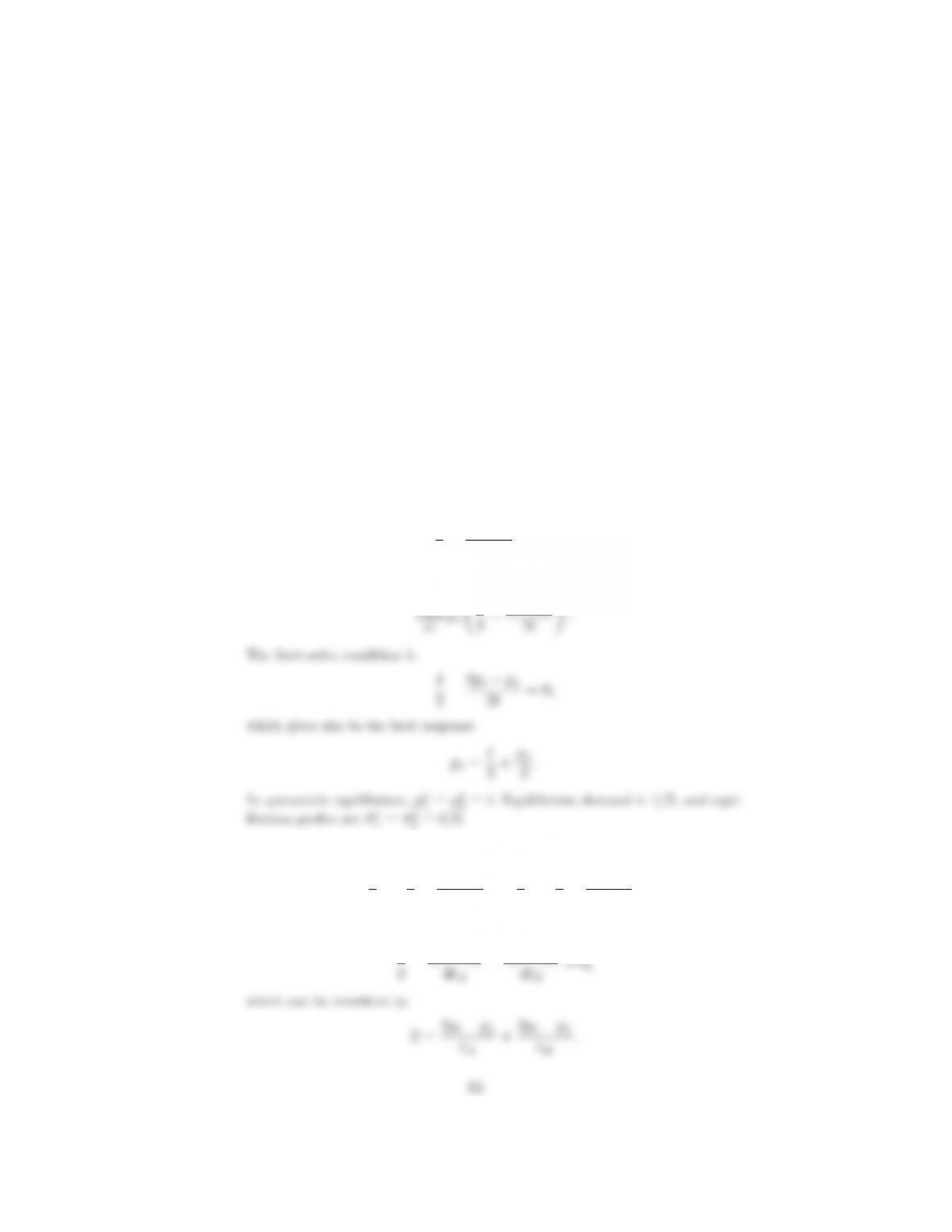
1. Standard linear Hotelling model. Set ttA=tB. Demand for firm i:
1
2pipj
2t; j 6=i
Firm i’s maximization problem is
2. The maximization problem now becomes
max
pi
1
2pi1
2pipj
2tA+1
2pi1
2pipj
2tB:
The first-order condition is
1
2pipj
= 0;
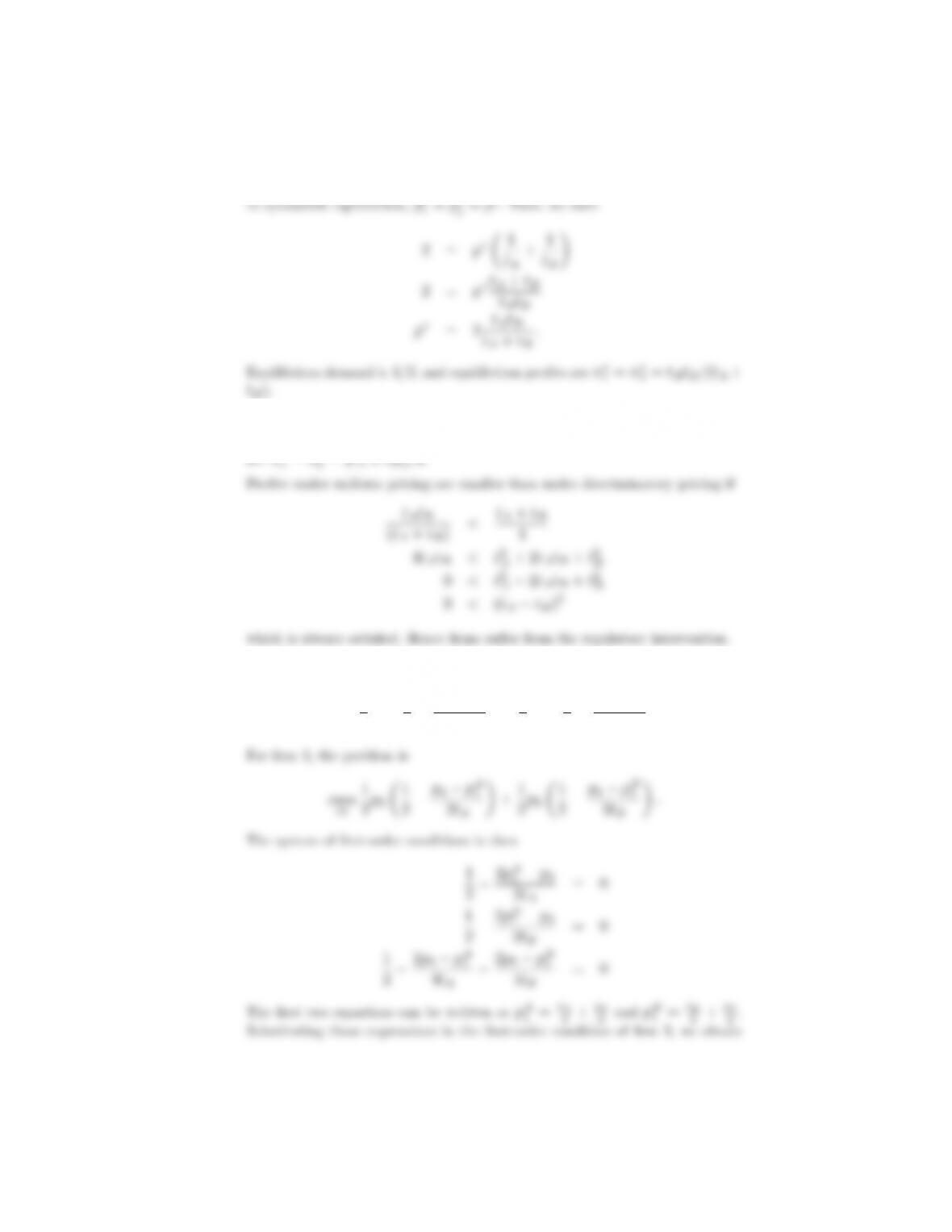
3. Using the results in 1, we obtain pA
1=pA
2=tAand pB
1=pB
2=tB.
Equilibrium demand is 1=4for each consumer type t, and equilibrium profits
4. For firm 1, the maximization problem is
max
pA
1;pB
1
1
2pA
11
2pA
1p2
2tA+1
2pB
11
2pB
1p2
2tB:
11
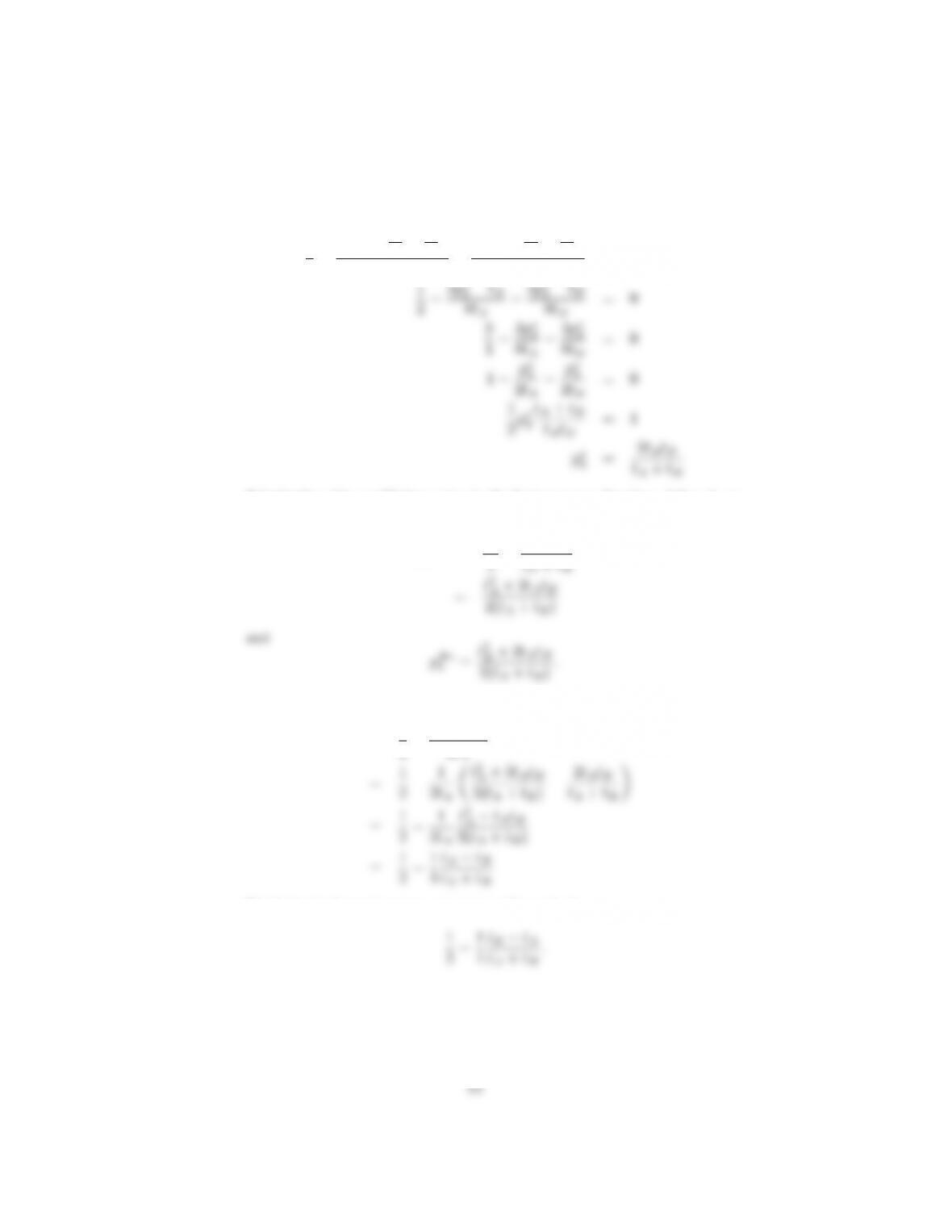
that, in equilibrium,
1
2
2p
2tA
2+p
2
2
4tA
2p
2tB
2+p
2
2
4tB
= 0
Substituting this equilibrium price in the best-response function of firm 1, we
obtain
pA
1=tA
Equilibrium demand for firm 1 among consumers of type tAis
1
2pA
1p
2
2tA
A+ 3tAtB
Similarly, its demand among consumers of type tBis
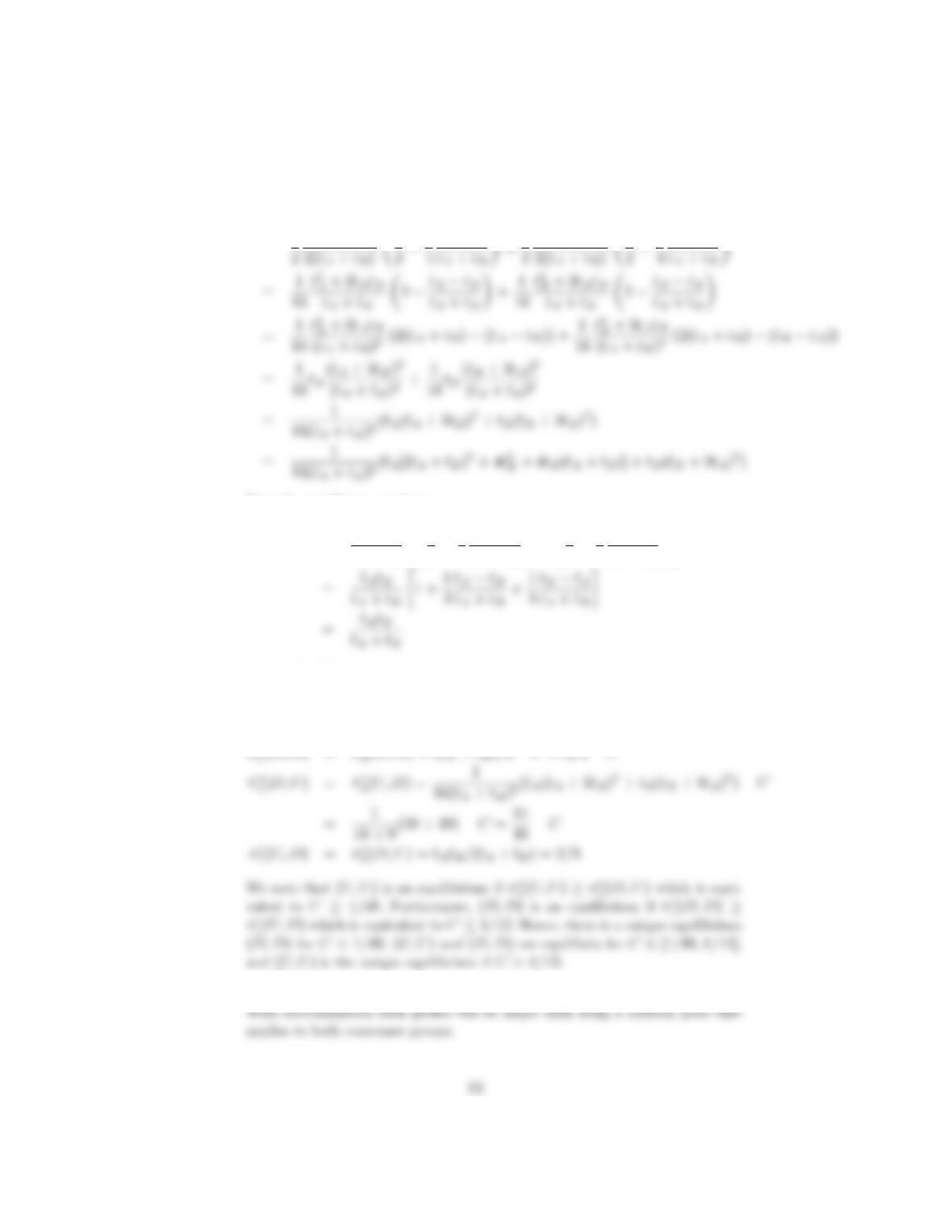
Hence, firm 1’s equilibrium profit is
1
t2
A+ 3tAtB
tAtB
t2
B+ 3tAtB
tBtA
16(tA+tB)2(tA[(tA+tB)2+ 4t2
Firm 2’s equilibrium profit is
tAtB
tA+tB1
2+1
4
tAtB
tA+tB+1
2+1
4
tBtA
tA+tB
tAtB
tBtA
5. Denote equilibrium profits as a function of the regimes Uor Dfor each of the
two firms. Using parameter values tA= 2 and tB= 1, we have
1(U; U) =
2(U; U) = tAtB=(tA+tB) = 2=3
6. If it is not too costly, firms will opt to acquire information on consumer types t.

Exercise 7 Price discrimination in duopoly with product returns
Consider a duopoly market with two firms and a continuum of consumers.
Each firm i2 f1;2gsells its product at price piand incurs marginal costs of
production equal to zero. Consumers are of measure 1 and have unit demand.
With the purchase of one unit of product ia consumer of type xobtains utility
rtjxlij piwhere liis the location of firm iand piis its price; if she does
not buy her utility is set equal to 1. Half of consumers belong to the group
that never returns a product—we call them “easy” consumers—and the other
half ask for the replacement of the product with some probability, which firms
have to provide—we call those consumers the “difficult” ones. The expected
cost of selling to a consumer in this second group is c > 0. It is assumed to be
independent of type x. Within each group, consumers are uniformly distributed
on the unit interval, x2[0;1]. Firms are located at 0 and 1, respectively.
1. Determine the equilibrium in the simultaneous-move price game in which
firms have to set a uniform price to all consumers. Report equilibrium
prices, outputs, and profits.
2. Suppose that firms have access to consumer data that allows them to
perfectly infer whether a consumer is easy or difficult; no information on
xis available. Determine the equilibrium in the simultaneous-move price
game in which each firm isets a price pE
ito easy consumers and pD
ito
difficult consumers. Report equilibrium prices, outputs, and profits.
3. Suppose that only firm 1 has access to consumer data that allows it to
perfectly infer whether a consumer is easy or difficult—this is common
knowledge among firms. Determine the equilibrium in the simultaneous-
move price game in which firm 1 sets prices (pD
1; pE
1)and firm 2 a uniform
price p2. Report equilibrium prices and profits.
4. Consider the two-stage game in which firms, in the first stage, firms can
acquire the ability to identify whether consumers are easy or difficult at
cost Cand in which, in the second stage, firms compete in prices. Using
your insights from parts 1 to 3, characterize the subgame-perfect equilibria
as a function of C.
5. Suppose that a third party controls the personal data about whether a
consumer is easy or difficult. What access price to those data would it set
at a prior stage? In the corresponding three-stage game, will one or both
firms acquire information? Discuss your findings.
Solutions to Exercise 7
1. Linear Hotelling model. Demand for firm i:
1
2pipj
2t; j 6=i
14
Firm i’s maximization problem is
1
2. The maximization problem now becomes
1
ipE
j
ipD
j
3. For firm 1, the maximization problem is
max
pD
1;pE
1
1
2pE
11
2pE
1p2
2t+1
2pD
1c1
2pD
1p2
2t:
For firm 2, the problem is
1
1
1
15
4. For C < c2
32t, each firm has a strict incentive to aquire data access independent of
5. The third party sells data access at a price equal to c2=(32t). In this simple
model, consumer welfare is not affected by the availability of personal data. The
Exercise 8 Personalized pricing
Consider a monopoly internet retailer who sells a single (digital) product at
zero marginal costs. Consumers have unit demand and heterogeneous valuations
ufor this product; the value of the outside option is equal to zero. Valuations u
are distributed on the interval [0;1], according to some continuous cumulative
distribution function. Unless a consumer protects her personal data at cost
” > 0, the monopoly internet retailer can infer the consumer valuation perfectly
and offer a personalized price; by assumption, arbitrage among consumers is
not possible. If a consumer protects her personal data, the monopolist does not
learn the valuation of this consumer.
Consider the following timing: First, each consumer decides whether to pro-
tect her personal data; second, the monopolist sets a uniform price to all consu-
mers who protect their personal data and a personalized price for each consumer
whose valuation is known to the monopolist; third, consumers make purchase
decisions.
1. Characterize the subgame-perfect equilibrium in this setting. In particular,
what are the privacy choices of consumers (their decision whether to pro-
tect their data) and what are the prices set by the monopolist? Is there a
unique equilibrium? [You may want to start with the uniform distribution
and then extend your analysis to non-uniform distributions.]
2. Suppose that uis uniformly distributed on [0;1]. Suppose, furthermore,
that, at stage 1, consumers think that the monopolist will charge the
unconditional monopoly price; i.e., pm= 1=2. For “negligibly small, what
is the outcome when consumers hold these possibly irrational beliefs at
stage 1 about price in case they hide their valuation, but are otherwise
rational (in particular, regarding the personalized price they receive if they
do not protect their personal data)? In particular, what are the privacy
choices of consumers and what are the prices set by the monopolist?
3. Suppose that uis uniformly distributed on [0;1]. Calculate consumer sur-
plus and monopoly profit in the two cases above. For “small, comment
on your findings concerning the comparison of profits and the comparison
of consumer surplus.
16
Solutions to Exercise 8
1. There is full unravelling in the sense that no consumer invests in protecting its
personal data. Proof by contradiction. Suppose that some consumer types find
it beneficial to protect its personal data. This can only be the case if consumers
expect some positive benefit. However, the lowest type will either face a price
above or exactly equal to its willingness to pay. Therefore, the lowest such type
2. Consumers expect to be able to buy at 1=2if they protect their personal data.
All consumers with u > 1=2 + “will protect their data. The firm will optimally
3. Consumers with u < 1=2+“make zero surplus. Consumer between 1=2+“and
1=2 + 2“make a loss u1=22“. All consumers between 1=2 + 2“and 1will
17