
Consider a market for a potentially vertically differentiated product. There
is a continuum of consumers of mass 1. Each consumer has unit demand. A
consumer of type has valuation s pfor a product of quality ssold at price
p. The outside option has valuation zero. A fraction of consumer is of type
2and the remaining fraction of type 1with 2> 1.
1. Suppose that the consumer type is public information (and that there is
no arbitrage between consumers). A monopolist can offer two qualities s1
and s2with s2> s1>0at prices p1and p2, respectively. The monopolist
incurs zero marginal costs and zero fixed cost. Alternatively, it can offer
only one of the two qualities (such that all or only a fraction of consumers
buy). Determine the profit maximizing solution (prices and allocation),
depending on the parameters of the model. Determine the monopoly
profit.
2. Suppose that the consumer type is private information of the consumer.
As in part 1 of the exercise, a monopolist can offer two qualities s1and s2
with s2> s1>0at zero marginal costs and zero fixed cost. Alternatively,
it can offer only one of the two qualities. Determine the profit maximizing
solution, depending on the parameters of the model. In particular, provide
all optimal selling strategies in the special case 1=2.
3. What happens to the optimal selling strategy if there are constant mar-
ginal costs of production such that high quality is more costly to produce
(marginal costs c2> c1= 0, where c2is “small”)? Provide a conjecture
(but do not formally analyze this case).
4. As in part 2 of the exercise, suppose that the consumer type is private
information of the consumer. Suppose now that the quality siof product
iis equal to the number of consumers buying this good. The firm can
offer one or two products at zero marginal costs and zero fixed cost. De-
termine the profit-maximizing selling policy of the monopolist pin case
of selling a single product. Determine then the profit-maximizing policy
(p1; p2)in case of selling both products. Does the firm prefer to sell one
or two products? Provide an explanation for your findings (in particular
in comparison to your findings in part 2).
5. Can you think of a real-world example that broadly fits the setting in part
4 of this exercise? Please elaborate in one paragraph.
Solutions to Exercise 10
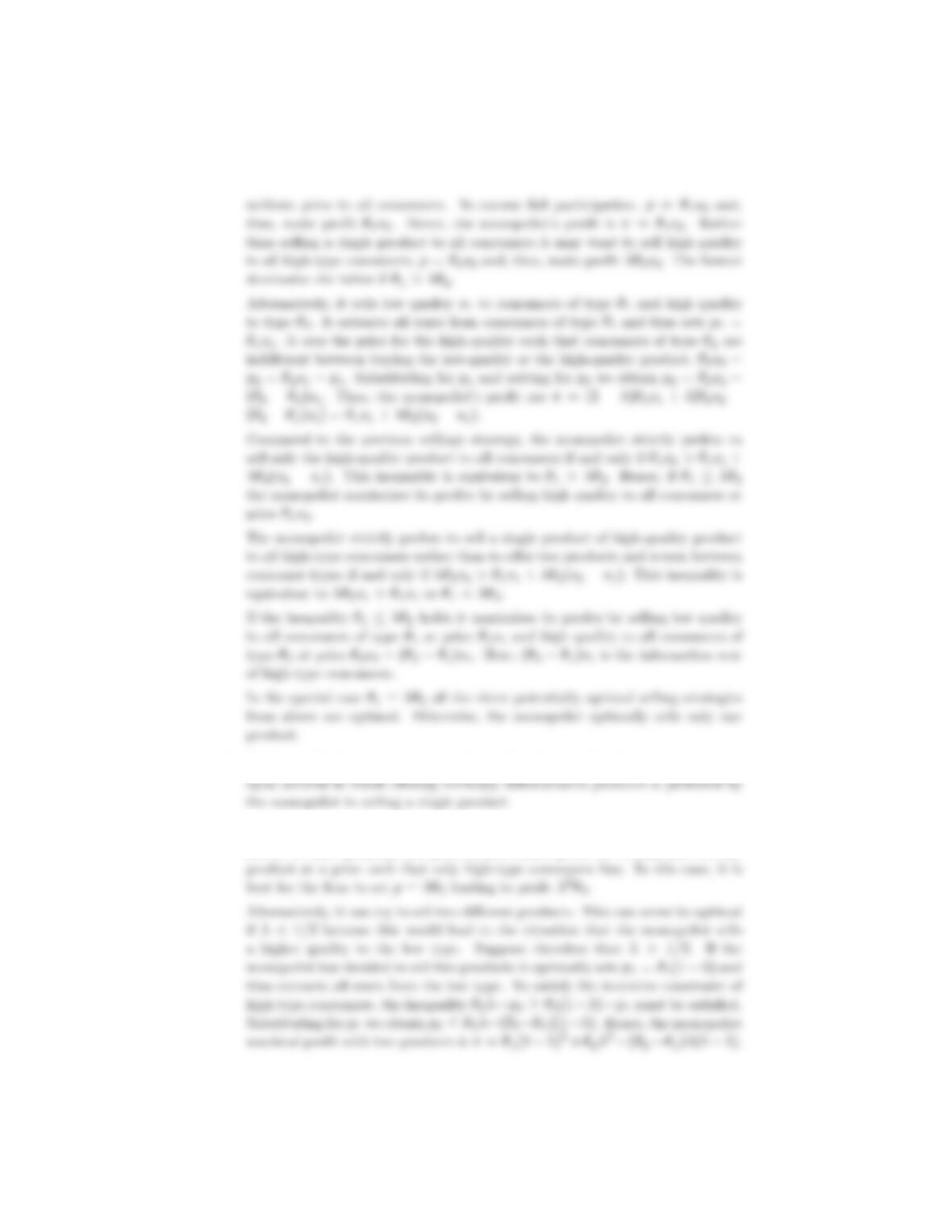
1. The monopolist sells high quality to all consumers. Each consumer of type 1
2. The monopolist may still want to offer high quality to all consumers. However,
since the consumer type is private information, the monopolist has to set a
21
3. If high quality has a larger marginal cost than low quality there is a non-empty
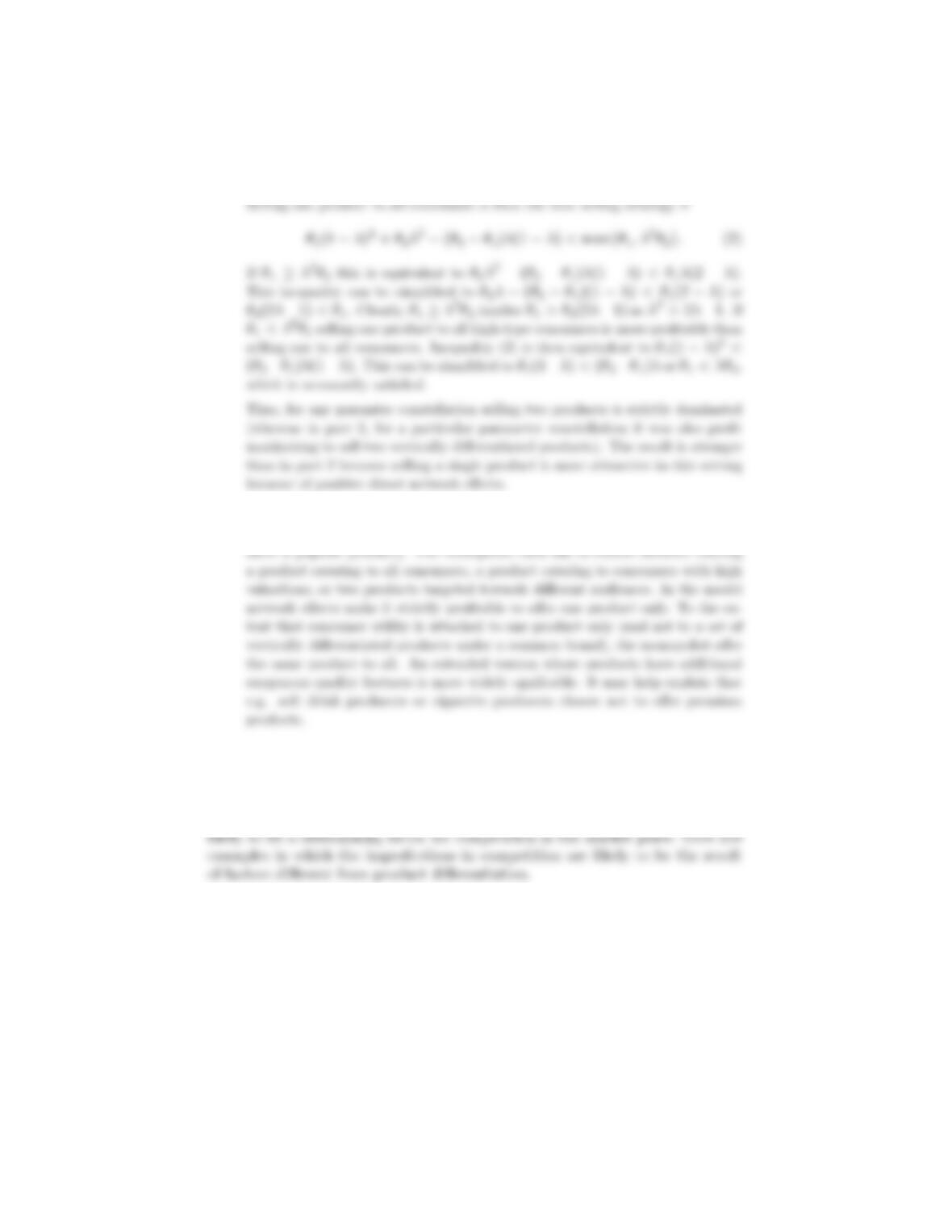
4. The monopolist can sell one product to all consumers. Product quality is there–
fore 1. It thus optimally sets price 1and makes profit 1. It may also sell one
22
5. Examples are goods where utility is derived from how many other people con–
sume the product (people may feel more integrated and better off if they con–
Exercise 11 Examples of product differentiation
Give five examples of product markets in which product differentiation is
Exercise 12 Price transparency and imperfect competition [included in 2nd edi-
tion of the book]
Consider a Hotelling model in which two firms are located at the opposite
ends of the unit interval and serve a unit mass of consumers, who are uniformly
distributed on this interval. Each consumer has unit demand and her utility if
she buys from firm 1, located at 0, is r x p1, where xis the consumer’s
location on the line, her utility if she buys from firm 2, located at 1, is r(1
23

x)p2. Her utility if she does not buy at all is 0. For simplicity, both firms are
assumed to have zero costs.
The two firms compete by simultaneously setting their prices. Consumers
fall into two categories: at every point on the line, a fraction with >0
of consumers observe p1and p2and then decide whether to buy from firm 1,
firm 2, or not to buy at all (these consumers behave as in a standard Hotelling
model). A fraction 1of consumers at every point x, do not observe p1and p2
(i.e., they are “uninformed” about prices). Instead, each uninformed consumer
forms an expectation about p1and p2, and uses these expectations to choose
whether to visit firm 1, firm 2, or none of the firms.
Visiting one firm is possible at zero costs, visiting both firms is infeasible or
prohibitively costy. If an uniformed consumer chooses to visit one of the two
firms, she learns its actual price, and then either buys from that firm or does
not buy at all. In equilibrium, the beliefs of uninformed consumers are correct.
For simplicity, assume that ris sufficiently high to ensure that the market is
fully covered for all values of .
1. Solve for the equilibrium when firms 1 and 2 choose p1and p2, respectively.
2. Let us interpret as “market transparency”: An increase in makes the
market “more transparent”. What happens to prices and what happens
to consumer surplus when the market becomes more transparent? What
is the intuition for your answer?
3. Suppose that a policy maker maximizes total surplus as the sum of con-
sumer surplus and profits. Should the policy maker enforce high trans-
parency or not? Explain the intuition for your answer.
4. Now suppose that consumers always observe firm 2’s price, p2, but, as
before, only a fraction of consumers observe p1while the others are uni-
formed and base their decision on their expectations regarding p1, which
are correct in equilibrium. Solve again for the Nash equilibrium. How
does affect the profit of firm? Does it pay firm 1 to have non-transparent
prices? Provide an intuition for your result.
Solutions to Exercise 15
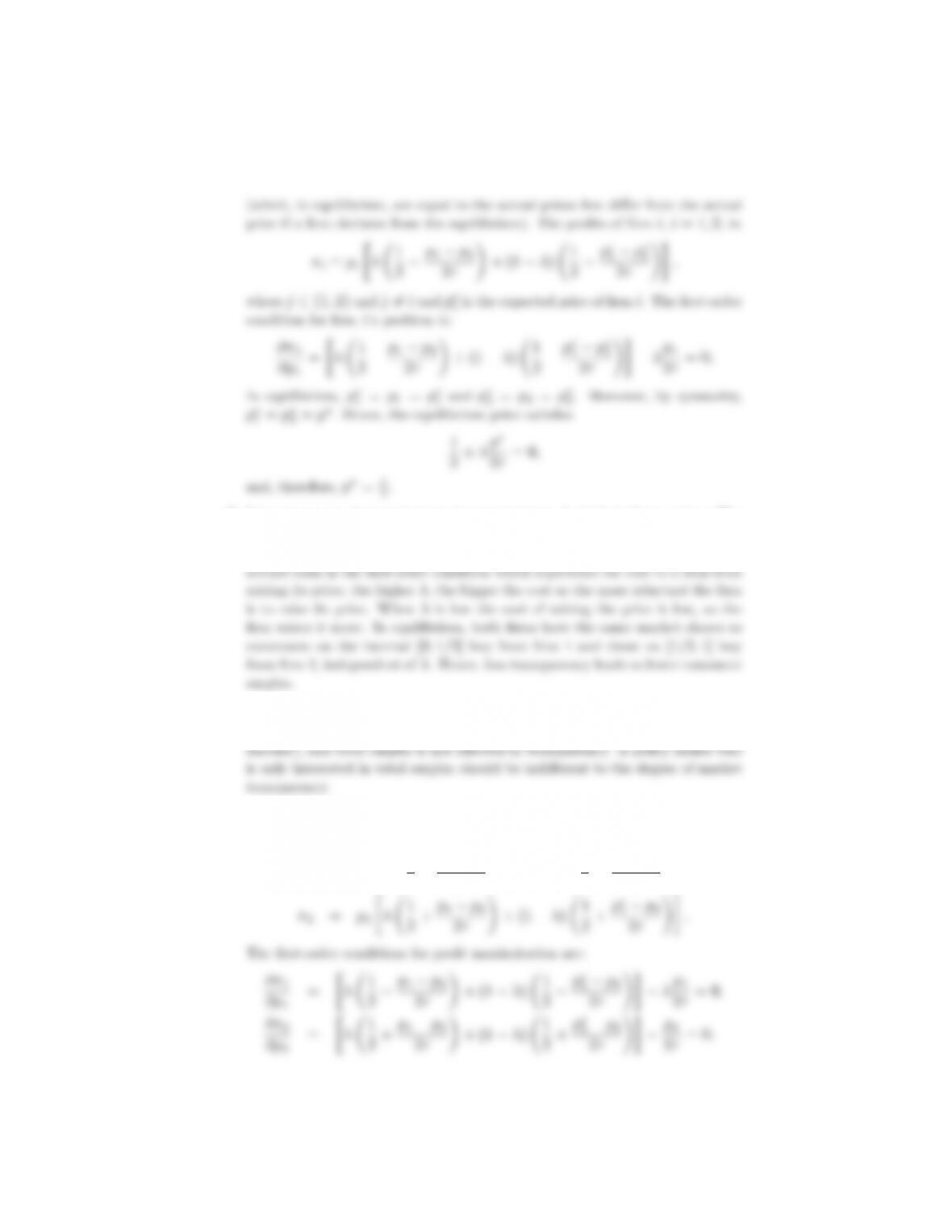
1. To solve for the Nash equilibrium, let us first determine the consumer who is
indifferent between the two firms. Given prices p1and p2, the location of the
indifferent consumer satisfies
24
2. It is easy to see that an increase in transparency, , leads to lower prices. The
reason is simple: When some consumers are uninformed, the firm does not lose
them when it increases its actual price. This can be seen by looking at the
3. From a welfare perspective, the market is covered so there is no deadweight loss.
The prices are then a wash (the firms gain and consumers lose but by the same
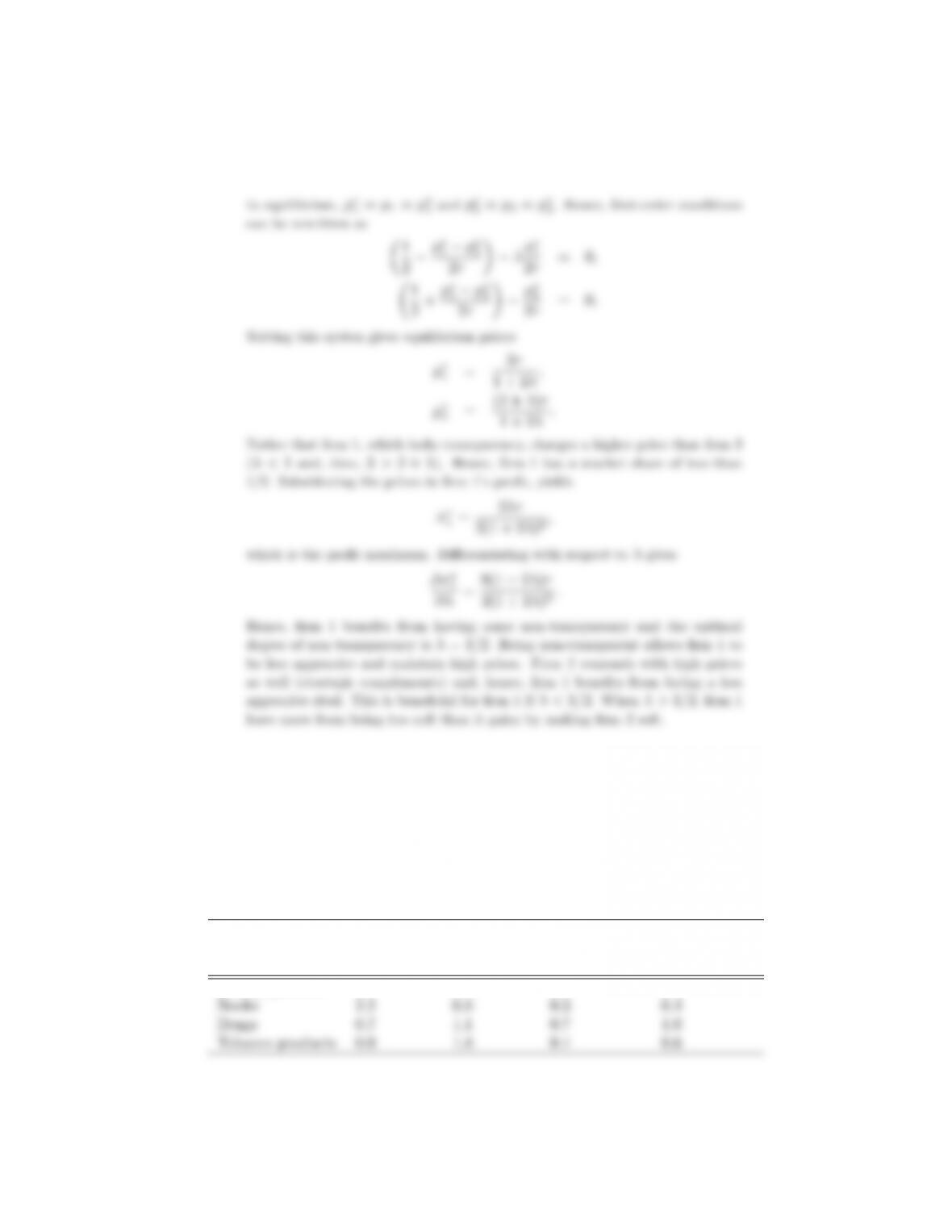
4. When only the price of firm 1 may not be fully transparent, the profits are given
by:
1=p11
2p1p2
2+ (1 )1
2pe
1p2
2;
1p2
25
Exercise 13 Advertising intensity
Consider the elasticities reported in the table below. The easiest way to
think about the advertising elasticities is the following: Total demand consists
of demand today and tomorrow. The short-run elasticity is the effect that
advertising today has on demand today whereas the long-run elasticity is the
effect that advertising today has on demand tomorrow. In which industries do
you expect advertising intensity to be high? Distinguish between short run and
long run.
Income
elasticity
Price
elasticity
Short-run
advertising
elasticity
Long-run
advertising
elasticity
Bakery products 0.7 0.3 0.2 0.3
26

Exercise 14 Wasteful advertising
Suppose that advertising expenditures are wasteful in the sense that they
only redirect existing demand and do not increase consumer utility. Can such
advertising be total surplus increasing? Explain.
Exercise 15 Surplus-increasing advertising in the Hotelling model
Consider a horizontally differentiated product market in which firms are lo-
cated at the extreme points of the unit interval. Firms produce at marginal
costs equal to zero. A continuum of consumers of mass 1 are uniformly distrib-
uted on the unit interval. They have unit demand and have an outside utility of
1. A consumer located at x2[0;1] obtains indirect utility v1=r1tx p1
if she buys one unit from firm 1 and v2=r2t(1 x)p2if she buys from
firm 2. Firms have marginal costs equal to zero.
1. Suppose that firms have set prices at p1and p2respectively. Determine
the demand function for each firm for each admissible price pair (p1; p2).
2. Suppose that the social planner chooses first-best optimal prices. Which
price pairs would be socially optimal.
3. Suppose that the two firms simultaneously set prices. Determine the mar-
ket equilibrium for all possible combinations of (r1; r2).
4. From now on consider the special case that t= 1. Suppose that each firm
ican use advertising to increase the willingness to pay from ri= 1 to
ri= 2. Consider the two-stage game in which firms choose advertising at
the first stage and price at the second stage. Characterize the subgame-
perfect Nash equilibrium of the game depending on the advertising cost
A. Consider the cases A= 2=9,A= 3=9, and A= 4=9. What is the
welfare ranking?
5. What are the equilibria for A= 5=18 and A= 7=18?
6. What are the welfare consequences of a reduction in advertising the ad-
vertising cost from A= 5=18 + “to A= 5=18 “for the limit where
“!0(determine whether total surplus increases or decreases and by how
much)? Comment on your result in one sentence.
7. What are the welfare consequences of a reduction in advertising the ad-
vertising cost from A= 7=18 + “to A= 7=18 “for the limit where
“!0(determine whether total surplus increases or decreases and by how
much)? Comment on your result in one sentence.
Solutions to Exercise 15
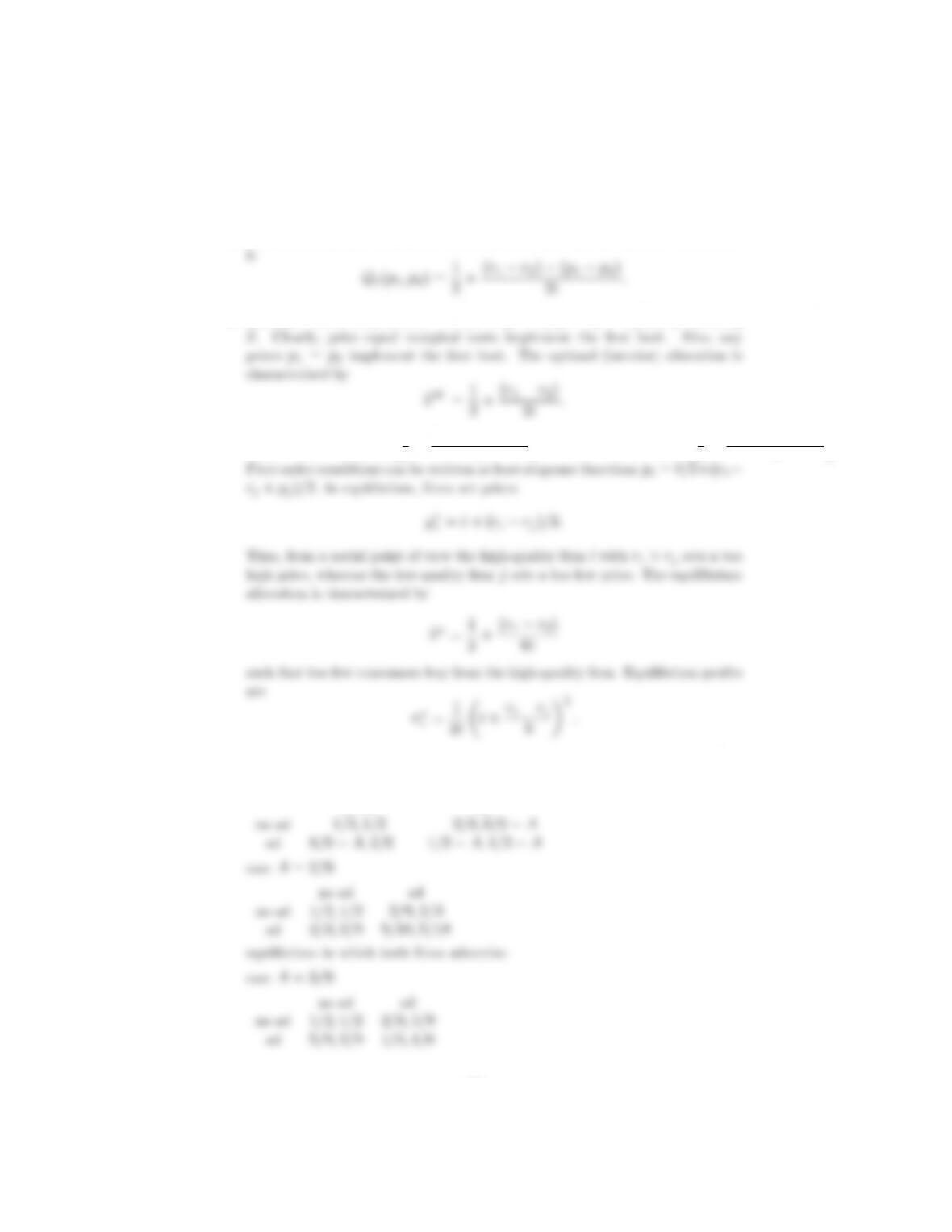
1. For prices such that demand is strictly positive for each firm, demand of firm 1
2. Maximize social surplus bxr1tbx2=2 + (1 bx)r2t(1 bx)2=2by choosing
3. Firm 1 solves maxp1p11
2+(r1r2)(p1p2)
2t, firm 2 solves maxp2p21
2(r1r2)(p1p2)
2t.
2tt+rirj
32
4. Profits in asymmetric advertising case: advertising firm makes (1=2)(4=3)2
A= 8=9A.
no ad ad
28
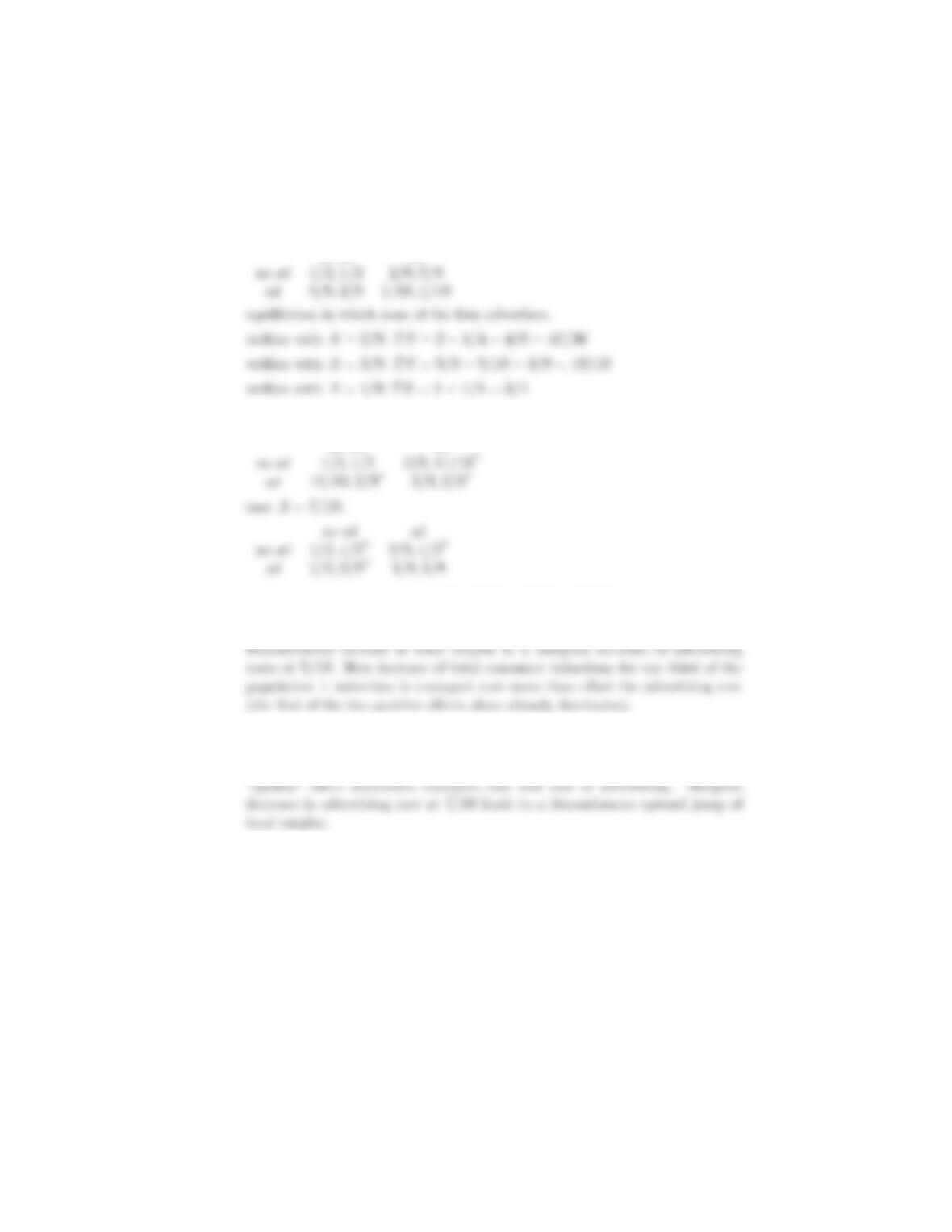
two asymmetric equilibria in which one of the firm advertises
case A= 4=9:
no ad ad
5. case A= 5=18:
no ad ad
6. welfare if one firm advertises 5=35=18 5=18 = 20=18
welfare if both firms advertise: 21=410=18 = 43=36
7. welfare if none advertises 3=4
welfare if one firm advertises: 5=35=18 7=18 = 1
Exercise 16 Negative advertising and information disclosure [included in 2nd
edition of the book]
Consider the linear Hotelling duopoly in which each firm produces a product
with a firm-specific undesirable ingredient at zero marginal costs. Suppose that,
absent advertising, consumers are not aware of this ingredient. In this case a
consumer of type xderives utility rtx p1if she purchases product 1 and
utility rt(1 x)p2if she purchases product 2. If a consumer learns that
product ihas the undesirable ingredient utility is decreased by d. Suppose that
parameter values are such that in the equilibria to be characterized below the
market is fully covered. Firms set prices simultaneously.
29
1. Derive the equilibrium if firms cannot inform consumers that their product
contains the undesirable ingredient.
2. Suppose that, at an initial stage, firm isimultaneously decide whether to
inform consumers that its product contains an undesirable ingredient (sup-
pose that such informative advertising is possibly costless). Characterize
the equilibrium of the two-stage game.
3. Suppose now that, at an initial stage, firms can simultaneously launch
costly attack ads in which they reveal that their competitor’s product
contains an undesirable ingredient. Characterize the equilibrium of the
two-stage game depending on the advertising cost A. Are consumers better
off in this equilibrium compared to the solutions in (1) and (2). Explain
your result.
4. Should attack ads be allowed in this setting?
Solutions to Exercise 16
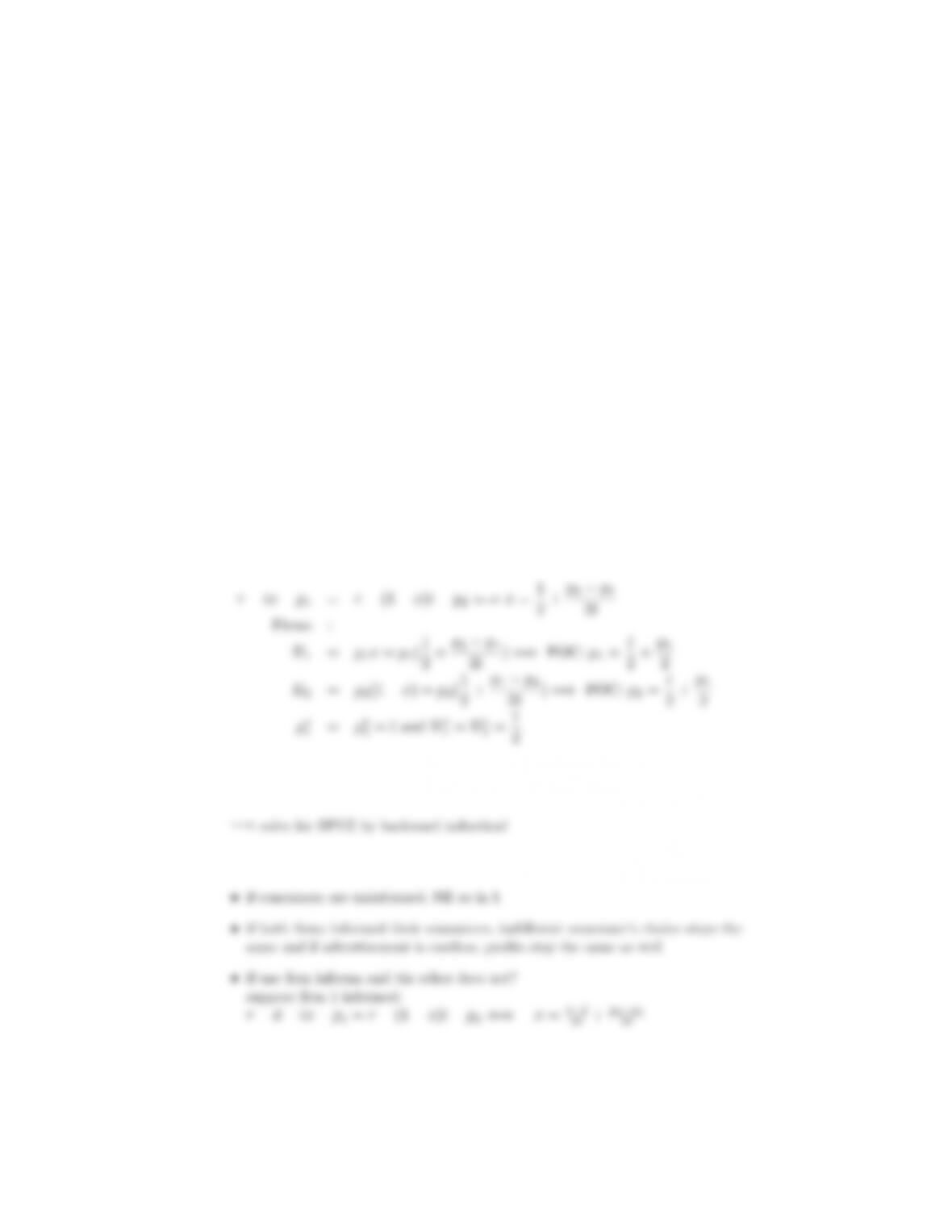
1. firms cannot inform consumers
!indifferent consumer:
2. two-stage game:
stage 2:
30
Note:
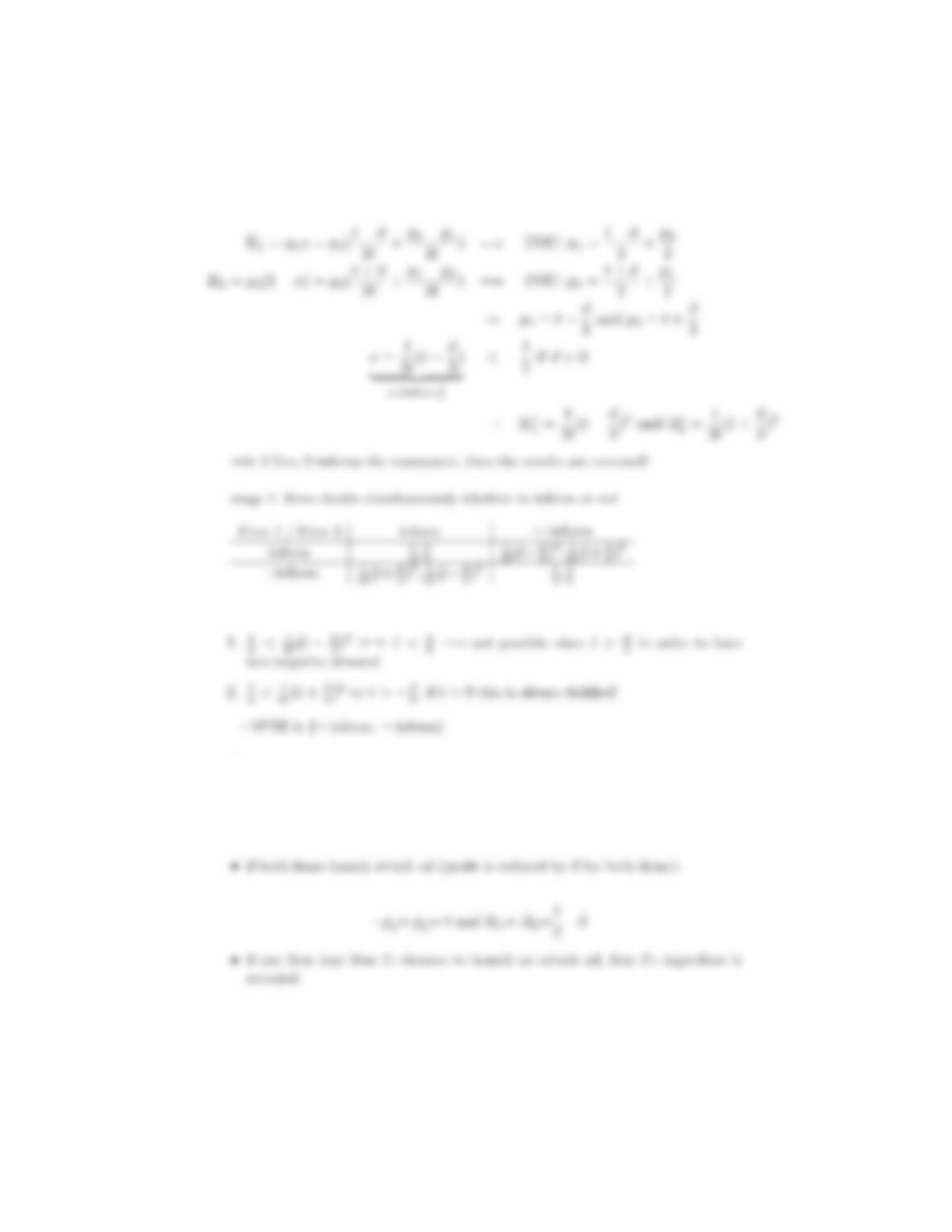
3.
stage 2:
if no firm launches a costly ad, see 1.
31
stage 1:
Firm 1 / Firm 2 attack ad :attack ad
What about consumers?
1. symmetric equilibria !consumers split at 1
2and pay price of t!efficient
Exercise 17 Informative advertising
It is not difficult to navigate in Lonely-Line City: a single street runs from
kilometer 0to kilometer 1along which 100 inhabitants are equidistantly distrib-
uted. [Approximate the consumer distribution by a continuum on [0;1] with a
mass of 100.] To keep the place residential the local government has decided
that no shops are allowed within the city limits. As it happens, there exists one
shop at each boundary of the city [one at point 0and one at point 1].
Each morning each inhabitant drinks one liter of fresh milk. Assume that
transporting one liter of milk costs tcents per kilometer (this is the disutility
incurred by an inhabitant if he walks or the cost for the shop for delivery), each
shop pays a wholesale price of ccents per liter.
32
1. Suppose that each shop isells one liter at price piat the shop and that
all inhabitants get up each morning and walk to one of the two shops to
get the milk. What is the price set by each of the two shops, what are the
2. Suppose that instead of consumers walking to one of the shops, both shops
have a delivery service and that shops set a price that depends on the
address of the inhabitant who buys. What are the prices charged by the
3. Return to the situation in (1.) but suppose that shops sometimes do not
have fresh milk available and that inhabitants only make the walk if they
know that they get the milk for sure. Therefore, each shop can buy the
right to use the city’s public speakers to advertise the availability of the
milk. There is time for two ads. The inhabitants of Lonely-Line City,
4. Consider a day at which both shops have milk available. Shops have
the following two options: (a) they jointly announce the availability of
milk in each ad, i.e., both ads contain information on both shops, (b) ad
Exercise 18 Comparative advertising [included in 2nd edition of the book]
Consider a Hotelling duopoly in which firms are located at the extreme
points of the unit interval and consumers of mass 1 are uniformly distributed
on the unit interval. The price of the two products is given and equal to 1,
p1=p2= 1 (e.g. because the price is fixed upstream); production costs are
zero. The quality of product iis denoted by si2[2;3]. The quality of each
product is drawn independently from the uniform distribution on this interval
33