
Industrial Organization: Markets and Strategies
Paul Belle‡amme and Martin Peitz
published by Cambridge University Press
Part III. Sources of Market Power
Exercises & Solutions
Exercise 1 Horizontal product differentiation1[included in 2nd edition of the
book]
Hong Kong Island features steep, hilly terrain, as well as hot and humid
weather. Travelling up and down the slopes therefore causes problems; this has
led the city authorities to imagine rather unusual methods of transport. One
famous example can be found in the Western District, where one of the busiest
commercial area of Hong Kong can be found. This area stretches from Des
Voeux Road in Central (which is at sea level) up to Conduit Road in the Mid-
Levels (which is the mid section of the hill of Hong Kong Island). Because the
street is so steep, sidewalks are made of stairs. To make travelling up the slope
easier for pedestrians, the Mid-Levels escalators were opened to the public in Oc-
tober 1993. (See http://www.12hk.com/area/Central/MidLevelEscalators.shtml
for some pictures of the escalators and the stairs of this area).
For the sake of this problem set, imagine the following story. Suppose that
the street is one kilometre long (kilometre 0 is down at the crossroad with Des
Voeux Road and kilometre one is up at the crossroad with Conduit Road).
Suppose that 100,000 inhabitants are uniformly distributed along the street.
Without loss of generality, we can approximate the consumer distribution by a
continuum on [0;1] with a mass set equal to 1 (i.e., we redefine all quantities by
dividing them by 100,000).
There are only two shops selling sweet-and-sour soup in this area. For sim-
plicity, we set their marginal cost of production to zero. As it happens, one shop
(named ‘Won-Ton’ and indexed by 1) is located at point 0, while the other shop
(named ‘Too-Chow’ and indexed by 2) is located at point 1. Everyday, each
inhabitant of the street may consume at most one bowl of sweet-and-sour soup,
bought either from Won-Ton or from Too-Chow. The price per bowl of the two
shops are respectively denoted by p1and p2. The net utility for a consumer
located at xon the interval [0;1] is given by
8
<
:
r1(x)p1if consumer buys at Won-Ton,
r2(1 x)p2if consumer buys at Too-Chow
0if consumer does not buy.
where it is assumed that ris large enough so that every consumer buys one
bowl of soup.
1

1. Before 1993 and the installation of the Mid-Levels escalators, walking up
the street was much more painful than walking down. This is translated
by the following assumptions: 1(x) = tx and 2(1 x) = (t+) (1 x),
with t; > 0.
(a) Derive the identity of the consumer who is indifferent between the
two shops.
(b) Compute the equilibrium prices and profits of the two shops.
(c) Show that Two-Chow’s profits increase if walking up the street be-
comes more costly for consumers, that is if increases (e.g., because
the temperature has risen). Explain the intuition behind this result.
2. After 1993, the Mid-Levels escalators made going up and down equally
painful for consumers. However, consumers had to pay a fixed fee f(in-
dependent of distance) to use the escalators. This is translated by the
following assumptions: 1(x) = tx and 2(1 x) = t(1 x) + f, with
f > 0.
(a) Derive the identity of the consumer who is indifferent between the
two shops.
(b) Compute the equilibrium prices and profits of the two shops.
(c) Express the condition (in terms of fand t) under which the previous
answers are valid (i.e. the condition for Too-Chow to set a price
above its zero marginal cost).
(d) Show that Two-Chow’s profits increase if taking the escalator be-
comes less expensive, that is if fdecreases. Explain the intuition
behind this result and contrast with your answer at (1c).
3. Comparing your answers for (1) and (2), establish and explain intuitively
the following results.
(a) Too-Chow suffers from the installation of the escalators (even when
its access is free, i.e., for f= 0).
(b) Won-Ton benefits from the installation of the escalators, unless the
extra transportation cost of climbing the stairs (i.e., ) is too large.
(To show this, set t= 2,f= 3 and compare Won-Ton’s profits for
= 2 and = 4).
Solutions to Exercise 1
1. Before 1993.
2
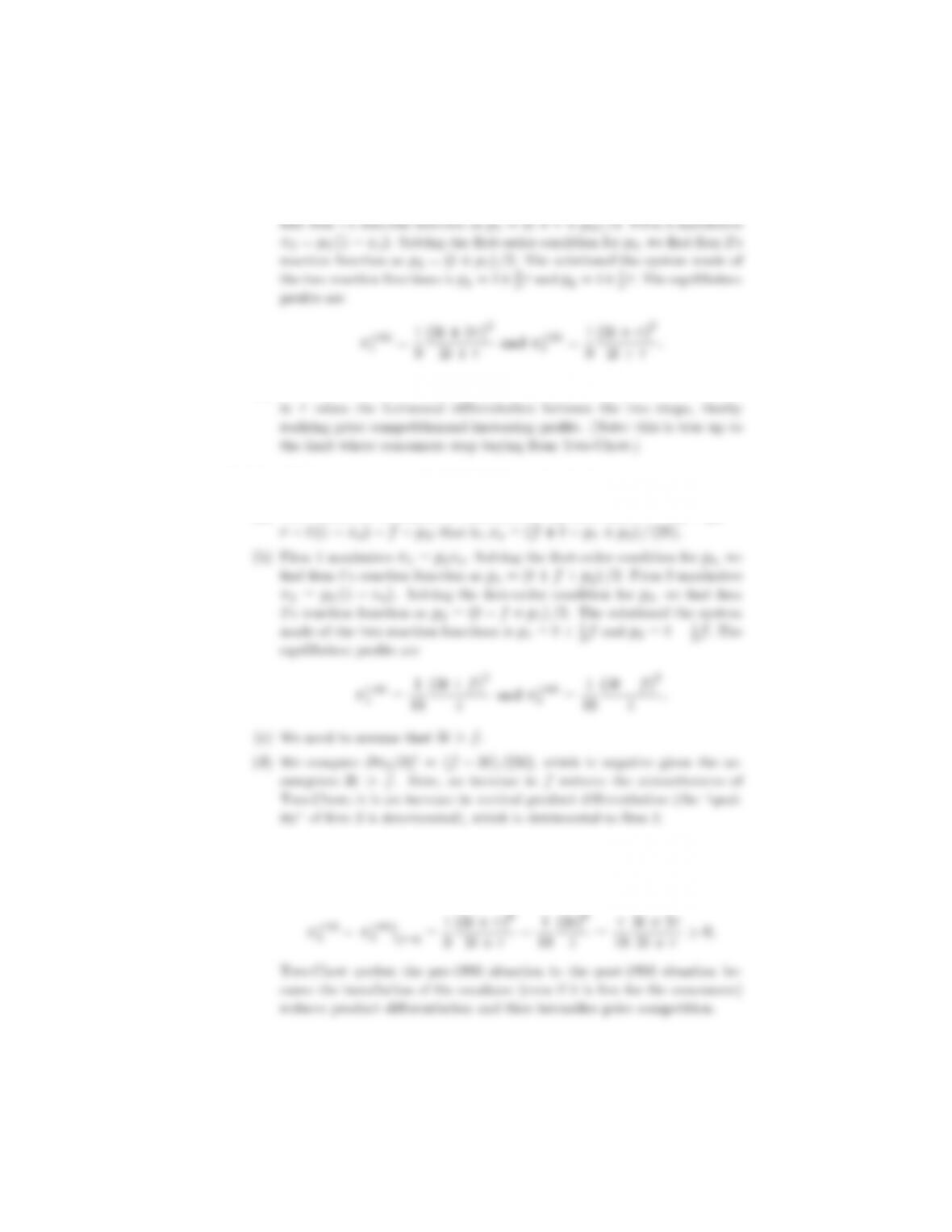
(b) Firm 1 maximizes 1=p1xo. Solving the first-order condition for p1, we
(c) We compute @2=@ = (3t+) (t+)=(9 (2t+)2)>0. An increase
2. After 1993.
(a) The indifferent consumer is identified by xssuch that rtxsp1=
3. Comparison
(a) We have
(3t+)2
(3t)2
3t+ 2
3
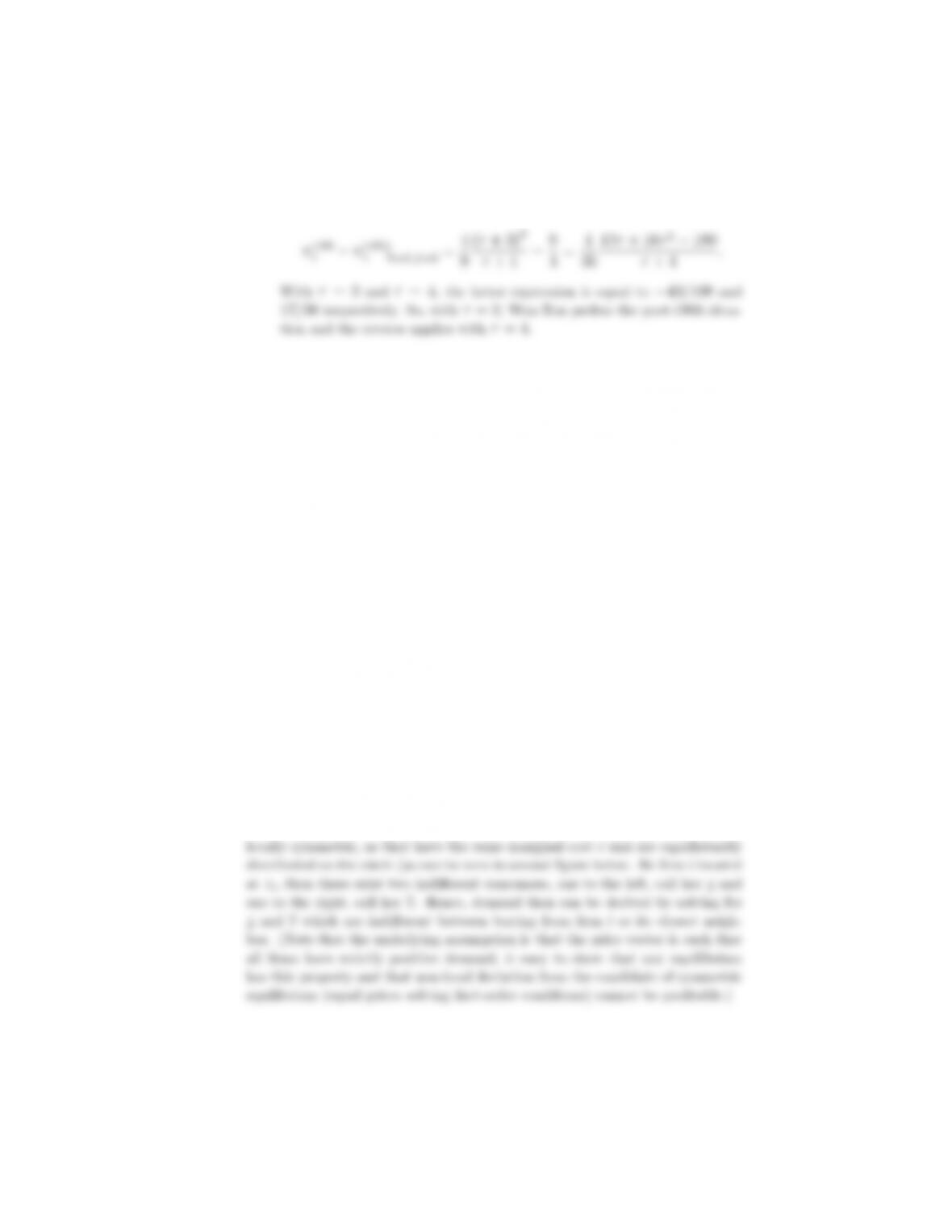
(b) We have
(+ 3)2
15+ 162180
Exercise 2 Competition on the Salop circle
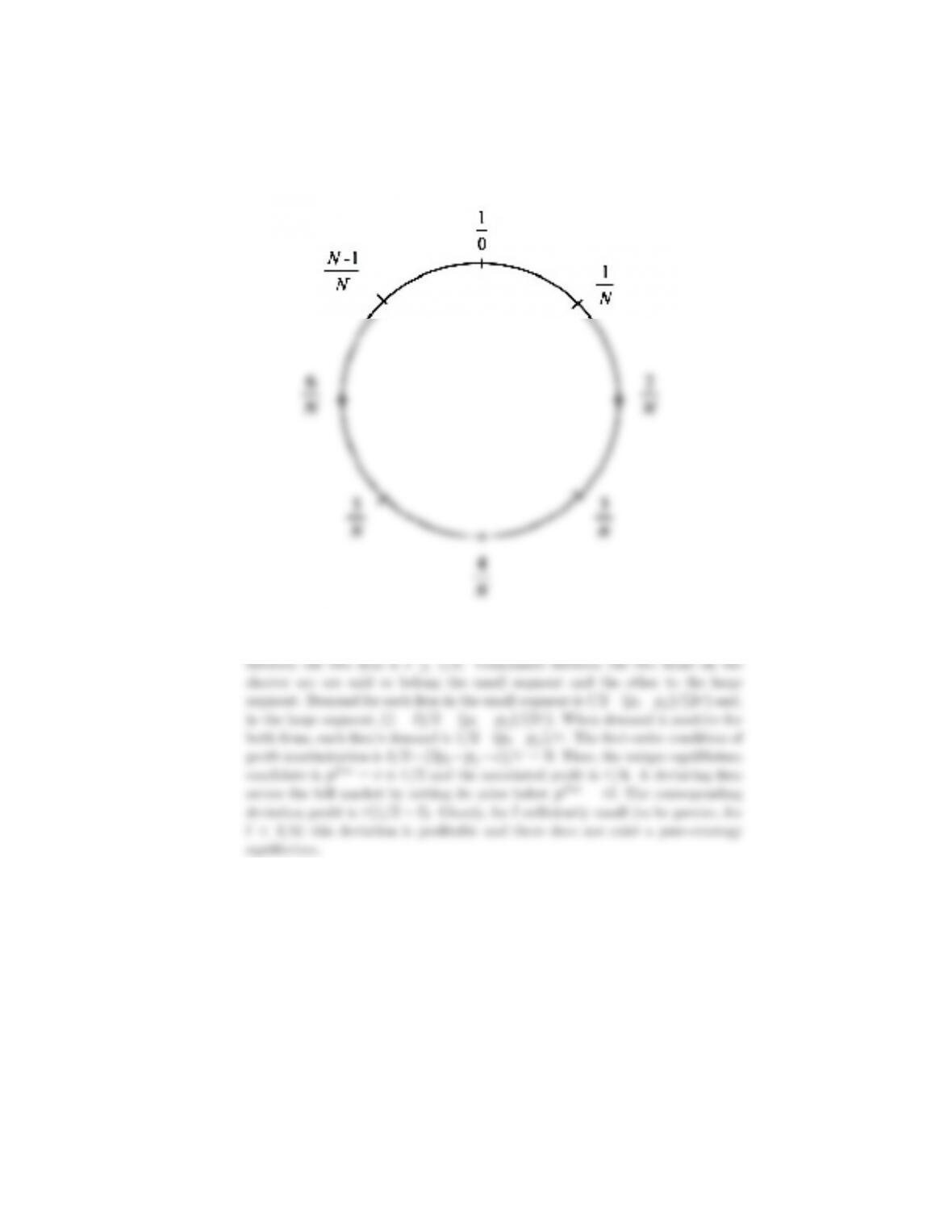
Consider a market in which firms 1; :::; N are equidistantly distributed on a
circle with circumference 1. Firms have constant marginal costs of production
c, which are the same for all firms. Consumers are uniformly distributed on the
circle (and have mass 1). A consumer xincurs a transportation jxlijwhen
buying from firm i. Here the distance between consumer and firm is the arc
distance on the circle (that is consumers move on the circle). Suppose that all
consumers are active in the market.
1. Determine the demand function of firm ias a function of all prices (for
prices such that the demand is positive for all firms).
2. Determine equilibrium prices in the game in which all firms set prices
simultaneously.
3. How do transport costs affect profits?
4. Argue informally whether or not you think that an equilibrium exists for
all location configurations.
Solutions to Exercise 2
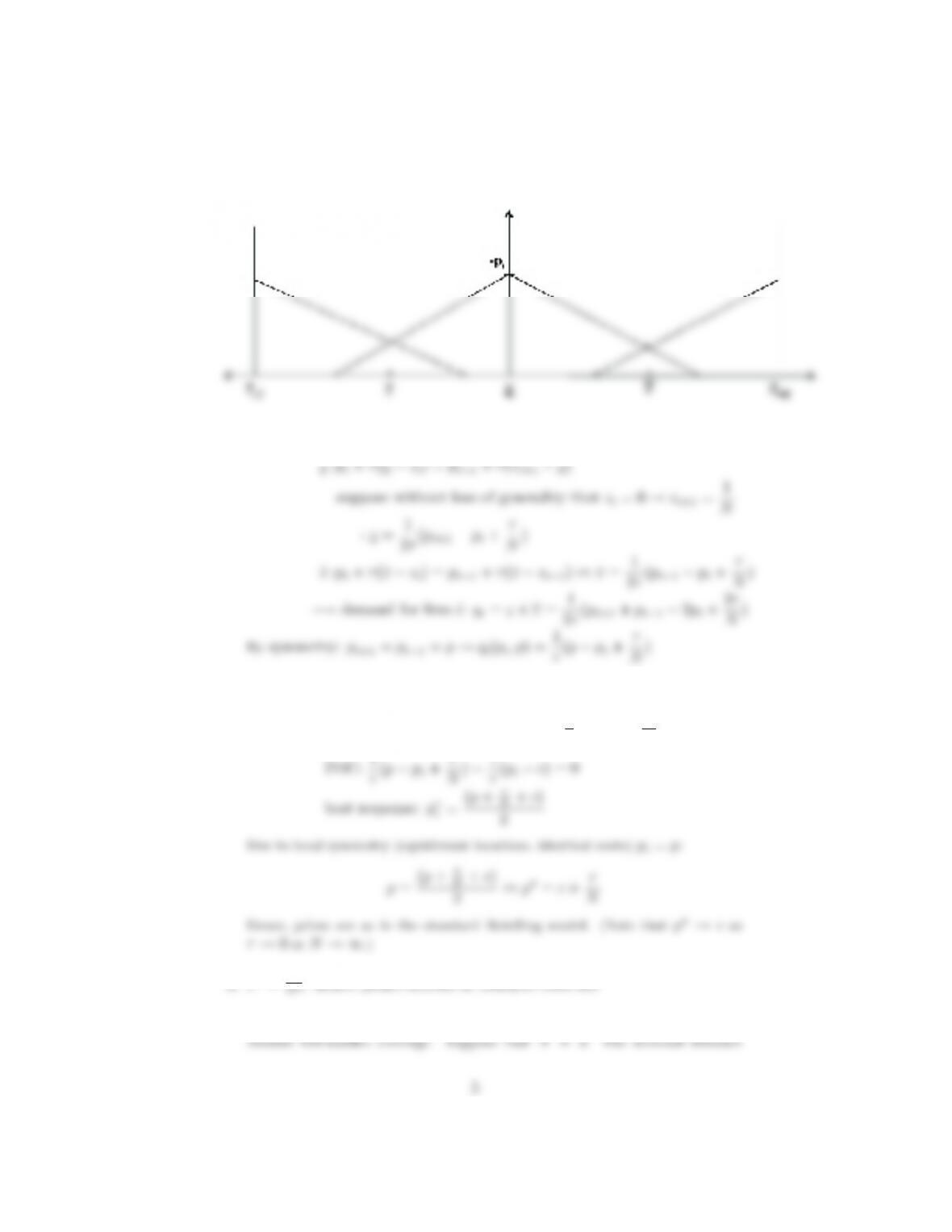
1. This model is often referred to as the circular city. As in the standard Hotelling
model, we can determine demand for each individual firm by finding the indif-
ferent consumer (assuming full-market coverage). We assumed that all firms are
4
2. Equilibrium prices are determined as follows
max
pi
i= (pic)qi(pi; p) = (pic)1
(ppi+
N)
3. =
4. Does an equilibrium exist for all locations? No. The proof is by contradiction.
Exercise 3 Quality-augmented Hotelling model [included in 2nd edition of the
book]
Consider the Hotelling model in which consumers are uniformly distributed
on the [0;1]-interval and firms Aand Bare located at the extreme points.
Firms produce a product of quality si. Consumer x2[0;1] obtains utility uA=
(rtx)sApAif she buys one unit of product Aand uB= (rt(1x))sBpBif
she buys one unit of product B. Each consumer buys either one unit of product
Aor one unit of product B.
6
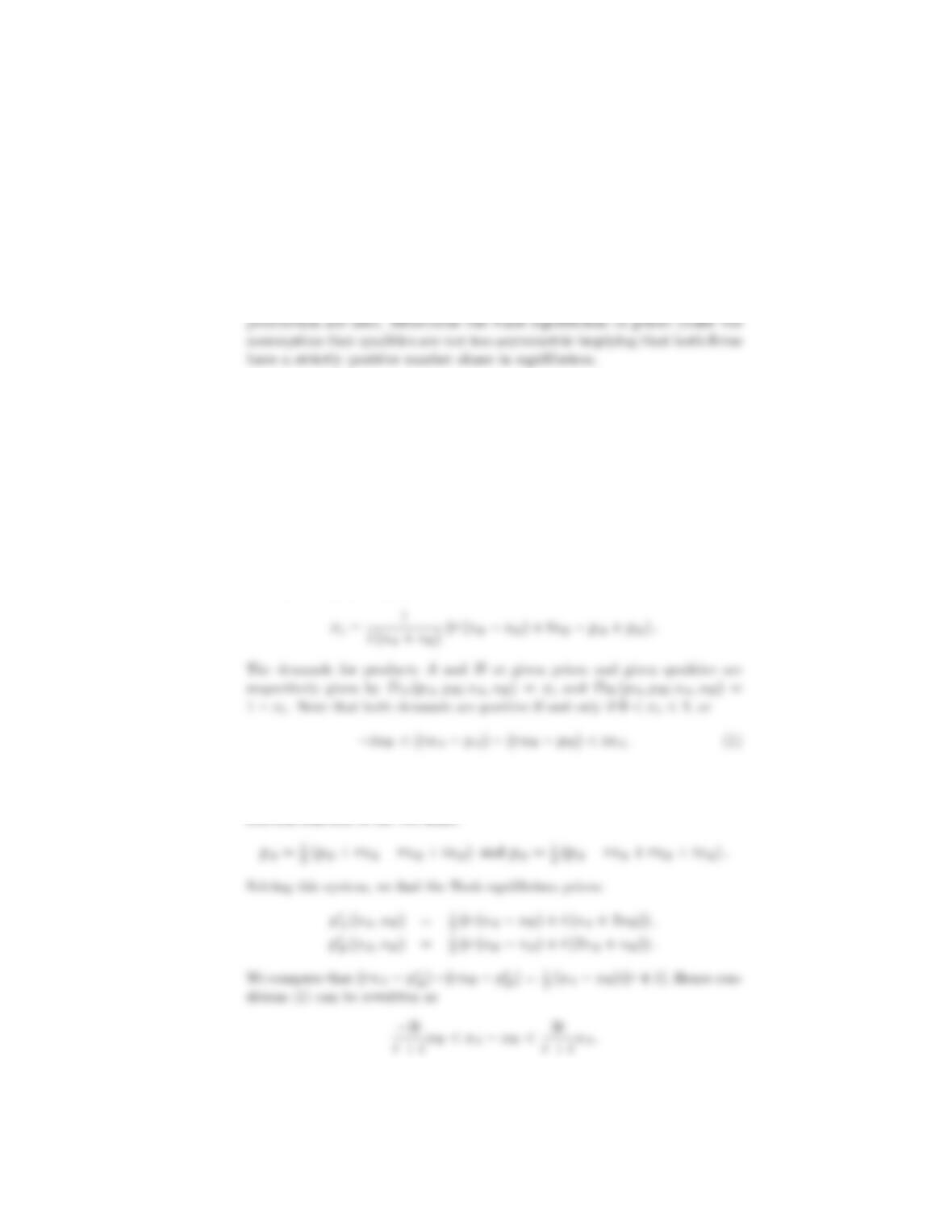
1. Describe the property of the utility function with respect to quality in two
or three sentences.
2. Determine the demand for products Aand Bat given prices and given
qualities.
3. Suppose that qualities sAand sBare given and that marginal costs of
4. Suppose that qualities are symmetric and that the cost of quality C(si)
is increasing and strictly convex in si. How does the equilibrium profit
depend on quality?
5. Compare this finding to the standard quality-augmented Hotelling-model
in which consumer xobtains utility uA=r+sAtx pAif she buys
product Aand uB=r+sBt(1 x)pBif she buys product B.
Solutions to Exercise 3
1. The indifferent consumer is identified by xisuch that (rtxi)sApA=
(rt(1 xi))sBpB, which is equivalent to
2. As long as conditions (1) are met, firm Aset pAto maximize A=pADAand
firm Bset pBto maximize B=pBDB. The first-order conditions yield the
reaction function of the two firms:
7
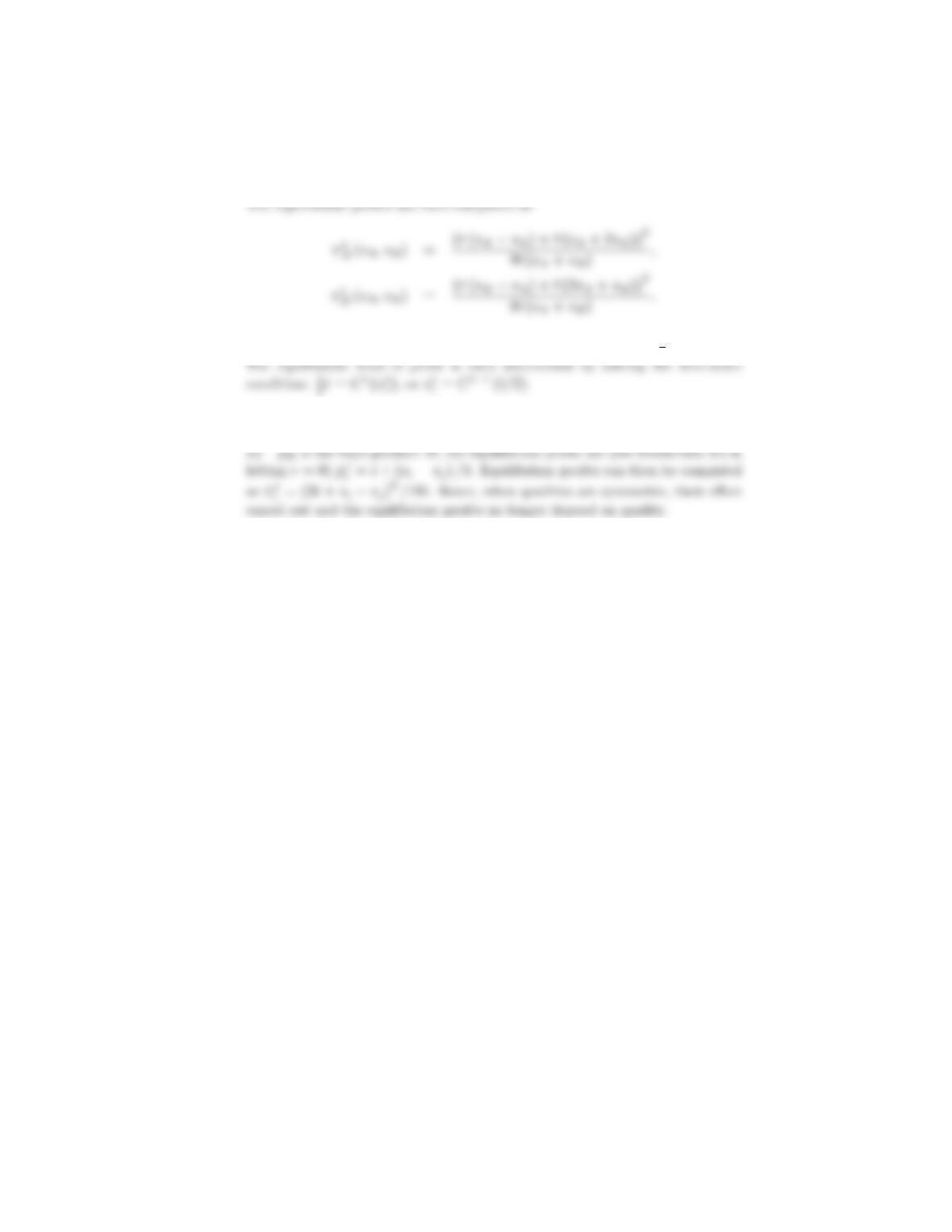
3. Let sA=sB=si. The profit of firm ican be written as i(si) = 1
2tsiC(si).
4. In the standard quality-augmented Hotelling-model in which consumer xobtains
utility uA=r+sAtx pAif she buys product Aand uB=r+sBt(1
Exercise 4 Market integration
Somewhere far away there exist two villages Applecastle (A) and Orangevil-
lage (B). Each village has its grocery store which sells a particular brand. Sup-
pose that initially connection are bad so that all inhabitants of A do their
shopping in A and all inhabitants of B do their shopping in B. Some villagers
propose a better connection between A and B.
1. Do the grocery owners support this connection? Is it possible that both,
one or none of the owners support the project? Explain.
2. What is the likely position the two city councils will take?
3. How may the opinion of the city council be different if there is a local sales
tax?
Exercise 5 Spatial competition
Consider a horizontally differentiated product market in which two firms are
located at any points l1and l2on the real line, respectively, with the notation
l1l2. Firms produce at marginal costs c. There is a continuum of consumers
of mass 1 who are uniformly distributed on the unit interval. They have unit
demand and have an outside utility of 1. A consumer located at x2[0;1]
obtains indirect utility v= maxfv1; v2gwith v1=r(xl1)2p1if she buys
one unit from firm 1 and v2=r(l2x)2p2if she buys from firm 2. Firms
have marginal costs equal to c.
8
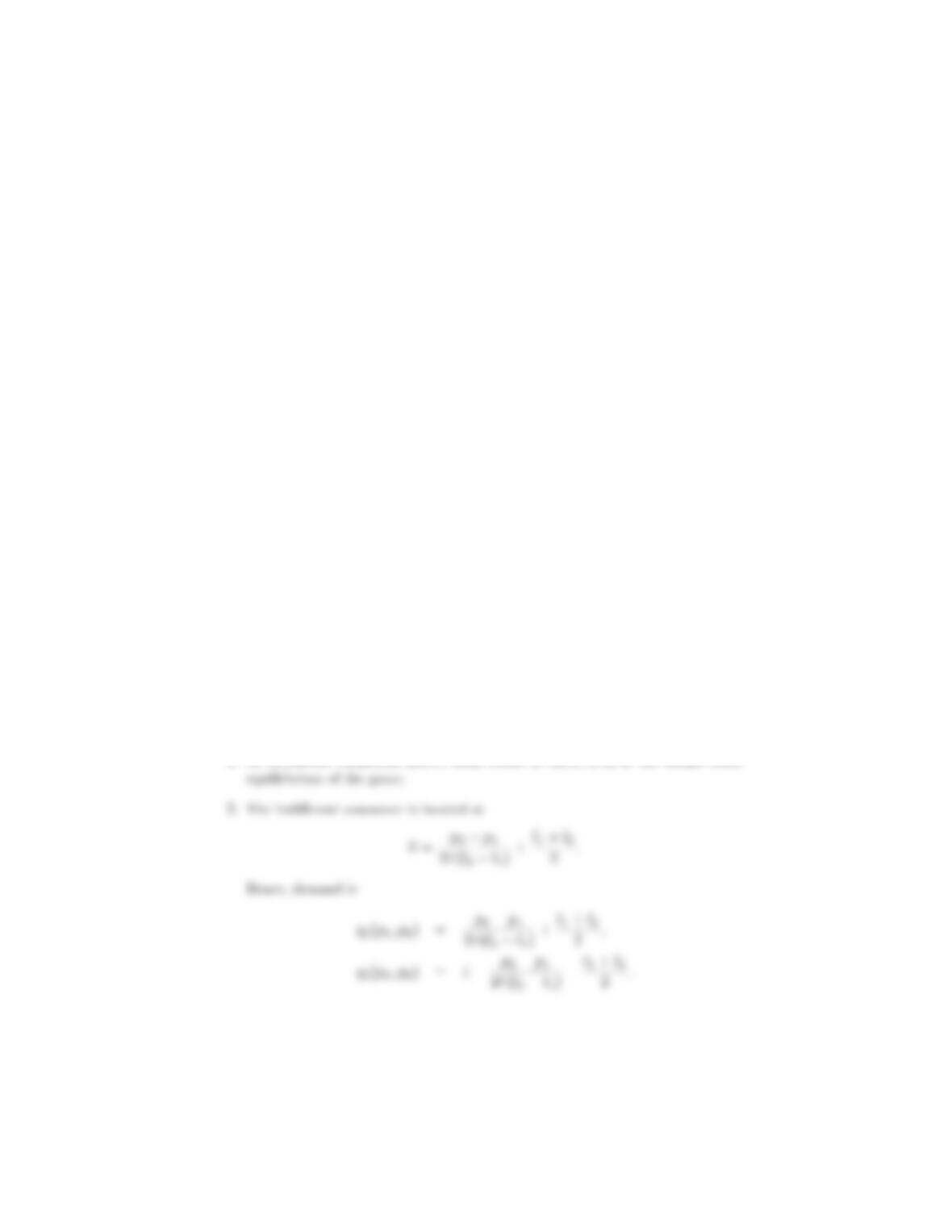
1. Suppose that prices are regulated at pi= 2c. In the game in which firms
simultaneously decide where to locate their product, characterize the Nash
equilibrium.
2. Determine the demand function for each firm for each admissible price
pair (p1; p2)given locations l1and l2.
3. Suppose that the two firms simultaneously set prices. Determine the mar-
ket equilibrium for all possible combinations of (l1; l2).
4. Suppose that the social planner chooses first-best optimal prices. Which
price pairs would be socially optimal, given the pair of locations l1= 0
and l2= 1=2?
5. Compare you results obtained in (1) and (2) for locations l1= 0 and
l2= 1=2. Is the equilibrium socially efficient? Depending on your answer
elaborate on the sources of the inefficiency or give the reason for efficiency.
6. Consider the two-stage game in which firm first set locations on the real
line simultaneously and then set prices simultaneously. Characterize the
set of pure-strategy subgame-perfect equilibria. Determine equilibrium
profits. Note: Calculations are tedious; explain the steps in your calcula-
tions. You may then work with functions l1= (l22)=3and l2= (l1+4)=3.
7. Determine the socially optimal solution of a welfare-maximizing social
planner who can choose firm locations in a market in which price decision
are decentralized (second-best optimum). Compare your results obtained
in (1) and (6) to second-best socially optimal locations and explain any
differences you obtained.
Solutions to Exercise 5
1. At symmetric exogenous prices, firms locate at (1=2;1=2) in the unique Nash
9
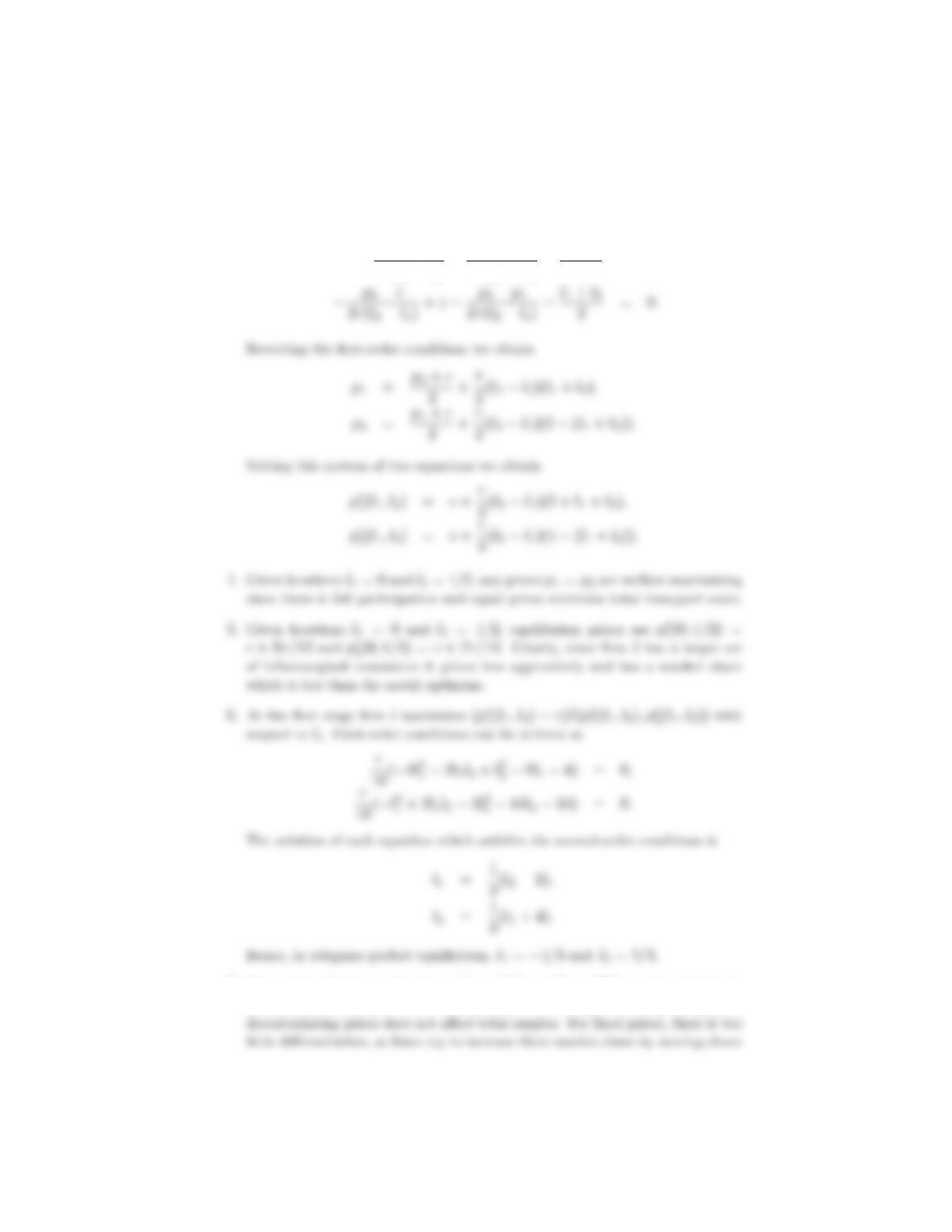
3. Firms maximize profits (pic)qi(pi; pj)with respect to pi. First-order condi-
tions are
p1c
2(l2l1)+p2p1
2(l2l1)+l1+l2
2= 0
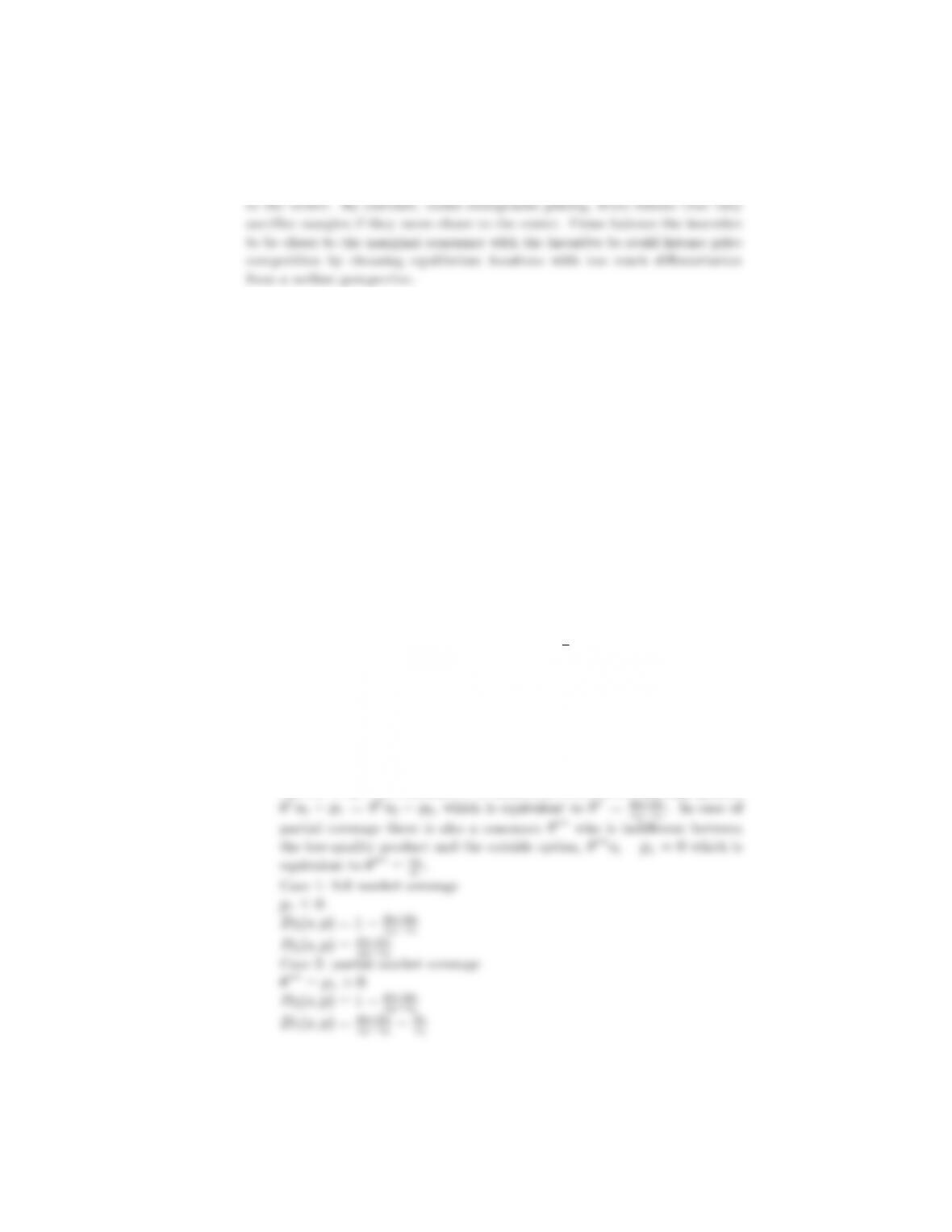
7. The social planner would choose l1= 1=4and l2= 3=4, as these locations
minimize total transport costs. In this symmetric setting with full participation,
10
Exercise 6 A model of vertical product differentiation
Suppose there are 2firms in a vertically differentiated market. Consumers
buy either one unit of any of the two goods or they do not purchase in the
market. If they do not purchase in the market their indirect utility is 0. If
they purchase good itheir indirect utility is sipi, where is the preference
parameter of a consumer, siis the quality of good iand piis the price of good
i. Assume that there exist consumers of mass 1 whose preference parameter is
uniformly distributed on [0;1].
1. Determine the demand function of each firm depending on prices and
qualities. [Hint: this is not the same model as the one presented in the
book.]
2. Suppose that qualities are given, s1< s2, and that firms face constant mar-
ginal costs of production c, which are independent of quality. Determine
equilibrium prices and profits in the game in which firms simultaneously
set prices.
3. Suppose firms set qualities from an interval [0;s]. Which qualities will re-
sult in subgame perfect equilibrium in the game in which firms set qualities
simultaneously at stage 1 and set prices simultaneously at stage 2?
Solutions to Exercise 6
1. (a) Derive demand functions by solving for indifferent consumers. Suppose
that s1< s2. The consumer is indifferent between low and high quality,
11
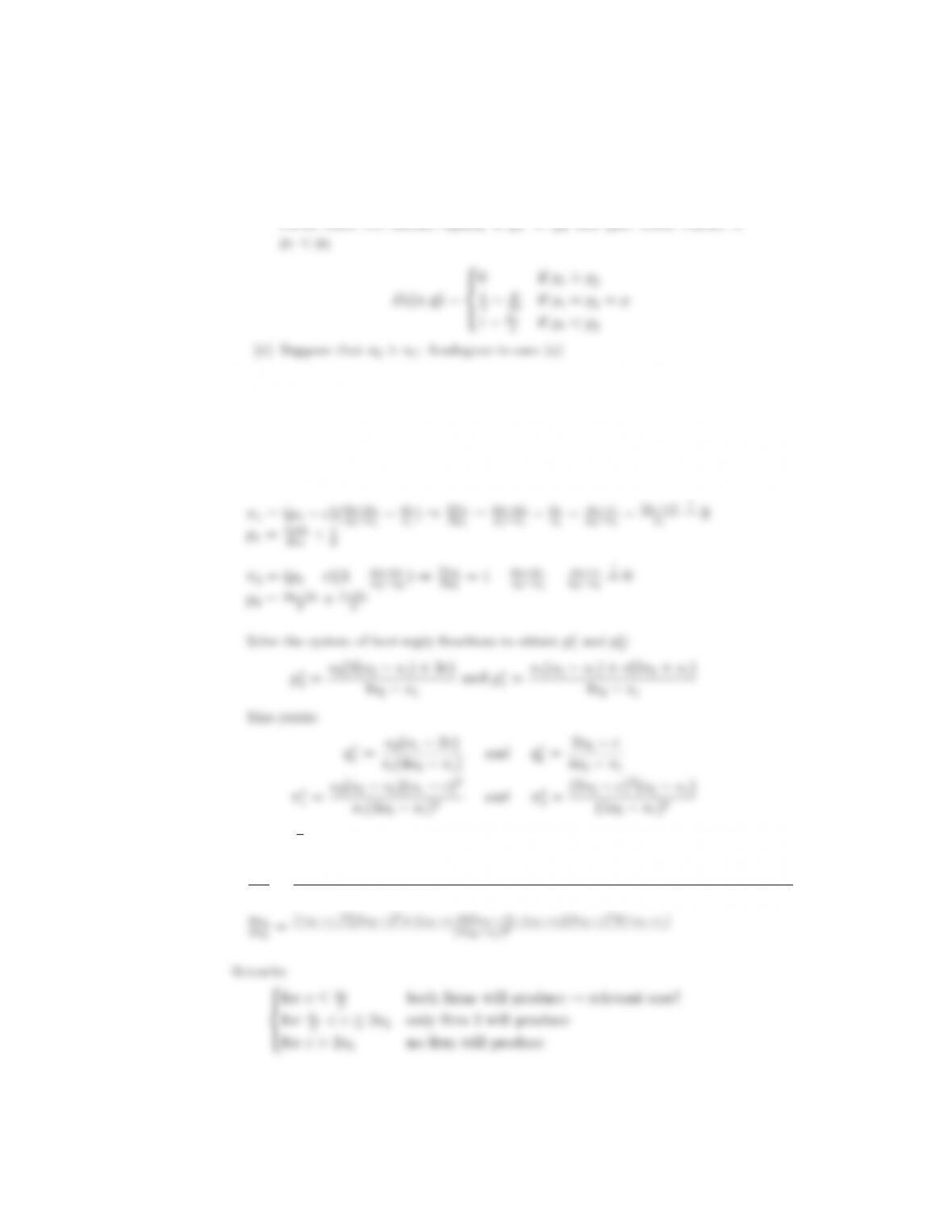
(b) Suppose that s1=s2=s: products are homogeneous.
Firms share the market equally if p1=p2and gain whole market if
2. Suppose that s1< s2, MC equal to cand independent of s. We determine
prices and profits for the price setting game. Demand given by (1a).
Case 1: full market coverage, =p1=s1= 0 for s1>0. Since p1< c, this
can not be profit-maximizing for firm 1.
Case 2:
>0,p1>0
!
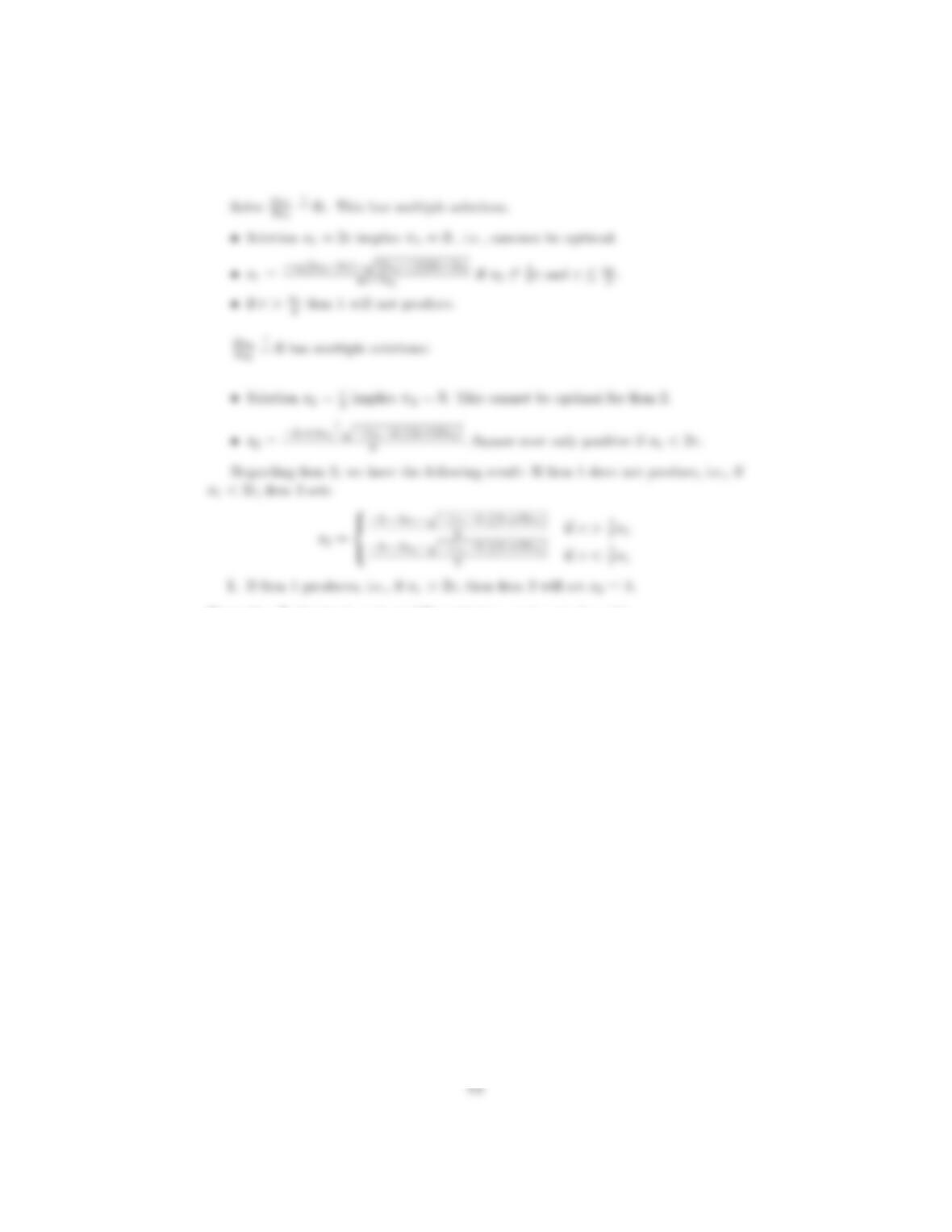
3. si2[0;s]. To determine subgame perfect Nash equilibrium, maximize reduced
profit functions with respect to si:
@1
@s1=s1s2(4s2s1)2[(s12c)2+(s2s1)2(s12c)](s2s1)(s12c)2s2[(4s2s1)22s1(4s2s1)]
(4s2s1)4s2
1
12
!
Exercise 7 Vertical product differentiation and cost of quality
A consumer with income mwho consumes a product of quality siand pays
piobtains the utility sim=6pi. If instead the consumer decides not buy the
good, the resulting utility is zero. Consumer income mis uniformly distributed
on the interval [2;8] with the density 1=6. The total mass of consumers is equal
to 1. There are two firms in the market. Firms 1 and 2 offer the qualities s1
and s2, respectively. Assume that s1; s22[1;2]. Label firms such that s1s2.
Suppose that firm ihas constant marginal cost equal to csiwith c < 2.
1. Derive the demand of firms 1 and 2, and calculate the best-response func-
tions of the two firms presuming that first-order conditions hold with
equality. Distinguish between full and partial coverage.
2. Calculate the Nash Equilibrium in prices and find the equilibrium profits
as a function of s1and s2. Distinguish between full and partial coverage
(considering only solutions to first-oder conditions).
3. What are the equilibrium quality choices of the two firms? (Again distin-
guish between the full and market coverage cases using first-oder condi-
tions.)
4. Which firm is more profitable? Consider the two cases mentioned above.
5. How does in the partial coverage equilibrium an increase in caffect the
profits of the two firms?
Solutions to Exercise 7
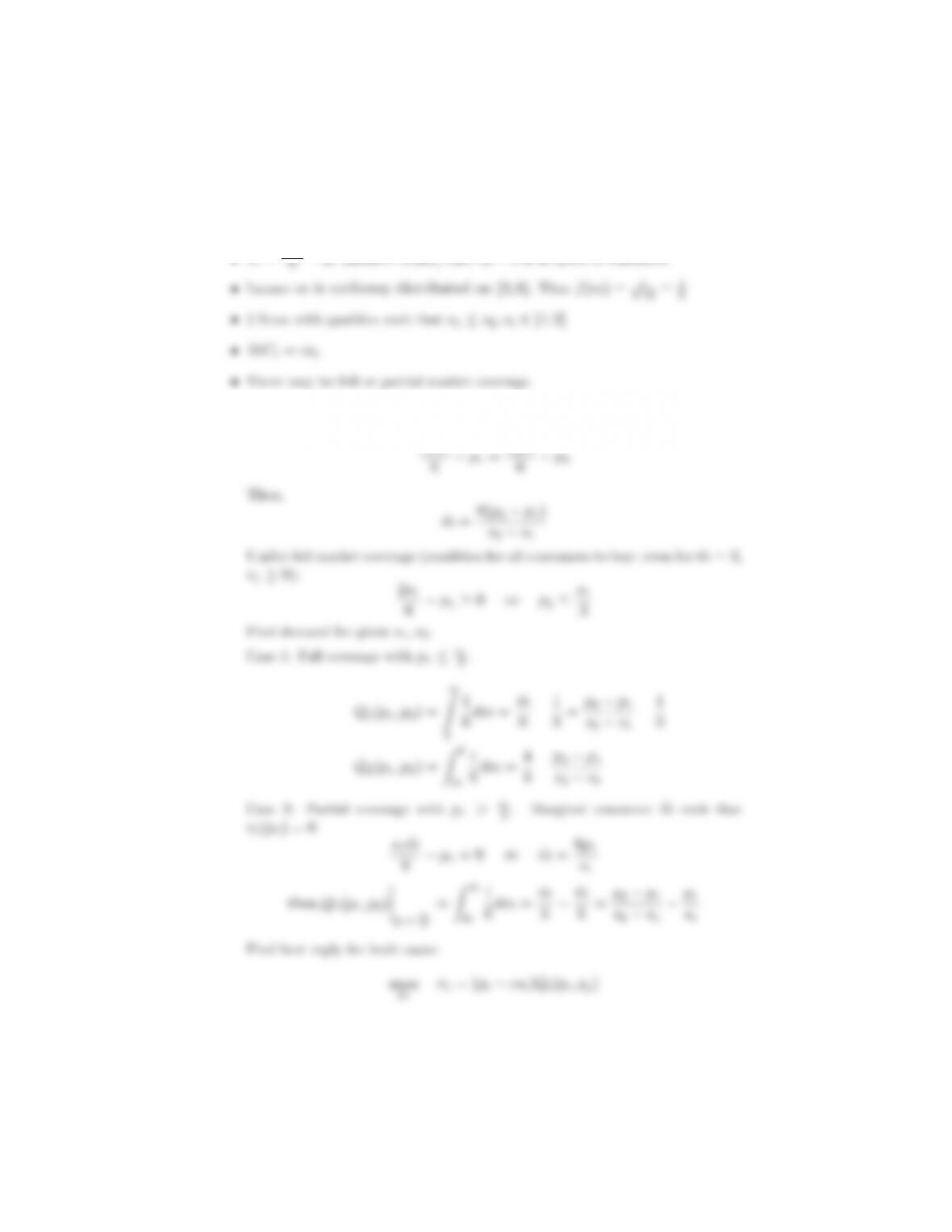
Assumptions:
vi=sim
1. Find consumer ^mwho is indifferent between low and high quality.
s1^m
pi
14
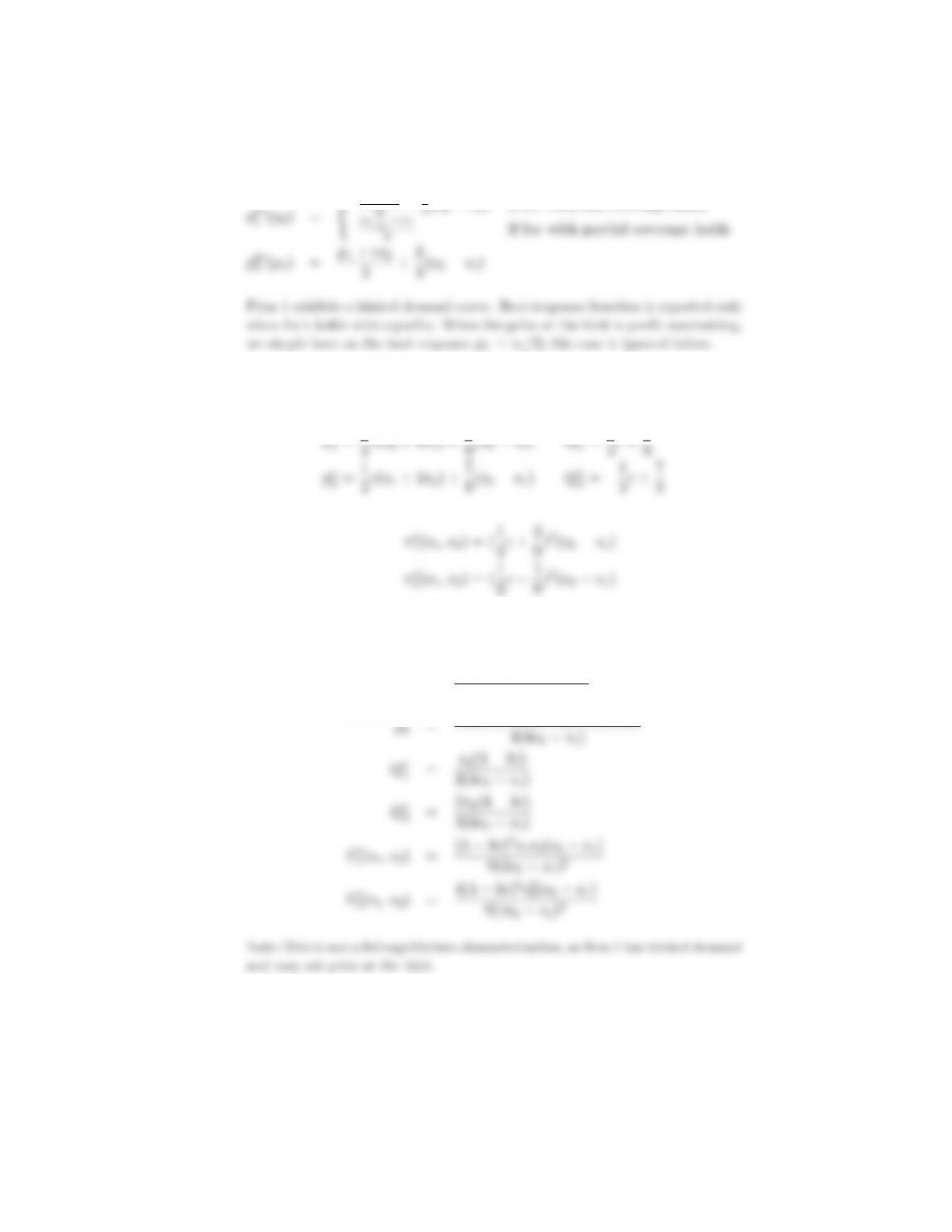
21
6(s2s1)if foc with full coverage holds
2. Case 1 (using best response with full coverage)
Equilibrium at the second stage: Solve pbr
1(pbr
2(p1)) for p1.
Case 2 (using best response with full coverage)
Equilibrium at the second stage:
p
1=s1((4 + 9c)s24s1)
3(4s2s1)
3. Case 1: At the first stage, determine s
1; s
2.
15
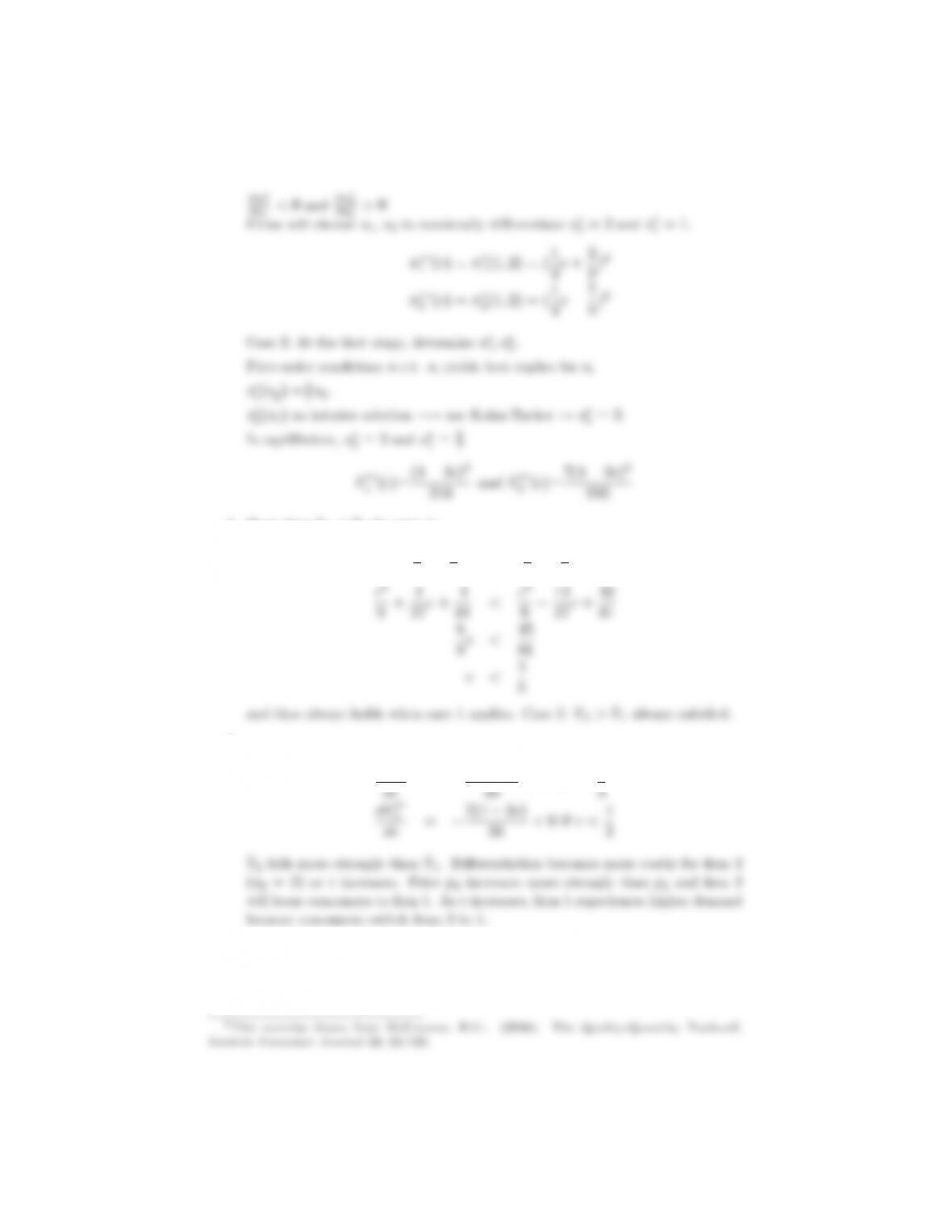
4. Show that e1<e2in case 1:
(1
3c+2
9)2<(1
3c7
9)2
5.
de
1
Exercise 8 The quality-quantity trade-off under vertical differentiation2[in-
cluded in 2nd edition of the book]
16

Consider the vertical differentiation model presented in Section 5.3. Suppose
that the quality of the product can be described by some number si2[s; s]
R+. Consumers are identified by 2; R+, which measures their prefer-
ence for quality. Consumers are distributed uniformly on ; and are of mass
M=. A consumer of type receives a utility of
vi(p; y;) = rpi+si
when consuming a unit of good i(where ris supposed to be sufficiently large,
so that all consumers buy in the market).
Two firms compete in the market. We look for the subgame-perfect equilibria
of the following two-stage game: firms first choose the quality of their product
and then compete in prices. Contrary to what was assumed in Section 5.3, we
assume now that the marginal cost of production depends on quality. We denote
by C(qi; si)the cost of firm iproducing qiunits at a quality siand we assume
C(qi; si) = aqisi.
With a > 0, this formulation introduces a trade-off between quality and quan-
tity as the marginal cost of production, asi, increases with quality. That is,
if the firm increases one dimension (quality or quantity), the cost of providing
the other dimension increases and the amount of this other dimension is thus
reduced. An example of such an inverse relationship between quality and quan-
tity can be found in the way an instructor teaches a course: as the number of
students enrolled (i.e., quantity) increases, the cost for the instructor of provid-
ing a high-quality teaching increases (given the time available, the instructor’s
ability to meet students outside of class, or to provide students with feedback on
their assignments, inevitably decreases with the number of students enrolled).
To guarantee interior solutions in the pricing game, we assume
> max 2a; +a
2:(A1)
1. Consider the second stage of the game where firms set prices simultane-
ously, taking the qualities as given. Firm 1 produces quality s1and firm
2 produces quality s2, with the convention that s1< s2. Derive the Nash
equilibrium in prices and express the equilibrium quantities and profits of
the two firms at stage 2.
2. Consider now the first stage of the game where firms simultaneously choose
the quality of their product.
(a) Show that (s1; s2) = (s; s)or (s; s)are the equilibrium quality choices
of the game.
(b) What is the effect of a stronger quality–quantity trade-off (i.e., of a
larger value of parameter a)? Discuss.
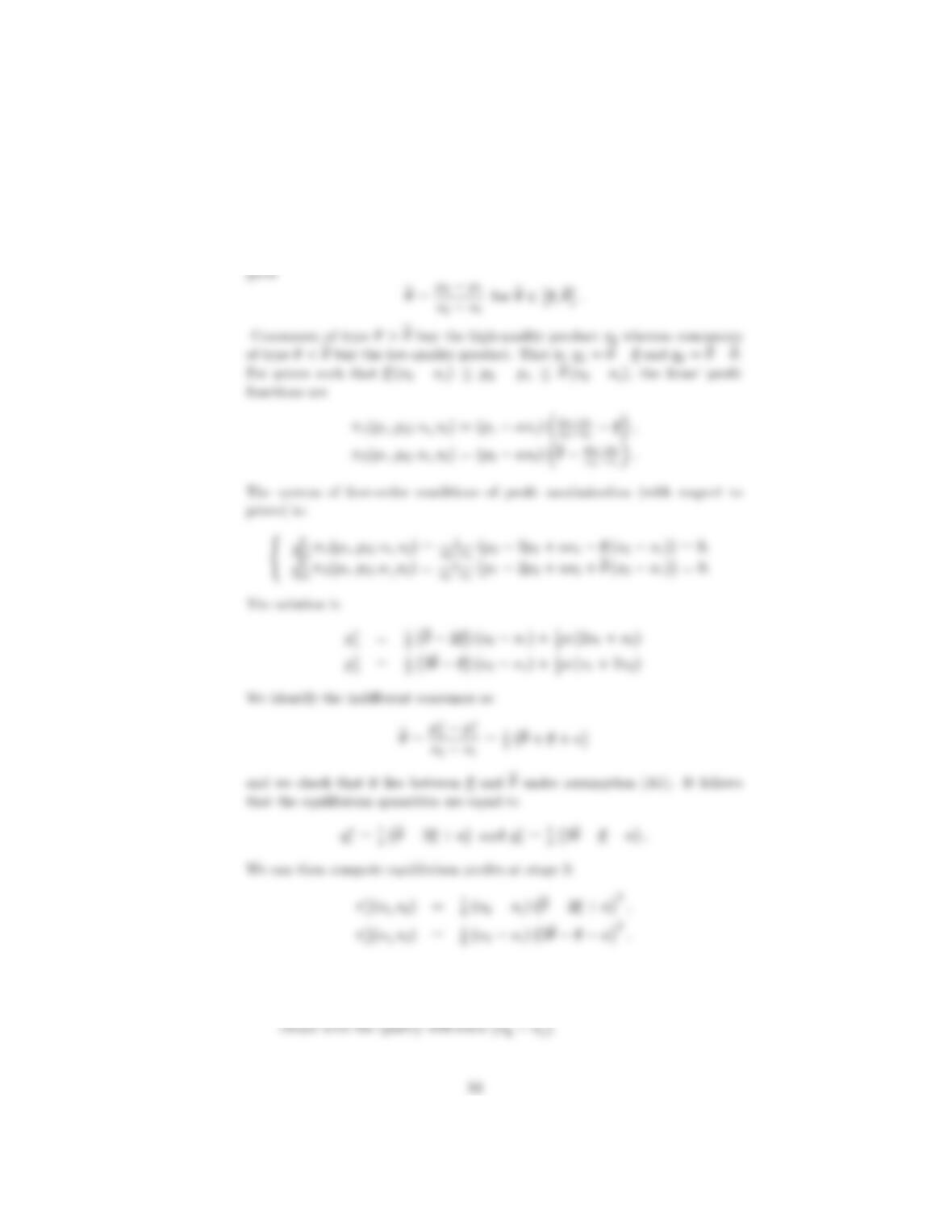
Solutions to Exercise 8
1. The indifferent consumer satisfies rp1+b
s1=rp2+b
s2. Solving for b
2. Quality choice
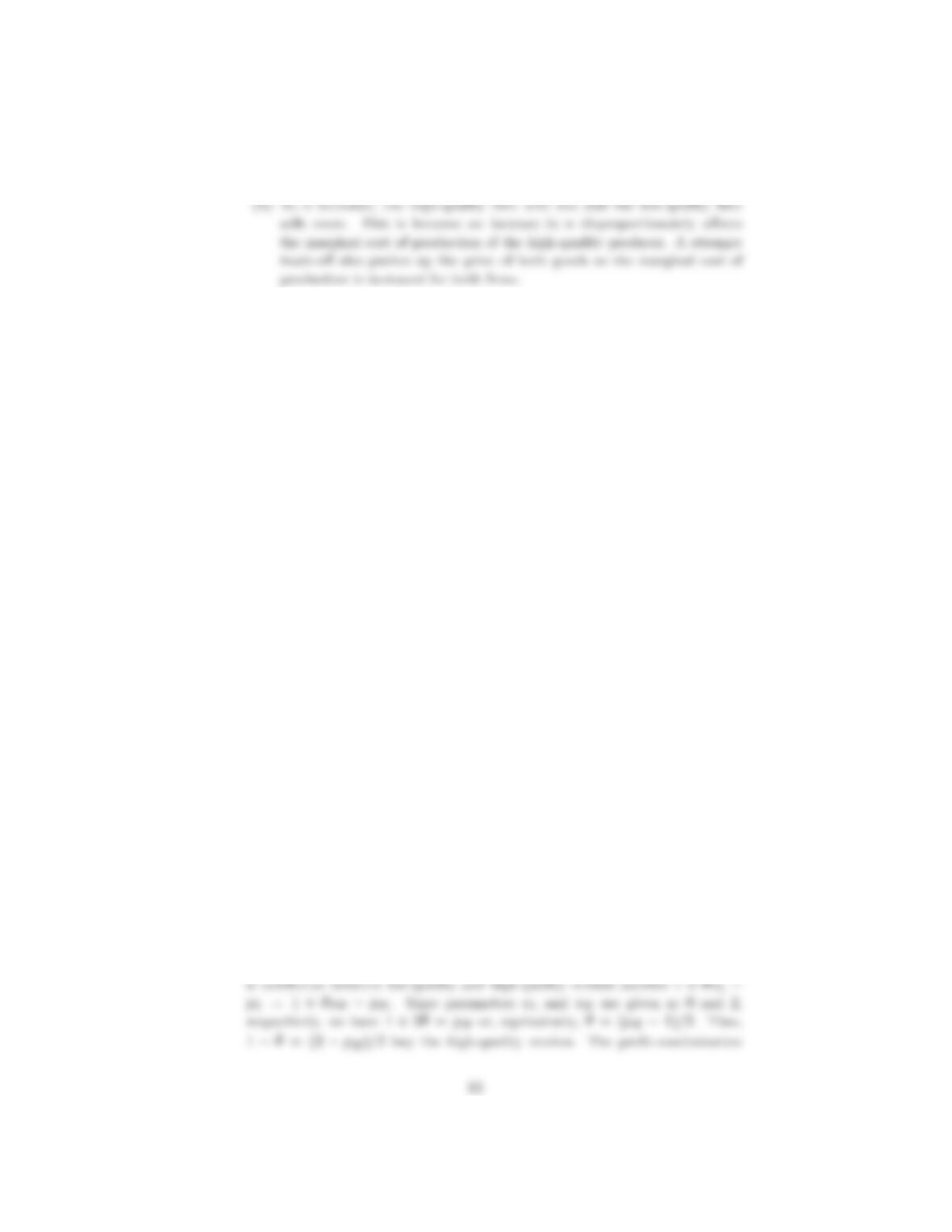
(a) The answer follows from the fact that both
1(s1;s2)and
2(s1;s2)in-
Exercise 9 Vertical product differentiation and product withdrawals
A continuum of consumers of mass 1 have unit demand for a product that
may be available in a low-quality and a high-quality version. A consumer of
type has valuation 1 + q pfor the version with quality qsold at price p; the
outside option of not buying in the market gives valuation 0. Type is uniformly
distributed on [0;1]. One or two firms are active in this product market. Their
marginal cost of production is equal to zero and, thus, independent of quality.
1. Consider the market environment in which firm 1 is a monopolist and
offers a low-quality version sL= 0 and a high-quality version sH= 2.
The regulator requires the firms to set its prices such that all consumers
buy in the market. Determine the monopoly solution (the monopolist sets
pLand pH).
2. Suppose that the low-quality version sLis not provided by firm 1, but by
firm 2. Firm 1 continues to offer sH. Characterize the duopoly solution
of the game in which the two firms simultaneously set prices.
3. Suppose now that firm 1 offers both versions sLand sHand firm 2 sL.
Characterize the duopoly solution of the game in which the firm 1 sets p1
L
and p1
Hand firm 2 simultaneously sets p2
L.
4. Suppose that firms have to pay a fixed cost K1=2for each product
they offer. Firm 1 has versions Land Havailable (it may offer none,
either one, or both) and firm 2 has only version Lavaialable (it may offer
this or no version). At stage 1, firms decide simultaneously whether to
withdraw any of the versions. At stage 2, they incur a fixed cost Kfor any
version they offer and simultaneously set prices for each available version.
Characterize the subgame-perfect equilibrium of this game.
Solutions to Exercise 9
1. Since all consumers have to buy, at least one of the two versions has to be
sold at a price not larger than 1. The monopoly optimally chooses to provide
the low-quality product at this price. Thus, pL= 1. The consumer who
2. There is now competition between both firms. Suppose that the regulatory
3. Both firms compete a la Bertrand with the low quality version. Thus, in equi-
librium, pL= 0. Hence, the firm 1 chooses its best response for its high–
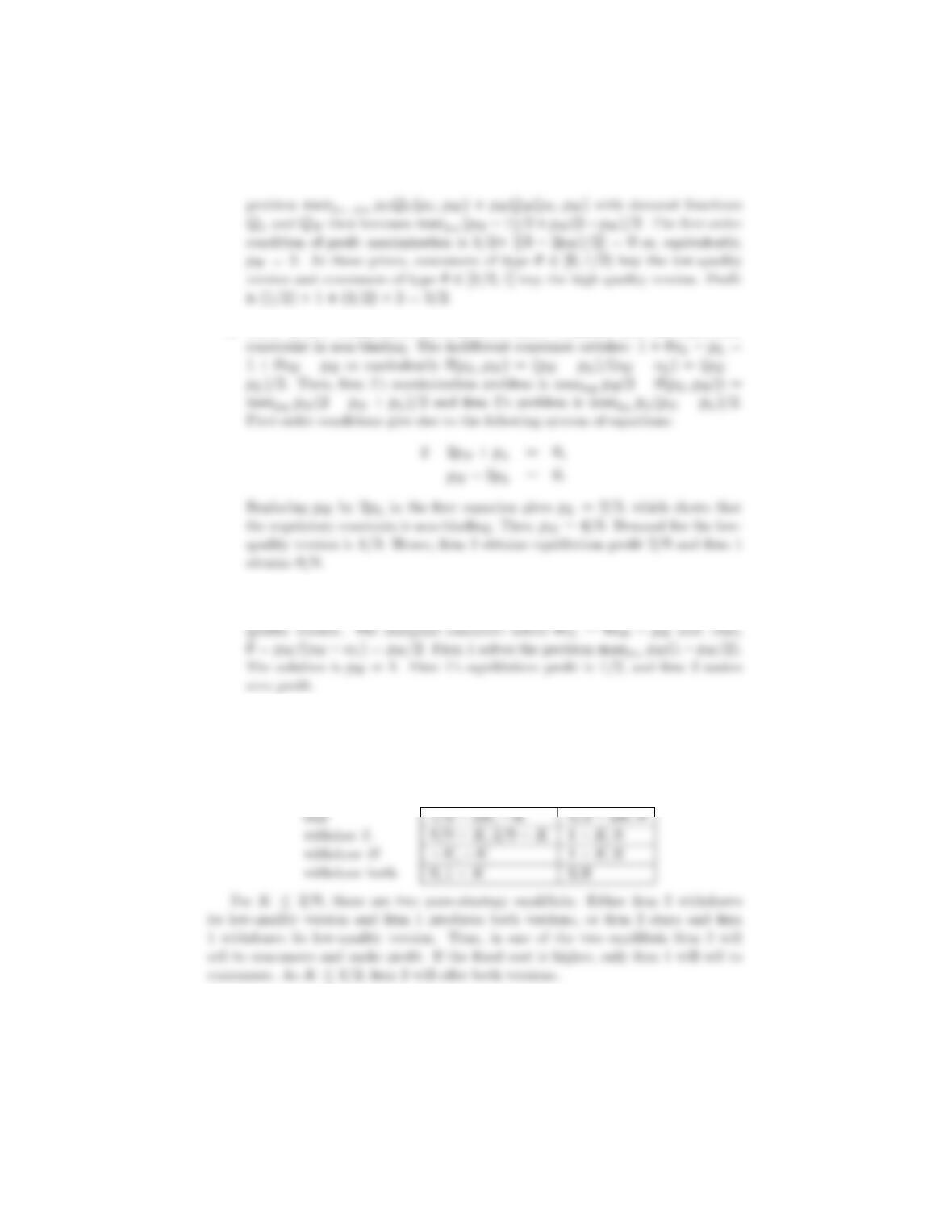
4. Based on the calculation in parts 1 to 3, we can write down the payoff matrix
at stage 1. We do so under the presumption that firm 1 does not withdraw the
high-quality version.
firm 1n2stay withdraw
Exercise 10 Exogenous and endogenous vertical differentiation and monopoly
discrimination
20