[2;3]. Both firms observe the two qualities of the product, consumers do not
observe the qualities. A consumer located at x2[0;1] derives utility Es1xp1
from product 1 and Es2(1x)p2from product 2, where Esiis the expected
quality of product igiven the information available to consumers.
1. Suppose that firms can simultaneously disclose their own quality siat
zero cost. Consumers then decide which product to buy. Characterize the
equilibrium of this game. Prove that it is the unique equilibrium.
2. Suppose now that disclosure is costly, i.e. a firm has to spend a given
advertising cost a2(0;1=4] to disclose its own quality. Suppose that
firm iconditions its action on sionly. Characterize the equilibrium of the
game in which firms first decide whether to advertise their own quality
truthfully or not to disclose any information and then consumers make
their choices. Note that firms know the cost aand make their disclosure
decisions simultaneously.
3. Suppose that instead of advertising their own quality, firms can costly
advertise only the quality difference s1s2, i.e. firms can only engage
in comparative advertising. Characterize the equilibrium in which both
firms simultaneously decide whether to disclose the quality difference at
cost a2(0;1=4].
4. Discuss verbally the welfare properties of the equilibria determined in (2)
and (3).
5. Consider now a model in which firms can choose not to advertise, to use
non-comparative advertising or to use comparative advertising. In the
last two cases the same advertising cost aapplies. Provide verbally an
intuition about the properties of the equilibrium of this game. To simplify
the argument, consider an alternative setting in which there are only two
discrete types si2 f2;3g.
Solutions to Exercise 183
1. Independent of sj, firm ialways discloses if si2(2;3]. To see this, note
that profit of firm iis i=qi1. Demand qiis determined as follows: The
34
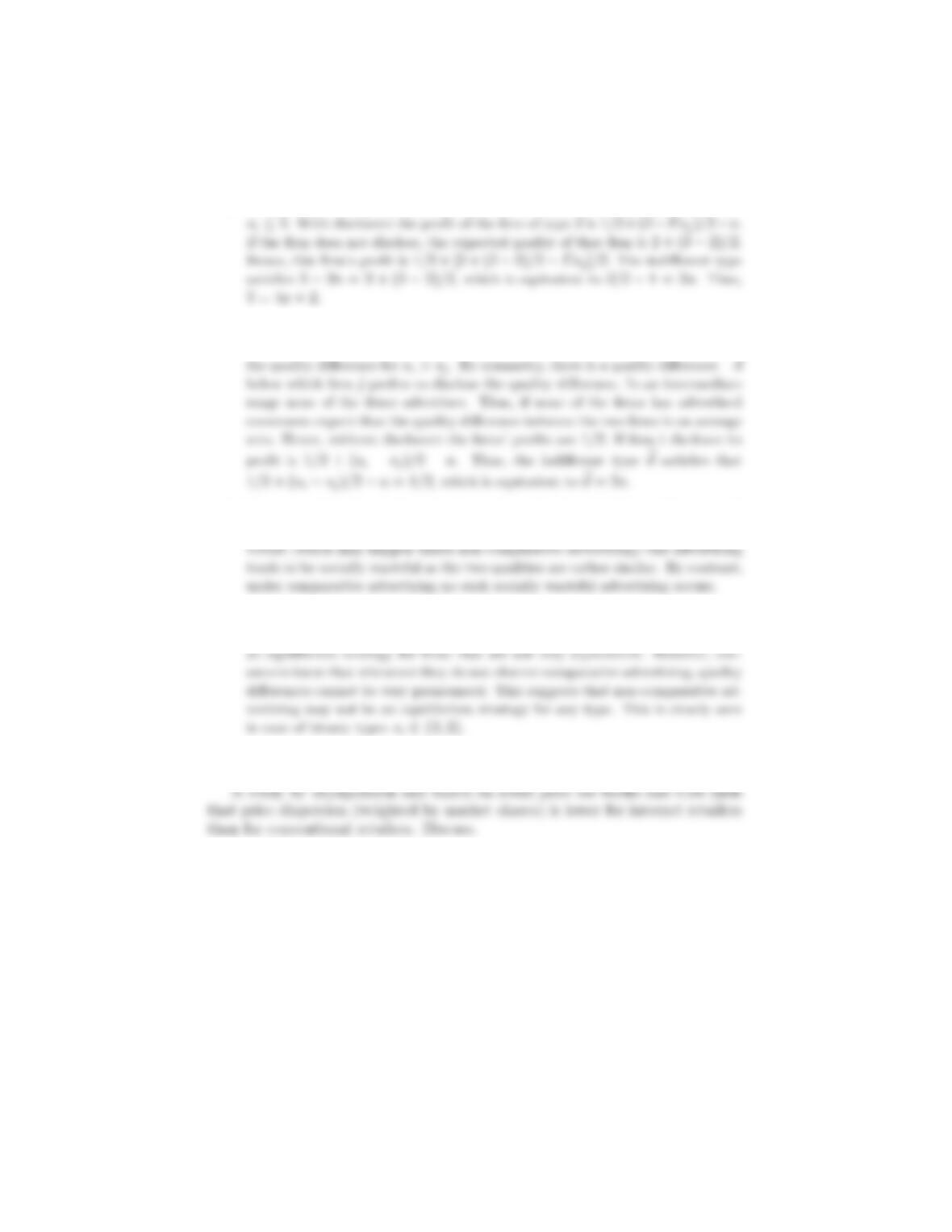
2. There exists a bs2[2;3] such firm idiscloses for sibsand does not disclose for
3. Clearly, only the firm with the higher quality may have an incentive to advertise.
There exists a critical quality difference b
dabove which firm iprefers to disclose
4. From a social point of view, disclosure is socially beneficial if qualities are suf–
ficiently asymmetric (not that the is full participation). When both firms ad-
5. If qualities are strongly asymmetric the high-quality firm has an incentive to
reveal this quality difference. This means that non-comparative can only be
Exercise 19 Price dispersion
Exercise 20 Spatial price dispersion
Two firms (1 and 2) produce a homogeneous good at zero marginal cost.
They face two types of consumers: a mass Nof consumers are informed about
the prices, p1and p2of the two firms and therefore buy from the cheapest firm;
a mass Mof consumers are uninformed in the sense that they only know the
price of one firm and therefore have a demand only for this firm. We assume
that M=M1+M2, where Miis the mass of consumers who can only observe
piand where M2> M1. All consumers have an inelastic demand: they buy at
most one unit of the good, as long as the price is not larger than their reservation
price R > 0.
35
1. Suppose that firm 1 sets its price before firm 2. Characterize the subgame-
perfect equilibrium of this two-stage game.
2. Repeat the previous question by supposing instead that it is firm 2 that
sets its price first.
3. Show that firm 1 has a second-mover advantage, while firm 2 is indifferent
between playing first or second.
Solutions to Exercise 20
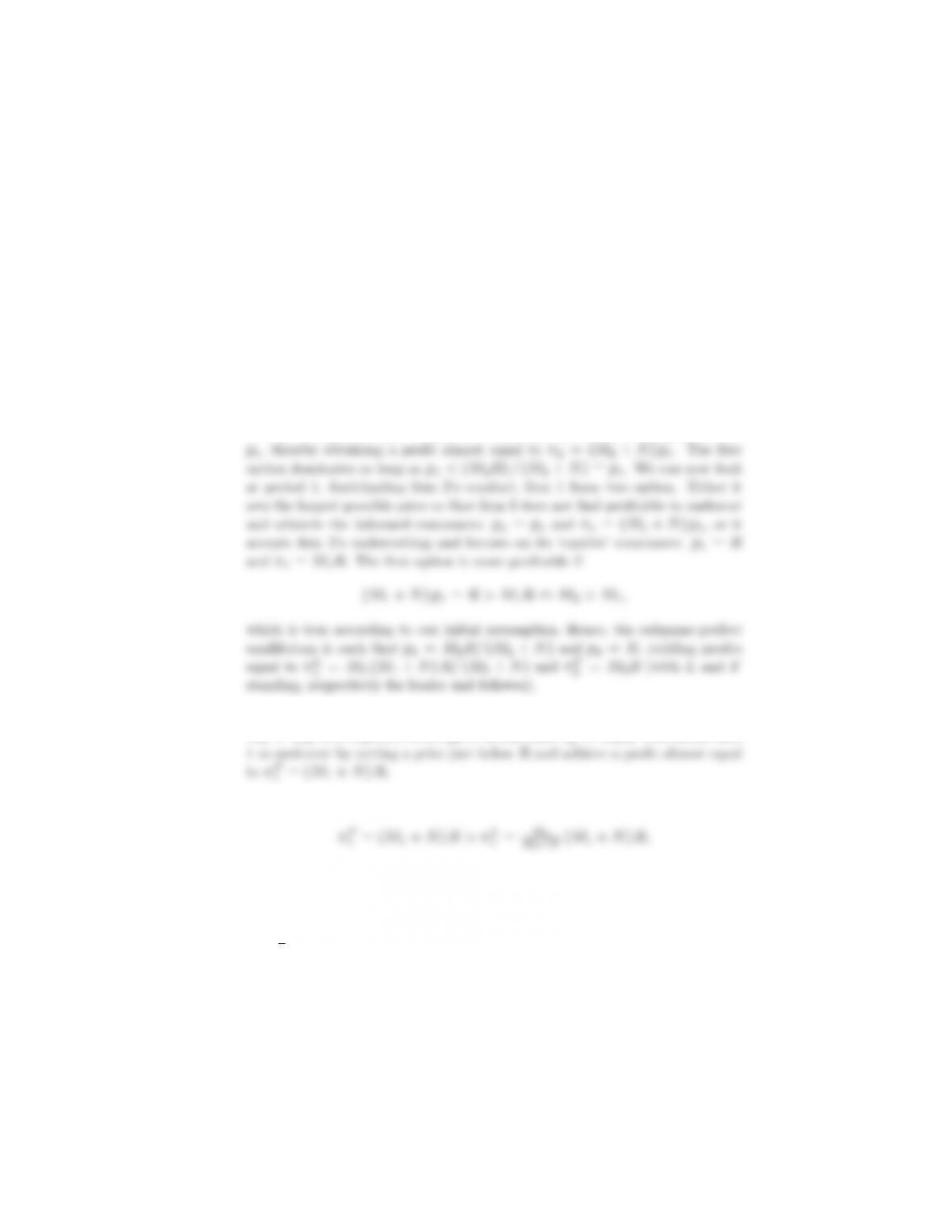
1. We start by solving the second-stage for any price pi2[0; R]set by firm 1. Firm
2 has two options. Either, it focuses on its ‘captive’ consumers and sets p2=R
to achieve a profit of 2=M2R, or it undercuts firm 1 by setting p2just below
2. The analysis of the second stage remains the same. As for stage 1, because
3. We see that L
2=F
2, whereas
Exercise 21 Another model of sales [included in 2nd edition of the book]
Consider a market for a homogenous product with nidentical price-setting
stores, where nis determined by free entry. Each store has a cost function
C(q) = pq, where qis the number of customers the store serves. There are
M+ 15 consumers in the market, each of whom wishes to buy up to one unit
and is willing to pay for it up to r= 1. The number of 15 consumers know the
prices charged by all the stores in the market (i.e., have zero search costs), while
Mconsumers do not know the prices at all (i.e., have prohibitively high search
costs). Of the latter M=n visit store iand none of the other stores, i= 1; :::; n.
36
1. Prove that there cannot exist a symmetric pure-strategy equilibrium in
this market.
2. Suppose that all the stores in the market use the same mixed strategy.
What is the support of the mixed strategy as a function of n?
3. Write the profit of a store when it charges p= 1 (hint: what is the
probability that when a store charges p= 1 it will have the lowest price in
the market?). Prove that this profit is zero. Use the zero profit condition
to compute the equilibrium number of firms, n. Given n, write the
support of the equilibrium mixed strategy of prices.
4. Compute the profits of a store when it happens to be charging the low-
est price in the market and when it does not. Using these expressions,
compute the equilibrium distribution of prices at each store, F(p).
5. What happens to the distribution of prices when the number of uninformed
consumers, M, increases? What does this result mean for the uninformed
consumers? Give an intuition for this.
6. What happens to the distribution of price paid by informed consumers
when the number of uninformed consumers, M, increases? Provide an
intuition for this result.
Solutions to Exercise 21
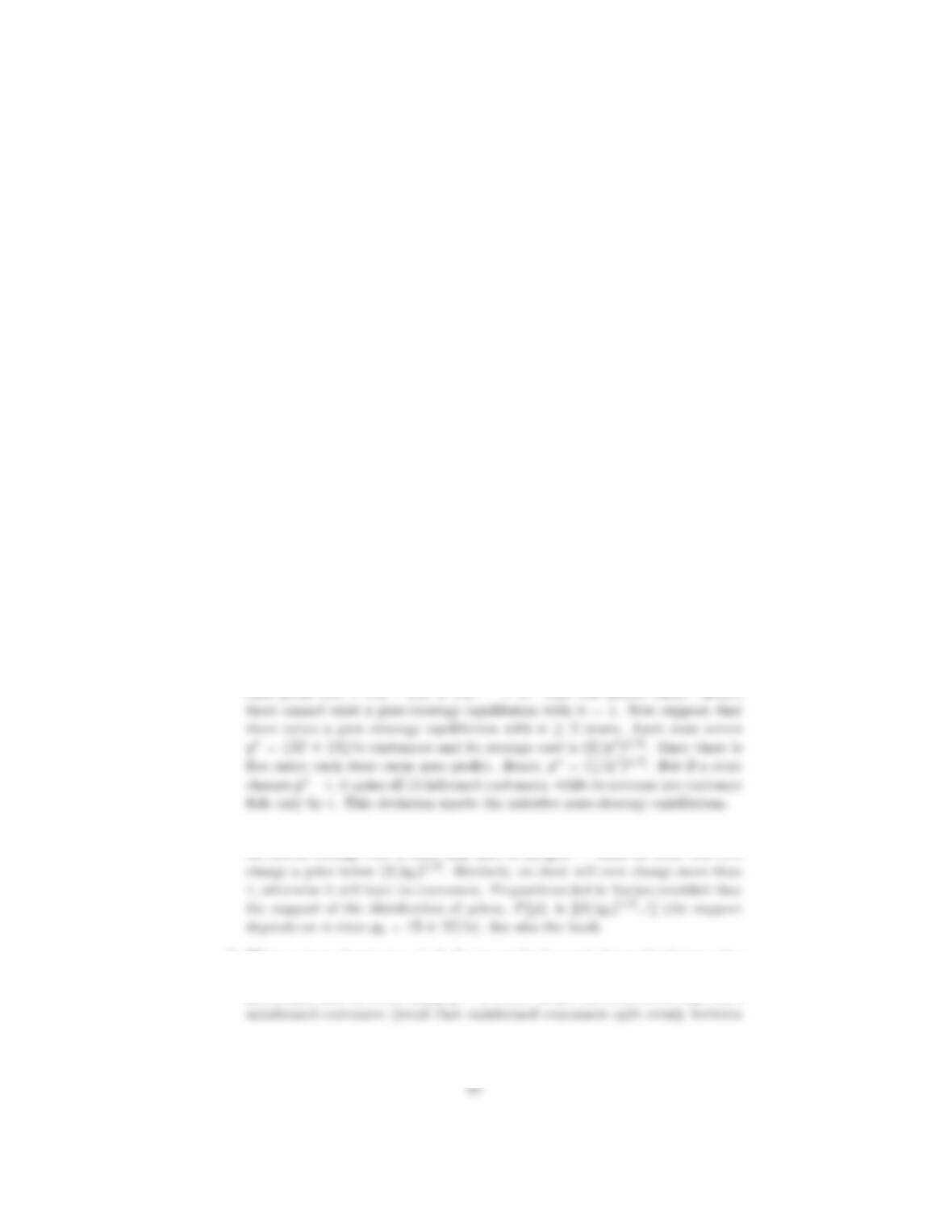
1. First, if n= 1 then the store will maximize profits by setting p= 1 and will
earn profit (M+ 15) (M+ 15)1=2>0. This will induce entry. Hence,
2. The largest number of customers one store may serve is qh= 15 + M=n. Hence
the lowest average cost a store may have is (1=qh)1=2. Thus no store will ever
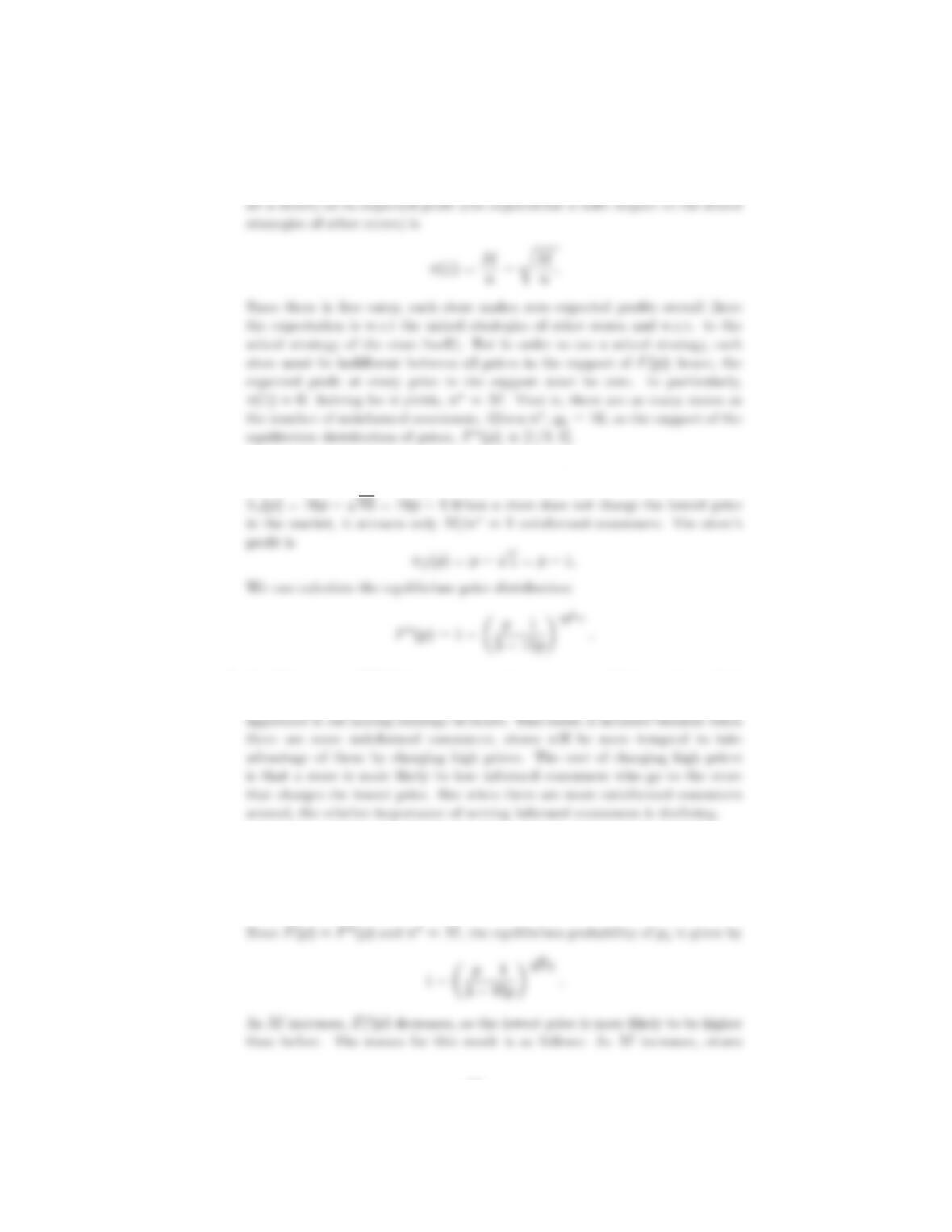
3. When a store charges p= 1, it almost surely does not charge the lowest price
in the market since stores use mixed strategies with no mass points so the
probability that all stores charge p= 1 is zero. Hence the store serves only M=n
4. When a store charges the lowest price in the market, it attracts 16 customers
(all 15 informed consumers plus 1 uninformed consumer). The store’s profit is
315p1
5. As Mincreases, F(p)decreases, so each store is more likely to charge high
prices. This means that the more uninformed consumers in the market, the less
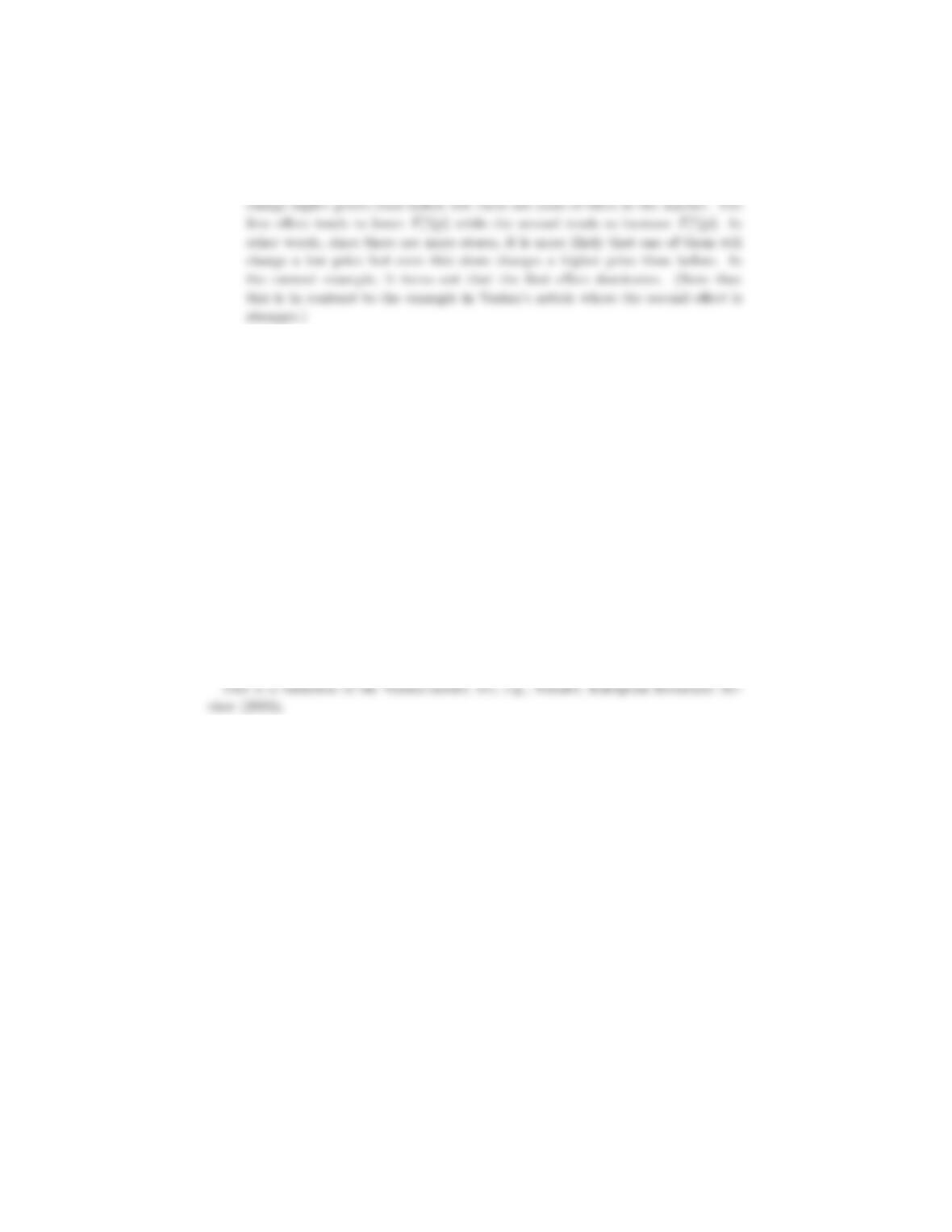
6. We label firm such that prices are in an increasing order, p1< p2< ::: < pn.
Informed consumers pay the lowest price on the market, i.e. p1. The distribution
of p1is given by
1(1 F(p1))n:
38
Exercise 22 Yet another model of sales
Suppose that two firms with constant marginal costs compete in prices
in a homogeneous product market. All consumers have unit demand and a
willingness-to-pay r. A share of consumers is informed about the prices in the
market. The share (1 )=2goes to firm i= 1;2and decides whether to buy
(these consumers do not know that a product from firm j6=iexists). Firms set
prices and then consumers make their consumption decisions.
1. Show that there does not exist a symmetric Nash equilibrium in pure
strategies.
2. Characterize equilibrium prices in the unique mixed-strategy Nash equi-
librium.
3. How do prices change if is increased?
4. How do equilibrium profits change as increases? (Calculate @=@.)
Solutions to Exercise 22
Exercise 23 Bargains and ripoffs
Consider a market for a homogenous product with nidentical stores, where
nis determined by free entry. Each store has a cost function C(q) = 4 + q, for
q4and C(q) = 1for q > 4(in other words, each store can sell up to its
capacity of 4 units and its cost of selling the first qunits is 4 + q). There are
Lconsumers in the market, each of whom wishes to buy up to 1 unit and is
willing to pay for it up to r= 5. Suppose that a fraction of all the consumers is
fully informed about the prices that the different stores charge. The remaining
(1 )Lconsumers are uninformed and have to pay a cost zin order to learn
the prices that different stores charge. If an uninformed consumer does not pay
z, she knows only the distribution of prices but not the actual prices charged
by each store. Such a consumer then picks a store at random. However, once
an uninformed consumer pays z, she becomes completely informed and knows
all prices charged by all stores.
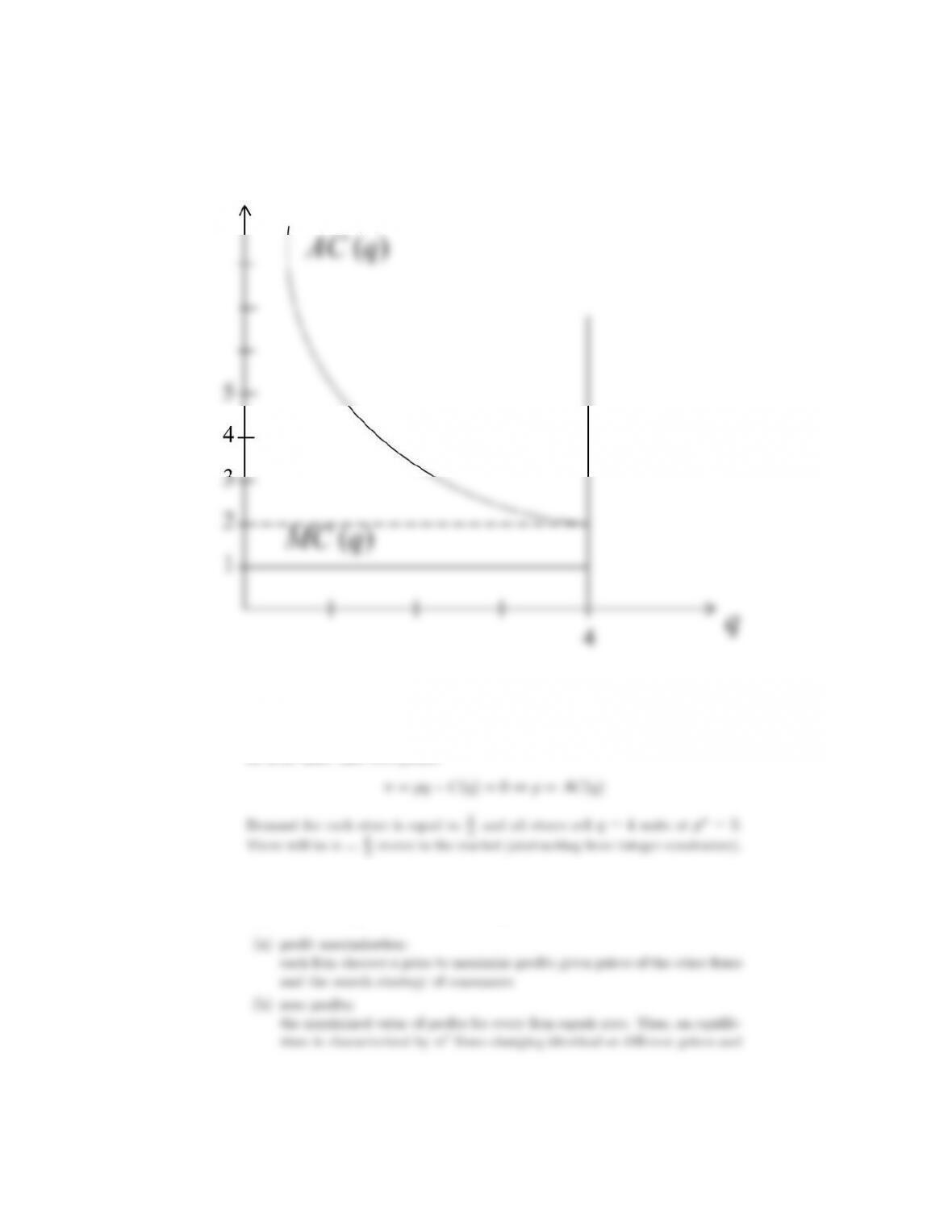
1. Compute the marginal and average costs of stores and illustrate it in a
figure.
39
2. Suppose that z= 0. Solve for the long-run competitive equilibrium in the
market.
3. Now suppose that z > 0. Prove that there can be at most 2 prices in a
Nash equilibrium.
4. Suppose from now on that parameters are such that firms optimally sell up
to capacity and that the high price is less than r. Assume that there are
two prices being charged in equilibrium. What is the low price, pl? Given
your answer, compute the high price, ph(hint: assume that a fraction of
all stores charge pland a fraction 1charge phand use the condition that
ensures that uninformed consumers do not find it worthwhile to search).
5. Compute the demand faced by low and high price stores (note that unin-
formed consumers pick stores at random so each stores gets an equal share
of the (1 )Luninformed consumers; informed customers are indifferent
among all stores that charge low prices, so each one of these store gets an
equal share of the L informed consumers).
6. Restict from now on attention to the parameter range such that ph< r.
Use your answers in (4) and (5) to express the zero profit conditions for
high and low price stores (recall that there is a free entry so in equilibrium,
each store must earn a zero profit).
7. Solve the conditions you wrote in (6) for and n.
8. How do the equilibrium values of and nvary with z? Explain the
intuition for your result.
9. Compute the average price on the market and the standard deviation of
prices. Using these calculations, let P D =SD=AP be a measure of price
dispersion, where SD is the standard deviation of prices, and AP is the
average price. How is P D affected by z? How is P D affected by ?
Explain.
Solutions to Exercise 234
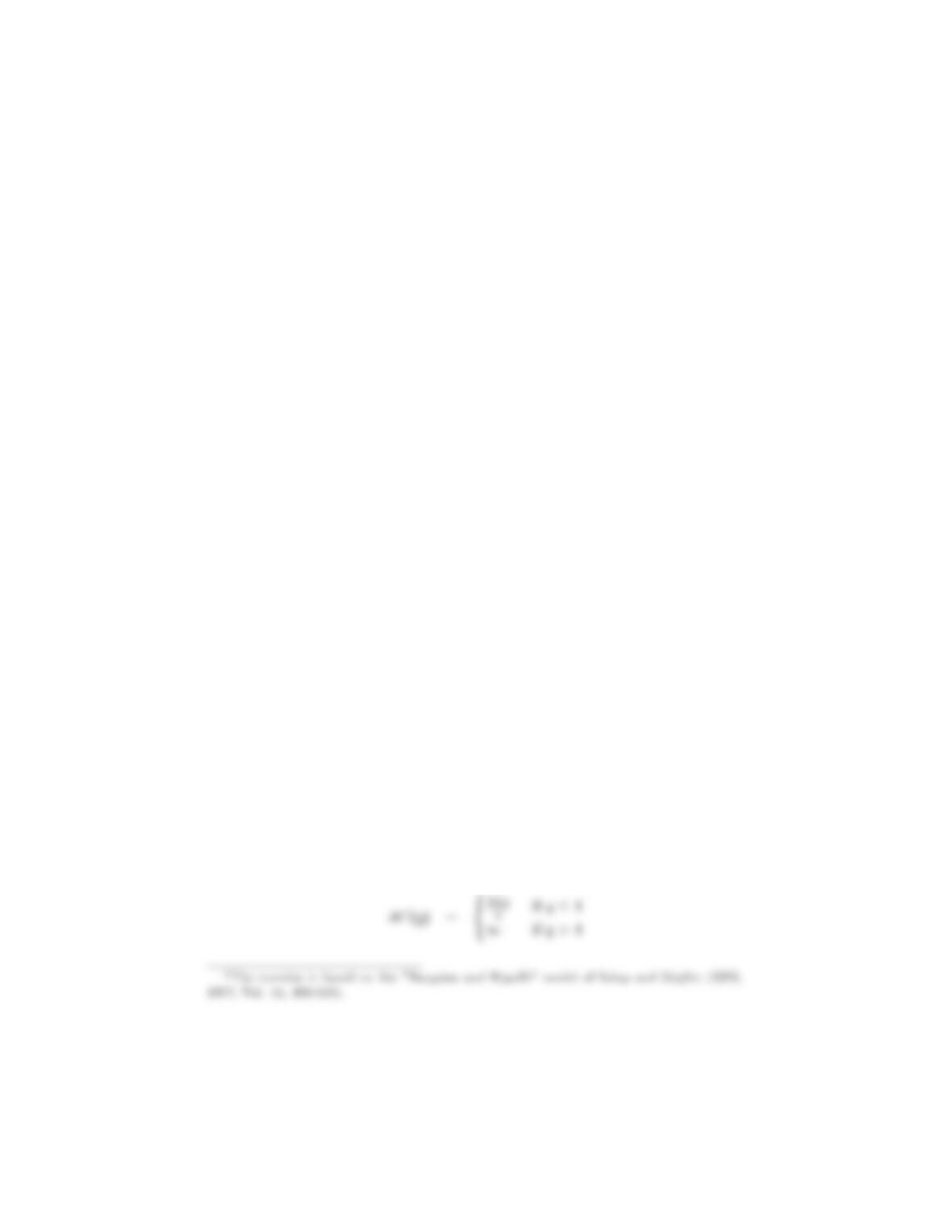
1.
MC =C0(q) = 1 for q4
qif q4
40
2. At z= 0, all consumers can become informed at zero cost. Thus, in equilibrium
all firms set the same price. Price must be such that no more entry occurs, i.e.
all firms must earn zero profits
3. An equilibrium consists of a number nof firms in the market and a price
vector p=fp
1; :::; p
ng. It gives rise to a percentage of consumers gathering
information. In equilibrium the following has to hold:
41
4. Two prices charged in equilibrium: pl; phsuch that uninformed consumers stay
uninformed and choose randomly. If uninformed consumers pay average price p
5. ph-firms: qh= (1 )L
n
n
|{z}
share of informed consum ers
n
|{z }
share of uninformed consumers
6. l= 0 ,pl=C(ql)
ql,2 = 4+q
q
n(1+
)
8. @
@z =(1)
(+z(1))2<0
!as it becomes harder to inform, i.e. as z“, the fraction of firms that demand
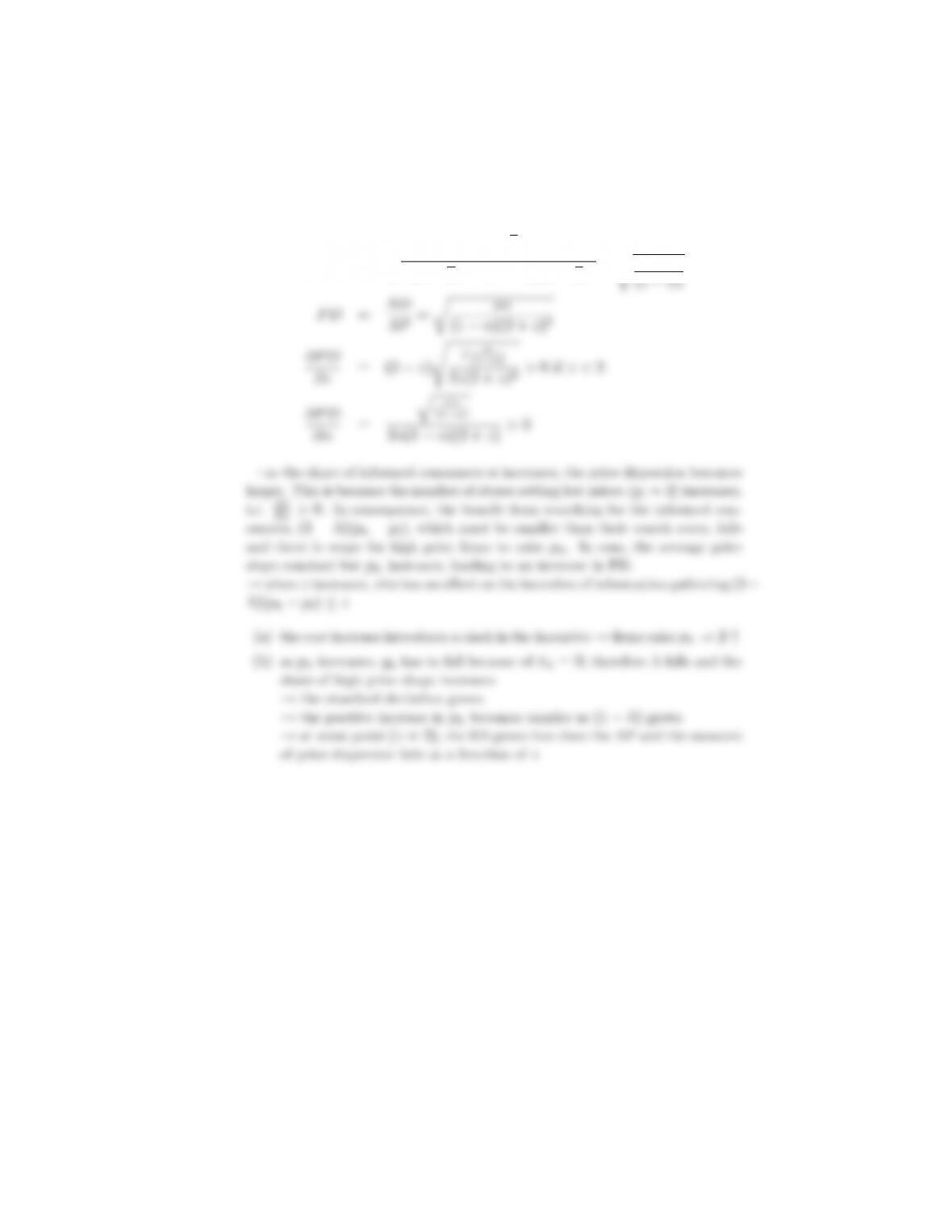
9.
AP =pl+ (1 )ph=p= 2 + z
SD =p(plp)2+ (1 )(php)2=rz
Exercise 24 Switching costs and competition
Switching costs relax competition and their presence are therefore profit-
enhancing. Is this statement necessarily correct? Explain.
Exercise 25 Switching costs and ex post competition
There are two firms, noted Aand B, producing a homogeneous good; their
marginal cost of production is normalized to zero. There is a unit mass of
consumers who have a unit demand for the good; their reservation price for the
good is equal to r > 0. In period 1, consumers bought one unit of the good
from one or the other firm; in particular, a mass Aof consumers bought from
firm A, and a mass Bfrom B, with A+B= 1. We concentrate here on the
period 2 game: the two firms set simultaneously their price (noted pAand pB)
44
and consumers decide from which firm to buy, given the two prices and given
the presence of a switching cost z < r, which they have to incur if they switch
firms from period 1 to period 2.
You are asked to characterize the Nash equilibrium in the price competition
game of period 2. In particular, answer the following three questions.
1. Given rand z, for which pairs (A; B)does a symmetric pure-strategy
Nash equilibrium exist in this game?
2. For which values of rand zwill there be no symmetric pure-strategy Nash
equilibrium in this game for any pair (A; B).
3. Give the economic interpretation of your results.
Solutions to Exercise 25
1. For z= 0, we are in the traditional Bertrand game and the unique Nash
equilibrium is pA=pB= 0. Now, suppose z > 0. Consider a candidate
symmetric equilibrium pA=pB=p. Take firm Asupposing that pB=p.
2. It is clear from the previous answer that no symmetric pure-strategy Nash
3. The presence of switching costs gives market power to the firms over their
locked-in consumers. (Note that in this problem, we only look at this
45
Exercise 26 Switching costs and pricing strategy
Suppose that two software companies launch a new software each. One of
them is called COOL, the other GREAT. There is a unit mass of consumers.
All of them consider the two software offers as identical. Both softwares are
produced at zero marginal costs and consumers are willing to pay rfor the
software.
1. Suppose that firms set prices and compete only in one period. Character-
ize equilibrium prices, allocation and profit. (If a group of consumers is
2. Suppose that each firm sold to half of the consumers their software and
that they launch new products COOL2 and GREAT2. Consumers are
willing to pay rfor the new products. Suppose, however, that consumers
3. Consider now the market environment in which the firm that produces
COOL in period 1 and COOL 2 in period 2 is aware of the fact that it will
4. Suppose now that consumers who bought COOL will not consider buying
GREAT2 in period 2 and that consumers who bought GREAT will not
5. Provide some real-world examples that have some similar features as the
6. Consider the market environment as described in (4). Suppose the courts
46