Solutions to Exercise 15
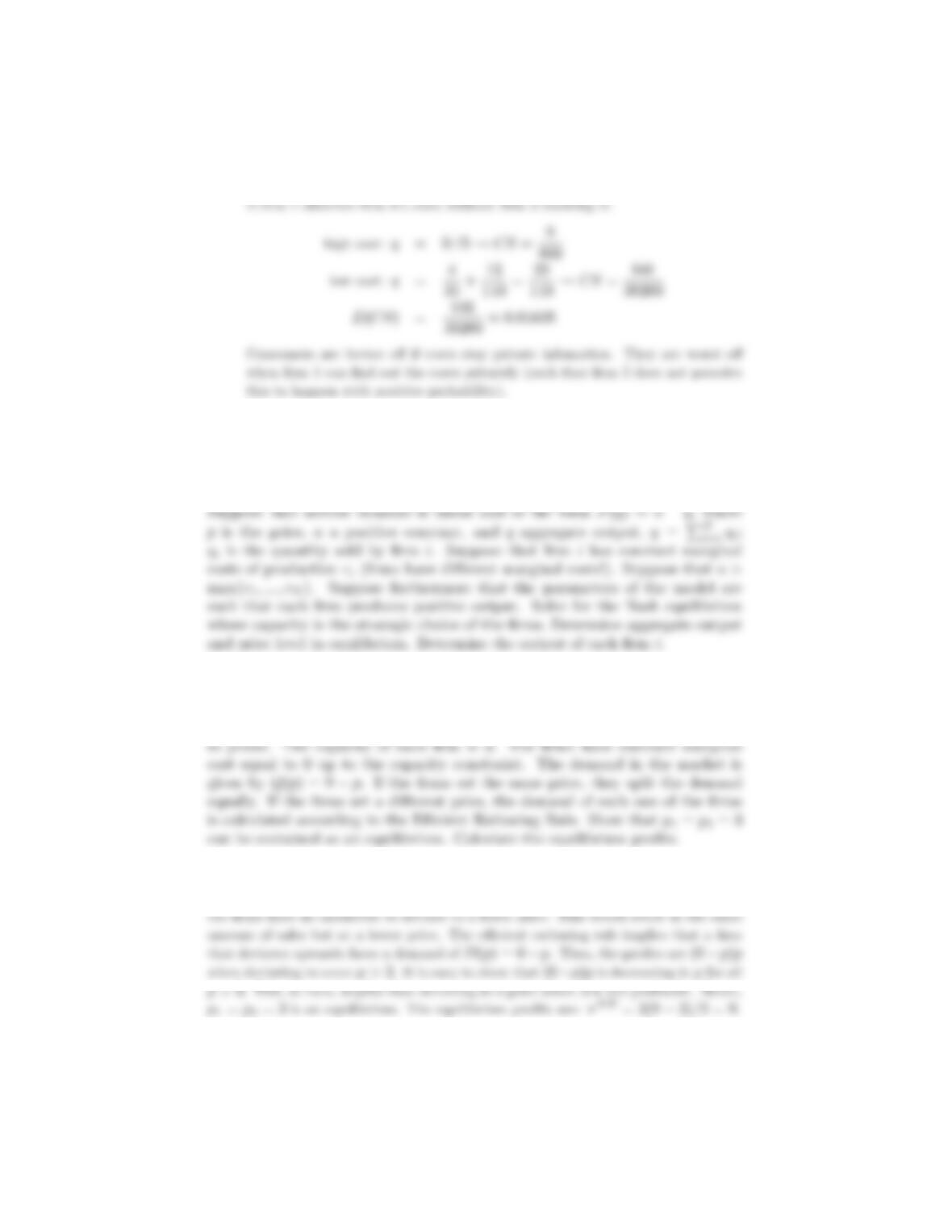
1. In this situation firms share information. Suppose that firm 2 has high costs.
The maximization problem of firm 1 is
max
q1
1= (1 q1q20:7)q1
q1=0:3
2= 0:15
1= (1 0:15 0:7)0:15 = (0:15)2= 0:0225
Suppose that firm 2 has low costs. Firm 1’s best response is the same as above.
Substituting firm 2’s best response into firm 1’s best response gives firm 1’s
equilibrium quantity. Substituting back into the expression for q2gives firm 2’s
equilibrium quantity. Obviously, the the lower cost firm (firm 2) makes higher
profits than its competitor.
q
1=3
20 7
80 +q1
4
1
2. Firm 2 privately observes its cost type. We solve for Bayesian NE in this static
game with asymmetric information. Firm 2’s best response depending on its
type is calculated as follows:
2= (1 q1q2c2)q2
E(q2)
q1=0:3E(q2)
2
NE strategies are fq
1=17
140 ;qL
2=4
35 ;qH
2= 0g. Equilibrium profits are
3. Firm 2 has an incentive to disclose its cost. If it is of high cost, it makes zero
4. If firm 1 finds out costs publicly, its expected profits are
E(1) = 1
2(0:15)2+1
2
1
144 =53
3600 0:01472;
20)2=9
400
When firm 2 has low costs, firm 1 will maximize
1= (0:3q14
35)q1,q1=13
140
5. Are consumers better off if firm 2’s costs stay private information?
If firm 2’s costs are publicly observed:
low cost: q=1
12 +2
15 =13
60 0:216
18
Exercise 16 Strategic capacity choice
Consider a market in which firms 1; :::; N set simultaneously capacities for
a homogeneous product and afterwards a third party, which observes market
demand and the capacity choice of each firm sets the market clearing price.
Exercise 17 Price setting in a market with limited capacity [included in the
2nd edition of the book]
Suppose that two identical firms in a homogeneous-product market compete
Solutions to Exercise 17
At the prices p1=p2= 3, both firms produce at full capacity. We conclude that
Exercise 18 Capacity-constrained imperfect competition
19

Suppose two firms in an industry face linear inverse demand curves Pi(qi; qj) =
7qiqj,i= 1;2,i6=j. Firms compete in a two-stage game; first they set ca-
pacity and then they set price or output. At the first stage firms set capacities,
at this stage the marginal costs of capacity is 6. Suppose that firms have zero
marginal costs of production up until installed capacity and that production
above capacity is not feasible. In case of rationing, rationing is assumed to be
efficient.
1. Suppose each firm has a capacity of 7. Analyze competition at stage 2.
Determine the Nash equilibrium if both firms set prices.
2. Consider the same situation as in (1) but suppose that firms choose quan-
tities, not prices at stage 2. Determine the Nash equilibrium.
3. Consider the same situation as in (1) but suppose that consumers do not
observe price and incur a cost of 1=2if, after visiting one firm, they decide
to visit the other firm. [You can think of identical consumers with the
demand function as given above]. Characterize the equilibrium if both
firms set prices. (What is the appropriate equilibrium concept here?).
Give an explanation (at most 2 sentences).
4. Suppose that firms have given capacities q1and q2, respectively. If firm 1
is the high-price firm, what is its demand function? Determine the Nash
equilibrium in prices (provided that qi49=24,i= 1;2). Show that
equilibrium prices satisfy p1=p2=aq1q2.
5. Determine the subgame perfect equilibrium of the two-stage game in which
firms first set capacities and then prices. Give an explanation (at most 3
sentences).
6. Suppose that firms collude at the stage at which they set capacity. What
should they do?
7. Suppose that firms are able to use a less costly technology (e.g., the mar-
ginal cost of capacity falls from 6to 11=2). What are the competitive
effects of this reduction in capacity costs? What would happen if those
costs fell to zero? Discuss your results.
Solutions to Exercise 18
1. Suppose that capacity is 7
!NE in prices
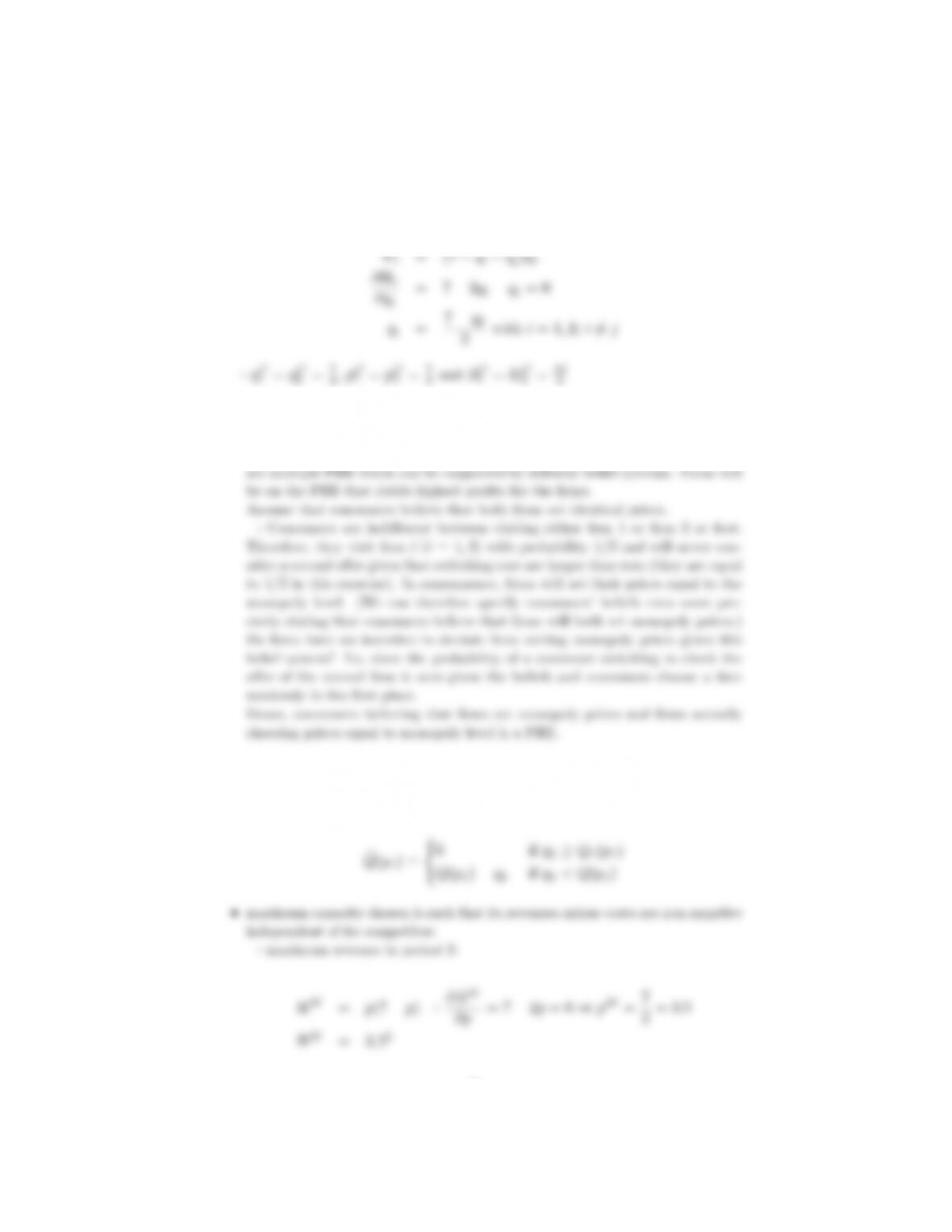
2. Suppose that capacity is 7
!NE in quantities:
3. Consumers do not observe prices before consumption
The appropriate equilibrium concept is a Perfect Bayesian Equilibrium (PBE)
since consumers’ decision which firm to choose depends on their beliefs. There
4. Suppose that firms have given capacities q1and q2:
efficient rationing rule implies the following demand for firm 1 (residual demand
for those not served by firm 2):
21
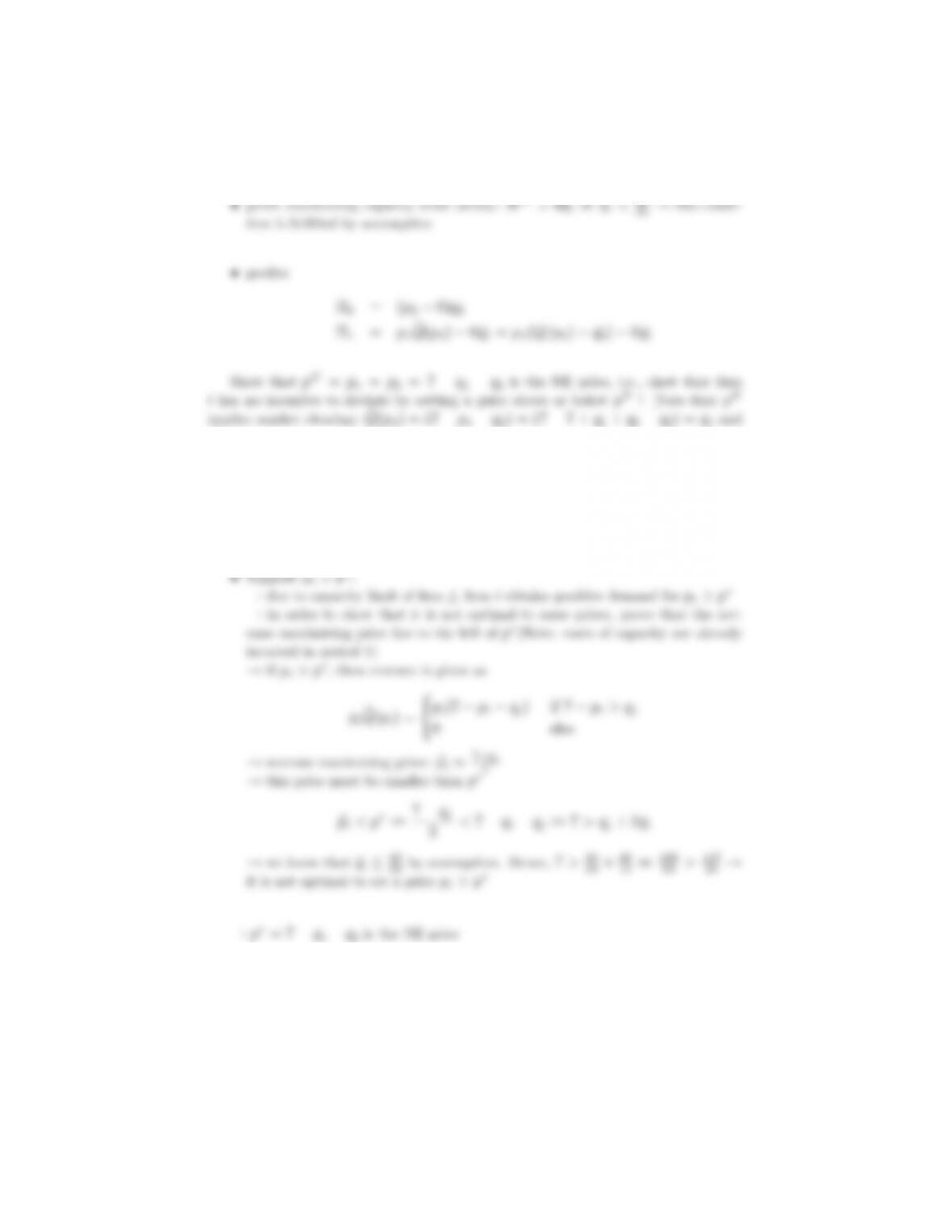
Q(p2) = q2]
Suppose pi< p:
!at pfirm isells all its capacity
!lowering piwould increase demand above capacity
!still sell qi, but at lower price !i#
5. SPNE of the two-stage game
!second stage: see 4)
22
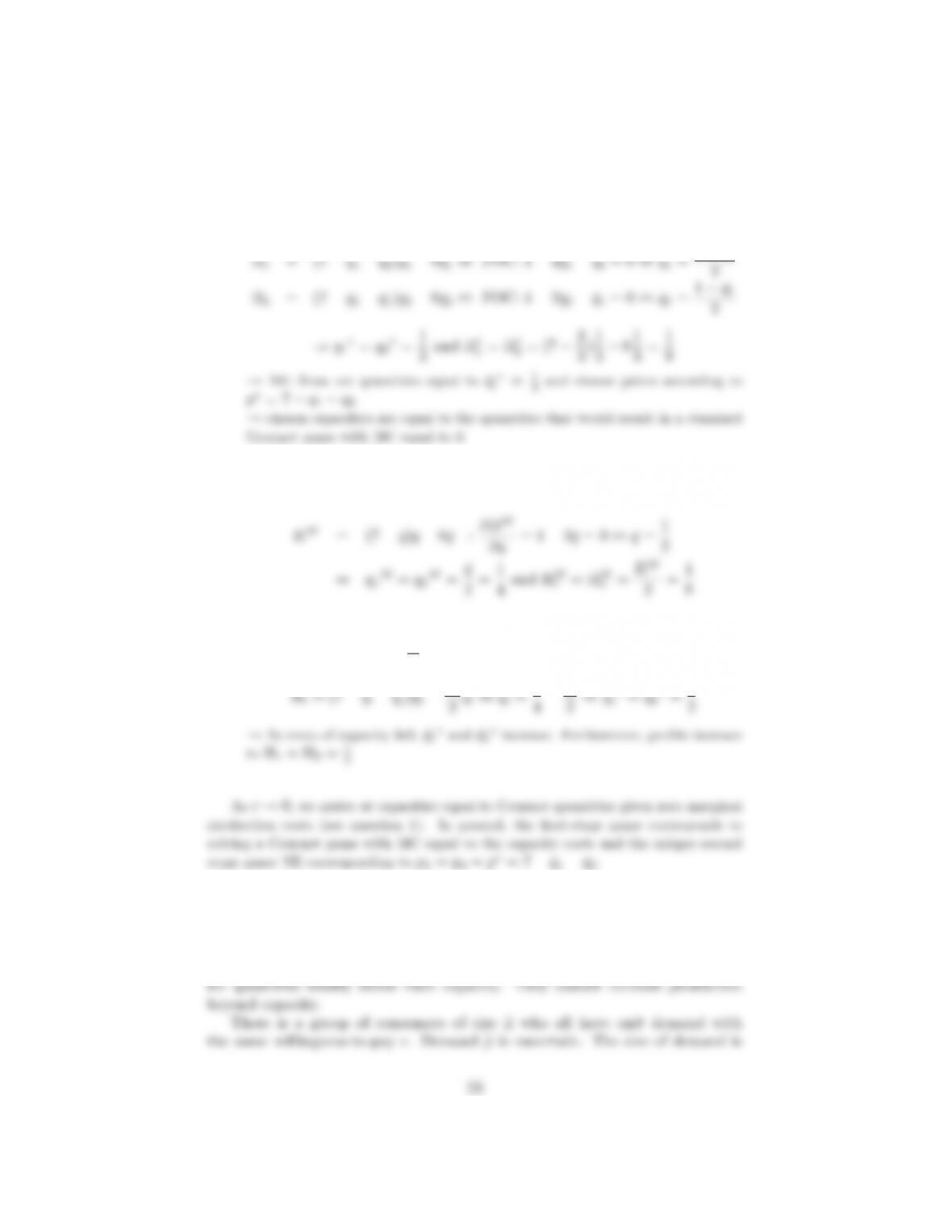
!first stage: plug in NE prices in the profit function:
6. If firms collude at the capacity setting stage, they maximize joint profits:
7. Reduction in MC to c=11
2changes the results of the first stage:
= q2
=1
Exercise 19 Competition, installed capacity, and demand uncertainty
Suppose two firms, firm 1 and firm 2, operate in a homogeneous good market.
The supply of firm i, denoted by qi, is constrained by installed capacity ki,
i.e., 0qikifor i= 1;2. Firms have zero marginal costs of production
1. Determine the allocation at stage 2 for given capacity choice.
2. Determine the Nash equilibrium at stage 2 for given capacities. Here you
have to distinguish between four different parameter regions. Note that
3. Analyze the 2-stage game and solve for subgame perfect Nash equilib-
ria (HINTS: Do not treat firms as symmetric. Consider capacity as a
pure strategy). What is the expected profit at this stage? Draw the best-
Exercise 20 Cournot equilibrium and competitive limit
Suppose there are Nfirms in a homogeneous good market which set their
output sequentially (firm iin period i). Suppose that firms have identical con-
stant marginal costs of production c. The industry faces an inverse demand
P(q) = aqwhere q=PN
i=1 qiis aggregate demand. Suppose that a > c.
1. What is the output level of firm iin the subgame perfect equilibrium?
2. What is the aggregate output for Nfirms?
3. Describe the equilibrium outcome when the number of firms increases
without bounds (N! 1).
Solutions to Exercise 20
Nfirms, M C = 0, homogenous good, output is set sequentially
)Search for SPNE (backward induction starting in period Nwith firm N)
24
25
Exercise 21 Competing in price-quantity pairs
Consider a duopoly for a homogeneous product. Firms i= 1;2set price-
quantity pairs (pi; qi)simultaneously. If at these pairs some consumers are
Exercise 22 Sequential price setting with differentiated products [included in
the 2nd edition of the book]
Consider a market with two horizontally differentiated products and inverse
demands given by Pi(qi; qj) = abqidqj. Set b= 2=3and d= 1=3. The
system of demands is then given by Qi(pi; pj) = a2pi+pj. Suppose firm
1has cost c1= 0 and firm 2 has cost c2=c(with 7c < 5a). The two firms
compete in prices. Compute the firms’ profits:
1. at the Nash equilibrium of the simultaneous Bertrand game,
2. at the subgame perfect equilibrium of the sequential game
(a) with firm 1being the leader, and
(b) with firm 2being the leader.
3. Show that firm 2always has a second-mover advantage, whereas firm 1
has a first-mover advantage if cis large enough.
4. Solve for the Nash equilibria of the endogenous timing game in which
firms simultaneously choose whether to play ‘early’ or to play ‘late’. If
they both make the same choice (either ‘early’ or ‘late’), the simultaneous
Bertrand game follows; if they make different choices, a sequential game
follows with the firm having chosen ‘early’ being the leader.
Solutions to Exercise 22
1. Nash equilibrium of the simultaneous Bertrand game. Firm 1 chooses p1to
maximize 1= (a2p1+p2)p1. Solving the first-order condition for p1, one
2. Sequential game
26
(a) If firm 1 is the leader, it takes firm 2’s price reaction into account when
(b) If firm 2 is the leader, it takes firm 1’s price reaction into account when
maximizing profits; that is, it chooses p2to maximize 2= (a2p2+
3. Firm 2 always has a second-mover advantage: F
2= (19a26c)2=1568 > L
2=
Exercise 23 Timing game [included in the 2nd edition of the book]
Use the results of the previous exercise to solve for the Nash equilibria of
the endogenous timing game in which firms simultaneously choose whether to
play ‘early’ or to play ‘late’. If they both make the same choice (either ‘early’ or
‘late’), the simultaneous Bertrand game follows; if they make different choices,
a sequential game follows with the firm having chosen ‘early’ being the leader.
Discuss the economic intuition behind your result.
Solutions to Exercise 23 The following matrix represents the normal form of
the game:
Firm 1 / Firm 2 Early Late
As far as firm 2 is concerned, we already know from Exercise 4.1 that F
2> L
2. It
27
Exercise 24 Information sharing in Cournot duopoly [included in the 2nd edi-
tion of the book]
Consider the Cournot duopoly with linear demand P(q) = 1 qwith q=
q1+q2and constant marginal cost. Firm one has marginal cost of zero. This is
commonly known. The marginal cost of firm 2 is privately known to firm 2; firm
Solutions to Exercise 24
Suppose first that firm 2 shares its information. In this case firm 1 learns the cost
type of firm 2. If firm 2’s costs are high, firm 1 knows that firm 2 will produce zero;
thus, firm 1 will produce the monopoly quantity qm
1= 1=2; the monopoly profit is
Solving this system we obtain q2= 2=7and q1= 3=7. We note that qm
1= 1=2>
3=7>1=3 = qd
1. Equilibrium at stage 2 under information sharing are
Exercise 25 Price competition and information sharing
Consider the same setting except that firms face a different demand function
and that firms set prices at stage 3. Let demand be Qi= 1 pidpjwith
d > 0so that products are substitutes and d < 1. Characterize the equilibrium
of this game. Does firm 2 have an incentive to share its private information?
Solutions to Exercise 25
Suppose that firm 2 decides to share its information at stage 2. If its costs are high,
firm 1 knows that firm 2 will produce zero. Thus, firm 1 will set the monopoly price
pm
1= arg maxp1(1 p1)p1= 1=2. If the costs are symmetric, we have a symmetric
price competition model with linear demand. Each firm imaximizes (1 pidpj)pi