Industrial Organization: Markets and Strategies
Paul Belle‡amme and Martin Peitz
published by Cambridge University Press
Part II. Market power
Exercises & Solutions
Exercise 1 Monopoly with quality choice
Consider a monopolist who sells batteries. Each battery works for hhours
and then needs to be replaced. Therefore, if a consumer buys qbatteries, he
gets H=qh hours of operation. Assume that the demand for batteries can be
derived from the preferences of a representative consumer whose indirect utility
function is v=u(H)pq, where pis the price of a battery. Suppose that u
is strictly increasing and strictly concave. The cost of producing batteries is
C(q) = qc(h), where cis strictly increasing and strictly convex.
1. Derive the inverse demand function for batteries and denote it by P(q).
2. Suppose that the monopolist chooses qand hto maximize his profit. Write
down the first-order conditions for profit maximization assuming that the
problem has an interior solution, and explain the meaning of these condi-
tions.
3. Write down the total surplus in the market for batteries (i.e., the sum
of consumer surplus and profits) as a function of Hand h. Derive the
first-order conditions for the socially optimal qand hassuming that there
is an interior solution. Explain in words the economic meaning of these
conditions.
4. Compare the solution that the monopolists arrives at with the social op-
timum. Prove that the monopolist provides the socially optimal level of
h. Give an intuition for this result.
Solutions to Exercise 1
1. The inverse demand for batteries is obtained by solving the following problem:
2. The monopolist’s maximization problem is given by
max
q;h qP (q)qc(h);
1
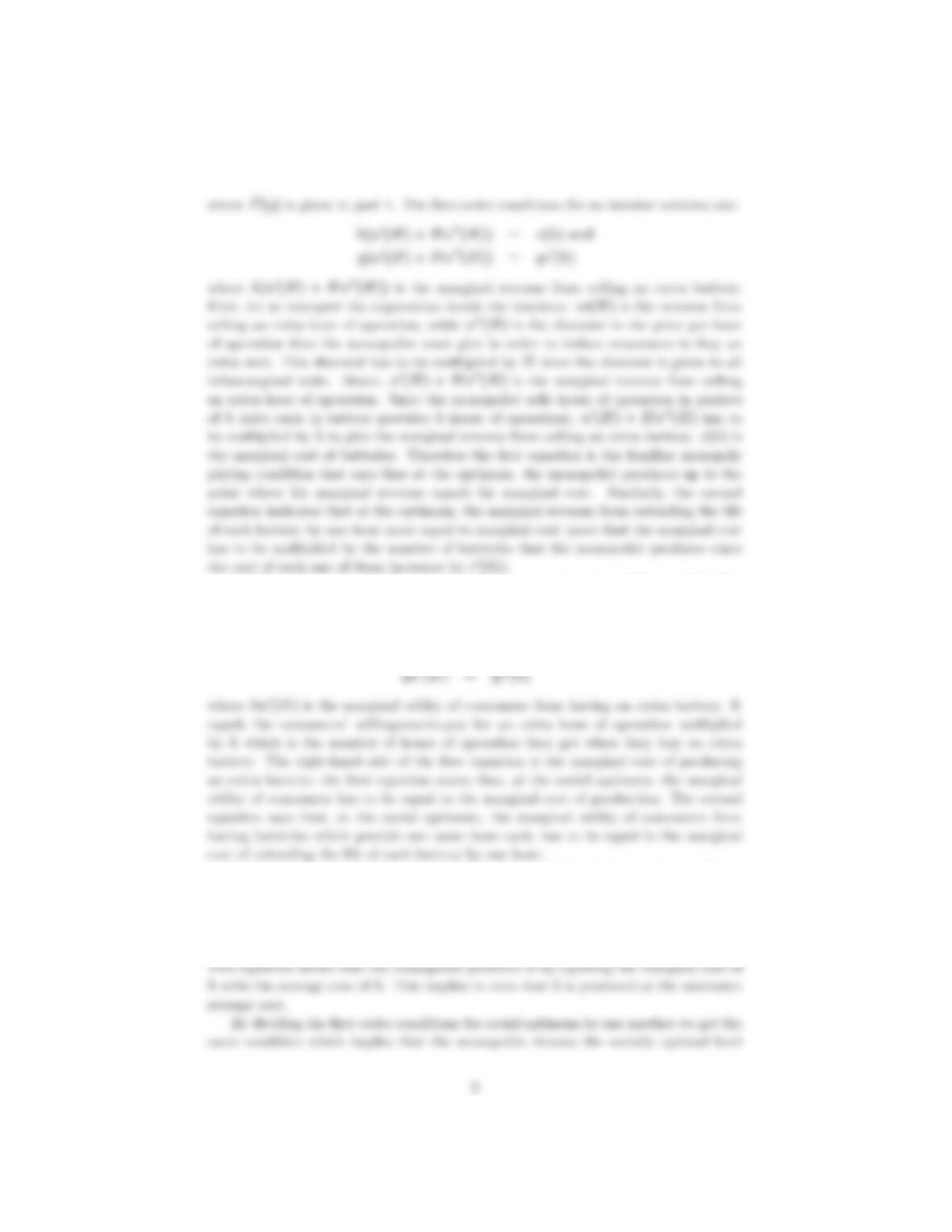
3. The total surplus in the market for batteries is given by u(H)qc(h). The
first-order conditions for the social optimum (assuming that an interior solution to
this problem exists) are
hu0(H) = c(h)and
4. To compare the solutions in parts 2 and 3, we divide the first-order conditions
for the monopoly problem by one another:
h
q=c(h)
qc0(h),c0(h) = c(h)
h:
Exercise 2 Monopoly versus Duopoly
Consider a market in which consumer type xis uniformly distributed on
the unit interval. Consumers demand 0 or 1 unit (they buy at most one unit
overall in the market). Firm Ais located at 0 and firm Bat 1. Firms incur
constant marginal costs of production c= 1=2. There is mass 1 of consumers.
A consumer located at x2[0;1] obtains utility ux=rxpAif she buys from
firm A;ux=r(1 x)pBif she buys from firm B; and 0if she does not
buy. If more than one firm is present, firms simultaneously set prices.
1. Consider the monopoly problem in which only firm Ais present and sets
its prices to maximize profits. Calculate the monopoly solution depending
on rwhere r2[0;4].
2. Consider the duopoly problem in which firms compete in prices. Solve for
Nash equilibrium depending on r. [Note: Be careful, make sure that you
characterize the equilibrium for any parameter r2[0;4]:]
3. Compare the price level in duopoly to the price level under monopoly.
Are duopoly pricing necessarily lower than monopoly prices? Explain
your findings.
4. Suppose that firm Ais the incumbent and, thus, has already entered the
market. Suppose at a stage prior to the price-setting stage, firm Bdecides
whether to enter. To enter the firm has to pay an entry cost Kwhich is
sunk. Depending on rcalculate the critical sunk cost ^
Kabove which firm
Bwould not be willing to enter the market.
Solutions to Exercise 2
1. Monopoly demand is 1for r1pA0or, equivalently, pAr1; it is ^x=
2. Duopoly equilibrium price is c+= 3=2. For this to be an equilibrium,
the indifferent consumer at x= 1=2must obtain positive net surplus; i.e.,
3
3. Price levels coincide for r3=2. In the range r2(3=2;2), the duopoly price
(such that the demands of the two firms just touch each other) is larger than the
monopoly price. For larger values of r, we compare the duoply price 3=2to the
4. Duopoly profits (gross of entry costs for firm B) are 1=2for r > 2;(r1)=2
Exercise 3 Price competition [included in the 2nd edition of the book]
Consider a duopoly in which homogeneous consumers of mass 1 have unit
demand. Their valuation for good i= 1;2is v(fig) = viwith v1> v2. Marginal
cost of production is assumed to be zero. Suppose that firms compete in prices.
1. Suppose that consumers make a discrete choice between the two products.
Characterize the Nash equilibrium.
2. Suppose that consumers can now also decide to buy both products. If
they do so they are assumed to have a valuation v(f1;2g) = v12 with
v1+v2> v12 > v1. Firms still compete in prices (each firm sets the price
for its product—there is no additional price for the bundle) Characterize
the Nash equilibrium.
3. Compare regimes from parts (1) and (2) with respect to consumer surplus.
Comment on your results.
Solutions to Exercise 3
2. Nash equilibrium given by p1=v12 v2,p2=v12 v1,1=v12 v2and
in 2). As v12 > v1by assumption, consumer welfare is strictly greater in 1)
Exercise 4 Price competition with asymmetric marginal costs
4
Consider a market with three firms offering a homogenous product at con-
stant marginal costs ci,i2 f1;2;3g. Firms simultaneously set prices pi. Con-
sumers have unit demand. Consumers’ willingness to pay vare distributed over
[0;1)according to a cumulative distribution function which takes values G(v).
1. Assume that ci=cfor all i. Assume that (1G(p))(pc)is single-peaked
and has a unique maximizer. Characterize all Nash equilibria. What are
equilibrium pices? What are equilibrium quantities?
2. Suppose that c1< c2< c3. Assume that (1 G(p))(pci),i= 1;2;3;is
single-peaked and has a unique maximizer. Characterize all Nash equilib-
ria. What are equilibrium pices? What are equilibrium quantities?
3. Which of the equilibria in (2) is typically chosen? Explain why.
Solutions to Exercise 4
1. Under symmetry, in Nash equilibrium, the price at which all trade occurs must
2. Any price pin the interval [c1; c2]can be supported as the price at which all
trade occurs in equilibrium. At least two firms must set this price; and one of
3. One typically selects an equilibrium with p1=p2=p=c2,p3=c3, and
Exercise 5 Cournot competition
Two firms (firm 1 and firm 2) compete in a market for a homogenous good
by setting quantities. The demand is given by Q(p) = 2 p. The firms have
constant marginal cost c= 1.
1. Draw the two firms’ reaction function. Find the equilibrium quantities
and calculate equilibrium profits.
2. Suppose now that there are nfirms where n2. Calculate equilibrium
quantities and profits.
5

Solutions to Exercise 5
Exercise 6 Equilibrium uniqueness in the Cournot model
Consider an oligopoly with nfirms that produce homogeneous goods and
compete à la Cournot. Inverse demand is given by P(Q)with P0(Q)<0, and
each firm ihas a cost function of Ci(qi)with C0
i(qi)>0and C00
i(qi)0. Denote
qi=Pj6=iqj.
1. Compute the first- and second order condition of firm i. Under which
conditions is the profit function of firm i,i, strictly concave?
2. Compute the slope of the best-reply function of firm i,dqi
dqi. In which
interval is this slope?
A sufficient condition for uniqueness of a Cournot equilibrium is (see, e.g.,
Tirole (1999), page 226)
@2i
@q2
i
+ (n1)
@2i
@qi@qi<0;
3. Suppose that demand is concave and that marginal costs are constant.
For which number of nis the condition above satisfied?
4. Suppose that P(Q) = abPn
i=1 qiand Ci(qi) = cqi, for all i2 f1; :::; ng.
Is there a unique equilibrium for any n?
Solutions to Exercise 6
Exercise 7 Competition and cost changes
Consider a homogeneous-product nfirm oligopoly where demand is given
by some downward-sloping, well-behaved log-concave inverse demand function
P(q). Firms compete in capacities qiand prices then adjust to clear the market;
i.e. if firms have chosen (q1; :::; qn)the market price will be p=P(q1; :::; qn).
Firms have constant marginal costs of production ci0.
1. Are capacities in such a market typically strategic substitutes or strategic
complements? Explain.
2. Use first-order conditions of profit maximization to obtain an oligopoly
pricing formula that provides a relationship between markup and price
elasticity of demand.
6
3. Suppose that firm iexperiences an increase in marginal costs. What hap-
pens to the equilibrium capacity of this firm i? What happens to the
equilibrium capacity of its competitors? What happens to industry ca-
pacity in equilibrium? Explain your answers (no formal analysis needed;
you can assume standard properties about the firms’ objective function).
Solutions to Exercise 7
1. Capacities are stategic substitutes, as the model is formally a Cournot model.
3. A cost increase shifts the best response function inward. Since under standard
Exercise 8 Industries with price or quantity competition
Which model, the Cournot or the Bertrand model, would you think provides
a better first approximation to each of the following industries/markets: the oil
refining industry, farmer markets, cleaning services. Discuss!
Exercise 9 An investment game
Consider a duopoly market with a continuum of homogeneous consumers
of mass 1. Consumers derive utility vi2 fvH; vLgfor product idepending
on whether the product is of high or low quality. Firms play the following 2-
stage game: At stage 1, firms simultaneously invest in quality: The more a firm
invests the higher is its probability iof obtaining a high-quality product. The
associated investment cost is denoted by I(i)and satisfies standard properties
that ensure an interior solution: I(i)is continuous for i2[0;1),I0(i)>0and
I00(i)>0for i2(0;1), and lim#0I0(i) = 0;lim“1I0(i) = 1. Before the
beginning of stage 2 qualities become publicly observable—i.e., all uncertainty
is resolved. At stage 2, firms simultaneously set prices.
1. For any given (1; 2), what are the expected equilibrium profits? In
case of multiple equilibria select the (from the view point of the firms)
Pareto-dominant equilibrium.
2. Are investments strategic complements or substitutes? Explain your find-
ing.
3. Provide the equilibrium condition at the investment stage.
4. How do equilibrium investments change as vHvLis increased?
Solutions to Exercise 9
2. At stage 1, each firm solves maxii(1 j) I(i). First-order condition
of profit maximization is
4. Rewriting the above equation as
= I0()
Exercise 10 Hotelling model
Reconsider the simple Hotelling model in which consumers are uniformly
distributed on the unit interval and firms are located at the extremes of this
interval. Now take consumers’ participation constraint explicitly into account.
Exercise 11 Price and quantity competition
Reconsider the duopoly model with linear individual demand and differen-
tiated products. Show that profits under quantity competition are higher than
Exercise 12 Asymmetric duopoly [included in the 2nd edition of the book]
8
Consider two quantity-setting firms that produce a homogenous good and
choose their quantities simultaneously. The inverse demand function for the
good is given by P=aq1q2, where q1and q2are the outputs of firms 1
and 2 respectively. The cost functions of the two firms are C1(q1) = c1q1and
C2(q2) = c2q2, where c1< a and c2<(a+c1)=2.
1. Compute the Nash equilibrium of the game. What are the market shares
of the two firms?
2. Given your answer to (1), compute the equilibrium profits, consumer sur-
plus, and social welfare.
3. Prove that if c2decreases slightly, then social welfare increases if the mar-
ket share of firm 2 exceeds 1=6, but decreases if the market share of firm
2 is less than 1=6. Give an economic interpretation of this finding.
Solutions to Exercise 12
1. The Nash equilibrium of the game is obtained by solving the following system
of equations:
@1
@q1
= (aq1q2)q1c1= 0;
q
1+q
2
2ac1c2
2. The equilibrium profits are given by
1= (aq
1q
2)q
1c1q
1= (q
1)2
9
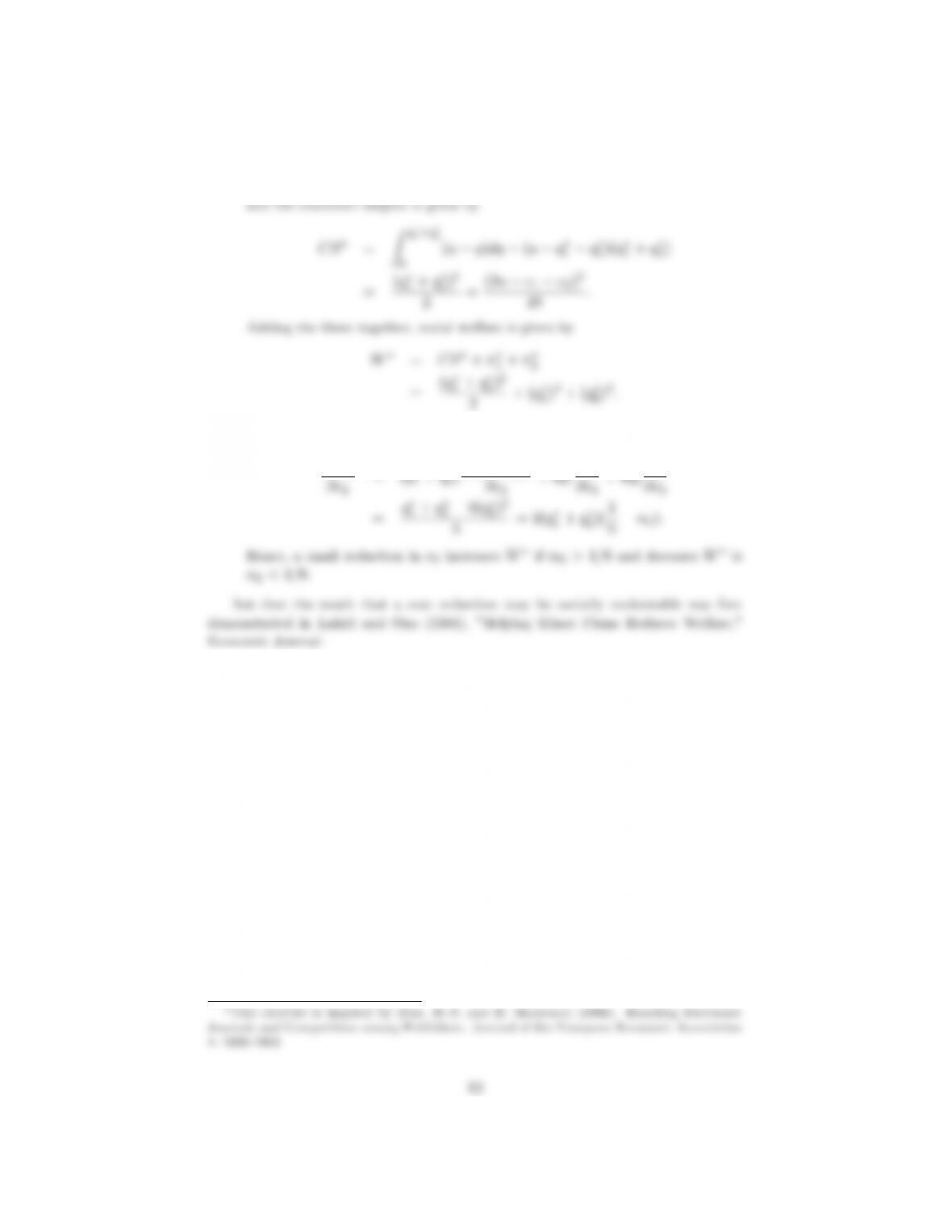
2+ (q
3. Differentiating Wwith respect to c2yields
@W
= (q
1+q
2)@(q
1+q
2)
+ 2q
1
@q1
+ 2q
2
@q2
Exercise 13 Selling independent products to budget-constrained consumers1
Consider two sellers 1and 2and a continuum of buyers. Seller ioffers
product iat price piand incurs zero marginal cost of production. Buyers are
identical and derive utility uifrom one unit of each product. Thus their utility
is uiif they buy one unit of product iand zero units of product j,j6=i; it is
u1+u2if they buy one unit of each product. Additional units do not give any
extra utility. Each buyer has a budget y, which she cannot exceed. Each seller
is assumed to prefer not to sell a unit rather than setting a zero price. Suppose
that u1> u2.
1. Derive the demand function of each buyer.
2. Consider the game in which sellers simultaneously set price. Characterize
the Nash equilibrium of the game.
3. Determine consumer surplus and total surplus that realize in equilibrium.
How does consumer surplus depend on income? Is the equilibrium neces-
sarily efficient or are there inefficiencies? Explain.
Solutions to Exercise 13
1. For p1u1,p2u2and p1+p2y,Q1(p1; p2) = 1 and Q2(p1; p2) = 1.
2. For u1u2y,p
1=yand seller 2 does not sell. Thus, the buyer only buys
product 1. Consider next the case u1+u2> y > u1u2. Note that when
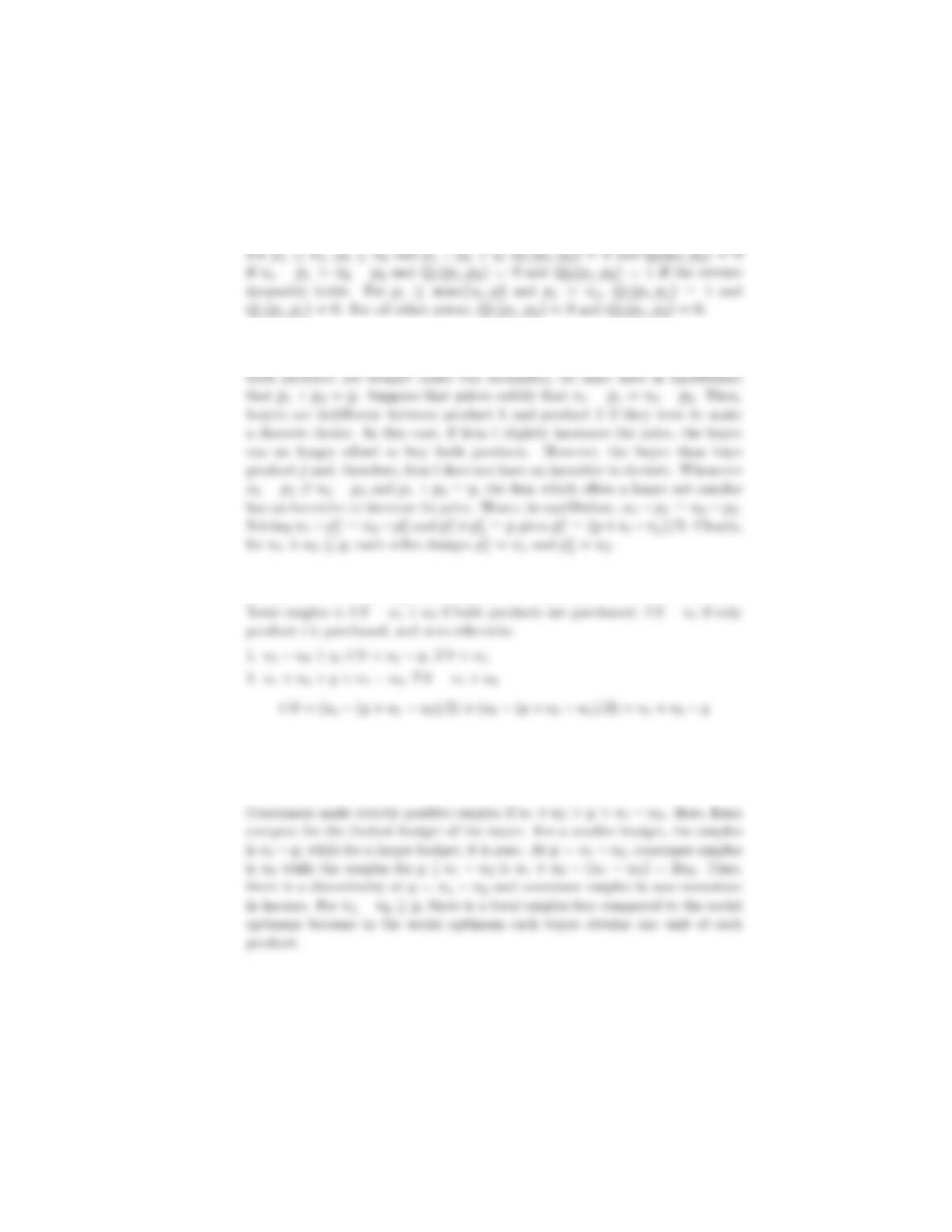
3. In this case consumer surplus is CS = (u1p1) + (u2p2)if both products are
purchased, CS = (uipi)if only product iis purchased, and zero otherwise.
3. u1+u2y,CS =u1u1+u2u2= 0,T S =u1+u2
When u1u2y, the allocation is inefficient, and it is efficient otherwise.
Exercise 14 Differentiated duopoly with uncertain demand
1. Consider a monopolist facing an uncertain inverse demand curve
p=abq +:
11

When setting its price or quantity the monopolist does not know but
knows that E[] = 0 and E[2] = 2. The cost function of the monopolist
is given by
C(q) = c1q+c2q2
2;
with a > c1>0and c2>2b.
Show that the monopolist prefers to set a quantity if the marginal cost
curve is increasing and a price if the marginal cost curve is decreasing.
Provide a short intuition for the result.
2. Now consider a differentiated duopoly facing the uncertain inverse demand
system
p1=abq1dq2+
and
p2=abq2dq1+;
with 0< d < b,E[] = 0 and E[2] = 2. Again, the cost functions are
similar for both firms and are given by C(q) = c1q+c2q2
2, with a > c1>0
and c2>2(b2d2)
b.
Both firms play a one-shot game in which they choose the strategy variable
and the value of this variable simultaneously.
Argue by the same line of reasoning as in (1) that
(a) if c2>0in the unique Nash equilibrium both firms choose quantities
(b) if c2<0in the unique Nash equilibrium both firms choose prices
(c) if c2= 0 there exist four Nash equilibria in pure strategies.
Solutions to Exercise 142
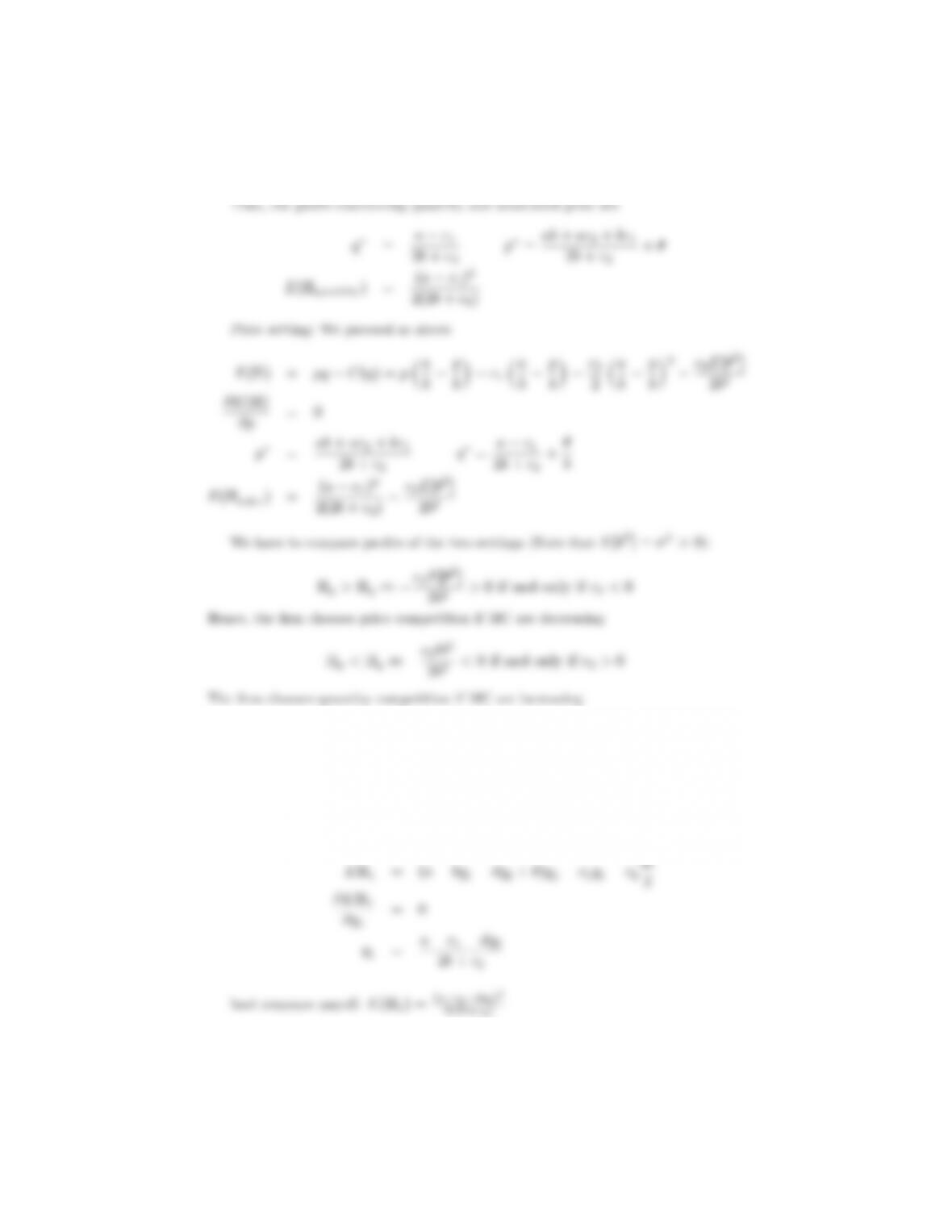
1. Price vs. quantity setting
Quantity setting: Maximize expected profit:
E() = pq C(q) = (abq)qc1qc2q2
2
@E()
@q =a2bq c1c2q= 0
12
2. Calculate best responses given the strategic choice of the other firm (by sym–
metry we only have to look at firm 1):
Suppose that firm 2 has decided to set quantity q2.
Best response by firm 1 when choosing quantity is:
q2
1
Best response by firm 1 when choosing price:
13
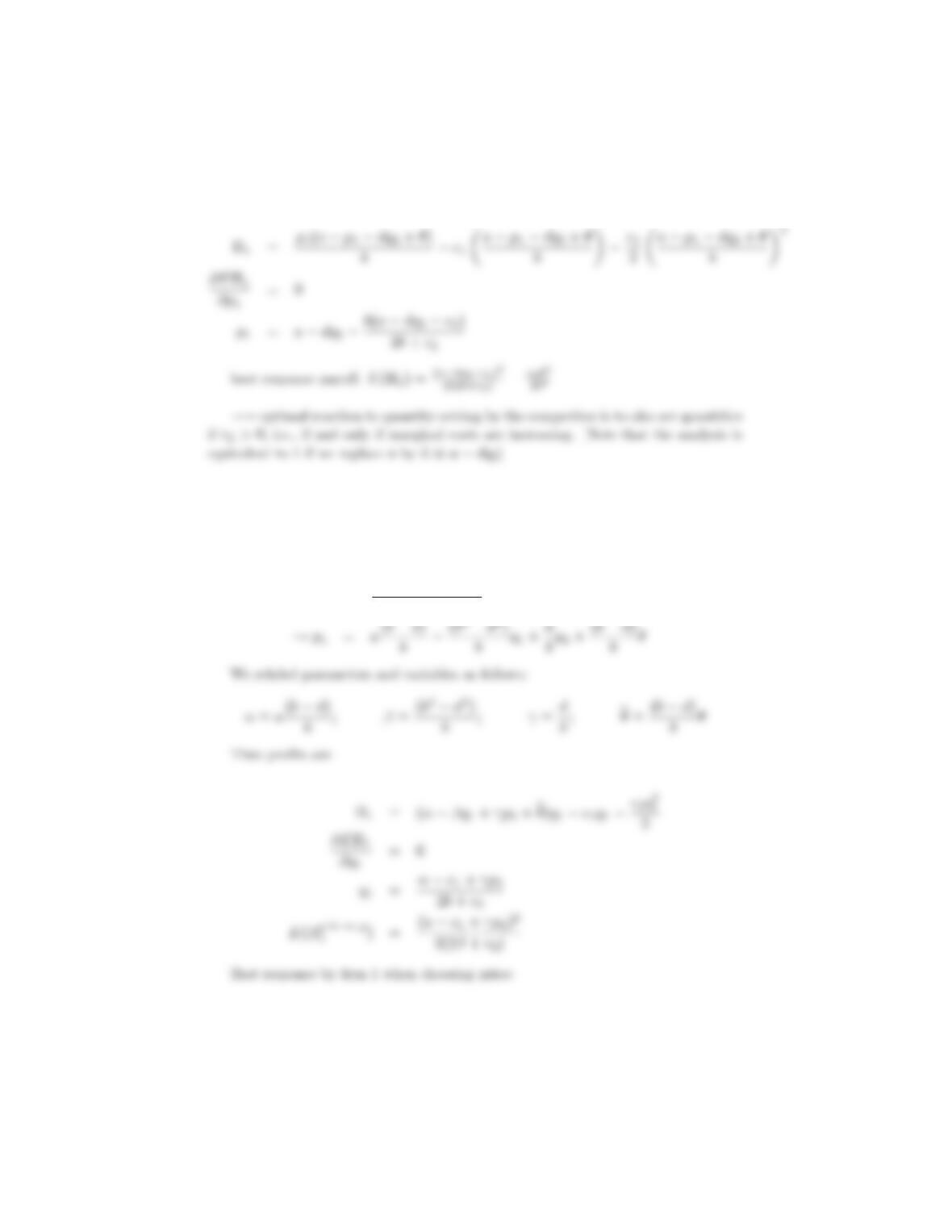
Suppose that firm 2 has decided to set price p2
Best response by firm 1 when choosing quantity:
plug q2=ap2dq1+
binto p1=abq1dq2+
14
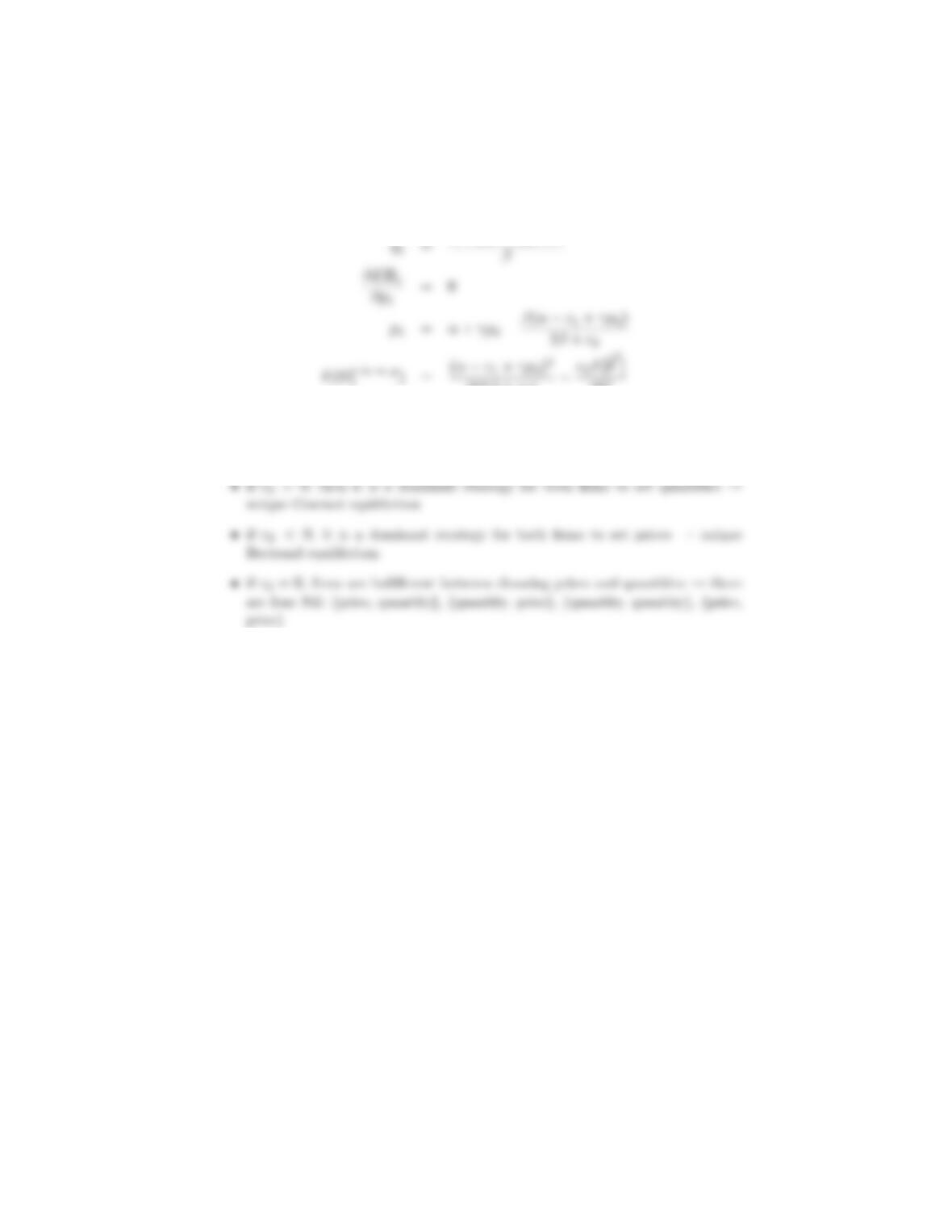
1) = (c1+p2)2
2(2+c2)c2E[b
2b2
Optimal best response to price setting by firm 2 is for firm 1 to set quantities if
c2>0, i.e., if and only if marginal costs are increasing.
Summary:
Exercise 15 Cournot duopoly and cost information
Consider a duopoly market for a homogeneous product in which firms set
quantity. Inverse demand is P(q) = 1 qwith q=q1+q2. Firm 1 has marginal
costs equal to 0.7. Firm 2 has marginal cost 0.65 with probability 1=2and 1
with probability 1=2.
1. Suppose that the cost type is publicly observed by both firms prior to the
quantity setting. Characterize the equilibrium outcome of this game.
2. Suppose from now on that firm 2 privately observes its cost type before
setting its quantity. Determine the equilibrium of this game. What is the
appropriate equilibrium concept? In particular, determine equilibrium
quantities and profits.
3. Would firm 2 have an incentive to reveal its cost type to firm 1 if it could
do so at zero cost?
4. Would firm 1 have an incentive to find out about firm 2’s costs? Would
it like to do so privately (assuming that firm 2 does not know the cost of
firm 1 has when investigating) or publicly?
5. Are consumers better off if firm 2’s cost type remains private information?
Discuss.
15