
Chapter 9: Market Segmentation, Targeting, and Positioning
CHAPTER SUMMARY AND LEARNING OBJECTIVES
LO 9.1 Describe the two primary market classifications.
Consumer products are bought by ultimate consumers for personal use. Business products are
purchased for use either directly or indirectly in the production of other goods and services for
resale.
LO 9.2 Summarize the three components necessary for effective market segmentation.
LO 9.3 Describe four types of geographic segmentation.
Marketers have long practiced geographic segmentation—dividing an overall market into
homogeneous groups based on their locations. Four types of geographic segmentation are
market size, market density, climate, and region.
LO 9.4 Summarize the five most commonly used demographic variables.
LO 9.5 Contrast psychographic segmentation with other segmentation variables.
Psychographic segmentation is defined as differentiating population groups according to values
and lifestyle factors which are common to the group.
LO 9.6 Describe the three forms of behavioral segmentation.
LO 9.7 Distinguish between the three basic strategies for reaching target markets.
Marketers spend a lot of time and effort developing strategies that best match their firm’s
LO 9.8 Explain how marketers build value propositions utilizing positioning strategies.
LO 9.9 Given a target market profile, classify each variable according to its base of
segmentation.
The four primary segmentation bases are geographic, demographic, psychographic, and
behavioral. All four bases can be utilized in combination to create a more complete customer
profile and enable marketers to effectively communicate their value proposition.
Chapter 9: Market Segmentation, Targeting, and Positioning
ACTIVATOR EXERCISE: Bad Targeting
Purpose: To emphasize the importance of accurate targeting when designing a marketing mix.
Format: Small group discussion, then class presentations.
Time: 20-40 minutes, depending on format.
Activity: Ask student groups to:
• Pick a specific product or brand
Have groups share their answer with the class.
Possible discussion questions for class: How do you know this customer group would be a
bad target? What is an alternate product in a similar category that might be a good fit for these
customers?
Result: Students will be using intuition and common sense to define target groups. If they have
Key takeaway: Some groups share characteristics that make them a better target for certain
products. Defining those characteristics is the foundation any good marketing strategy.
Chapter 9: Market Segmentation, Targeting, and Positioning
LECTURE OUTLINE
9-1 Types of Market
A market is a group of people with sufficient purchasing power, authority, and willingness to
buy. Marketers must use their expertise to understand the market for a good or service, whether
it’s a new athletic shoe for marathon runners or a new accounting software program for large
corporations.
Products usually are classified as either consumer products or business products. Consumer
To determine the classification of an item, consider two elements:
• Who will buy the product
• How or why the product will be used
Classroom activity: Have students (on their own or with a partner) choose one of the following
products. These are typically considered consumer products, but ask students to think about
how they could be used as business products. Ask them to specify the business buyer and how
the product will be used by that buyer.
Lawn care products
Key Takeaway: Companies must approach marketing differently depending on whether
Estimated time: 10–20 minutes
9-2 Criteria for Effective Market Segmentation
The target market for a product is the segment of consumers most likely to purchase a
particular item. Market segmentation attempts to isolate the traits that distinguish a certain
group of consumers from the overall market. An understanding of the group’s characteristics—
Chapter 9: Market Segmentation, Targeting, and Positioning
The division of the total market into smaller, relatively homogeneous groups is called market
segmentation. However, segmentation can be an effective tool when three requirements are
met. The segment must be
• significant in size and purchasing power,
Significant in Size and Purchasing Power
Example: With jobs, incomes, and decision-making power, female consumers represent
a hefty amount of purchasing power, over $7 trillion, or more than 60% of the nation’s
wealth.
i
Women control or influence the purchase of more than 85% of all consumer
goods, including items such as stocks and bonds for investment, personal computers,
and family vehicles.
ii
Profitable
Classroom activity: As individuals or with a partner, brainstorm scenarios where a particular
segment might be large, but not a suitable target because they’re unlikely to be profitable.
Consistent with the Firm’s Marketing Capabilities
Classroom activity: As individuals or with a partner, brainstorm scenarios where pursuing a
large and potentially profitable segment would not be consistent with a particular firm’s
marketing capabilities. Try to use real products and brands for this activity.
Estimated time: 15–20 minutes
Chapter 9: Market Segmentation, Targeting, and Positioning
9-3 Geographic Segmentation
Marketers have long practiced geographic segmentation—dividing an overall market into
homogeneous groups based on their locations. Geographic location does not ensure all
Market Size
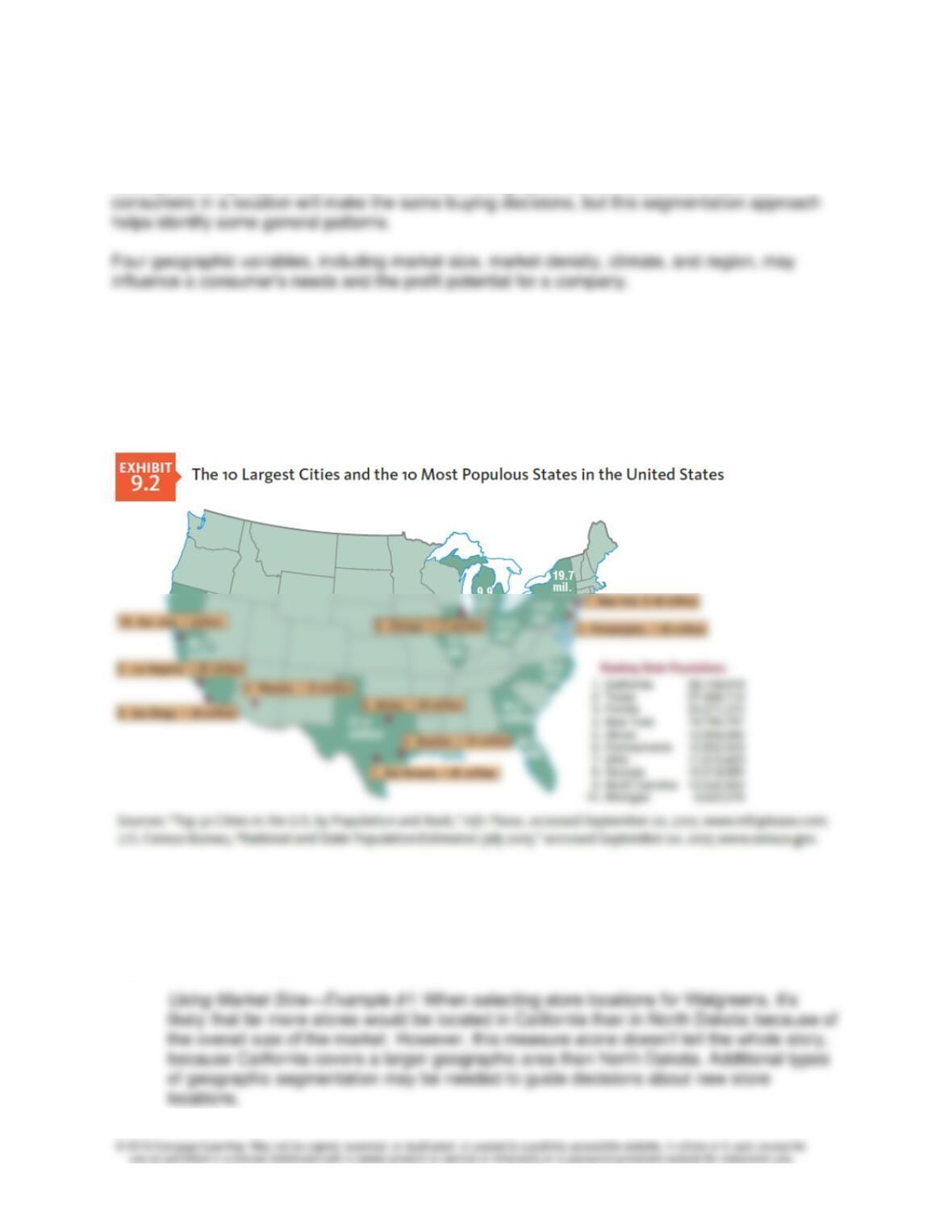
Market size may be defined as the number of individuals residing in a particular geographic
market area.
PRESENTATION VISUAL: MindTap Exhibit 9.2 showing largest cities and states in the
United States
While population numbers indicate the overall size of a market, other geographic indicators such
as job growth give useful guidance to marketers, depending on the type of products they sell.
Automobile manufacturers might rank geographic areas by household income, because it is an
important factor in the purchase of a new car.
Chapter 9: Market Segmentation, Targeting, and Positioning
Market Density
Market density is the number of residents within a specific geographic area, such as a square
mile. Urban areas have the greatest population density, with large numbers of individuals
residing within a small geographic area. Rural areas have the lowest population density.
Consumer lifestyles can differ dramatically between these areas. City dwellers often rely on
public transportation and may get along fine without automobiles, whereas those who live in the
suburbs or rural areas depend on their own cars and trucks. Also, those who live in the suburbs
spend more on lawn and garden care products than city dwellers. Marketers can use this type of
information to determine where their products are most likely to be successful.
Using Market Density—Example #1: Understanding market density would help you
Climate
Climate is also a useful geographic segmentation approach since weather patterns and
temperature ranges likely affect consumer needs. Snow blowers and winter coats would be
Region
The region of the country can also be a useful segmentation approach. Demand for some
categories of products can vary according to region, and marketers must be aware of how these
regions differ. The most obvious differences can be driven by climate, which is discussed
above, but regional differences go beyond weather. They can be driven by differences in
culture, recreational opportunities, incomes, and other reasons.
Example: A recent survey found that Seattle and Portland, Oregon, top the list in coffee
Chapter 9: Market Segmentation, Targeting, and Positioning
Classroom activity: Divide students into small groups and ask them to brainstorm a specific
geographic segmentation description that includes at least two of the above variables for:
Red Bull
Surfboards
Key Takeaway: Four geographic variables, including market size, market density,
Estimated time: 20–30 minutes
9-4 Demographic Segmentation
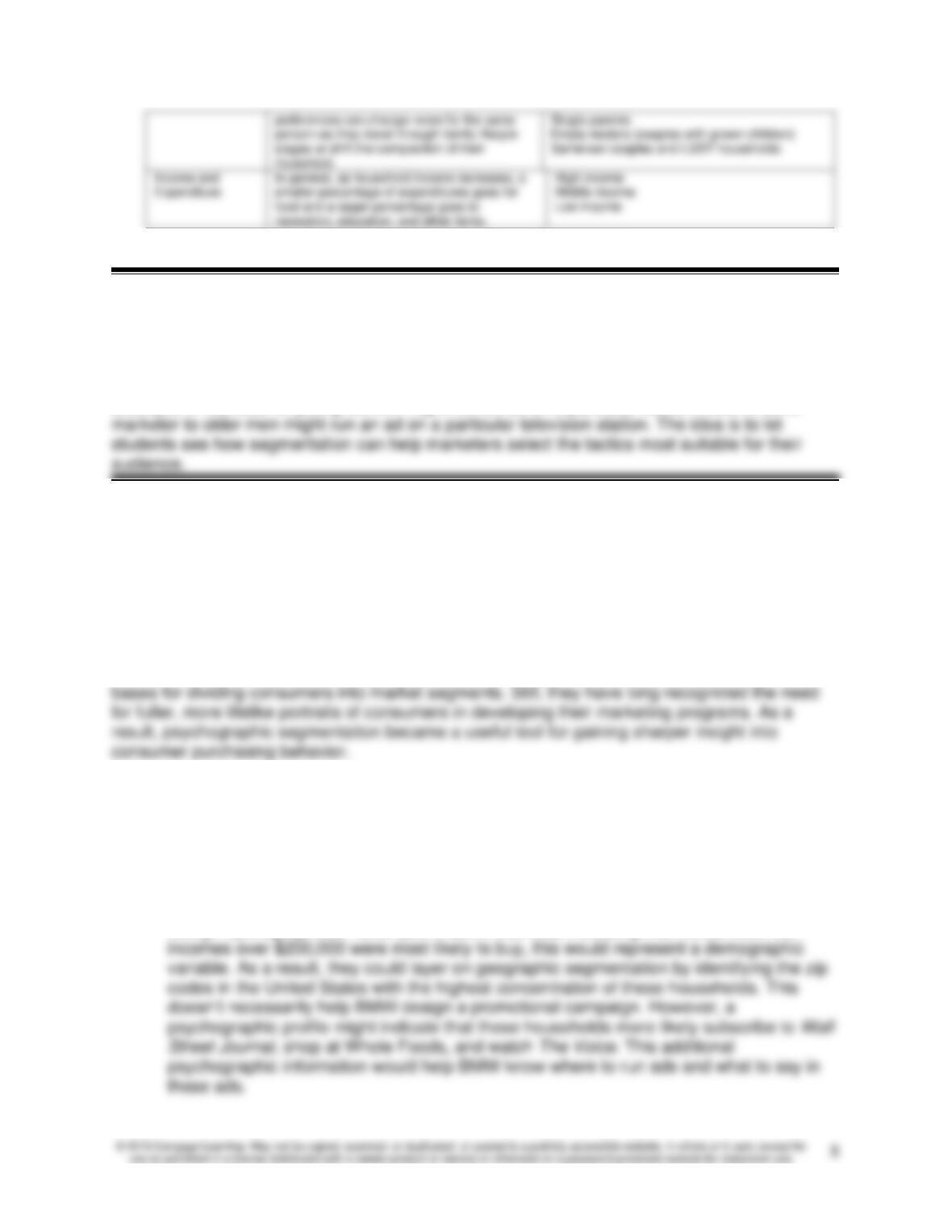
The most common method of market segmentation—demographic segmentation—defines
consumer groups according to demographic variables such as gender, age, ethnic group, family
life cycle stage and household type, and income.
PRESENTATION VISUAL: MindTap Exhibit 9.3 showing bases of demographic
segmentation
Demographic
Variable
Explanation
Segment Examples
Gender
Gender can be an important segmentation
base with some products used exclusively by
men or women while others are used by both
ages and generations typically have different
income levels and consumer preferences.
Millennials
Generation X
Baby Boomers
fastest growing are Hispanics, African
Americans, and Asian Americans.
African American
Asian American
Male
Female
Chapter 9: Market Segmentation, Targeting, and Positioning
Classroom activity: Ask students to create a demographic profile of themselves based on the
five bases of demographic segmentation. Then ask them to share the profiles with a classmate.
Finally, ask them to identify how a marketer might use that information to reach you with a
marketing pitch. What types of products would be the best fit? What distribution strategies could
they use? Where could they run ads to reach you? Share some examples with the class.
Example: A marketer to young women might run an ad on a particular social network, but a
Key Takeaway: Demographic segmentation can help marketers communicate effectively
with their target audience.
Estimated time: 25–30 minutes
9-5 Psychographic Segmentation
Marketers traditionally referred to geographic and demographic characteristics as the primary
Psychographic segmentation is defined as differentiating population groups according to
values and lifestyle factors which are common to the group. Consumer lifestyles include
attitudes, values, social activities, media usage habits, and more.
Psychographic segmentation is a good supplement to demographic and geographic
segmentation.
Using Psychographics ̶—Example: If BMW had data indicating that households with
Chapter 9: Market Segmentation, Targeting, and Positioning
Marketers may also utilize PRIZM, an industry-leading segmentation service that blends
research on demographics, consumer lifestyle behavior, media usage, and shopping habits to
divide every U.S. household in terms of 66 segments.
vii
PRIZM data can help marketers plan
new products, select distribution channels, and create advertising campaigns targeted to the
segments most likely to purchase their product.
Note: Many students will resist being fit in a “box” by these segment descriptions. Be ready for
push back on the whole concept because it is often confused with stereotyping. The key is for
them to learn that marketers need some way to approximate the profile of their target audience
so they can discern how to reach them, what to say, and how to make products better.
Classroom activity: Ask students to take their profile (based on demographic segmentation)
and add some psychographic segmentation, including values, social activities, and especially
Key Takeaway: While demographic segmentation is an important tool for targeting
customers, marketers increasingly use psychographic segmentation; it creates even
more accurate and meaningful profiles for marketers to utilize when making decisions.
Estimated time: 20–35 minutes
9-6 Behavioral Segmentation
The methods for market segmentation discussed previously—geographic, demographic, and
psychographic—form an important basis for identifying target customers who will be the focus of
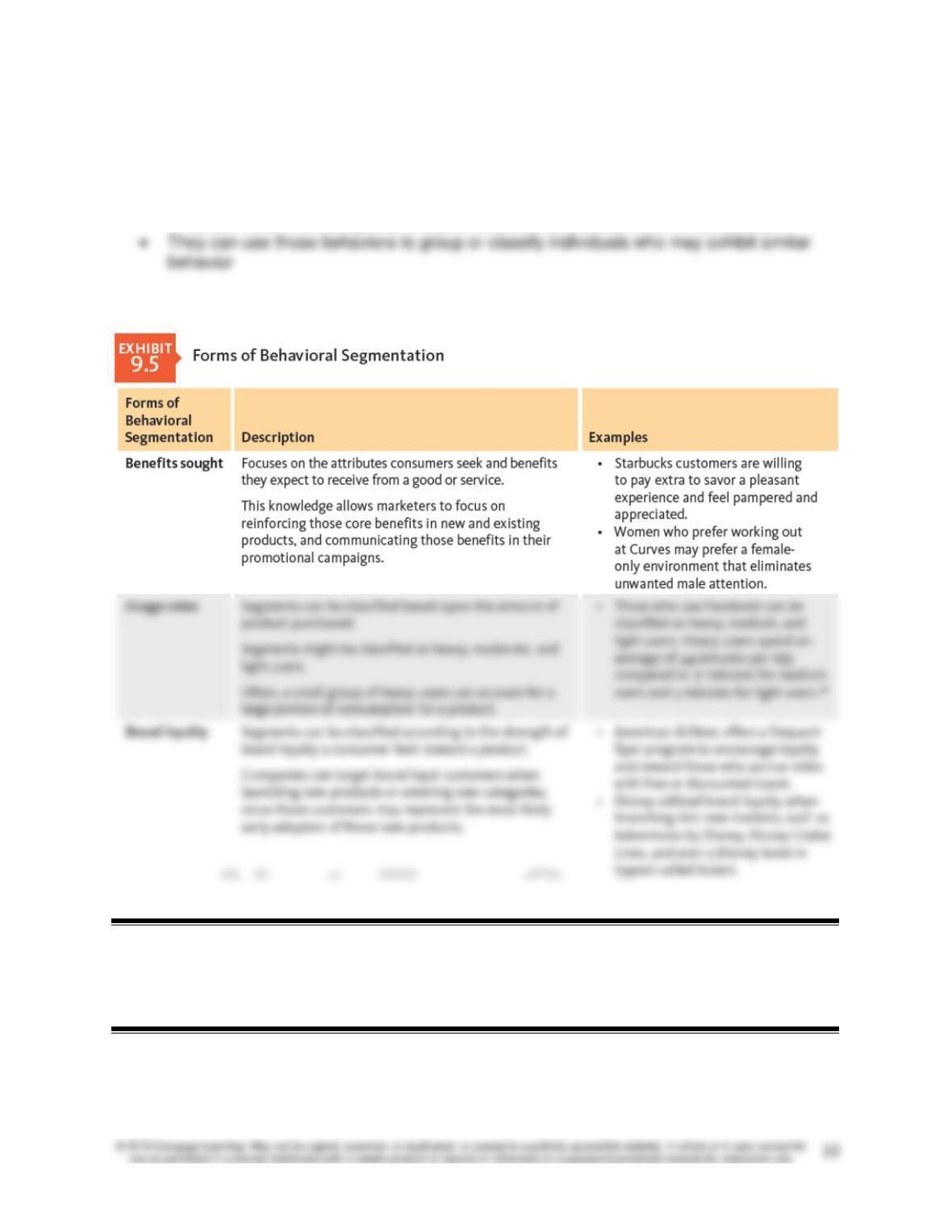
Chapter 9: Market Segmentation, Targeting, and Positioning
Fortunately, there is another method for market segmentation that is more direct and based on
actual consumer behavior.
Behavior segmentation is beneficial to marketers because:
• They can focus marketing efforts based on demonstrated behavior of actual users
PRESENTATION VISUAL: MindTap Exhibit 9.5 showing bases of behavioral segmentation
Discussion question: Ask students some of the following questions . . .
What is a product that you buy at least once per week?
What is a brand that you are loyal to? Why?
How might a marketer use the above information when designing their marking mixes?
Chapter 9: Market Segmentation, Targeting, and Positioning
Key Takeaway: Behavioral market segmentation tactics are a valuable addition to
geographic, demographic, and psychographic methods when designing marketing
mixes.
Estimated time: 10 minutes
9-7 Strategies for Reaching Target Markets
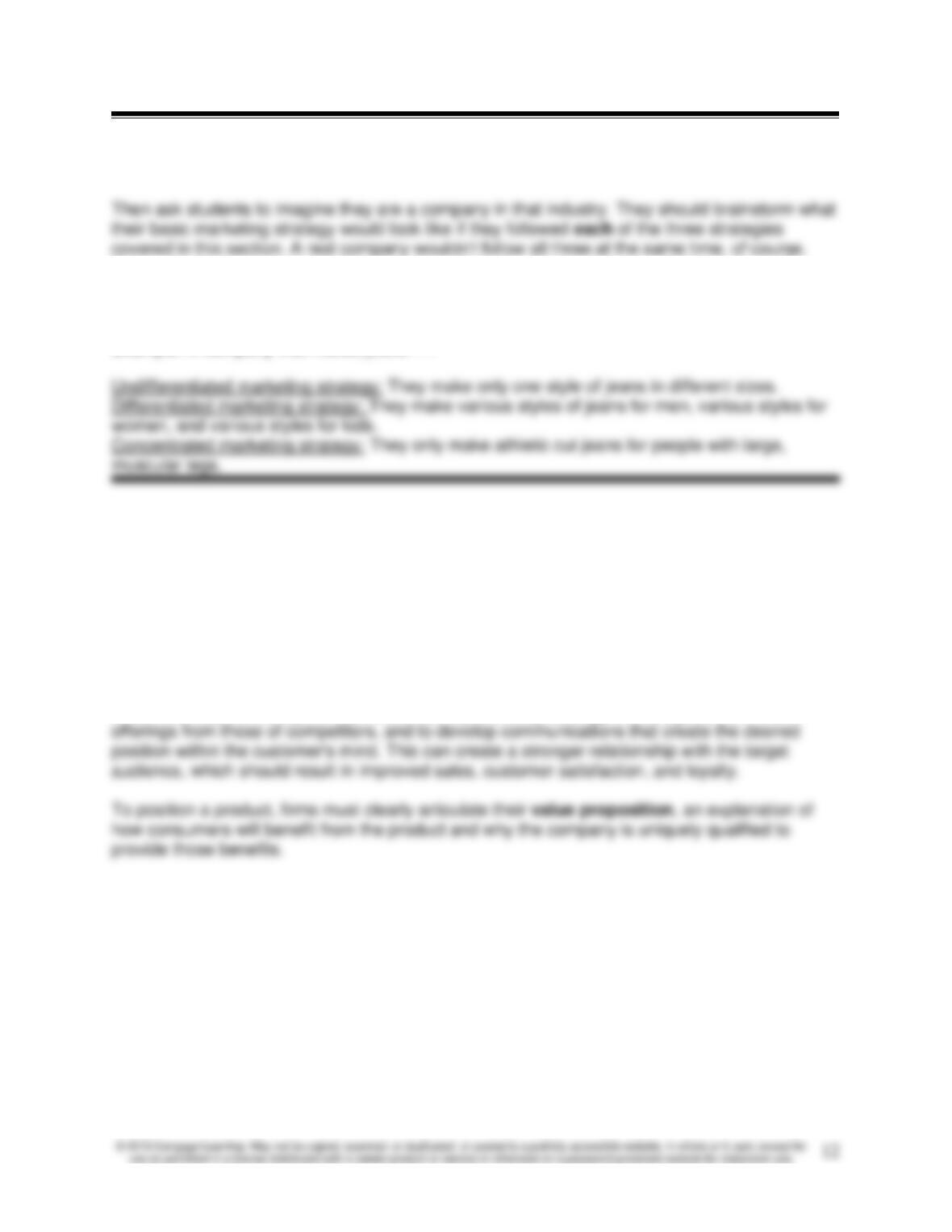
PRESENTATION VISUAL: MindTap Exhibit 9.6 showing types of marketing strategies
Strategy
Description
Example
Advantages
Disadvantages
Undifferentiated
marketing
All customers are
targeted using a
single marketing
mix; also called
mass marketing.
Red Bull is sold in
the same format,
with the same
branding,
worldwide.
▪ Provides
production
efficiencies
▪ Focuses on
similarities in
needs or
desired
benefits
versus
are targeted using
for athletes
satisfaction
higher overall
revenue
promotion
may increase
Potential customers
may be targeted at
very narrow, basic
levels such as by
ZIP code, specific
recommendations
to shoppers based
on past purchase
history and/or the
products they are
mix,
especially
promotion
revenue
▪ Vulnerable to
competitors
who offer
specialized
alternatives to
targeted
segments
Chapter 9: Market Segmentation, Targeting, and Positioning
Classroom activity: In small groups, assign a product category to each team. Examples could
be restaurants, some type of packaged food or beverage category, clothing, a service business
category such as law firms, etc.
Rather, students are showing the alternative strategies the company could choose from. The
goal for this exercise is to have students differentiate between each of these approaches
because they can sometimes be confusing.
Key Takeaway: Marketers may utilize different strategies to reach their desired target
markets depending on their business goals and characteristics of the market.
Estimated time: 15–25 minutes
9-8 Positioning Strategies and Value Propositions
Once firms have selected their target markets, they must decide how best to position the
product. The concept of positioning seeks to put a product in a certain position, or place, in the
minds of prospective buyers. Marketers use a positioning strategy to distinguish their firm’s
Chapter 9: Market Segmentation, Targeting, and Positioning
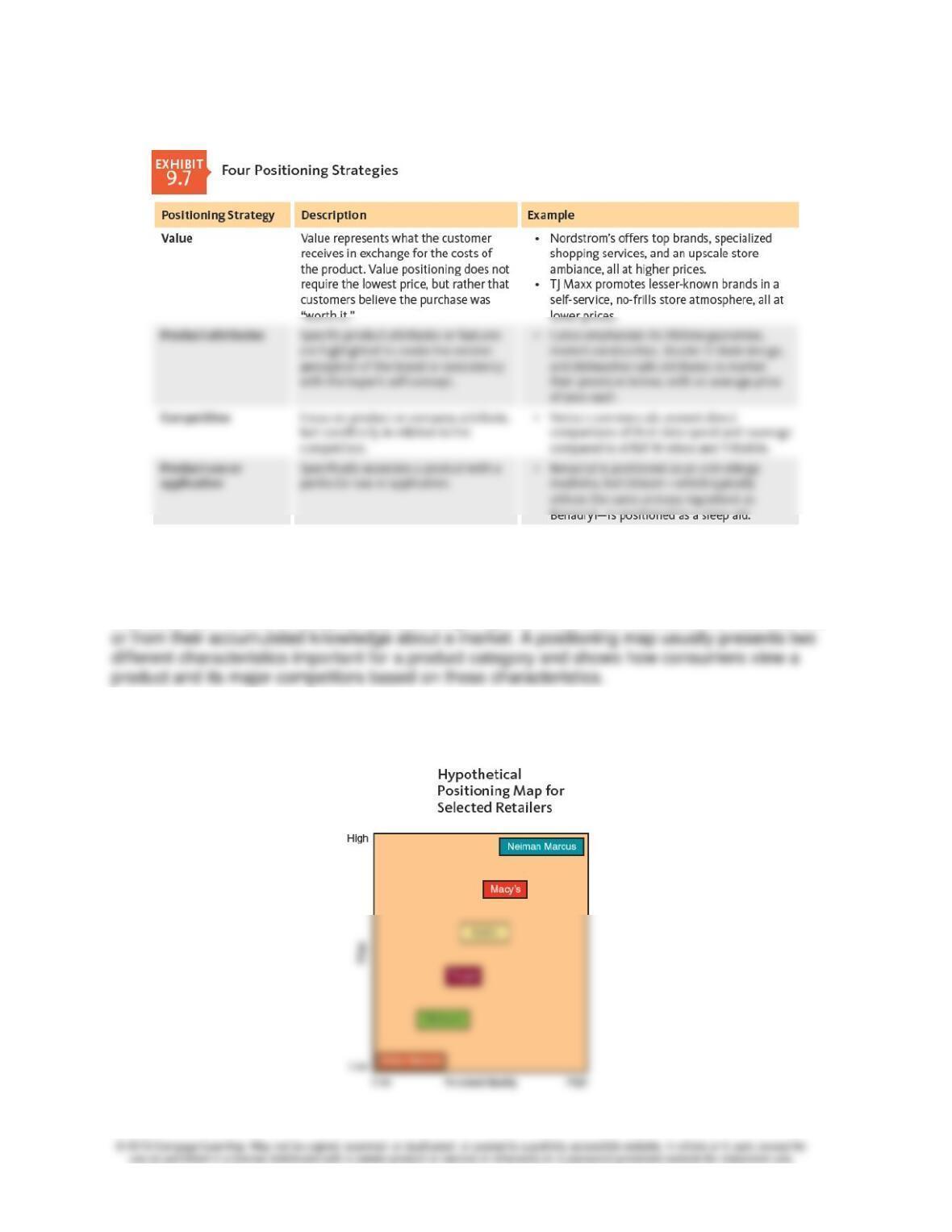
PRESENTATION VISUAL: MindTap Exhibit 9.7 showing the four positioning strategies
A positioning map provides a valuable tool for helping managers position products by
graphically illustrating consumers’ perceptions of competing products within an industry.
Marketers can create a competitive positioning map from information solicited from consumers
PRESENTATION VISUAL: MindTap Exhibit 9.8 showing example of positioning map for
retailers
Chapter 9: Market Segmentation, Targeting, and Positioning
Classroom activity: In small groups, have students select one of the following categories (or
they can think of a category themselves):
Restaurants
Now ask students to create a positioning map for at least four companies in that category.
Example: Students might select speed of service and price to distinguish the restaurants
category. In one corner of the map they might have McDonald’s because it’s fast and cheap. In
the other corner, they might have a fine dining establishment from your region (such as Ruth’s
Chris Steak House) because they are slower and expensive.
Estimated time: 15–40 minutes (depending on whether you conduct the classroom activity)
9-9 Classifying Segmentation Variables
Note: This section helps students apply the concepts learned earlier in the chapter. It can be
used to reinforce those concepts and prepare them for the end-of-chapter activity.
Marketers have lots of choices for segmenting markets to identify a target audience. The four
primary segmentation bases are geographic, demographic, psychographic, and behavioral. All
four bases can be utilized in combination to create a more complete customer profile and
Chapter 9: Market Segmentation, Targeting, and Positioning
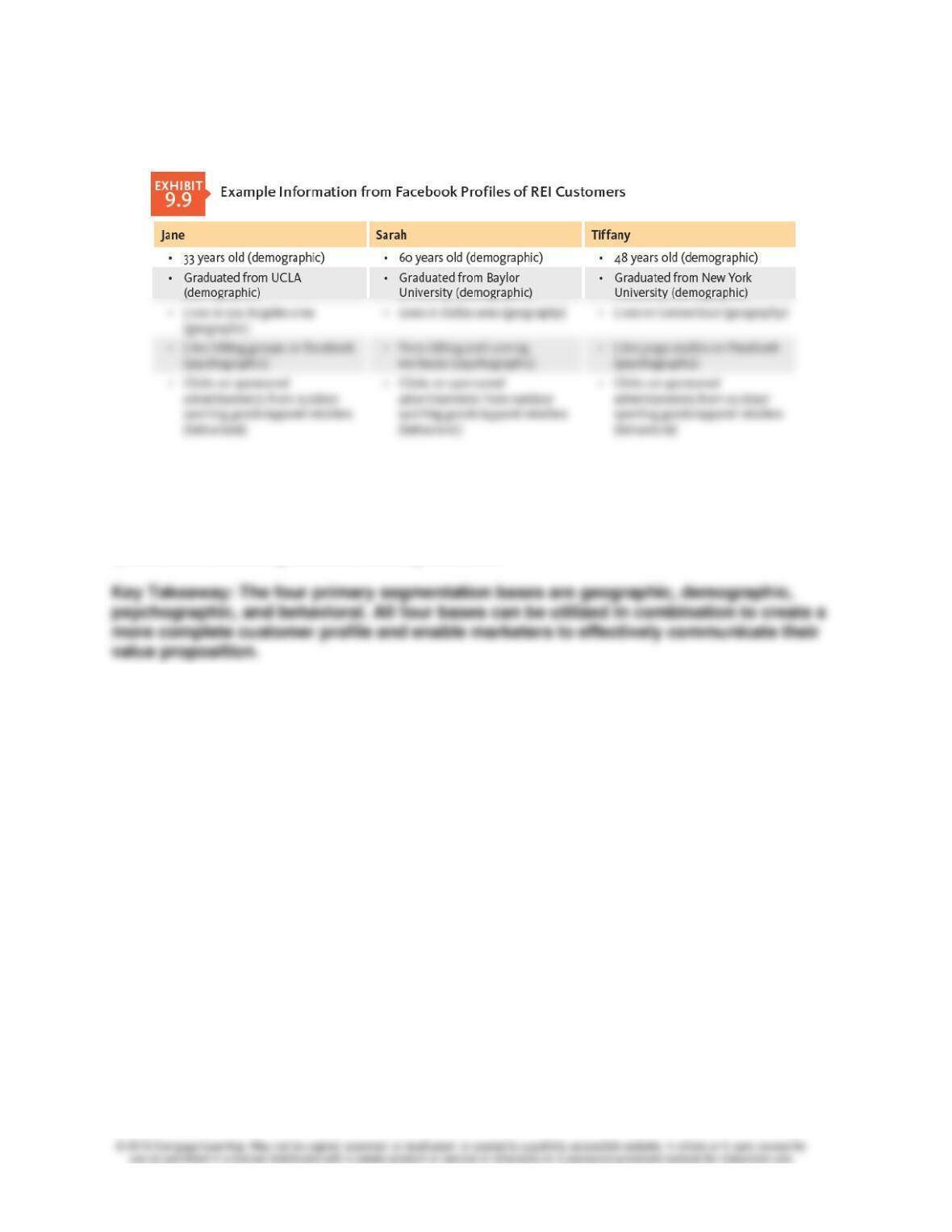
PRESENTATION VISUAL: MindTap Exhibit 9.9 showing example of Facebook profiles for
REI customers by various bases of segmentation
Note: You can either show the exhibit as a review of how to classify each variable or you can
simply say each variable in class and ask students whether it’s demographic, psychographic,
geographic, or behavioral. Of course, if students have the book the answers are right there in
the exhibit; however, the discussion can still provide good reinforcement and prompt any
questions students might have about segmentation.
Estimated time: 10–20 minutes
Chapter 9: Market Segmentation, Targeting, and Positioning
LEARN IT TODAY . . . USE IT TOMORROW
VIGNETTE AND ACTIVITY
The opening vignette for Chapter 9 discusses REI, an outdoor and sporting goods retailer.
Since REI sells goods and travel packages specific to the outdoor experience, they have a
specific kind of target audience.
Note: Answers to the chapter ending activity can be discussed in class after the activity
due date.
Market segmentation and targeting
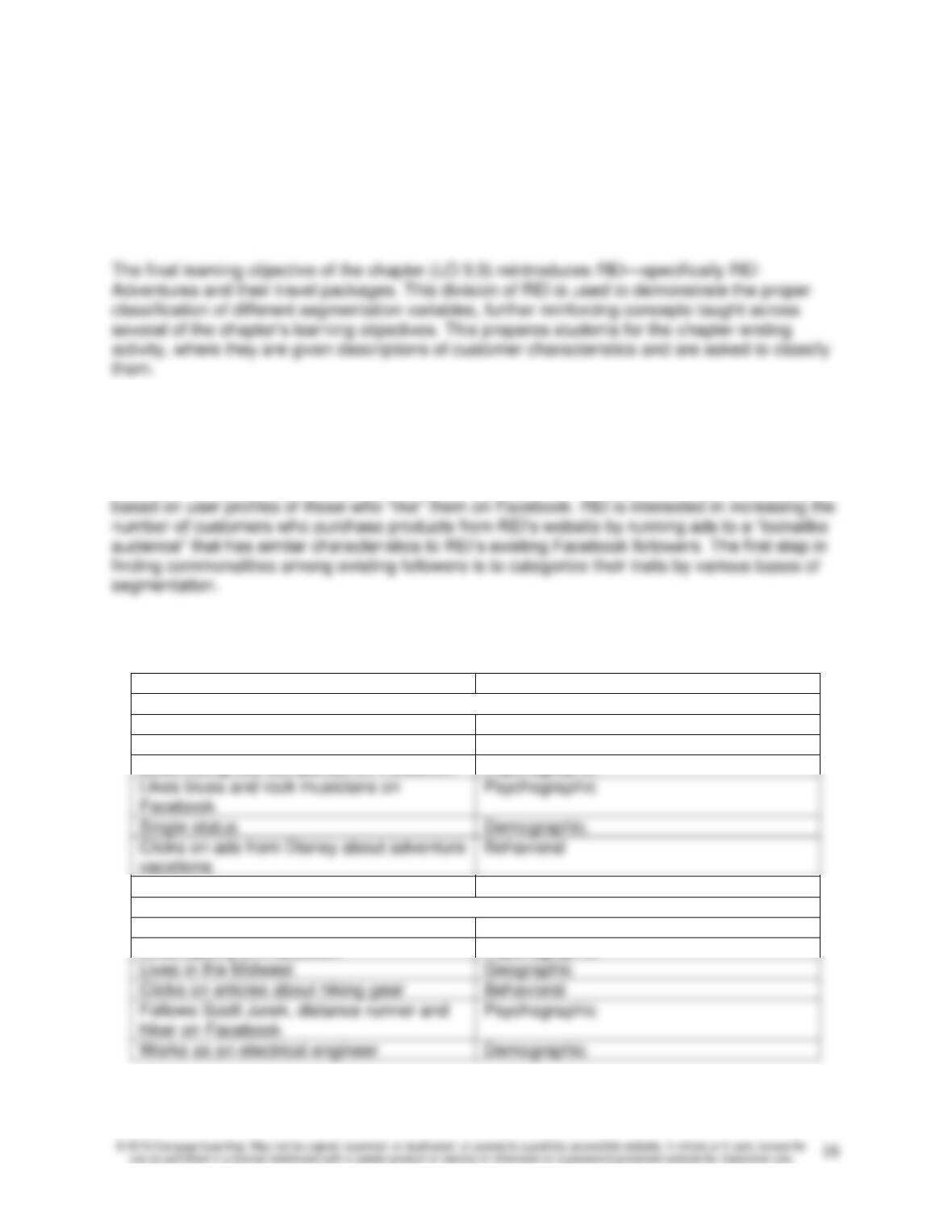
REI would like your help identifying the segmentation bases of their typical online shopper
Review the following profiles of Facebook fans and identify the segmentation base (geographic,
demographic, psychographic, and behavioral) that best describes each characteristic.
Facebook Profile Characteristics
Correct Answer
Profile #1: Mark
Is member of kayaking group on Facebook
Psychographic
Lives in Nashville, TN
Geographic
Likes hiking tour companies on Facebook
Psychographic
Facebook
Single status
Demographic
vacations
Profile #2: Sylvia
Likes craft beer brands on Facebook
Psychographic
Likes Spotify on Facebook
Psychographic
Lives in the Midwest
Geographic
Clicks on articles about hiking gear
Behavioral
hiker on Facebook
Works as an electrical engineer
Demographic
Chapter 9: Market Segmentation, Targeting, and Positioning
ADDITIONAL HOMEWORK/CLASSROOM ACTIVITIES
Product Positioning
Purpose: To give students a chance to apply product positioning concepts.
Exercise: Divide your class into groups of three to five students, and ask each group to choose
a product—familiar to all of them—that needs repositioning. (Possible categories: a beverage
brand, a pizza restaurant, clothing line, your college, a television network, etc.) Then, direct
them to just do it!
• Step 1: Identify the current positioning (quick sentence)
Ask each group to share their results with the class (and you can expect a remarkable level of
creativity).
Questions for Reflection:
• How do you know when a product needs to be repositioned?
Ethics Exercises
Marketers are making a new pitch to men—at the risk of political incorrectness. Marketers for
firms such as Unilever and Kmart were frustrated at their inability to reach young male
Questions for Reflection:
• What are some of the pitfalls of approaching the young male segment with these tactics?
Chapter 9: Market Segmentation, Targeting, and Positioning
Internet Research Activities
Psychographic segmentation. Visit the websites of Caterpillar, Marriott Hotels, and Dr
Pepper. How does each firm employ psychographic segmentation (such as the VALS approach)
to the marketing of its products? Is there a relationship between the use of psychographic
segmentation and the types of products sold by each firm?
Note: Marriott and Dr Pepper are companies that market products and services that enhances
lifestyles. Caterpillar is into construction, financial products, etc. Hence, the approach of these
companies will be different. Innovation, resources, values, and lifestyles of the customers of
these companies would also be different. Students need to prepare a report on the relationship
between the products marketed by these companies, and the psychographic segmentation
done by its marketers.
Note: Student answers may vary. Siemens website has different sections where visitors can
choose between product groups, market-specific solutions, countries, languages, and
industries. It shows that Siemens uses more than one method of product segmentation. Their
product range is wide, hence, using multiple methods of product segmentation is inevitable.
Target market. Visit the website of Philips. What strategy or strategies does the firm employ for
reaching its target markets? Does it rely more on undifferentiated or differentiated marketing?
Chapter 9: Market Segmentation, Targeting, and Positioning
KEY TERMS
Market: A group of people with sufficient purchasing power, authority, and willingness to buy.
Consumer products: Products bought by ultimate consumers for personal use.
Geographic segmentation: Dividing an overall market into homogeneous groups based on
their locations.
Market size: The number of individuals residing in a particular geographic market area.
Market density: The number of residents within a specific geographic area, such as a square
mile.
Demographic segmentation: Defining consumer groups according to demographic variables
such as gender, age, ethnic group, family life cycle stage and household type, and income.
Differentiated marketing: Different market segments are targeted using a different marketing
mix for each segment.
Concentrated marketing (Niche marketing): A single market segment is selected and the firm
concentrates its efforts on profitably satisfying that segment.
Positioning: Putting a product in a certain position, or place, in the minds of prospective
buyers.
Chapter 9: Market Segmentation, Targeting, and Positioning