
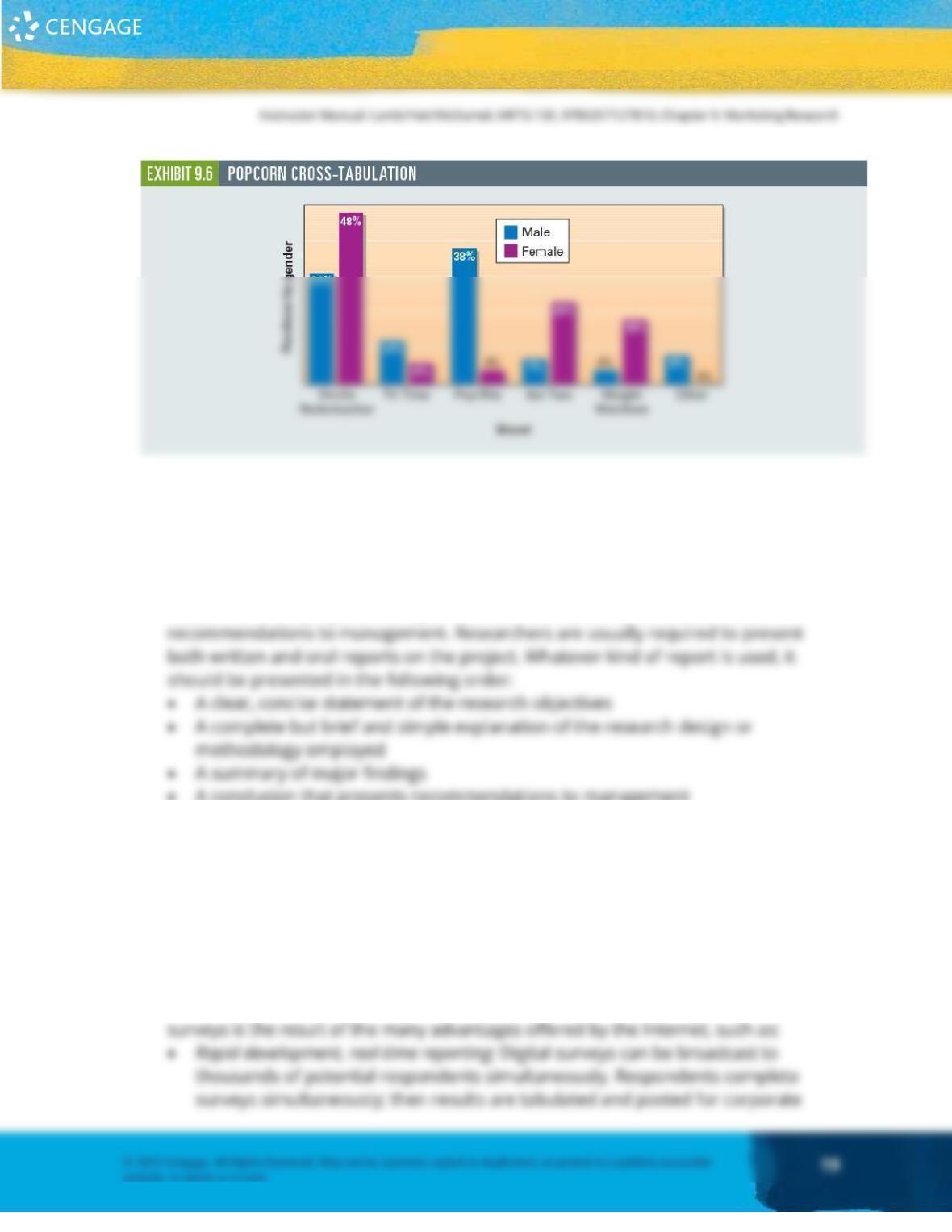
PRESENTATION VISUAL: Exhibit 9.6 Popcorn Cross-Tabulation
q. A cross-tabulation lets the analyst look at the responses to one question in relation
to the responses to one or more other questions. For example, in Exhibit 9.6, what
is the association between gender and the brand of microwave popcorn bought
most frequently?
r. Preparing and Presenting the Report: After data analysis has been completed, the
researcher must prepare the report and communicate the conclusions and
• A conclusion that presents recommendations to management
s. Following Up: Following up is the final step in the marketing research process. The
researcher should determine why management did or did not carry out the
recommendations in the report.
3. The Profound Impact of the Internet and Smart Devices on Marketing Research (LO 9-3,
PPT Slide 38, DISC: Online/Computer)
a. Online survey research has replaced computer-assisted telephone interviewing as
the most popular mode of data collection.
b. Advantages of Online Surveys: The huge growth in the popularity of online
greater relevance to each respondent’s own situation.
• Improved respondent participation: Smartphone surveys take half as much time to
complete as phone interviews, can be accomplished at the respondent’s
convenience, and are much more stimulating and engaging. As a result, online
surveys enjoy much higher response rates.
• Web survey systems are software systems specifically designed for web
questionnaire construction and delivery. They consist of an integrated
questionnaire designer, web server, database, and data delivery program
designed for use by nonprogrammers. The web server distributes the
questionnaire and files responses in a database. The user can query the server
In addition, panel providers update members’ profiles to ensure they are able to
consistently target qualified people for surveys.
e. Online Focus Groups: A growing number of research firms are conducting focus
groups online. Online focus groups operate similarly to conventional focus groups,
except the group does not meet physically—everything is conducted on the
• Broad geographic scope
• Accessibility to hard-to-reach individuals
f. Online Research Communities: An online research community is a carefully selected
group of consumers who agree to participate in an ongoing dialogue with a
particular corporation. All community interaction takes place on a custom-designed
4. The Growing Importance of Mobile Research (LO 9-4, PPT Slide 46, DISC:
Online/Computer)
a. Mobile survey traffic now accounts for about half of all interview responses. Mobile
research provides immediate feedback when a consumer makes a decision to
5. Scanner-Based Research (LO 9-, PPT Slide 49, DISC: Research)
a. Scanner-based research is a system for gathering information from a single group
of respondents by continuously monitoring the advertising, promotion, and pricing
they are exposed to and the things they buy. Scanner-based research also entails
the aggregation of scanner data from retailers, analysis, and identification of sales
trends by industry, company, product line, and individual brand. The variables
measured are advertising campaigns, coupons, displays, and product prices.
b. Neuromarketing is a field of marketing that studies the body’s responses to
marketing stimuli. Some companies have begun using neuromarketing to study
microscopic changes in skin moisture, heart rate, brain waves, and other biometrics
to see how consumers react to things such as package designs and ads.
6. When Should Marketing Research Be Conducted? (LO 9-6, PPT Slide 54, DISC: Research)
a. Research should be undertaken only when the expected value of the information is
b. Customer Relationship Management: The key to managing relationships with
customers is the customer relationship management (CRM) cycle, shown in Exhibit
9.7.
• Identify customer relationships – This may simply entail learning who the
customers are or where they are located, or it may require more detailed
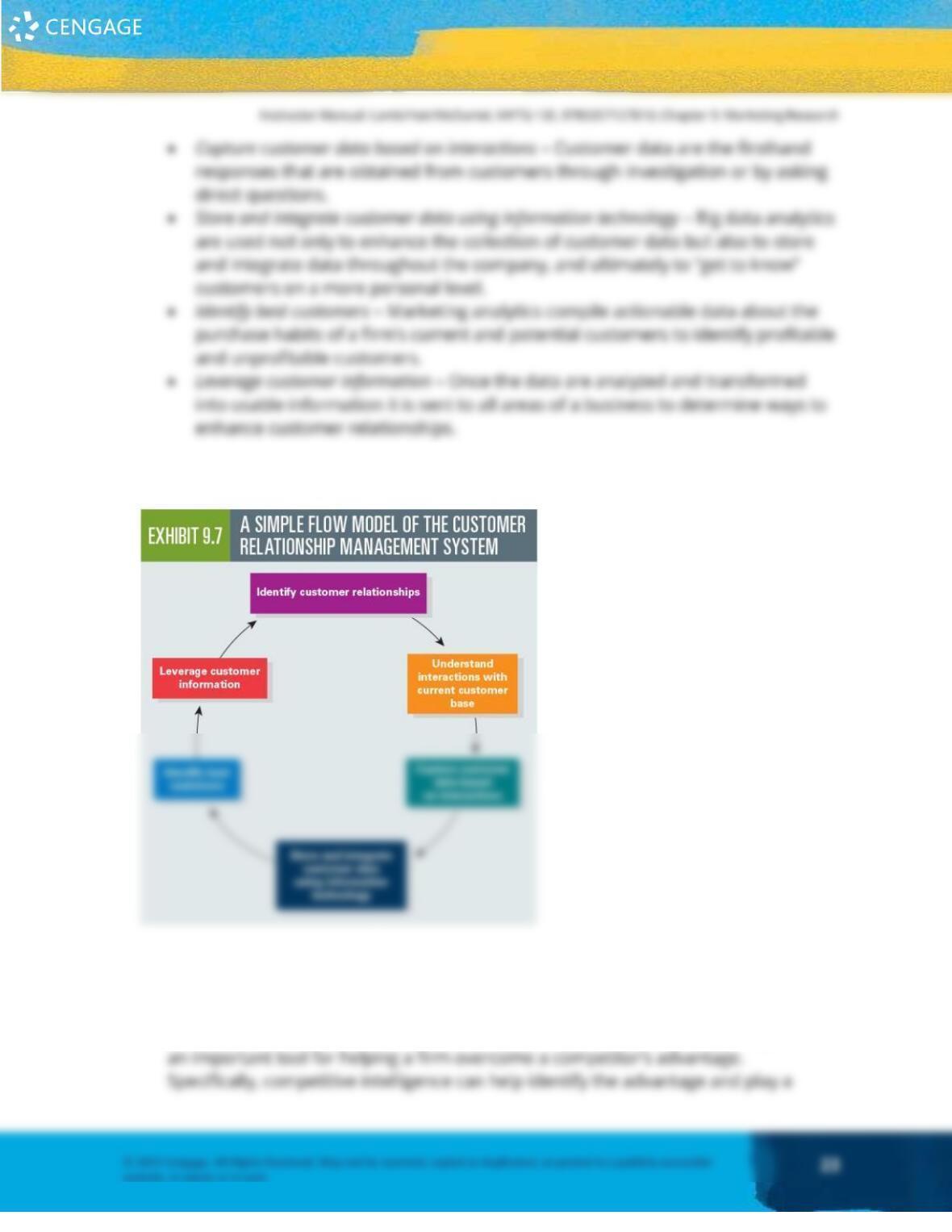
PRESENTATION VISUAL: Exhibit 9.7 A Sample Flow Model of the Customer
Relationship Management System
7. Competitive Intelligence (LO 9-7, PPT Slide 57, DISC: Research)
a. Intelligence is analyzed information. Competitive intelligence (CI) helps managers
assess their competition and vendors in order to become more efficient and
effective competitors. Derived from military intelligence, competitive intelligence is
[return to top]
Discussion Questions
You can assign these questions several ways: in a discussion forum in your LMS; as whole-
class discussions in person; or as a partner or group activity in class. A generic discussion
rubric is provided in the Appendix.
1. Discussion: (LO 9-1, PPT Slides 8-9) Duration 5-10 minutes.
a. Explain to students that marketing research has traditionally been associated with
manufacturers of consumer goods, but today an increasing number of
organizations, both profit and nonprofit, are using marketing research.
• Can you name some examples?
• Why do you think this trend exists?
2. Discussion: (LO 9-5, PPT Slides 52-53) Duration 5-10 minutes.
a. Scanner-based research is seen by some as “the ultimate answer” for marketing
researchers. Ask students:
• Do you see any disadvantages of this methodology?
• Does scanner-based research allow you to understand why consumers buy
certain products?
i. Scanner-based research provides an accurate, objective picture of the
[return to top]
Additional Activities and Assignments
A generic discussion and writing rubric is provided in the Appendix.
1. Activator Exercise: Start with a Cup o’ Joe (LO 9-1)
Purpose: To engage students in the process of collecting research data.
Classroom Format: Small group discussion, then class presentations
(Estimated Time: 20-30 minutes)
1. Divide the class into small groups and assign each group one of the following
tasks (it’s OK if more than one group is assigned tasks 2 and 3 because you’ll be
• Task 2: Secondary Research About Coffee Market Overall – The groups
assigned this task will research the size and scope of the coffee market in
the United States or globally. They should look for things such as total
revenue for the coffee market and how that revenue breaks down
between different categories (coffee shops, grocery store coffee, etc.).
They can also look for current and expected growth rates, as well as other
information, such as amount of coffee consumed per capita, the largest
2. Provide about 10 minutes for each group to work.
3. Have the primary research group conduct their survey with the class.
Online Format: Discussion board with posted response from each student
(Estimated Time: 15-25 minutes)
1. Provide students with the following writing prompt:
Choose one of the following three research tasks and write a post with your results.
• Task 1: Primary Research Group – Develop a primary research survey with five
to seven questions about your classmates’ coffee use.
2. Have students respond to their classmates’ posts, ask questions, and discuss
some of the concepts behind the research process.
Additional questions for a classroom or discussion board: Based on this
assignment, what is the difference between primary and secondary research? Is it
challenging to write survey questions that yield useful information? How difficult is it
to find secondary research data? What are some common sources of secondary
research data?
2. Class activity: (LO 9-2)
Format: This activity can be facilitated in both a classroom and an online
environment. Instructions for how to facilitate the activity in the classroom and
online are provided below. (Estimated time: 20-30 minutes)
Classroom Format: Divide students into groups of three or four. Have each group
design a short questionnaire on the product or topic of their choice. Groups should
Online Format: If you’re delivering your course online, you can have students do
this on their own and have them post their answers in a discussion board. Use the
following prompt to facilitate this activity:
3. Class activity light (LO 9-3)
Format: This activity can be facilitated in both a classroom and an online
environment. Instructions for how to facilitate the activity in the classroom and
online are provided below. (Estimated time: 15-25 minutes)
Classroom Format: Divide students into small groups of three or four. Instruct
groups to use the Internet to find an online survey-making tool, such as Survey
Online Format: If you’re delivering your course online, you can have students do
this on their own and have them post their answers in a discussion board. Use the
following prompt to facilitate this activity:
Use the Internet to find an online survey-making tool, such as Survey Monkey, Survey
4. Class activity: (LO 9-6)
Format: This activity can be facilitated in both a classroom and an online
environment. Instructions for how to facilitate the activity in the classroom and
online are provided below. (Estimated time: 20-30 minutes)
Classroom Format: Divide the class into groups of three or four. Have them pose
as the marketing team for a major manufacturer of their choice. Ask them to think
the process shown in Exhibit 9.7 to resolve the issue.
Online Format: If you’re delivering your course online, you can have students do
this on their own and have them post their answers in a discussion board. Use the
following prompt to facilitate this activity:
Imagine that you are the marketing manager for a major manufacturer of your choice.
5. Class activity: (LO 9-7)
Format: This activity can be facilitated in both a classroom and an online
environment. Instructions for how to facilitate the activity in the classroom and
online are provided below. (Estimated time: 15-25 minutes)
Classroom Format: Divide students into groups of three or four. Instruct each
group to choose a firm in the personal computer manufacturing industry. Go to the
selected firm’s website and gather as much competitive intelligence as possible.
Invite several groups to share their findings.
6. Additional activity: Staying in the Spotlight (LO 9-1)
Purpose: To help students apply the marketing research process.
Background: Ongoing marketing research can play a significant role in keeping a
business viable over the long term. This exercise is designed to help students
Classroom Format: Divide the students into groups of four or five, and give them
the following information:
1. Scenario: You and your partners are the owners of an upscale nightclub called
Harbor Lights on Sunset Boulevard in Hollywood, California. When you opened
2. The Challenge: You and your team have ten minutes to develop your ideas for
marketing research by responding to the following questions:
• What primary and secondary information would you seek? Why?
• What are the advantages and disadvantages of your approach?
3. The teams will need to work quickly, but the time limit works well because they
often generate their best ideas for this project in the first few moments. Ask
each group to share their responses with the class, and encourage them to
Online Format: Discussion board with posted response from each student
(Estimated Time: 15 minutes)
Use the following prompt to facilitate this activity in a discussion board:
1. Scenario: You are the owner of an upscale nightclub called Harbor Lights on Sunset
Boulevard in Hollywood, California. When you opened the club two years ago, it
2. The Challenge: You have ten minutes to develop your ideas for marketing research
by responding to the following questions in a post:
• What primary and secondary information would you seek? Why?
Additional Questions for Reflection:
• Which steps of the marketing research process differ based on the target
audience?
• Does product category affect the marketing research process? If so, how?
7. Online Research activity: Data Analysis (LO 9–2)
The Census Bureau publishes vast amounts of data about the nation each year. Visit
the website shown below. Collect the following data by state: per-capita income,
8. Online Research activity: Focus Groups (LO 9–3)
Visit each of the websites listed below. Each discusses the proper way to organize
and conduct a focus group. After reviewing the material, prepare a brief report on
the subject.
9. Online Research activity: Marketing Research Firm Services (LO 9-3)
Nielsen is one of the world’s largest marketing research firms. Go to the firm’s U.S.
Additional Resources
External Videos or Playlist
Appendix
Generic Rubrics
Providing students with rubrics helps them understand expectations and components of
assignments. Rubrics help students become more aware of their learning process and
progress, and they improve students’ work through timely and detailed feedback.
Customize these rubrics as you wish. The writing rubric indicates 40 points and the
discussion rubric indicates 30 points.
Standard Writing Rubric
Criteria
Meets Requirements
Needs Improvement
Incomplete
Content
The assignment clearly and
comprehensively
addresses all questions in
the assignment.
The assignment partially
addresses some or all
questions in the
assignment.
The assignment does not
address the questions in
the assignment.
0 points
7 points
0 points
Research
The assignment is based
upon appropriate and
adequate academic
literature, including peer
reviewed journals and
other scholarly work.
5 points
The assignment is based
upon adequate academic
literature but does not
include peer reviewed
journals and other
scholarly work.
3 points
The assignment is not
based upon appropriate
and adequate academic
literature and does not
include peer reviewed
journals and other
scholarly work.
0 points
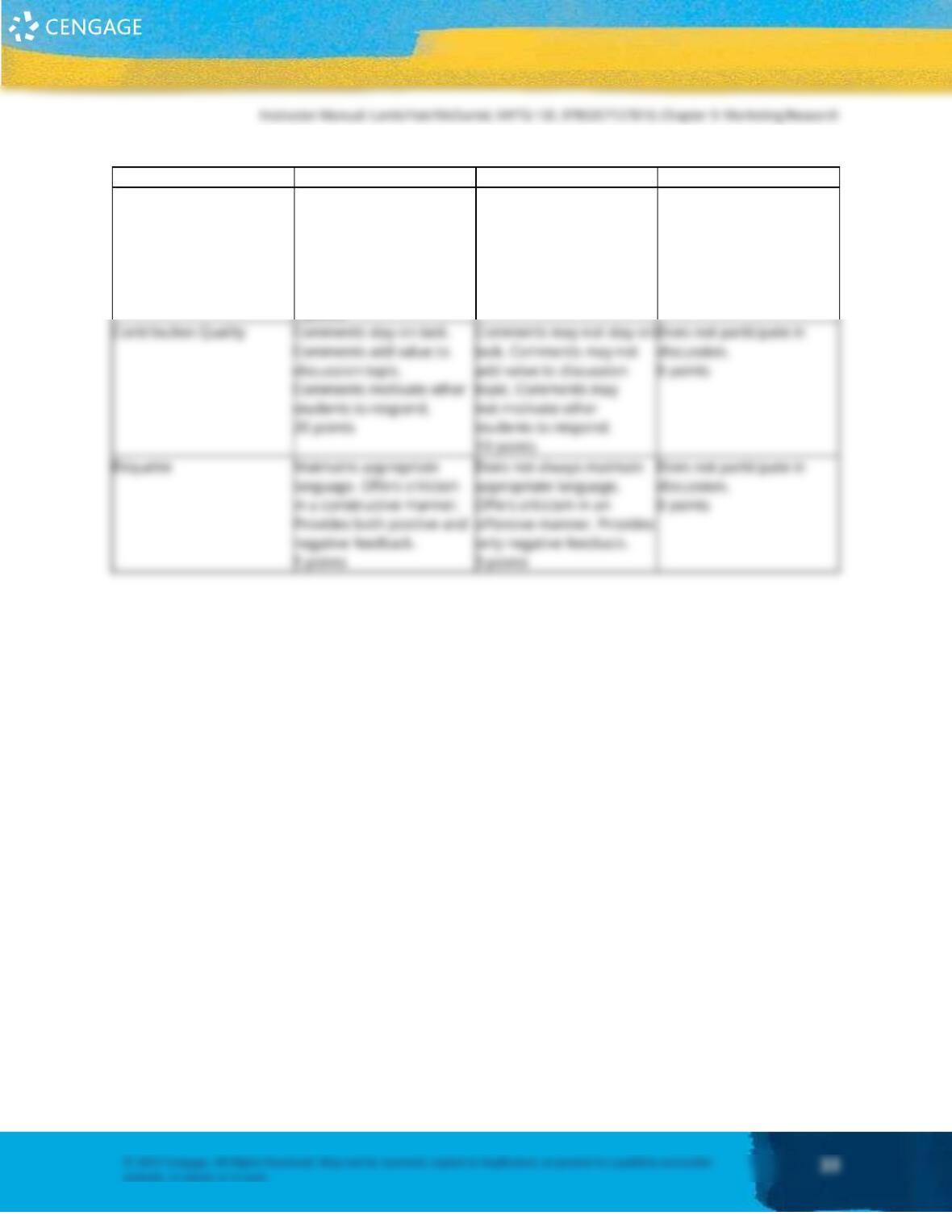
Standard Discussion Rubric
Criteria
Meets Requirements
Needs Improvement
Incomplete
Participation
Submits or participates in
discussion by the posted
deadlines. Follows all
assignment. instructions
for initial post and
responses.
Does not participate or
submit discussion by the
posted deadlines. Does not
follow instructions for
initial post and responses.
3 points
Does not participate in
discussion.
0 points