
Chapter Nine
Innovation and Competitiveness
Authors’ Comments
This chapter presents ideas for competing that do not fit well in the usual
conceptualizations of marketing strategy and the marketing mix. An entrepreneurial
orientation adds vibrancy to a company’s marketing efforts and tends to create
enhanced and unique kinds of value for customers. Innovation is a key part of an
Opening Vignette
Sun Creates an Innovative Partner Network
In the opening example, Sun Microsystems noticed that its customers were becoming
overwhelmed with the intricacies, choices, and uncertainties involved in building E-
commerce systems. To bring all the pieces together in one place, Sun formed the
iForce partner network and developed programs to support it technically and with
Chapter 9: Innovation and Competitiveness 2
Learning Objective
Understand the application of entrepreneurial marketing and
innovation in order to compete in business-to-business markets.
Entrepreneurial Marketing is marketing that is … (PowerPoint 9.2)
Innovation is creating something new and making it useful.
Proactivity is doing something before others do it.
Controlled risk taking is a combination of knowing what the risks really are,
taking moderate risks in which the worst case is survivable, and finding ways to
Opportunity seeking is actively look for opportunities and constantly
evaluating how attractive prospective opportunities are.
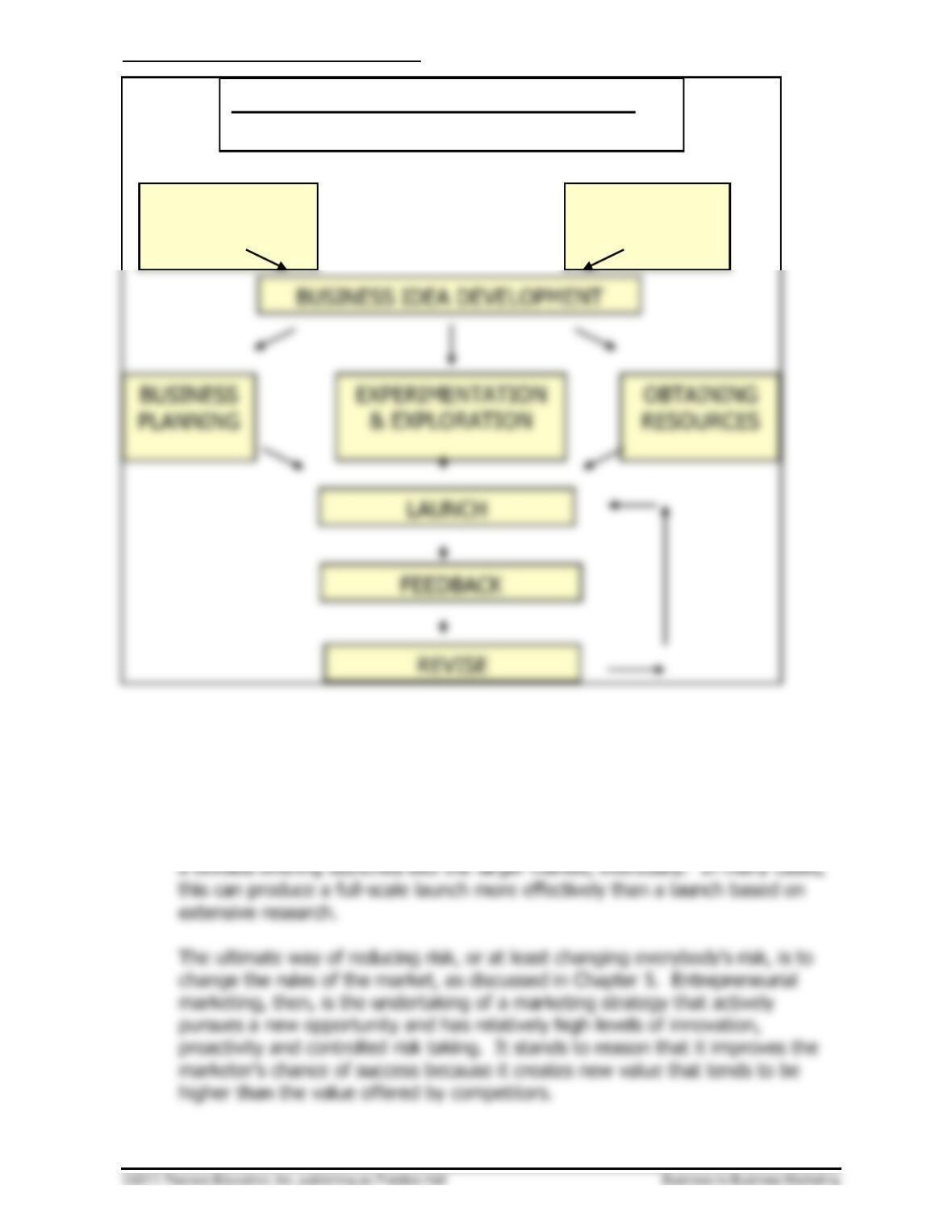
For any one entrepreneurial event, there is a cycle of activity: (Exhibit 9-1 and
PowerPoint 9.4 show the Entrepreneurial Cycle)
For this event to be successful … (PowerPoint 9.5)
a. the opportunity must be kept firmly in mind
the opportunity full bore–taking too long can kill momentum
More on Controlled Risk Taking:
(Summary of this is PowerPoint 9.6; four bullets, one for each
Chapter 9: Innovation and Competitiveness 3
A way that information can be gathered while being proactive is to run one or
more “experiments.”
i
These are trial runs in which the new business, new
product, or new program is launched on a minimal scale in the market, usually
in a small, controllable portion of the market. The results can be assessed and
Exhibit 9-1 Entrepreneurial Cycle
OPPORTUNITY
RECOGNITION
IDEA
GENERATION
Chapter 9: Innovation and Competitiveness 4
Learning Objective (Shown here for implementing Entrepreneurial
Marketing)
Understand how to implement innovation and entrepreneurial
marketing in business-to-business marketing.
Practical Aspects of Creating an Entrepreneurial Orientation (PowerPoint 9.7
shows the headings, below)
Hiring people who are comfortable acting entrepreneurially—three key traits
Directing Appropriate Activities (PowerPoint 9.9)
• Opportunity recognition comes in part from traditional market research
Removing Impediments (PowerPoint 9.10)
• Requirement for extensive justification increases the time it takes to
launch initiatives
Providing Incentives (PowerPoint 9.11)
• Providing a range of incentives needs to be considered, including cash,
Learning Objectives
Obtain an understanding of how innovation relates to entrepreneurial
marketing.
Gain a sense of how innovation can be accomplished in all elements of
the offering.
Chapter 9: Innovation and Competitiveness 5
Competing Through Innovation (PowerPoint 9.12 has three bullets, each
summarizing the paragraphs, below)
Innovation in the non-product elements of the offering can be just as
important–sometimes even more important–than product innovation. An
Top level management, with the help of strategy planners, decide on
businesses to pursue, goals to pursue, and general strategy. In so
doing, they need to determine how innovative to be within the chosen
strategy. The question becomes what type(s) of innovation to
emphasize. Different types of innovation imply different kinds of
organization and activities. (PowerPoint 9.13, with three bullet points,
below)
• Incremental innovations take the existing product and offering
and make small-step improvements.
Considerations of disruptive vs. sustaining innovations (PowerPoint 9.14)
• Sustaining innovation is innovation that improves the existing
dominant technology, products or offerings. It serves the needs
of higher-end customers who already purchase similar products,
but who want more value from these products.
Chapter 9: Innovation and Competitiveness 6
An example of disruption is how Internet news is disrupting the
business of printed newspapers. Similarly, digital photography,
particularly sharing photos over the internet, is disrupting film-
• In the long term, nearly all firms must deal with disruptive
innovation. Too often, existing companies must deal with
someone else’s innovation disrupting their business.
Regarding disruptive innovation:
It’s better to do it to yourself
than to have it done to you by a competitor
(maybe a competitor
A review of the characteristics of market ownership is probably
appropriate at this time. (“Define, evolve, collaborate”)
(PowerPoint 5.16 through PowerPoint 5.19)
Pursuing disruptive innovation (PowerPoint 9.15)
• A corporate or business strategy that intends to “change the rules
of the industry or marketplace,” as discussed in Chapter 5, almost
always needs to pursue breakthrough or disruptive innovation and
• Implementation of disruptive innovation involves five things
(PowerPoint 9.16)
1. Separate the project or business unit responsible for pursuing
disruptive innovation from the existing company with its

Chapter 9: Innovation and Competitiveness 7
To emphasize the necessity of #1 above, consider a discussion of
student experiences in organizations. The individuals reluctant to
embrace change (for whatever reason, cynicism, resistance to change,
risk adverse, or just plain negative) can lower the expectations of an
entire group, effectively slowing or stopping the innovation process. It’s
not unusual for a student to use the phrases “let a sleeping dog sleep”
or “if it isn’t broke, don’t fix it.” The market driven/ownership position of
Pursuing Sustaining Innovation (PowerPoint 9.17)
To compete for any length of time within an industry, a company must
pursue sustaining innovation. The process for preparing the periodic
marketing plan can be used as the framework for instituting sustaining
innovation throughout the offering.
Time pacing of planned organization change–setting strict time tables
Too often, business-to-business marketing planning focuses innovative
attention on products and markets to the exclusion of innovation in the
Chapter 9: Innovation and Competitiveness 8
Learning Objective (Repeated here for Implementing Innovation)
Understand how to implement innovation and entrepreneurial
marketing in business-to-business marketing.
Practical Aspects of Accomplishing Innovation (PowerPoint 9.18 shows the
headings in this section)
Hiring the right people–match the type of person to the type of innovation
being pursued. (PowerPoint 9.19)
• Someone that takes a visionary, extensive redesign approach to every
Directing Appropriate Activities (PowerPoint 9.20)
• Establish networks of people who are good information sources
• Radical innovation needs autonomy and constant rethinking of the
future market and appropriate business models
• A large problem in product commercialization is the match between the
company’s beliefs about the innovation and customers’ beliefs
PostIt note were almost ignored by 3M. Originally the outcome of an
unsuccessful attempt to develop an adhesive, 3M did not recognize its
many uses. Initially, the wrong sales channel was used and the product
Chapter 9: Innovation and Competitiveness 9
(PowerPoint 9.21)
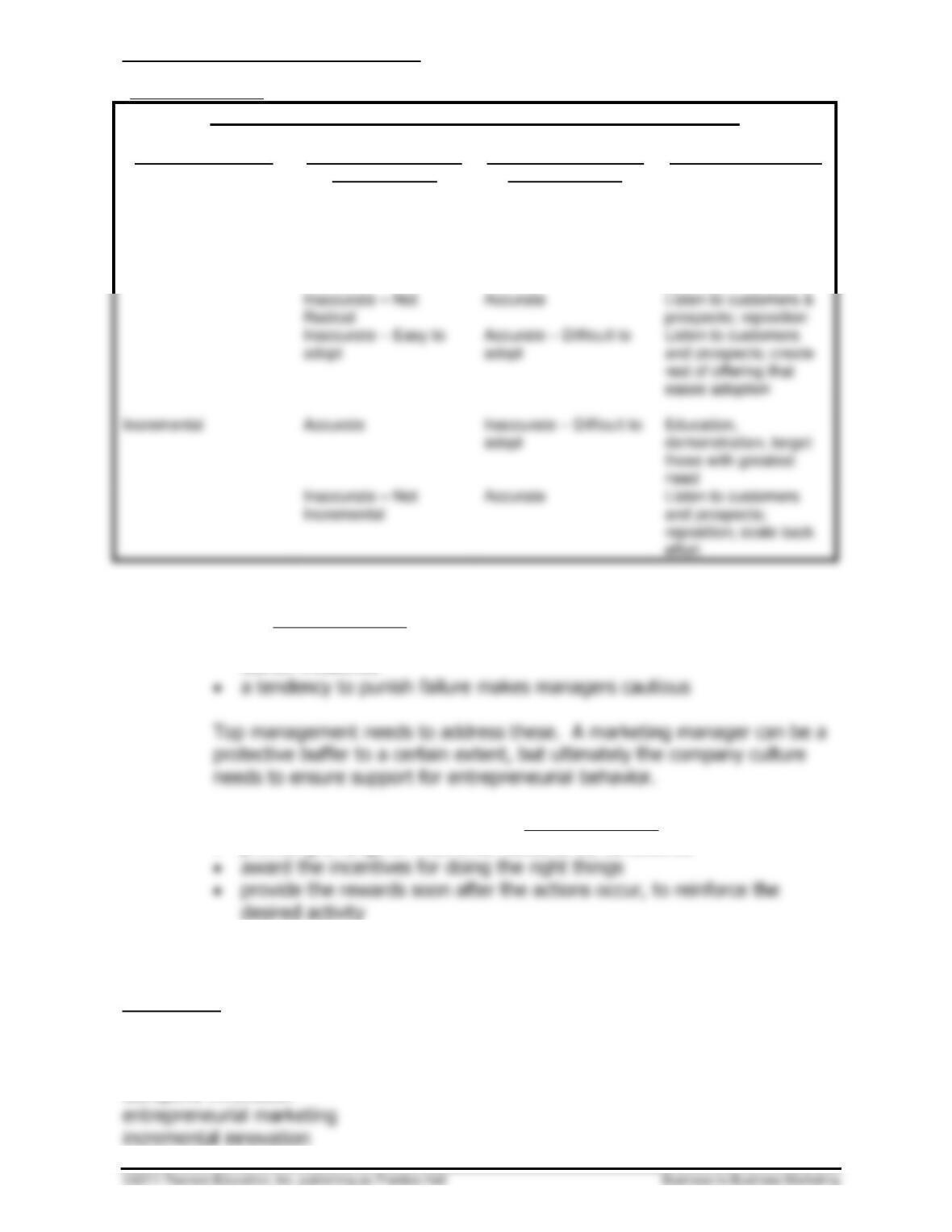
Exhibit 9-3. Perceptions and Misperceptions of Innovations
Type of Innovation
Supplier Perception /
Misperception
Customer Perception
/ Misperception
Approach to Solving
Radical
Accurate
Inaccurate — Not
Radical
Education,
demonstration
Accurate
Inaccurate — Difficult to
adopt
Education,
demonstration, target
by TALC
Inaccurate – Not
Radical
Accurate
Listen to customers &
prospects; reposition
adopt
demonstration, target
those with greatest
effort
Removing Impediments–similar to addressing impediments for Entrepreneurial
Marketing (PowerPoint 9.22)
• a requirement for extensive justification increases the time it takes to
launch initiatives
Providing incentives for being innovative (PowerPoint 9.23)
• providing a range of incentives needs to be considered
Key Terms
breakthrough innovation
controlled risk taking
discovery-based planning
disruptive innovation

Chapter 9: Innovation and Competitiveness 10
Answers to Questions for Review and Discussion
1. Why would taking an entrepreneurial orientation in business-to-business
marketing yield better competitiveness for a company than would a more
reactive, risk-averse approach?
An entrepreneurial orientation should tend to yield better performance because the company
2. How does innovation differ from proactivity?
3. Why is controlled risk taking more competitively attractive than strictly risk–
averse behavior?
Controlled risk taking is more competitively attractive than strictly risk-averse behavior because
4. What is the difference between radical innovation and disruptive innovation?
5. Why is an autonomous organizational unit the appropriate way to pursue
disruptive innovation?
Without an autonomous organizational unit the innovating company will tend to kill the new
6. Why should a marketing manager try to enhance and direct incremental, non–
product innovation? Since it is incremental, why not just let it happen on its
own?
A marketing manager should try to enhance and direct incremental, non-product innovation
7. Compare the marketing mix and customs of an innovation-oriented firm and a
market share-driven firm. What prevents a share-driven firm from also being a
leader in innovation?
The marketing mix and customs of an innovation-oriented firm and a market share-driven firm
compare as follows:
Innovation Share driven
8. Referring to Question 11, what suggestions could you make to a share-driven
firm that also wants to be known as the innovator in the market?
Suggestions for a share driven firm seeking to be known as a market innovator might include
the following:

Chapter 9: Innovation and Competitiveness 12