
Instructor Manual
Lamb/Hair/McDaniel, MKTG 13E, 9780357127810; Chapter 9: Marketing Research
Table of Contents
Purpose and Perspective of the Chapter …………………………………………………………………………. 2
Cengage Supplements …………………………………………………………………………………………………… 2
Learning Outcomes ……………………………………………………………………………………………………….. 2
Complete List of Chapter Activities and Assessments ……………………………………………………… 3
Key Terms ……………………………………………………………………………………………………………………… 4
What’s New in This Chapter ……………………………………………………………………………………………. 7
Chapter Outline …………………………………………………………………………………………………………….. 7
Discussion Questions …………………………………………………………………………………………………… 24
Additional Activities and Assignments …………………………………………………………………………… 25
Additional Resources ……………………………………………………………………………………………………. 31
External Videos or Playlist ……………………………………………………………………………………………………….. 31
Appendix …………………………………………………………………………………………………………………….. 32
Generic Rubrics ……………………………………………………………………………………………………………………… 32
Standard Writing Rubric …………………………..……………………………………………………………………………… 32
Standard Discussion Rubric ……………………………………………………………………………………………………… 33
Purpose and Perspective of the Chapter
The purpose of this chapter is to define and explain the importance of marketing research,
the process of collecting and analyzing data to solve marketing problems. The marketing
Cengage Supplements
The following product-level supplements provide additional information that may help you
in preparing your course. They are available in the Instructor Resource Center.
• Transition Guide (provides information about what’s new from edition to edition)
• Educator’s Guide (describes assets in the platform with a detailed breakdown of
activities by chapter with seat time)
Learning Outcomes
The following learning outcomes are addressed in this chapter:
9-1 Define marketing research and explain its importance to marketing decision
making.
9-2 Describe the steps involved in conducting a marketing research project.

9-6 Explain when marketing research should be conducted.
9-7 Explain the concept of competitive intelligence.
Complete List of Chapter Activities and Assessments
For additional guidance refer to the Teaching Online Guide.
Chapter
Learning
Objective
PPT slide
Activity/Assessment
Duration
Certification
Standard
N/A
MindTap: Why Does
Company Data Collection
Matter to Me?
5 minutes
BUSPROG:
Reflective
Thinking
DISC:
Customer
9-1
MindTap: Learn It 9-1: The
Role of Marketing
Research
5 minutes
BUSPROG:
Analytic
Research
9-3
MindTap: Learn It 9-3:
The Profound Impact of
the Internet and Smart
Devices on Marketing
Research
5 minutes
BUSPROG:
Analytic
DISC:
Research
9-4
MindTap: Learn It 9-4: The
Growing Importance of
Mobile Research
5 minutes
BUSPROG:
Analytic
DISC:
Research
9-6
MindTap: Learn It 9-6:
When Should Marketing
Research Be Conducted?
BUSPROG:
Analytic
DISC:
Research
DISC:
Research
9-1 – 9-7
MindTap: Assignment
25 minutes
BUSPROG:
Analytic
DISC:
Marketing
Plan
DISC:
Research
9-2
37
Knowledge Check 1 in PPT
5 minutes
BUSPROG:
Analytic
DISC:
Marketing
Plan
9-3
45
Knowledge Check 2 in PPT
5 minutes
BUSPROG:
Analytic
DISC:
9-5
Discussion 2 in PPT
BUSPROG:
Research
DISC:
Research
[return to top]
Key Terms
behavioral targeting (BT): a form of observation marketing research that combines a
consumer’s online activity with psychographic and demographic profiles compiled in
databases.
competitive intelligence (CI): an intelligence system that helps managers assess their
competition and vendors in order to become more efficient and effective competitor.
computer-assisted personal interviewing: an interviewing method in which the
interviewer reads questions from a computer screen and enters the respondent’s data
directly into the computer .
ethnographic research: the study of human behavior in its natural context; involves
observation of behavior and physical setting.
executive interview: a type of survey that usually involves interviewing business people at
their offices concerning industrial products or services.
experiment: a method of gathering primary data in which the researcher alters one or
more variables while observing the effects of those alterations on another variable.
management decision problem: a broad-based problem that uses marketing research in
order for managers to take proper actions.
marketing research objective: the specific information needed to solve a marketing
research problem; the objective should be to provide insightful decision-making
information.
mystery shoppers: researchers posing as customers to gather observational data about a
store.
neuromarketing: a field of marketing that studies the body’s responses to marketing
stimuli.
nonprobability sample: any sample in which little or no attempt is made to get a
representative cross section of the population.
observation research: a research method that relies on four types of observation: people
watching people, people watching an activity, machines watching people, and machines
watching an activity.
random sample: a sample arranged in such a way that every element of the population
has an equal chance of being selected as part of the sample.
research design: specifies which research questions must be answered, how and when
the data will be gathered, and how the data will be analyzed.
sample: a subset from a larger population.
survey research: the most popular technique for gathering primary data, in which a
researcher interacts with people to obtain facts, opinions, and attitudes.
universe: the population from which a sample will be drawn.
[return to top]
What’s New in This Chapter
The following elements are improvements in this chapter from the previous edition:
• New examples of how Dick’s Sporting Goods, Sports Authority, Cabela’s, and Bass
Pro can use marketing research to tweak their inventory and in-store displays to
build sales.
• New discussion of use of marketing research to determine the number of sales
[return to top]
Chapter Outline
In the outline below, each element includes references (in parentheses) to related content. “LO
CH–##” refers to the chapter learning outcome; “PPT Slide #” refers to the slide number in the
PowerPoint deck for this chapter (provided in the PowerPoints section of the Instructor Resource
1. The Role of Marketing Research (LO 9-1, PPT Slide 3, DISC: Research)
a. Marketing research is the process of planning, collecting, and analyzing data
relevant to a marketing decision. Marketing research:
• Is the function that links the consumer, customer, and public to the marketer
b. Marketing research has three roles: descriptive, diagnostic, and predictive. Its
descriptive role includes gathering and presenting factual statements. Its diagnostic
role includes explaining data. Its predictive function is to address “what if”
questions.
c. Management Uses of Marketing Research: Marketing research can help
managers:
• Improve the quality of decision making
d. Understanding the Ever-Changing Marketplace: Marketing research helps
managers to understand what is going on in the marketplace and to take advantage
of opportunities. One of the hottest trends in technology today is the Internet of
Things (IoT), which refers to everyday devices—such as refrigerators, toys, light
2. Steps in a Marketing Research Project (LO 9-2, PPT Slide 10, DISC: Research)
a. The marketing research process is a scientific approach to decision making that
maximizes the chance of getting accurate and meaningful results. Exhibit 9.1 traces
the seven steps in the research process.
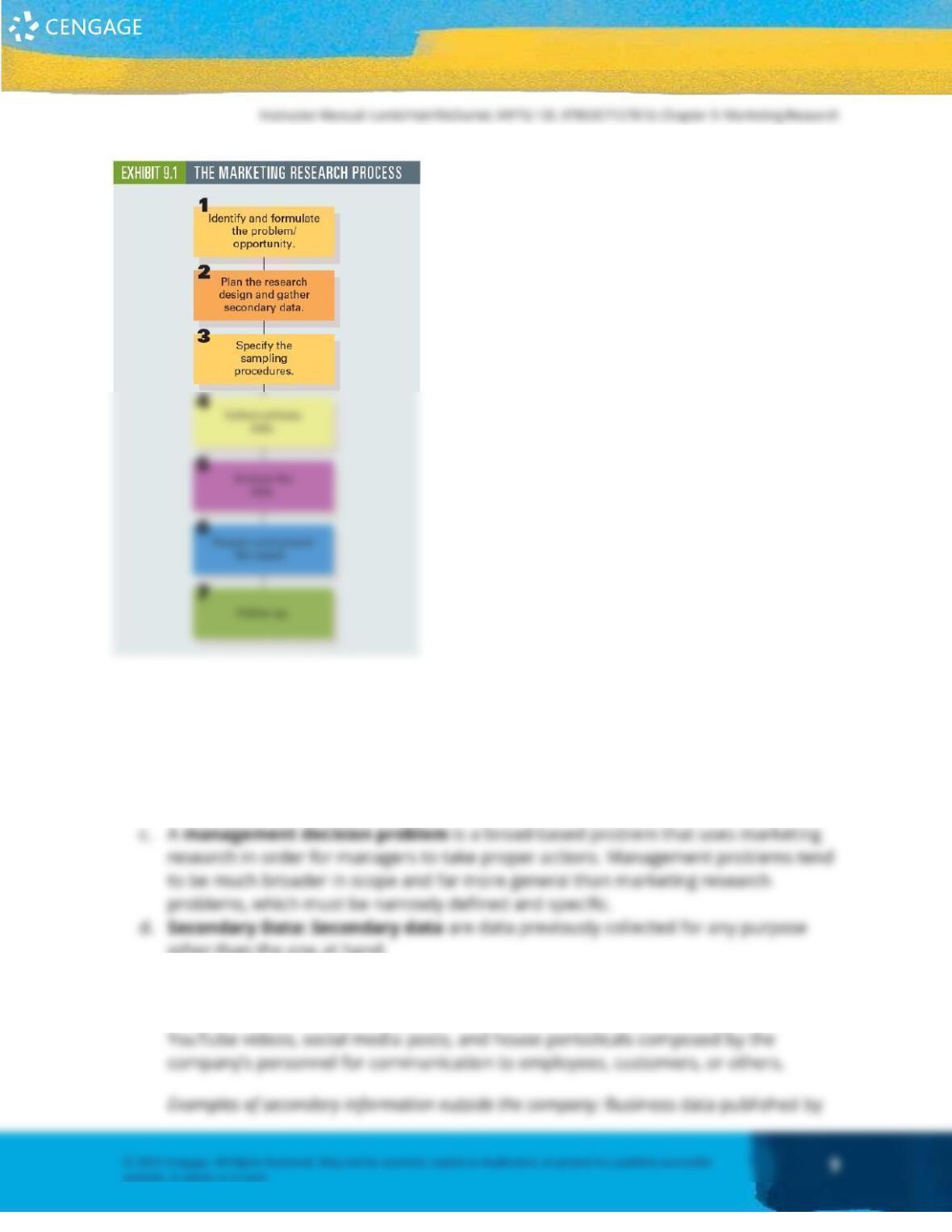
PRESENTATION VISUAL: Exhibit 9.1 The Marketing Research Process
b. The marketing research problem involves determining what information is
needed and how that information can be obtained efficiently and effectively. The
marketing research objective defines the specific information needed to solve a
marketing research problem; the objective should be to provide insightful decision-
making information. Managers must combine this information with their own
experience and other information to make proper decisions.
other than the one at hand.
Examples of secondary information originating inside the company: The company’s
website, annual reports, reports to stockholders, blogs, product testing results,
periodicals and other news media.
e. Advantages of secondary data include the following:
• Saves time and money.
f. Disadvantages of secondary data include the following:
• The researcher’s unique problem and the purpose for which the secondary data
were originally gathered are typically different.
• Secondary data sources often do not give detailed information that would
enable a researcher to assess their quality or relevance.
Example: A company wanted to determine the market potential for a fireplace
• The Growing Importance of Social Media Data: The user databases of social media
sites like Twitter, Pinterest, and Facebook tell companies’ marketers a lot about
who you are and what you like, though often on an anonymous basis.
o Facebook owns and controls data collected from 1.47 billion daily and 1.79
million monthly active users. Facebook now combines its social data with
third-party information from data brokerages, such as data collected from

g. Planning the Research Design and Gathering Primary Data: Research design
specifies which research questions must be answered, how and when the data will
be gathered, and how the data will be analyzed. Sometimes research questions can
h. Survey Research: The most popular technique for gathering primary data is survey
research, in which a researcher interacts with people to obtain facts, opinions, and
attitudes. Traditional forms of survey research include:
• In-home personal interviews – provide high-quality information but tend to be
very expensive because of the interviewers’ travel time and mileage costs
i. All forms of survey research require a questionnaire. Questionnaires ensure that all
respondents will be asked the same series of questions. They include three basic
types of questions:
• Open-ended question – an interview question that encourages an answer
phrased in the respondent’s own words
j. When designing a questionnaire:
• Ensure the question is clear and concise.
k. Observation Research: Observation research is a research method that relies on
four types of observation: people watching people, people watching an activity,
machines watching people, and machines watching an activity. Examples of these
various observational situations are shown in Exhibit 9.4.
PRESENTATION VISUAL: Exhibit 9.4 Observational Situations
Situation
Example
People watching people
Observers stationed in supermarkets watch consumers
select frozen Mexican dinners; the purpose is to see how
much comparison shopping people do at the point of
purchase.
l. Some common forms of people-watching-people research include:
• One-way mirrors allow researchers to see the participants, but the participants
cannot see the researchers.
• Mystery shoppers are researchers who pose as customers to gather
observational data about a store. Interaction occurs only so the mystery shopper
can observe the actions and comments of the employee.
Example: A major apparel retailer using a computer-simulated environment
recently found that some men have trouble putting outfits together. Men also
hesitate to pick up clothing items because they can’t fold them back the same
way. With this knowledge, the apparel chain made two major changes: it began
selling items together as complete outfit solutions and folded shirts and other
clothes more simply. Sales of men’s clothes increased by 40 percent.
m. Experiments: An experiment is a method of gathering primary data in which the
researcher alters one or more variables while observing the effects of those
n. Specifying the Sampling Procedures: Once researchers decide how they will
collect primary data, the next step is to select the sampling procedures they will use.
A sample is a subset from a larger population. The universe is the population from
which a sample will be drawn. After the universe has been defined, the next
question is whether the sample must be representative of the population. If the
answer is yes, a probability sample is needed. Otherwise, a nonprobability sample
might be considered.
• Probability Samples: A probability sample is a sample in which every element in
the population has a known statistical likelihood of being selected. One type of

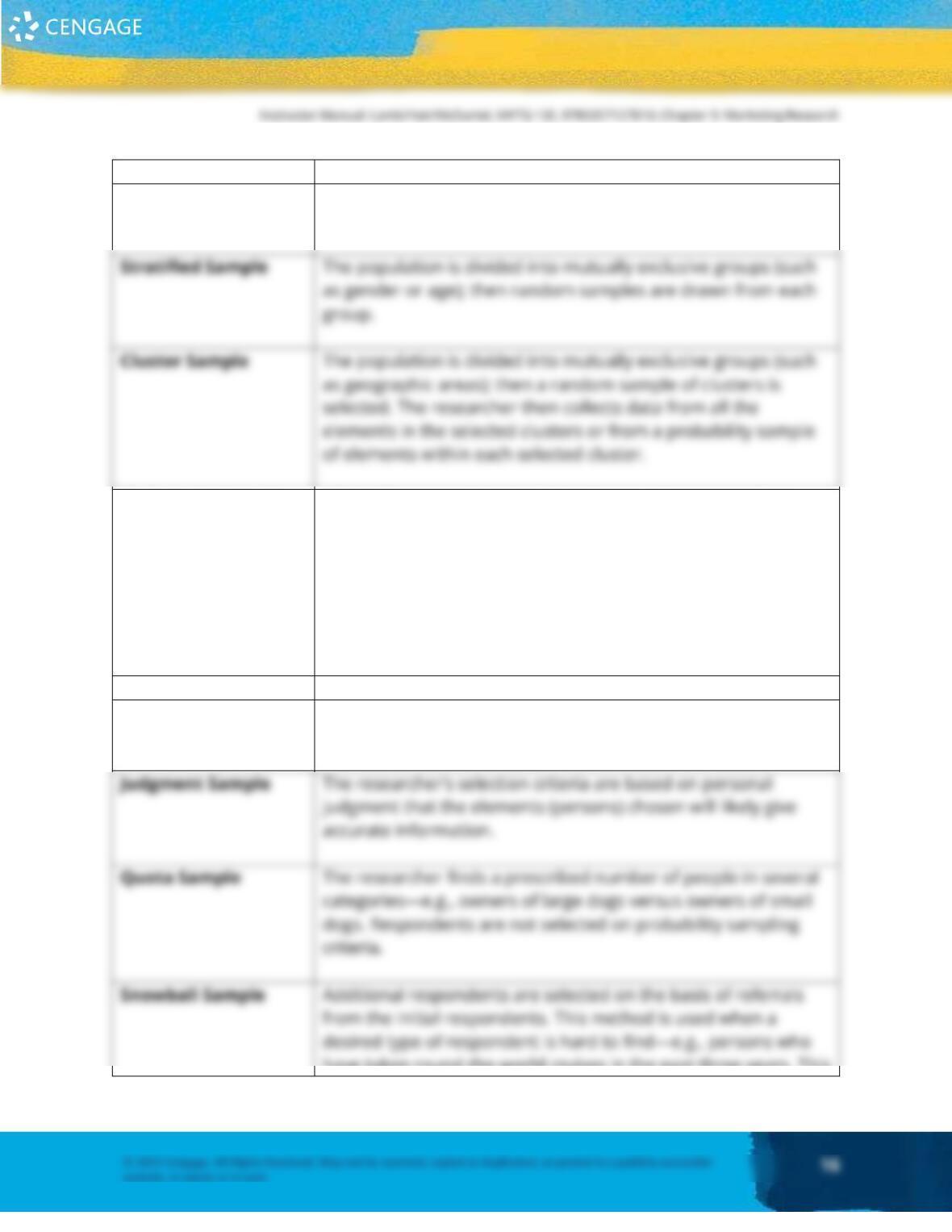
PRESENTATION VISUAL: Exhibit 9.5 Types of Samples
Probability Samples
Simple Random
Sample
Every member of the population has a known and equal chance
of selection.
Systematic Sample
A list of the population is obtained—e.g., all persons with a
checking account at XYZ Bank—and a skip interval is obtained
by dividing the sample size by the population size. If the sample
size is 100 and the bank has 1,000 customers, then the skip
interval is 10. The beginning number is randomly chosen within
the skip interval. If the beginning number is 8, then the skip
pattern would be 8, 18, 28…
Nonprobability Samples
Convenience Sample
The researcher selects the population members from whom it
is easiest to obtain information.
have taken round-the-world cruises in the past three years. This
• Types of Errors: Whenever a sample is used in marketing research, two major
types of errors may occur:
o A sampling error occurs when a sample somehow does not represent the
target population. Two types of sampling errors include:
− Frame error – an error that occurs when a sample drawn from a
population differs from the target population
− Random error – an error that occurs when the selected sample is an
imperfect representation of the overall population
Examples: Suppose a telephone survey is conducted to find out Chicago
o. Collecting the Data: Marketing research field service firms are used to collect some
primary data. A field service firm specializes in interviewing respondents on a
subcontracted basis. Besides conducting interviews, field service firms provide focus
group facilities, mall intercept locations, test product storage, and kitchen facilities
to prepare test food products.