14
C. Glocalization [Instructor PPT Slide 18]
The term glocalization represents one alternative that allows flexibility in responding to the
unique value profiles of consumers. Glocalization represents the idea that the marketing
strategy may be global, but the implementation of that strategy at the marketing tactics level
should be local.
Q: Explain the concept of glocalization with an example.
Video material for this chapter is starting on page 24 of the IM
End of Chapter Material
Discussion Questions
(*) Indicates material on prep cards.
1. *Why are culture and meaning inseparable?
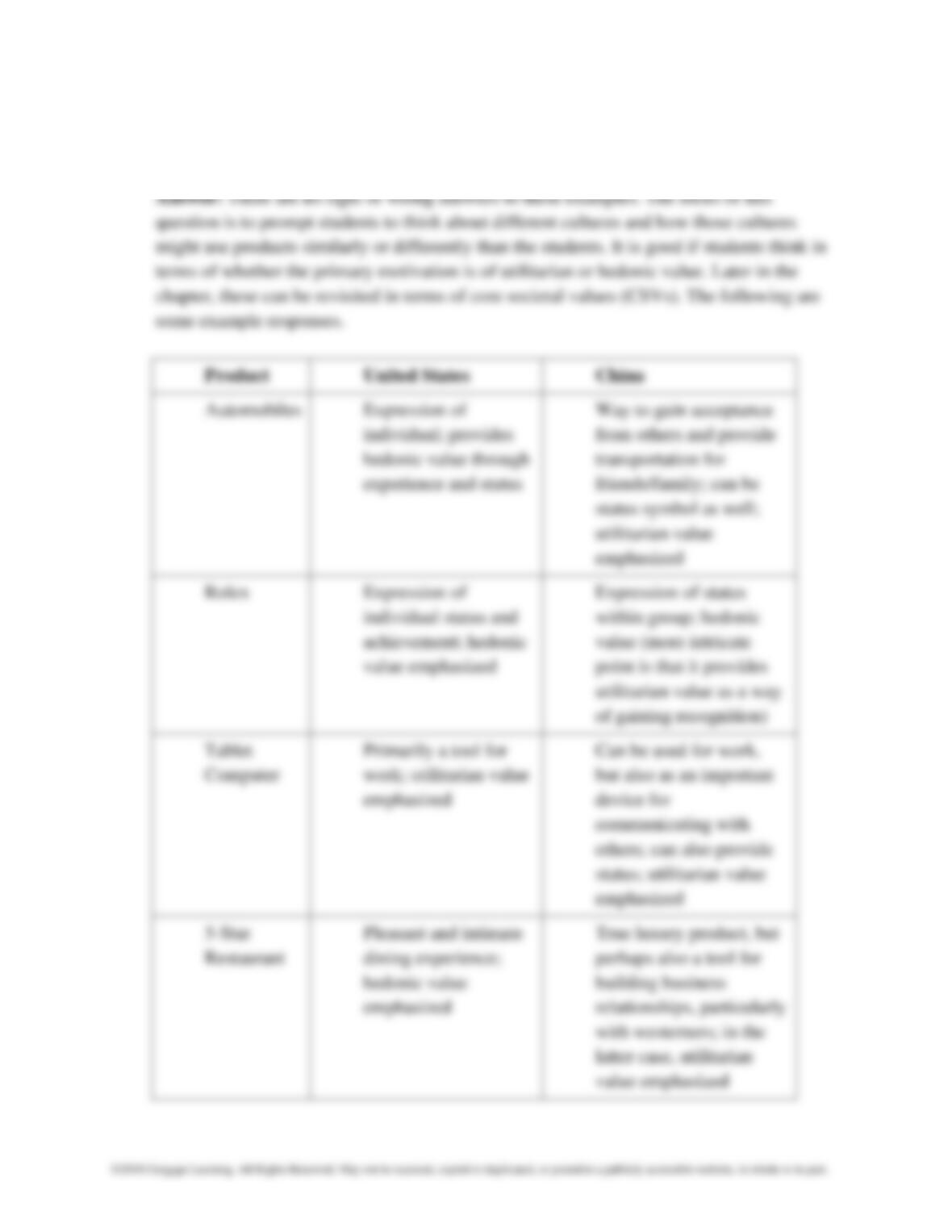
2. Culture affects the value of consumer behaviors. Consider the differences in American
consumers versus Chinese consumers. Contrast the value that consumers in these countries
15
might typically desire in the following products: Automobiles, Rolex watch, Tablet
computer, 5-star restaurant.
©2018 Cengage Learning. All Rights Reserved. May not be scanned, copied or duplicated, or posted to a publicly accessible website, in whole or in part.
3. *What is meant when one says that “culture gives meaning to objects and activities”?
4. List and briefly describe each of the five dimensions of CSVs.
©2018 Cengage Learning. All Rights Reserved. May not be scanned, copied or duplicated, or posted to a publicly accessible website, in whole or in part.
5. Using the Hofstede website discussed in the chapter, compute the cultural distance
between the United States and Belgium. Then, compute the cultural distance between the
United States and Denmark.
6. What do the terms acculturation and enculturation mean, and how do they relate to
consumer socialization?
©2018 Cengage Learning. All Rights Reserved. May not be scanned, copied or duplicated, or posted to a publicly accessible website, in whole or in part.
7. Describe the socialization processes that have shaped your current food preferences as a
consumer.
8. *Describe the concepts of translational equivalence and metric equivalence and how they
relate to communication differences across cultures.
9. What are the basic elements of nonverbal communication?
19
©2018 Cengage Learning. All Rights Reserved. May not be scanned, copied or duplicated, or posted to a publicly accessible website, in whole or in part.
Answer: The basic elements are as follows:
Time
Mannerisms/body language
Space
Etiquette/manners
Agreement
Relationships
Symbols
BUSPROG: Communication
DISC: Strategy
LO: 9-4
Topic: A-head: Fundamental Elements of Communication
Bloom’s: Knowledge
Difficulty: Easy
10. Define Globish.
11. What is meant by glocalization?
20
Group Activity
Ask someone from the international department at a nearby university to visit your classroom, or
have an international student pay a visit so that students can experience consumer culture. Have
the student or representative discuss Exhibit 9.1 on culture, meaning, and value. This activity
allows students to understand the impact of marketing in cultures around the world. This activity
could lead to a panel discussion if two or more students hail from other countries.
Assignments
1. *Design an advertisement that intends to communicate the benefits of a facial cream to
family skin care for each of the following consumer markets. Consider the relative role of
verbal and nonverbal communication in doing so.
Germany
Egypt
Japan
Israel
New Zealand
2. Use the Internet to find the consumer corruption indices for various nations (see
www.transparency.org). Why do these values differ so greatly from nation to nation? How
21
would this factor into the idea of cultural distance? Do you believe it would be ethical to
do business in one of the more traditionally corrupt nations, such as Russia or Nigeria?
3. Select a country that you think would be an interesting country to live in. Examine the
country’s CSV scores, which can be found at http://geert-hofstede.com. In what ways do
you think these scores might affect your lifestyle in that country? How do you think the
cultural distance between your home culture and this culture affect your acculturation
process? Would it be easy or difficult? Why?
4. Interview a fellow student who is from a culture other than your own. How does this
student view the dimensions of CSV (individualism, masculinity, power distance,
uncertainty avoidance, long-term avoidance)? How have these dimensions affected the
22
student’s behavior since arriving in your country? Were you aware of the importance of
these dimensions in the student’s life? What major cultural differences has the student
noticed since arriving in your country?
5. View a popular foreign movie. What consumer behavior differences do you observe in the
culture that you are witnessing? Do you observe differences between your culture and the
culture in the movie in terms of nonverbal communication, sex roles, and individual or
collective attitudes?
Chapter Video Summary
To view the video case on Lonely Planet, access the Chapter 9 Media Quiz in CB8 Online
(create a course at login.cengage.com).
Lonely Planet
23
©2018 Cengage Learning. All Rights Reserved. May not be scanned, copied or duplicated, or posted to a publicly accessible website, in whole or in part.
prosper. Lonely Planet aims to provide travelers with consistent information leading to
memorable personal experiences. It emphasizes marketing as a means of communicating
effectively with customers, and attributes much of the success of global businesses to a robust
branding strategy.
Ask your students:
1. What are the factors that can be attributed to the global success of Lonely Planet?
2. How does Lonely Planet seek to distinguish itself from its peers?
3. Discuss Lonely Planet’s position on branding.
24
©2018 Cengage Learning. All Rights Reserved. May not be scanned, copied or duplicated, or posted to a publicly accessible website, in whole or in part.
differentiate itself from competition—dubbing the travel guidebooks into different
languages and using generic images to target its customers.
BUSPROG: Diversity
DISC: Customer | International Perspective
LO: 9-1
Topic: A-head: Culture and Meaning Are Inseparable
Bloom’s: Comprehension
Difficulty: Moderate
CB Scenario Video
As Baby Boomers reach 65, marketers are preparing for the changing needs of the Me
generation. Stores are modifying designs to make it easier for aging consumers to access
products despite any physical limitations. Companies are developing technologies that can be
used to help older people live safer and fuller lives. The buying power of the Baby Boomer
cohort will ensure that marketers take good care of this market segment.
Ask your students:
1. In the context of collectivism and individualism, how do baby boomers differ from
teenagers?
2. Suppose you are planning to start a health club for baby boomers in your city. In the
context of power distance, how would you approach them?
©2018 Cengage Learning. All Rights Reserved. May not be scanned, copied or duplicated, or posted to a publicly accessible website, in whole or in part.