Chapter 8: Global Marketing
CHAPTER SUMMARY AND LEARNING OBJECTIVES
LO 8.1 Describe the global business landscape in terms of U.S. imports, U.S. exports,
and major industries.
Global marketing expands a company’s market, allows firms to grow, and makes them less
dependent on their own country’s economy for success.
LO 8.2 Differentiate between WTO, NAFTA, and EU in terms of basic functions and
member countries.
LO 8.3 Summarize the five major factors that influence the global marketing environment.
LO 8.4 Summarize the six alternative strategies for entering global markets.
LO 8.5 Describe the five alternative marketing mix strategies used in global marketing.
LO 8.6 Given an example of a company’s goals for expanding globally, determine the
most appropriate market entry strategy.
Marketers must consider factors such as risk propensity, local demand for the product, degree
of control, and knowledge of the foreign market when considering which market entry strategy is
most appropriate.
Chapter 8: Global Marketing
ACTIVATOR EXERCISE: Going Global
Purpose: To introduce students to the factors involved in going global.
Format: Small group discussion, then class presentation.
Time: 20–40 minutes, depending on format.
Activity: Besides generating additional revenue, firms expand operations outside their home
Notes: For larger companies, ask students to pick a country where that business does not
already operate. Ask them to specify why they would sell in that country. Sometimes this
exercise can work better for smaller, more local companies that students might be familiar with.
How would you get the word out to customers in the new market? How would you physically
make and ship products for customers in the new markets? Would you make any changes to
the product?
Ask students to present their ideas to the class.
Result: Students will usually realize there are a number of complexities involved beyond the
Chapter 8: Global Marketing
LECTURE OUTLINE
8-1 Global Marketing
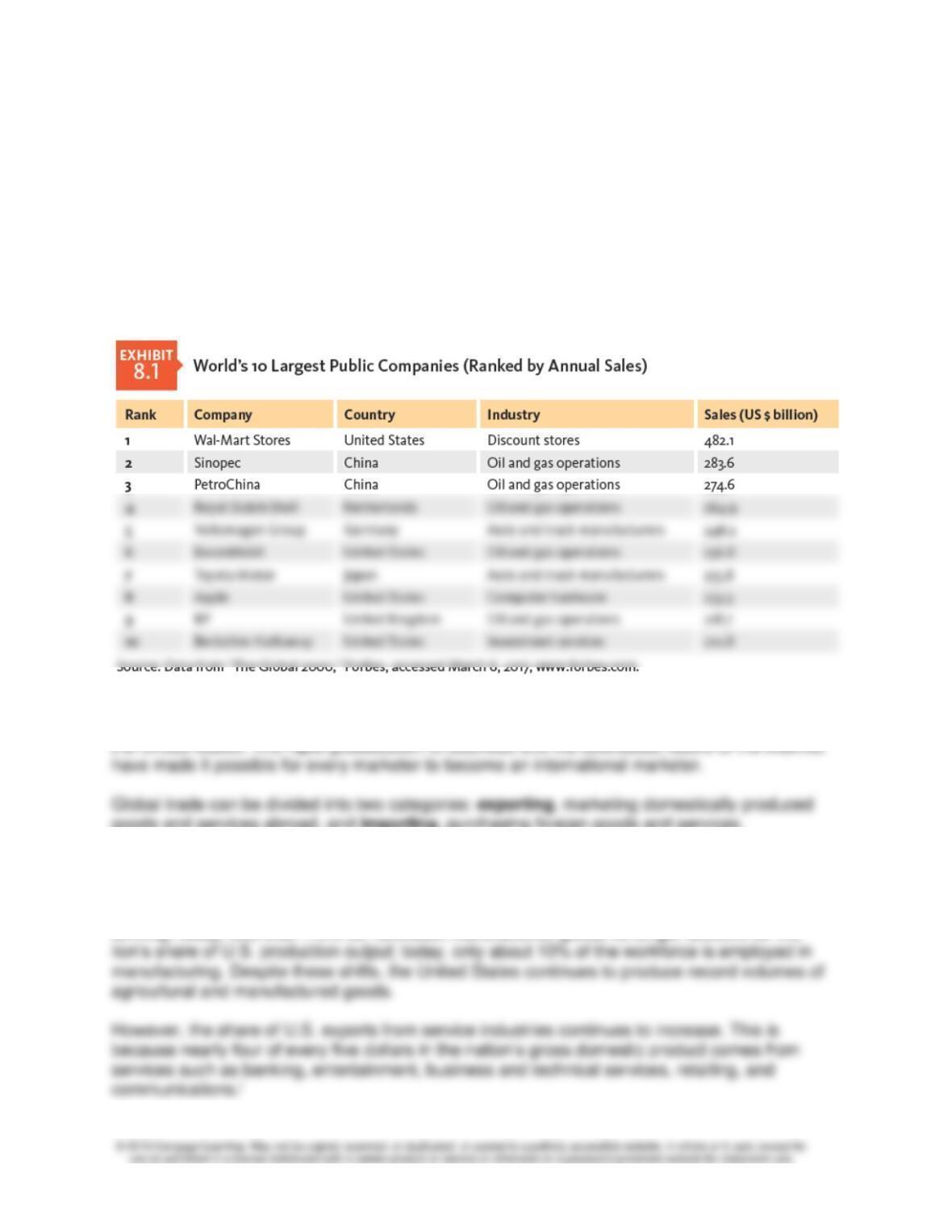
As the list of the world’s 10 largest public corporations reveals, less than half of these
companies are headquartered in the United States.
PRESENTATION VISUAL: MindTap Exhibit 8.1 showing 10 largest companies in the world
(by revenue)
For most companies—large and small—global marketing is rapidly becoming a necessity. The
demand for foreign products is increasing, both for U.S. products abroad and foreign products in
goods and services abroad, and importing, purchasing foreign goods and services.
Exports
The United States used to export mainly physical goods and agricultural products, but this has
changed for a number of reasons. In the 1800s, more than 90% of Americans worked in
Chapter 8: Global Marketing
Imports
Importing goods and services from other countries provides several benefits such as increased
access to resources, lower prices, and expanded choices for consumers. Some firms rely on
purchasing raw materials abroad as input for their domestic manufacturing operations.
Example: A North Carolina furniture manufacturer may depend on purchases of South
American teak, while a shoe manufacturer may import leather from Italy.
Classroom activity: In small groups, students will explore how changes in importing and
exporting would transform our economy. Assign one of the following questions to each group.
Ask them to brainstorm and share a two-minute presentation with the class about their analysis.
It’s OK for students to research these issues using their phones or computer in order to gather
real-world data to support their presentations.
What would happen if iPhones were produced in the United States instead of China?
What would happen if the United States stopped importing oil from countries outside of North
America?
Note: Ask students to analyze these questions in terms of employment levels and economic
growth, prices for goods, economic power of the various countries involved, adjustments that
various countries and companies would make to the new reality, and so on.
Estimated time: 10–30 minutes (depending on whether you facilitate the classroom activity)
8-2 Multinational Economic Integration
Selling products to another country can be complicated for any business, especially since each
country might have its own tax policies, trade restrictions, and currency. It gets even more
complicated if two countries have disagreements about trade, leading to increased tariffs,
which are taxes levied against imported goods.
Chapter 8: Global Marketing
To understand the global marketing environment, it’s useful to know the basics of WTO, EU,
and NAFTA—three important examples of multinational economic integration.
The World Trade Organization
The World Trade Organization (WTO) is a 164-member organization that:
• oversees trade agreements among its members,
In cases of trade disputes, WTO decisions are binding on member countries. Countries that
seek to become members of the WTO must participate in rigorous rounds of negotiations that
can last several years. Russia holds the record for waiting the longest: Having applied for
membership in 1993, its application was approved in 2011.
iii
The European Union
The best-known example of a multinational economic community is the European Union (EU).
The EU:
• has adopted a common currency,
Twenty-eight countries make up the EU. With a total population of more than 510 million people,
the EU forms a huge common market.
iv
In addition to simplifying transactions among members,
the EU looks to strengthen its position in the world as a political and economic power.
The NAFTA Accord
More than two decades after the passage of the North American Free Trade Agreement
(NAFTA)—an agreement between the United States, Canada, and Mexico that removes trade
Classroom activity: Divide the class into groups and ask them to pretend they are advising
Congress and the White House whether to stay in NAFTA. They can choose to support or
oppose continuation of the trade deal. They can research their rationale on their phone or
laptop. Ask them to state at least five reasons for their recommendation.
Chapter 8: Global Marketing
Estimated time: 15–40 minutes (depending on whether you facilitate the classroom activity)
8-3 The International Marketing Environment
As in domestic markets, the environmental factors discussed in Chapter 3 have a powerful
Classroom activity: Divide students into groups and assign each a country. Ask them to
evaluate the following questions and provide specific answers:
What types of products are more likely to succeed in that country? Why?
What types of products are less likely to succeed in that country? Why?
What issues must marketers consider when marketing in that country?
The following are countries that would provide a diverse array of answers to these questions:
Canada
Brazil
Economic
A nation’s size, per-capita income, and stage of economic development determine what types of
products will be successful there. Nations with low per-capita incomes may be poor markets for
Infrastructure—the underlying foundation for modern life that includes transportation,
communications, banking, utilities, and public services—is another important economic factor to
consider when planning to enter a foreign market. An inadequate infrastructure may constrain
marketers’ plans to manufacture, promote, and distribute goods and services in a particular
country.
Example: Recognizing that distribution could impact business in the Philippines, Unilever
Chapter 8: Global Marketing
Social-Cultural Environment
Before entering a foreign country, marketers should study all aspects of its culture, including
International Political-Legal Environment
Global marketers must continually stay abreast of laws and trade regulations in each country in
which they compete. Legal requirements of host nations affect foreign marketers.
Example: Despite China’s many advances in recent years—and even as it attempts to
build a modern economy—the Chinese government continues to censor the Internet.
Discussion question: Given China’s decision to censor the Internet, should companies such
as Facebook and Google—who advocate free speech—do business in China?
Political conditions often influence international marketing as well.
Example: Political unrest in places such as the Middle East, Africa, Eastern Europe,
The political environment also involves labor conditions in different countries.
Example: For decades, Chinese laborers have suffered workplace abuses, including
Discussion question: How much extra would you be willing to pay for clothes, electronics, and
other goods if you were guaranteed they were made in safe factories with humane workplace
practices? 10%? 25%? Higher? Or none at all? Why?
International Technological Environment
More than any innovation since the telephone, Internet technology has made it possible for both
large and small firms to connect to the entire world.
Chapter 8: Global Marketing
Discussion question: What strategies could be used to increase Internet usage in countries
such as Africa? In what ways would it benefit their citizens economically and socially?
International Competitive Environment
Due to technological advancements, many shoppers are now global consumers, having become
Key Takeaway: Environmental factors have a powerful influence on the development of a
firm’s global marketing strategy.
Estimated time: 30 minutes
8-4 Strategies for Entering Foreign Markets
Besides generating additional revenue, firms can benefit from international distribution for many
other reasons. For example, marketers may encounter new ideas for product development, new
PRESENTATION VISUAL: MindTap Exhibit 8.4 showing the strategies for entering foreign
markets
Chapter 8: Global Marketing
Exporting
Contractual Agreements
As a firm gains sophistication in global marketing, it may enter contractual agreements that
provide several flexible alternatives to exporting. Two distinct strategies fall under the category
of contractual agreements, and while they offer more control than exporting they do come with
additional complication and risk.
Example: Fast-food companies such as McDonald’s have been successful franchisers
around the world because the company has menu offerings that cater to local tastes.
Foreign licensing grants foreign marketers the right to distribute a firm’s merchandise or to use
its trademark, patent, or process in a specified geographic area. These arrangements usually
set certain time limits, after which agreements are revised or renewed.
Example: Polo Ralph Lauren, an American clothing and home goods brand, has foreign
licensing partners that distribute its clothing. Polo Ralph Lauren says these licensing
Subcontracting
When subcontracting, the production of goods or services is assigned to local companies.
Using local subcontractors can prevent mistakes involving local culture and regulations.
Manufacturers might subcontract with a local company to produce their goods or use a foreign
distributor to handle their products abroad or provide customer service. Manufacturing within the
Chapter 8: Global Marketing
International Direct Investment
International divisions
A company with the resources and commitment to enter a foreign market can invest in building
or creating a wholly owned facility there. While setting up international divisions requires
Acquisitions
A company can buy an existing firm in a country where it wants to do business.
Example: Asian firms, particularly Chinese, have been seeking to purchase U.S.
businesses, mostly in industries involving natural resources, such as oil, natural gas,
metals, and coal.
Joint Ventures
Companies may also engage in international marketing by forming joint ventures in which they
share the risks, costs, and management of the foreign operation with one or more partners.
Classroom activity: Divide students into groups and ask them to pretend they work for a firm
that wants to introduce its brand of headphones to the Brazilian marketplace. Ask them to
decide which strategies the firm could use most effectively for entering the market.
Key Takeaway: Choosing the appropriate strategy for entering foreign markets depends
on the industry, company size, and goals for global expansion.
Estimated time: 30–45 minutes
Chapter 8: Global Marketing
8-5 Marketing Mix Strategies
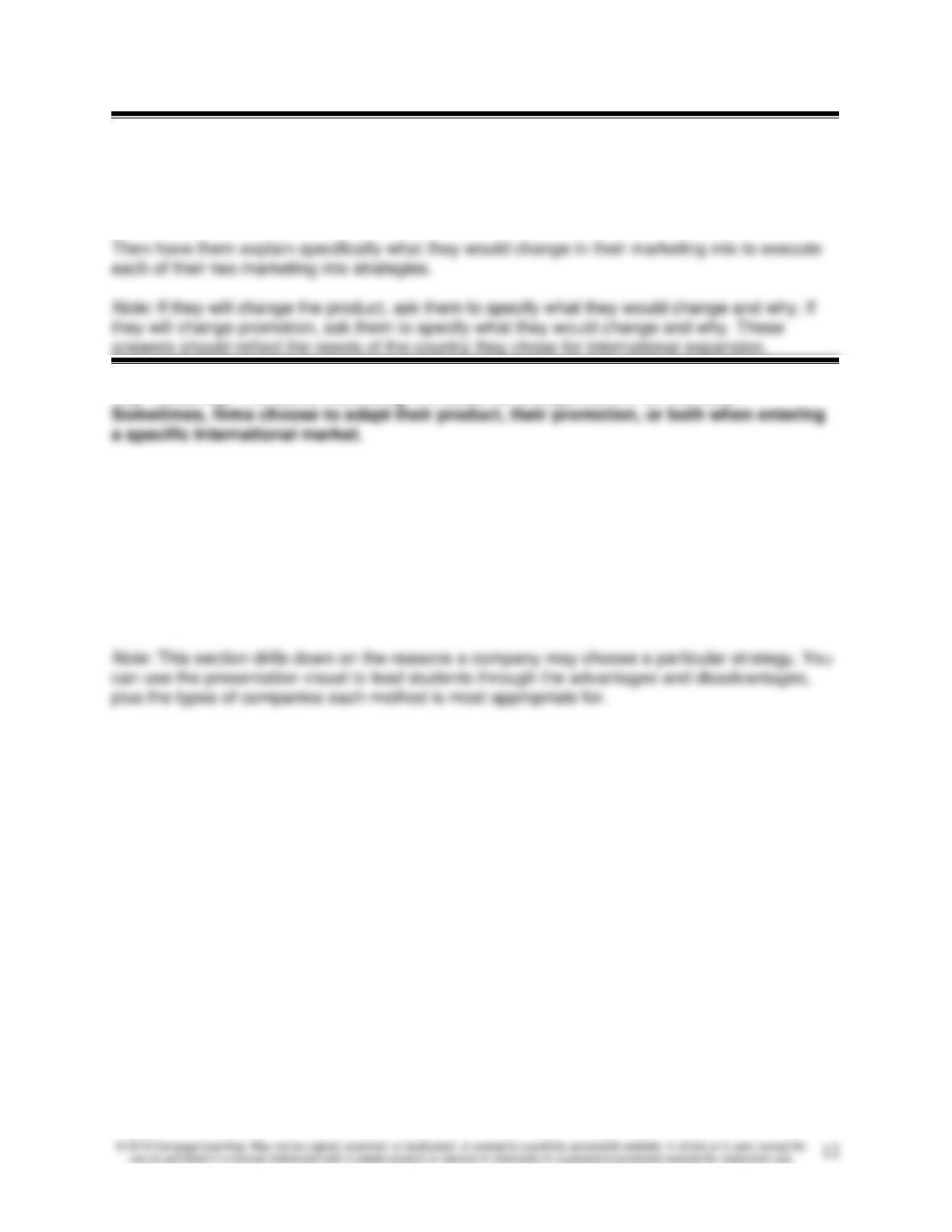
In developing a marketing mix, global marketers first concentrate on two basic decisions:
• Do we change our product for the international market?
• Do we change our promotional strategy for the international market?
Once one of those five product and promotional strategies is chosen, marketers must also
implement pricing and distribution strategies to support them.
PRESENTATION VISUAL: MindTap Exhibit 8.5 showing international marketing mix
strategies
Chapter 8: Global Marketing
Classroom activity: Divide students into groups and ask them to choose:
One product to promote
One country to target for international expansion
Two marketing mix strategies (not including straight extension)
Estimated time: 15–30 minutes
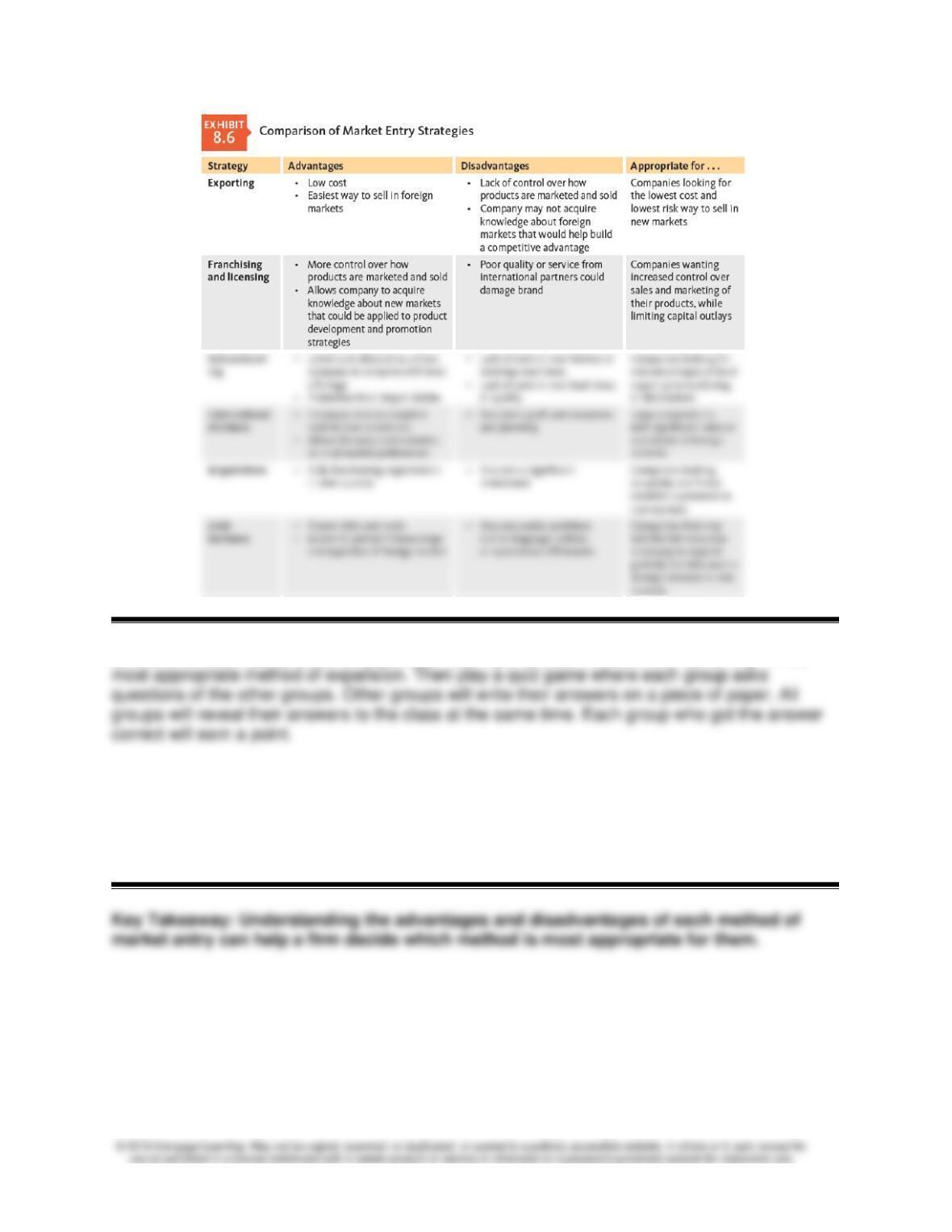
8-6 Determining a Market Entry Strategy
When choosing a market entry strategy, it’s important to have a clear understanding of the
advantages and disadvantages of each.
PRESENTATION VISUAL: MindTap Exhibit 8.6 showing comparison of entry strategies
(see next page)
Chapter 8: Global Marketing
Classroom activity: In small groups, have students create quiz questions that provides a
scenario for a company expanding globally. Each quiz question should end by asking for the
Example: Joe’s Granola has only sold in the United States and he wants a low cost, low risk
way of expanding internationally. He realizes this means he might lack control over exactly how
his products are sold, but at this point he realizes it’s his only choice. What is his preferred
method of market entry?
Answer: Exporting
Estimated time: 15–40 minutes (depending on whether you facilitate the classroom activity)
Chapter 8: Global Marketing
LEARN IT TODAY . . . USE IT TOMORROW
VIGNETTE AND ACTIVITY
The opening vignette for Chapter 8 discusses Nederlander, an international theater company.
Students learn about the company’s origins and about their decisions to expand worldwide.
Note: Answers to the chapter-ending activity can be discussed in class after the activity
due date.
Global Marketing
Video Quiz on The Nederlander Organization “Global Marketing”
Question 1
Nederlander’s first expansion globally was to purchase three theaters in London, England. This
strategy of entering global markets is called ________.
a. subcontracting
b. franchising
Question 2
If the Nederlander Group uses a standardized marketing mix in a new market, with no changes
to its product or promotion, it is using a ______ strategy.
a. product adaptation
b. straight extension
Question 3
After a successful run in New York, Nederlander would like to take Evita to a theater in
Argentina as Eva Perón was a much-loved historical figure there. This decision was likely based
on the Nederlander Group’s examination of their ___________.
a. political-legal environment
b. economic environment
Question 4
If the Nederlander Group wanted to take the production of Newsies to a theater in Paris, but
realized that some of the song lyrics would need to be changed in order for French audiences to
understand the jokes, they would be using a ________ strategy.
a. promotion adaptation
b. straight extension
Question 5
The Nederlander group has expanded to China through a strategic partnership with China Arts
and Entertainment Group. They are hoping to open a production of Ghost, based on the movie
by the same name. Nederlander has been forced to cut one song from the show due to
censorship imposed by the nation’s government. Which external environment does this reflect?
a. Political-legal
Chapter 8: Global Marketing
ADDITIONAL HOMEWORK/CLASSROOM ACTIVITIES
Global Marketing Strategy
Purpose: To help students apply marketing strategy concepts to “real–world” situations.
Relationship to Text: Going global
Estimated Class Time: About 20–25 minutes
Exercise: Divide your students into small groups, then direct each team to select a company—
familiar to everyone in the group—that could benefit from promoting its products to the French
Questions for Reflection:
• What product categories are most likely to succeed in the French market? Why?
Globalization and Cultural Exchanges
Purpose: To highlight the cultural shifts that have resulted from economic globalization.
Background: During the past 25 years, the United States has been accused with increasing
Relationship to Text: The U.S. as a target for international marketers
Estimated Class Time: About 10 minutes of discussion
Exercise:
• Ask your class for examples of how American culture has spread to other
countries around the world. American students who have traveled are a great
Chapter 8: Global Marketing
as a war movie and in Japan (where it was also a hit) as a love story. If you have
computer projection, you may also want to take your students through the
McDonald’s website (http://www.mcdonalds.com), which shows how key foods
have been modified in other countries (e.g., seaweed fries and red-bean sundaes
in Hong Kong).
phones, import beers, U-2, sushi, and so on.
Questions for Reflection:
• Does American culture help or hinder acceptance of foreign products? How?
• Given the cultural exchanges spurred by globalization, are we in danger of
developing a homogenous, “vanilla” world culture? Why or why not?
Internet Research Activities
Chinese currency policy
Critics contend that the Chinese government pursues policies that keep the value of the
Global marketing strategies. Samsung—the electronics company based in South Korea—has
been quite successful over the past 10 years at marketing its products worldwide. Visit the
Samsung website and note two or three elements of the firm’s global marketing strategy. Next

Chapter 8: Global Marketing
World statistics. The CIA World Factbook contains a wide range of information and statistics
on individual countries. Go to www.cia.gov, select “World Factbook,” and then “Guide to Country
Comparisons.” Then click on the relevant section to obtain the top five countries in each of the
following:
a. Per-capita GDP
Chapter 8: Global Marketing
KEY TERMS
Exporting: Marketing domestically produced goods and services abroad.
Importing: Purchasing foreign goods and services.
European Union (EU): An economic union of 28 European countries that works to remove
trade restrictions, permit the free flow of goods and workers throughout member nations, and
promotes human rights.
North American Free Trade Agreement (NAFTA): An agreement between the United States,
Canada, and Mexico that removes trade restrictions among the three nations.
Infrastructure: The underlying foundation for modern life that includes transportation,
communications, banking, utilities, and public services.
Exchange rate: The price of one nation’s currency in terms of another country’s currency.
Subcontracting: When the production of goods or services is assigned to local companies.
International direct investment: Financial investment in foreign firms or facilities.
Joint ventures: When companies share the risks, costs, and management of the foreign
operation with one or more partners.
Chapter 8: Global Marketing