• Attribute: Emphasis is on product features or customer benefits.
• Price and quality: High price connotes quality while low price indicates value.
• Use or application: Numerous uses or applications may increase desire or
suggest greater value.
Example: Nike’s iconic “Just Do It” campaign appealed to the emotions of having a
dream and achieving goals. The results were a 4 percent drop in customer attrition,
a 6 percent increase in customer advocacy, and a whopping 50 percent jump in
same-store sales.
g. Repositioning: To sustain growth in slow markets or to correct positioning
mistakes, products sometimes need to be repositioned. Repositioning requires
changing consumers’ perceptions of a brand in relation to competing brands.
[return to top]
Discussion Questions
You can assign these questions several ways: in a discussion forum in your LMS; as whole-
class discussions in person; or as a partner or group activity in class. A generic discussion
rubric is provided in the Appendix.
1. Discussion: (LO 8-1, PPT Slides 6-7) Duration 10 minutes.
a. Encourage students to consider marketing without any segmentation and ask
them some of the following questions:
• What would happen if you tried to market a product to everyone, especially
now that we live in a globally connected world? Is it possible?
[return to top]
Additional Activities and Assignments
A generic discussion and writing rubric is provided in the Appendix.
1. Activator Exercise: Bad Targeting (LO 8-3)
Purpose: To emphasize the importance of accurate targeting when designing a
marketing mix.
Format: This activity can be facilitated in both a classroom and an online
Classroom Format: Small group discussion, then class presentations (Estimated
Time: 20-40 minutes)
1. Ask student groups to pick a specific product or brand.
2. Describe three potential customer groups that would be a BAD target for
this product.
Example: Marketing Jack Link’s beef jerky to young, female, vegan women.
Online Format: Discussion board with posted response from each student
(Estimated Time: 5-10 minutes)
1. Use the following prompt to facilitate this activity in a discussion board:
Choose a specific product or brand. Describe three potential customer
groups that would be a BAD target for this product.
2. Have students respond to their classmates’ posts, offer constructive
Additional questions for a classroom or discussion board: How do you know this
customer group would be a bad target? What is an alternate product in a similar
category that might be a good fit for these customers?
Result: Students will be using intuition and common sense to define target groups.
2. Class Activity (LO 8-1)
Format: This activity can be facilitated in both a classroom and an online
environment. Instructions for how to facilitate the activity in the classroom and
online are provided below. (Estimated time: 10-20 minutes)
Classroom Format: Have students break into groups of three or four to discuss the
concept of market segmentation. Instruct them to imagine that they are going to
Online Format: If you’re delivering your course online, you can have students do
this on their own and have them post their answers in a discussion board. Use the
following prompt to facilitate this activity:
Imagine that you are going to market a certain type of vehicle. Trying to market this
3. Class Activity (LO 8-3)
Format: This activity can be facilitated in both a classroom and an online
environment. Instructions for how to facilitate the activity in the classroom and
online are provided below. (Estimated time: 10-20 minutes)
Classroom Format: Ask students to break up into pairs or groups of three. Have
them imagine that they work for a commercial real estate development company.
They are considering developing a new tract of 35 luxury homes that will sell in the
$500,000 to $800,000 range. First, have them devise a description of the market
segment for these homes. Then ask them to use the four criteria to determine
whether their proposed market segment is reasonable or if they need to refine their
description of their market segment.
Online Format: If you’re delivering your course online, you can have students do
this on their own and have them post their answers in a discussion board. Use the
following prompt to facilitate this activity:
4. Class Activity (LO 8-4)
Format: This activity can be facilitated in both a classroom and an online
environment. Instructions for how to facilitate the activity in the classroom and
online are provided below. (Estimated time: 15-25 minutes)
Classroom Format: Ask students to create a demographic profile of themselves
based on the five bases of demographic segmentation: age, gender, income level,
ethnicity, and family life-cycle. Ask them to identify how a marketer might use that
information to reach them. What types of products would be the best fit? What
distribution strategies could marketers use? Where could marketers run ads to
reach them? Share some examples with the class.
Based on this profile, make suggestions on how marketers can reach you and what
products would be the best fit.
In commenting on your classmates’ posts, identify several other products you think would
be of interest to them. Suggest strategies marketers could use to target your classmates
5. Class Activity (LO 8-4)
Format: This activity can be facilitated in both a classroom and an online
environment. Instructions for how to facilitate the activity in the classroom and
online are provided below. (Estimated time: 20-35 minutes)
Classroom Format: Ask students to take their original profiles (based on
demographic segmentation in previous activity) and add some psychographic
segmentation, including values, social activities, and especially media usage (what
channels they watch, what sites or publications they read, what streaming stations
they listen to, etc.). Now, what products would they recommend? How does this
influence what strategies marketers would use to reach them? Encourage students
Online Format: If you’re delivering your course online, you can have students do
this on their own and have them post their answers in a discussion board. Use the
following prompt to facilitate this activity:
Later, evaluate and offer constructive feedback on other students’ product and strategy
suggestions. Comment on how the addition of psychographics enriched the segmentation
process.
Example: Student A has identified himself as a 21-year-old, single, Hispanic American
male earning less than $30,000 a year. In expanding his profile to include psychographic
6. Class Activity (LO 8-1)
Format: This activity can be facilitated in both a classroom and an online
environment. Instructions for how to facilitate the activity in the classroom and
online are provided below. (Estimated time: 10-20 minutes)
Classroom Format: Have students (on their own or with a partner) choose one of
the following products. These are typically considered consumer products, but ask
Online Format: If you’re delivering your course online, you can have students do
this on their own and have them post their answers in a discussion board. Use the
following prompt to facilitate this activity:
Choose one of the following products. These are typically considered consumer products,
but think about how they could be marketed as business products. What company
characteristics could you use to segment the business-to-business buyers for the chosen
product? In your post, specify the business buyer and how the product will be used by
that buyer.
• Lawn care products
• Microwave oven
7. Class Activity (LO 8-6)
Format: This activity can be facilitated in both a classroom and an online
environment. Instructions for how to facilitate the activity in the classroom and
online are provided below. (Estimated time: 20-40 minutes)
Classroom Format: Have students divide up into pairs or groups of three. Instruct
each group to discuss and choose a product or product category that interests
Online Format: If you’re delivering your course online, you can have students do
this on their own and have them post their answers in a discussion board. Use the
following prompt to facilitate this activity:
Begin by choosing a product or product category that interests you, then work through
8. Class Activity (LO 8-7)
Format: This activity can be facilitated in both a classroom and an online
environment. Instructions for how to facilitate the activity in the classroom and
online are provided below. (Estimated time: 15-25 minutes)
Classroom Format: Have students divide into groups of three or four. Assign a
product category to each team. Examples could be a restaurant, some type of
packaged food or beverage category, a clothing item, a service business category
such as a law firm, etc.
Example: A company that makes jeans . . .
• Undifferentiated marketing strategy: They make only one style of jeans in
different sizes.
Online Format: If you’re delivering your course online, you can have students do
this on their own and have them post their answers in a discussion board. Use the
following prompt to facilitate this activity:
For your post, choose a product category, such as a restaurant, some type of packaged
food or beverage category, a clothing item, or a service business category, such as a law
9. Class Activity (LO 8-8)
Format: This activity can be facilitated in both a classroom and an online
environment. Instructions for how to facilitate the activity in the classroom and
online are provided below. (Estimated time: 15-25 minutes)
Classroom Format: Have students divide up into groups of three or four. Invite
them to imagine that they are the marketing team for a brand or product category
of their choice that is going to be marketed directly to consumers through the
company’s website and other digital channels. Instruct teams to brainstorm creative
ideas for collecting target customer data through a CRM system. How could they use
CRM to personalize the buying experience for their customers, and how could they
use it to encourage customer loyalty? Invite several groups to share their
recommendations with the class.
Online Format: If you’re delivering your course online, you can have students do
this on their own and have them post their answers in a discussion board. Use the
following prompt to facilitate this activity:
10. Class Activity (LO 8-9)
Format: This activity can be facilitated in both a classroom and an online
environment. Instructions for how to facilitate the activity in the classroom and
online are provided below. (Estimated time: 10-20 minutes)
Classroom Format: Have students (on their own or with a partner) choose three
Online Format: If you’re delivering your course online, you can have students do
this on their own and have them post their answers in a discussion board. Use the
following prompt to facilitate this activity:
Choose three different products that interest you. For each product, identify the most
11. Additional activity: Product Positioning (LO 8-9)
Purpose: To give students a chance to apply product positioning concepts.
Format: This activity can be facilitated in both a classroom and an online
environment. Instructions for how to facilitate the activity in the classroom and
online are provided below.
Classroom Format: Divide your class into groups of three to five students and ask
each group to choose a product—familiar to all of them—that needs repositioning.
(Possible categories: a beverage brand, a pizza restaurant, clothing line, your
college, a television network, etc.) Then, direct them to follow these steps:
1. Identify the current positioning (quick sentence).
Ask each group to share their results with the class (and you can expect a remarkable
level of creativity).
Online Format: Discussion board with posted response from each student
(Estimated Time: 15-25 minutes)
1. Use the following prompt to facilitate this activity in a discussion board:
Choose a specific product that needs repositioning. Once you have chosen
your product, post the following items in the discussion board:
2. Have students discuss the positioning maps and offer constructive feedback
when commenting on their classmates’ posts.
Additional Questions for Reflection:
• How do you know when a product needs to be repositioned?
12. Online Research Activity: Psychographic Segmentation (LO 8-4)
Visit the websites of Caterpillar, Marriott Hotels, and Dr Pepper. How does each firm
employ psychographic segmentation to the marketing of its products? Is there a
relationship between the use of psychographic segmentation and the types of
products sold by each firm?
13. Online Research Activity: Market Segmentation (LO 8-4)
Go to the website of Siemens. How does Siemens segment its markets, such as
geographic, demographic, psychographic, or benefit-based? Does the firm use more
than one method of product segmentation? Why or why not?
14. Online Research Activity: Target Market (LO 8-4)
Visit the website of Philips. What strategy or strategies does the firm employ for
reaching its target markets? Does it rely more on undifferentiated or multisegment
marketing?
[return to top]
Additional Resources
Appendix
Generic Rubrics
Providing students with rubrics helps them understand expectations and components of
assignments. Rubrics help students become more aware of their learning process and
progress, and they improve students’ work through timely and detailed feedback.
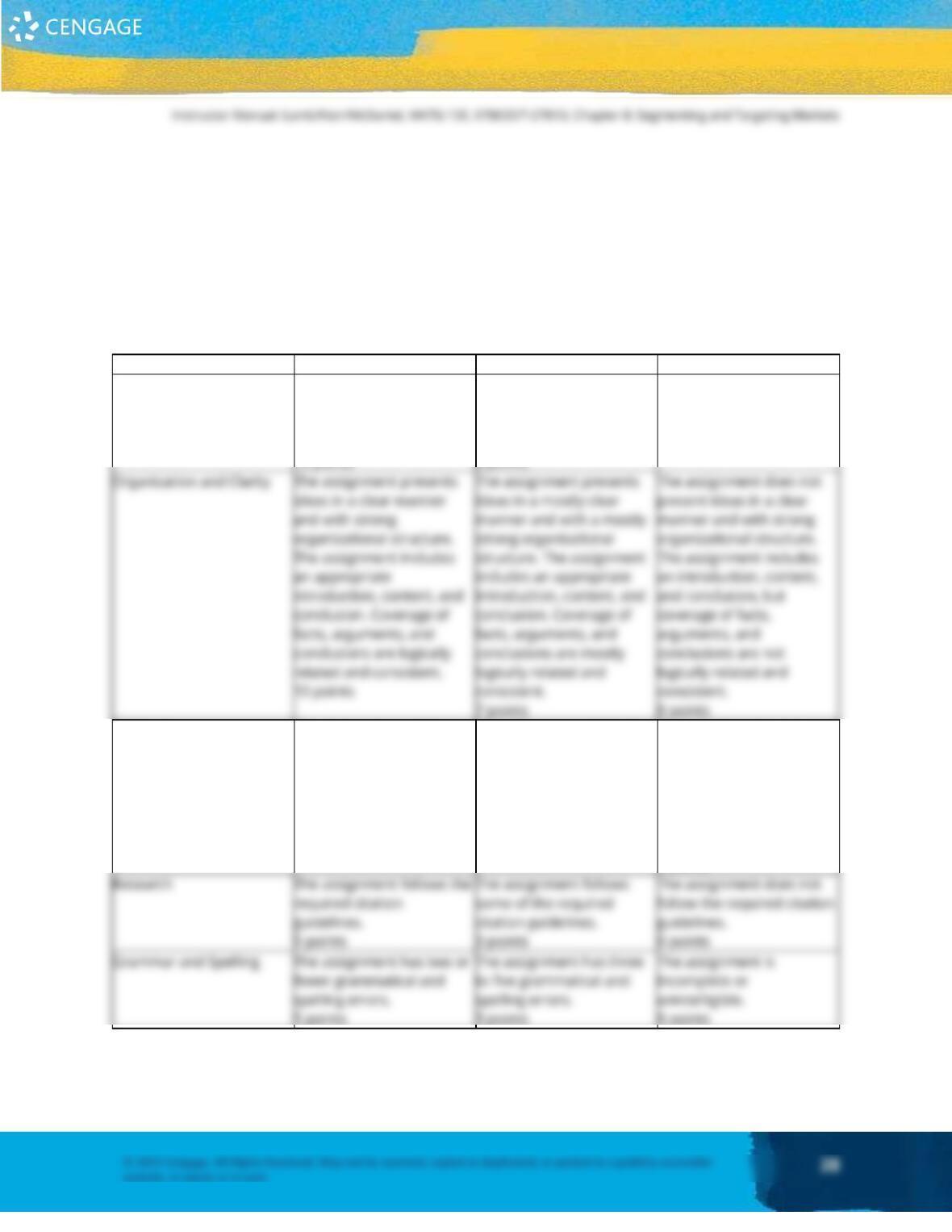
Customize these rubrics as you wish. The writing rubric indicates 40 points and the
discussion rubric indicates 30 points.
Standard Writing Rubric
Criteria
Meets Requirements
Needs Improvement
Incomplete
Content
The assignment clearly and
comprehensively
addresses all questions in
the assignment.
The assignment partially
addresses some or all
questions in the
assignment.
The assignment does not
address the questions in
the assignment.
0 points
Research
The assignment is based
upon appropriate and
adequate academic
literature, including peer
reviewed journals and
other scholarly work.
5 points
The assignment is based
upon adequate academic
literature but does not
include peer reviewed
journals and other
scholarly work.
3 points
The assignment is not
based upon appropriate
and adequate academic
literature and does not
include peer reviewed
journals and other
scholarly work.
0 points
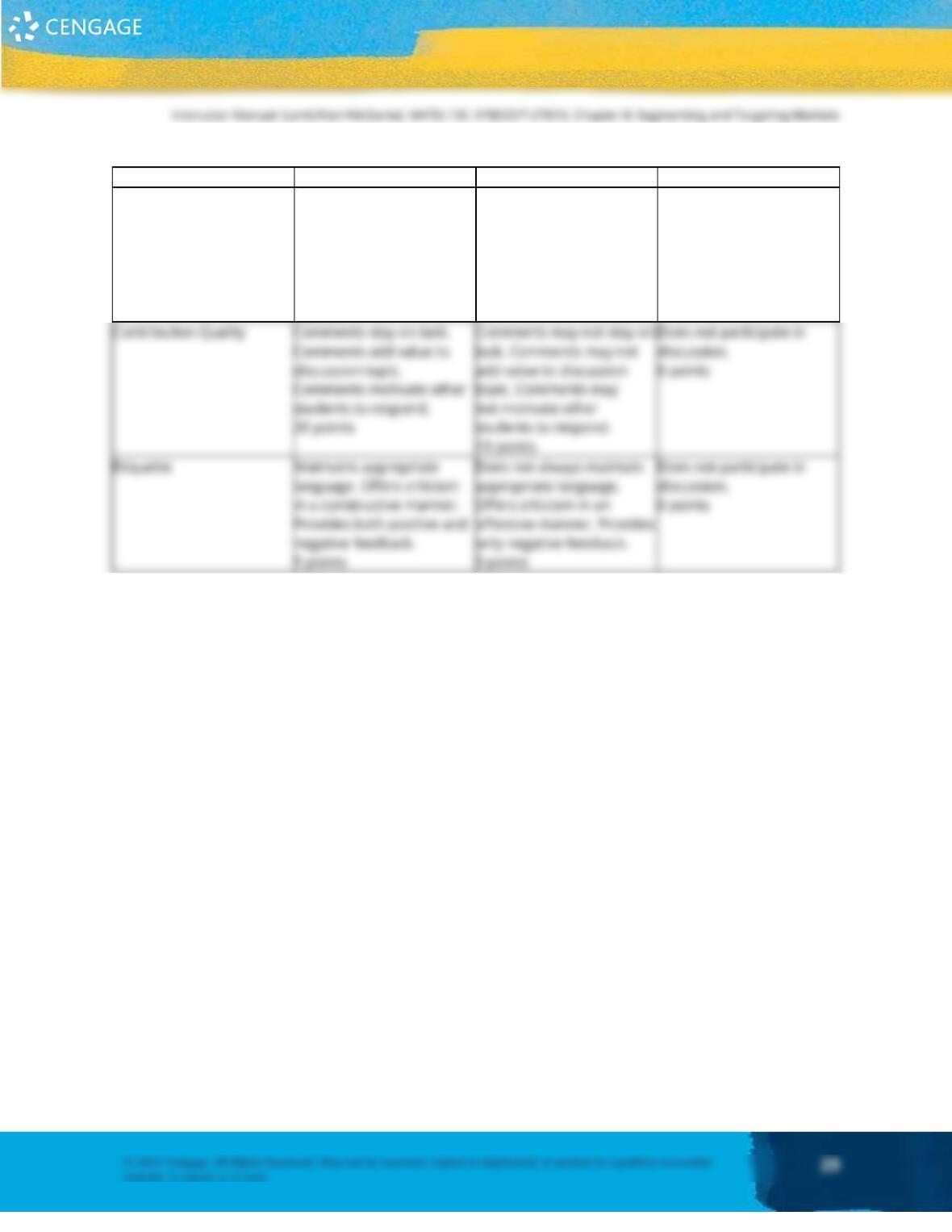
Standard Discussion Rubric
Criteria
Meets Requirements
Needs Improvement
Incomplete
Participation
Submits or participates in
discussion by the posted
deadlines. Follows all
assignment. instructions
for initial post and
responses.
5 points
Does not participate or
submit discussion by the
posted deadlines. Does not
follow instructions for
initial post and responses.
3 points
Does not participate in
discussion.
0 points