
Instructor Manual
Lamb/Hair/McDaniel, MKTG 13E, 9780357127810; Chapter 8: Segmenting and Targeting
Markets
Table of Contents
Purpose and Perspective of the Chapter …………………………………………………………………………. 2
Cengage Supplements …………………………………………………………………………………………………… 2
Learning Outcomes ……………………………………………………………………………………………………….. 2
Complete List of Chapter Activities and Assessments ……………………………………………………… 3
Key Terms ……………………………………………………………………………………………………………………… 5
What’s New in This Chapter ……………………………………………………………………………………………. 6
Chapter Outline …………………………………………………………………………………………………………….. 6
Discussion Questions …………………………………………………………………………………………………… 16
Additional Activities and Assignments …………………………………………………………………………… 17
Additional Resources ……………………………………………………………………………………………………. 27
External Videos or Playlist ……………………………………………………………………………………………………….. 27
Appendix …………………………………………………………………………………………………………………….. 28
Generic Rubrics ……………………………………………………………………………………………………………………… 28
Standard Writing Rubric …………………………..……………………………………………………………………………… 28
Standard Discussion Rubric ……………………………………………………………………………………………………… 29
2
© 2022 Cengage. All Rights Reserved. May not be scanned, copied or duplicated, or posted to a publicly accessible
website, in whole or in part.
Purpose and Perspective of the Chapter
The purpose of this chapter is to learn the characteristics of markets, which are individuals
or organizations that make purchases, and market segments, which are groups with similar
product needs. Market segmentation enables marketers to tailor marketing mixes to meet
the needs of particular population segments and depends on four basic criteria: (1) a
Cengage Supplements
The following product-level supplements provide additional information that may help you
in preparing your course. They are available in the Instructor Resource Center.
• Transition Guide (provides information about what’s new from edition to edition)
• Educator’s Guide (describes assets in the platform with a detailed breakdown of
Learning Outcomes
The following learning outcomes are addressed in this chapter:
8-1 Describe the characteristics of markets and market segments
8-2 Explain the importance of market segmentation
8-3 Discuss the criteria for successful market segmentation
8-4 Describe the bases commonly used to segment consumer markets
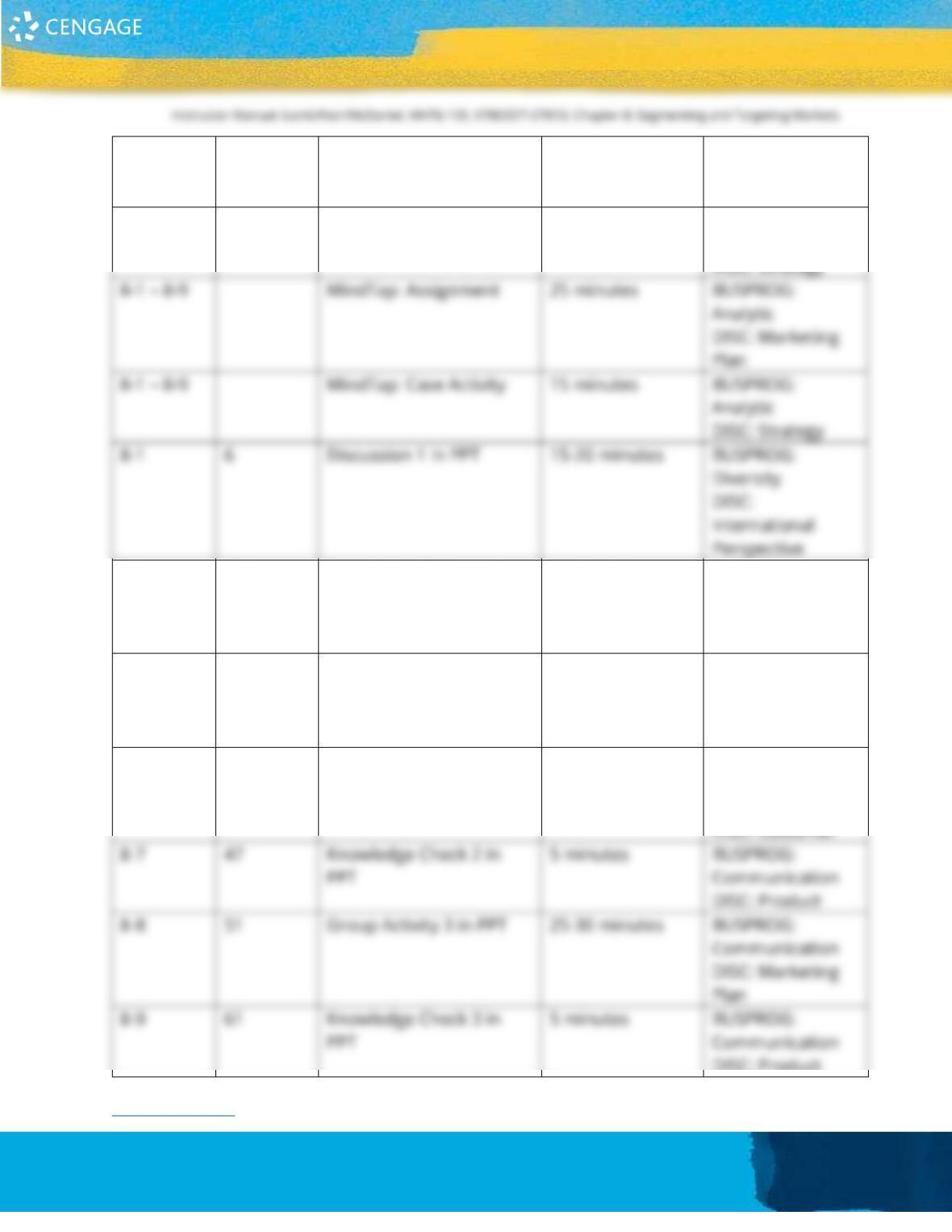
Complete List of Chapter Activities and Assessments
For additional guidance refer to the Teaching Online Guide.
Chapter
Learning
Objective
PPT slide
Activity/Assessment
Duration
Certification
Standard
N/A
MindTap: Why Does
Market Segmentation
Matter to Me?
5 minutes
BUSPROG:
Reflective
Thinking
DISC: Customer
Segments and The
Importance of Market
Segmentation
DISC: Customer
8-3
MindTap: Learn It 8-3:
Criteria for Successful
Segmentation
5 minutes
BUSPROG:
Analytic
DISC: Strategy
8-4
MindTap: Learn It 8-4:
Bases for Segmenting
Consumer Markets
5 minutes
BUSPROG:
Analytic
DISC: Customer
8-5
MindTap: Learn It 8-5:
Bases for Segmenting
Business Markets
5 minutes
BUSPROG:
Analytic
DISC: Customer
8-6
MindTap: Learn It 8-6:
Steps in Segmenting a
Market
5 minutes
BUSPROG:
Analytic
DISC: Customer
8-7 – 8-8
MindTap: Learn It 8-7 and
8-8: Strategies for
10 minutes
BUSPROG:
Analytic
4
© 2022 Cengage. All Rights Reserved. May not be scanned, copied or duplicated, or posted to a publicly accessible
website, in whole or in part.
Selecting Target Markets
and CRM as a Targeting
Tool
DISC: Strategy
8-9
MindTap: Learn It 8-9:
Positioning
5 minutes
BUSPROG:
Analytic
DISC: Strategy
MindTap: Assignment
25 minutes
BUSPROG:
Analytic
DISC: Marketing
Plan
MindTap: Case Activity
15 minutes
BUSPROG:
Analytic
Diversity
International
Perspective
8-3
13
Knowledge Check 1 in
PPT
5 minutes
BUSPROG:
Reflective
Thinking
DISC: Strategy
8-4
29
Group Activity 1 in PPT
25-30 minutes
BUSPROG:
Reflective
Thinking
DISC: Customer
8-6
37
Group Activity 2 in PPT
25-30 minutes
BUSPROG:
Reflective
Thinking
8-8
51
Group Activity 3 in PPT
25-30 minutes
BUSPROG:
Communication
Plan
DISC: Product
[return to top]
Key Terms
80/20 principle: a principle holding that 20 percent of all customers generate 80 percent of
the demand.
benefit segmentation: the process of grouping customers into market segments
according to the benefits they seek from the product.
cannibalization: a situation that occurs when sales of a new product cut into sales of a
firm’s existing products.
concentrated targeting strategy: a strategy used to select one segment of a market for
targeting marketing efforts.
market segment: a subgroup of people or organizations sharing one or more
characteristics that cause them to have similar product needs.
market segmentation: the process of dividing a market into meaningful, relatively similar,
and identifiable segments or groups.
market: people or organizations with needs or wants and the ability and willingness to
buy.
repositioning: changing consumers’ perceptions of a brand in relation to competing
brands.
satisficers: business customers who place an order with the first familiar supplier to satisfy
product and delivery requirements.
segmentation bases (variables): characteristics of individuals, groups, or organizations.
target market: a group of people or organizations for which an organization designs,
implements, and maintains a marketing mix intended to meet the needs of that group,
resulting in mutually satisfying exchanges.
What’s New in This Chapter
The following elements are improvements in this chapter from the previous edition:
• New discussion of importance of market segmentation with examples
[return to top]
Chapter Outline
In the outline below, each element includes references (in parentheses) to related content. “LO
CH–##” refers to the chapter learning outcome; “PPT Slide #” refers to the slide number in the
PowerPoint deck for this chapter (provided in the PowerPoints section of the Instructor Resource
Center); and, as applicable for each discipline, accreditation or certification standards (“DISC”).
Introduce Chapter 8 and review the learning outcomes. (PPT Slide 2).
1. Markets and Market Segments (LO 8-1, PPT Slide 3, DISC: Customer)
7
© 2022 Cengage. All Rights Reserved. May not be scanned, copied or duplicated, or posted to a publicly accessible
website, in whole or in part.
a. A market is (1) people or organizations with (2) needs or wants and (3) the ability
and (4) the willingness to buy. It’s important to note that a group of people or an
organization that lacks any one of these characteristics is not a market.
2. The Importance of Market Segmentation (LO 8-2, PPT Slide 8, DISC: Customer)
a. Market segmentation has become a powerful marketing tool for success only since
the 1960s. Because it provides marketers with a deeper understanding of customer
lifestyles, values, jobs to be done, need states, and buying occasions, marketers can
b. The analysis of big data has provided new ways of reaching a deeper understanding
of consumers and their behavior.
Example: Swedish furniture company Ikea uses big data to determine how to adjust
3. Criteria for Successful Segmentation (LO 8-3, PPT Slide 10, DISC: Strategy)
a. The three most valuable outcomes of market segmentation include the following:
• It allows marketers to identify groups of customers with similar needs, and then
b. A useful segmentation scheme should also meet four basic criteria:
• Substantiality: A segment must be large enough to make commercial sense. A
housing development, for example, does not need an extensive pool of potential
customers to still make commercial sense due to the high price of each home.
• Identifiability and measurability: Marketers must be able to identify and
measure the size of a segment based on data such as population, number of
4. Bases for Segmenting Consumer Markets (LO 8-4, PPT Slide 14, DISC: Customer)
a. Marketers use segmentation bases, or variables, which are characteristics of
individuals, groups, or organizations, to divide a total market into segments.
Markets can be segmented using a single variable, such as age group, or several
variables, such as age group, gender, and education. Single-variable segmentation is
simpler and easier to use than multiple-variable segmentation. However, as the
• Age Segmentation: Common age groups include newborns, infants, young
children, tweens, Millennials, Generation X, Baby Boomers, and seniors.
Although there are obviously many differences, the people within each of these
categories often share some common traits, habits, and needs.
Examples: Generation Z born between 1995 and 2015 want to work for their
• Gender Segmentation: In the U.S., women buy 70% to 80% of the consumer goods
sold each year, although a recent marketing trend is to market traditionally
“female–oriented” products toward men and vice versa.
• Income Segmentation: Income is an obvious choice for segmenting markets
because income level influences consumers’ wants and, more important, their
ability to buy.
• Ethnic Segmentation: Historically, marketers in the United States functioned as if
all Americans conformed to a homogenized, Anglo-centric ideal. Today, they are
d. Family life-cycle (FLC) segmentation: In many cases, purchasing decisions are
determined by a combination of age, marital status, and the presence or absence of
children. The most common categories are explained in Exhibit 8.1.
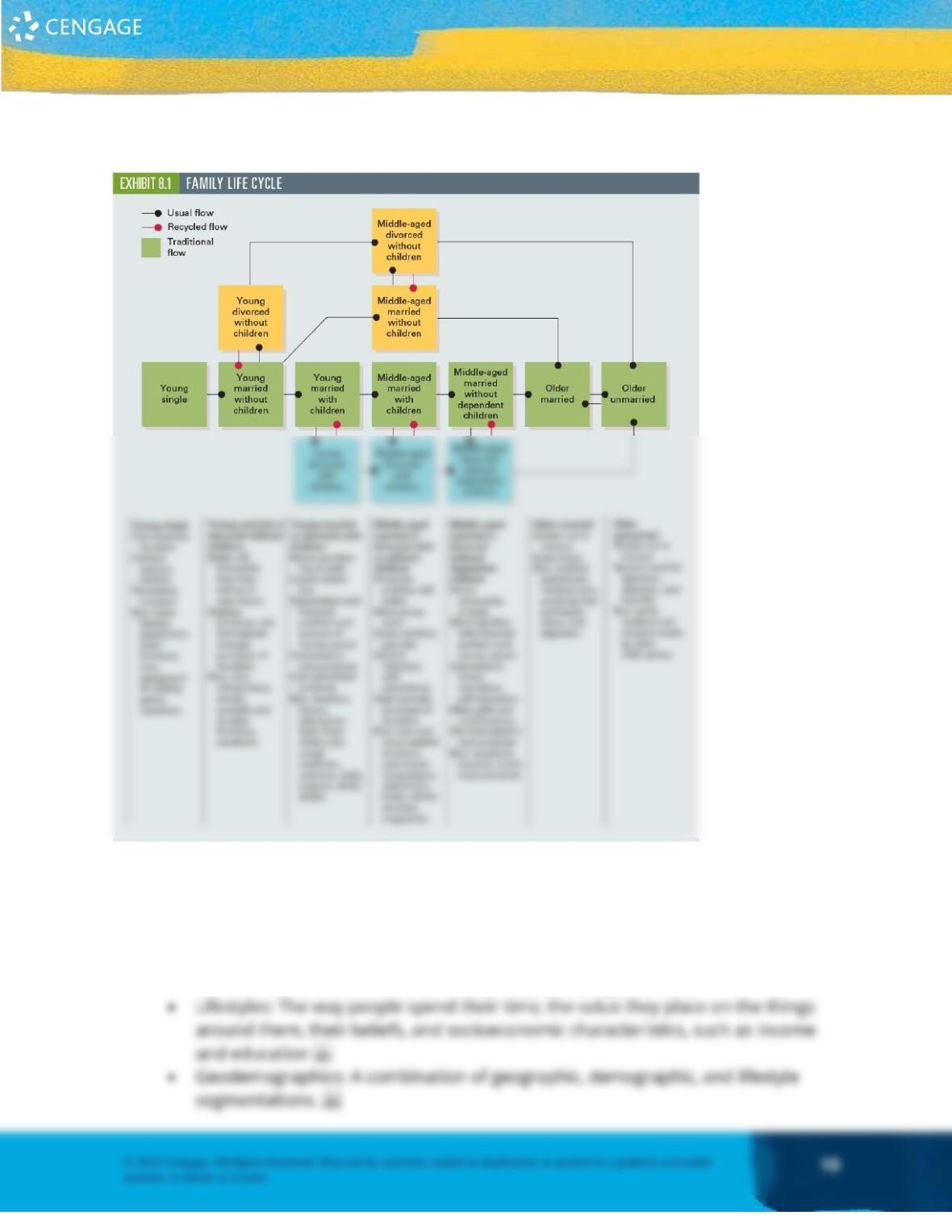
Instructor Manual: Lamb/Hair/McDaniel, MKTG 13E, 9780357127810; Chapter 8: Segmenting and Targeting Markets
PRESENTATION VISUAL: Exhibit 8.1 Family Life Cycle
e. Psychographic Segmentation: As helpful as age, gender, income, ethnicity, FLC
stage, and other demographic variables are, sometimes more information is needed
to develop meaningful segmentation strategies. Psychographic segmentation
expands upon these basics with variables like:
• Personality: A person’s traits, attitudes, and habits
• Motives: The emotions that can influence purchasing decisions
f. Psychographic variables can be used individually or combined with other variables
to provide more detailed descriptions of market segments.
Example: After analyzing data from more than 14,000 people in 22 countries, DuPont
Nutrition & Health identified six core consumer segments in the health and wellness
g. Usage-Rate Segmentation: Usage-rate segmentation divides a market by the
amount of product bought or consumed.
h. Categories vary with the product, but they are likely to include some combination of
5. Bases for Segmenting Business Markets (LO 8-5, PPT Slide 31, DISC: Customer)
a. The business market’s four broad segments—producers, resellers, government, and
institutions—need to be further segmented to be truly useful to business
marketers. (Refer to Chapter 7 for more details on business markets, if needed.)
Two possibilities are:
b. Company Characteristics: Geographic location, type of company, company size,
and product use can be important segmentation variables. Segmenting by customer
c. Buying Processes: The purchasing strategies of the buyers may also provide useful
segments. Two types of buyers have been identified:
6. Steps in Segmenting a Market (LO 8-6, PPT Slide 34, DISC: Strategy)
The six-step process for segmenting a market is as follows:
a. Select a market or product category for study. Whether it’s a market in which the
firm already competes, a new but related market or product category, or a totally
new market, the overall market or product category should be clearly defined.
b. Choose a basis or bases for segmenting the market: There are no foolproof
procedures for selecting segmentation variables, but the segmentation scheme
must produce segments that meet the four basic criteria discussed earlier in this
chapter (substantiality, identifiability and measurability, accessibility, and
responsiveness).
It is important to monitor segmentation strategies over time. Markets are dynamic, so
approaches must adapt to the changes that occur in customers’ lives.
7. Strategies for Selecting Target Markets (LO 8-7, PPT Slide 39, DISC: Strategy)
a. A target market is a group of people or organizations for which an organization
designs, implements, and maintains a marketing mix intended to meet the needs of
that group, resulting in mutually satisfying exchanges. There are three general
c. This strategy is often used by first movers in a market. With no competition, the firm
may find it unnecessary to tailor marketing mixes to the preferences of market
segments at first. However, this makes the company more susceptible to
competition.
d. Concentrated Targeting: When using a concentrated targeting strategy, a firm
selects a market niche—meaning one segment of a market—for targeting its
marketing efforts. The firm’s marketers can concentrate on understanding the
needs, motives, and satisfaction of that segment’s members and on developing and
maintaining a highly specialized marketing mix. If the right segment has been
e. Multisegment Targeting: With a multisegment targeting strategy, a firm
chooses to serve two or more well-defined market segments and develops a distinct
marketing mix for each one. Some of the benefits of this strategy include greater
sales volume, higher profits, larger market share, and economies of scale in
manufacturing and marketing. Some of the downsides of the multisegment
targeting strategy include higher costs for product design, production, promotion,
inventory, marketing research, and management. It can also result in
cannibalization, which occurs when sales of a new product cut into sales of a firm’s
existing products.
Example: P&G practices a multisegment targeting strategy with 18 different laundry
8. CRM as a Targeting Tool (LO 8-8, PPT Slide 48, DISC: Marketing Plan)
a. Companies successfully using CRM typically customize their goods and services
based on data generated through interactions between carefully defined groups of
customers and the company. (Refer to Chapter 1 for more details on CRM, if
needed.)
Example: Etsy, an online marketplace where entrepreneurs can sell products they
curate or craft by hand, provides a good example of the application of CRM. Based
b. Four trends that are expected to lead to an even greater use of CRM are:
• Personalization: CRM helps companies fulfill consumers’ desire to be treated as
individuals with their own unique sets of needs and wants.
• Time savings: With the direct and personalized marketing efforts generated by
CRM, consumers can spend less time making purchase decisions and more time
doing the things that are important to them.
9. Positioning (LO 8-9, PPT Slide 53, DISC: Promotion
a. Once marketers have chosen which segment or segments to target with their
marketing mix, they can develop the product’s positioning. In general, position
refers to potential customers’ overall perception of a brand, product line, or
organization relative to competing offerings. Effective positioning requires
d. The alternate strategy is to highlight the product’s similarities to competing products
or brands.
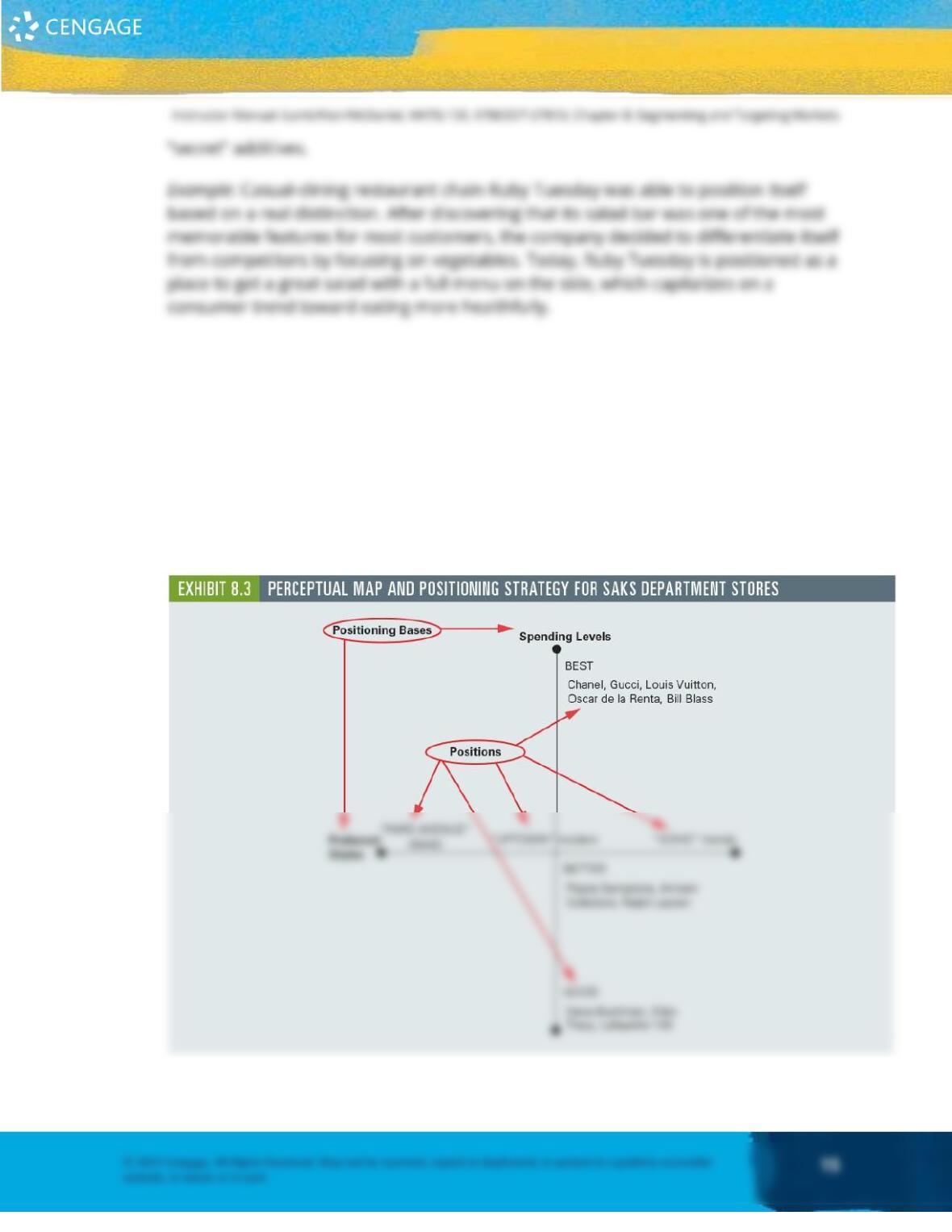
e. Perceptual Mapping: Perceptual mapping is a means of displaying or graphing, in
two or more dimensions, the location—or position—of products, brands, or groups
of products in customers’ minds as compared to competing products or brands. The
dimensions used can include such positioning bases as price, use, or user. Exhibit
8.3 provides an example.
PRESENTATION VISUAL: Exhibit 8.3 Perceptual Map and Positioning Strategy for Saks
Department Stores
f. Positioning Bases: Firms use a variety of bases for positioning: