Chapter 8
Search Marketing: SEO and PPC
Learning Objectives:
By the time students complete this chapter they should be able to:
• Discuss the reasons why search marketing is so important.
• Explain the difference between a directory and a search engine.
Chapter Perspective
Search marketing and email marketing (Chapter 7) are both so important—and so complex—that
they easily warrant separate discussions of an hour to an hour and a half. We created separate
email and search chapters for this reason. Still, search is extremely intricate and students should
understand that this section of the chapter only represents an overview from a marketing
Students in my classes have gotten jobs in search from the exposure in the basic course, although
typically they develop their interests more fully in our advance marketing technology course,
where we do AdWords Campaigns for the Google Online Marketing Challenge (GOMC) in the
spring. Students there receive a $250 budget and run a paid search campaign for a firm or NGO
that has never done paid search before. They learn a lot and can win a prize, which may involve
a trip to California to Google Headquarters (my teams have never won). It is possible to do the
Google AdWords challenge in this introductory course alone as a project, although it is quite all-
consuming for the students and works better, for me at least, in a dedicated course.
When writing this chapter there was so much detail left out that we considered writing a
Search is primarily an acquisition technique, whereas email can be used for acquisition, but
works better at customer retention. Search works because the customer is looking for exactly
what your firm has to offer.
The Growing Impact of Search Slides 2-6
It is interesting to begin by asking students how often they search and for what. Most of us use
search engines frequently and the reasons range from serious informational needs to being too
lazy to remember URLs. Students may not have thought about how often they use search
Data from search engine marketing agency iCrossing and from the Search Engine Marketing
These data make it clear why marketers feel compelled to include SEM in their marketing plans.
It is a good idea to check these and other sources when teaching this chapter to get the most
updated information. For example, as of writing this instructor section, Google has AGAIN
changed its search algorithm (A set of structured steps for solving a problem, in this case, finding
information on the web; search algorithms are proprietary to each search engine tool) to make it
It is easy to see why marketers like search. Since so many consumers are online searching it is a
good way to reach their target audience. Most people begin their major purchase searches online
these days. Organic search, although it requires work in web design, does not require payment
every time the company name appears. You are also catching people right when they are looking
for your service. This is a growing industry and growth is being fuelled by mobile applications
as well. Search can help with branding, online sales, lead generation, driving traffic to the
websites and just getting content in front of the right people.
The World of Search Slide 7
The first thing students need to be clear about is the difference between a search engine (e.g.,
Google) and a directory (e.g., Yahoo!, at least at the beginning). A directory is an aid in finding
Internet websites; list of sites are usually arranged by category and the directory has a search
Search Engine Marketing Slide 8
Directories have declined in importance as SEM (search engine marketing) has risen. There are
two types of SEM. SEO is search engine optimization, which to confuse things is also known as
natural search, organic search or sometimes even algorithmic search. The next type of search is
pay-per-click (PPC) also known as paid search. The differences in the two are outlined in Table
8.1 (Slide 7). Paid search requires allocating a budget and managing the process intensely.
Natural search seems free but also requires work to keep up in the rankings.
Organic Search Slide 9
Keywords are key (pun intended) to optimizing organic search, although links and other factors
are also important. Keywords are search terms, words or phrases, selected by the user when
making a search in a search engine. The term keywords also refers to terms that are bid on in a
PPC system such as Google or Bing. Keywords also refer to a section in the HTML code for a
website where site developers put the terms that they hope search engines will classify the site as
when users search for those terms on the web.
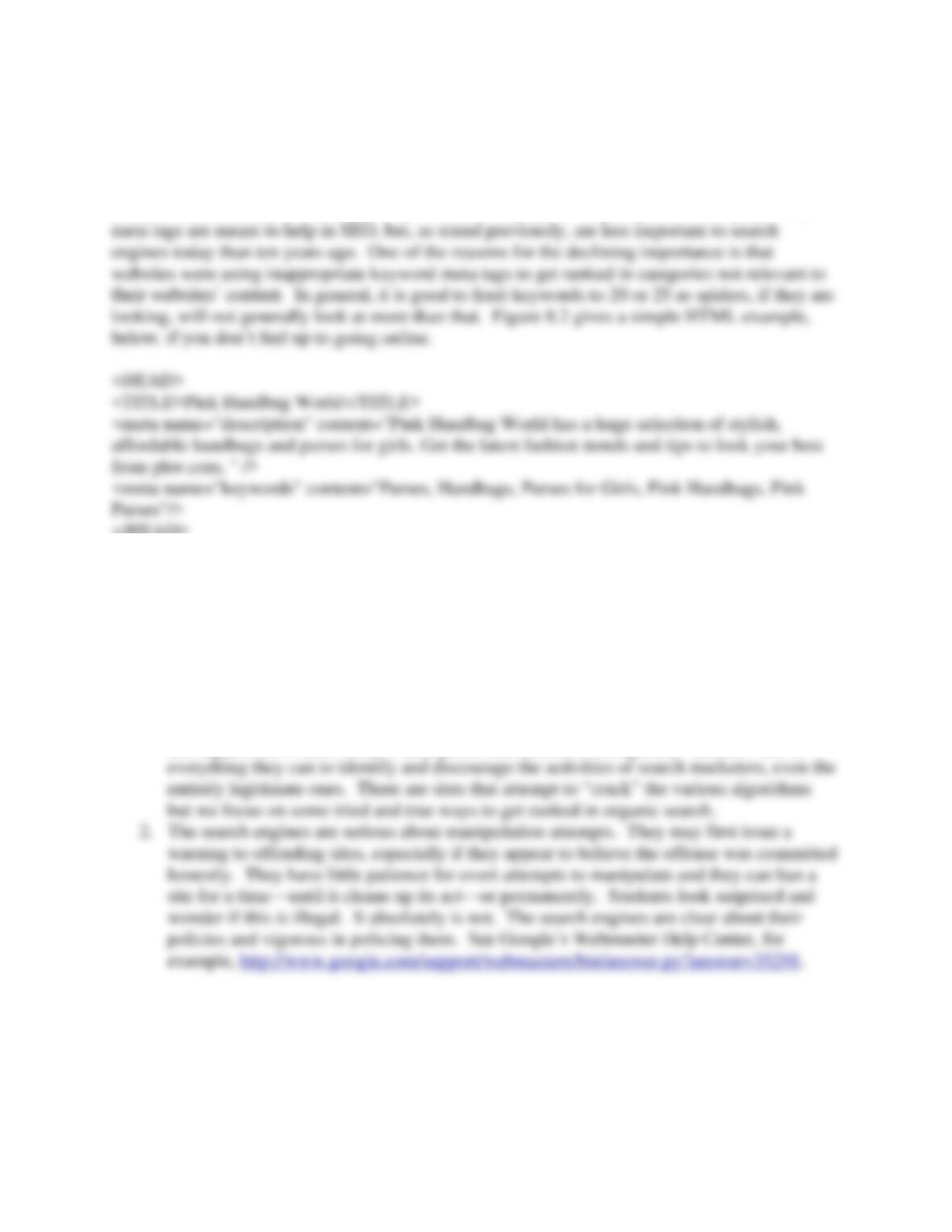
used. In Chrome, click on the little wrench in the upper right, then tools, then view source to
view the page source.
Students should be familiar at least with how HTML (Hyper Text Markup Language) works. It
really is a text markup tool that just helps websites display the way they wish to display. The
</HEAD>
Search Engines Slides 10-15
Students need to be crystal clear about two things in terms of search engines and SEO:
1. Each search engine has its own ranking algorithm, and they change constantly. The term
algorithm is critical to understanding how search engines work. The search engines say
that they are always changing their algorithms is to make them better, and that’s certainly
true. It is also effective in making the job of search engine marketers more difficult, and
the engines know that. They would prefer that results be completely “natural” and do
Slide 9, Figure 8.3, explains how search engines work and is based on Google’s own published
information. Behind the scenes crawlers or “spiders” develop lists of keywords from websites
and these are brought back to the index servers that attempt to create indices of the relationships
between various pieces of web information.
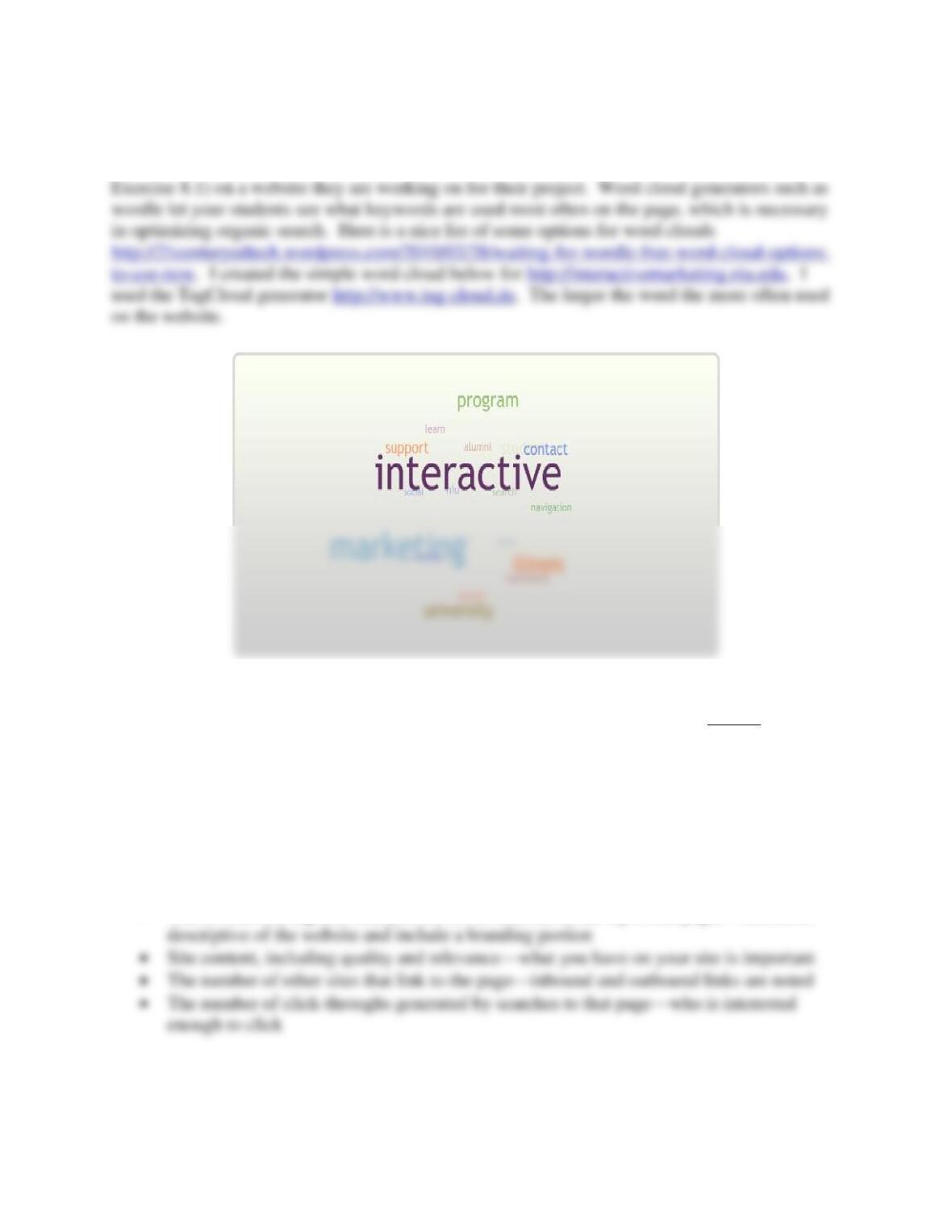
Figures 8.4 a and b show search engine spider simulator and a keyword density chart for a
particular web page. These graphics and those in Figure 8.6 did not turn out well in the book
but are well reproduced in Slides 12-14. I often have students run these tools (see Interactive
Figure 8.6 (Slide 14) shows where paid search results show up in Google and should not need
much explanation. However, Google is now putting some search results on the bottom of the
page. So it is probably best, if you can, to do a few live searches in class and see where the ads
turn up. I recommend doing the same searches in Bing and Yahoo! and comparing the results.
These tools are important because of the way that search engines algorithm’s work. Search
engine algorithms are looking for:
• The location and frequency (density) of keywords on the page—1-3% density is a good
goal
• The HTML title tag (the title you see in the blue bar at the top of the page)—should be
Optimizing Organic Search Slide 16-19
Keyword analyses using tools such as keyword density charts, spider simulators, and word
clouds are important in optimizing organic search. As the text states, there are several steps in
optimizing a website for organic search. Make no mistake, the website must usually be changed
and this aspect of SEO is not free. We have optimized our interactive marketing site several
times since I have been at my university and it has been a long process each time. Some good
steps to follow are:
1. Define the target market—who is looking for your site; you can get some statistics from
Google Analytics
Figure 8.8 and Slide 16 form my visual summary of how to approach SEO. There is a typo in
the text (at tags instead of alt tags) that is corrected on the slide. Items that are usually included
in the rankings for natural searches are also the ones that should be targeting for SEO. These
items are considered the “low lying fruit” of SEO that can be easily added to a page:
• The URL or Domain Name: The URL itself should be descriptive of the firm and
consistent with how you want to be found. Being around a long time and having a search
history will also help.
Quality of links is important; a link from your cousin’s personal site is not likely to be worth
much in terms of ranking. The title tag (bar at the top of each page) plays a prominent role in
how the site information is displayed on the results page for some engines, including Google.
Google has declared war on irrelevant/poor quality content as a determinant of ranking. As you
might imagine, there is considerable discussion about exactly what Google means by “quality
content.” Relevance is usually the first descriptor used. As listed above, search engine
algorithms also take into account the number of click-throughs achieved by the listing.
Figure 8.9 discusses whether the econsultancy site is optimized for organic search. Note that the
title tag should include both a keyword piece and a branding piece. Their keyword|branding
combination is “econsultancy.com|Become a smarter digital marketer.” The tag line is great but
the keyword is a point of discussion. Do potential users search for econsultancy or digital
marketing consultant? If econsultancy.com is little esoteric, included in Slide 26 the San Diego
Zoo website from Chapter 12 for discussion. It is a great website but students can debate whether
it is designed for search and what the user intent is in entering the site.
Organic and Paid Search Work Together Slide 20
Natural and paid search often work together. If the paid ad runs next to the organic search
listing, the customer might click on one, the other, or both, making analysis difficult but
improving sales nonetheless. The phrase “search is search” emphasizes this point.
using the keyword results from good research for an SEO campaign in a paid search campaign
also.
PPC or Paid Search Slides 21-25
Although I recommend both paid and organic search, many marketers who don’t have the time,
the money, or the expertise (and it takes all 3) to do SEO or who are in competitive search
categories generally turn to paid advertising. I recommend getting a free coupon from Google;
offers abound and running a campaign during class if you can’t do the GOMC. I suggest a PPC
process in the text, which is similar to that for SEO, that you can use running your campaign.
Honestly, search is a “learning by doing” type of lesson.
The steps to run such a campaign are:
1. Investigate broad search categories and trends—Google Trends and Insights for Search
are helpful
You need to select a number of things in the AdWords tool, such as the time of day to run the ad
or ads, the daily budget, the reach of the ad, what type of device, etc. One of the really important
choices is the type of match: broad, phrase, exact, negative (Table 8.2). We recommend phrase
match for campaigns with small budgets such as the one you are running in class so you don’t
blow your budget. Students often overlook the importance of negative keywords so don’t forget
to emphasize.
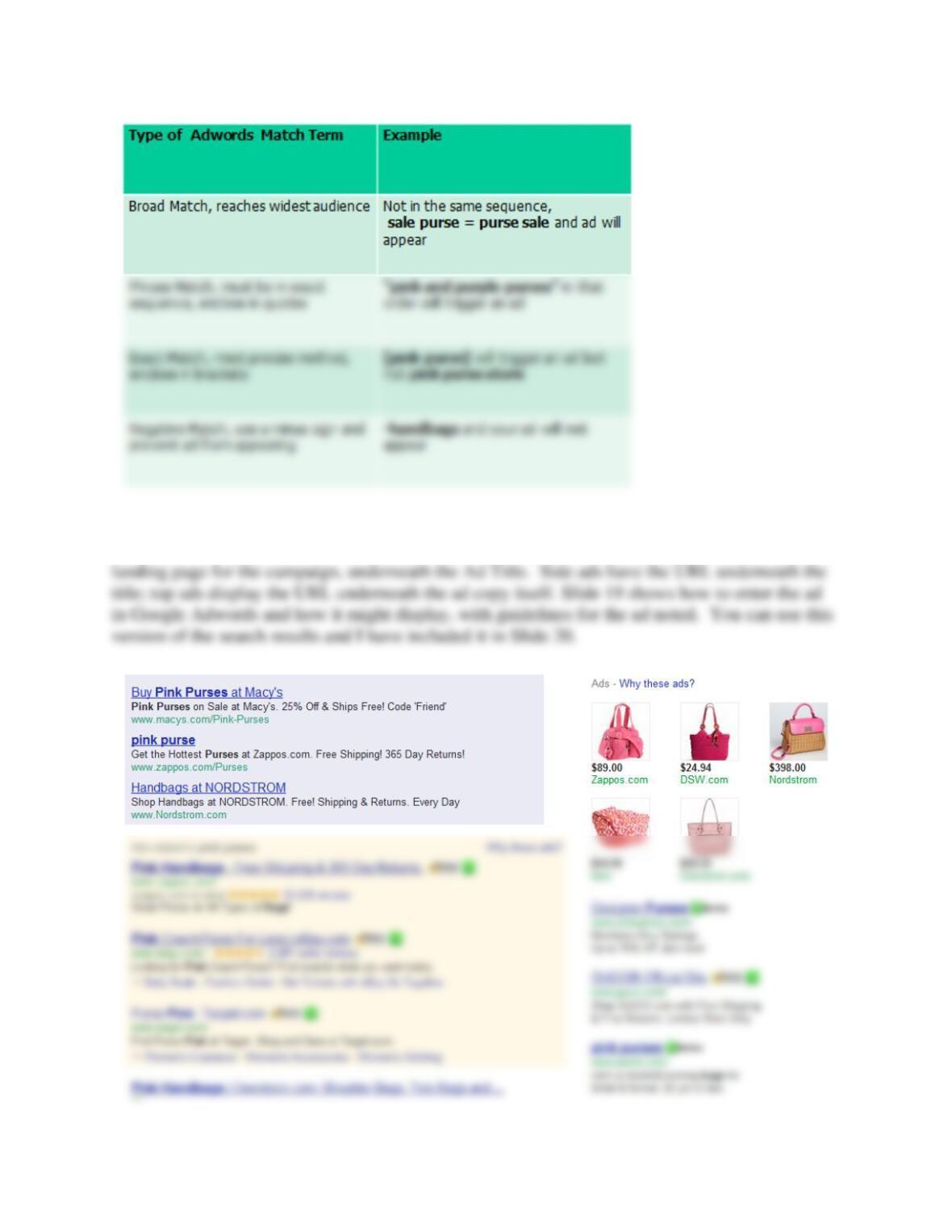
One small note from when the chapter was written. Some of the ads do not look like Figure 8.11
and have the display URL, the URL that is shown in the ad that may link to another customized
There are some bad practices in search (referred to as “Black Hat SEO practices”—the opposite
is, of course, acceptable white hat practices). These practices are similar to the bad practices for
web design in Chapter 12 and include:
• Flash entry pages (in fact, all images are a problem and need alt tags to make them visible
to search engines)
• Frames
• Lack of a usable site map
The importance of not using banned techniques cannot be stated too forcefully or too often.
Students often assume that they can do something clever and trick the search engines into a high
ranking. Sorry, but the search engines are usually way ahead of the tricksters.
Specialty Search Slide 26
Google’s desktop search probably had the highest market share, although there are others. Some
were willing to let a search engine index the contents of their hard drive; some are not. It has
been discontinued because of both privacy concerns and the movement toward cloud computing
Local search is growing rapidly as indicated in the text and originated from the desire to meet the
User’s Intent, What the searcher is really looking for when a keyword is typed into a search
These are the specialized search categories supported by Google:
Blog Search Find blogs on your favorite topics—use to keep up to date in class
Custom Search Create a customized search experience for your community—use Google on
a website
Product Search Search for stuff to buy—use to illustrate points in class
There is also the ability to do specialized search on patents and finance news on Google.
Some of the other types of specialty search engines are as follows:
• Topical search: such as WorldWideScience.com, WebMD
• Industry search: such as business.com, chemindustry.com
The Relationship between Search and Social Media Slide 27
The best way to use social media to expand SEO is to expand your profiles on social media so
they show up in searches. The next step is to monitor social media conversations and then use the
keywords and terms in your SEO campaigns to increase your rankings. Finally, you can drive
inbound links through targeted postings on social media outlets.
Search is a key focus of Internet marketers at present and has two aspects, paid and organic.
Both need to be managed separately and require a different focus. Web pages need to be written
with algorithms in mind for SEO and PPC requires bidding on the most relevant and cost-
effective keywords. Both processes require research on the web using readily available tools.
Social media monitoring can be helpful in the keyword selection process.
Search marketing has great impact whether it is optimizing a website so it is easily visible to the
search engines or placing paid ads on search engine results. Search engines are also increasing in
variety of use with local and vertical search engines becoming important in specialized markets.
They can streamline the user experience and make search more useful and accessible to niche
and small business marketers.
Discussion Questions
1. Why do you think search has become such an important part of the life of Internet
users?
I don’t have any data on “why,” but there seem to be at least two reasons:
1. The web is so huge, and it gets larger every day. There are many things we’d never find
if we didn’t have a search capability.
2. What options do marketers have when it comes to developing a search marketing
strategy?
The intent of the question was to get students to think about organic/natural vs. paid search
results and to be able to clearly define each. If it needs to be reinforced, going to a search results
page and identifying the organic listings and the paid ads would be a good thing to do.
3. What are the most impactful elements of a website in terms of optimizing a site for
organic search?
You can center the discussion around either Figure 8.8 or Figure 8.10 or both. Students should
4. How come the major search engines do not publish their algorithms?
First, algorithms can be seen as a competitive advantage. Second, the companies don’t want
5. Compare the two searches in Figure 8.6. Which produces the better results in terms of
quality and relevance? Why?
This is a matter of opinion and discussion. I personally find the Google searches to be generally
6. Why do paid and natural search work so well together?
7. How do search strategies differ for mobile devices?
There are fewer ads on mobile searches, making keyword bidding more important. The size of
8. Why is local search likely to be important in the future? What other trends are likely in
organic and paid search?
Search engine users are becoming more demanding and want their searches to be seen as
Internet Exercises
1. Internet Career Builder Exercise.
2. Choose a well-known branded product with which you are familiar.
a. Brainstorm and identify at least 10 keywords that a person might use to
search for the product or the brand.
b. Search for the product on at least two different search engines.
i. What is the product’s position in natural search?
ii. What is its position in paid search?
c. Use the Google Adwords’ keyword tool to learn how good your keyword
choices were. Were there others that should have been in your top 10?
d. What recommendations would you have for the managers of the product to
help them improve their organic search rankings on the search engines you
studied?
This is based on the material in the text, especially the section in which the keyword tool is
discussed. As is mentioned, the keyword tool is now external and you don’t have to open an
3. Using the branded product above, imagine that you have the opportunity to market
that product through paid search. Select keywords and develop at least two different ad
groups with two different ads underneath them. Design two of the ads and be prepared
to discuss in class which might be most effective.
Students can create AdWords ads as noted in the text and in the PowerPoints. They can open
their account and create ads without spending any money or just create ads in word of PPT for
Key Terms
broad match all search volumes for that keyword idea, including synonyms and related words.
CPC (cost-per-click) the cost of the paid ad campaign divided by the number of clicks.
CPM (cost-per-thousand) the amount paid in purchasing advertising; in this case, means the
cost per thousand impressions, or the cost divided by the total number of impressions.
exact match search volume for that particular keyword.
index server stores the information index, which has categorized websites as a best fit to certain
keywords.
keywords search terms, words, or phrases that are selected by the user when making a search in
a search engine; also refers to terms that are bid on in a PPC system, or a section in the HTML
code for a website where site developers put terms that they hope search engines will classify the
site when users search for those terms on the web.
keyword density percentage of times a particular word is used in a website page in comparison
to the number of words on that page.
paid search the paid aspect of SEM based on an advertising model where firms seeking to rank
high in specific search categories will bid on certain terms or “keywords” in the hopes of a
lucrative ad ranking; also known as PPC (pay-per-click).
phrase match search volume that includes that entire phrase.
search engine website that works to help users to find the things they want to find on the
Internet.
search engine algorithm displays the search engine’s “best guess” at which pages are most
relevant to the user’s search and in which order they should be shown.
universal search the inclusion of search results from multiple content sources such as videos,
images, news, maps, books, and websites into one set of research results.
user intent what the user is actually searching for.