CHAPTER 7
GROUP INFLUENCES ON CONSUMER BEHAVIOR
LEARNING OBJECTIVES
LO1: Explain reference groups and the criteria used to classify them
LO2: Discuss consumption subcultures, including brand and online communities and
their importance for marketing
LO3: Summarize the types and degree of reference group influence
SUMMARY
LO1: Explain reference groups and the criteria used to classify them.
A reference group is a group whose presumed perspectives or values are being used by an individual
LO2: Discuss consumption subcultures, including brand and online communities and their
importance for marketing.
A consumption subculture is a group that self-selects on the basis of a shared commitment to a
particular product or consumption activity. These subcultures also have (1) an identifiable, hierarchical
social structure; (2) a set of shared beliefs or values; and (3) unique jargon, rituals, and modes of
symbolic expression. A brand community is a non geographically bound community, based on a
LO3: Summarize the types and degree of reference group influence.
Informational influence occurs when an individual uses the behaviors and opinions of reference group
members as potentially useful bits of information. Normative influence, sometimes referred to as
LO4: Discuss within-group communications and the importance of word–of-mouth
communications to marketers.
Communication within groups is a major source of information about certain products. Information is
communicated within groups either directly through word-of-mouth (WOM) communication or
LO5: Understand opinion leaders (both online and offline) and their importance to marketers
Opinion leaders are highly knowledgeable about specific products or activities and are seen as the
“go–to person” for specific types of information. These individuals actively filter, interpret, or provide
product and brand- relevant information to their family, friends, and colleagues. A defining
LO6: Discuss innovation diffusion and use an innovation analysis to develop marketing strategy
Groups greatly affect the diffusion of innovations. Innovations vary in degree of behavioral change
required and the rate at which they are diffused. The first purchasers of an innovative product or
service are termed innovators; those who follow over time are known as early adopters, early
majority, late majority, and laggards. Each of these groups differs in personality, age, education, and
LECTURE TIPS AND AIDS
1) The impact of conformity can be dramatized by physically going through the Asch study
2) Many people feel that conformity per se is bad and attach a personal meaning to it that implies
being weak and dependent. Spend a few minutes discussing this false notion of conformity.
4) I like to cover roles along with groups (see Student Handout 1). The concept of a role-related
product cluster is particularly useful. Sometimes it is easiest to do by asking students to define a
role-related product for students. Functionally necessary products should be mentioned – books,
5) It is useful to have a number of students describe instances in which they gave or received
information related to products, services or shopping. Write brief summaries of each instance on
the board. The class can analyze the common characteristics of opinion leadership.
7) Table 7-3 is useful. The text authors have used this table as the basis for executive seminars and
for consulting. It is well received and easily used.
8) Student Handout 2 can be used to measure opinion leadership/seeking. One activity would be to
have students create measures related to product involvement and expertise and relate this to level
Student Handout 1: ROLES
Roles are defined and enacted within groups. A role is a prescribed pattern of behavior expected of a
person in a given situation by virtue of the person’s position in that situation. Thus, while an
individual must perform in a certain way, the expected behaviors are based on the position itself and
not on the individual involved. For example, in your role as a student, certain behaviors are expected
of you, such as attending class and studying. The same general behaviors are expected of all other
students. Roles are based on positions, not individuals.
All of us fulfill numerous roles. Role overload occurs when an individual attempts to fill more roles
than the available time, energy, or money allows. Occasionally, two roles demand different behaviors.
A typical student might fill the roles of student, bookstore employee, roommate, daughter, sorority
member, intramural soccer player, and many others. In numerous situations, this fairly typical student
will face incompatible role demands. For example, the soccer team member role may require practice
one evening while the student role requires library research. This is known as role conflict. Most
career-oriented individuals, particularly married females, experience conflicts between their role as a
family member and their career. Two working women summarized the stress that this can produce:
• I feel guilty, I mean there’s still that part of me that says I ought to be able to be Super Mom, I
ought to be able to do it all. I mean, you know, it’s an ego blow to acknowledge to myself that I
can’t do it all. I’ve learned over the years to deal with that better.
So, its not punishment to them, and it helps me out.
The set of roles that an individual fulfills over time is not static. Individuals acquire new roles—role
acquisition—and drop existing roles—role deletion. Since roles often require products, individuals
must learn which products are appropriate for their new roles. For example, the student described
earlier may soon drop her roles as college student, roommate, intramural soccer player, and bookstore
Application of Role Theory in Marketing Practice
Role-Related Product Cluster
A role-related product cluster (sometimes referred to as a consumption constellation) is a set of
products generally considered necessary to properly fulfill a given role. The products may be
functionally necessary to fulfill the role or they may be symbolically important. For example, the
stirrup. The high sides of the boot protected the rider’s ankles from thorns. Today, the “cowboy” role
still calls for boots, although few urban cowboys spend much time in the saddle. The boot now is
symbolically tied to the cowboy role.
Role-related product clusters are important because they define both appropriate and inappropriate
Evolving Roles
Role evolution occurs as the behaviors expected of a role change. Role evolution presents challenges
and opportunities for marketers. For example, the shifting role of women now includes active sports.
Role Conflict and Role Overload
As roles evolve and change, new types of role conflicts come into existence. These role conflicts offer
Role Acquisition and Transition
Role acquisitions and transitions present marketers with the opportunity to associate their products or
brands with the new role. This is a particularly useful approach when major role changes occur for
significant numbers of people. For example, the role change from young single to young married
person happens to most people in our society and requires a significant shift in role-related behaviors.

Copyright 2020 © McGraw-Hill Education. All rights reserved. No reproduction
or distribution without the prior written consent of McGraw-Hill Education.
Student Handout 2: OPINION LEADERSHIP/SEEKING SCALES*
Instructions: This short questionnaire is about ________________ (product category). Please read
each statement carefully. For each statement, please circle the number that most closely matches your
view of the opinions stated. The items are scaled from 1 to 7, with a higher number meaning stronger
agreement.
1. My opinion on ____________ seems not to count with other people.
4. I don’t need to talk to others before I buy ____________.
5. Other people come to me for advice about choosing ____________.
9. I often persuade other people to buy the ____________ that I like.
10. I feel more comfortable buying a ____________ when I have gotten other
people’s opinions on it.
*Even items measure opinion seeking and odd items measure opinion leadership. Scoring needs to be
reversed on some items for consistency.
REVIEW QUESTIONS
1) How does a group differ from a reference group?
2) What criteria are used by marketers to classify groups?
Marketers find four criteria useful: (1) membership, (2) strength of social tie, (3) type of contact,
and (4) attraction.
3) What is a dissociative reference group? In what way can dissociative reference groups influence
consumer behavior?
A group that serves as a negative (unattractive) reference point. The degree of desirability of group
4) What is an aspiration reference group? How can an aspiration reference group influence
behavior?
Nonmembership groups with a positive attraction. They exert a strong influence on product
5) What is a consumption-based group or a consumption subculture? What are the characteristics of
such a group? How can marketers develop strategy based on consumption subcultures?
A consumption subculture is a distinctive subgroup of society that self-selects on the basis of a
shared commitment to a particular product class, brand, or consumption activity. These
subcultures also have (1) an identifiable, hierarchical social structure; (2) a set of shared beliefs or
values; and (3) unique jargons, rituals, and modes of symbolic expression. Thus, these subcultures
are reference groups for their members as well as those who aspire to join or avoid them.
6) What is a brand community? What are the characteristics of such a group?
A brand community is a non-geographically bound community, based on a structured set of social
7) How can a marketer foster a brand community?
Research finds that certain practices or activities can enhance value for members of brand
communities. These practices cluster around four categories, namely social networking,
8) What is an online social network site? What are the guidelines for marketers operating in online
communities and social networking sites?
An online social network site is a web-based service that allows individuals to (1) construct a
public or semi-public profile within a bounded system, (2) articulate a list of other users with
whom they share a connection, and (3) view and traverse their list of connections and those made
9) What types of group influence exist? Why must a marketing manager be aware of these separate
types of group influence?
Informational influence, identification influence, and normative influence. The manager needs to
be aware of which conformity type exists because it will affect the marketing strategy required.
10) What five factors determine the strength of reference group influence in a situation?
and the individual’s confidence in his/her ability to make a sound decision.
11) What is the Asch phenomenon and how do marketers utilize it?
An example of the fact that people will conform to a group opinion even when there is clear,
objective evidence that the group is wrong.
12) How can a marketer use knowledge of reference group influences to develop advertising
strategies?
Marketers can and do use all three types of reference group influence (informational,
13) What is an opinion leader? How does an opinion leader relate to the multistep flow of
communication?
14) What characterizes an opinion leader?

Opinion leaders have greater knowledge of and interest in the product category in question. They
are exposed to more mass media, and are more gregarious and outgoing. However, they tend to
have the same demographic characteristics as their followers.
15) What determines the likelihood that a consumer will seek information from an opinion leader?
16) How does a market maven differ from an opinion leader?
The term market maven is used to describe individuals who are opinion leaders about the shopping
process in general. An opinion leader is a specialist who possesses a high level of knowledge for a
given product or class of products.
17) Explain the role of enduring involvement in driving opinion leadership?
Opinion leaders possess the characteristic of having a greater long-term involvement with a given
18) How can marketing managers identify opinion leaders?
Offline, opinion leaders can be targeted through specialized media sources. For example,
19) How can marketers utilize opinion leaders?
The first task is to identify opinion leaders for a particular product or service. Then a portion of the
20) What is buzz? How can marketers create it?
Buzz can be defined as exponentially expanding WOM. It happens when “word spreads like wild
21) Compare and contrast Twitter and Snapchat?
Snapchat is a platform that allows users to message others privately by sending pictures or short
videos that uniquely disappear a few seconds upon viewing the message. Twitter is a micro–
22) What is an innovation? Who determines whether a given product is an innovation?
An innovation is any idea, practice, or material artifact perceived by the potential market to be
new.
23) What are the various categories of innovations? How do they differ?
Continuous, dynamically continuous, and discontinuous. They differ by degree and importance of
24) What is the diffusion process? What pattern does the diffusion process appear to follow over time?
25) Describe the factors that affect the diffusion rate for an innovation. How can these factors be
utilized in developing marketing strategy?
Marketing effort. The rate of diffusion is heavily influenced by the extent of marketing effort
involved.
Fulfillment of felt need. The stronger the need that the innovation satisfies, the faster the diffusion.
Complexity. The more difficult the innovation is to understand and use, the slower the diffusion.
The key to this dimension is ease of use, not complexity of product. Complexity involves both
attribute complexity and trade-off complexity.
diffusion.
Perceived risk. The more risk associated with trying an innovation, the slower the diffusion. Risk
can be financial, physical, or social.
Marketers need to analyze new products on each dimension and develop strategies to overcome or
minimize any weaknesses.
26) What are adopter categories? Describe each of the adopter categories.
They are groups based on the relative time at which the consumer adopts (buys) the product.
a. Innovators: venturesome risk takers. Younger, better education and more socially mobile.
d. Late Majority: skeptical about innovations. Older, less social status and mobility.
e. Laggards: locally oriented and engage in limited social interaction. Relatively dogmatic and
oriented toward the past.
27) How can a marketer use knowledge of adopter categories to develop marketing strategy?
Discussion Questions
28) Respond to the questions in Consumer Insight 7–1.
Q1 – Seeding is getting free product in the hands of influential members of groups. It is a tool for
reducing risk since experience is the single most trusted source of information about a product or
service. Influential customers within a network then spread the word via WOM and e-WOM.
Q3 – The internet has made WOM and networks both actionable and measurable and scalable.
Seeding and other techniques can be used “offline.” However, marketers can predict, track, and
engage in WOM marketing efforts via social networks in a much more efficient and effective way.
29) Using college students as the market segment, describe the most relevant reference group(s) and
indicate the probable degree of influence on decisions for each of the following:
a) Brand of toothpaste: friends, roommates = Low
c) Purchase of breakfast cereal: family, roommates = Low (if for own use) to High (if group
use)
d) Becoming a vegetarian: roommates, friends, family = Moderate
Answer Questions 30–33 using: (a) shoes, (b) barbecue grill, (c) car, (d) toaster, (e) iPad, and (f)
adopting a pet from a shelter.
It is useful to assign these questions or a subset of them to teams of two or three. Have each team
answer for a different product and present their conclusions in class. The class should discuss each
30) How important are reference groups to the purchase of the above-mentioned products or
activities? Would their influence also affect the brand or model? Would their influence be
informational, normative, or identification? Justify your answers.
Table 7-1 is a useful tool here for making judgments about product class versus brand influence.
31) What reference groups would be relevant to the decision to purchase the product or activity (based
on students on your campus)?
These will likely be highly individualized answers.
32) What are the norms of the social groups of which you are a member concerning the product or
activity?
These will likely be highly individualized answers. An interesting approach is to ask for the norms
involved and the sanctions for not conforming.
Respond to the questions in Consumer Insight 7–2.
Q2 -Answers will vary. This is another good discussion topic for classroom participation
Q4 -Answers will vary. However, some possible answers could include being sure to monitor
hashtags especially if they begin to trend, attach your CGC campaign to a charitable or social
cause, promote your CGC campaign with prizes to encourage consumer participation, and be sure
to check for legal consequences before launching your campaign.
33) Describe two groups that serve as aspiration reference groups for you. In what ways, if any, have
they influenced your consumption patterns?
The answers to this will be individualized. This question is often difficult for students to answer.
34) Describe two groups to which you belong. For each, give two examples of instances when the
group has exerted (a) informational, (b) normative, and (c) identification influence on you.
The answers to this will be individualized. This question is often difficult for students to answer
35) Develop two approaches using reference group theory to reduce drug, alcohol, or cigarette
consumption among teenagers.
36) What ethical concerns arise in using reference group theory to sell products?
37) Describe a consumption subculture to which you belong. How does it affect your consumption
behavior? How do marketers attempt to influence your behavior with respect to this subculture?
38) Do you belong to a brand community? If so, describe the benefits you derive from this group and
how it affects your consumption.
You may find that a good way to begin discussion is to describe a relevant brand community for you
(or use a brand community that they can relate to).
39) Do you belong to an online community? If so, describe the benefits you derive from this group
and how it affects your consumption.
40) Answer the following questions for: (i) Dyson bladeless fan, (ii) space flight, (iii) cell phone-based
GPS.
a) Is the product an innovation? Justify your answer.
c) Who on your campus would serve as opinion leaders for the product?
This is a fun and useful exercise that usually generates good discussion.
41) Describe two situations in which you have served as or sought information from an opinion leader.
Are these situations consistent with the text?
A good way to start discussion is to provide your own, personal answer. Or, give the students 5
42) Are you aware of market mavens on your campus? Describe their characteristics, behaviors, and
motivation.
Most dorms, fraternities, sororities, and other reasonably large ongoing groups will contain one or
more market mavens for shopping activities relevant to the group.
43) Have you used Twitter recently? Why? Who did you use? How did it work? What marketing
implications does this suggest?
44) Identify a recent (a) continuous innovation, (b) dynamically continuous innovation, and (c)
discontinuous innovation. Justify your selections.
45) Analyze the Roomba (robotic vacuum cleaner) in terms of the determinants in Table 7-3 and
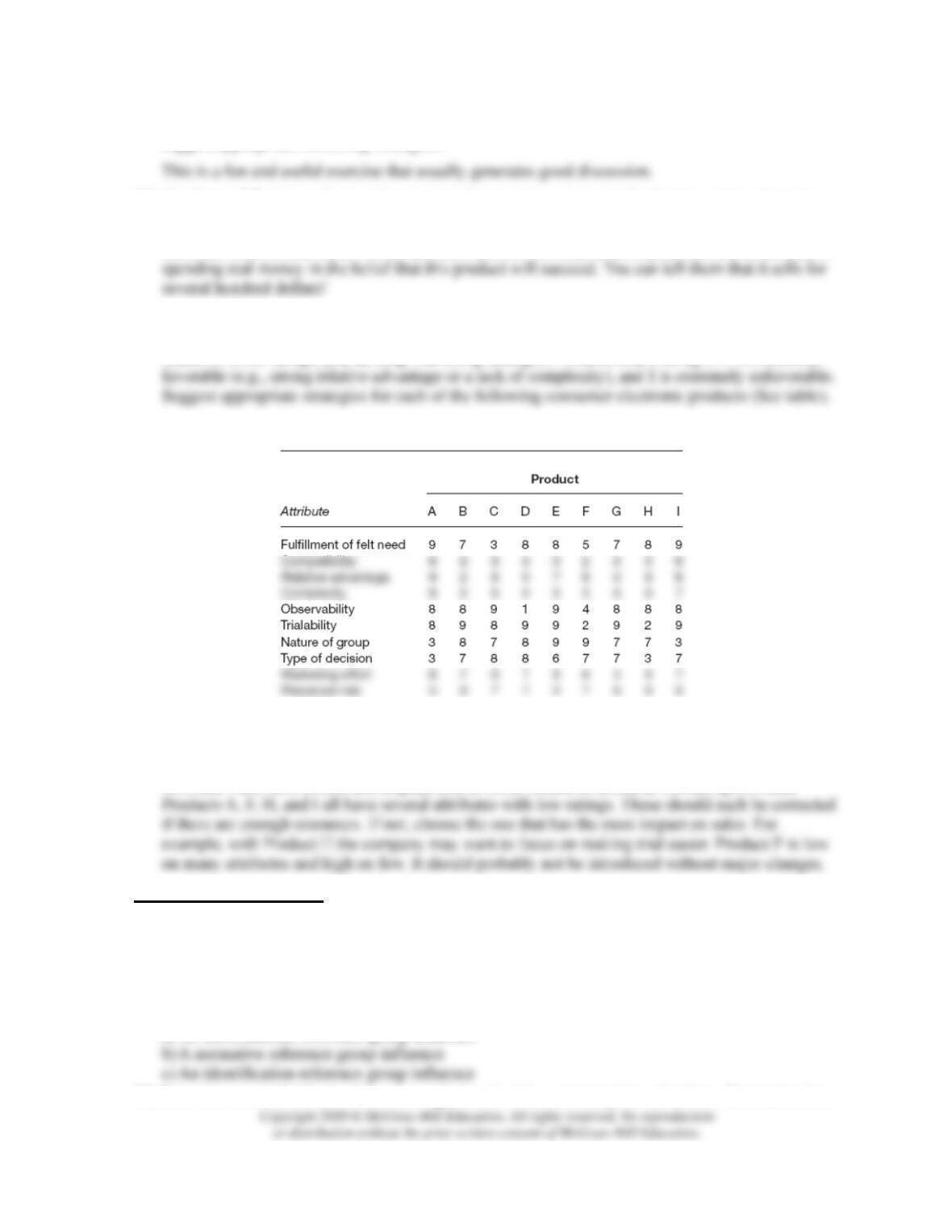
46) Conduct a diffusion analysis and recommend appropriate strategies for the innovation shown in
Illustration 7-10.
Have the students use Table 7-3 for this fun exercise. You may need to point out that a real firm is
47) Assume that you are a consultant to firms with new products. You have members of the
appropriate market segments rate innovations on the 10 characteristics described in Table 7-3.
The basic strategy is to enhance the attributes that a product is weak on. Product C has a very low
Application Activities
48) Find two advertisements that use reference groups in an attempt to gain patronage. Describe the
advertisement, the type of reference group being used, and the type of influence being used.
49) Develop an advertisement for (i) teeth whitening strips, (ii) an energy drink, (iii) an upscale club, (iv)
Red Cross, (v) scooters, or (vi) vitamins using the following.
50) Interview two individuals who are strongly involved in a consumption subculture. Determine how

it affects their consumption patterns and what actions marketers take toward them.
51) Interview an individual who is involved in a brand community. Describe the role the firm plays in
maintaining the community, the benefits the person gets from the community, and how it affects
his or her consumption behavior.
52) Identify and interview several opinion leaders on your campus for the following. To what extent
do they match the profile of an opinion leader as described in the text?
a) Local restaurants
53) Interview two salespersons for the following products. Determine the role that opinion leaders
play in the purchase of their product and how they adjust their sales process in light of these
influences.
a) Smartphones
b)
Golf equipment
54) Follow a brand on Twitter for a week. What types of marketing strategies are they engaged in and
how are they utilizing Twitter to facilitate brand awareness and solve customer problems.