7-14 Chapter 7 ♦ Business Marketing
class into small groups of 4-5 people. Each group should read the question and then use their textbooks, or any work that
was completed previously, to perform the exercise. Then each group should discuss or present their work to the class.
APPLICATION EXERCISE
Purpose: This exercise helps students confront the gray areas in their own ethical perceptions.
Setting It Up: You can have students work individually, in pairs, or in groups to complete the checklist on page 219 of
This exercise was inspired by the following Great Idea in Teaching Marketing:
computes the averages and compares the results to previous outcomes of practitioners. The results typically generate
some spirited discussion.
Gregory B. Turner, College of Charleston
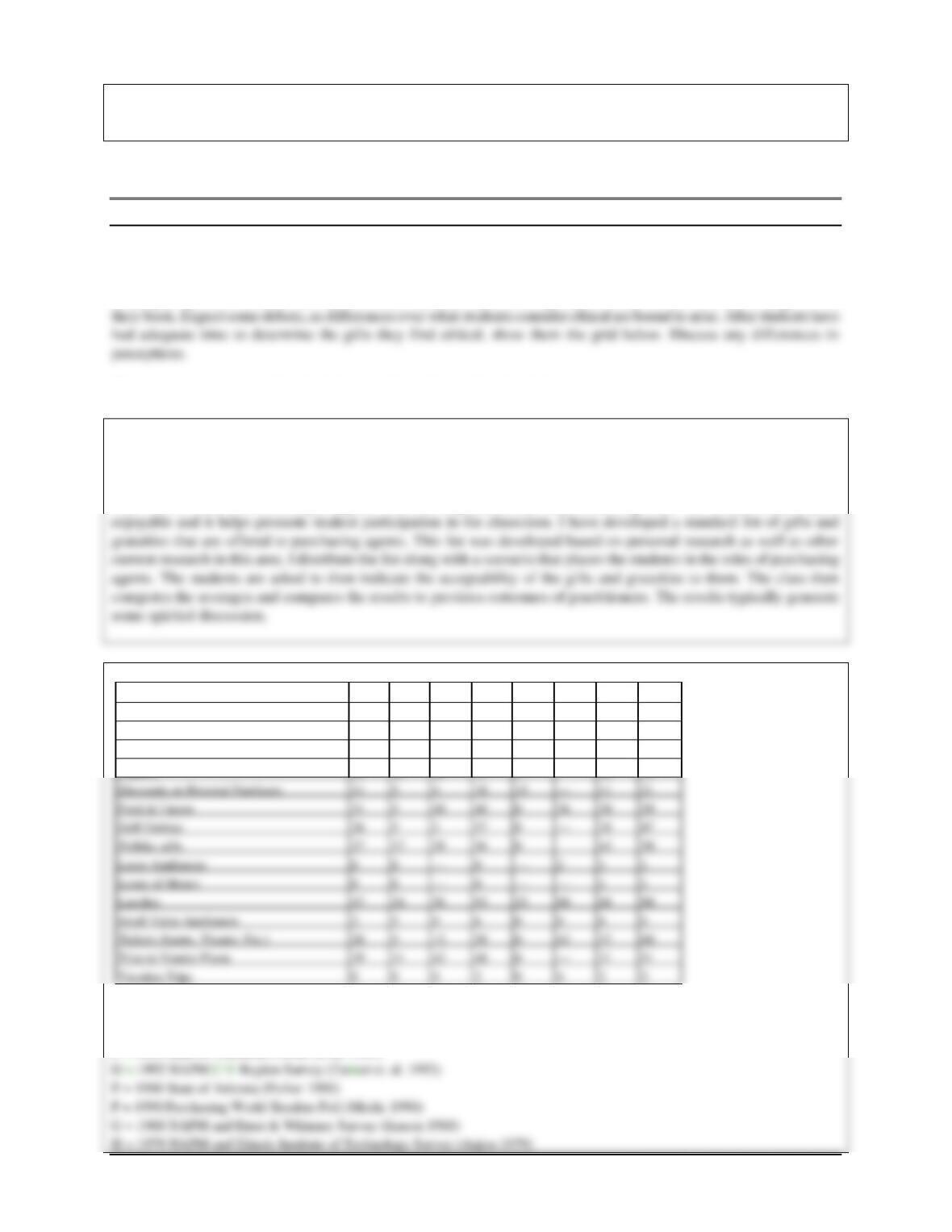
STUDENT ETHICS VS. PRACTITIONER ETHICS
This exercise can be used during a logistics or ethics segment in my basic Marketing class. The students find it quite
TYPE OF GIFT/FAVOR
A
B
C
D
E
F
G
H
Advertising Souvenirs
29
19
69
30
54
80
73
92
Automobiles
0
0
—
0
—
—
1
1
Clothing
5
0
6
16
0
—
7
3
Dinners
38
10
22
79
8
–
48
70
Discounts on Personal Purchases
11
5
9
18
15
—
11
21
Food & Liquor
31
5
49
40
0
36
30
29
Golf Outings
26
5
2
57
0
—
28
47
Holiday gifts
27
17
29
56
0
—
43
30
Large Appliances
0
0
—
0
—
2
1
1
Loans of Money
0
0
—
0
—
—
1
1
Lunches
47
24
36
93
23
80
68
90
Small Value Appliances
2
5
0
6
0
6
6
6
Tickets (Sports, Theater, Etc.)
28
5
13
59
0
42
37
60
Trips to Vendor Plants
39
11
42
48
0
—
31
51
Vacation Trips
0
0
4
2
2
A = 1995 – 1997 NAPM National Meetings (Turner et. al. 1998)
B = 1994 State of South Carolina (Turner et. al. 1995)
C = 1994 State of Alabama (Turner et. al. 1995)
Chapter 7 ♦ Business Marketing 7-15
ETHICS EXERCISE
1. Would it be legal and ethical for Cameron Stock to accept this gift?
It may be legal to accept the gift in certain states, but it would not be ethical. Although Cameron has built a
his own way.
2. How is this addressed in the AMA Statement of Ethics? Go to the AMA Web site at
www.marketingpower.com/AboutAMA/ and reread the Statement of Ethics. Write a brief paragraph
summarizing where the AMA stands on the issue of supplier gifts.
There is no specific paragraph in the code regarding supplier gifts. There is, however, a rule against exercising
MARKETING PLAN EXERCISE
Purpose: For continued general assistance in business plans and marketing plans, students should visit
marketing plan.
CASE STUDY
Pantone: This Year’s Color: Honeysuckle
1. Pantone’s color-management systems were designed in a business environment and are primarily
employed by businesses and entrepreneurs seeking to standardize colors across various production
applications. Do you think Pantone’s systems might have any use for regular consumers, though? If so
how?
Answers and examples will vary. Generally though, consumers will most likely be color conscious as well, for
2. The colors in Pantone’s systems are created from the proprietary formulations for a base set of inks.
What kind of demand do the inks have with the color management systems as a whole?
The demand relationship would be one of derived demand. If businesses don’t adopt the Pantone color system,
7-16 Chapter 7 ♦ Business Marketing
Some might also argue for joint demand, as the color system and the ink formulations must be employed
3. What type of business product is the Pantone Management System?
The management system itself is probably best described as a business service. The system is used to provide a
LESSON PLAN FOR VIDEO
Company Clips ReadyMade—Making Business Relationships
Like most periodicals, ReadyMade relies on advertisers for much of its revenue. Finding companies interested in
advertising in the magazine and cultivating those relationships is an important component of making the company
successful. ReadyMade must constantly market its product to potential investors through personal contact and
solicitation. ReadyMade also must develop relationships with distributors and other businesses that will directly or
indirectly promote the magazine and help make it successful. As you watch this video, notice the strategies that Darci
Andresen describes as she explains the process she goes through as head of Advertising Sales & Special Promotions
when seeking new advertisers.
Solutions for Viewing Activities (also for the Company Clips questions in the textbook):
1. When marketing to potential advertisers, what strategies could ReadyMade use to promote itself without
having to rely on hard statistics about its readers?
2. What sort of strategic alliances does ReadyMade maintain? In what ways are these partnerships
beneficial to the magazine?
The magazine prides itself on its authenticity, that is, it will not sell influence over content or special requests to
3. Go to ReadyMade’s Web site, www.readymademag.com. What evidence do you see of its business
partnerships? How does it use its Web site to market itself to businesses?
Supplemental Exercise: Video
Company Clips
Pre-Class Prep for You:
• Preview the Company Clips video segment for Chapter 7. This exercise reviews concepts for LO2 and LO3.
Chapter 7 ♦ Business Marketing 7-17
• Review your lesson plan.
• Make sure you have all of the equipment needed to show the video to the class, including the DVD and a way to
project the video.
Pre-Class Prep for Students:
Video Review Exercise Activity
• Warm-up
magazine that is obviously marketed to them or their demographic and how they know that it is.
• In-Class Preview
o Review the definition for relationship marketing.
• Follow-up
o Take-home-assignment: Have students perform a situational (SWOT) analysis on ReadyMade magazine’s
business strategy, to be turned in later.
Supplemental Exercise: Class Activity
Consumer Buying Behavior
Class Activity—Marketing to Distribution Channels
Ask your students to go to the Internet and locate Web sites that are targeted to business customers. Have them report on
the information available at these Web sites that would be valuable to the business customer. Also have them report on
GREAT IDEAS FOR TEACHING CHAPTER 7
James S. Cleveland, Sage College of Albany
DISCUSSION BOARD TOPICS TO ENCOURAGE PARTICIPATION
Discussion board questions provided to students to encourage them to engage in thinking and writing about the
content of the Principles of Marketing course usually take the form of a provocative statement to which students are
asked to respond. An example of this would be: All PR is good PR.
nature of such topics can be frustrating.
I have developed, therefore, a series of discussion board questions to use with experienced, adult students. These
questions are designed to encourage them to use their experiences as employees and consumers as doorways to better
understand the course material, and to make their own responses more interesting to themselves and to the other students
in the class who will read and comment on them.
Each question has three parts:
1. First, there is a sentence or two from the students’ textbook introducing the topic. By using the text author’s
Here are additional such discussion board questions developed for Chapter 6 of Marketing 9e. Each is written to fit
the same text cited above but could easily be rewritten and revised to fit another text.
Series A
1. The business market consists of four major categories of customers: producers, resellers, government, and
institutions.

Chapter 7 ♦ Business Marketing 7-19
Series B
1. Business buyers behave differently from consumers. A buying center includes those persons in an
7-20 Chapter 7 ♦ Business Marketing
Elizabeth J. Wilson, Louisiana State University
A DECISION-MAKING EXERCISE FOR BUSINESS MARKETING
This exercise is designed to introduce undergraduate students to decision-making in the context of
organizational buying. Several distinctions of organizational buying, compared to consumer buying, can be
made by using this exercise. For example, differences in decision criteria are highlighted and individual
versus group decision-making can be demonstrated.
Procedure
The three decision evaluations represent different product categories in organizational buying — office copiers,
accessory goods that do not become part of the final product; painted sheet metal, component parts; and an industrial
Part A: Individual Evaluation – A helpful class exercise is to have students’ role play as organizational buyers to work
through these decisions individually. Students are instructed to read the decision context statement and then examine the
nine “vendors” described by each block. For example, in the copier decision, vendor N offers a copier that is priced at
$3,500, has the A level feature package (see bottom of decision), requires two hours of maintenance (downtime) per
Part B: Group Evaluation – The second part of the exercise involves group decision-making. Arrange students in
groups of 2 to 4 persons and have them evaluate these decisions again but this time they all must agree on the point
REFERENCE: Lamb, Charles W., Joseph F. Hair, and Carl McDaniel (1992), Principles of Marketing, Cincinnati,
OH: Southwestern Publishing.
Chapter 7 ♦ Business Marketing 7-21
BUYING DECISION FOR OFFICE COPIERS
Decision Context: Your firm needs a new copier to supplement current copiers already in place. Moderate
volume use (25,000 copies per month) is expected.
N ____ pts. D ____ pts. J ____ pts.
Price: $3,500 Price: $4,400 Price: $5,000
Feature Package: A Feature Package: C Feature Package: B
C ____ pts. W ____ pts. T ____ pts.
Price: $3,500 Price: $4,400 Price: $5,000
Feature Package: B Feature Package: A Feature Package: C
A ____ pts. G ____ pts. L ____ pts.
Price: $3,500 Price: $4,400 Price: $5,000
Feature Package: C Feature Package: B Feature Package: A
Feature Package Key:
A. Reduction/Enlargement, 11 x 17 oversized documents, toner flow control.
7-22 Chapter 7 ♦ Business Marketing
BUYING DECISION FOR PAINTED SHEET METAL
Decision Context: Your firm needs to consider vendors for awarding annual purchase agreements. The contract
to supply the annual requirement of painted sheet metal may be awarded to one of several vendors described
below.
L ____ pts. T ____ pts. P ____ pts.
Quality of Quality of Quality of
Paint Work*: 92% Paint Work*: 95% Paint Work*: 99%
F ____ pts. M ____ pts. S ____ pts.
Quality of Quality of Quality of
Paint Work*: 92% Paint Work*: 95% Paint Work*: 99%
W ____ pts. G ____ pts. B ____ pts.
Quality of Quality of Quality of

Chapter 7 ♦ Business Marketing 7-23
BUYING DECISION FOR AN INDUSTRIAL BOILER SYSTEM
Decision Context: Your company needs a boiler system for a new office building. Evaluate the alternatives in
terms of making recommendations to senior management about which vendor(s) would best meet your company’s
needs.
G ____ pts. T ____ pts. P ____ pts.
Pollution Control (% Pollution Control (% Pollution Control (%
Sulfer retained): Sulfer retained): Sulfer retained):
R ____ pts. J ____ pts. F ____ pts.
Pollution Control (% Pollution Control (% Pollution Control (%
Sulfer retained): Sulfer retained): Sulfer retained):
B ____ pts. M ____ pts. W ____ pts.
Pollution Control (% Pollution Control (% Pollution Control (%
Sulfer retained): Sulfer retained): Sulfer retained):
7-24 Chapter 7 ♦ Business Marketing
Richard Turshen, Pace University
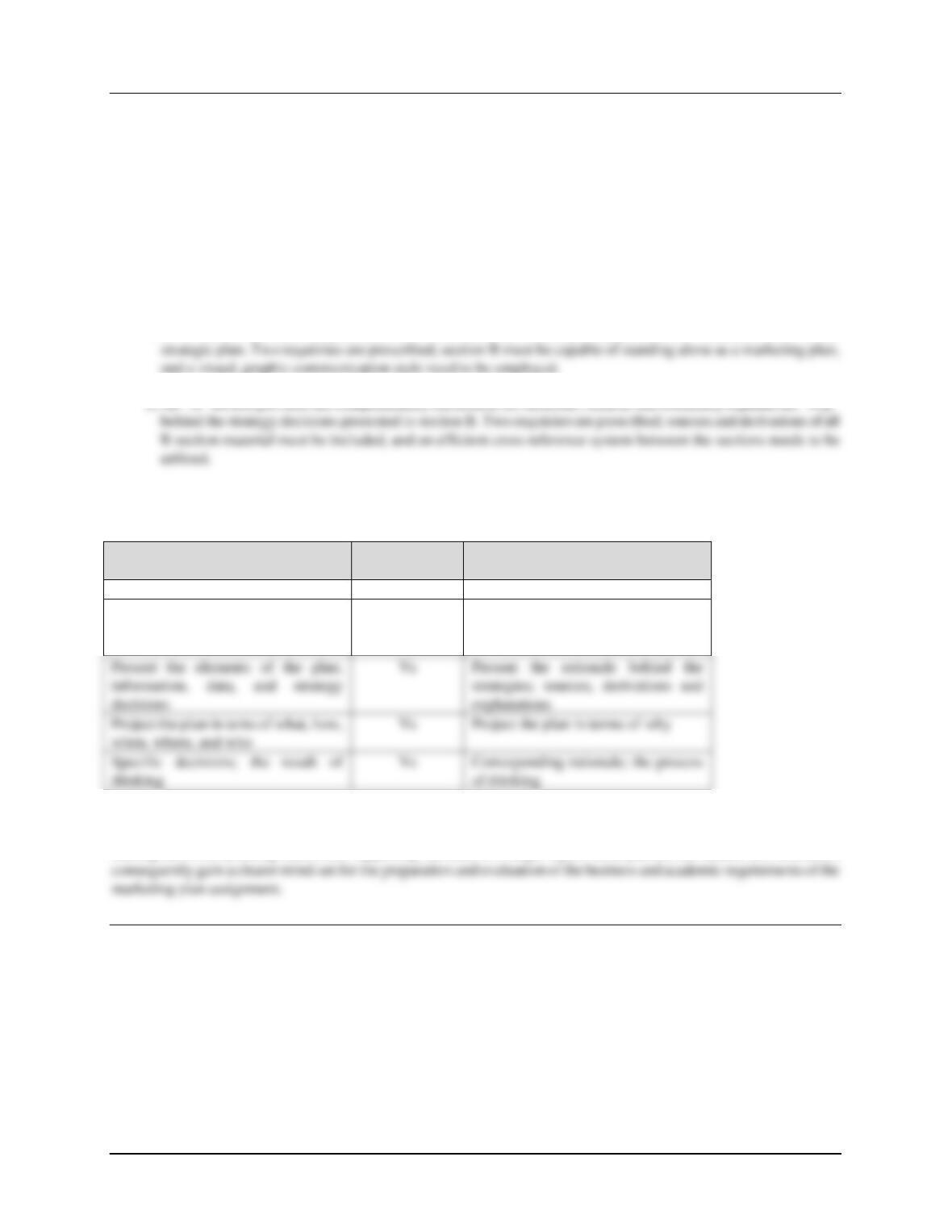
BUSINESS DOCUMENT VS. ACADEMIC TREATISE
The Dilemma: In order to demonstrate their knowledge of marketing principles on two learning levels —
comprehension and application — students are often asked to prepare a marketing plan for a new product. Traditionally,
they are required to produce a business document and an academic treatise simultaneously within the same written
report. This dichotomous intellectual responsibility not only creates a dilemma for the student relative to preparation, but
also for the instructor relative to evaluation.
The Solution: In order to separate the two distinct requirements, a supplemental reporting component is added to the
assignment; in effect, the plan is subdivided into two sections:
1. A “B” section provides the practical BUSINESS document that explicitly presents the “what and when” of the
2. An “A” section provides the complimentary theoretical ACADEMIC manual that essentially explains the “why”
Summary: The following comparative summary is supplied to the students:
Business Subdivision
(Marketing Plan)
Vs.
Academic Subdivision
(explanatory manual)
Business presentation for your boss
Vs
Academic presentation for your
professor
information, data, and strategy
decisions
strategies; sources, derivations and
explanations
Project the plan in terns of what, how,
when, where, and who
Project the plan in terms of why
Specific decisions; the result of
thinking
Corresponding rationale; the process
of thinking
Conclusion: The tested technique of subdivision avoids the muddled mix of applied strategic marketing decision
making and corresponding theoretical supporting rationale in a single report. Both parties, the student and instructor,
Shirine Mafi, Otterbein College
RESEARCHING A CORPORATION
Students are divided into teams of three to five members. Each team works together throughout the quarter. Teams each
select a corporation and research that company for all project assignments. The final project grade is based partially on
peer evaluations.
PROJECT ASSIGNMENT I
Through a 10-12 page paper, students become familiar with the company and the environmental forces that shape the
company and its industry. The report also entails a marketing opportunity analysis.
PROJECT ASSIGNMENT II
Chapter 7 ♦ Business Marketing 7-25
Based upon the findings of the marketing opportunity analysis, teams recommend one of the following options and
produce a marketing plan accordingly:
Group
Presentation: Each team presents its project to the class. All members participate equally. The team not only presents
its findings, but must be able to defend its plan to the class. Use of visual aids is encouraged. ,
Group